Home Blog Page 867

Supreme Court upholds mandatory pre-trial detention except in financial crimes

0
Thursday's ruling means that people accused of homicide, rape, kidnapping, fuel theft, burglary and firearm offenses will continue to be jailed before trial.
Thursday's ruling means that people accused of homicide, rape, kidnapping, fuel theft, burglary and firearm offenses will continue to be jailed before trial. Grant Durr via Unsplash

The Supreme Court (SCJN) has ruled that current mandatory pre-trial detention arrangements are valid except in cases in which alleged perpetrators are accused of tax fraud, smuggling and tax evasion via the use of phony invoices.

As a result of Thursday’s ruling, mandatory preventive detention will continue to apply to suspects accused of a range of crimes including homicide, rape, kidnapping, fuel theft, burglary and firearm offenses.

Less than three months after Justice Luis María Aguilar withdrew an earlier proposal to do away with mandatory pre-trial detention due to insufficient support among his colleagues, the SCJN on Thursday rejected a new proposal to end the constitutionally-enshrined practice.

Only five of 11 justices supported the new proposal, which sought to do away with automatic pre-trial detention in favor of allowing judges to use their discretion to determine whether alleged perpetrators of serious crimes should be imprisoned as they await trial. A minimum of eight votes was needed for the proposal to be approved.
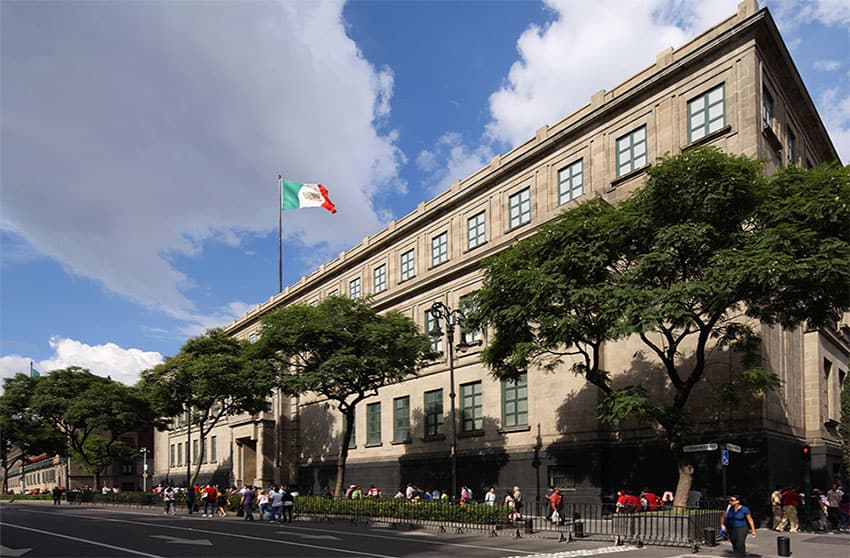
The seat of the Supreme Court of Justice of the Nation (SJCN) in Mexico City.
The seat of the Supreme Court of Justice of the Nation (SJCN) in Mexico City. ArturoZaldivar.com

While the SCJN upheld the constitutionality of mandatory pre-trial detention for most crimes to which it applies, separate proposals to eliminate the measure in cases of fraud, smuggling and tax evasion via the buying and selling of fake invoices found sufficient support among the 11 justices. Preventive detention for those three crimes only became compulsory in 2019 after the government broadened the list of offenses to which the measure applies. Suspects in fraud, smuggling and tax evasion cases could still be jailed before they are sentenced if a judge approves prosecutors’ request to that end.

Luis Tapia, a human rights lawyer, asserted that in not ruling generally against mandatory pre-trial detention the SCJN “missed the opportunity … to protect the rights of people in prison.”

Some 92,000 people are currently in prison awaiting trial, a figure that equates to over 40% of the entire prison population in Mexico. Some suspects languish in prisons for years without facing trial, although by law they shouldn’t be held in preventive custody for more than two years.

Although Tapia would have liked the SCJN to completely eliminate the mandatory pre-detention provision, he told the newspaper El País that Thursday’s ruling is nevertheless a “blow” to the legal measure as the court has placed “certain limits” on its use.

Justice Aguilar argued that mandatory pre-trial detention is “contrary to human rights and thus inadmissible” in a country seeking to uphold the rule of law.

Critics of the practice argue that it violates due process, the presumption of innocence and personal freedoms.

Aguilar argued that preventive prison shouldn’t be an “automatic and thoughtless measure” but one used only when it is really necessary, such as in cases when the suspect is deemed to be a flight risk or his or her freedom while awaiting trial is determined to be a risk to citizens’ safety.

Chief Justice Arturo Zaldívar believes that pretrial detention should be the exception rather than the rule, and said earlier this year that the measure has been abused in Mexico. However, he was one of six justices who didn’t support Aguilar’s proposal due to concerns about its legality, deeming it “constitutionally and technically untenable.”
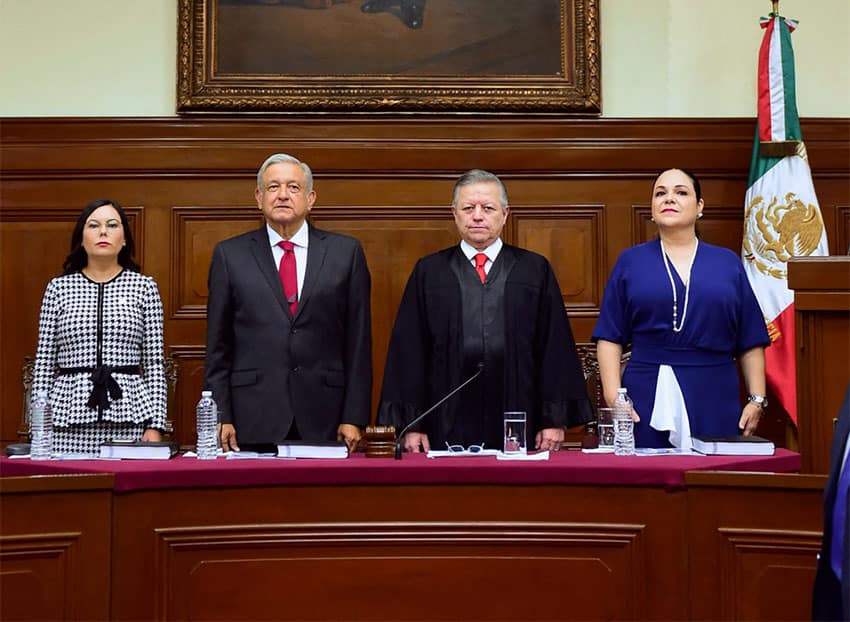
President López Obrador and Chief Justice Arturo Zaldívar at the Supreme Court's 2019 yearly report.
President López Obrador and Chief Justice Arturo Zaldívar at the Supreme Court’s 2019 yearly report. LopezObrador.org.mx

He and other justices who opposed the proposal argued that the SCJN doesn’t have the authority to rule against the use of mandatory pre-trial detention in the majority of crimes to which it currently applies as the measure is set out in the constitution.

Justice Alberto Pérez Dayán said earlier this year that he wasn’t the kind of person who “tears pages out of the constitution.”

The three crimes for which the SCJN ruled in favor of eliminating mandatory pre-trial detention are not specifically mentioned in the relevant article of the constitution.

Justice Yazmín Esquivel, who also opposed Aguilar’s proposal, argued that mandatory pre-trial detention is an essential tool in the fight against crime, a view shared by the federal government and its leader, President López Obrador, who railed against a 2021 SCJN ruling against the mandatory use of preventative custody for people accused of financial crimes.

Tapia, the lawyer, said that the Supreme Court’s latest ruling “sends a message to the president that he can’t continue increasing the catalogue” of crimes to which mandatory pre-trial detention applies.

“This decision has a political impact insofar as the court is not validating the strategy of considering mandatory pre-trial detention as the solution to problems of criminality,” he said.

López Obrador on Friday condemned the SCJN’s decision to eliminate automatic pre-trial detention for financial crimes, asserting that the ruling is “very regrettable” and “an embarrassment” as a majority of justices chose to protect “tax evaders.”

“Say what you will [but] it’s protecting those above, the magnates, the white collar criminals,” he said. “Yesterday was a bad day for the judicial power.”

López Obrador and other high-ranking members of his government have been openly critical of the nation’s judges, some of whom have ruled against government policies and delivered judgments that have stalled public infrastructure projects.

In September, a senior security official named and shamed numerous judges who allegedly acted improperly by releasing suspected criminals from custody, while in May 2021, Navy Minister José Rafael Ojeda went so far as to say that it seems that the judiciary is the “enemy” of the state in many organized crime cases because judges often act in a way that makes it appear they are on the side of the criminals. 

With reports from El País, Reforma, El Financiero and Milenio

General in charge of National Guard in Zacatecas killed in a shootout

0
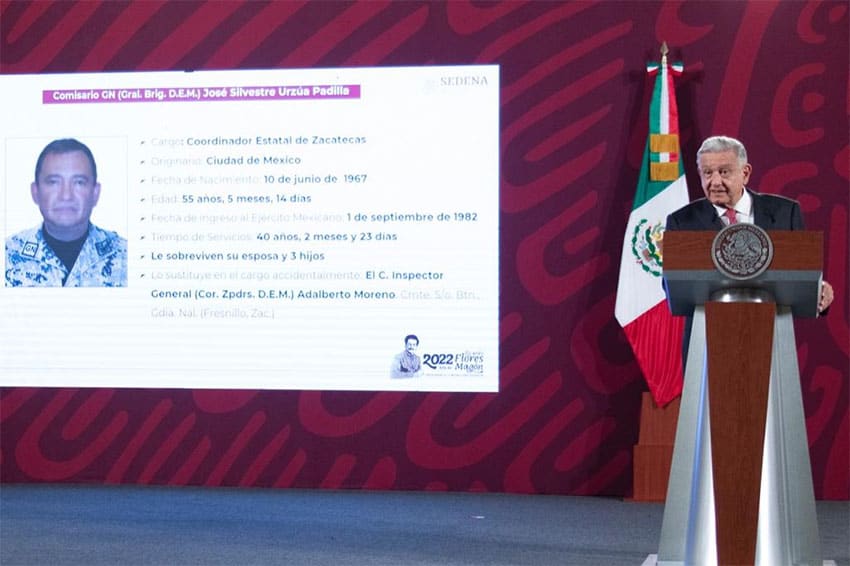
General José Silvestre Urzúa Padilla saluting in military uniform
General José Silvestre Urzúa Padilla. Cuartoscuro.com

General José Silvestre Urzúa Padilla, the National Guard coordinator in Zacatecas, was shot dead on Thursday during a clash with an organized crime group.

The shootout took place in Los Pinos, a municipality near where Zacatecas borders with San Luis Potosí and Aguascalientes. It began on Thursday morning and continued into the afternoon. At least four other members of the security forces were injured during the confrontation.

At his morning press conference on Friday, President López Obrador paid tribute to the murdered general and emphasized that actions were underway to detain his killers.

“Army forces have been mobilized since yesterday, with many elements deployed to the area to confront this gang,” he said. “The leaders responsible, those who ordered the aggression, have already been identified … In the confrontation, one or two of the aggressors lost their lives and three or four were arrested.”

President López Obrador said Friday morning that the killers have been identified and that there are actions underway to capture them.
President López Obrador said Friday morning that the killers have been identified and that there are actions underway to capture them. Presidencia de la República

The governor of Zacatecas, David Monreal Ávila, sent condolences to the general’s family and reemphasized the state’s commitment to tackling organized crime.

“We will not rest in the struggle to pacify the state and confront criminality, the desire to which the general gave his life,” he said in a tweet.

General Urzúa Padilla assumed the leadership of the Zacatecas National Guard in January of this year. At the time of his death, his unit was carrying out a search and arrest operation against a criminal group in Los Pinos, in response to local demands to address rising kidnappings and the corruption of local police forces.

In October, Governor Monreal had ordered security forces in Zacatecas to redouble their efforts to contain criminal violence in the state.

Zacatecas’ homicide rate increased by more than 400% between 2015 and 2021, driven largely by competition between the Sinaloa Cartel, Jalisco Cartel and several local gangs for control of lucrative drug trafficking routes and fentanyl production areas. Exactly a year ago, AMLO implemented Plan Zacatecas II, deploying more than 1,900 soldiers and 1,600 agents of the National Guard to the state to reinforce security.

AMLO has also ordered that all operations against organized crime be directed by senior military commanders, rather than lower-ranking officers. During Friday’s press conference, he insisted this policy would continue, despite Urzúa Padilla’s death.

With reports from El País, La Jornada, Reforma, Expansión Política and InSight Crime

Brazilian Nubank introduces savings accounts, debit cards to Mexican market

0
Nu México now offers debit cards and savings accounts.
Nu México now offers debit cards and savings accounts. Nu México

Brazil’s Nubank, the largest financial technology firm in Latin America, is now offering savings accounts and debit cards in Mexico through the digital bank’s arm, Nu México.

In a Wednesday press conference, Ivan Canales, who will replace Emilio González as the director of Nu México, said the firm would open a waiting list for the opening of the savings accounts, with first access being granted to clients and members of the company’s digital forum, known as Comunidad Nu.

The firm said it will also launch a Mexican debit card for customers to withdraw cash from ATMs.

Nubank was founded in Brazil in 2013 with the goal of offering consumers a no-fee credit card, backed by investors that included Warren Buffett’s Berkshire Hathaway firm. In Mexico, Nu started operations in 2019.

Nu México’s new products have been launched as a Popular Financial Society (Sofipo), a kind of financial institution which operates with the approval of Mexico’s national bank commission, CNBV. This was possible thanks to its purchase of AKALA, a Sofipo that Nu México acquired in September 2021 as part of its expansion plans, which followed an investment of US$ 135 million to boost Nu’s growth in the country.

Before turning into a Sofipo, Nu México launched its first product in 2020 — an international credit card with no yearly fee. By September 2021, the company was the second largest issuer of credit cards in the country.

In a country where only 47% of the population have bank accounts, Nu México has 3 million clients already — an increase of 4% compared to the third quarter of 2021.

Nu executives hope that the savings accounts, which will not require a minimum balance and will be completely digital, will lure Mexicans with no bank accounts, particularly those in rural areas far from physical branches of traditional banks.

Nu México's headquarters in Mexico City.
The Nu headquarters in Mexico City. Nu México

To date, Nu has users in nine out of every 10 municipalities and covers 80% of the government’s priority rural areas. Canales said that technology was essential to reach those rural communities.

“There are many problems to be solved,” he said. “The financial system in Mexico is very complex, and we believe there are simpler products we can offer to transform the financial life of users.

He added that Mexico, which represents 20% of the population of Latin America, is Nu’s second largest market and a key piece of the firm’s global expansion.

“For folks that have never had a savings product before, this type of digital solution with Nu’s formula of great customer support will also be a compelling value proposition,” Canales told Reuters in an interview.

As of February 2022, Nu reached 53.9 million customers in Brazil, Mexico and Colombia as part of a growing trend. The company estimates that 55% of its monthly active users have chosen it as their main account.

Financial services have dominated Latin America’s startup scene in recent years. According to the Latin American private capital association LAVCA, about 40% of the private funding in 2021 went to financial technology, often referred to as fintech. As of Q1 of 2022, the association also found that fin-tech startups raised US $1.2 billion, marking the fourth largest quarter on record for investment in the region.

With reports from El Economista and Reuters

Mexico’s muralism movement first changed Mexico, then the world

0
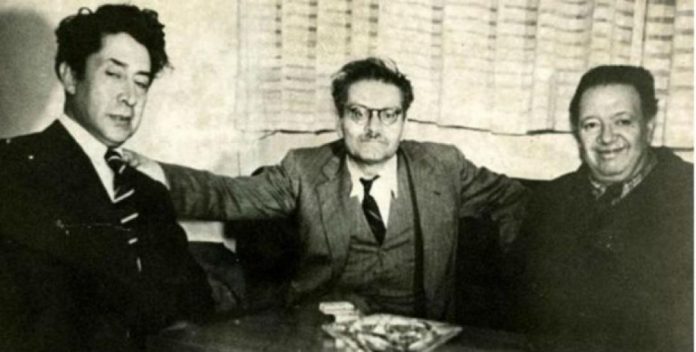
Jose Clemente Orozco, David Alfaro Siquieros, Diego Rivera
Mexico's muralism movement, considered to be founded by artists José Clemente Orozco, David Alfaro Siquieros and Diego Rivera, pictured here, took flight after they were recruited to paint murals by Mexico's post-revolutionary government. Hermanos Mayo

In 1920, close to the end of the Mexican Revolution, General Álvaro Obregón made a move that would have a significant impact on Mexico’s political history but also its cultural history —  a move that changed art indelibly in Mexico, as well in the world.

In that year, Obregón overthrew President Venustiano Carranza, was elected president himself and then set about fomenting a national artistic and cultural shift in Mexico, the remnants which still can be found today.  

Obregón’s coup was the culmination of a decade of civil war that had seen constant military battles, ever-changing factions and armies and a revolving door of leaders since 1910. 

Upon being officially elected president in December 1920, Obregón tasked his minister of education José Vasconcelos with increasing literacy and forging what was seen as a much-needed sense of national and cultural unity. 

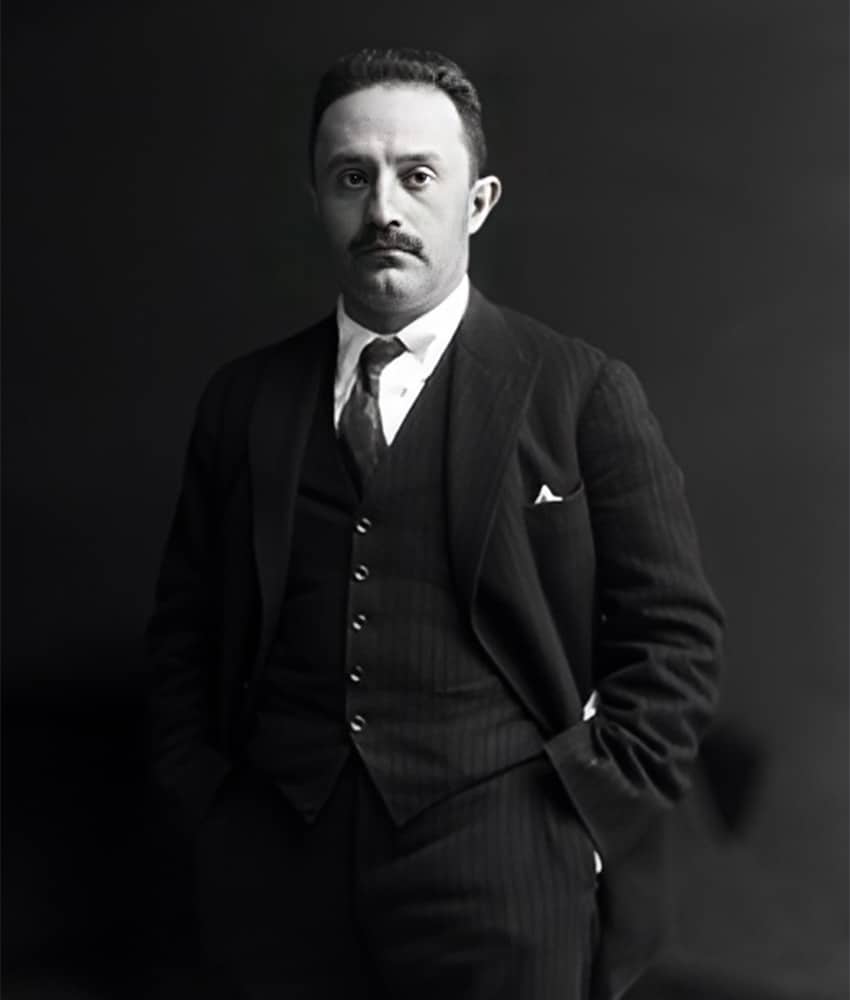
Jose Vasconcelos
Mexico’s Education Minister José Vasconcelos commissioned many of Mexico’s artists to paint murals to educate Mexicans about their history and instill national pride. Creative Commons

Vasconcelos’s idea was to portray the revolution’s history in public spaces, using a visual language that would teach Mexicans about the revolution and instill national pride in their indigenous heritage. 

During Obregón’s presidency, Vasconcelos mobilized creatives of all types — artists, musicians, singers, writers — to help forge this new identity, one in which Mexico’s indigenous past would be glorified and its colonial legacy condemned.

Three of the most famous of those creatives, muralists Diego Rivera, José Clemente Orozco and David Alfaro Siqueiros — the founders of the Mexican Muralist Movement and known as “Los Tres Grandes” (The Big Three) — would forever impact Mexico’s art, as well as artists worldwide. 

Before Obregón came to power, Mexico was already experiencing a cultural renaissance, inspired by opposition to Díaz’s government. José Guadalupe Posada, for example, created his iconic figure later known as La Catrina to mock society’s pro-European cultural pretensions under Díaz’s leadership.

Diego Rivera's "Creation"
The first mural commissioned by the Obregón government was Rivera’s “Creation.” UNAM

Posada, Orozco, Rivera Siquieros were among many artists already looking closer to home for a uniquely Mexican artistic style when they linked themselves with Obregón. 

The Big Three were all commissioned to paint the first Obregón government fresco murals at the National Preparatory School in Mexico City in the early 1920s. Rivera’s “Creation,” the first of them, can still be seen today in Mexico City. He portrayed the Mexica as a great empire whose achievements were to be glorified.

Novelist John Dos Pasos, bemoaning the state of modern art in the United States, said at the time that “Going to see the paintings of Diego Rivera in the courts of the [Public Education Ministry] straightens you out a bit … If it isn’t an [art] revolution in Mexico, I’d like to know what is.”

Many of the works Los Tres Grandes did for the Obregón government are still visible in Mexico’s cities today, and most of them are accessible to the public. Here’s where to see some of them: 

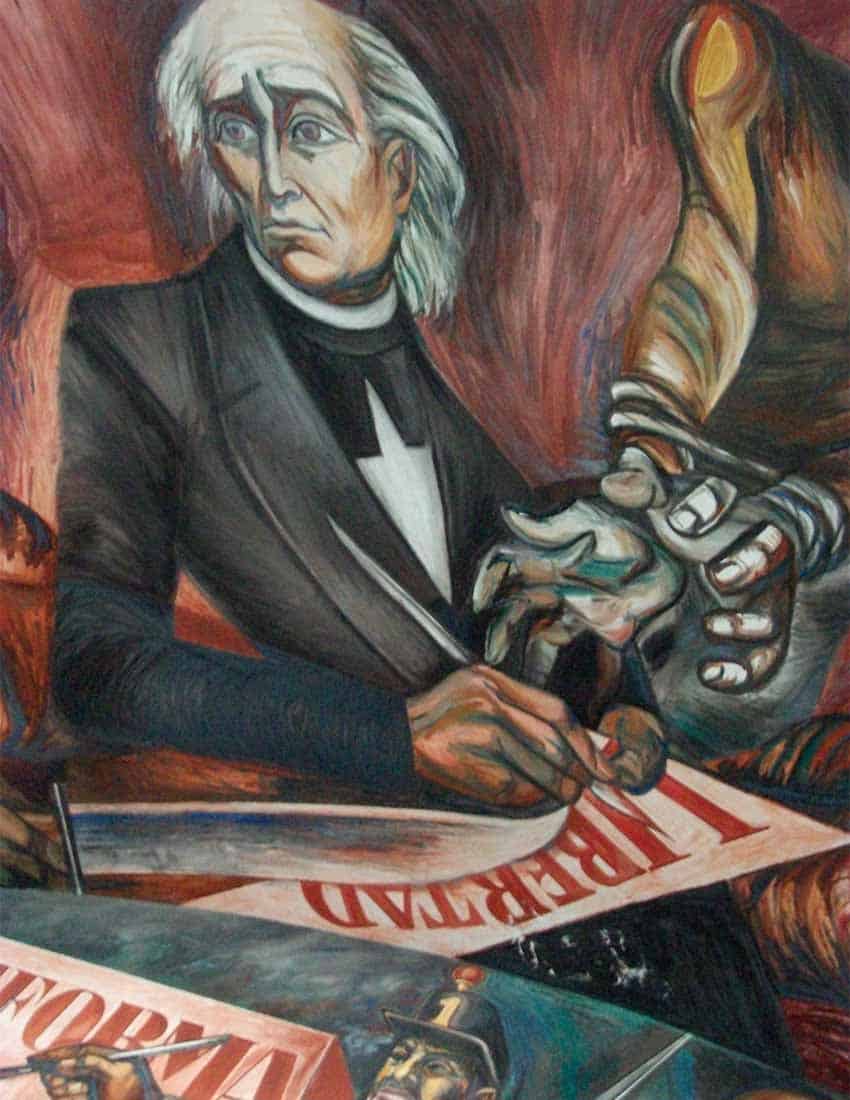
"The Abolition of Slavery" by Jose Clemente Orozco
“The Abolition of Slavery” by Jose Clemente Orozco, can be seen in Guadalajara’s Municipal Palace. Creative Commons
  • Two of Rivera’s most famous government-commissioned murals reside at the National Palace and the former National Preparatory School. The National Palace’s stairway mural, “The History of Mexico,” relates the history of the Mexican people in three parts. Rivera’s “Creation” is still at the former National Preparatory School, now a cultural center owned by UNAM and known as the San Ildefonso Building.
  • Siqueiros painted the massive mural “Del “Porfirismo a la Revolución” (From Porfirism to the Revolution) in Chapultepec Castle. A visual history of Mexico from Díaz’s dictatorship to the Revolution, it contrasts decadent iconic European imagery surrounding Díaz with images of Mexicans living in slavery and ignorance. It also contains phrases connected with the Revolution uttered by leaders such as Francisco Madero and Ricardo Flores Magón.
  • Orozco’s murals can be seen at the former Hospicio Cabañas, a UNESCO World Heritage Site in Guadalajara. Once a massive hospital and orphanage, the artist’s 57 murals there take aim at authority figures and depict Mexican history as a brutal, bloody struggle. There’s also his “Reconstruction,” painted in 1926 in what is today Orizaba, Veracruz’s Municipal Palace.
  • A smaller but impressive collection of Orozco’s work can be found in Guadalajara’s Municipal Palace, including several well-known murals celebrating Father Hidalgo. Above the main staircase is a mural depicting Hidalgo wielding a flaming torch to ignite the independence movement. In the Chamber of Deputies, another depicts Hidalgo liberating the Mexican people by signing the word “freedom” in deep bloody red, suggesting the human cost of the independence movement. 
  • Murals by all three artists are also prominently displayed on the first floor of the main hall of Mexico City’s Palacio de Belles Artes (Fine Arts Palace) and at the San Ildefonso Building. There are also several other works by Mexican artists who were commissioned to paint murals as part of the program.  

Vasconcelos and The Big Three and their contemporaries successfully tackled the difficult task of forging a Mexican identity, presenting the people with a national identity and history that glorified its indigenous roots in a way that has endured.  

They also made an indelible impact outside Mexico: they are credited with helping revive the use of frescoes in modern art and changing the public’s perception of art in the U.S. and elsewhere — taking it out of museums and into public spaces. They also inspired the United States’ Depression-era Works Progress Administration (WPA) arts programs, which funded creatives to document U.S. daily life and the cultural expression and traditions of average people.

But ultimately, Rivera, Orozco, and Siqueiros created magnificent murals that will always belong to the Mexican people, who can visit them whenever they wish to remind themselves both of the Revolution and of the glory of their indigenous past. 

David Alfaro Siquieros mural The New Democracy
Siquieros’ “The New Democracy” can be seen at the Palacio de Bellas Artes in Mexico City. Creative Commons

Sheryl Losser is a former public relations executive and professional researcher.  She spent 45 years in national politics in the United States. She moved to Mazatlán last year and works part-time doing freelance research and writing.

Durango reports 10th meningitis death in outbreak

0
Hospital del Parque in Durango city was one of several private hospitals closed by authorities in response to the outbreak.
Hospital del Parque in Durango city was one of several private hospitals closed by authorities in response to the outbreak. Twitter

A mysterious outbreak of meningitis has now claimed the lives of nine women and one man in the northern state of Durango.

The state Health Ministry reported Wednesday that 61 cases of the infection had been confirmed and that 10 people had died. The infections, which have been identified as fungal meningitis, were all detected in Durango city.

Most infections occurred in women who were pregnant and underwent surgeries such as cesarean sections in recent months, according to a report by the news website Animal Político. However, the newspaper El Financiero reported that the most recent death was that of a 47-year-old man who had surgery on a fractured leg in September. He was the first male to die during the current outbreak of meningitis, an infection of the protective membranes that surround the brain and spinal cord.

The cause of the Durango outbreak hasn’t been established, but two medical specialists who spoke with Animal Político suggested that tainted counterfeit medicine or contaminated hypodermic needles could be to blame.

Based on the available information, the chief suspect would appear to be contaminated bupivacaine, an anesthetic that can be used to relieve pain during child birth.

Animal Político reported that all the women who contracted meningitis had had epidurals. Most gave birth in private hospitals, and were discharged before subsequently being readmitted to hospital when they fell ill with meningitis.

Supporting the hypothesis that contaminated bupivacaine is behind the outbreak is the fact that on Nov. 10 the health regulator Cofepris ordered the withdrawal of four batches of the anesthetic manufactured by Mexican pharmaceutical company PiSA as a preventative measure while an investigation into the cause of the meningitis cases took place. The warning applied to almost 250,000 vials of the medication.

On Nov. 7, a Durango health official also issued a warning against the use of PiSA-manufactured bupivacaine due to cases of  “adverse reactions” following use of the drug.

Officials visit one of dozens of patients who have come down with fungal meningitis in recent weeks.
Officials visit one of dozens of patients who have come down with fungal meningitis in recent weeks. Secretaría de Salud de Durango

However, an infectious disease specialist who spoke with Animal Político believes it’s unlikely that the bupivacaine manufactured by PiSA was contaminated. Alejandro Macías instead raised the possibility that a contaminated counterfeit version of the anesthetic has been used in Durango.

If the PiSA bupivacaine was contaminated, there would have been a larger meningitis outbreak as the medication was distributed widely, including in several foreign countries, Macías said. If PiSA’s four batches were contaminated, there would have been hundreds of thousands of meningitis cases, he said. However, the outbreak has been limited to Durango city, a situation that led Macías to formulate his counterfeit medicine hypothesis.

On Nov. 15, the federal Health Ministry said in a statement that a group of its experts was working with Durango authorities to determine the cause of the meningitis outbreak. It hasn’t provided an update since then.

The Health Ministry noted that 49 cases and six deaths had been reported by Nov. 14, meaning that an additional 12 cases and four deaths have been confirmed in the last nine days, despite the withdrawal of the suspect batches of bupivacaine. Macías and Isaac Chávez Díaz — another doctor who spoke with Animal Político — said that meningitis symptoms, among which are headache, fever and a stiff neck, can appear weeks after infection.

Most of those who died were new mothers who received epidurals during labor, leading experts to suspect contaminated anesthetic.
Most of those who died were new mothers who received epidurals during labor, leading experts to suspect contaminated anesthetic. Depositphotos

As part of the investigation into the meningitis outbreak, health authorities inspected health care facilities in Durango and subsequently shut down one private hospital and two operating rooms of another private hospital “due to critical irregularities,” the Health Ministry said.

Chávez Díaz, a National Autonomous University-trained anesthesiologist, told Animal Político that the meningitis mortality rate is high even though patients in Durango have been treated with antifungal medications because “it’s a very serious illness.”

He said that contaminated needles could be the cause of the meningitis outbreak, but admitted that his hypothesis is difficult to corroborate. Chávez said that disposable syringe needles could have been used on more than one occasion after being subjected to an unsuccessful sterilization process.

He and Macías said that definitively establishing the cause of the meningitis outbreak in Durango will take time and money. “It’s not a 100-meter sprint, it’s a marathon,” Macías said.

One of the women who died after becoming ill with meningitis was Alejandra Rojas’ sister, Maleny. Rojas wrote on Facebook this week that her sister died after being hospitalized for 16 days. She became ill after having a cesarean section at a Durango city private hospital in August, according to her post.

“What for us was joy from having my nephew became pain from losing my sister … because of a hospital who didn’t look after her health,” Rojas wrote.

With reports from Animal Político, Reforma and El Financiero

AMLO declares he has ‘millions’ of friends, but no time to attend their life events

0
Mexico City Mayor Claudia Sheinbaum is a close ally of López Obrador, who has lauded her work as mayor.
Mexico City Mayor Claudia Sheinbaum is a close ally of López Obrador, who has lauded her work as mayor. Gobierno de CDMX

President López Obrador revealed Thursday that he generally doesn’t attend weddings and baptisms because doing so would take up too much of his time.

He divulged the information after congratulating Mexico City Mayor Claudia Sheinbaum on her upcoming marriage to Jesús María Tarriba, an official with Mexico’s central bank.

“I don’t usually attend ceremonies, baptisms or weddings,” López Obrador told reporters at his regular news conference after he was asked whether he would attend Sheinbaum’s nuptials.

AMLO added that he hasn’t attended such events for years because he gets a lot of invitations and accepting them would take up a lot of his time.

“I have many friends, millions of friends, brothers, sisters, the truth is there is affection, a lot of affection and it is reciprocated by a lot of people, not just my family,” he said.

Sheinabaum, a close ally of the president, announced Wednesday that she would marry her partner of six years. “Both of us decided [to get married]. … The truth is I’m happy,” she said in an interview.

The mayor declared last month that she is “ready” to become Mexico’s first female president, and is openly campaigning for the Morena party nomination for the 2024 presidential election.

Many political observers believe she’s López Obrador’s preferred successor, but the president asserts he doesn’t have a favorite among those vying to be Morena’s presidential candidate. Not attending his protégé’s wedding is perhaps one way he intends to prove his point.

With reports from El Universal and El Financiero 

Mexican Karen Díaz is one of the first female World Cup referees

0
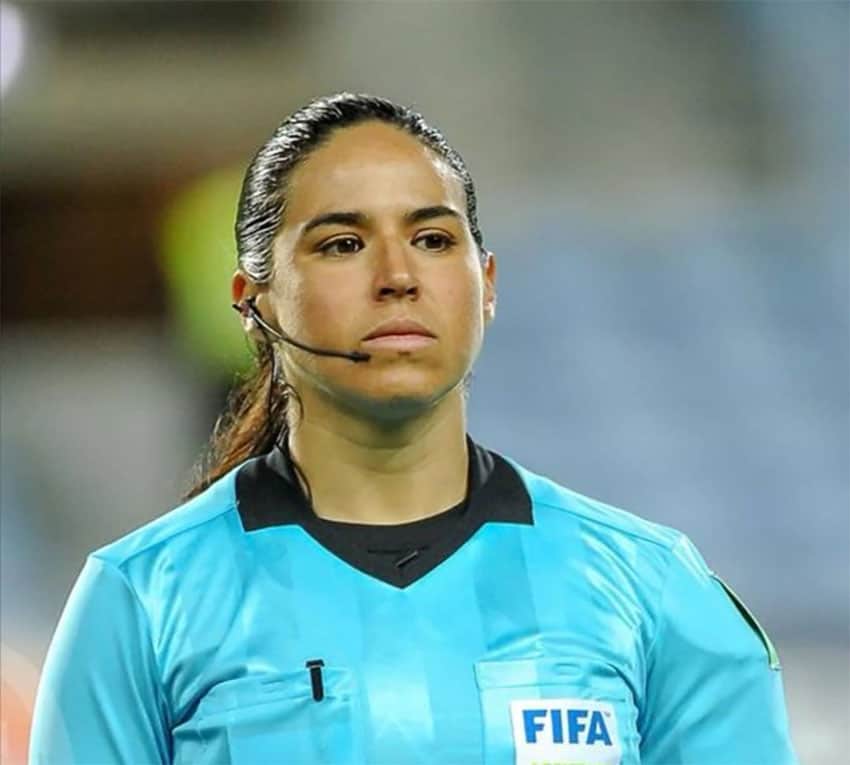
Karen Díaz runs alongside the action at a Cruz Azul versus León game in October, where she acted as assistant referee.
Karen Díaz runs alongside the action at a Cruz Azul versus León game in October, where she acted as assistant referee. Edgar Negrete Lira / Cuartoscuro.com

Karen Díaz Medina of Mexico has made history at the World Cup, participating as a reserve assistant referee in Morocco’s 0-0 tie against Croatia on Wednesday at Al Bayt Stadium in Qatar.

For the first time ever, FIFA, world soccer’s governing body, chose women referees to participate in this year’s men’s World Cup, and among the six selected was Díaz, a 38-year-old native of the city of Aguascalientes.

“They deserve to be at the FIFA World Cup because their performance is consistently excellent, and that is the determining factor for us,” said Pierluigi Collina, chairman of the FIFA Referees Committee.

The six women are among a total of 36 referees, 69 assistant referees and 24 members of the video review team. Díaz was selected as an assistant referee, the person on the sidelines whose duties include holding up a flag when a player is offside (previously known as a linesman or lineswoman).

As a reserve assistant in the Morocco-Croatia match — and also in Portugal’s 3-2 victory over Ghana on Thursday — Díaz was tasked with maintaining order on both benches and announcing player substitutions and the added time at the end of each half. She also would have replaced an assistant referee if one of them was unable to continue due an injury or medical reason.

Díaz has a university degree in agro-industrial engineering, but before that, she became interested in soccer officiating when she was working at the snack shack at a youth sports center.

“The designated referee did not show up for the game,” she recalled in a 2020 interview. “The league administrator asked me if I wanted to referee the game, and I said yes. I liked it and I enjoyed the experience … From then on, I was assigned more games every week and with the money earned I was able to pay for college.”

Díaz has 12 years of experience and has been an official in Liga MX matches since 2016. In 2020, she became the first female to officiate in a Liga MX final when she was an assistant referee for the second leg of Pumas vs. León.

Mexican referee Karen Díaz
Karen Díaz on the field in 2020. Twitter @TUDNMEX

Asked why she is so passionate about officiating, Díaz replied, “First of all, because I love soccer. This is a profession that makes you fall more in love with it each day, since each day you can face a new challenge. It is a fantastic experience that involves all your senses in each game.”

Certified as a FIFA assistant referee in 2018, Díaz was then given a number high-profile assignments at which FIFA officials could observe her, including the Concacaf under-17 women’s championships in Nicaragua in 2018, the Concacaf under-20 men’s championships in Florida the same year and the Scotiabank Concacaf League in 2020. Concacaf stands for the Confederation of North, Central America and Caribbean Association Football, and it is one FIFA’s six regional governing bodies.

The six female referees in Qatar for the 2022 World Cup are Stephanie Frappart (France), Salima Mukansanga (Rwanda) and Yoshimi Yamashita (Japan) as referees and Neuza Back (Brazil), Kathryn Nesbitt (U.S.) and Díaz as assistant referees.

Frappart, 38, became the first woman to referee at a men’s World Cup when she was the reserve assistant for Tuesday’s Mexico-Poland match, which ended in a 0-0 tie. On Thursday, she was the fourth official in the same Portugal-Ghana match in which Díaz was the reserve assistant.

Mexico’s national team returns to Group C action in a highly anticipated match against Argentina and superstar Lionel Messi on Saturday at 1 p.m. CST. The match is drawing even more focus in the wake of Argentina’s stunning 2-1 loss to Saudi Arabia on Tuesday.

Each team has three group games, after which the top two teams in each of the eight groups will advance to the knockout round. Mexico, which has one point after its 0-0 tie against Poland, has made it to the knockout round in seven straight World Cups, but has failed to advance to a “quinto partido” (fifth game) each time.

The World Cup started Nov. 21 and will conclude Dec. 18.

With reports from Animal MX, ESPN and Concacaf.com

Telecommunications company to invest in US-Mexico ‘digital highway’ in Gulf of Mexico

0
Submarine cables are laid on the sea floor and used for global internet communication Shutterstock

Telecommunications company Gold Data will invest $150 million to develop a “digital highway” in the gulf of Mexico to link its digital infrastructure in Miami with its data centers in Mexico City, Cancún, and Querétaro. This will take the form of a 1,899 kilometer submarine cable, which will be composed of ten pairs of fiber and will have a capacity of 250 terabytes per second (TBPS). 

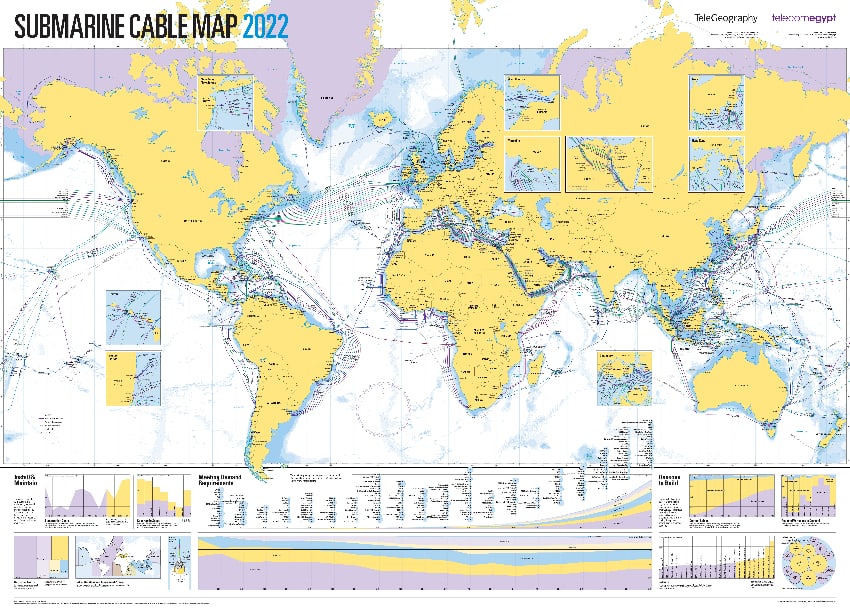
Submarine cables are used for international internet connections. Globally, there are 486 similar active cable systems connecting 1,306 landing sites (or stations). Gold Data’s “digital highway” will be the first cable to land in Mexico in over 20 years. The Arcos cable system connecting Tulum and Cancún with 22 other cities surrounding the Caribbean sea was built in 2001. The Pan-American Crossing (PAC), built in 2000, connects the Pacific Coast in the U.S. to Mazatlán and Tijuana before continuing to Central America. 

Submarine cables are laid using specific ships capable of laying the cable on the seabed. While satellites are also used to transmit data, they are more expensive and less efficient than cables. 

The submarine cable is the final stage of Gold Data’s business plan. Already, it has an underground network connecting its data centers within Mexico.  

Global submarine cable map for 2022. Telegeography

“Our state-of-the-art network topology is revolutionizing connectivity in Mexico, reducing latency by up to 35%, a key factor for businesses and content providers seeking reliable, low-latency, high quality connectivity” the company said.  

“The expansion of this network to the United States will be a game changer for Mexico’s fast-growing innovators.” 

Gold Data specializes in providing direct connectivity throughout the Americas and the Caribbean. It currently connects 17 U.S. cities with 35 countries in Latin America and the Caribbean. 

The companies Orange Marine, Alcatel Submarine, and Ciena will partner with Gold Data to carry out the construction. 

The submarine cable is projected to facilitate growth in the telecommunications industry while compensating for the country’s aging traditional communications systems. It will also improve digital efficiency and benefit several sectors, including finance, health and retail. 

The cable is expected to be complete in 2025 and has a predicted lifespan of 25 years. 

With reports from El Economista, AM Querétaro, and  Expansión

Cancún leads the country in clean ‘Blue Flag’ beaches

0
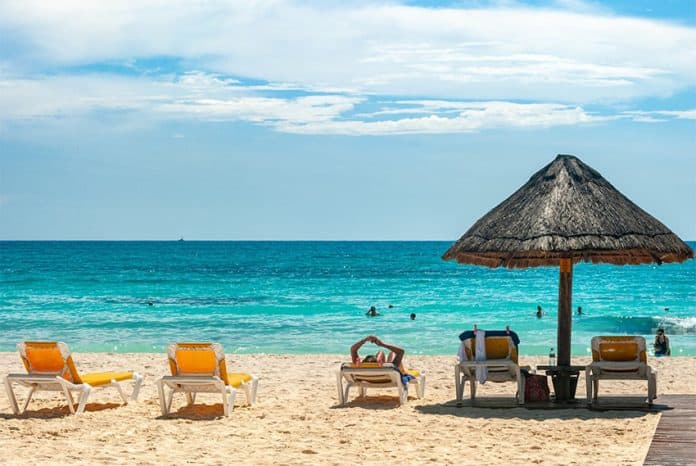
Tourists relax on the beach in Cancún, Quintana Roo.
Tourists relax on the beach in Cancún, Quintana Roo. David Vives via Unsplash

Cancún has held onto first place for the cleanest beaches in Mexico after receiving the highest number of Blue Flag awards last week.

At an event held Nov. 17 in Playa Delfines, Cancún was awarded its renewed 2022-2023 certifications for 7 beaches and 31 boats that met the 33 criteria required by the Foundation for Environmental Education (FEE).

The beaches that renewed their Blue Flag certifications are Playa Del Niño, Playa Las Perlas, Playa Chac Mool, Playa Ballenas, Playa Marlín, Playa Delfines and Playa Coral. The recognition was also granted to the hotels responsible for their care and maintenance: Fiesta Americana Condesa, Hotel Live Aqua and Hotel Iberostar.

To qualify for the Blue Flag, a series of high environmental, educational, safety, and accessibility standards must be met and maintained. This achievement is a testament to the “care, attention and effort put into maintaining natural areas at the forefront with the highest quality standards,” said the mayor of Benito Juárez, Quintana Roo (the municipality where Cancún is located).

Cancún has won international recognition for maintaining a high concentration of Blue Flag beaches despite massive tourism.

“Cancún is the national Blue Flag capital, which means that its main industry, tourism, can enjoy a long and environmentally-friendly future,” FEE chief Joaquín Díaz Ríos said.

The Blue Flag certification is one of the world’s most recognized voluntary awards for beaches, marinas, and sustainable boating tourism operators. To date, Mexico ranks 10th in the number of Blue Flag awarded sites, with 103 locations.

With reports from Blue Flag and The Cancun Sun

Mexico announces new platform for tracing chemical precursors

0
Federal authorities in Jalisco prepare to destroy 13 tonnes of chemical precursors seized from secret laboratories, in August 2021.
Federal authorities in Jalisco prepare to destroy 13 tonnes of chemical precursors seized from secret laboratories, in August 2021. Cuartoscuro.com

The Mexican government has launched an online platform to trace so-called “dual-use” chemicals, which it hopes will help prevent legally imported chemical precursors being diverted for the manufacture of illegal synthetic drugs.

The system was designed by the Federal Commission for the Protection against Sanitary Risks (Cofepris), Mexico’s drug regulatory agency, in conjunction with the Navy. It will allow the chemical industry to apply for permits to trade regulated chemicals via a secure, transparent digital platform and assign traceable QR codes to shipments.

At a press conference, Cofepris head Alejandro Svarch explained that the system would be a key tool in monitoring 72 regulated chemicals, including ephedrine, benzene and ammonium chloride. These all have legitimate purposes in manufacturing but can also be used to produce illicit drugs such as methamphetamine and fentanyl.

“We will be able to track the use of these regulated chemicals in real time, from their departure from the port of origin to their transfer, including national tracking, multilocation, transfer between warehouses and, of course, their final use as a pharmaceutical or cleaning product,” Svarch said.

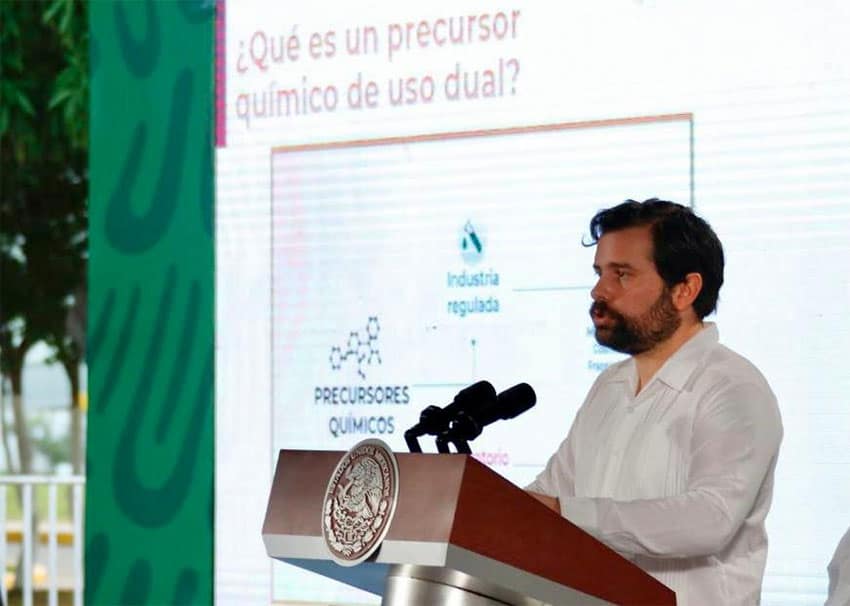
Cofepris head Alejandro Svarch announced the new system at a press conference on Wednesday.
Cofepris head Alejandro Svarch announced the new system at a press conference on Wednesday. Presidencia de la República

Although Mexico has long “flagged” imports of these chemicals, lack of effective follow-up often allowed shipments to go astray. Some have been stolen from warehouses, while others have been sold on to front companies used by drug cartels.

Of the six Mexican companies licensed to trade in regulated chemicals, all but one have come under investigation for irregular practices, and four currently have their activities suspended or terminated.

Furthermore, diversion of precursor chemicals has been facilitated by corruption within Mexican regulatory agencies, including Cofepris itself. At the press conference, Svarch explained that the new system would be implemented alongside complete digitalization of Cofepris’ records, after the Navy Intelligence Unit assisted in exposing a murky history of extortion and collusion between the agency and suspect drug companies.

“In an obscure archive … there was a discretional use, with no accountability, of imports of shipments of various chemicals with the intent of manufacturing, in many cases, illicit substances,” Svarch said.

Easy access to precursor chemicals is one of the factors that has allowed Mexican drug cartels to develop industrial-scale production of synthetic drugs. Precursors are usually sourced from manufacturers in Asia and imported via ports on Mexico’s west coast, before being diverted to clandestine laboratories in states such as Sinaloa and Michoacán. Most of the methamphetamine and fentanyl produced in these labs is destined for the US market.

With reports from Proceso, Associated Press and InSight Crime