Home Blog Page 880

Senate unanimously passes bill to double paid vacation for Mexican workers

0
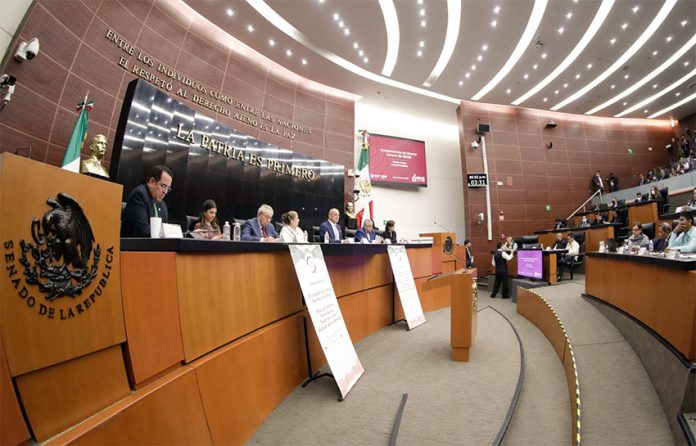
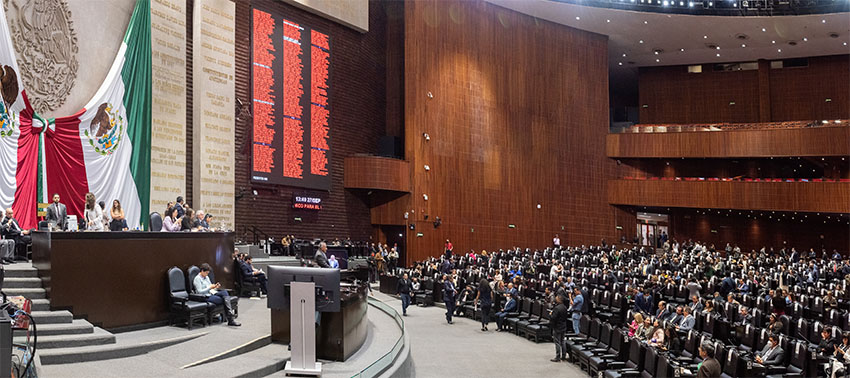
The Senate in session on Thursday.
The bill, first approved by the Senate in November, has now been finalized. Senado de México

On Thursday, the Senate unanimously approved a bill that modifies federal labor law to double annual leave for workers. For new employees, that would mean an increase from six to 12 days of annual paid leave after the first year of employment.

Entitled “Vacaciones Dignas Ya” (Decent Holidays Now), the bill also grants workers two days per subsequent year of service up to 20 days and, from the sixth year onward, paid leave would increase by two days for every five years of service until reaching the maximum statutory entitlement of 32 days.

The president of the Labor and Social Welfare Commission, Senator Napoleón Gómez Urrutia of the Morena party, explained that the bill seeks to guarantee more time off for rest and recreation. “Work is one of the many components of a full life. In the same way, we need free time for our personal development,” he said.

The current legislation has not been amended in 52 years, placing Mexico as one of the world economies with the shortest initial annual leave. According to data from the World Policy Analysis Center, this is only comparable with countries like Brunei, Malaysia, Uganda, the Philippines and Thailand. It is also way below the International Labor Organization’s (ILO) recommendation of at least 18 workdays based on a statutory six-day workweek.

Under the current scheme, it would take a worker in Mexico 45 years of service in the same company to equal the vacation period to which the labor force in Brazil or Panama is entitled from the first year of work.

At the same time, the World Health Organization has reported that Mexico ranks highest in the world for levels of work-related stress. These statistics go in hand with those from the Organization for Economic Cooperation and Development (OECD), which places Mexico as one of the member states with the highest working hours but one of the least productive.

The project was proposed in September by Citizens Movement party Senator Patricia Mercado and will next go to the lower house of Congress for a final vote. If approved, it will bring Mexico closer to meeting the ILO’s recommendation and could also increase productivity. “The issue at hand seeks to ensure that workers participate in productivity gains through better wages and more leisure time,” said Gómez Urrutia.

Assuming the bill goes on to become law, the new legal terms would affect all valid individual or collective work contracts at the time of the law’s entry into force, which is estimated for Jan. 1, 2023, or the day after its publication.

With reports from Forbes México, El Economista and El Canal del Congreso

Mexico was United States’ No. 1 trade partner in September, new data shows

0
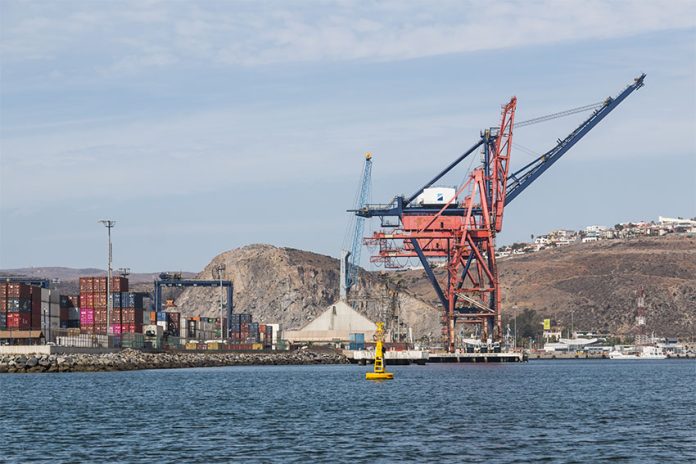
The Ensenada International Terminal in Baja California.
The Ensenada International Terminal in Baja California. Sherry V. Smith / Depositphotos

Mexico was the United States’ largest trade partner for a second consecutive month in September with two-way trade increasing 23% to more than US $67 billion, new data shows.

United States Census Bureau data shows that two-way trade totaled $67.4 billion in September, with almost 60% of that amount coming from Mexican exports to its northern neighbor.

Mexican exports were worth just over $39.5 billion in September while imports from the U.S. were worth just over $27.9 billion.

That left Mexico with a monthly trade surplus of almost $11.6 billion, a 25.3% increase compared to the same month last year.

The value of its exports — which include cars, computers, oil and agricultural products — was up 23.3% annually in September, while Mexico’s outlay on U.S. imports increased 22.5%. It was the 19th consecutive month that the value of Mexican exports to the U.S. increased on an annual basis.

The value of trade between Mexico and the United States was slightly higher than that between the U.S. and Canada in both August and September.

Mexico and the U.S. shipped goods worth $587.5 billion to each other in the first nine months of the year, a new record for the period and a 21% increase compared to last year. Mexican exports accounted for almost $341.7 billion, or 58%, of the total, while imports from the U.S. were worth $245.8 billion. Mexico thus had a trade surplus of $95.8 billion with the U.S. in the first nine months of the year, a new record high.

While Mexico was the United States No. 1 trade partner in August and September, it is in second spot behind Canada for the January-September period, as U.S.-Canada trade was worth a slightly higher $604.1 billion to the end of the latter month.

U.S.-China trade totaled just under $526.8 billion in the period, making the Asian economic powerhouse the No. 3 trade partner of the world’s largest economy in the first nine months of the year.

With reports from El Financiero, Reforma and El Economista 

Mérida to host Latin America’s 50 Best Restaurants awards

0
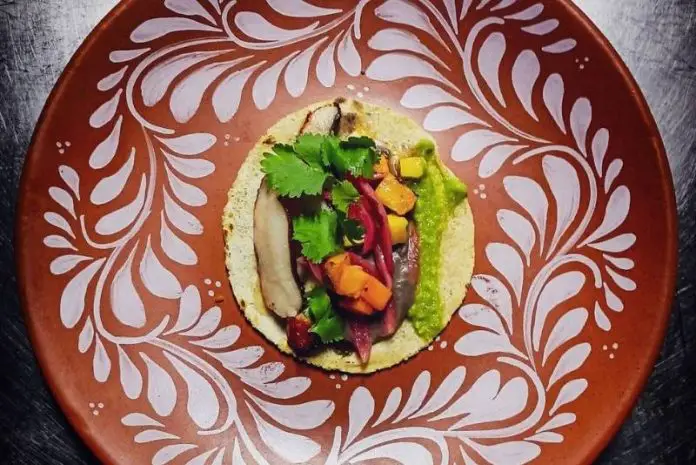
A dish from Manzanilla restaurant in Ensenada, which is a runner up in the 51-100 awards list Photo: The World's 50 Best

Mérida will be host to the 10th annual Latin America’s 50 Best Restaurants awards ceremony on Nov. 15. The event will bring together chefs and restaurateurs in-person for the first time since 2019 to showcase the fine dining scene in Latin America.

The 2021 top 50 list had 11 restaurants located in Mexico, including Pujol in Mexico City, Corazón de Tierra in Valle de Guadalupe and Chique in Cancún.

The voting panel includes 300 anonymous chefs, restaurant industry experts and food writers who nominate 10 restaurants where they had their best dining experiences in the last 18 months.

The 50 Best’s signature thought-leadership forum, known as #50BestTalks, will also take the stage as part of the program on Nov. 14.

This year’s theme of Cocina Consciente (Conscious Cooking) will bring together leaders in the industry to discuss working conditions, environmental and economic sustainability, healthier food, and ethical sourcing practices.

In the days leading up to the awards event, the city will also host the first edition of the Festival Sabores de Yucatán (Flavors of Yucatán festival), which will take place Nov. 11-13. 

From wine and food tastings to masterclasses by renowned chefs, the festival aspires to be a “world-class event that year after year, attracts important chefs, cooks and traditional cooks, gastronomic leaders, critics, journalists and investors, to get to know the state’s gastronomic scene,” according to Michelle Fridman Hirsch, Minister of Tourism Development for Yucatán.

With reports from La Jornada Maya and The World’s 50 Best.

This popular pulque bar’s owner is a kindly, knife-wielding grandma

0
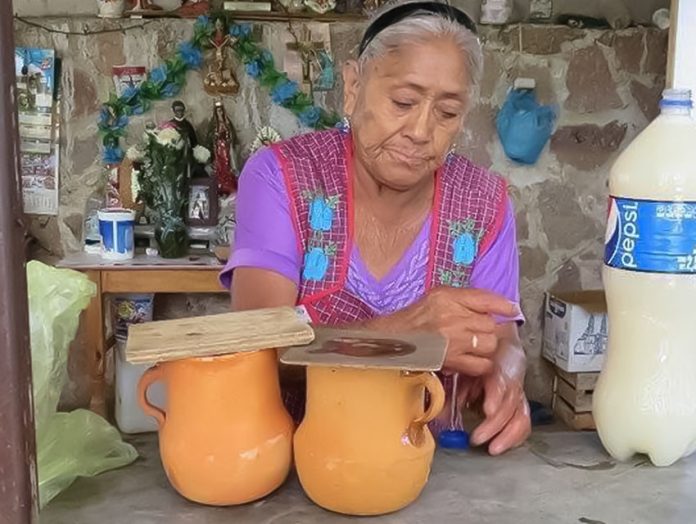
Dona Chencha, owner of La Flor de Mexquitic pulque bar in San Luis Potosi, Mexico
Doña Chencha fills the traditional clay mugs for serving pulque at La Flor de Mexquitic in the town of Maravillas, San Luis Potosí. Beloved by her regular patrons, she tolerates no shenanigans. Alejandro Ortiz/Facebook

The newspaper El Universal calls her San Luis Potosí’s “queen of pulque.” Her real name is María Crescencia Ortiz Hernández, but everyone calls her Doña Chencha, out of both familiarity and respect.

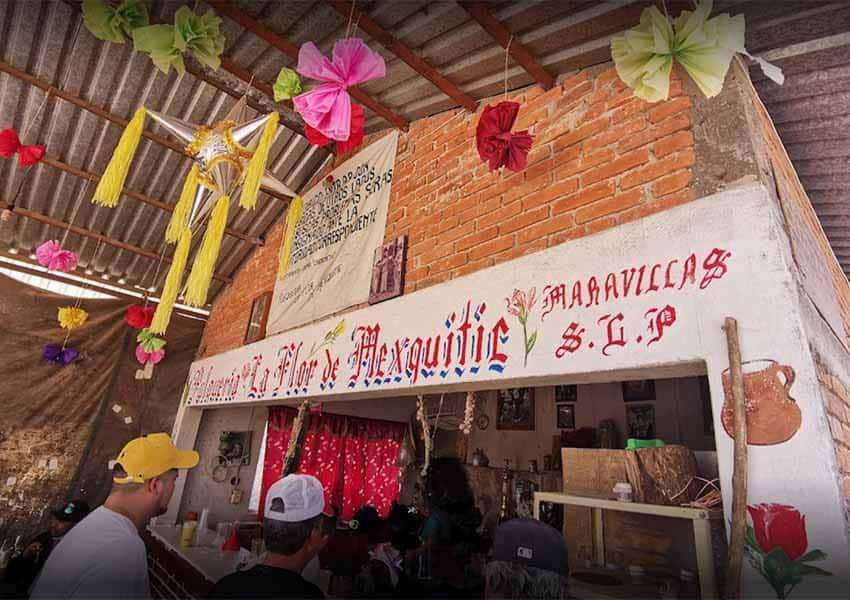
Her claim to fame is a small pulquería (pulque bar) called La Flor de Mexquitic in Maravillas, a San Luis Potosí community in the Mexquitic de Carmona municipality. The state capital is only a 20-minute drive from here, and urbanization is making its way here fast. 

All the seating is outdoors or semi-outdoors, allowing you to enjoy the agaves, trees and surrounding farmland. Two local artists and I arrived on a Wednesday to find it nearly empty with just La Doña and a table filled with local regulars. 

But this tranquility belies the fact that pulquerías in Mexico have every bit the dangerous reputation that biker bars do in the United States. Owning and running a pulque bar is not for the faint of heart. Nevertheless, Doña Chencha an 80-year-old woman, will tolerate no shenanigans. This becomes obvious when you enter, where there is a prominent sign warning, “If you come looking to fight, you will be thrown out.”

La Flor de Mexquitic pulque bar in Maravillas, San Luis Potosi, Mexico
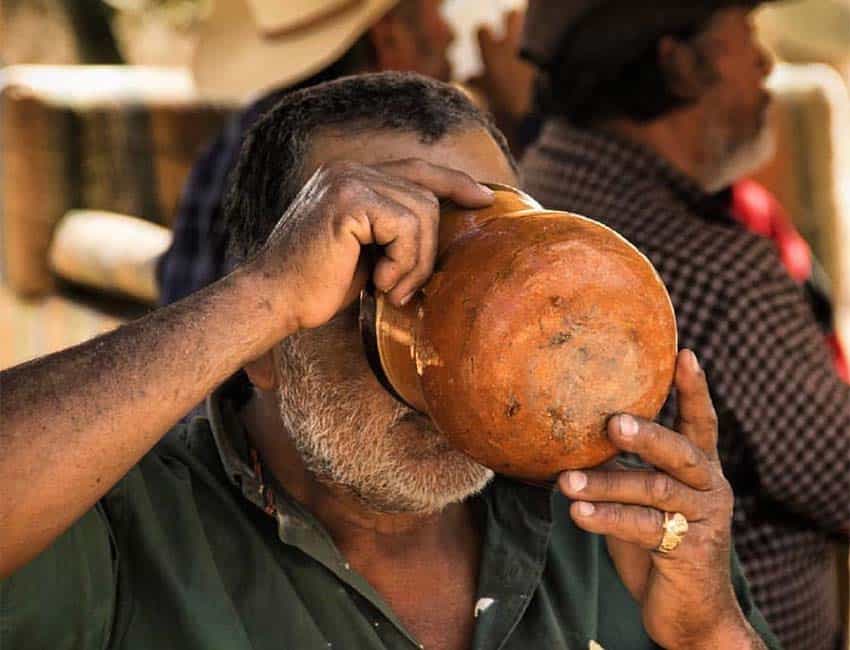
Another satisfied customer drinks Doña Chencha’s pulque to the last drop. Carlos Burgos/Facebook

Doña Chencha speaks bluntly and directly and has absolutely no problem adding cuss words to make her point; she does not care what anyone thinks of her. When we asked her how she deals with unruly customers, she pulled out a small knife.

However, there is more to her story. Over the time we spent at the pulquería and talked to her, it became very obvious that she has a well-established relationship with the farm and construction workers that sat at the table for regulars. At first, they were tense, clearly wanting to know what these strangers wanted with her, then relaxed as the Doña did.

There is no doubt that these gentlemen (and they are gentlemen in their own way), would never hesitate to back Doña Chencha up. She is full of anecdotes, including one where she and the regulars threw out a woman who was threatening them as “the girlfriend of a local narco.”

She comes from a family that’s made pulque for several generations. She was already helping at the tender age of nine, and by age 17, was preparing her own batches to sell.

La Flor de Mexquitic pulqueria in Maravillas, San Luis Potosi, Mexico
La Flor de Mexquitic’s setup is simple, and much of the seating is outdoors, but it still attracts a crowd. Oscar Llanas/Google

For many years, she was a housewife, but when her husband died in 1982, she needed a way to make a living, so she turned back to what she knew: she established a pulquería on the land her husband left her. She had the full support of her family, and even today, many of her children and grandchildren set up stands in and around the bar to sell food to the crowds that come on weekends.  

But despite being tough enough to keep a lid on the rowdiness that pulquerías are famous for, Doña Chencha is not invincible: thank goodness I made the trip out there with two local artists, Marissa Martínez and Eduardo Santillan: first of all, she had difficulty understanding my foreign accent, but when Martínez explained that I wanted to interview her, Chencha at first insisted that she “…didn’t have the vocabulary…” to do something like that.

Had I been there alone, I simply would have drunk a pulque to be polite and then left her in peace. But we sat at one of the tables and my two companions began to draw Doña Chencha into conversation about her life and the bar. At first, the answers were short as she passed by, but she eventually sat with us to chat. What would have been an awkward half-liter of pulque turned into a jovial experience for everyone, La Doña included. 

La Flor de Mexquitic has managed to keep most of its rural, rustic charm. It is open everyday, but the best time to go for most people is on weekends, when it fills up with people from all over, including families. On weekends, there are not only pulques flavored with whatever fruits are in season but also a variety of homemade local foods. When available during its very short season in late summer, you can even find colonche, a fermented prickly-pear beverage. 

La Flor de Mexquitic pulque bar, Maravillas, San Luis Potosí
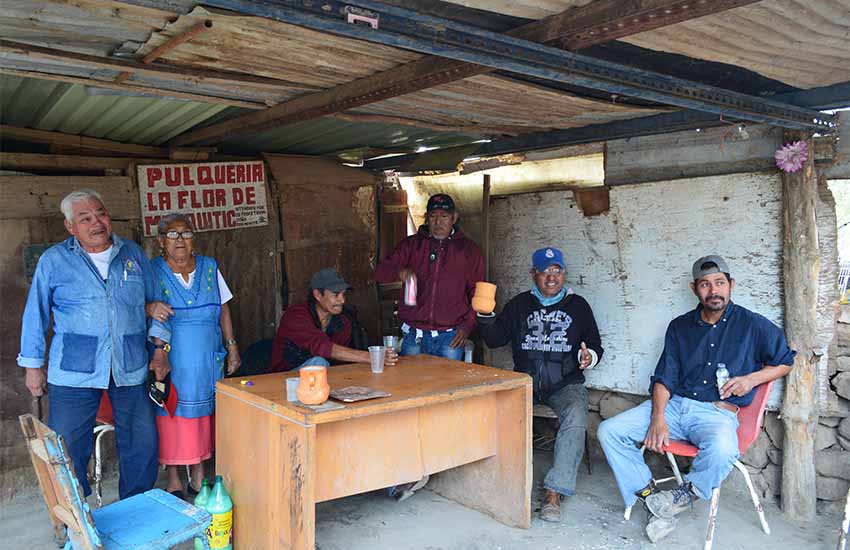
Doña Chencha and her regulars. All but one insisted on the photo, and La Doña dragged him back inside.

But don’t wait too long to visit: as much as La Flor de Mexquitic is a local institution, its future is in doubt.

Doña Chencha is in good health, and even if retirement were an option, I doubt she would take it. But she is 80 years old. She has 10 children (not sure how many grandchildren she has), but despite the support from her family, there isn’t the same interest in making pulque among the younger generations.

She doesn’t blame them: they have educational and career opportunities that were unthinkable in her time.

  • To get directions to Doña Chencha’s pulquería, enter “Pulquería La Flor de Mexquitic” into Google.   

Leigh Thelmadatter arrived in Mexico 18 years ago and fell in love with the land and the culture in particular its handcrafts and art. She is the author of Mexican Cartonería: Paper, Paste and Fiesta (Schiffer 2019). Her culture column appears regularly on Mexico News Daily.

Mexico plagued by ‘firearms pandemic,’ foreign minister declares

0
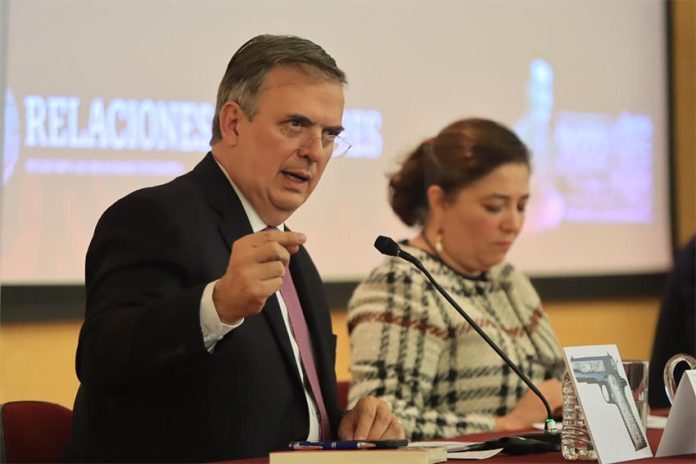
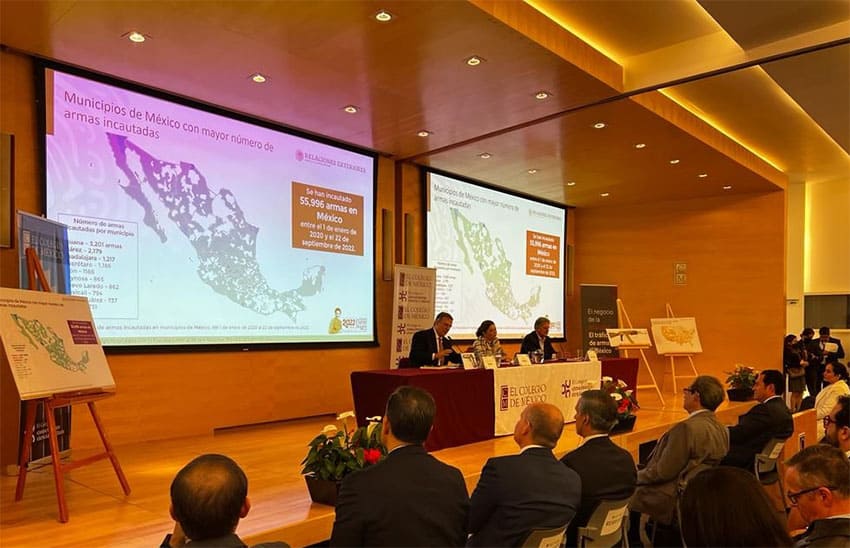
Foreign Minister Ebrard speaks at Thursday's event, "The business of death: arms trafficking in Mexico."
Foreign Minister Ebrard speaks at Thursday's event, "The business of death: arms trafficking in Mexico." Twitter @SRE_mx

Most of Mexico is in the grip of a “firearms pandemic,” Foreign Affairs Minister Marcelo Ebrard said Thursday.

Speaking in Mexico City at a conference on arms trafficking, Ebrard said that authorities have seized almost 56,000 guns since the beginning of 2020. He indicated that significant numbers of weapons have been confiscated in the vast majority of states.

“There are states in the republic, Yucatán and Oaxaca for example, where we’ve found very few [guns], except for in one part of the Isthmus [of Tehuantepec],” he said, referring to a region of the latter state.

“Outside there and the mountains of the north [of Mexico], our entire country is going through a firearms pandemic of different degrees of intensity,” Ebrard said.

The minister shared a map of the areas where the most weapons were confiscated.
The minister shared a map of the areas where the most weapons were confiscated. Twitter @SRE_mx

The foreign minister presented a map that showed where high numbers of guns were seized between January 1, 2020 and late September 2022. More than 3,200 firearms were confiscated in Tijuana — one of Mexico’s most violent cities — while almost 2,200 were taken off the streets of Ciudad Juárez.

Over 1,000 weapons were seized in three other cities — Guadalajara, Querétaro and León — while Reynosa (865), Nuevo Laredo (862), Mexicali (794), Cancún (737) and Celaya (731) were also hotspots for firearm confiscations.

Ebrard said it was no surprise that so many weapons were seized in Tijuana given that the border city has one of the highest murder rates in the country. He reiterated his view that the United States needs to do more to stop the flow of firearms into Mexico, asserting that combating the smuggling of guns can help the government to achieve its goal of further reducing homicides.

Ebrard said late last year that reducing violence in Mexico will be very difficult if the United States doesn’t do more to stop the illegal flow of weapons into the country, while he asserted last month that U.S. authorities should be checking vehicles leaving that country with the same thoroughness as they check those entering the U.S.

The foreign minister suggested Thursday that stopping the southward flow of weapons is a far easier task than combating the entry of drug precursors to Mexico and the northward flow of narcotics to the United States.

“The effort the United States has to make to drastically reduce the flow [of firearms] to Mexico is very small compared to the effort Mexico has to make to control precursor chemicals and [the flow of] drugs that reach the United States,” Ebrard said.

“… In other words, we’re not asking them to carry out a huge, difficult, complex, almost impossible operation,” he said.

After attending high-level security talks with United States officials in Washington last month, Ebrard said that Mexico and the U.S. had “a common plan for 2023:  … to drastically reduce the trafficking of weapons to Mexico and … to increase controls on precursor chemicals and the movement of fentanyl [to the United States].”

A car passes through a scanner along the U.S. border.
U.S. border agents have already begun scanning vehicles leaving that country at some areas along the Mexico-U.S. border. Josh Denmark / U.S. CBP

The federal government believes that more than 200,000 guns are smuggled into the country each year, meaning that for every firearm seized since 2020, about 10 crossed the border into Mexico.

Official data published by the newspaper Milenio this week shows that Mexican and U.S. authorities seize just a tiny fraction of that number at the two countries’ shared border. U.S. Customs and Border Protection data shows that that agency confiscated just 982 firearms during the 2022 U.S. fiscal year, which ended September 30.

Mexican customs officers seized just 416 guns in northern border states during the same period, meaning that authorities of both countries confiscated a grand total of 1,398 firearms during 12 months — 0.7% of the estimated 200,000 weapons that flow into the country annually.

Ebrard asserted Thursday that Mexican authorities “won’t allow” U.S. firearms seizures to remain so low, and suggested that Mexico could even pay for equipment to facilitate inspections of Mexico-bound vehicles. “I hope it doesn’t get to that, that we’ll reach some agreement,” he said.

President López Obrador and U.S. President Joe Biden said in a joint statement earlier this year that Mexico and the U.S. are “committed like never before to completing a multi-year joint U.S.-Mexico border infrastructure modernization effort for projects along the 2,000-mile border.”

Mexico committed to invest US $1.5 billion on border infrastructure while the U.S. pledged $3.4 billion for projects at its southern and northern borders. Those investments should improve both countries ability to detect illegal goods such as weapons and drugs.

In addition to pressuring the United States government, Mexico is seeking to hold U.S. gun manufacturers and vendors to account for the role they play in illegal arms trafficking. The federal government announced last month that it would appeal the dismissal of its lawsuit against United States gun manufacturers, which it accuses of negligent business practices. It has also filed a separate suit against five gun stores in Arizona, accusing them of involvement in illegal arms trafficking to Mexico, where firearms are used to commit tens of thousands of homicides annually.

With reports from Reforma and Milenio

El Chapo’s hometown in Sinaloa could get a drug trafficking museum

0
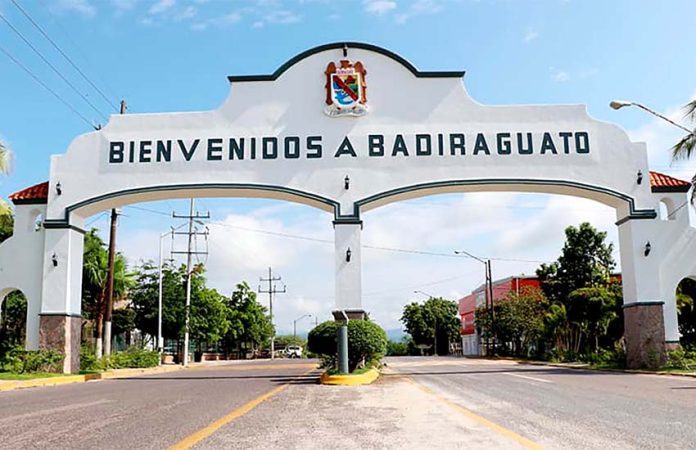
Badiraguato, Sinaloa, where town fathers are considering building a narco hismuseum
Badiraguato's mayor says that the municipality should embrace rather than deny the town's notoriety as the birthplace of drug kingpins Joaquín Guzman, Rafael Caro Quintero and José Esparragoza, Government of Badiraguato

A “narco-museum” could soon open in the birthplace of convicted drug lord and former Sinaloa Cartel leader Joaquín “El Chapo” Guzmán.

The mayor of Badiraguato, a municipality in the northern state of Sinaloa about 80 kilometers northeast of Culiacán, recently said that he’s open to the idea of a museum that tells the stories of notorious drug traffickers such as El Chapo, Rafael Caro Quintero, current Sinaloa Cartel leader Ismael “El Mayo” Zambada and Juan José “El Azul” Esparragoza, an ex-leader of the same cartel.

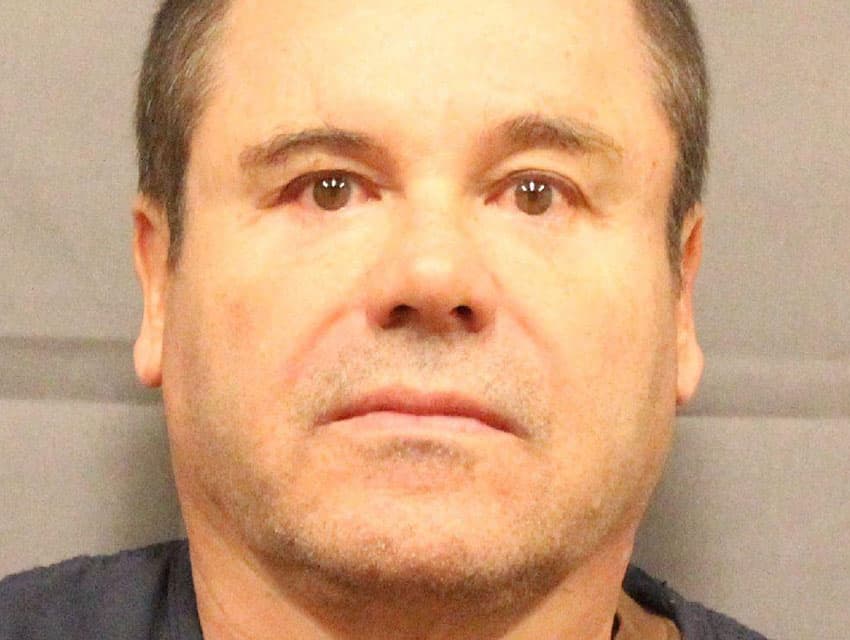
El Chapo – sentenced to life in a U.S. prison in 2019 after being convicted on drug trafficking and organized crime charges – was born in La Tuna, a small community in the municipality of Badiraguato, which borders Durango and Chihuahua. Caro Quintero and Esparragoza, like Guzmán, were born in Badiraguato, while Zambada was born in a small town in the neighboring municipality of Culiacán.

Mayor José Luis López Elenes described Badiraguato as a traffickers’ “cradle” and asserted that “we can’t deny our history.”

Joaquin "El Chapo" Guzman in 2017 in U.S. custody
Joaquin “El Chapo” Guzmán in 2017 after being extradited to the United States. DEA

“We have to acknowledge it, and we’re going to work on that basis. It’s possible that we could have a drug trafficking museum; we’re not closed-minded on any issue. We’re going to listen to all … [ideas],” he said in recorded remarks disseminated by the news website Noticiero Altavoz.

“We’re a government that listens to [people’s] voices,” the Morena party mayor added. Despite being receptive to the possibility of creating a narco-museum, López said that his government was aiming to “overcome the stigma of drug trafficking” via the economic development of Badiraguato.

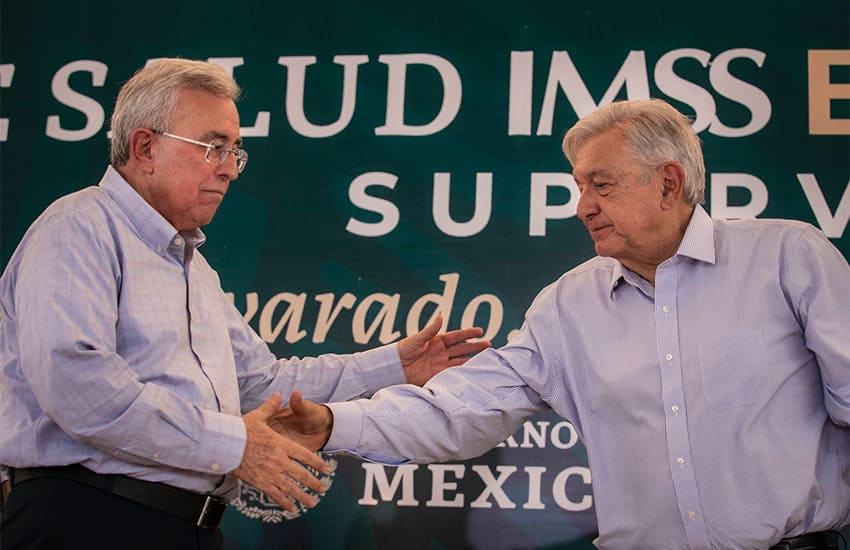
Sinaloa’s governor, however, doesn’t like the idea of a narco museum. “I don’t share that point of view at all, and I emphatically reject the idea of building a museum of drug trafficking in Badiraguato,” Rubén Rocha Moya said.

If the mayor’s idea is acted upon, the museum would be housed in a 14-million-peso (US $711,000) regional museum building that is currently under construction. Whether the project goes ahead appears likely to hinge on the advice of “museum specialists.”

Sinaloa Governor Rubén Rocha Moya, left, said he “emphatically” opposes the idea of a narco museum. Rubén Rocha Moya/Twitter

“If they tell us that having a narco museum will benefit the municipality of Badiraguato, we’ll promote it from government,” López said.

A narco museum there could perhaps be similar – albeit on a smaller scale – to Las Vegas’ The Mob Museum, which hosted a speaking event exploring “the rise and fall of El Chapo” earlier this year.

Mexico City has a narco museum, first built in 1986 as a training room for soldiers inside a Defense Ministry (Sedena) facility but converted into a museum in 2002. The Museo del Enervante (The Illicit Drug Museum) displays objects confiscated during Mexico’s drug war. However, it is not open to the general public, only by written request and at Sedena’s discretion.

With reports from Reforma 

Employers association calls on government to expand cybersecurity efforts

0
A computer screen showing multi-colored code.
Part of the problem is a global shortage of cybersecurity specialists, Coparmex said. Ilya Pavlov via Unsplash

Business leaders are worried about national cybersecurity in light of the September hack of the Defense Ministry (Sedena), and have urged the federal government to take action in a statement released last week.

In a document titled “Sedena’s hack: serious and concerning,” the national employers association (Coparmex) expressed its concern regarding the hack. The statement emphasized that investment in cybersecurity should be a priority for both companies and governments and lamented that Mexico doesn’t have a cybersecurity law.

The association said that “The need for a Federal Law on Cybersecurity has been made clear […] to quickly deal with this type of threat in a world increasingly dependent on information technologies.”

After the Ministry was hacked, Coparmex insisted that Sedena and all government agencies responsible for national security and public security need to be strengthened — particularly cyber units to combat crimes such as extortion, “which has grown by a 55.6% between the years 2018 and 2022 (according to numbers from the first four months),” said the statement, which was published last week.

A Coparmex graphic displays the name of the associations new report, "Serious and concerning: the Sedena Hack."
A Coparmex graphic displays the name of the associations new report, “Serious and concerning: the Sedena Hack.” Coparmex

Back in September, the Guacamaya group of Central American hackers leaked thousands of internal Sedena emails to the media outlet Latinus. Among the information leaked there was information relating to impunity in sexual assault cases within Sedena; the recruitment of chemistry professors by the Sinaloa Cartel to produce fentanyl; and the risk of collapse of a section of the Maya Train, among other sensitive information.

Coparamex noted that though the national security budget has increased, most of that increase has gone to Sedena, often for “emblematic works” of AMLO’s administration like infrastructure projects, which are not strictly security-related. This contrasts with the Security Ministry budget for 2023, which had a 1% increase and “which doesn’t respond to current needs,” Coparmex remarked.

Similarly, the National Institute for Transparency and Access to Information (INAI), called on Congress to increase the cybersecurity budget by 30 million pesos (US $1.5 million), arguing that in July alone, the institute registered more than 60 million cyberattacks.

The statement also mentioned a lack of cybersecurity specialists, saying that the world is short at least 2 million workers relative to demand for employees and that Mexico’s government should closely work alongside universities to design programs on cybersecurity and motivate students to enroll in such programs. “Mexico must join the effort and bring alternatives to young people in these areas,” the INAI statement said.

The statement also mentioned what other countries have done in the matter, such as the United Kingdom, Japan, France, Italy, Australia, Germany, and the United States. “There’s no doubt that investment in security needs to be rethought looking at other countries’ examples […] Biden signed an executive order in May 2021 designed to encourage cybersecurity initiatives, named a national chief cyber officer to oversee digital security policies and announced measures to protect his information systems.”

Coparmex also called on the government to consider cyberspace as an extension of Mexican territory. “There needs to be a master plan to guide all the initiatives on cybersecurity and that facilitates a cross-government coordination, considering cyberspace as another part of the national territory which demands its defense system,” it said.

“The seriousness of the case warrants recognition of the full scale [of the problem],” Coparmex concluded. “… Not only is national security at risk, but also people’s lives.”

With reports from El Economista and Proceso

Polls find mixed opinions about government’s proposed electoral reform

0
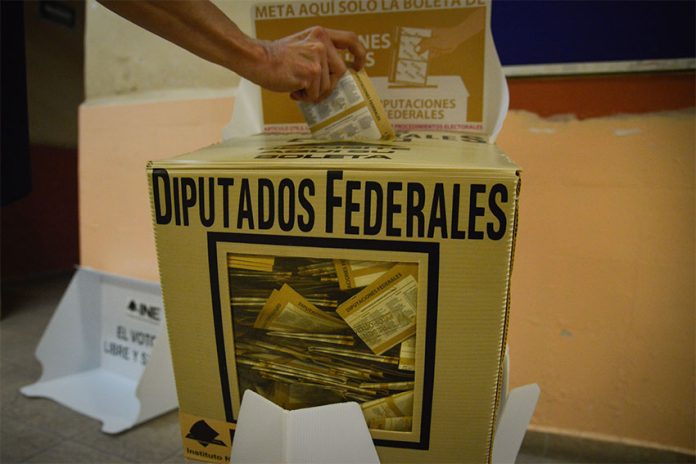
A Mexican citizen casts their vote for federal deputy at a voting station in Mexico City during the June 2021 federal elections. Mario Jasso / Cuartoscuro.com

A survey conducted for the National Electoral Institute (INE) has found strong support for key proposals in the federal government’s controversial electoral reform bill, but a Reforma newspaper poll yielded markedly different results.

Obtained by the newspaper El País, the results of the INE poll show that 93% of 400 respondents support the proposal to cut public funding for political parties.

Almost nine in 10 of those polled — 87% — agreed with the plan to reduce the number of federal lawmakers, while 78% supported the idea of allowing citizens to elect electoral councilors and electoral tribunal judges and 74% backed the move to cut the INE’s budget.

The proposed reform is currently being analyzed and debated by lower house lawmakers and could be put to a vote later this month.

The poll — conducted for INE by three private companies in September — also found majority, albeit less overwhelming, support for three other proposals.

Almost seven in 10 respondents — 68% — approved of the plan to allow more citizens to vote electronically, while 53% backed the proposal to get rid of state-based electoral institutes and tribunals.

Just over half of those polled — 52% — said they supported the proposal to replace the INE with a new, centralized authority to be called the National Elections and Consultations Institute (INEC). That result is very different to that yielded by a Reforma newspaper poll, which found that only 13% of an undisclosed number of respondents believe that the INE should be disbanded and replaced by a new authority.

Published Tuesday, the Reforma poll results show that 80% of respondents believe that the INE has played an important role in guaranteeing democracy in Mexico and 71% said that its demise would pose a threat to democracy.

The proposed reform would mean less public funding for political parties and cuts to election-related media publicity budgets.
The proposed reform would mean less public funding for political parties and cuts to their media publicity budgets. File photo

Half of those polled by Reforma said that President López Obrador and the ruling Morena party want to dismantle the INE in order to “appropriate the new institute to control elections.”

Fewer respondents — 43% — said that the aim of the reform is to improve Mexico’s electoral system. Almost nine in 10 people — 88% — said it’s important for the electoral institute to be independent of the president of the day and political parties, while 79% said that guaranteeing “clean and impartial elections” should be the priority of electoral reform.

Only 48% of respondents said that electoral councilors should be elected by citizens, 30 points lower than the percentage found by the INE poll. Almost two-thirds of respondents — 65% — said that electoral reform should wait until after the 2024 presidential election, while 61% said that getting rid of the INE before that election is held will “create questions” about its legitimacy.

If the INE is disbanded in the coming months, 77% of respondents believe that a “post-election conflict” is very or somewhat probable.

López Obrador sees Reforma as a conservative newspaper opposed to his government, but 70% of those polled said they had a good or very good opinion of the president. A slightly higher percentage of respondents — 73% — said the same about the INE.

The poll results suggest that most respondents believe that protecting the INE and the current electoral system is more important than giving the president what he wants — even though they generally support him.

The INE survey yielded a significantly different result vis-a-vis attitudes toward the electoral institute, which is led by presidential antagonist Lorenzo Córdova. Only 56% of respondents said they had a positive opinion of the INE, with others expressing beliefs that it is corrupt, facilitates electoral fraud, is in cahoots with certain political parties and is a bad manager of public resources. The president and Morena lawmakers have made similar claims and insinuations themselves.

Mexico’s main opposition parties — the PAN, the PRI, the PRD and Citizens Movement — as well as business organizations, some civil society organizations and the Catholic Church, among others, have expressed opposition to the proposed electoral reform and spoken out in defense of the INE. The president and his cabinet ministers, Morena and its allies and the National Human Rights Commission, among others, support the proposed reform, which seeks to modify the constitution and thus requires the support of two-thirds of lawmakers — a super majority Morena and its allies don’t have — to pass Congress.

The Chamber of Deputies, partially full, during the most recent legislative session.
The reform proposes eliminating 200 “proportional” representatives of political parties. For the remaining 300 deputies, voters would choose from nation-wide lists by party, rather than voting by district. CC BY-SA 4.0

“Electoral reform is very important in order to banish fraud,” López Obrador said last month. “The [electoral] councilors act on orders, we have to correct that, enforce democracy as a way of life and a political system.”

In an interview with the newspaper El Universal, prominent political scientist José Antonio Crespo noted that Mexico is divided on the issue of electoral reform.

“The electoral issue is controversial,” he said. “… The INE has been the core of democratization [in Mexico] and a lot of sectors [of society] want to defend it. They don’t want it to be changed or for it to be subordinated to the government,” Crespo said.

“So it’s an issue of confrontation that without doubt places governability at risk. From now until the 2024 election these tensions are going to grow.”

In addition to commissioning a poll, the INE asked the European Commission for Democracy through Law — known as the Venice Commission — to offer an opinion on the proposed electoral reform. The electoral institute — whose very survival is at stake — might be more inclined to agree with the Venice Commission’s findings rather than the opinions of the majority of those who responded to its own poll.

In its “Opinion on the Draft Constitutional Amendments Concerning the Electoral System of Mexico,” the Venice Commission said that “the proposed amendments to the constitution do not provide sufficient guarantees of the independence and impartiality of the INEC and of the judges of the Electoral Tribunal.”

Among other critical remarks, the commission said that “the creation of a highly centralized INEC should be reconsidered since an onerous and complex centralization might compromise the impartial and independent operation of the electoral administration at different levels of the federation.”

Earlier in its report, the Council of Europe advisory body said that “among the proposed changes, three seem to stand out.”

  1. The creation of a new national electoral authority whose members would be directly voted in by ‘the people’ and also manage state and local elections.
  2. Cuts to public funding and media time for political parties.
  3. Reconfiguring of Congress not only by eliminating 200 (out of 500) proportional representation seats in the lower house, but also electing the remaining 300 by nation-wide lists from parties rather than districts.

“This reform, if adopted, will radically change the electoral system in Mexico and the management of its electoral process. Previously all constitutional electoral reforms had been proposed by the opposition,” the Venice Commission said.

“This is the first time that the president, whose political supporters have the majority in the Congress, initiates such ambitious constitutional changes which will significantly affect the next elections to take place in 2024.”

With reports from El País, Reforma and El Universal 

Mycotourism blooms in mushroom-rich Mexico

0
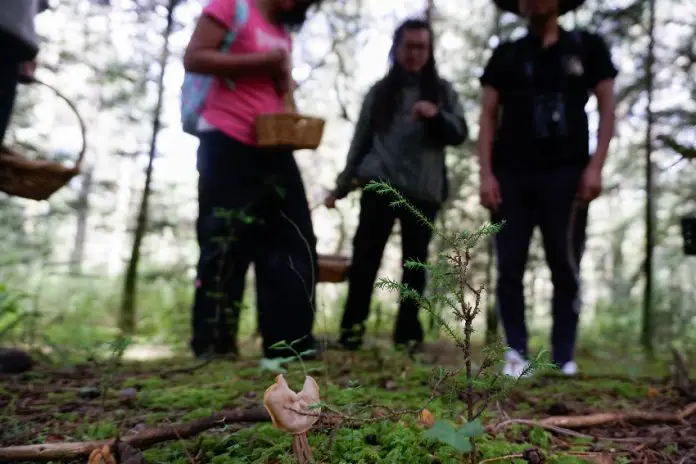
A mushroom tour group stops in the forest to view a rabbit’s ear mushroom in La Malinche National Park, Mexico, on Sept. 5, 2021. Miguel Ángel Reyes, far right, the chef and forager who coordinates the tour, can quickly identify where the mushrooms appear. Photo credit: Patricia Zavala Gutiérrez, Global Press Journal Mexico

This story was originally published by Global Press Journal. 

PUEBLA, MEXICO — Miguel Ángel Reyes and his brother, Jorge Reyes, hadn’t visited their hometown, San Miguel Canoa, in several years. Working as chefs in tourist sites throughout Mexico, the brothers decided in early 2019 to return to the small town nestled at the foot of La Malinche, or Matlalcuéyatl, volcano, in the eastern state of Puebla.

They were shocked to find that a fire had devastated the ancient forest surrounding the town. The smoke darkened the air “like a movie,” Miguel Reyes recalls. In the aftermath of the disaster, the brothers had an idea: They would use their ancestral and culinary knowledge of wild mushrooms to organize a Wild Mushroom Festival, which they hoped would attract tourists and garner support for reforestation.

Little did they know, they were jumping headfirst into a growing industry: mycotourism, or tourism centered on finding, identifying and learning about wild mushrooms.

But the young chefs have a secret ingredient for success. They are nanacateros, a word from the Náhuatl language to describe a select group of Náhuatl speakers who possess ancestral knowledge of wild mushrooms. As interest grows in protecting forests and mushroom habitat, scientists and the general public are increasingly recognizing and valuing that expertise, cultivated by indigenous communities in Mexico over centuries.

Miguel Reyes learned how to identify mushrooms from his grandmother, who began teaching him when he was just 10 years old. On the mycotourism tours Miguel Reyes conducts alongside other experts, he stewards that ancestral knowledge. He provides the Náhuatl name of the mushroom; talks about the traditional ways to clean, cook and preserve each specimen; and shares its significance in indigenous rituals.

Based on oral tradition from their parents and grandparents, who were also nanacateros, the mushroom foragers have learned to distinguish between varieties and evaluate their safety, toxicity and uses. They have also learned the best times to forage and how to find desired mushrooms — a skill with significant economic impact.

Mexico has the second-highest number of edible mushroom varieties of any country in the world, according to data that Dr. Jesús Pérez Moreno, an internationally recognized authority, presented at the Segundo Coloquio de Biología de Hongos, a mushroom biology colloquium organized by the National Autonomous University of Mexico’s School of Science.

Daniel Claudio Martínez Carrera is technical director of the Centro de Biotecnología de Hongos Comestibles, Funcionales y Medicinales, a center that studies mushroom biotechnology. According to the center’s studies, which Martínez says are the first ever conducted in the country, the value of the mushroom supply chain — including both large- and small-scale mushroom producers as well as foragers — exceeds $250 million per year.

“The economic flow is important,” Martínez says, “and generates more than 25,000 jobs, directly or indirectly.”

For María Isabel Juana Pérez Manzano, a nanacatera from San Isidro Buensuceso, in the state of Tlaxcala, collecting mushrooms brings in additional income for her family. Mushrooms, as a non-timber forest resource, represent a considerable source of income for many families, with an income per foraging season of between 3,360 and 4,320 Mexican pesos ($163-$209), according to the Food and Agriculture Organization of the United Nations.

But mushrooms represent far more than a few pesos for foragers.

Adriana Montoya Esquivel, an ethnomycologist with the Centro de Investigación en Ciencias Biológicas, a research center at the Autonomous University of Tlaxcala, says mushrooms are vital indicators of the health of their environments. Connecting the local and scientific knowledge of indigenous communities will enhance understanding of the threats against biodiversity — which include illegal logging in the area and forest fires, among others — and promote sustainable alternatives, she says.

Humberto Thomé Ortiz is the founder of the Laboratorio Social de Micoturismo en México (Social Laboratory for Mycotourism in Mexico), an experimental space for mycotourism collaboration between indigenous communities, the academic sector, the government and the general public. He says the knowledge the communities possess about wild mushrooms needs to be preserved, because it provides critical biological data to which scientists may not have access.

A warning on the website of the  (The Digital Multimedia Repository for Determining Edible and Toxic Mushrooms), a project developed by mycologists from the Institute of Biology at the National Autonomous University of Mexico, reads: “This site must not be used to identify mushrooms in the field and consume them. The only safe way to consume wild edible mushrooms is to purchase them from mushroom gatherers who possess a deep traditional knowledge for identifying them.”

There is an increasing number of mycotourism experiences in Mexico, but Thomé believes that not all of them are structured or regulated well because Mexico, unlike Europe, lacks legislation that addresses mushroom collection.

For Thomé, mycotourism, when formulated and carried out well, can be a model for an important and restorative experience that helps society value — and protect — the environment.

And many mycotourists say the experience is well worth the time and effort.

Alejandra Ávila Cossío, 19, a scout and hiking enthusiast, says it was “fascinating” to learn about mushrooms. And Yamil Hernández Urquieta, 25, a pharmaceutical biochemist who says he was drawn to the tour because he’s passionate about biology, was left with a taste for more. “It was great,” he says, “and we hope to come back again next year.”

Patricia Zavala Gutiérrez is a Global Press Journal reporter based in Mexico.

Global Press Journal is an award-winning international news publication with more than 40 independent news bureaus across Africa, Asia and Latin America.


Canadian man arrested after allegedly killing police officer in Tulum

0
Downtown Tulum, Mexico
The man shot the officer in the village of Francisco Uh May, part of the municipality of Tulum. Creative Commons

Quintana Roo authorities have arrested a foreign man who allegedly shot and killed a police officer in the municipality of Tulum.

The state Attorney General’s Office (FGE) said in a statement Tuesday that Patrick “C.” was detained due to his “probable participation in the crime of homicide” in the community of Francisco Uh May on Monday.

The FGE said that municipal police traveled to the village northwest of the resort town of Tulum after receiving reports that a man, “apparently of Canadian nationality,” was firing a gun at a vehicle.

When the police arrived, Patrick C. shot at the officers and wounded one of them, the FGE said, adding that the injured officer subsequently died.

After the attack, the Canadian man then entered his home and set it on fire before exiting, the statement said. Officers then fired at the suspect, and he sustained a gunshot wound to his leg before being detained. He was subsequently taken to hospital in Playa del Carmen, where he remains in police custody, the FGE said.

The confrontation reportedly took place in the early afternoon on Monday. Francisco Uh May is located about 25 kilometers northwest of Tulum and about the same distance southeast of the Cobá archaeological site.

It was unclear how long the alleged murderer had been living in the Mayan community, described on a vacation rentals site as “a small but unique village that is known for arts and crafts.”

Mexico News Daily