The Elote Azul Korhupo Anapu festival aims to promote Michoacán's emblematic blue corn.
A festival celebrating one of Michoacán’s culinary outliers, its visually striking blue corn, is set to take place in Uruapan this weekend.
The festival, known as Elote Azul Korhupo Anapu, aims to highlight the state’s botanical wealth and promote the trade of its emblematic blue corn. It will take place September 3–4 at the communal auditorium in San Francisco Corupo, a community in the municipality of Uruapan.
The region is known as the Purépecha Plateau, the agricultural heartland of the Purépecha people.
Organizers expect up to 1,500 people to attend the event, which could earn the community some 600,000 pesos (US $30,000).
The event will exhibit products derived from corn as well as cultural presentations of Purépecha tradition: the indigenous group has the historical distinction of never being conquered by the once-dominant Aztec Empire.
Dances originating from Querétaro and México state will be presented: both states are also producers of blue corn. Folkloric dancers from the U.S. state of Oregon will also perform, and indigenous ball games will be presented as well as an elevation of paper Cantoya balloons.
While there are more than 60 varieties of corn in Mexico, blue corn offers some distinct nutritional advantages: the unusually colored crop contains less starch and has a lower glycemic index than its more commonly consumed paler rival.
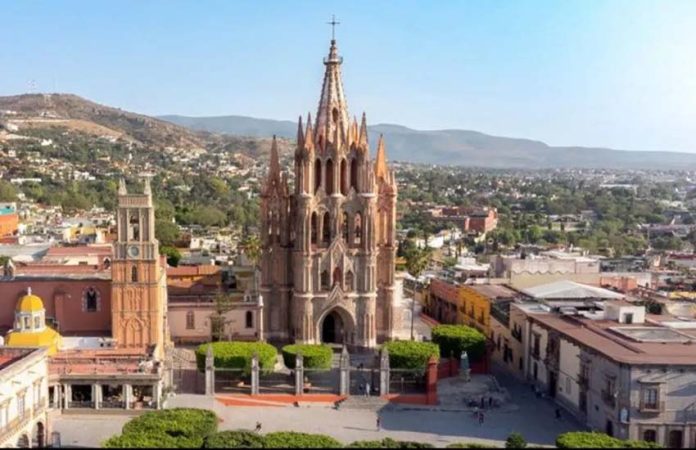
San Miguel de Allende, Guanajuato's historic center, where the project is taking place, is a UNESCO World Heritage Site. INAH
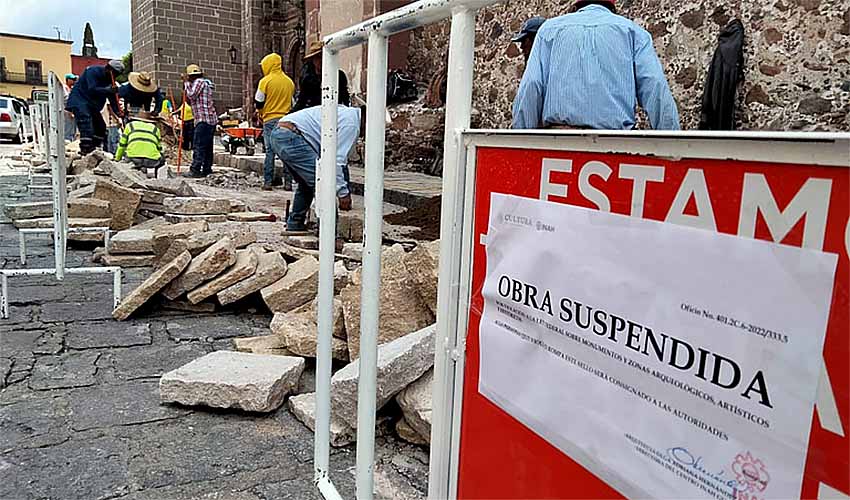
The widening of a sidewalk in San Miguel de Allende, Guanajuato, has upset the powers that be at the National Institute of Anthropology and History (INAH).
In a statement issued Saturday, INAH said it had detected an unauthorized “intervention” in the historic center of the colonial city, which has been a UNESCO World Heritage site since 2008.
It didn’t specify the unauthorized work, but reports identified it as the widening of a sidewalk on Juárez Street in order to improve access for people with disabilities. INAH said that the project altered “the urban image of the municipality” and could place the World Heritage designation at risk.
INAH said that personnel from its Guanajuato office confirmed last Wednesday the “execution of work without the authorization of the institute” and consequently suspended the project. However, workers ignored the suspension order and continued to undertake work to widen the sidewalk, it said.
The federal agency ordered the sidewalk widening project shut down, but the city has continued work on it.
INAH said that municipal police refused to provide support and as a result it sought the assistance of the National Guard, which did manage to bring the work to a halt. But the caper didn’t end there as INAH received reports from citizens last Wednesday night alerting it that the project had resumed.
The institute noted that the San Miguel de Allende municipal government decided to undertake the work,“contravening … the collaboration and coordination agreement signed with INAH in December 2021.”
The aim of that agreement, it said, was to “join forces for the protection, conservation, restoration, recovery and dissemination of cultural, paleontological, archaeological and historic wealth.”
“INAH calls on municipal authorities to suspend the work carried out without the authorization of INAH, to respect the law and agreements signed and to … establish a working group in favor of the conservation of the cultural, historical and architectural heritage of San Miguel de Allende,” the statement said.
INAH’s exhortation apparently came too late as the institute’s Guanajuato director said that the project was finished in the early hours of last Thursday morning. Olga Adriana Hernández Flores said that the workers completed the project under the cover of darkness “like criminals.”
According to a La Jornada newspaper report, INAH filed a criminal complaint against the municipal government, but the institute made no mention of that in its statement.
Hernández said that the San Miguel de Allende government – currently led by Institutional Revolutionary Party Mayor Mauricio Trejo – has carried out other projects without the authorization of INAH.
“It’s probable that [San Miguel de Allende] will enter the list of cities that could lose the [UNESCO] declaration,” she said.
A local government official countered that INAH’s authorization wasn’t required for the sidewalk project because it fell under the category of maintenance.
“It’s maintenance work to pedestrianize the street, the section of sidewalk is too small,” said José Emilio Lara Sandoval, the municipal government’s director for the historic center and heritage.
For his part, Mayor Trejo said in a statement that the work complied with UNESCO recommendations. “One of the main objectives is the recovery of public spaces, making them more passable for pedestrians, generating pleasant environments where [historical] monuments are emphasized,” he said.
Mexico’s automobile industry has a new achievement to celebrate after Ford México revealed its first car made exclusively by women.
The Mustang Match-E, a battery electriccompact crossover SUV, has been built exclusively by women since 2020 at a Ford plant in México state.
During a visit to the plant in Cuautitlán, accompanied by Ford México CEO Luz Elena Castillo, Foreign Minister Marcelo Ebrard said the factory was Ford’s most productive worldwide before boasting the all-female feat. “Another very interesting thing is the manufacture of this vehicle. It’s the first one manufactured exclusively by women. For the first time in the world all the manufacture of the vehicle is done by women,” he said.
Ebrard added that there are also women working at managerial levels at the factory and praised the company for its forward thinking ethos. “The gender perspective of Ford is very good. We are very happy that Mexico is exporting and producing these vehicles that are not the future, they are already the present,” he said.
Photos on the foreign minister’s social media show one of the Mustang Match-E vehicles, decorated with an image of a woman wearing a bright flower in her free flowing purple hair. The car’s design also bears the logo of Warriors in Pink, the company’s initiative to fight breast cancer.
Ebrard also looked ahead to September 12 for the High-Level Economic Dialogue (HLED) talks with a U.S. delegation. He said the government would unveil its strategy to convert half of the cars produced in the country to electric. “By September 12 we will know what the route is, what the next steps are and who has to do what. [That goes for] all the companies in the automotive sector, the entire energy sector of Mexico including the Federal Electricity Commission, and … the government,” he said.
Mexico and the United States will together invest almost US $500 million in a range of sewage treatment projects designed to clean up the heavily polluted Tijuana River, which flows into the Pacific Ocean just north of the border in San Diego County.
At a ceremony held earlier this month at the Tijuana River National Estuarine Research Reserve in Imperial Beach, California, Mexican and U.S. officials signed an agreement that commits to funding 17 priority projects. The International Boundary and Water Commission pact pledges almost $144 million in Mexican funding and at least $330 million in U.S. spending for a total outlay of approximately $474 million.
The Ministry of Foreign Affairs (SE) said the San Antonio de los Buenos wastewater treatment plant in Tijuana will undergo a complete renovation while the South Bay International Wastewater Treatment Plant just north of the border in San Ysidro will be expanded in order to double its current capacity. SE also said that pumping stations and other water and sewage infrastructure on the Mexican side will be upgraded.
“With this important agreement, the governments of Mexico and the United States commit to working together on the planning, design, [re]construction and rehabilitation of existing wastewater infrastructure in the region of Tijuana, Baja California, and San Diego, California, including the Pacific Ocean,” the ministry said.
[wpgmza id=”368″]
“The new infrastructure will provide for the conveyance, treatment, disposal and when applicable reuse of wastewater to reduce contamination in the Tijuana River basin.”
According to the United States Environmental Protection Agency (EPA), the planned projects will increase sewage treatment capacity by 43 million gallons – or 162.7 million liters – per day. The overhaul of the Tijuana wastewater treatment plant is slated to be finished by 2027, and will reduce the quantity of untreated sewage discharged to the Pacific Ocean by 80%, the EPA said.
Scott Peters, a U.S. congressman who represents San Diego, expressed optimism that the overhaul of the Tijuana plant will be finished sooner than 2027.
The pollution of the Tijuana River and the Pacific Ocean off the coast of both northern Baja California and southern California has been a problem for decades, but has worsened in recent years as pressure on the sewage system continued to grow. Binational environment group Wildcoast said in 2018 that the Tijuana wastewater treatment plant was dumping 1,750 liters of untreated sewage into the Pacific Ocean per second.
Imperial Beach in San Diego, where the Tijuana River meets the Pacific Ocean, has been repeatedly closed in past years for unsafe levels of sewage in the water.
Raw sewage, chemicals and trash discarded in the Tijuana River in Mexico usually end up at Imperial Beach, where the waterway flows into the Pacific Ocean. Scores of U.S. border patrol agents reportedly became ill in 2017 after being exposed to contaminants while working in the vicinity of the border. Pollution of the coastline in southern California has forced the closure of beaches on numerous occasions.
Peters described sewage infrastructure in Tijuana as “really decrepit,” asserting that it lacked maintenance.
“The treatment plant is falling apart, so sewage is falling into the water — not through a pipe with partial treatment, but without any treatment,” he said. “They have a double problem — growing population and failing infrastructure,” the lawmaker added.
Baja California Governor Marina del Pilar said last week that the new funding agreement showed that governments on both sides of the border are committed to solving the longstanding pollution problem. “We’re taking a historic step that will transform the life and environment of our region,” she said.
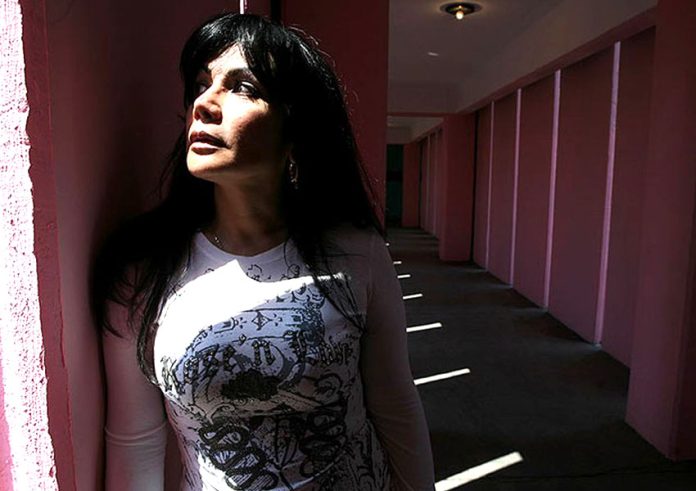
Sandra Ávila Beltran, who is often referred to by the nickname Queen of the Pacific, says the series' lead character is based on her.
La Reina del Pacífico (The Queen of the Pacific) believes the protagonist of the television drama La Reina del Sur (The Queen of the South) is based on her, and she’s not happy about it.
Sandra Ávila Beltrán, a 61-year-old Mexicali native, is aiming to get a hefty payout from streaming service Netflix and television network Telemundo. She says that the lead character in the Spanish-language TV show — the fictional drug lord Teresa Mendoza — is an unauthorized portrayal of her.
Ávila, who is often referred to by the nickname La Reina del Pacífico, has been accused but never convicted of drug trafficking. However, she spent seven years in jail on money laundering and firearm charges
Legal documents obtained by the Milenio newspaper show that Ávila filed an administrative complaint against Netflix and Telemundo with the Mexican Institute of Industrial Property (IMPI) in January. Ávila argues that her image was used without her consent. According to her lawyers, the filing is the first step toward a legal case against the two U.S. behemoths.
Actress Kate del Castillo portrays the fictional Mexican drug lord Teresa Mendoza, a character that Sandra Ávila says is based on her. Twitter
La Reina del Sur premiered in 2011, ran for a second season in 2019 and will hit screens for a third season later this year. Those two companies named in the complaint co-produced seasons 2 and 3 of the drama, in which actor Kate del Castillo stars as Mendoza, a Mexican woman who becomes the most powerful drug trafficker in the south of Spain.
The series is not to be confused with an English-language remake of the series, entitled Queen of the South, which starred Alice Braga as Teresa Mendoza and ran on the USA network between 2016 and 2021.
Ávila, Milenio reported, believes that the similarities between her and the fictitious Mendoza are no coincidence.
“The resemblance between Teresa and Sandra is certainly there to interpret,” the newspaper said, noting that both are brunettes, attractive, norteñas (from northern Mexico), in their 50s and involved in the drug trafficking world. In addition, La Reina del Sur has been promoted as a series based on actual events.
In her IMPI complaint, Ávila claimed that Netflix and Telemundo “acted maliciously with the intention of discrediting me and obtaining an economic benefit based on that.”
She specifically cited a 2019 Telemundo news broadcast during which the network did a cross-promotion for the second season of La Reina del Sur that included footage of both Ávila and del Castillo as Mendoza, insinuating a link between them. A Telemundo reporter went further, saying that Ávila — a niece of Guadalajara Cartel founder Miguel Ángel Félix Gallardo and allegedly a go-between for the Sinaloa Cartel and Colombian cocaine traffickers — was the “muse” for the series.
If her complaint is successful, Ávila will seek in court an amount equal to 40% of the profits generated by the Spanish-language series, which could mean a multimillion-dollar payout given the drama’s estimated revenue.
Ávila’s lawyers said they decided on the 40% figure because the Supreme Court ruled last year that alcoholic beverage company Diageo México must pay actor Gael García Bernal 40% of the revenue it obtained from sales of Johnnie Walker whisky during the period that its Caminando con Gigantes (Walking with Giants) campaign ran in September and October 2011.
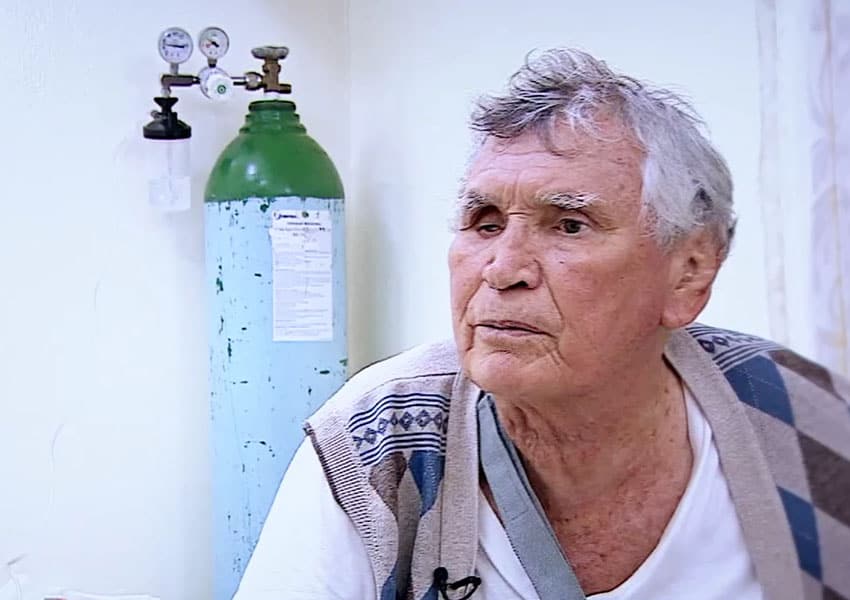
Ávila is a niece of Guadalajara Cartel founder Miguel Ángel Félix Gallardo, who had his own nickname: The Boss of Bosses. He’s seen here in an interview with Telemundo in 2021.
The company used García’s image without authorization in that campaign.
Ávila’s complaint asserted that “the use of [her] image” was not for an “informative or journalistic purpose” but for a “commercial” one. She and her lawyers say that Netflix and Telemundo have violated Mexican copyright laws as well as the Mexican constitution and international agreements.
“Nobody has the right to disseminate the image of a person, her anecdotes, life and essence without authorization,” Israel Razo, a lawyer for Ávila, said in a message sent to Milenio.
In an interview with Milenio Televisión, the lawyer asserted that his client has been defamed by the screening of La Reina del Sur because she has never been convicted of drug trafficking charges.
“It has a direct impact on her image … living with a drug trafficker moniker is very difficult,” Razo said.
Razo pointed out that Ávila has been acquitted of all drug trafficking charges against her. “Imagine going out to the street and having … [people] see you as a drug trafficker and separately having foreign companies exploiting that,” he said. “… What we want is to set a precedent [that] you can’t use people’s image carelessly,” Razo said.
The case could have broader ramifications given that numerous other accused and convicted narcos have been portrayed on screen, in many cases without any attempt to obscure their identity.
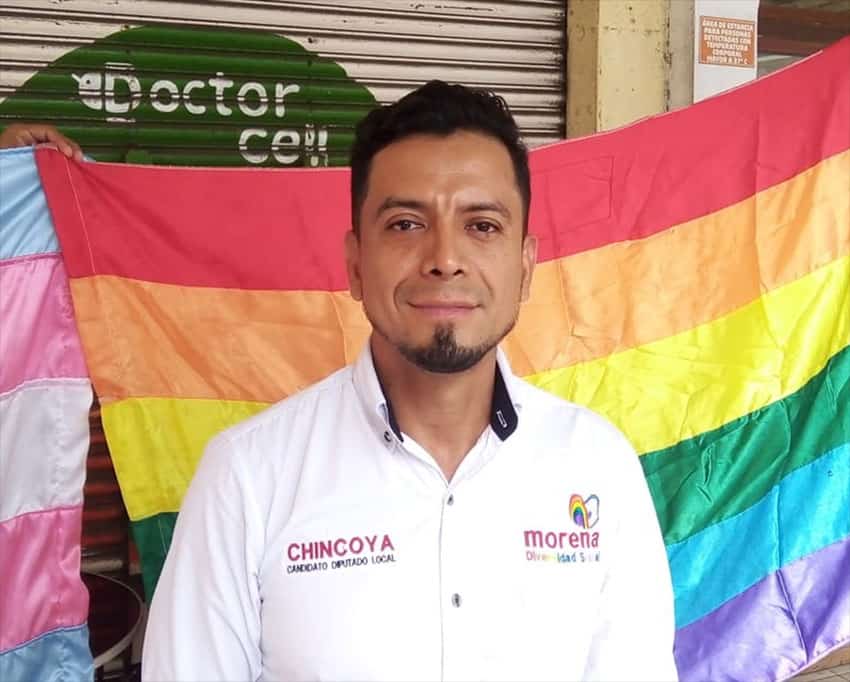
Students should be able to choose what kind of uniform they use based on how they self-identify, Durán says.
A Veracruz lawmaker who identifies as non-binary wants schools in the state to adopt a gender-neutral uniform policy.
Veracruz state Deputy Gonzalo Durán Chincoya said a gender-neutral uniform should be promoted in schools and that students should be able to dress in line with the free development of their personalities.
“Let’s get rid of this prejudice, this prototype, this binarism of man and woman. We are just simply people and as people todas, todos and todes have the right,” Durán said, using the feminine, masculine and non-gendered terms for “everyone.”
“It’s part of the free development of the personality. Schools should work on these issues to keep up with the times and respect identities, [personal] expressions and above all to contribute to the free development of the personality,” the lawmaker added.
Veracruz state Deputy Gonzalo Durán Chincoya.
Durán said the issue shouldn’t generate conflicts as they are rights stipulated in human rights law, calling on students to “Go as you self-identify.”
Durán cited the National Council to Prevent Discrimination (Conapred), which has recommended that schools allow students to choose the uniform and hairstyle that is most comfortable for them, whether that be pants or skirt, long hair or short hair. This month, a new Conapred recommendation also advised that students should be allowed to dye their hair, if they choose.
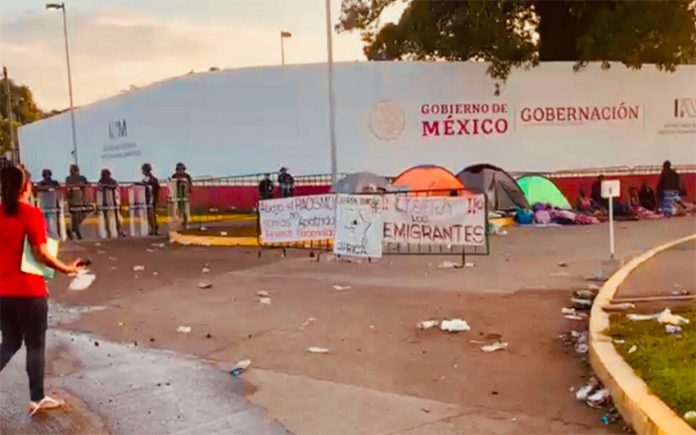
The Tapachula detention center where migrants are held without recourse to human rights protection.
Mexico News Daily writer Ben Wein reflects on his incarceration last October in a detention center in Chiapas where more than 100 “rescued” migrants are held, some for months on end, under extrajudicial detention.
There was no explaining my way out of it. Once the immigration authorities in Chiapas had demanded my passport, and I was unable to present it, my fate was sealed.
Ciudad Hidalgo, the small town on the Guatemala border, is where most undocumented migrants enter Mexico with their eyes on the United States. Immigration officials dot the road between the border and the nearby city of Tapachula, where I’d safely and regrettably stowed my passport in a hotel room.
Resistance seemed futile, and dangerous. Beside some inattentive immigration agents was a soldier with a very large gun. He looked perfectly well concentrated.
I protested but was promised I’d be taken to an immigration center simply to verify my details in a database. I readily accepted that premise, but truthfully I had another motive: as a journalist recently arrived to cover the migration crisis, I was intrigued to see where it would all lead.
Clarity came swiftly. I was loaded onto a bus by National Guardsmen with some 40 Haitian migrants and a few Central Americans. It was night when we arrived at the Siglo XXI detention center on the outskirts of Tapachula.
Once inside, it was belts and shoelaces off, and there was no way back. The bureaucrat registering my details had no interest in my tale of woe, nor did the half-dozen armed police in our vicinity. On paper, there was nothing to complain about: the bureaucrat helpfully reminded me that, according to the records, I’d been “rescued.”
It was a blessing in disguise. Tapachula is the heart of the American migration crisis, and the sinister Siglo XXI is its Sistine Chapel. In a place where no journalists are invited, there were some lessons that could only be learned from the inside.
1) Migrants are detained and held in Mexico at the threat of force. The government terms their detention as “rescue,” which is not only a misnomer but a lie. I spoke to many hundreds of migrants in Chiapas, and not one wanted the assistance of Mexican immigration authorities. They feared them. Everyone inside Siglo XXI was desperate to leave but not allowed to. They’d been locked up in large halls with more than 100 persons, guarded by armed police officers in watchtowers.
These prisoners weren’t only endangered by state officials but by other migrants, some of whom were members of Central American gangs. Many people inside were physically ill, and many others were suffering mentally. Hygiene was poor, sleep was scarce and the diet was short on vitamins. Mexico may be a risky place, but migrants sent to detention centers are guaranteed danger.
2) A murderer who has been arrested and imprisoned is in many ways better off than a detained migrant. Given that migrants have officially been rescued rather than arrested, they are not granted the rights awarded to criminal suspects. They have no access to legal representation, and there’s no promise of a phone call. Doubtless, the conditions in Mexican penitentiaries are squalid, but the same can be said for Siglo XXI.
Under extrajudicial detention, all possessions are confiscated, including cellphones and money. Migrants receive a mattress not unlike a gymnasium mat and some blankets and are told to find a place to sleep on a crammed floor. They wear the clothes they arrived in for the duration of their stay. Toilets don’t flush, and the stalls don’t have doors.
Ben Wein aboard the bus with migrants after his arrest in Chiapas.
A courtyard area is open during the day, based on the discretion of immigration officials. On my third day, we were forced outside while builders did some heavy construction work inside. I frequently asked immigration officials what the legal capacity of our confines was, but was ignored. Such information was unavailable and no one thought it their duty to answer questions.
Effectively, our rights depended on the whims of disinterested immigration agents. I once asked an immigration official if I could leave Siglo XXI, given that I hadn’t been arrested. “I don’t recommend it,” he replied, gesturing at an armed policeman.
No migrant should have been detained for more than 15 working days, but many had been inside for months. Venezuelans, Cubans and Indians seemed to be confined the longest.
3) The police officers in Siglo XXI wore the uniforms of a police unit that no longer exists. The Policía Federal (Federal Police) was absorbed into the National Guard in 2019, the new security force established by President López Obrador. Why officers from a defunct unit were working in a migrant detention center is a matter for speculation. Some officers worked with Central American gangsters, known as Maras — four boys from Honduras. The Maras tried to break up protests organized by prisoners and they were feared because they were known to work with the police. Many migrants said the police supplied the Maras with cigarettes and marijuana to sell inside.
4) Obedience was a bad strategy in Siglo XXI, but it was adopted by most of the people inside. Immigration authorities seemed too overwhelmed and disinterested to keep close track of who was under their protection, so if a migrant didn’t protest their case, they faced being forgotten.
One Venezuelan journalist, Joel Rondón, repeatedly held demonstrations and managed to attain regular meetings with the center’s ghost like director. Rondón managed to speed up the release of many of his friends. Low on patience after more than a month inside, he feigned an escape one day and was tackled to the ground by police officers who put him in confinement. The next day, he was released. It is unclear why he was released, but making trouble seemed to speed up the process. He is now awaiting an asylum hearing in New York.
My passport was eventually delivered to the detention center by the owner of the hotel I’d been staying at in Tapachula. I was told by officials that my entry stamp was insufficient evidence and that the document had to be “verified” in Mexico City. I spent long periods banging on the locked metal door directly opposite two police officers. I provoked the officers by shouting for an immigration official over and over until they lost their patience and searched for one. It was risky but effective, and getting lost in the system seemed such an awful prospect that it was worth pushing my luck.
Disobedience has also proved effective for migrants outside of detention centers: most of those who have joined migrant caravans, in defiance of Mexican law, have eventually been awarded year-long visas, providing them the right to travel to the U.S. border.
5) The majority of migrants inside Siglo XXI didn’t fit media caricatures. The news media tends to display them as impoverished or dangerous. Firstly, the population was incredibly diverse: while there were many Central Americans and Haitians, I also saw Indians, Ghanaians, Uzbeks, Senegalese people, Cubans, Venezuelans, a Peruvian and even a couple of confused Irish backpackers.
Poverty is only part of the story. Migrants from the Caribbean or from outside the Americas paid for an expensive flight, normally to reach South America. Many of the migrants in Siglo XXI were young, decently educated and pulled by the promise of opportunity.
However, Central Americans, who were a minority in Siglo XXI, did largely fit the profiles discussed on both ends of the political spectrum. Many were fleeing serious hardship and danger, their age range was huge and some were criminals. Most were chancers looking to improve their lives. For them the United States was a couple of bus rides away, and many had worked there before. Given their vicinity and relatively short detention period in Mexico, it seemed logical to take the risk to improve their earnings by some twentyfold.
6) If you’re detained, your embassy may not be of much use. After battling my way to a phone call, there was no answer at the British Embassy in Mexico City. Luckily, I’d been writing to my friend Paulina Martínez Núñez before I was detained. She thought to contact the embassy separately and Vice Consul Andrew Castle was put on the case, apparently from Costa Rica. But the embassy’s assistance was miserly: “Despite numerous calls and emails to the detention center, we received no response,” Castle later wrote to me in an email.
Instead, I owed my release to Martínez. She ingeniously got the head of the National Immigration Institute (INM) in Chiapas on the phone. I was released soon after that call, which had been beyond the capabilities of embassy staff but was possible for a Mexican with the cultural know-how.
7) It wasn’t all bad. Being inside a detention center had its fun side. Sometimes it felt like being back in school, goofing around and playing tricks on the police and immigration officials. There wasn’t much anger at those officials: the migrants and staff were players in a cat-and-mouse game arranged by people in high positions, far from view. The officials were doing their jobs — poorly — and earning their salaries. With a dearth of activities on offer, chitchat was the best entertainment available.
I spoke to migrants from five continents, and everyone had a tale to tell. There was strong rapport between migrants, and unlikely cultural exchanges: Venezuelans bonded with citizens of Burkina Faso. Even the Maras were decent conversationalists.
For people who are down on their luck, the migrants were incredibly trustworthy. Once I had my passport but still couldn’t leave, the document became an object of fascination for the migrants. For them, a passport is everything, and a British passport had the glamour of a Ferrari. Short on entertainment, everyone wanted a look. Naturally, I felt protective of the small but invaluable document. However, the requests kept coming, and I started handing it out.
To their credit, the passport repeatedly disappeared from my view to some other part of the detention center but would invariably return after about 10 minutes, in perfect condition.
Dead fish blanket cover part of the surface of the México lagoon in Mexicali on Friday.
Thousands of fish turned up dead in a lake in a Baja California border city last week and authorities said it could be due to a natural phenomenon provoked by scorching temperatures.
Biblical in appearance, a white sheet of fish carcasses covered the surface of the México lagoon in Mexicali, as seen in a video posted to social media on Friday.
In the video, a blanket of motionless fish are seen across the lake, stretching for hundreds of meters. The fish species have been confirmed as Mayan sardine, gizzard shad, black bass, European common carp and African tilapia.
Temperatures of 45 C (113 F) are thought to have lowered water levels, provoking a reduction in the lake’s oxygenation, leaving the fish vulnerable, the news site Excelsior reported. However, the head of a process control laboratory for the State Comission of Public Services in Mexicali (CESPM), Abraham Castro, said that rain was the causative factor, which he said had disturbed sediments at the bottom of the lake.
Mexicali Mayor Norma Bustamante denied that the deaths had been caused by waste dumping in the lake.
Mexicali’s head of wastewater for the CESPM, Benjamin Carrillo, said the phenomenon occurs twice a year, in August and again in March or April and that it can be sparked by cloudy conditions, causing the lake’s oxygen levels to dive.
National Water Commission (Conagua) personnel collected the bodies of the fish for further analysis.
Vehicle fires and caltrops created traffic blockades on Federal Highway 45. Twitter
At least two major universities, along with an unknown number of schools for younger people, canceled in-person classes in Zacatecas on Monday due to an outbreak of violence around the state.
Army troops from nearby Jalisco have joined the National Guard in patrolling areas that have been affected by roadblocks, shootings and vehicle fires allegedly perpetrated by cartel members in the region. The municipalities most affected have been Fresnillo, Zacatecas city, Jerez and Valparaíso — all within about 100 kilometers of one another.
Among the institutions that called off classes were the Autonomous University of Zacatecas, the National Polytechnic Institute and the Academic Mineral Institute. Primary, junior high and high schools in Valparaíso and Fresnillo also told their students to stay home.
Fresnillo has been plagued since Friday by shootings, roadblocks and at least one house fire. As of Monday, at least one man was reported murdered.
A semi-trailer was set ablaze as part of a blockade in Zacatecas city.
“In order to safeguard the security and integrity of the university community, particularly students … face-to-face academic activities will be suspended this Monday, August 29,” explained UNAM Zacatecas officials, adding that classes would take place virtually. At most of the schools, Monday was to be the first day of classes.
Additionally, 350 medical interns were told to not show up for work Monday by order of the IMSS, the Zacatecas Health Secretariat and UNAM Zacatecas, according to a tweet from journalist Paco Elizondo.
Saúl Monreal, the mayor of Fresnillo and the brother of Zacatecas Governor David Monreal Ávila, urged state and federal authorities to take action against the dispute-fueled violence that is turning the population into “hostages.” Fresnillo was reportedly the municipality most affected by the violence.
On Saturday, there were reports of at least eight blockades with burning vehicles. The violence continued over the weekend and into Monday. On Sunday evening, a spokesperson for the State Peacebuilding Board reported a trailer truck with its cabin on fire in the municipality of Zacatecas. There have also been reports of armed clashes, allegedly involving cartel members. The violence is suspected to be in response to the “alleged arrest of a priority objective,” according to Elizondo.
On Saturday afternoon, Zacatecas Minister of Public Security Gen. Adolfo Marín Marín posted a video to social networks stating that security had been reinforced throughout the region, some 90 arrests had been made and that “everything was under control,” as reported by Infobae.
The news website also reported that citizens were posting on social media networks about armed clashes, though that information was not confirmed. Infobae wrote that the clashes might have been “between members of the Sinaloa Cartel (CDS) and members of the Jalisco Nueva Generación Cartel (CJNG).”
As of Monday morning, Governor Monreal had not issued any statements about the violence.
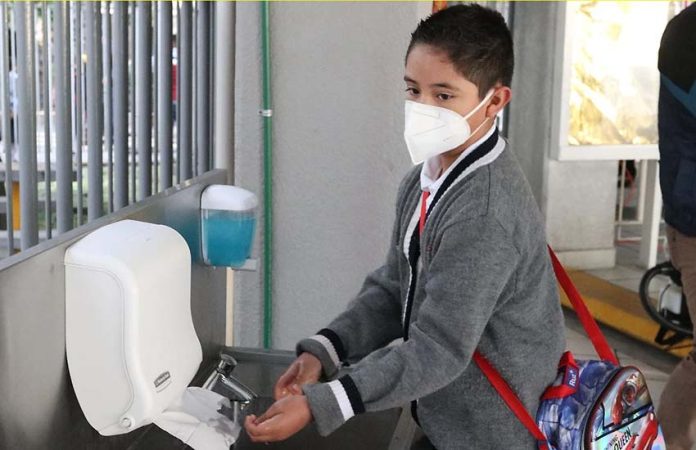
Just under 24.5 million students begin the new school year in preschools, primary schools and middle schools across Mexico Monday. SEP
After 2 1/2 years of interruptions due to the COVID pandemic, more than 24 million students return to the classroom Monday to begin the 2022–23 academic year.
Just under 24.5 million students will begin the new school year in preschools, primary schools and middle schools across Mexico, according to the Ministry of Public Education (SEP). Over 5.2 million high school students returned to the classroom after summer vacation on August 15.
Basic education students — those from preschool to middle school — will take classes given by some 1.2 million teachers in almost 233,000 schools, according to SEP.
In a statement published Sunday, the Education Ministry urged students to return to in-person classes, stressing that “the necessary conditions” to do so are in place.
Leticia Ramírez becomes Mexico’s new education minister Thursday. She inherits a plan for implementing major curriculum changes from her predecessor, Delfina Gómez. Presidencia
It noted that health authorities are recommending a range of measures to ensure that in-person learning can resume safely amid the ongoing COVID pandemic. Among the recommendations are the use of face masks in enclosed spaces, the frequent washing of hands, and the carrying out of activities in the open air where possible.
Health authorities also advocated vaccination against COVID for both teachers and students. Teachers were among the first people in Mexico offered shots, but the federal government only extended its vaccination program to younger children this year.
Also notable is the fact that Mexico’s schools will have a new Education Minister this week: Delfina Gómez, who shepherded the new curriculum into being, is leaving the position Thursday to become a candidate for the governor of México state in 2023. Her successor, Leticia Ramírez Amaya, who has a degree in education and worked as a primary school teacher, most recently served as the director of citizen attention for the federal government.
The return to school comes as Mexicans face an inflation rate that reached 8.62% in the first half of August, the highest level in over two decades. Prices for school supplies such as pens, pencils and notebooks have increased even more, according to a vendor in the historic center of Mexico City.
“Products here have been affected by [a] 25–30% [price rise], but we try to give [customers] a good price so that they can buy everything they need,” Diego Tejada told CNN.
The ruling Morena party offered students and their families one way to save on school supplies: in a Twitter post on Sunday, it included six printable — and propagandistic — notebook labels with lines for students to write in their name, grade, subject and teacher. Each features an image of President López Obrador, Morena’s founder.