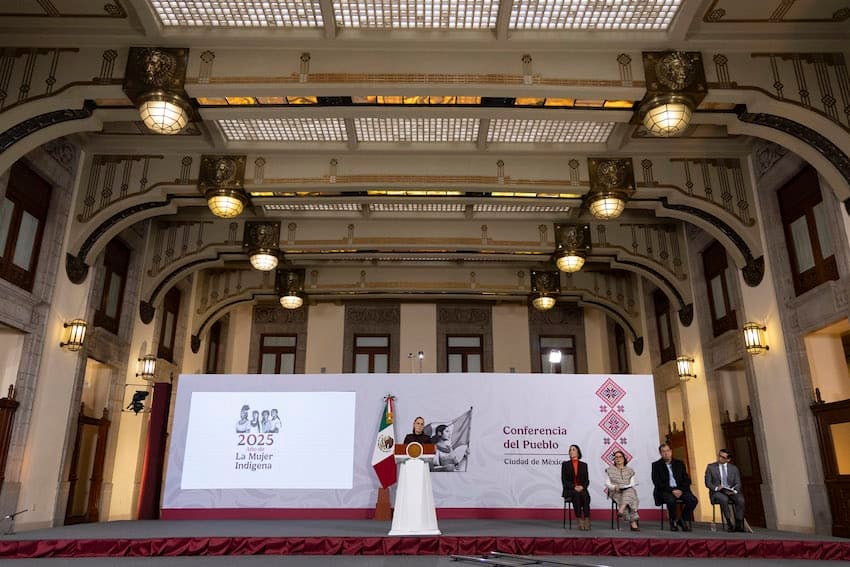
At the very start of her Wednesday morning press conference, President Claudia Sheinbaum reiterated Mexico’s opposition to foreign interventions and interference as the United States ramps up its aggressive posture against Venezuela. (Click here to read Mexico News Daily’s story.)
Later in the mañanera, Sheinbaum responded to questions about the Mexico-U.S. security meeting that took place in Mexico City last week.
She also spoke about Mexico’s energy needs after Energy Minister Luz Elena González announced that the construction of 20 renewable energy projects has been approved.
Criminal groups’ use of drones a focus of Mexico-US security meeting
Asked about the Mexico-United States security meeting that took place in the Mexican capital last Thursday, Sheinbaum said that the use of drones by organized crime groups was an issue of particular interest to U.S. government representatives.
“So this issue was discussed, among many other issues,” she said.
Mexican crime groups have been using drones for years, including to launch attacks on rivals and security forces.
Cartel drone attacks force residents to flee El Chapo’s hometown in Sinaloa

Earlier this year, Steven Willoughby, a senior official in the U.S. Department of Homeland Security, said that “nearly every day, transnational criminal organizations use drones to convey illicit narcotics and contraband across U.S. borders and to conduct hostile surveillance of law enforcement.”
He also said that “it’s only a matter of time” before Mexican criminal organizations carry out drone attacks against U.S. citizens and law enforcement authorities.
Mexico’s Ministry of Foreign Affairs (SRE) said in a statement on Tuesday that Mexican and U.S. officials, including acting Mexican Foreign Minister Roberto Velasco and U.S. Ambassador to Mexico Ron Johnson, “analyzed emerging challenges to global security” at last Thursday’s meeting, “particularly the use of unmanned aerial systems by criminal organizations.”
The SRE said there was also an “emphasis on arms trafficking” at the “second meeting of the Security Implementation Group [SIG] between Mexico and the United States.”
“… Both governments agreed to deepen and accelerate information sharing on arms trafficking and continue with weapons and ammunition seizures. They also agreed to give continuity to their cooperation on extraditions and strengthen investigations related to fuel theft, with the goal of maximizing the impact of coordinated actions ahead of the next SIG meeting, scheduled for January 2026,” the ministry said.
Sheinbaum said that U.S. President Donald Trump’s designation of fentanyl as a weapon of mass destruction wasn’t broached at the meeting, as the designation hadn’t been made when it took place.
Sheinbaum responds to State Department’s comment about the ‘linking’ of Mexican and US ‘analytical platforms’
In its own statement about the bilateral security meeting that took place on Dec. 11, the U.S. Department of State said that “both nations committed to enhancing intelligence sharing and linking analytical platforms to pre-empt and respond to drone attacks at the border.”
According to the public safety technology company SoundThinking, the use of “technology with advanced analytics can provide critical insights into border security while helping law enforcement agencies proactively address security challenges.”
“Agencies can leverage AI and machine learning in near real-time for data analysis to optimize patrol strategies, identify high-risk areas and emerging threats, and allocate resources more efficiently,” the company says on its website.
Asked about the linking of Mexican and U.S. “intelligence platforms,” Sheinbaum said the interconnection wouldn’t be permanent.
“It’s an exchange of information,” she said. “It’s not that they’re going to have platforms here in Mexico.”
#Mañanera @Claudiashein aclaró que no habrá plataformas de inteligencia permanentes de EU en México y que se trata de intercambio de información bajo convenios y protocolos, como ha ocurrido en administraciones previas.https://t.co/ti8sAhL2nI
📹Especial pic.twitter.com/5sBXIRBigt— REFORMA (@Reforma) December 17, 2025
Sheinbaum subsequently noted that Mexico can request — and has requested — to borrow or purchase security equipment from the U.S. government that the Mexican government doesn’t have itself.
In such cases, there is a “formal agreement” between the two countries and “formal protocols” that have to be followed, she said.
During his visit to Mexico in September, U.S. Secretary of State Marco Rubio said “there are opportunities to cooperate on equipment,” explaining that Mexico may have an interest in purchasing some U.S. equipment and vice versa.
‘Energy is needed for the development of the country’
Energy Minister González announced that private companies will invest US $4.75 billion in 15 solar energy projects and five wind projects that will be located across 11 states.
She said that construction will commence “immediately” because land for the projects has been secured and permits have been issued.
Once completed, the projects “will inject an additional capacity of 3,320 megawatts of generation,” González said.
Later in the press conference, Sheinbaum said that “energy is needed for the development of the country.”
“… Development requires electrical energy. It also requires other types of energy, like gas, for example, but it mainly needs electricity,” she said.
“… So we’re guaranteeing sufficient electrical energy for the development of the country. And Plan México needs energy. If we want to produce more in Mexico, we need more energy. So this [investment] scheme allows us to guarantee that there is energy,” Sheinbaum said.
By Mexico News Daily chief staff writer Peter Davies (peter.davies@mexiconewsdaily.com)