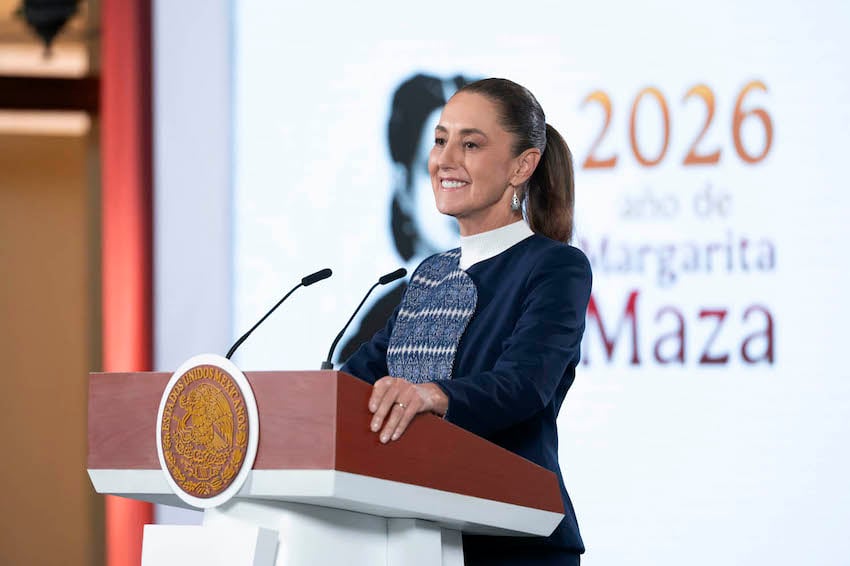
At her Wednesday morning press conference, President Claudia Sheinbaum commented on the latest data on exports and gave reporters an insight into the federal government’s daily security meetings.
She also noted that Economy Minister Marcelo Ebrard was in Washington D.C. for meetings with U.S. officials.
Here is a recap of the president’s Jan. 28 mañanera.
Sheinbaum celebrates record exports and US $2.4B trade surplus
Sheinbaum acknowledged that the value of Mexico’s exports in 2025 reached a record high — US $664.8 billion, according to preliminary data from the national statistics agency INEGI.
She also noted that Mexico recorded a trade surplus in 2025, the first in five years.
Mexico’s 2025 exports hit record high, creating first trade surplus in 4 years

“We exported more than we imported, which is always good for the economy,” Sheinbaum said.
She noted that auto sector exports declined last year, but asserted that it was more to do with a reduction of demand in the United States than the tariffs U.S. President Donald Trump imposed on vehicles made in Mexico.
Sheinbaum highlighted that exports from certain other sectors, including electronics, increased “significantly.”
“This has to do not only with the trade agreement [the USMCA], but also with Mexico’s competitive advantages over other countries, including its proximity [to the United States],” she said.
INEGI’s data shows that the value of manufacturing exports increased 9.8% last year.
Excluding the auto sector, whose exports declined 4.2%, the manufacturing sector’s export revenue increased 17.3%.
Inside the government’s daily security meetings
Sheinbaum told reporters that her government’s security meetings take place every weekday from 6 a.m. to 7.20 a.m., after which the president faces the press for her mañanera.
Detalla la presidenta Claudia Sheinbaum cómo son las reuniones de su Gabinete de Seguridad de lunes a viernes. pic.twitter.com/1gWUCIeTs6
— JorgeArmandoRocha (@JorgeArmandoR_) January 28, 2026
She said the meetings begin with a report from Security Minister Omar García Harfuch, who speaks about the “most important” happenings and arrests that occurred the previous day as well as “any special cases.”
Among the other attendees are the heads of the Army, the Navy and the National Guard, and the federal interior minister.
After the update from García Harfuch, Sheinbaum said that she and her security cabinet colleagues look at a crime data “dashboard,” which shows statistics for the whole country as well as by state and municipality.
Based on the data, “we take some decisions,” the president said.
“And then a particular issue is discussed. For example, when the mayor of Mexico City comes, we consider issues in Mexico City,” she said, adding that when she and her colleagues are outside the capital, the security meetings focus on security issues in the state where they are located.
Sheinbaum also said that the new federal Attorney General, Ernestina Godoy, comes to the security meetings once a week to discuss “issues of coordination” between the federal government and the Federal Attorney General’s Office.
“That’s what the security meetings are all about,” she said before recalling that Interior Minister Rosa Icela Rodríguez also gives a daily report on problems “related to governability” in Mexico, which also includes information on upcoming protests and other “specific issues.”
Ebrard in Washington
Sheinbaum briefly noted that Marcelo Ebrard was in Washington D.C., where on Wednesday he met with U.S. Trade Representative Jamieson Greer and Secretary of Commerce Howard Lutnick.
After the meeting between Ebrard and Greer, the Office of the United States Trade Representative said in a statement that “both sides recognized substantial progress in recent months” in discussions on trade relations and the upcoming USMCA review, and “agreed to continue intensive engagement to address non-tariff barriers.”
“In addition, they agreed to begin formal discussions on possible structural and strategic reforms in the context of the first USMCA Joint Review, including stronger rules of origin for key industrial goods, enhanced collaboration on critical minerals, and increased external trade policy alignment to defend workers and producers in the United States and Mexico and to combat the relentless dumping of manufactured goods in our region.”
The meeting between Ebrard and Greer came two weeks after Trump asserted that the USMCA provides “no real advantage” to the United States and is “irrelevant” to him.
“I think they want … [the USMCA], I don’t really care about it,” said Trump, who claimed that the United States doesn’t need goods from Mexico or Canada.
In October, Greer accused Mexico of failing to comply with the USMCA in a range of areas.
In a video message posted to social media on Wednesday afternoon, Ebrard said he had a “very good” conversation with Greer’s “team.”
“We spoke about … the next steps for the free trade agreement between our countries,” he said.
“As you know, it has to be reviewed this year. We’ve already made progress on many issues so that the review is carried out as quickly as possible and goes as well as possible,” Ebrard said.
He said that he spoke about tariffs with Greer, about “how the auto industry is evolving,” and about other issues related to trade between Mexico and the United States.
Ebrard also said they spoke about “critical minerals and the security of supply chains.”
The Trump administration has imposed tariffs on a range of imports from Mexico including steel, aluminum and light and heavy vehicles, significantly undermining the USMCA.
Later on Wednesday, Ebrard said on social media that he spoke to Lutnick about “trade and investment between both countries.”
He said his meeting with the commerce secretary was “positive and cordial,” and declared that “the year is starting off well in that field.”
By Mexico News Daily chief staff writer Peter Davies (peter.davies@mexiconewsdaily.com)