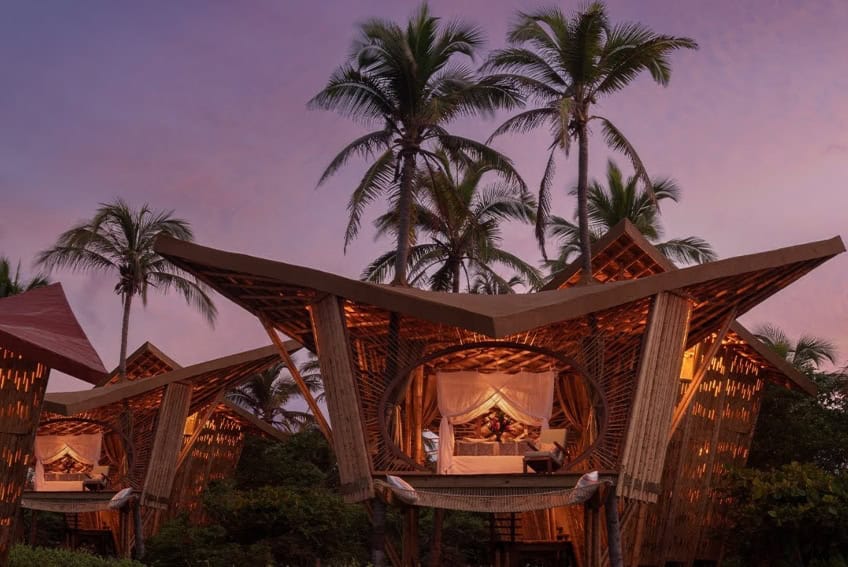
If you scroll Tasman’s Instagram, you’ll come across a reel of an owl. Her name is Catalina, and she’s AMINA Wind Hotel’s unintentional mascot. One day, she showed up and built a nest on the windowsill of one of the guest rooms — and never left. Now she’s something of a celebrity and is helping to entice bookings from curious guests.
It’s the dream, isn’t it? Open a beachfront hotel on an untouched coastline, where your only neighbors are humpback whales or great egrets. But the reality behind opening a hotel in a landscape like this isn’t necessarily what social media suggests.
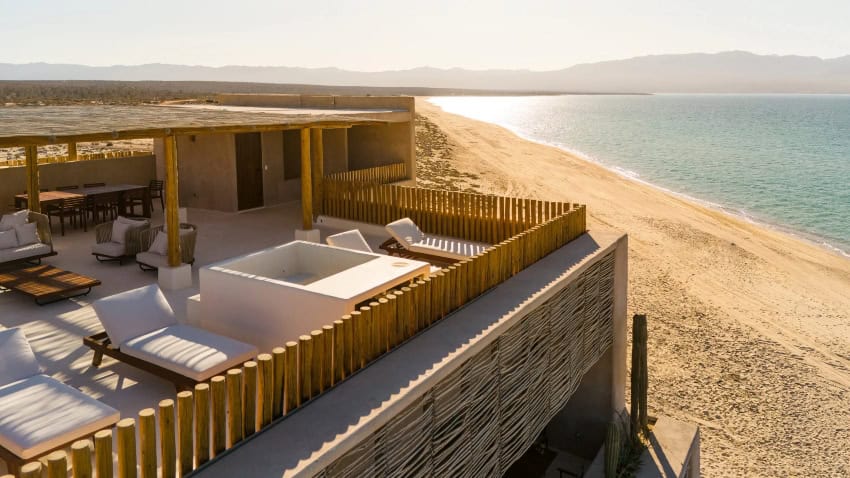
Between Jaco Luchtan, co-founder and hospitality director of Tasman, operating off-grid properties in remote coastal Mexico, and David Leventhal, founder of Playa Viva, a regenerative resort in Guerrero that’s been operating for 17 years, the duo have navigated financial collapses, solar systems that failed in the heat and weeks without basic amenities. From storms to Christmas parties, they’ve had their share of surprises, some so frustrating they’ve stopped to wonder why in the world they’re doing this.
But then, Catalina’s babies crack out of their shells. An international fuel crisis surges while your monthly expenses remain unaffected. People start changing their habits, swapping what’s easy for what’s eco-friendly. “There are times when you say, ‘ Is it worth it?’ But then you see the impact,” notes Luchtan.
The off-grid hotel business is a journey. A journey that requires tenacity and passion, plus a thick skin. If that sounds like an adventure you’re itching for, here’s what two experts want you to know before you start.
Why developers avoid these places (and why these two didn’t)
First, the question every outsider asks: Is it safe?
Guerrero, where Playa Viva operates, is currently rated Level 4 (“Do Not Travel”) by the U.S. State Department. Baja California Sur and Oaxaca, where Tasman runs properties, sit at Level 2. The ratings make potential tourists skeptical, particularly in Mexico. But remote coastal land at Level 4 is often untouched precisely because it’s been left alone.

Leventhal’s property in Guerrero sits on pre-colonial agricultural terraces, surrounded by mangrove and intact coastal forest. Before breaking ground, his team spent a year cataloguing species and planting trees. “The form of the project came out of that process,” he says. “We did a proper history of the place — what was here, how did it become degraded, what’s our role in restoring it.”
The land, the history and the communities that haven’t been priced out of their own coastline are what bring operators like these two to places most developers avoid. Avoid, because it’s far from easy to develop here.
Before you open, you have to build everything else first
Water, power and waste management aren’t utilities you really need to think much about when running a city hotel. Out here, they’re often projects for you to figure out on your own.
One of Tasman’s properties had no access to water — the pipes didn’t exist. Water had to be trucked in, pipes built from scratch and permits filed for both, a process often quite painstaking in Mexico. To top it off, local garbage collection ran the property around 2,000 pesos per truck visit, a far cry from urban collection costs. For reference, Mexico City and Mérida’s municipal collection is heavily subsidized and barely registers as a line item.
Above all, power is by far the biggest variable. Playa Viva runs entirely off solar, but getting to that point took three installations. A storm in Oaxaca caused several trees to collapse, taking out local power lines. “It’s key to build a good relationship and collaborate with local authorities. This ensures an uninterrupted guest experience,” says Luchtan. That relationship came in handy when clearing the branches. Without it, they’d have been waiting weeks — instead, the group and the government worked together for a faster result.
Then there’s the regulatory layer. Any tourism project that uses Mexico’s federal beachfront strip (Zofemat) or alters coastal ecosystems falls under federal jurisdiction for concessions and environmental permits through Semarnat, and the rules aren’t always totally clear. In the early days of construction, Leventhal’s lawyer mentioned, almost in passing, that you can’t build on dunes. His property was dune-front. “The next day, we go back to the lawyer’s office and he says, ‘Oh, that wasn’t a law. That was a proposed law.'”
When you run out of toilet paper in the middle of nowhere
When something breaks or runs out at a remote property, there’s no quick fix. No same-day delivery, no hardware store down the road. “When you need a plumber,” says Luchtan, “there might be one or two in the whole town.” Whether they pick up the phone is another matter.
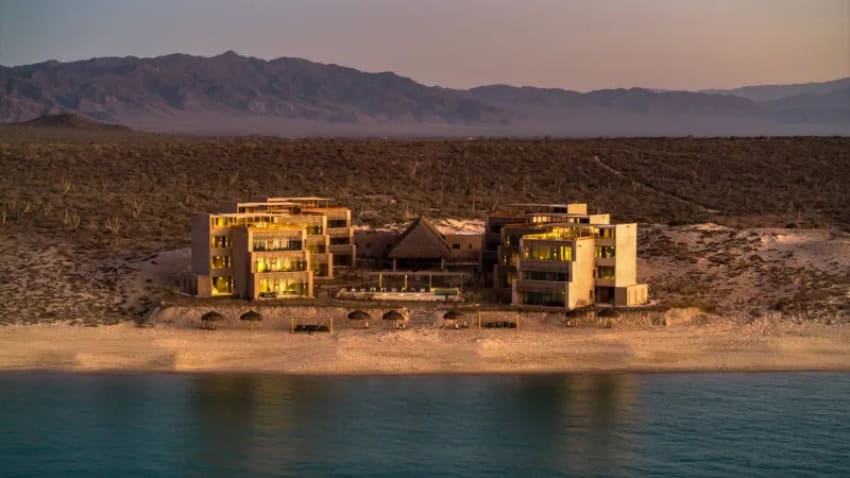
Tasman learned that lesson in the bathroom, so to speak. Its properties use biodigesters: on-site systems that process waste through a delicate bacterial balance that regular toilet paper disrupts. When their supply of biodegradable paper got stuck in international customs, they were forced to use whatever was on hand — not a good solution for the system or the guests.
Leventhal’s supply chain education was more gradual. Seventeen years ago, certified organic bath products in plastic-free packaging simply didn’t exist in Mexico. For some time, he sourced from a U.S. supplier and carried shampoo in his luggage on every trip down.
The bigger wake-up came at a Christmas party for village kids. A piñata exploded plastic-wrapped candy across the property, and debris turned up for days. “This doesn’t work. We can’t do this,” he told his team. That conversation became a grueling department-by-department audit. Today, staff bring labeled Tupperware to the butcher in town — no plastic bags, just filled containers. The hotel has since switched to plastic-free shampoo bars after a guest whose company manufactured them happened to stay.
In short, procurement is less a supply chain problem and more of a design flaw; one that’s usually solved on the spot.
The real price tag of an off-grid hotel in Mexico
Guests often arrive expecting a discount. Remote, off-grid and back-to-basics — surely that means cheaper? It doesn’t.
“Many times they get to know (the costs) only once they book,” says Luchtan. “When they leave the place, they understand.”

Leventhal has long stopped thinking about his business in terms of quarterly profit. His solar system tells the story: three installations, unit costs dropping each time and now an energy infrastructure whose operating costs don’t move with fuel prices. Meanwhile, a conventional hotel’s energy bill climbs indefinitely.
As the owner, costs aren’t always yours to pay. “Think of Coca-Cola,” Leventhal says. “They save money using plastic bottles, but the cost of collecting that plastic, the environmental damage and the damage to human bodies from microplastics — those get dumped on everyone else. A regenerative business tries not to do that.”
The market is catching up to that logic. Mexico’s ecotourism sector — the broadest category that captures what both operators are building — was estimated at around US $3.3 billion in 2024, with projections pointing sharply upward.
Am I crazy to do this? Financial collapse, swine flu and a failed solar system
Leventhal launched Playa Viva into what he calls “a perfect storm”: the 2008 global financial collapse, a swine flu outbreak that cut foreign tourism to Mexico by roughly 55–60% in a single quarter and a simultaneous federal crackdown on cartels. Hotel occupancy in coastal destinations collapsed. He pivoted the model homes he’d already built into a boutique hotel and kept going. “You don’t know what you don’t know, so you stay flexible.”
When COVID hit, he was ready. Rather than contract, he pre-built capacity to expand from 12 to 19 rooms, betting on a travel surge on the other side. The bet paid off. Mexico received 45 million international tourists in 2024, up 7.4% from 2023 — the strongest numbers since before the pandemic.
Tasman’s solar system failed because the installer hadn’t accounted for battery behavior in extreme heat — discovered in the field, with guests on the property. Energy costs skyrocketed and remained high for months. Instead of giving up, the group made clear communication a company policy. “Don’t cover it up,” says Luchtan. “Transparency.” From there, the solution arises.
The ultimate question: Is it worth it?
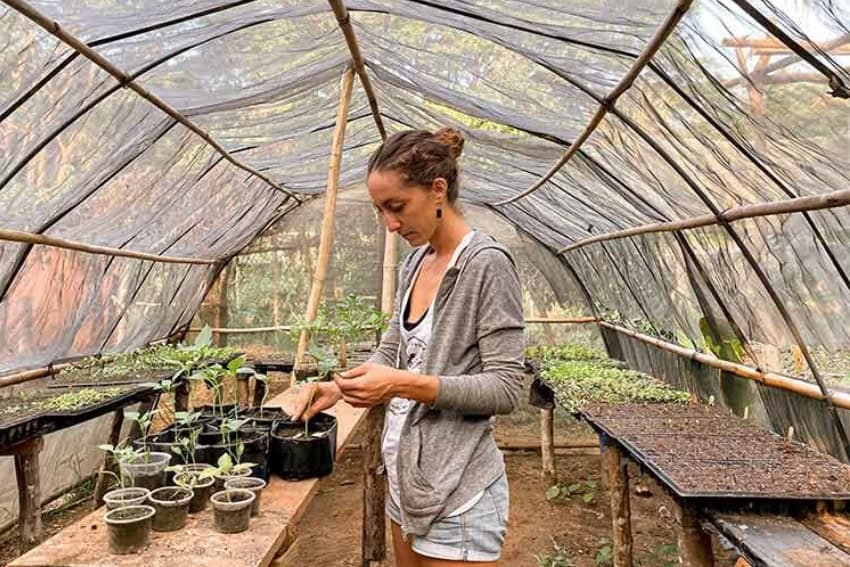
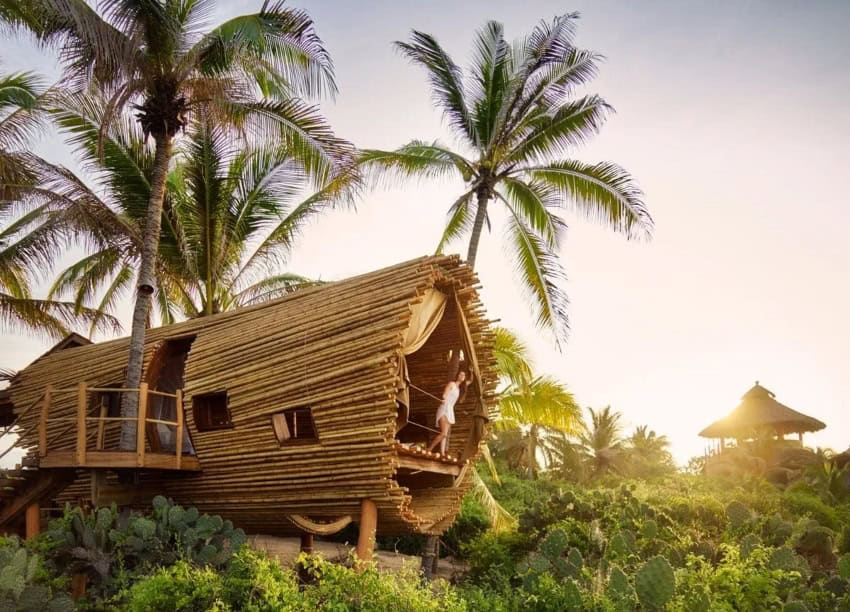
Almost two decades later, Leventhal still lights up talking about Playa Viva’s growth: beyond the treehouses, it’s home to a 20-acre permaculture farm and works with Resimar, a community-based watershed restoration project working to regenerate the land and waterways surrounding the property. The project came out of the land, he says. The land picked them.
Luchtan is coaching his current general manager through a five-year career plan. The purpose was, initially, to fill a role; now, it’s to expand local youth’s horizons. “We want to open the horizons of maybe 20 or 30 people who work in the hotel and grow to be rich with them.”
Neither makes this sound easy. Yet both are still doing it.
Did Catalina the owl read Tasman’s company motto? No. Do the humpback whales off La Ventana care about solar installation costs? Not at all. But they show up anyway, on a coastline that exists because someone decided it was worth protecting — and worth the fight to keep it that way.
“The goal is to build richer soil — literally and metaphorically,” says Leventhal. It appears that’s exactly what he’s done.
Bethany Platanella is a travel planner and lifestyle writer based in Mexico City. She lives for the dopamine hit that comes directly after booking a plane ticket, exploring local markets, practicing yoga and munching on fresh tortillas. Sign up to receive her Sunday Love Letters to your inbox, peruse her blog or follow her on Instagram.