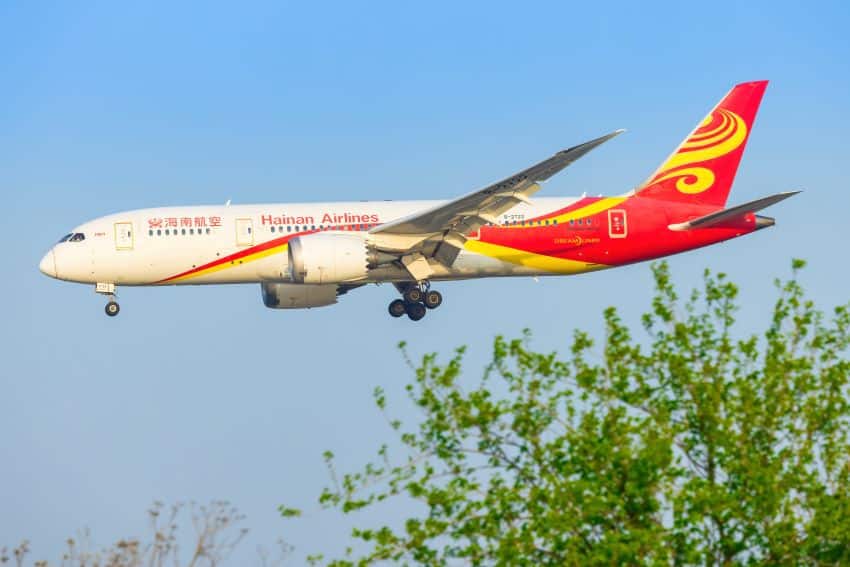
Mexican budget airline Volaris is teaming up with China’s Hainan Airlines to significantly expand air connectivity between the two counties.
The two airlines announced a strategic alliance on Tuesday which will use the international airports in Tijuana and Mexico City as hubs.

The agreement partners a full-service carrier, Hainan, with an ultra low-cost carrier (ULCC). Such partnerships are not common practice in the industry and typically rely on code-sharing, allowing the ULCC to use the full-service carrier’s brand and network to reach new markets.
Hainan offers more than 1,700 routes with destinations in Asia, Europe, North America, Oceania and Africa. Last year, the Chinese carrier began operating twice-weekly flights to Mexico, one to Mexico City and the other to Tijuana.
The Volaris-Hainan alliance will feature a codeshare agreement, making all flights available through Hainan’s sales channels.
Though still awaiting regulatory approval, the partnership is set to commence in the second half of 2025. It remains to be seen if loyalty integration and premium services will cross over.

Once implemented, the plan will allow Hainan customers to access Volaris’ domestic network — comprising more than 50 destinations — without being required to make multiple reservations, streamlining the travel experience.

This integrated booking system is designed to streamline the travel experience from Asia to Mexico’s interior, allowing for a single reservation covering both segments.
In a press release, Volaris CEO Enrique Beltranen described the agreement as significant, saying the partnership strengthens Volaris’ commitment to providing accessible connectivity.
“We are proud to announce this alliance with Hainan Airlines, a highly prestigious international airline,” he said. “Its strong presence in China opens a wide range of opportunities for tourism and business between Asia and Mexico.”
The alliance represents a significant milestone for Volaris, establishing its first partnership with a Chinese carrier.
Travel Update magazine said the agreement could potentially lead to a reciprocal arrangement, which would offer Mexican travelers enhanced access to international destinations via Hainan’s expansive network.
Volaris’ existing codeshare agreements with Frontier Airlines and Iberia Líneas Aéreas appears to be part of a strategy to broaden the Mexican airlines’ international reach, potentially paving the way for further collaborations.
The agreement boosts Mexico’s international connectivity and, according to Aviación al Día magazine, reinforces Volaris’ position as Mexico’s leading airline in passenger numbers.
Volaris rival Aeroméxico has partnerships with China Southern and China Eastern.
With reports from El Economista, Expansión, Aviación al Día and Travel Update