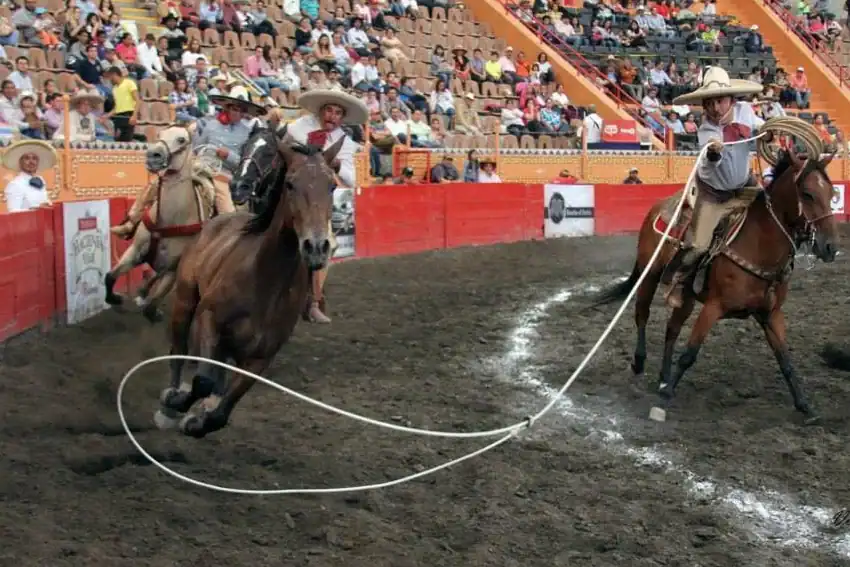
Amigos, this weekend I went back to the saddle. After decades without riding, taking the reins again felt less like a hobby and more like going home. Within charro circles, there’s a phrase we like to repeat: “A charro isn’t made, but born.”
More than riding, I missed the people and the culture around charrería. Charros tend to have a very particular temperament: forward-moving, blunt and generous, with the kind of steel nerves you need if you’re going to be a good horseman. They also come with a certain bon vivant streak; they know their horses, their tequila and sobremesa.
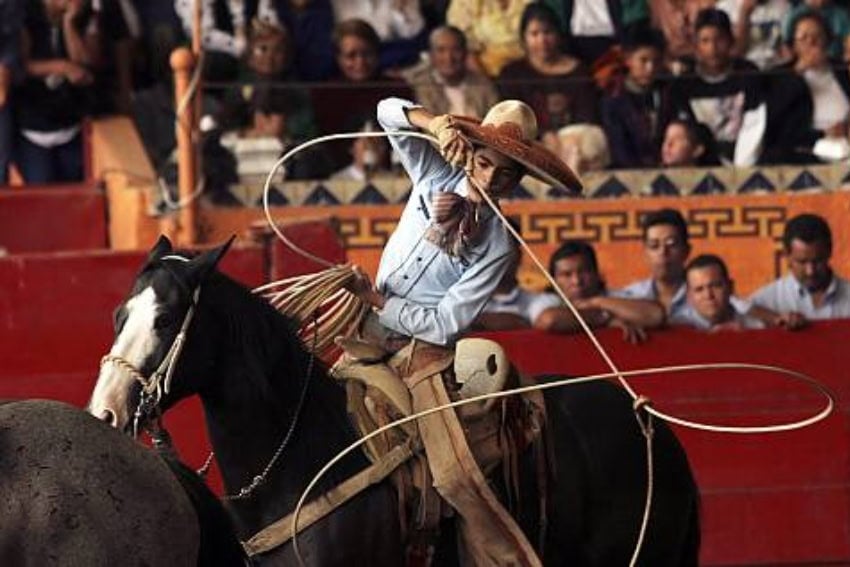
Today, as a historian and former charra, I find it intriguing how charrería has been closely tied to Mexico’s elite and become an emblem of our identity. Since the viceregal period, it has been a pastime of ranch owners, generals, power brokers and businessmen who could afford to spend serious money and time on horses. Even today, you need resources to practice charrería. And even if no one admits it openly, charros still tend to quietly quiz newcomers: What family are you from, who taught you, which lienzo do you ride at? Just to prove you really were born into the charro world.
From cattlemen to charros
Charrería emerged with the introduction of cattle and horses into what is now Mexico in the mid-1500s, and with the daily work of managing the haciendas and ranches that Spanish families carved out of the newly conquered territory. Much of the ranching economy is concentrated in a region known as Nueva Galicia, roughly corresponding to today’s Jalisco, Nayarit, Aguascalientes and Zacatecas.
In the early colonial years, however, Indigenous people, mestizos and even creoles were forbidden to ride. The ban didn’t last. Within a few decades, it became clear that Spanish landowners found it beneath them to do the hard work of tending their own cattle, and the law quietly yielded to economic reality. Yet, those landscapes demanded highly skilled horsemen who could control herds across vast, open stretches of land.
So who handled the herds?
Here, it’s worth pausing to acknowledge the horsemen from Salamanca, in Spain. They had already adopted elements of Mozarabic riding styles, and the few historians who study charrería seriously argue that Mexico inherited from them not only the word “charro,” but also the basic saddle design, the one-handed rein, characteristic clothing and even the broad-brimmed hat.
In other words, Mexican charrería is the local expression of a much longer equestrian tradition that can be traced back — through Spain — to Arab riders. Mexico did not import a fully formed “charro” from Europe; it reworked this Iberian, Hispano-Arab way of riding in the very specific context of New Spain’s haciendas and Indigenous labor.

Over time, the “charros of the new world” changed the repertoire by turning the reata (or rope) into a central tool. Roping cattle had been a practical necessity; gradually, charros began to show off with it, adding personal style and spinning tricks before throwing the loop.
That is why so many of today’s charreada events carry the names of specific ranch tasks. What looks like a stylized performance in the lienzo is essentially a carefully choreographed memory of everyday work: stopping a horse on a dime, roping a steer by the head, flipping it and holding it down.
How did those working horsemen end up as a national symbol?
By the time of Mexican Independence in 1821, the new country needed a face — a figure who could stand in for “the real Mexico.” That figure couldn’t be a peninsular Spaniard, and it couldn’t be purely Indigenous either in a society built on mestizaje. The charro, a popular and admired mestizo or criollo horseman, was perfectly placed to become that emblem.
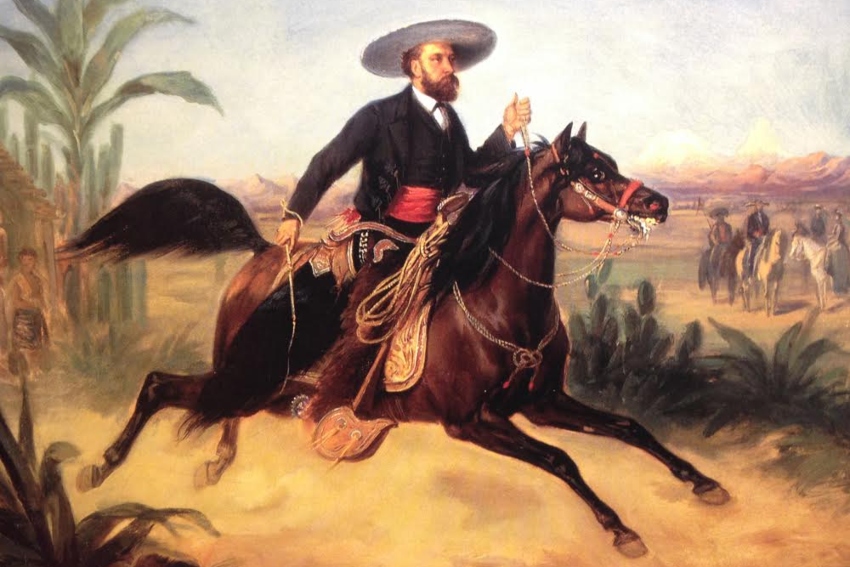
No wonder that some forty years later, when the Austrian archduke Maximilian of Habsburg arrived to rule Mexico with conservative backing, one of his first political gestures was to tour the country dressed as a charro. He believed that wearing the charro suit would signal love and respect for his adopted nation.
Contrary to a persistent myth, Maximilian did not invent or redesign the charro suit. It already existed, in multiple variants, and was worn by different social groups. The emperor adopted it, quite deliberately, as a marketing strategy — a way to wrap himself in an already powerful symbol.
By the Porfiriato at the turn of the twentieth century, Mexico’s economic and social life revolved around haciendas, and the charro was a key figure in keeping those estates working.
When the Revolution broke out, many of those charros — men used to commanding horses, men and territory — became colonels and generals. They turned into part of the new political class, standing shoulder-to-shoulder with both the common soldier and the emerging military elite.
From horseman to national sport
After the Revolution, Mexico once again needed a symbol of the nation. As in a century before, that symbol had to be mestizo, with revolutionary overtones but also a fundamentally “kindly” face.
Radio, cinema and the press all helped sculpt that figure. The charro, once merely a cattleman on horseback — and by then firmly embedded in Mexico’s economic and political elite — became a national emblem.
In 1921, that elite coalesced into the Asociación Nacional de Charros, which still exists today. Its role was to preserve charro tradition, but also to regulate it.
Official recognition followed quickly. In 1934, the president established September 14 as National Charro Day, and in 1940, another president formally declared charrería the national sport of Mexico. Even today, though their influence has waned, members of the Asociación Nacional de Charros ride in the official Independence Day parade every September 16, since they are the “reserve” of the Mexican Army.
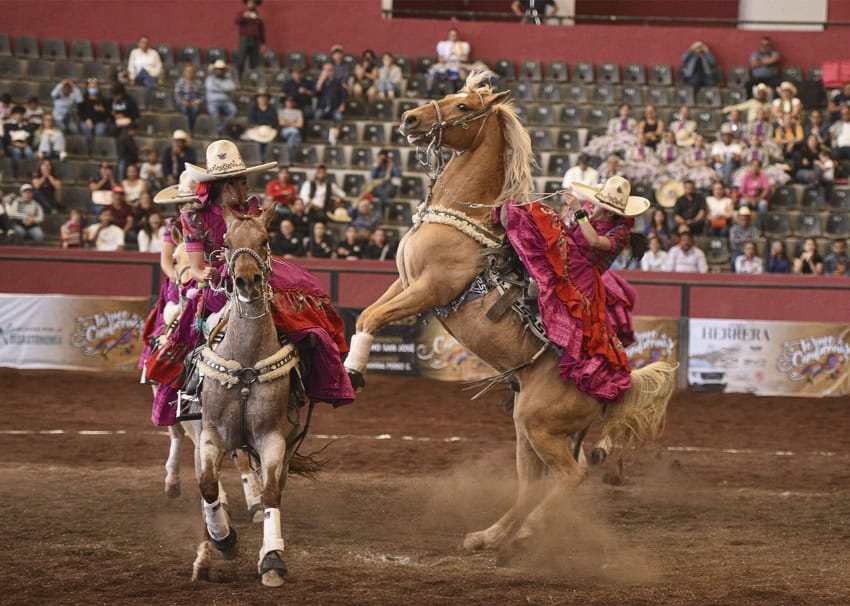
Riding alongside the charro, there is almost always a woman: dressed as an adelita or a china poblana, she is part of the visual script of “lo mexicano.” But her story is its own chapter.
What happens during a charreada?
Men’s charrería and the suertes
In the men’s competition, charrería is organized around a series of set events, or suertes: coleadero, piales, cala de caballo, bull and mare riding, manganas on foot and on horseback and the paso de la muerte, among others, formally codified as ten core disciplines.
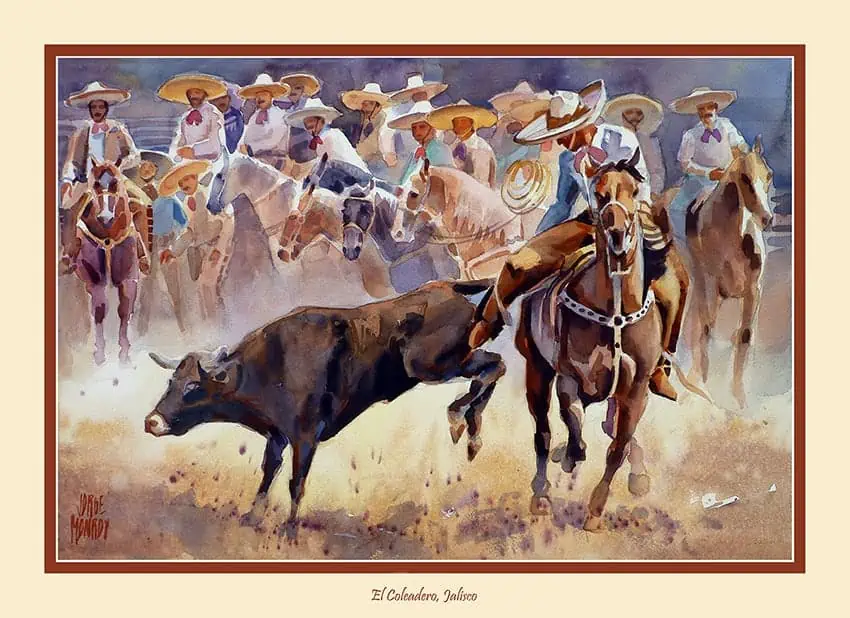
Each one is designed to showcase specific aspects of ranch skill: roping and throwing cattle, stopping and reversing a horse with precision, staying on a bucking animal, or leaping from a saddled horse onto a running mare. The logic is always the same — demonstrate mastery of livestock, recall the routines of hacienda work and do it all with elegance under pressure.
Escaramuza charra
Escaramuza teams are made up of eight women who perform tightly choreographed patterns at a gallop, riding sidesaddle, with both legs draped to one side of the saddle.
Academics see these women as heirs to revolutionary figures like the adelitas and to popular icons like the china poblana, but also as modern athletes negotiating strict dress codes, risk and discipline.
They ride directly into the heart of a sport built by men, and in doing so they subtly redraw the silhouette of who gets to be associated with the word charro.
Children and youth charrería
Charro associations and the federation have created children’s and youth divisions, treating them as crucial to passing down the tradition. In its heritage listing, UNESCO explicitly highlights these intergenerational dynamics: families training together, elders teaching youngsters, skills and stories moving from one generation to the next.
Charros today
Recent scholarship treats charrería as a living cultural phenomenon that still shapes regional and national identities. Even though today charro practices intersect with globalization, mobility and changing land use, charrería exists alongside gated communities, industrial agriculture and streaming platforms. Yet it continues to offer a thick sense of belonging and a language of resistance to cultural erasure.
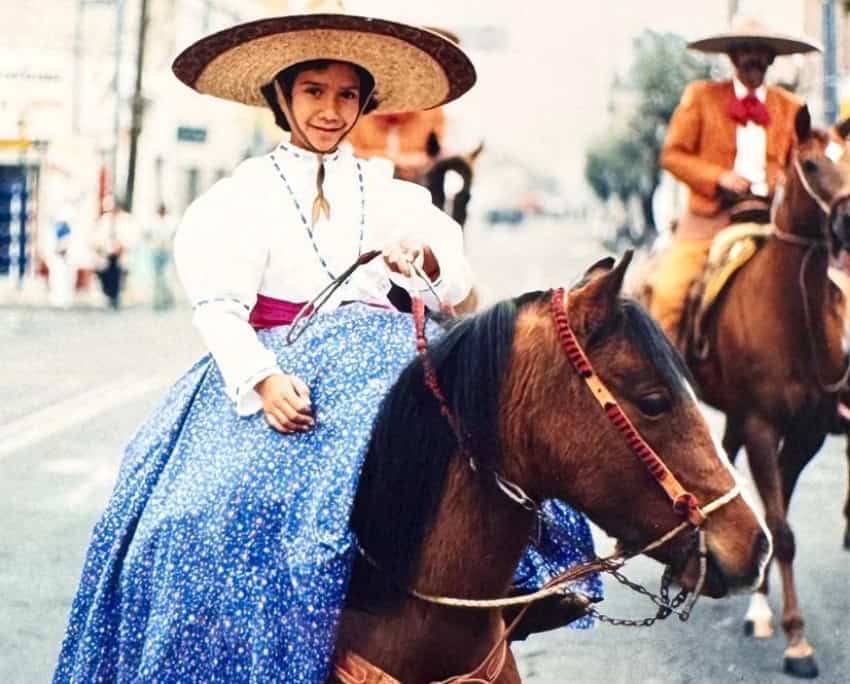
Today, that world of reins, reatas and carefully rehearsed risk is no longer just a private passion of a few families or a convenient symbol for the state. It is formally recognized as part of Mexico’s intangible cultural heritage, a living archive of memory and muscle that survives only because, generation after generation, someone is still willing to climb into the saddle and ride.
Maria Meléndez writes for Mexico News Daily in Mexico City.