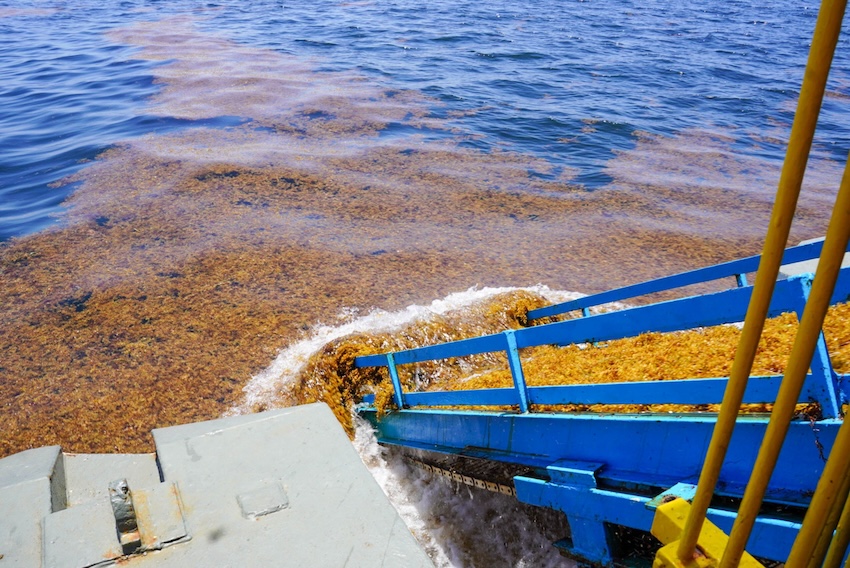
The 2025 sargassum season along Mexico’s Caribbean coastline has virtually concluded, as autumn’s cold fronts promise a drop in sea temperature and a resulting decrease in seaweed arrivals.
Esteban Amaro, director of the Quintana Roo Sargassum Monitoring System, said that although nearly 85,000 tonnes of the macroalgae were collected this year, the amount was not nearly as much as had been feared.
“The currents are changing … moving north, the southeasterly winds have decreased and there’s very little sargassum in the sea now,” he said. “Arrivals have dropped significantly in the past two weeks, suggesting the season is almost over.”
Of the 100 beaches Amaro’s organization monitors, only six saw sargassum last week, but the minimal quantities reaching the beaches were easily cleared.
Based on the latest monitoring data and satellite imagery, Amaro anticipates that Quintana Roo Governor Mara Lezama will be able to declare the end of the sargassum season sometime next week. In 2024, the sargassum season lingered until mid-November.
On Monday, Lezama expressed gratitude to federal, state and local authorities whose collaborative efforts in cleaning up the beaches helped make for a successful summer.
Despite heroic clean-up efforts, sargassum keeps accumulating on Quintana Roo’s coast

Initial forecasts warned that 2025 could be a record year for sargassum, but a variety of factors reduced the amount that washed up on beaches, Amaro said. Most important were preventive measures taken by the Navy and local authorities that allowed a considerable amount to be caught offshore. More than 7,500 meters of containment barriers were installed off the Quintana Roo coast.
Although nearly 85,000 tonnes of the seaweed reached shore through last week — double the 40,000 tonnes that arrived in 2024 — the total fell far short of the more than 522,000 tonnes that invaded the region’s beaches in 2018.
Still, Amaro said sargassum seasons have been increasing in intensity since 2011, with cycles of heavy seasons every three years, adding that changing climatic conditions produce regional fluctuations from year to year.
This year also saw sargassum arrivals vary greatly from one week to the next.
In one week in early September, 663 tonnes of sargassum were collected from Cancún’s beaches, just over 5% of the 13,000 tonnes removed in Cancún throughout the eight-month sargassum season. Last year, only 3,700 tonnes of the seaweed arrived on Cancún’s beaches.
Then, one week in late September, the Navy collected more than 400 tonnes of sargassum from the Costa Maya, while Cancún’s beaches were relatively undisturbed.
With reports from La Jornada and Reportur