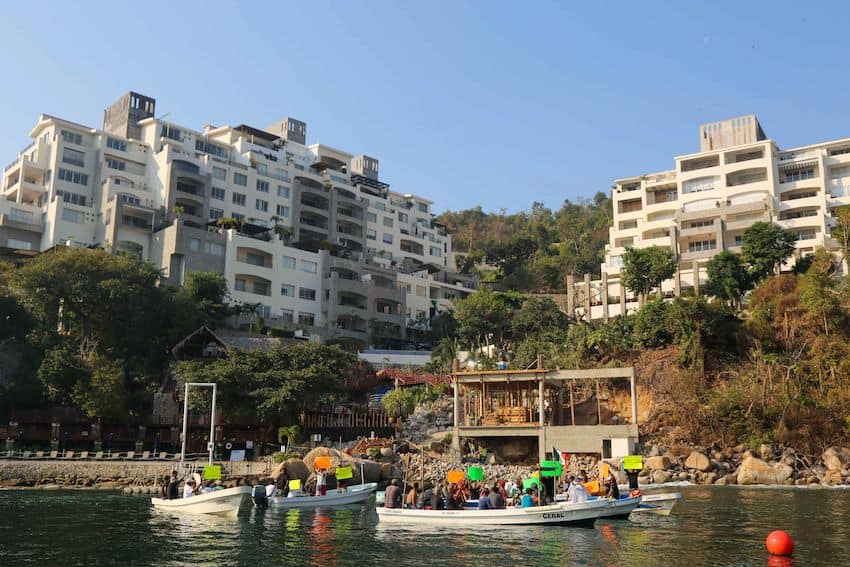
Fishermen and divers in the Acapulco beach area of Puerto Marqués are accusing a luxury condominium’s expansion project of “ecocide of the seabed,” thrusting a local construction dispute into a push to criminalize large-scale environmental destruction in Mexico.
Members of the Fishermen and Divers Cooperative Society say the project — a new restaurant plus swimming pool — is being built on land reclaimed from the sea in front of Vista Real, a 20-year-old resort-style condo complex in the Punta Diamante corridor.

During boat tours with reporters this week, they alleged that for about five months, workers have been dumping rocks, rubble, wood and other waste directly into the waters of Puerto Marqués bay.
“They’re building a swimming pool at sea level; you can see the pipes,” local fishermen and divers told the newspaper La Jornada.
The cooperative’s president, Gregorio Pérez Palma, warned that “all that material falls to the bottom and contaminates the seabed. It is damage that can be irreversible,” adding: “We want the construction permit revoked, and we also want the concession revoked, because they are clearly pushing us away from our marine areas.”
The disputed work sits in a protected area southeast of Acapulco’s classic hotel strip and main bay.
Part of the high-end Punta Diamante corridor, Puerto Marqués itself is a low-key beach and fishing community with casual seafood shacks, local water sports and better prices than the “Golden Zone.” It has recently become reachable via water from central Acapulco on the new Navy-operated Marinabús.

Fishermen say the work is going up inside a protected zone where shellfish harvesting is off-limits so stocks can recover. They say snails, seaweed, octopuses, oysters, clams and lobsters reproduce there, and warn it could take 10 to 15 years for the fishery to bounce back if the seabed is smothered like in earlier projects.
They also worry that chlorinated water from the pool would add another blow to marine life.
Locals say the bay has not yet recovered from Hurricane Otis, which battered Acapulco’s already fragile tourism economy in October 2023.
The city is still rebuilding hotels and basic services after successive shocks, including a January earthquake that left more than 400,000 residents without water.
The complaints echo earlier “ecocide” accusations by Guerrero fishermen, who in 2022 blamed a federal power plant for killing some 150 tonnes of sardines with chemical discharges.
Nationally, scholars at the National Autonomous University of Mexico and advocacy groups are lobbying to have ecocide — defined as massive, long-term ecosystem destruction — recognized as an international crime akin to genocide and added to the Rome Statute of the International Criminal Court.
Fishermen in Puerto Marqués say their bay is a test case — and they are demanding that all three levels of government get cracking.
With reports from La Jornada, Quadratín Guerrero and El Sol de Acapulco