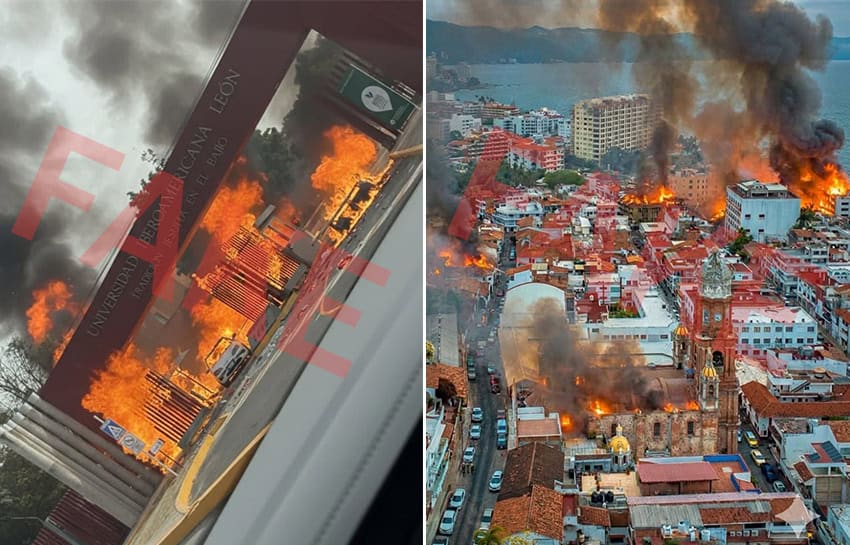
A plane in flames on the tarmac at Guadalajara Airport. Smoke billowing from a burning church in the resort city of Puerto Vallarta.
Images of these scenes appeared on social media on Sunday as members of the Jalisco New Generation Cartel (CJNG) reacted violently to the death of their leader, Nemesio “El Mencho” Oseguera Cervantes, who was shot by soldiers during an operation in Jalisco.
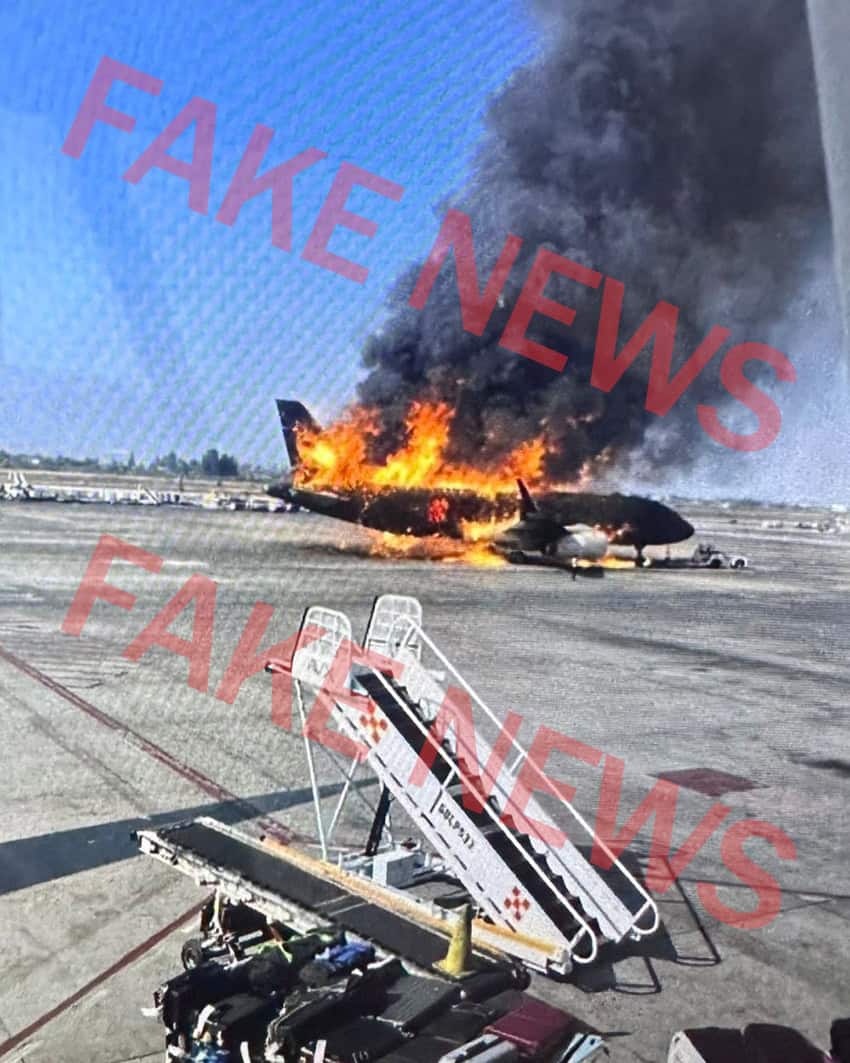
They added to fear and panic in Mexico at a time when fiery narco-blockades were appearing in states across the country and cartel members were setting banks and OXXO stores on fire and engaging in gunfights with National Guard officers.
Both images, however, were fake, apparently created with the assistance of artificial intelligence, but nevertheless serving to make a very bad situation look even worse.
They were among a plethora of fake news that proliferated online on Sunday, and it wasn’t confined to social media.
Gunmen have taken over Guadalajara Airport, reported various major news outlets, a development seemingly supported by footage of passengers panicking and running, but which, in fact, was not true.
President Claudia Sheinbaum was taken by helicopter to a naval vessel off the Sonora coast to ensure her safety. Also false.

The Puerto Vallarta Costco burned to the ground. Didn’t happen.
Still, fake images and fake news went viral on social media on Sunday, shared not only by unsuspecting internet users but also by the CJNG itself, according to experts cited in media reports.
On Wednesday, the federal government ramped up its efforts to expose these fabrications, presenting a five-minute video during the regular “lie detector” segment of Sheinbaum’s morning press conference.
Sheinbaum and other federal officials had already denounced the dissemination of fake news related to the “El Mencho” operation before the video was screened.
On Sunday, the government of Jalisco promptly denounced various images as false.
Ante los hechos registrados este día, es importante actuar con responsabilidad.
Se ha detectado la circulación de imágenes, audios y publicaciones falsas. Evita compartir contenido sin verificar su origen y confirma que provenga de fuentes oficiales. pic.twitter.com/NZbXxYsWlZ
— Gobierno de Jalisco (@GobiernoJalisco) February 22, 2026
No, a US agent didn’t strangle ‘El Mencho,’ says government
Before the aforesaid video was played, the government’s fake news debunker-in-chief Miguel Ángel Elorza Vásquez said that after Sunday’s operation targeting “El Mencho,” media outlets, commentators, politicians and social media users “promoted lies, disinformation and fake news about the operation, its origin and the events that occurred in different cities … of the country.”
Although some of the fake news went viral and fooled many people, Elorza — the head of Infodemia, a government initiative dedicated to debunking fake news — asserted that most Mexicans heeded the call to inform themselves about the prevailing situation via official channels of communication.
Citing a study by the Tec. de Monterrey university, the government’s “lie detector” video said that between 200 and 500 posts containing false information related to the operation against “El Mencho” appeared on social media.
Between 20 and 30 of those posts — which many social media users shared — were viewed more than 100,000 times, the video said.
The video labeled various social media posts and news stories as lies, including ones that claimed that cartel members were threatening to attack civilians and that armed men had entered the Guadalajara Airport.
It also highlighted that the two images described at the top of this article were false, and declared that posts asserting that U.S. tourists had been taken as hostages were untrue.
In addition, the video denounced as false claims that the U.S. was involved in the operation against “El Mencho,” including an assertion that a U.S. agent killed the CJNG leader by strangling him as he was being airlifted to a hospital for medical treatment.
The Tec. de Monterrey report cited in the video did not identify who produced the phony content related to that operation and the violent chaos that ensued.
🔴En la #MañaneraDelPueblo, el #DetectorDeMentiras mostró una campaña de desinformación tras la operación realizada en Jalisco para detener a Rubén “N”, alias ‘El Mencho’”:
❌Mentira que el crimen organizado amenazó con atacar a la población civil.
❌Mentira que miembros del… pic.twitter.com/K08deqo69z— InfodemiaMx (@infodemiaMex) February 25, 2026
‘They are trying to show that the Mexican government doesn’t have control over the country’
Citing experts, Reuters reported that fake news related to the death of “El Mencho” “spread at surprising speed,” with “unsuspecting” social media users — and the CJNG “in some cases — disseminating the phony images, posts and stories.
The objective of the cartel, Reuters wrote, was to “make its retaliatory wave of violence appear greater and more terrifying than it really was.”
Jane Esberg, an assistant professor of political science at the University of Pennsylvania, told the news agency that “they are trying to show that the Mexican government doesn’t have control over the country.”
Esberg, who has studied Mexican criminal groups’ use of social media, said that the dissemination of fake material on social media contributed to the creation of a narrative that the CJNG had a retaliatory presence all over Mexico on Sunday. While acts of violence occurred in 20 states, many municipalities of those states weren’t affected.
Federal Security Minister Omar García Harfuch said Monday that authorities had identified social media accounts sharing fake news and would conduct investigations to determine which ones have “direct relationships with an organized crime group” — i.e. the Jalisco Cartel.
While cartels have long used social media as a propaganda tool, the emergence of AI means that they — and others, including so-called “narco-influencers” — can create phony material that serves their agenda with nothing more than a laptop or a phone.
Pablo Calderón, an associate professor in politics and international relations at Northeastern University in London, told Reuters that cartels use social media to amplify their image and power and to influence public opinion, including by disseminating misinformation.
“Sunday was a good day for Mexican security forces,” he said, even though 25 National Guard officers were killed, and other troops sustained injuries in clashes with CJNG gunmen.
“But organized crime has been successful in shifting the narrative, away from the [military operation] to chaos,” Calderón said.
Vanda Felbab-Brown, an organized crime expert at the Brookings Institution in Washington D.C., told the Associated Press that it’s likely that people linked to the CJNG were responsible for some of the disinformation that circulated online on Sunday.
“The criminals are becoming very tech-savvy,” she said before describing the “level of misinformation” as “impressive.”
AI-generated images depicting scenes of violence “certainly added to the aura of chaos and meltdown in Mexico,” Felbab-Brown said.
‘We didn’t know what was true and what was false’
Victoria Elizabeth Peceril, a 31-year-old mother of three, told the Associated Press in Guadalajara on Wednesday that “we didn’t know what was true and what was false” amid the violent reaction to the death of “El Mencho.”
“We were really scared,” she said.
Given that the CJNG is known for extreme and spectacular acts of violence — including the downing of a military helicopter in 2015 and a brazen 2020 attack on García Harfuch when he was Mexico City police chief — deciphering whether an AI-generated image is real or false becomes even more difficult. Could the cartel have set a plane and a church ablaze? Conceivably, yes.
Yoni Pizer, a homeowner in Puerto Vallarta whose car was hijacked and firebombed on Sunday, noted in an interview with The New York Times that “there were images and videos that were not real.”
“People started posting that the gangs were just shooting randomly and killing people in town. That wasn’t true,” he said.
Fake news also distorted how people abroad perceived what was happening in Mexico on Sunday. One Mexico News Daily writer said that her grandmother in the United States believed that the CJNG was targeting Americans in Mexico due to U.S. involvement in the operation against “El Mencho,” which was limited to intelligence sharing, according to the Mexican and U.S. governments.
Back in Mexico, Nicolás Martín, a 28-year-old Mexico City resident who was in Puerto Vallarta when the violence began, told AP that “at first, we believed everything [we saw on social media].”
He said he was surprised by the high quality of the fake images that circulated on Sunday.
Sarai Olguín, a 22-year-old university student in Guadalajara, also said it was difficult to tell what was real and what was false. She found a silver lining in the dissemination of fake material, saying that it played a role in convincing people not to leave their homes.
“In a way it’s good, because all of this false news helped take care of people even though they sowed immense fear,” Olguín told AP.