Monday set an ambitious pace for the week. President Claudia Sheinbaum announced her scaled-back electoral reform plan, declared the start of formal USMCA review talks with the United States, and faced questions about a possible recall election after her original constitutional reform had failed in Congress.
The middle of the week brought two significant gatherings of Mexico’s business and financial establishment. On Wednesday — the 88th anniversary of Mexico’s historic oil expropriation — the American Chamber of Commerce held its annual assembly, where U.S. Ambassador Ronald Johnson struck an optimistic note on trade and the bilateral relationship. That same day, Sheinbaum traveled to Veracruz for an oil expropriation anniversary ceremony where she pledged to sharply reduce the country’s dependence on imported natural gas. On Thursday she addressed the 89th Banking Convention, announcing that cash payments at gas stations and highway toll booths would be phased out before the end of the year — part of Mexico’s push to digitalize its economy.
The week closed on a more difficult note. Friday found Sheinbaum in Cancún demanding a full U.S. investigation into the death of a 19-year-old Mexican in ICE custody in Florida — a sobering counterpoint to the week’s diplomatic optimism — as record-breaking spring heat blanketed more than a dozen states across the country.
Didn’t have time to catch this week’s top stories? Here’s what you missed.
Electoral reform and presidential accountability
The week opened with Sheinbaum laying out a legislative path forward after her original constitutional electoral reform fell short in the lower house of Congress. As MND reported, she framed her scaled-back “Plan B” proposal as a strike against political excess, targeting bloated state legislature budgets — some allocating up to 39 million pesos per deputy — and outsized politician salaries. On Tuesday, Interior Minister Rosa Icela Rodríguez presented further details of the plan, including that citizens would have the right to request a presidential recall election in either 2027 or 2028. The provision aligns with one of Sheinbaum’s 100 commitments on taking office. With her approval ratings consistently polling well above 60%, few expect such a vote to go against her.
Trade: USMCA takes center stage
The most consequential development of the week for Mexico’s economic future was the formal launch of USMCA review negotiations. Economy Minister Marcelo Ebrard sat down with U.S. Trade Representative Jamieson Greer in Washington on Wednesday, with both sides marking the official start of talks that will shape North American trade for years to come. Canada is expected to join the process in May. Mexico’s stated priorities are the removal of U.S. tariffs on automotive, steel and aluminum. By Thursday, Sheinbaum said her government had responded point-by-point to the 54 non-tariff barriers raised by Washington, declaring the majority of concerns settled.
USMCA trade deal negotiations formally kick off in Washington

On the business community side, the American Chamber of Commerce held its 109th General Assembly, where U.S. Ambassador Ronald Johnson described the USMCA review as “an opportunity to deepen integration” and compared the bilateral relationship to a marriage with no prospect of divorce. The gathering also saw CPKC Mexico president Oscar Del Cueto named as AmCham’s new president for the 2026-27 period.
Mexico-U.S. relations: Cooperation rhetoric meets harder realities
Security Minister Omar García Harfuch traveled to Washington on Monday to meet with DEA Administrator Terrance Cole, with both sides proclaiming an era of “historic” bilateral cooperation on drug trafficking and weapons seizures. The warm tone was complicated by somber news later in the week. A New York Times investigation found up to 500,000 guns still flow from the U.S. into Mexico annually. Then on Thursday, Interior Minister Rodríguez reported that Mexico’s “Mexico Embraces You” repatriation program had registered nearly 190,000 returnees since January 20, 2025 — a measure of the scale of Trump’s deportation drive. The week ended on a still darker note when Sheinbaum demanded a full investigation into the death of 19-year-old Royer Pérez Jiménez, an Indigenous Maya man from Chiapas who died in ICE custody in Florida on March 16 — reportedly the youngest person to die in U.S. immigration detention under the current Trump administration. Mexico sent diplomatic notes to Washington and pledged to pursue all legal avenues.
Security and cartels: Mencho’s crime scene and El Mayo’s daughter
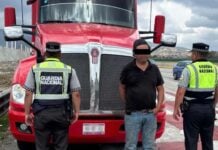
Fallout from the February killing of CJNG boss El Mencho continued on multiple fronts. The week opened with the Army arresting a key CJNG logistics operative known as “Pepe” — the man who had driven El Mencho’s romantic partner to the Tapalpa hideout where the cartel boss was ultimately tracked down and fatally wounded on Feb. 22. The Federal Attorney General’s Office also acknowledged that journalists freely entered the Jalisco cabin complex where Oseguera had been hiding, saying the site was too dangerous to secure immediately. The FGR conceded the scene was “altered and contaminated,” raising chain-of-custody concerns about evidence including alleged cartel payroll documents showing bribes to police and government officials.
In a separate cartel development, Mexican forces briefly detained Mónica Zambada Niebla — daughter of imprisoned Sinaloa Cartel boss “El Mayo” Zambada — during a Thursday raid near Culiacán that killed 11 cartel members, then released her within hours. Critics pointed out she remains on the U.S. Treasury’s sanctions list, though she has no arrest warrant active in Mexico or the U.S.
Energy and economy: Sovereignty, a deadly fire and a digitalization push
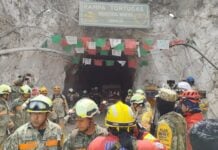
On the anniversary of Mexico’s oil expropriation, Sheinbaum declared reducing natural gas imports Mexico’s next major energy goal, noting the country currently imports 75% of its consumption almost entirely via pipeline from the United States. That same week, the troubled Olmeca (Dos Bocas) Refinery in Tabasco became the site of tragedy when an oily water overflow sparked a fire that killed five people, prompting an FGR investigation. Pemex said the refinery itself was undamaged and operating at full capacity.
Also on the economic front, Sheinbaum used her address at the 89th Banking Convention to announce that cash payments at gas stations and highway toll booths would be phased out starting this year, part of a broader push to digitize the Mexican economy. Currently cash accounts for roughly 80% of all transactions in Mexico. The government is coordinating with the banking sector and Banco de Bienestar to ensure access to digital payments for all citizens.
Looking to an all-digital future, Sheinbaum plans to eliminate cash at the pump and the toll booth
Meanwhile, new INEGI data showed Mexico’s manufacturing sector contracted 1.8% in January — the steepest monthly drop since 2015 — with employment in the sector down 2.5% year over year, weighed down by U.S. sectoral tariffs on automotive and steel products.
International headlines: Spain, AMLO, FIFA and a UN win
In a diplomatically significant moment, King Felipe VI of Spain acknowledged the “abuses” and “moral controversies” of the Spanish conquest during a visit to a Madrid exhibition on Indigenous Mexican women. Sheinbaum called it “a gesture of rapprochement,” and Mexico formally extended an invitation to the king for the World Cup opener on June 11. FIFA, however, rejected Mexico’s offer to host Iran’s group-stage matches, which Iran had requested after Trump cast doubt on the team’s safety in the United States amid escalating Middle East tensions.
Former president AMLO broke his post-retirement silence for the third time, calling on Mexicans to donate to a newly created NGO supporting Cuba amid a U.S. fuel blockade. The appeal sparked controversy over how the association obtained fast-tracked tax-agency authorization to collect donations; Sheinbaum pledged a personal contribution while critics said she evaded the transparency questions. At the U.N., Mexico scored a multilateral win when the Commission on Narcotic Drugs approved a Mexico-led resolution aimed at preventing pharmaceutical manufacturing equipment from being repurposed for the production of synthetic drugs.
Society, health and the environment
It was a significant week for reproductive rights. Following court rulings won by activist coalitions, the national social security health system IMSS is now legally required to offer elective abortion services in the 25 states where abortion has been decriminalized. The rulings have broad effect, protecting not just the nearly 300 plaintiffs who filed the lawsuits, but all IMSS beneficiaries in those states.
Separately, the government was also studying setting a minimum age for social media use following similar moves by Australia and France, with concrete proposals expected by June.
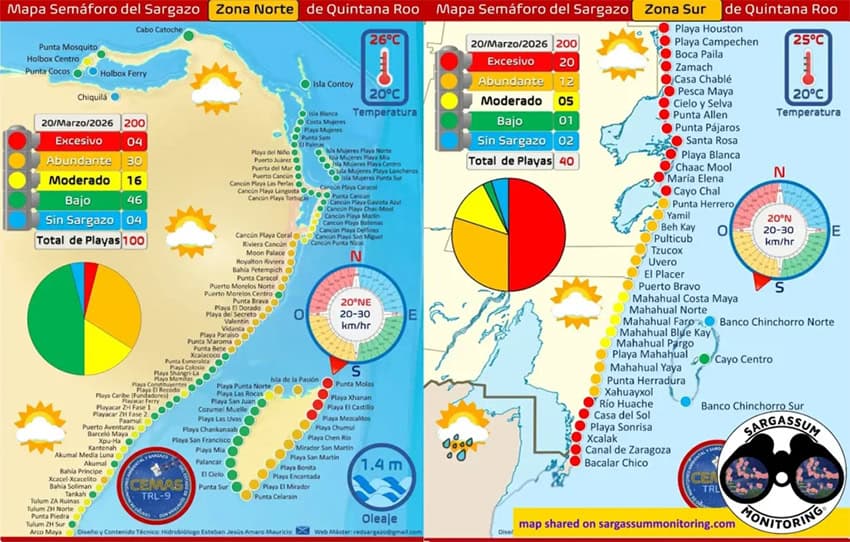
Friday marked spring’s arrival, and with it came a record heat wave: 12 states recorded temperatures above 40°C (104°F) going into the weekend, with Hermosillo and Mexicali both setting new records for March. Climatologists warned that spring heat is now arriving weeks earlier than it did a decade ago, driven by climate change. On the coasts, researchers warned that the Riviera Maya could be heading into its worst-ever sargassum season, with seaweed arriving early and a record 9.5 million tonnes already spotted in the Atlantic — a worrying backdrop as spring break and Holy Week vacations kick off.
Also in the news this week
- Mexico City set a Guinness World Record for the largest soccer class ever, with 9,500 participants filling the Zócalo as a World Cup warm-up.
- Carín León and Jelly Roll have teamed up on “Lighter,” the first official song of the 2026 FIFA World Cup, produced by Canadian hitmaker Cirkut — one artist from each host nation.
- Four endangered Mexican wolves were released into Durango’s Sierra Madre Occidental, the species’ first return to the state in 50 years, under a binational U.S.-Mexico conservation program.
- Mexico’s monarch butterfly colonies grew 64% this winter. Conservationists welcomed the rebound while warning the population still remains critically low, well below historic levels.
- President Sheinbaum proposed a free BTS concert at the Zócalo after three stadium shows sold out instantly, writing to South Korea’s president to request his help arranging additional dates.
- Hundreds of migrant children in Mexico City have been training since late February for “Goals for Inclusion,” an EU-funded soccer tournament in April aimed at integration and community-building for kids fleeing violence and poverty.
Looking ahead
Mexico enters the coming weeks with several high-stakes processes in simultaneous motion. USMCA working groups will begin drilling into the treaty’s 34 chapters, while Sheinbaum’s Plan B electoral reform heads to the Senate. The death of Royer Pérez Jiménez in U.S. detention will test the limits of bilateral cooperation rhetoric. Meanwhile the World Cup — and millions of arriving tourists — is now less than three months away, with sargassum, heat and security all posing potential complications for a government keen to show Mexico at its best.
Looking for last week’s roundup? Check it out here.
Mexico News Daily
This story contains summaries of original Mexico News Daily articles. The summaries were generated by Claude, then revised and fact-checked by a Mexico News Daily staff editor.