
Holy Week set the rhythm for the final days of March and the first days of April, slowing the pace of official business while millions of Mexicans headed to the beach, the mountains or hometown celebrations. President Claudia Sheinbaum held no press conference Thursday or Friday, but the news didn’t take a vacation. Trade tensions with Washington deepened, economic data continued to send mixed signals, and Iztapalapa marked its most celebrated Passion Play in 183 years.
Didn’t have time to catch this week’s top stories? Here’s what you missed.
Sheinbaum under pressure at home and abroad
The week opened with the publication of a new poll showing Sheinbaum’s approval rating has fallen to its lowest point since she took office — 53.9%, down from 62.8% in January, according to AtlasIntel’s LatAm Pulse survey. The drop was driven by rising public concern about corruption and crime, both of which jumped roughly 10 percentage points as a concern among respondents in a single month. The poll came despite the February killing of CJNG boss El Mencho, an operation 78% of respondents said they supported.
At her Monday mañanera, Sheinbaum revealed she had made a personal donation of 20,000 pesos to a humanitarian fund for Cuba, emphasizing the contribution had nothing to do with her role as president. She also acknowledged a second Mexican death in ICE custody — José Guadalupe Ramos Solano, who died at California’s Adelanto Processing Center on March 25, at least the 14th such death in U.S. immigration detention this year — and said her government would file a complaint with the Inter-American Commission on Human Rights. On Wednesday, she took aim at Mexican politicians who appear on U.S. television to “speak badly of Mexico,” calling the practice unpatriotic and a threat to sovereignty — a thinly veiled reference to PAN Senator Lilly Téllez, a frequent Fox News guest who has publicly called for U.S. military intervention against cartels.
The economy in two speeds
The week’s economic picture was characterized by a familiar tension between strong external performance and fragile domestic fundamentals. Exports surged nearly 16% annually in February — the second-best monthly performance in three years — driven largely by manufacturing. Within that surge, a structural shift has quietly become a milestone: tech exports have overtaken automotive as Mexico’s leading export sector for the first time, with computer equipment shipments growing nearly 145% in 2025 as U.S. companies redirected demand away from Chinese suppliers. Chihuahua and Jalisco together accounted for nearly seven in ten dollars of Mexican tech exports.
Yet the domestic picture remains more complicated. Mexico added nearly 600,000 jobs in February, but that recovery followed a loss of more than 700,000 positions in January, leaving the first two months of the year in net negative territory. Much of February’s job growth was driven by self-employment rather than formal sector hiring. The Finance Ministry struck an optimistic tone, submitting a budget framework to Congress that projects GDP growth of up to 2.8% this year — but private sector analysts surveyed by the Bank of Mexico are forecasting roughly half that, at 1.49%.
Trade friction with Washington
The U.S. Trade Representative released its annual trade barriers report, formally accusing Mexico of shutting U.S. energy companies out of its market through permit delays, unjustified revocations and regulations that favor Pemex and CFE over private operators. The report revives a dispute that has been unresolved since the U.S. and Canada first requested USMCA consultations on Mexican energy policy in 2022 — and lands squarely in the middle of active review negotiations.

Separately, the U.S. House of Representatives passed legislation that could impose sanctions on Mexico over its long-running dispute with Alabama-based Vulcan Materials, whose limestone quarry near Playa del Carmen was declared a protected natural area under the previous administration. Sheinbaum said her government is exploring alternative sites where the company could continue operations, signaling a willingness to find a negotiated exit — but the bill is now pending a U.S. Senate vote, keeping pressure on.
Security and human rights
The Navy carried out 234 arrests across five states as part of the ongoing Operation Sable, seizing more than a tonne of methamphetamine. A separate maritime operation off the coast of Michoacán, made possible by U.S. intelligence sharing, resulted in the arrest of six suspects and the seizure of 650 kg of suspected cocaine.
In a less welcome international spotlight, the U.N. Committee against Enforced Disappearances published a report concluding that Mexico’s forced disappearances — more than 132,000 missing persons and nearly 4,500 clandestine graves — amount to crimes against humanity, and asked the U.N. Secretary-General to refer the matter to the General Assembly. The Mexican government forcefully rejected the findings as biased and legally flawed, while human rights organizations and families of the disappeared condemned the official response as evasive.
Holy Week: Faith, traffic and a UNESCO milestone
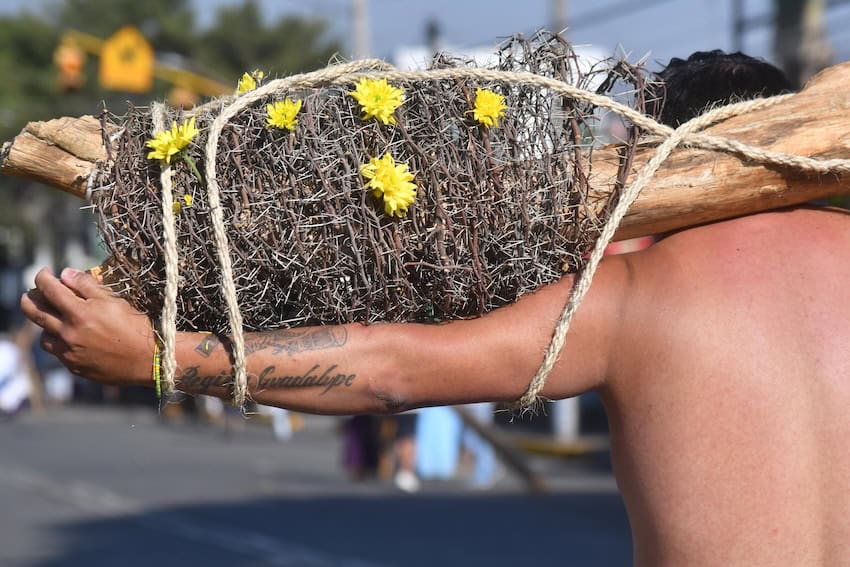
As millions of Mexicans observed Semana Santa, Iztapalapa staged its 183rd annual Passion Play — the first since UNESCO added the event to its Representative List of the Intangible Cultural Heritage of Humanity in December. Record-setting crowds on Good Friday (estimated at 2.8 million people) watched a 25-year-old medical surgeon bear the cross through the borough’s eight historic neighborhoods before the crucifixion scene atop Cerro de la Estrella.
For those heading back to the highways after the break: Truckers and farmers have announced a nationwide mega-blockade for Easter Monday, April 6, targeting major routes including the Mexico City-Querétaro, Mexico City-Cuernavaca and Culiacán-Mazatlán corridors. Organizers say they chose the date to avoid disrupting Holy Week travel — but school holidays don’t end until Friday, meaning some vacationers will be caught in the disruption regardless.
Also in the news this week
- Los Cabos braced for more than 100,000 spring break visitors ahead of Holy Week, with hotel occupancy expected to hit 90%.
- A caravan of about 800 migrants left Tapachula, Chiapas, for Mexico City to seek visa regularization, as thousands more remained stranded in the southern border city.
- An Arizona gun store owner was federally indicted for allegedly trying to sell military-grade weapons to both the CJNG and the Sinaloa Cartel.
- Poachers raided a sea turtle egg sanctuary in Oaxaca and were caught on video, prompting a federal environmental investigation after the footage went viral.
- A fossilized skull unearthed in Nuevo León has been identified as a new species of mosasaur, a six-meter marine predator researchers named Prognathodon cipactli.
- Mexico launched its long-awaited national supercomputer, Coatlicue, set to become Latin America’s largest public supercomputer, built in partnership with the Barcelona Supercomputing Center.
- Pedro Pascal is filming his new movie De Noche on location in Mexico City, directed by Todd Haynes, with Mexico City’s head of government stopping by the set.
- Yucatán sent its first-ever mamey shipment to the United Kingdom, opening a new European market for the tropical fruit after more than two years of meeting British phytosanitary requirements.
Looking ahead
The return from the holiday break will bring the mega-blockade immediately into focus, with truckers and farmers demanding more action on highway insecurity, cheaper diesel and agricultural subsidies. USMCA working groups are expected to continue drilling into the treaty’s 34 chapters against a backdrop of growing U.S. pressure on energy policy. And with the World Cup now fewer than 70 days away, the government will be keen to demonstrate that the country can manage its security challenges and welcome the world at the same time.
Mexico News Daily
This story contains summaries of original Mexico News Daily articles. The summaries were generated by Claude, then revised and fact-checked by a Mexico News Daily staff editor.