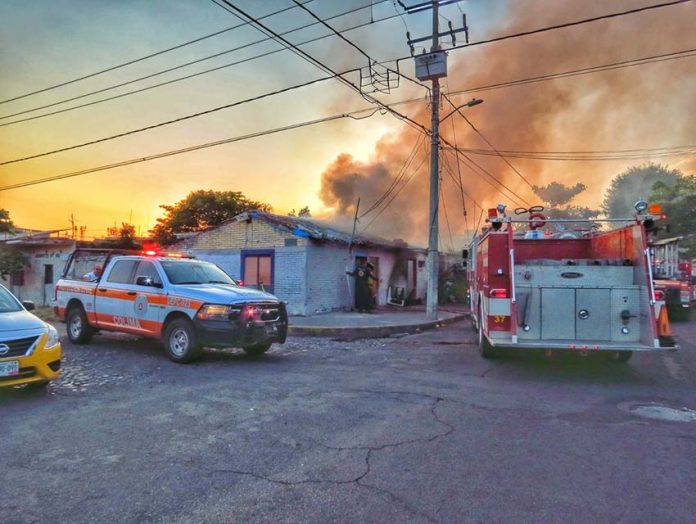
Firefighters respond to a blaze in Colima city that followed an organized crime battle on March 27. Civil Protection
Warning that violent crime and gang activity are widespread, the U.S. Consulate General in Guadalajara issued a strongly worded security alert for Colima, warning its citizens not to travel to the state due to crime and kidnapping amid an ongoing turf war between criminal groups.
While the U.S. Department of State had already included Colima in a Do Not Travel advisory on March 16, that travel advisory was focused on Nuevo Laredo. Colima was included with Baja California, Chihuahua, Coahuila, Durango, Guanajuato, Jalisco, México state, Morelos, Nayarit, Sonora and Zacatecas. It advised increased caution in all other states except Campeche and Yucatán, where normal precautions were recommended.
It also instructed citizens to reconsider travel to Mexico due to COVID-19.
The new advisory, issued on April 1, focuses exclusively on the state of Colima, “where shooting incidents between criminal groups have occurred in public places where bystanders have been injured or killed,” the Consulate General said. It also warns particularly against travel to Colima city.
Colima is the smallest state in the country by population, home to just over 730,000 citizens. However, its modest size and remote location haven’t spared it from becoming one of the most violent places in Mexico: 84 people were killed from February 7 to March 7, almost three per day.
Eleven people were killed and five were injured in the state over the weekend.
The wave of violence started with a prison riot on January 25, in which nine inmates were killed. The violence spread to the streets on February 7 in a territorial battle between the Jalisco New Generation Cartel (CJNG) and the local gang Los Mezcales, a previous ally that switched allegiance to the Sinaloa Cartel.
Colima was Mexico’s most violent state on a per capita basis for five consecutive years between 2016 and 2020, before losing that unenviable title to Zacatecas last year.
Morena party Governor Indira Vizcaíno Silva interrupted 72 years of Institutional Revolutionary Party (PRI) power in Colima by winning the June 2021 elections.
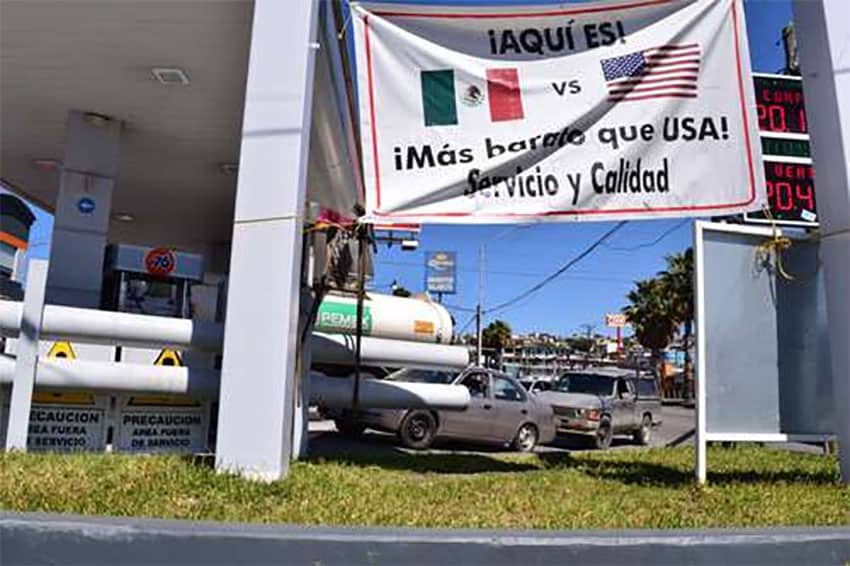
A gas station attendant at work in Tijuana, where gas stations have been busy serving customers from north of the border.
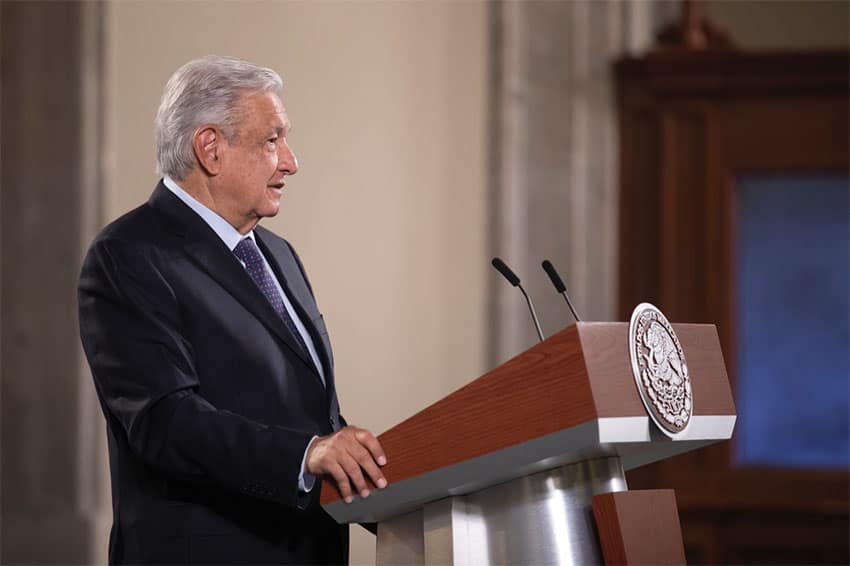
President López Obrador confirmed Monday that gasoline subsidies have been reinstated in the northern border region.
The Finance Ministry (SHCP) said Saturday that there would be no subsidies between April 2 and 8 in 40 municipalities in Baja California, Sonora, Chihuahua, Coahuila, Nuevo León and Tamaulipas.
In a separate statement the same day, the SHCP said there was a shortage of gasoline in the border region due to United States motorists coming into Mexico to take advantage of lower prices.
But the ministry said Sunday that supply wasn’t a problem after all and that the government was committed to keeping gasoline prices stable in the northern border region.
“Despite the international price of gasoline increasing in recent days due to the conflict in eastern Europe, the government of Mexico is committed to keeping the price of gasoline stable throughout Mexico, including the border region,” the SHCP said.
The president confirmed the reinstatement of subsidies at his Monday press conference.
“… Pemex has maintained gasoline supply and has [sufficient] national production inventory to meet demand in the north and all regions of the country.”
López Obrador said Monday that the decision to remove subsidies – which caused gas prices in the northern region to increase by up to 5 pesos over the weekend – had been corrected.
The issue has been “fixed,” he told reporters at his regular news conference, claiming there is enough gasoline supply to meet demand even with subsidies in place.
The subsidies – among which are the lowering, and recently the complete removal, of the IEPS excise tax on fuel – help people a lot, López Obrador said.
“In the case of the border they help Mexicans who have dual nationality and also Americans, who are our neighbors and who come to fill up in Mexico because gasoline is cheaper,” he said. “It’s an act of solidarity toward them as well.”
One person who crosses the border to purchase gasoline is Adrián, a resident of Chula Vista, a city that is part of the San Diego metropolitan area.
“Here it is! Cheaper than USA,” reads an advertisement at a Tijuana gas station.
“From one moment to the next, the price [of gasoline in the United States] went crazy,” he told the newspaper El Universal late last week.
“Rents are expensive, things cost more … [and] now having to pay between US $7 and $8 for a gallon of gasoline is simply crazy,” said Adrián, who crosses into Tijuana at night to fill up his car.
According to the website Gasolina México, the average price of a liter of regular gasoline in Tijuana was 21.02 pesos (US $1.06) at midday Monday, or US $4 per gallon. The average price across Mexico was 21.5 pesos.
According to the AAA gas prices website, the average price in California was US $5.85 per gallon, or 46% higher than the Tijuana price.
Although the SHCP and López Obrador asserted that Pemex has enough gasoline to supply gas stations in the north of the country, there have been reports of shortages. Some gas stations in Tijuana and Mexicali are among those that have recently run out of fuel due to increased demand.
The Finance Ministry said Saturday that supply problems had also been caused by private importers ceasing to purchase gasoline. Energy sector experts said in February that gasoline retailers were effectively being forced to purchase fuel from Pemex because the federal government wasn’t renewing import permits and has shut down some privately owned fuel storage terminals.
The government is determined to keep fuel prices down as much as it can as high inflation causes the prices of many products to surge. The determination to keep prices down this week could be even stronger given that López Obrador’s popularity will be tested in a revocation of mandate, or recall, referendum this Sunday.
The Mexican Institute for Competitiveness, a think tank, published an analysis last month that found that the net cost to the government of subsidizing fuel prices could be as high as 205.5 billion pesos (US $10.4 billion) this year.
I live in the capital’s Roma neighborhood, which is very central and in the part of the city closest to where most tourists would likely start their trek to the airport if they choose to fly out of AIFA.
When my Uber driver, Francisco, picked me up, he was just as excited as I was. He hadn’t been to the new airport to drop off passengers yet, just the airport’s customs for a second job he holds, and he wanted to see the place as much as I did.
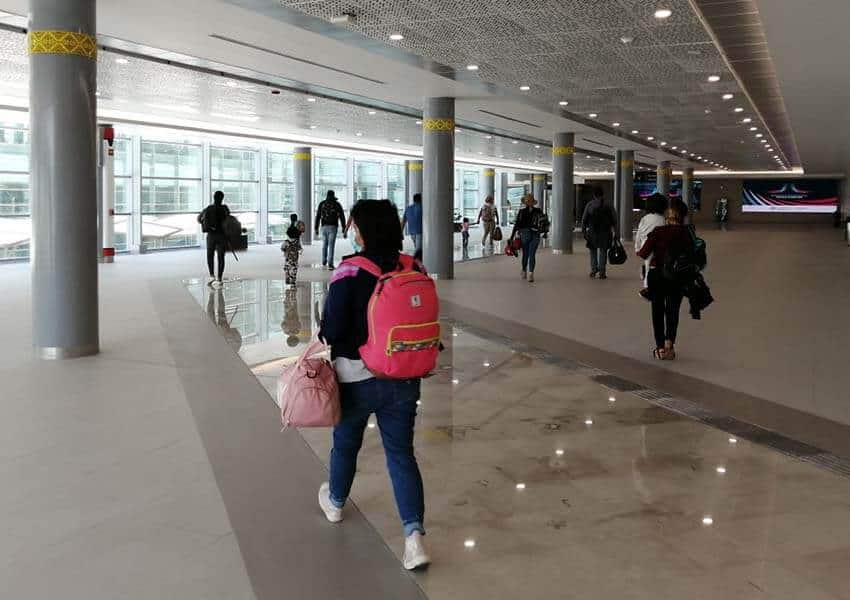
There was no fighting for a drop-off spot at the entrance last month when the writer arrived. Also the flight security process took only five minutes.
On the way through the middle of the city (which was the most congested and longest part of the ride), he told me how the airport was so close to his children’s apartment that they were all flying to Nuevo León next weekend to try it out. He was relieved that they would no longer have to go all the way to Benito Juárez.
“The travel times, the wait times, it’s all been dramatically reduced,” Francisco said, “In Benito Juárez, we have to wait eight or 10 hours in customs. Now it doesn’t take any more than an hour to get our merchandise.”
Once we were outside the city, the traveling was faster but as we neared the airport, several signs pointed us in one direction, yet GPS took us in another. Francisco said this was because the main overpass that would take you directly to the airport road wasn’t finished yet.
Not until we were riding along an 11-kilometer cement wall with nothing but dust and construction crews did I start to worry. The signage was nil, and it was starting to get dangerously close to the time I needed to be there for my flight. The Uber app said it would be another 30 minutes, which I did not have.
A woman from whom we ended up asking for directions assured us that straight ahead would be a roundabout and tunnel and that on the other side was the passenger drop-off. She was right, but at this point, the ride had been around an hour and 45 minutes, and I was starting to sweat.
However, once we arrived, my driver didn’t need to jockey for a space to drop me off; there were no other cars. My trip through security took a blissful five minutes.
But have you ever been to a new restaurant where there are too many waiters with not enough for them to do? Felipe Ángeles Airport was a little like that. The security guy stopped me to tell me that he was letting through my sunscreen at 120 milliliters but that next time, everything had to be 100 milliliters max (I think he even wagged his finger). Four attendants at the gate “helped” us form a line to show our tickets. The guy at the Hudson News snack and newspaper shop gave me a free chocolate bar with my purchase!
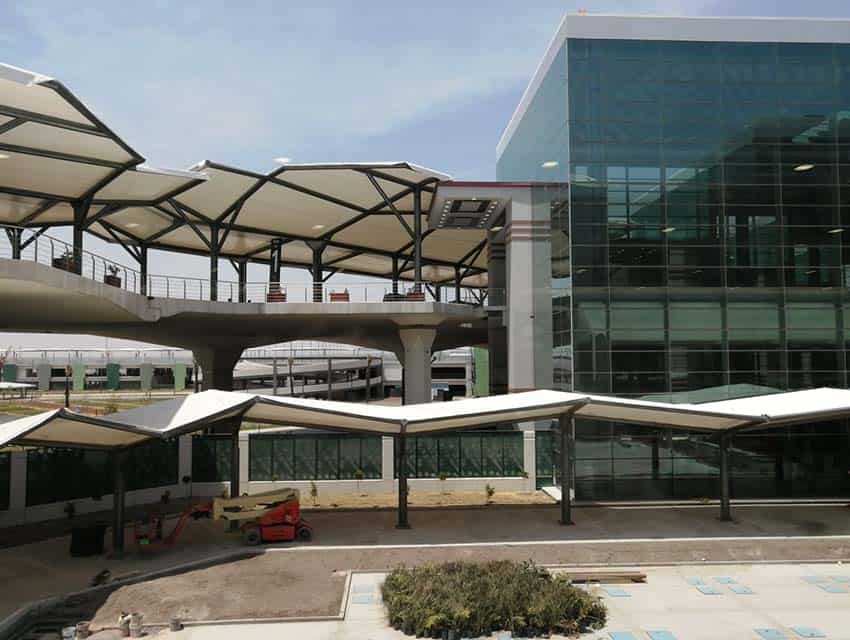
So the place was a bit of a ghost town, but everything was shiny and new with massive windows that looked out over the tarmac and lots of expansive space that felt modern and well-proportioned. Most shops, however, while plastered with signage, were empty. As far as food, there were a few places to buy snacks and a pastes stand, which is about my least favorite Mexican on-the-go snack, so I passed.
The bathrooms were clean and spacious but with no paper in my stall and no soap in the dispensers.
The flight went off without a hitch, although there was turbulence both leaving and coming back to the airport and I wonder if that’s a result of the geography of the new airport or if I just had bad luck. My flights going and coming to Cancún were both full to the brim with everyone snapping selfies in the new airport before boarding.
The flight back was easy. At baggage claim, there were only three conveyer belts — fine when you only have about eight flights a day but it won’t be so great once the airport is fully operational.
As people exited the terminal, there was general confusion about where to go and how to get home. There is a pick-up area just outside of baggage claim with official taxis, and then to the right near the pick-up area the Suburban Train station and a sign for the bus station on the floor below (but the staircase was surrounded by scaffolding and looked closed).
Right now, the airport is only handling a few flights per day.
The Suburban Train (which is not up and running) and the Buenavista train station will eventually connect to get you from the airport to the city in 45 minutes for less than US $2. I was cheered to see construction crews actually working on the train rails and not just an empty platform and station. The Suburban Train would have been my No. 1 option for getting home, had it been finished.
Rechecking that I was going the right way, I headed down to the bus station which is set up nicely with a waiting area and seven different bus lines all with a small counter selling tickets. But some of the tickets sellers were missing. And even though the official-looking woman supervising the construction next to us said that they were sure to return, they didn’t in the 30 minutes I was there.
I tried to find those buses that I thought would take me to the Benito Juárez airport or the World Trade Center like I’d read about, but all the bus lines only had service to the north and south bus terminals as well as a few other longer distances (Puebla, Toluca, Querétaro, Cuernavaca). I ended up taking a bus to Central Norte bus terminal (at a very reasonable 75 pesos), but once there, I had to take the Metro to my house (I could have taken a cab or a bus as well), which with a suitcase is a pain.
The airport also offers Mexibus, which is the mass-transit option with various stops in México state. It’s like a small Metrobus with nine stops ending at Ojo de Agua, which connects with the Metro Line B.
On the Metro map, it looked like I would need at least four line changes for me to get to the stop closest to my house, and definitely take the same amount if not more time as the bus, so I skipped it.
I made it home in a little under two hours after leaving the airport, so the bus/Metro combo was slightly longer but less than a fourth the price of a cab (the Uber to the airport cost 476 pesos).
In the end, the facilities were new and smart looking, the staff (a lot in military fatigues) were extremely helpful and friendly and the flight was a breeze. But the travel times and the inconvenience of the distance wouldn’t make it worth it for me if I were a traveler visiting Mexico City.
That said, I think for local folks that live near the airport, it is going to change their lives! They already have to travel an hour and a half to fly anywhere, and this airport is going to make it so much simpler for them to move around. The ease of some things – the customs office speed my Uber driver mentioned, breezing through airport security – might not be the same once AIFA is as busy as Benito Juárez, but then again maybe the two airports will balance each other out.
I also think that when the suburban train is finished it will be a much easier, faster, and more convenient way to get into the city – its inauguration is planned for June 2022. I had to wait 20 minutes for an inbound bus. But maybe once there is lots of traffic, they will run every five to 10 minutes.
So don’t believe the naysayers, or the hype. It’s just an airport, not a work of art or a worthless money pit. AIFA will be great for travelers who live in the northern region of the metropolitan area. The distance from the city means that international travelers and people who live in the heart of Mexico City will still want to come through Benito Juárez International Airport for the time being.
But maybe that’s not who this new airport is for, and maybe that’s OK.
Despite the downgrade, the Finance Ministry growth projection is still more optimistic than that of the Bank of México.
The Finance Ministry (SHCP) has cut growth forecasts for 2022 to 3.4%, largely due to high global inflation rates.
The SHCP forecast growth of 4.1% in September, but revised that figure to 3.4% on Friday, and expects 3.5% growth in 2023. Inflation in Mexico hit 7.29% in the first half of March, while U.S. inflation hit 7.9% in February, a 40-year high.
The SHCP’s forecast is more optimistic than the Bank of México’s expectation. The central bank predicts 2.4% growth in 2022. Experts surveyed by the bank expect still lower growth this year, at 1.8%, a far cry from the 5% predicted for the next three years by President López Obrador in February. The last time Mexico achieved two consecutive years of growth over 5% was 1996-97. Prior to that was in the early 1980s.
The SHCP explained its revision by highlighting supply-demand imbalances due to the COVID-19 pandemic and Russia’s invasion of Ukraine, which exacerbated the inflation of food and raw materials prices and could cause shortages of materials for manufacturing and automotive production.
The SHCP said government infrastructure projects, the benefits of the United States-Mexico-Canada Agreement (USMCA) treaty, the minimum wage increase and government social programs were expected to help economic growth by strengthening the domestic market.
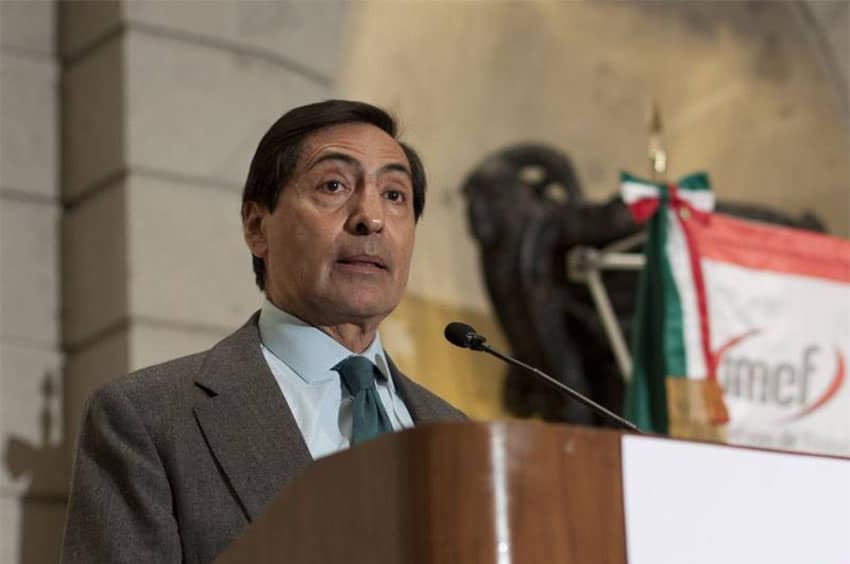
Finance Minister Rogelio Ramírez de la O.
The SHCP also expects the price of oil to bolster the economy, which it estimates will average US $92.90 per barrel in 2022 and $61.10 per barrel in 2023. At the beginning of the year, a barrel was expected to average $55.10 per barrel in 2022.
The SHCP predicts inflation to average 5.5% in 2022 and 3.3% in 2023. It expects the peso to be valued at 20.7 to the dollar in 2022 and 20.9 in 2023.
Finance Minister Rogelio Ramírez de la O said Mexico’s dependence on exports exposed it to the unexpected volatility of global markets. Exports make up 40% of the Mexican economy, and “in that part we have had a negative impact that was not contemplated when we calculated the growth rate of 4%,” he said.
The port of Pichilingue can currently accommodate both cargo and passenger ships. API BCS
A company that intended to build a new 1-billion-peso (US $50.6 million) cruise ship pier and terminal in La Paz, Baja California Sur, has withdrawn its plans, but environmentalists fear that it could revive the project sometime in the future.
Aquamayan Adventures, owned by businessman Isaac Hamui Abadi, planned to build a pier capable of accommodating two large cruise ships in Pichilingue, a Gulf of California port about 40 kilometers north of the city of La Paz.
The plan was met by significant opposition because the development, which was also slated to include restaurants, shops and other facilities for cruise ship passengers, would have impinged on the Balandra Flora and Fauna Protection Area, which includes a beach considered one of the most beautiful in the world.
The Baja California government announced in late March that Aquamayan Adventures had withdrawn its application to build the pier and asked the federal Environment Ministry (Semarnat) to terminate the environmental impact assessment it was carrying out to determine whether the project would be approved.
Mario Sánchez, regional director of the Mexican Center for Environmental Law (CEMDA), said the company’s decision confirmed that the project was incompatible with the natural environment. He also said that local planning regulations explicitly prohibit a project of the type Aquamayan Adventures intended to build.
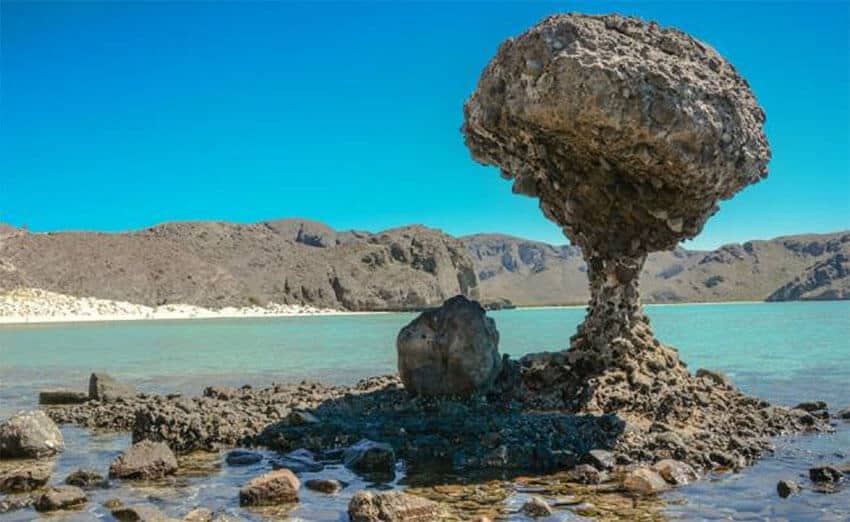
The Balandra natural protected area’s famous mushroom rock formation, with Balandra Bay in the background.
“Economic and tourism development should not compromise the stability and proper functioning of ecosystems [and] the species that live in them,” Sánchez said, referring to marine animals such as whale sharks and bottlenose dolphins.
CEMDA and other groups asserted that the pier project would adversely affect the Balandra area as well as the whale shark sanctuary in La Paz Bay and the Espíritu Santo Archipelago National Park.
Activists participated in dozens of protests to denounce the project and thousands of state residents signed a petition against it. Semarnat held a public consultation process earlier this year that allowed environmental groups and citizens to raise concerns.
As part of its pier project, which was slated to simultaneously accommodate two cruise ships measuring up to 360 meters and carrying up to 6,000 passengers each, Aquamayan Adventures planned to dredge almost 80,000 cubic meters of La Paz Bay.
Local scientists said that dredging would contaminate the Gulf of California with mud and toxic insoluble hydrocarbons.
Scientists also said that Aquamayan Adventures’ environmental information didn’t outline the impact a proposed desalination plant would have on the Mogote-Ensenada de La Paz wetlands, a site protected by the Ramsar Convention on Wetlands of International Importance. Construction of a desalination plant was planned to provide fresh water to the cruise ship pier and terminal complex.
While groups and citizens opposed to the proposed development are happy with Aquamayan Adventures’ decision, Sánchez warned that it could be a “temporary victory” for environmentalists.
The CEMDA director and Alejandro Águila, an environmental engineer and head of a collective opposed to the pier project, believe that the company could seek approval for the development at a later date.
“It’s a strategy – we’ve experienced it in other processes before. They present the project, test the waters, see what [people] say, … withdraw it and rethink it,” Sánchez said.
Aquamayan Adventures has ample time to reconsider its plans. Via a competitive tendering process held last year, the company was awarded a 25-year concession for the area where it planned to build the new pier. Aquamayan Adventures, which paid 40 million pesos (US $2 million at today’s exchange rate) for the concession, has an option to extend it for an additional 20 years, according to the contract it signed.
The new 50-peso bill was introduced in October 2021.
The 50-peso bill has been named Bank Note of the Year 2021, meaning the Bank of México has won the prestigious award two years running.
The voting membership of the International Bank Note Society (IBNS) selected the predominantly purple 50-peso note above 19 other attractive notes released in 2021.
The bill depicts Tenochtitlán, the last Mexica capital and forbear to Mexico City, and a version of the national emblem, an eagle perched on a prickly pear cactus eating a rattlesnake.
The reverse side of the note features an axolotl, a kind of salamander found in Mexico’s ecosystem of lakes and waterways.
Last year, a 100-peso bill depicting the self-educated nun and intellectual Sor Juana Inés de la Cruz, with the monarch butterfly biosphere reserve on its reverse, was voted the winner for 2020.
One side of the 50-peso note features an eagle perched on a cactus, an image from the legend of the founding of Tenochtitlán. In the background is a depiction of the same city, inspired by a Diego Rivera mural.
More than 100 new banknotes were released worldwide in 2021, but the IBNS only deemed 20 to be sufficiently original to merit nomination. The IBNS said the battle for first place was a tight contest with the Mexican bill edging out Sao Tome and Principe’s 200-dobra bill.
Third place was a tie between a Bank of England note featuring World War II code breaker Alan Turing and a bill from Costa Rica commemorating the abolition of the country’s army.
Notes from Romania, the Royal Bank of Scotland, China and the Cook Islands were all among the top eight.
The Tenochtitlán note is part of the Bank of México’s G Series, first introduced in 2018. It is printed on polymer, a material popular among IBNS’ voting members for its security features, and is produced in a printing complex in Jalisco which began operation just before the COVID-19 pandemic.
Past banknote of the year recipients include Aruba, Canada, Uganda, the Faroe Islands, two time winner Switzerland and three time winner Kazakhstan, among others.
AMLO's son José López Beltrán could teach his dad about thick skins: politicians mocked his luxury home with a Lego-style version; he said he wants one for his son.
My kid cannot take a joke.
Don’t get me wrong. She’s plenty funny and great at making jokes in that obvious and exaggerated eight-year-old kind of way. But under no circumstances does she consider being a target of the joke acceptable (unless she’s the jokester, of course) — no matter how good-natured or lighthearted it might be.
This is too bad, as she’s growing up in one of the jokiest cultures I’ve encountered. “Lisa,” I tell her. “You live in one of the most bromista countries in the world. If you don’t learn to chill a little bit, you’re going to have a Very Bad Time, fair or not.”
In the meantime, I try my best (like we all do, right, fellow parents?) to find that balance between the two seemingly mutually exclusive facts that we know we must impart to our children: one, that they are unconditionally loved and exceedingly unique and special; and two, that they are no better than anyone else.
The jokes are usually in service to this second lesson, meant to be gentle and lighthearted reminders that none of us are actually perfect and right at all times.
Those without children might be surprised to know that most kids (in non-abusive homes, anyway) actually have to learn that they’re not naturally flawless beings. Frustration with that fact can be harsh, but a good sense of humor can help them to take at least some things in stride.
Humility isn’t a natural trait, but it makes the world go round, so here we are. A good-natured joke or two can help smooth out those jagged lessons.
Like most people, I’m a fan of comedy. It feels good to laugh! But boy oh boy, are we all ever on edge these days.
Laughter is a pleasant way of losing control. (Notice how people say “I lost it!” when describing a bout of uncontrollable laughter?) But as Will Smith learned after the Slap Heard ʼRound the World, the line between losing control in a positive way and a negative way can show itself to be exceedingly thin.
And as every comedian from medieval court jesters to Chris Rock and Mexico’s Chumel Torres can tell you, a joke might get a laugh or it might get you in serious trouble. And in this very sensitive and on-edge world where we’re all feeling pretty darn cranky (and about to “lose it” in a bad way) most of the time, comedy is changing. The types of jokes that people find acceptable to laugh at are shrinking.
This isn’t necessarily a complaint but my own personal “wow, so many things have changed — I must be getting old!” reflections of bafflement.
I came of age cracking up at the no-holds-barred wit of Sarah Silverman’s standup routines, Jon Stewart on The Daily Show, and celebrity roasts, as well as watching movies like American Pie and Scream that I very much doubt could be made today since they partially relied on tropes now seen as racist or sexist.
We can be funny, of course, without making fun of other people. And it’s especially a positive thing for famous people with large audiences to be sensitive to the feelings of others. But if comedy is truly about pushing boundaries in unexpected and absurd ways — then how do we both keep that going and follow all these newer rules?
Is simply not laughing and instead rolling our eyes not enough of a response when we hear a joke we don’t like?
I’ve been thinking about this question since it was announced that Chumel Torres, who became well-known for a sort of “Mexican Daily Show” program on YouTube, was being investigated for gender-based violence after making fun of Morena party Senator Bertha Alicia Caraveo Camarena on his show for supporting AMLO in the face of a scandal about his son’s opulent home in the United States. On the episode in question, among vitriolic humor at her expense, he referred to her as “mamacita” (cute chick). Caraveo acknowledged to the press this week that she had filed the report with authorities against Torres with the federal Attorney General’s Office.
My immediate response was to roll my eyes. In fact, I’d go as far as to say that I consider jokes about powerful politicians to be a necessary public service. It’s both a way of reminding those in power that we’re watching rather than ignoring them while they do as they please. It’s also a way of making sure average citizens have a notion of what’s going on in the political arena even if they don’t read the paper for three hours every day.
Not all politicians can take a joke, though. AMLO seems to have set the tone for his party in being particularly thin-skinned, although he doesn’t seem to have trouble personally with being flat-out mean in response — no humor-casing necessary.
That said, there’s a bit of nuance to unpack in the senator’s response: I personally think it’s fair to say that Torres was taking aim at her in her role as a politician; she responded, however, as if she were being attacked for being a woman, which I don’t believe was the case.
And anyway, she’s in the public eye. She’s one of the few people around here who is actually actively running the country. And people who say they’re our public servants when really they’re our rulers deserve major scrutiny and criticism when they mess up; it’s simply part of the job.
Perhaps she and AMLO could take a cue from President Obama, a master at knowing just how to deal with jokes at his expense — my favorite was when he announced he’d do even better than showing his birth certificate and would show a birth video … then put on the Simba presentation scene from The Lion King, to wild laughter and applause.
It’s OK to not laugh, and to feel hurt or mad instead. It’s good for jokesters to apologize when they realize they’ve hurt someone. But the real power move is when the target comes up with the perfect comeback that helps us all to take ourselves a little less seriously.
So let that papacito Chumel have it, Senator. Think of a good one. He can take it.
Many know turmeric only in its powdered form, mostly to add color to dishes.
One chef-friend told me this, then another. By the time a third strongly suggested the same thing, I was on my way to the mercado. I ran into yet a fourth chef-friend, visiting from Vancouver, who also encouraged me to get the real thing.
“It makes a huge difference,” he said. “You’ll never use powdered again.”
It was turmeric we were talking about, (cúrcuma in Spanish) an essential Indian spice used by billions of people all over the world. If, like me, you’ve only cooked with the powdered version, you’re in for a delightful surprise.
For many of us, turmeric’s only use has been in its powdered form, to add an earthy ochre color to dahls, soups and curries. Fresh turmeric, though, drastically changes the flavor landscape, adding a rich, bright complexity — especially when paired with coconut milk — and helps balance spicier seasonings.
Turmeric’s flavor also works in egg dishes, marinades for chicken, pork and beef, hot cereals and bean dishes. It elevates a basic like chicken noodle soup or Basmati or brown rice to something memorable. It makes a delicious, pretty and nutritionally advantageous tea or hot drink.
Humans have been consuming turmeric for centuries for both flavor and health.
“Golden milk” (haldi doodh in Hindi) is a traditional Indian drink recently “adopted” by health food aficionados due to turmeric’s ability to increase antioxidants and build up the immune system. Many people drink the tea every day or take it in capsule form. Basically warm sweetened milk with turmeric, it can include black pepper, fresh ginger, black tea and cardamon too. I’ve included a recipe here, but feel free to adjust the ingredients to your taste.
Fresh turmeric rhizomes are easily and inexpensively available in Mexico. Like ginger, the plant flourishes here.
The “fingers” are straighter, smaller and thinner than ginger, and under the thin skin, the flesh is bright carrot-orange — which immediately stains anything it comes in contact with. Chefs strongly suggest using disposable latex gloves and considering carefully what cutting boards and implements you use when cooking with fresh turmeric. Like fresh ginger root, turmeric fingers can be frozen and then grated when needed.
Please take the warning about turmeric staining seriously; if you think beets are bad, fresh turmeric is even worse. Skin, fabric, wood, light-colored silicone spatulas (sigh) … all will turn orange. Use latex gloves or plastic bags over your hands. Some say scrubbing your skin with sugar will help remove the stains, but I’ll go with gloves!
Golden Milk
¼ cup water
½-inch piece fresh turmeric, grated OR ½ tsp. dried turmeric
1½ -inch piece fresh ginger, grated
1 cardamom pod
1 (2-inch) cinnamon stick
3 black peppercorns
½ Tbsp. honey
1 cup milk (dairy, coconut or nut)
1 black tea bag
Place water, turmeric, ginger, cardamom, cinnamon, peppercorns and honey in small pan over low heat. Bring to simmer; add milk and teabag. When milk is steaming, add more honey if desired. Pour through a fine-mesh strainer into a cup.
1-inch piece fresh turmeric, grated, OR ½ tsp. turmeric
1-inch piece fresh ginger, grated
¼ tsp. freshly ground black pepper
Salt
In large skillet, heat oil over medium-high. Add turmeric, ginger and black pepper, stir and cook 1 minute. Add chickpeas. Continue cooking, stirring to coat in spices and oil, until chickpeas are crispy and golden on edges. Season well with salt. Serve immediately.
Turmeric Fried Eggs with Kale, Yogurt & Bacon
4 slices cooked bacon
1 bunch curly kale, ribs and stems removed, leaves torn into large pieces
5 Tbsp. olive oil, divided
Salt
1 cup plain Greek yogurt
4 eggs
½-inch piece fresh turmeric, grated OR ½ tsp. dried turmeric
For serving: red pepper flakes, lime wedges
Fried till crispy in turmeric, pepper and ginger, these chickpeas make a great side dish — or even a quick meal over some rice.
Preheat oven to 375 F (190 C). Spread kale on baking sheet. Drizzle with 2 Tbsp. oil, massage into leaves and season with salt. Bake 5–7 minutes, tossing halfway through, until lightly browned around edges and crisp-tender.
Season yogurt with salt. Divide among plates. Top with the bacon and kale.
Heat remaining 3 Tbsp. oil in nonstick skillet over medium-high. Add eggs one at a time, gently shaking skillet to keep them from sticking together. Tilting skillet toward you, spoon oil over egg whites, cooking until set. Remove from heat, keeping skillet tilted.
Add turmeric to oil and gently baste eggs. Divide eggs among plates; drizzle with remaining oil and lime juice, sprinkle with red pepper flakes and serve.
Grilled Pork Chops with Pineapple-Turmeric Glaze
½ cup pineapple juice
¼ cup honey
¼ cup rice vinegar
3 Tbsp. Dijon mustard
1 tsp. crushed red pepper flakes
½ tsp. toasted sesame oil
½ tsp. ground turmeric
Four (1-inch-thick) bone-in pork chops
Salt
Heat grill; oil grate. Bring pineapple juice, honey, vinegar, mustard, red pepper, sesame oil and turmeric to simmer in small saucepan over medium heat. Stir until reduced to ¾ cup, 10–15 minutes. Cool. Set aside half of sauce for serving.
Season pork with salt. Grill over direct heat until browned all over, about 3 minutes per side. Continue grilling, turning and basting with the sauce until it’s charred and coated with a thick layer of glaze, about 4 minutes.
Check internal temperature of pork. If needed, continue grilling. Let chops rest 10 minutes before slicing. Serve with reserved sauce.
Creamy Turmeric Pasta
½ lb. spaghetti, fettucine or capellini
1Tbsp. butter
1 large shallot OR ½ large onion, thinly sliced
2 garlic cloves, thinly sliced
Salt and pepper
1 tsp. ground turmeric
½ cup half-and-half
1 cup freshly grated Parmesan, plus more for serving
2 Tbsp. minced fresh parsley/chives
Cook pasta according to package instructions. Drain, reserving about ½ cup pasta cooking water.
Melt butter in large saucepan over medium heat. Add shallot/onion, garlic, salt and pepper; cook, stirring, until golden-brown, 3–4 minutes.
Add turmeric; stir to toast, about 30 seconds. Slowly whisk in half-and-half. Bring to a simmer. Whisk in 1 cup Parmesan.
Add pasta and reserved pasta cooking water. Toss to coat; sprinkle with fresh herbs. Serve immediately.
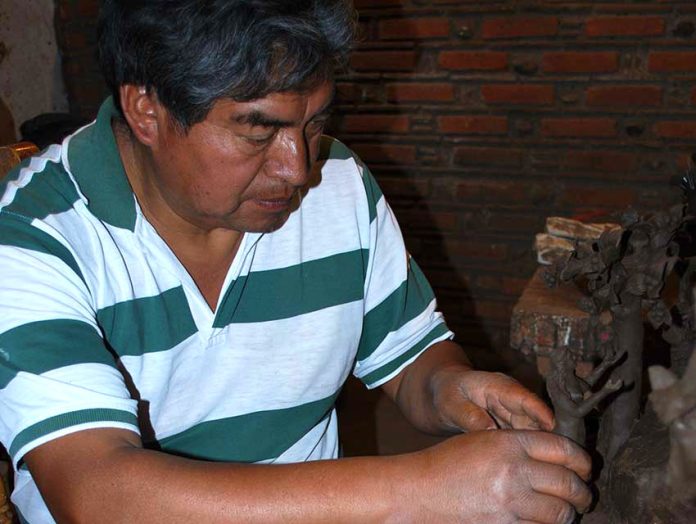
Tiburcio Soteno in 2017 at his workshop in Metepec, México state. Alejandro Linares Garcia
On March 20, 2022, Mexico’s world of folk art lost one of its masters.
Tiburcio Soteno was not just a fine ceramicist, he was a central figure in a community’s struggle to maintain its identity in the face of sprawling urbanization.
For almost all of its history, Metepec, México state, was a rural farming community with an important pottery industry dating back to the pre-Hispanic period. Today, if you go into the town’s historic center, you can see that rural heritage in the church and the masonry houses, whose mortar joints are decorated with small pebbles to create a unique look.
However, that ancient charm stops abruptly a couple of blocks from the church as you enter an unending sea of often unpainted cinder block construction. Land prices driven up by local growth and the rise of bedroom communities catering to those working in the western part of Mexico City means that farming is all but extinguished here.
But pottery manages to hang on.
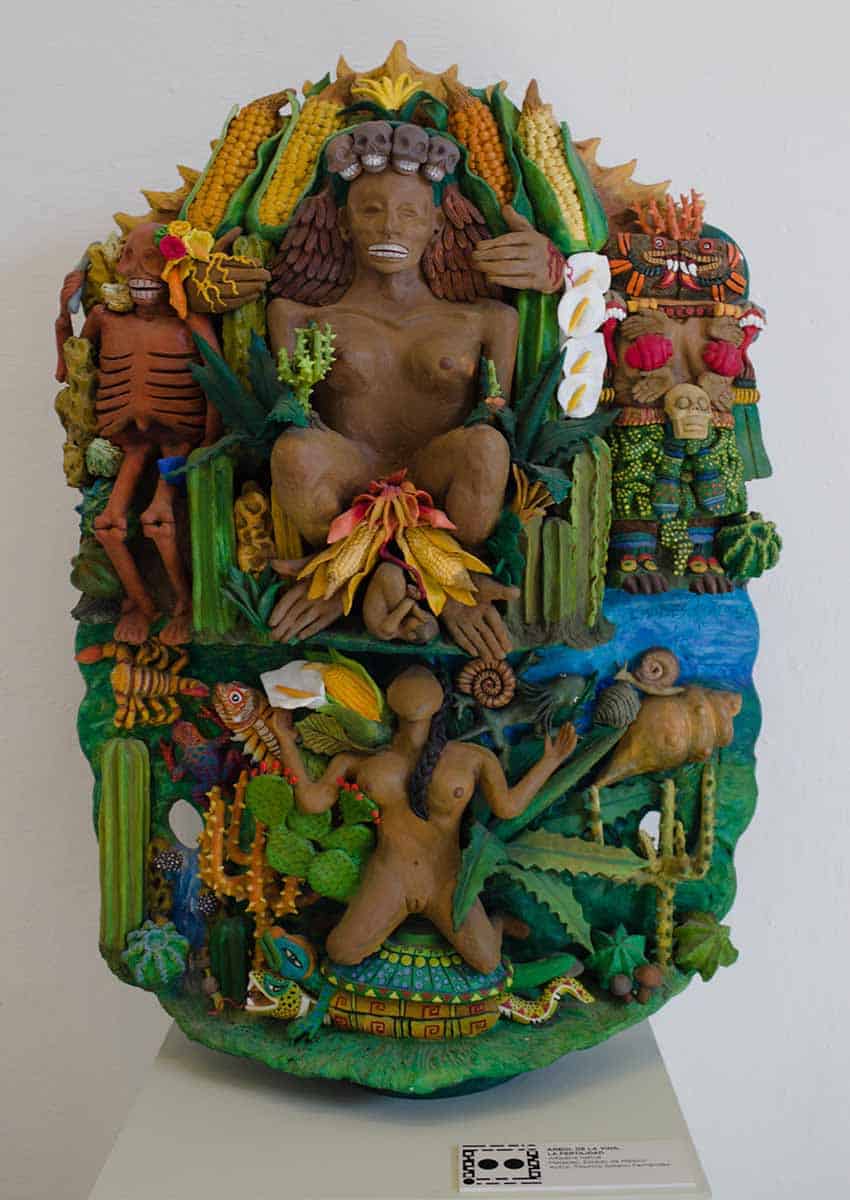
Abstracted tree sculpture by Tiburcio Soteno with pre-Hispanic images related to fertility. ANGM 142/Creative Commons
The oldest forms are utilitarian, especially the making of pots called cazuelas, which are often used for cooking mole sauce and rice. But in the last century, in response to changes in the market, many of the town’s artisans began shifting to decorative items, such as sun-and-moon wall decorations and mermaid figures.
But perhaps Metepec’s most important contribution to Mexican folk art is its “trees of life” sculptures.
Originally decorated candle holders, these winding, ornate tree sculptures have since taken on a life of their own, even losing spaces to put any candles. The most traditional of these is a tree with leaves and animals representing the Garden of Eden and figures of Adam and Eve. However, they have since evolved to include other themes; even the tree part itself can be stylized to the point that it becomes an abstract geometric support structure.
Metepec’s trees of life are most popular in central Mexico, including Mexico City, but are also well-known worldwide among Mexican folk art collectors.
The Soteno family has been instrumental in the development of these sculptures. Both of Tiburcio’s parents were potters, but it was his mother, Modesta Fernández, who began to experiment with more decorative pieces in the first half of the 20th century.
Her success changed the family’s fortunes.
Four-meter tall tree of life made by Tiburcio Soteno’s nephew Oscar Soteno, who learned from Tiburcio, on display at the Museum of Folk Art in Mexico City. Alejandro Linares García
All of Fernández’s children went into ceramics, and all started working when they were children. However, Tiburcio became the most recognized for his technique, creativity and innovation.
Over a six-decade career, he created numerous mermaids, Nativity scenes and even soldier figures. However, it is his work with the trees of life that earned him the title of “Grand Master of Folk Art” and led him to being included in Fomento Cultural Banamex’s prestigious registry of Mexico’s best artisans.
I was extremely fortunate to meet Maestro Tiburcio a few years ago at his family’s workshops. Like many intergenerational artisan clans, there is an informal apprenticeship system by which the next generation grows up with their hands in clay. A gracious host, Tiburcio gave us a full tour and demonstration. The fact that he had created works for museums and other collections around the world never went to his head.
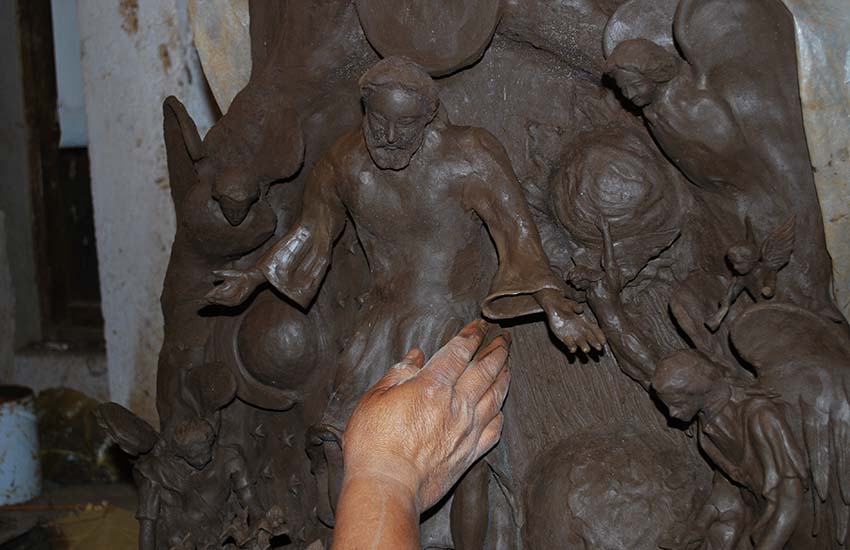
His trees’ structures consist of a wire “skeleton,” over which clay is molded by hand. Then comes the arduous work of creating and placing the nearly infinite number of elements: for Tiburcio, only a few highly repetitive elements, such as leaves, were done with molds; everything else, including all the painting, was done freehand.
Tiburcio and his family have made pieces as small as several centimeters to those over five meters high, each with their own technical challenges. But it was their creativity that brought in commissions to create unique tree sculptures, such as ones based on the Laura Esquivel novel Like Water for Chocolate, on Dante’s Inferno, on the life of Juana Inés de la Cruz, and on the 2010 Bicentennial of Mexico’s Independence.
In fact, their success has led to most of the family’s business being special orders.
Detail of an image of God on a traditional tree of life being made by Tiburcio Soteno. Alejandro Linares García
Tiburcio was instrumental in passing on his mother’s innovative spirit. Rather than resting on laurels, he encouraged following generations to continue to improve and innovate. The family is so prominent in Metepec because there are four generations of clay-working Sotenos.
And Tiburcio’s sons Carlos, Saul and Israel are all noted artisans, as is nephew Oscar, all with pieces in noted public and private collections in North America, Europe and Asia.
The maestro may no longer be with us, but he ensured that his legacy always will be.
Leigh Thelmadatter arrived in Mexico 18 years ago and fell in love with the land and the culture in particular its handcrafts and art. She is the author of Mexican Cartonería: Paper, Paste and Fiesta (Schiffer 2019). Her culture column appears regularly on Mexico News Daily.
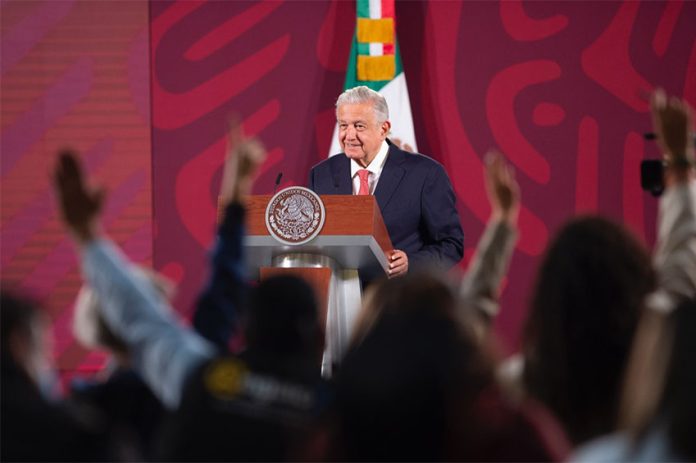
President López Obrador takes questions at his Tuesday press conference. Presidencia de la República
Last weekend was a busy one, even by President López Obrador’s standards. It took him around the Valley of México to a bridge in Morelos, a gas plant and hospital in Hidalgo, a ceremony in Puebla, a soccer pitch in México state and the mayor’s office in Mexico City’s Iztapalapa borough, the most populated municipality in the country.
Monday
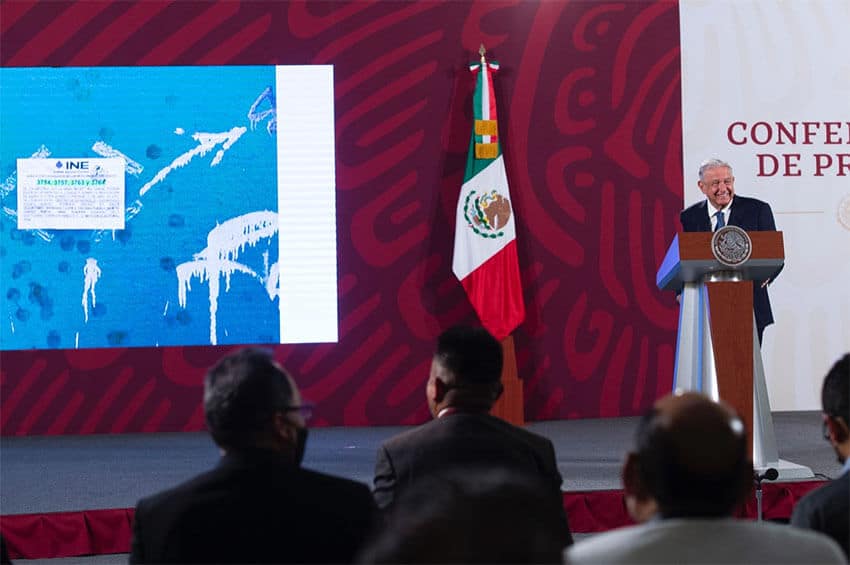
First on the agenda: democracy and how to do it. The president highlighted a referendum in Uruguay on Sunday as participatory democracy done right, but mocked a tiny leaflet used by the National Electoral Institute (INE) to promote the upcoming vote on his performance.
“You have to search for those leaflets like Dora the Explorer,” he said, referring to the character from an old children’s cartoon.
INE advertising was the butt of jokes at Monday’s conference. Presidencia de la República
Lithium, however, wasn’t for sale. López Obrador hopes to make it a national asset through the electrical reform and said Bolivian authorities were working to help Mexico exploit its lithium reserves.
Later in the conference, AMLO cited a left wing icon who’d come to know both Bolivia’s rulers and Mexico’s treasures well. “Che Guevara said when he visited Palenque: ‘It’s the jewel of the Americas,'” the president proudly recounted, referring to the Argentinian revolutionary whose life was ended by Bolivia’s security forces.
Tuesday
The president was back to his side job on Tuesday, hawking lottery tickets. For 200 pesos (US $10) hopefuls were in with a chance of winning a lot on a beach in Sinaloa or a luxury car seized from criminals.
On a falsely reported shooting in Cancún, AMLO noted the media’s capacity for invention and assured that security was in good order.
“Mexico is a country with tranquility and with peace. Violence is limited to very few regions of the country. It has more to do with confrontation between gangs … Mexico is a safe country of good, hardworking people,” he said.
With the energy reform still in the offing, the president delivered an announcement on his next proposed reform. National Electoral Institute councilors should be elected by citizens, he said.
“I’m going to propose that it be the people who elect electoral councilors and magistrates directly … I hope it will end the issue of elitist agreements contrary to the interests of the people,” the president added.
Wednesday
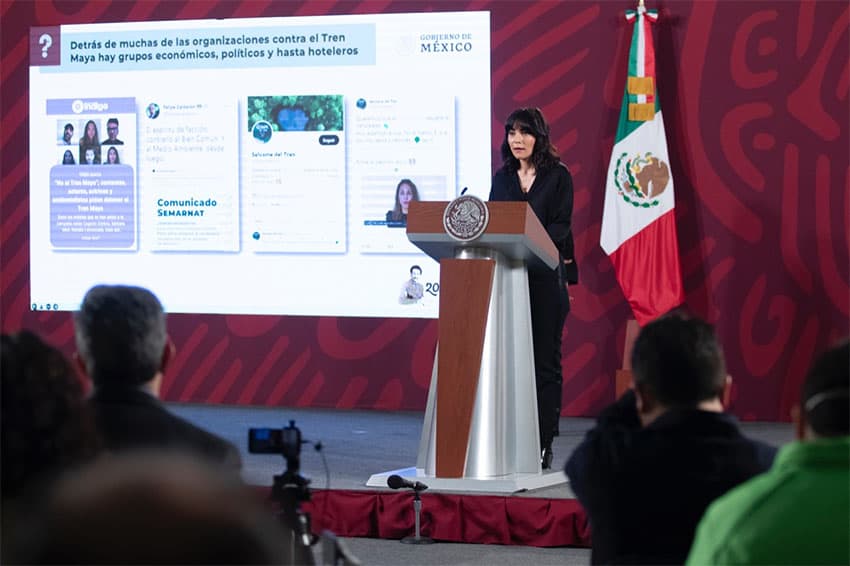
Elizabeth García Vilchis, as per her weekly duty, debunked the media’s errors and fibs that had caught her eye. She said Mexican migrants returning from the United States couldn’t have been charged bribes because they hadn’t made formal legal complaints and added that those who don’t consider Lake Texcoco an area of natural beauty had financial interests in the canceled airport there.
García assured that the Maya Train wasn’t damaging to the environment compared to the mining, pig farms and tourism promoted by previous administrations and mocked journalists who she said erroneously reported a shooting at Cancún airport.
A miniature Lego model of the controversial home of López Obrador’s son had been exhibited by lawmakers from the National Action Party (PAN). The president showed his amusement: “A Lego of José Ramón’s house … What creativity. Such cuties,” he mocked, before adding there was nothing untoward with his son’s living arrangements. “José Ramón is 40 years old, he’s married. He rented it with his wife. 100,000 pesos [US $5,040] per month. I wouldn’t do it, but he’s independent,” he said.
On Wednesday, Elizabeth García Vilchis took aim at opponents of the Maya Train in her weekly segment. Presidencia de la República
On a video allegedly showing navy personnel manipulating a supposed crime scene related to the 2014 disappearance of 43 student teachers, the president said that Navy Minister Rafael Ojeda had no involvement. Investigations are ongoing into the disappearance of students from the Ayotzinapa teachers’ college in Guerrero in 2014.
Thursday
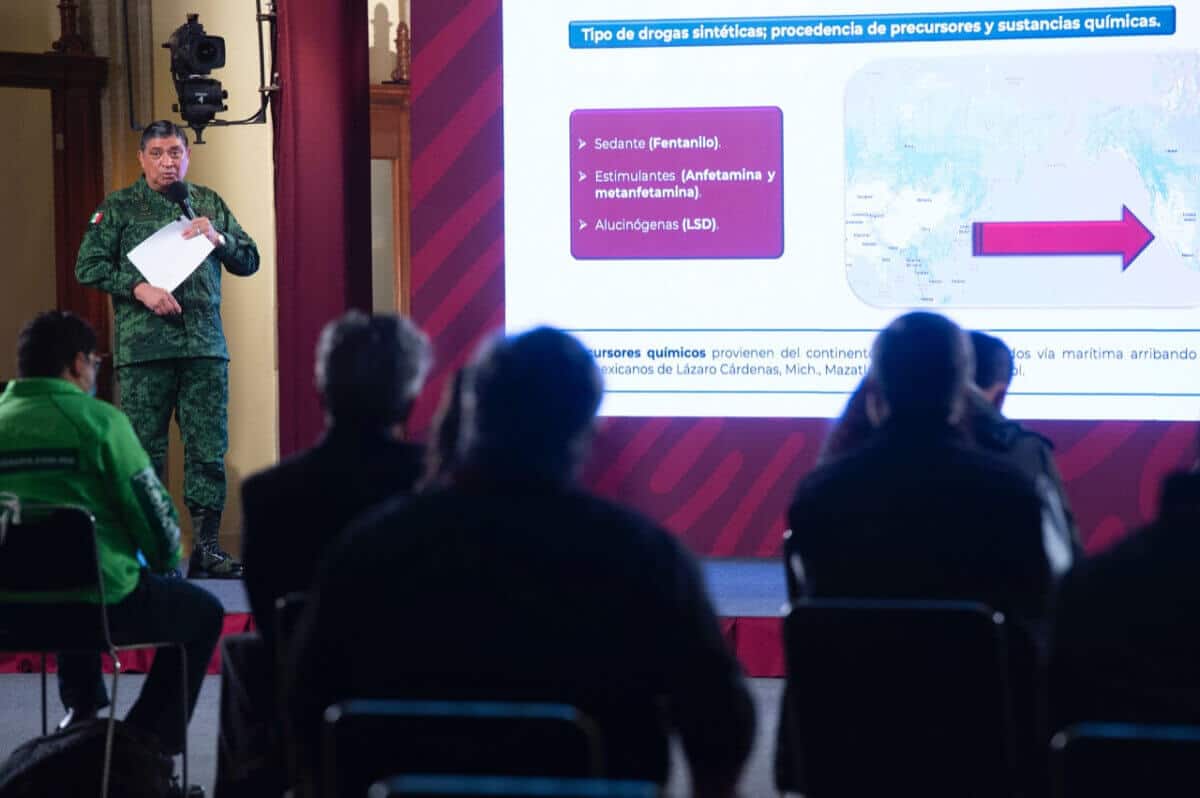
Drugs were the topic of choice for Defense Minister Luis Cresencio Sandoval and he started with a brief history lesson: U.S. drug demand grew in the 1970s leading to marijuana and opioid production in Mexico; in the 1980s the focus switched to cocaine and in 2009 methamphetamine laboratories in Mexico mushroomed, he said. Recently, marijuana production in Mexico has dropped due to U.S. legalization of the drug, he explained.
Cresencio added that the government had eradicated marijuana and opium poppy fields 7,000 times the size of Mexico City’s Aztec Stadium, mainly in Sinaloa, Durango, Chihuahua and Guerrero.
Cocaine, he said, came to the country from South and Central America: 73,834 kilograms have been seized during the administration. He detailed that the base substances to make methamphetamine and similar drugs were coming from Asia through ports on the Pacific. Cresencio said 127 labs had been busted by the current administration, mostly in Sinaloa.
The president said the government was considering legalizing “nondestructive drugs with light effects, as is the case with marijuana,” but that an internal agreement hadn’t been struck, and later confirmed he was meeting with U.S. Climate Envoy John Kerry and 20 U.S. business representatives to discuss the electrical reform.
Defense Minister Luis Cresencio Sandoval shared information about the status of the drug trade and history of drugs in Mexico on Thursday. Presidencia de la República
The tabasqueñosaid he’d stand strong on his proposals. “There are many technocrats who think that the state must be diluted and that everything has to be solved by the market. No … Good politics was invented to bring order to chaos,” he affirmed.
“They felt well attended and satisfied, because it’s not true that [the electricity reform] promotes dirty energy sources … it’s not true we don’t want to produce solar, wind and hydroelectric energy,” he said.
He added that there would be no new coal plants in Mexico and that the three in operation were running at 50% capacity.
“Compared to the coal energy produced in China or the United States, it’s nothing,” the president insisted, before highlighting the construction of Latin America’s biggest solar park in Puerto Peñasco, Sonora.
“There weren’t really any protests, they were very respectful,” López Obrador added of the meeting with Kerry and company.
However, the president hinted that the meeting was not entirely cordial. The U.S. proposed that a working group participate in the reform, but the suggestion was rebuffed.
“They raised it and I remained silent … It wasn’t accepted … for a group to watch over our activities,” the president revealed.