Tourists gather inside a Puerto Morelos hotel during Thursday's shooting incident.
A confrontation between presumed drug dealers left two people dead in Puerto Morelos, Quintana Roo, while tourists and locals scrambled for cover.
The attackers arrived by boat on a beach in the Riviera Maya destination, then proceeded to execute two presumed low-level drug dealers. The incident occurred in Petempich Bay, causing many in the area to seek safe haven in the nearby hotels, including the Hyatt Ziva Riviera Cancún and Azul Beach Resort. In addition to the two deaths, a tourist received medical attention for a mild injury after being hit in the head with a firearm.
One witness to the chaos was NBC executive Mike Sington, who was at the Hyatt at the time.
“All guests and employees told to duck, and we’re all taken to hiding places at Hyatt Ziva Riviera Cancun Resort. Active shooter? Terrorist or kidnapping threat? They’re not telling us anything,” Sington said on Twitter, posting video showing how he and others followed staff instructions to hide in the depths of the hotel.
“Other guests told me they heard gunfire. Resort is secluded, was told gunman came up from the beach. Hotel employees hugging each other,” he wrote half an hour later.
Another hotel guest wrote, also on Twitter: “Active shooter in our hotel. We’re hiding in my room, a group of us. Praying all guests and hotel staff get through this. Men with machine guns came in from the beach.”
Still hiding in a dark room deep in the hotel. Other guests told me they heard gunfire. Resort is secluded, was told gunman came up from the beach. Hotel employees hugging each other. pic.twitter.com/7Vv16Y7Zts
Some 2 1/2 hours later, around 5 p.m., Hyatt staff told hotel guests that someone had been apprehended, but advised them to shelter in their rooms with the doors barricaded, Sington said. But state officials have not announced any arrests.
Rather, the Quintana Roo Attorney General’s Office has only reported that the disturbance was a conflict between drug dealers, and that there were no serious injuries apart from the deaths of the alleged drug dealers.
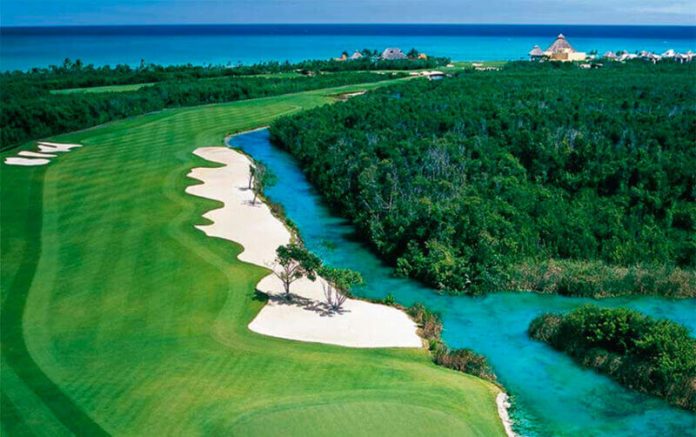
The Mayakoba golf championship will be played at the El Camaleón Golf Club in Playa del Carmen.
With the Mexico Grand Prix, a major boxing match and a PGA Tour golf tournament in Quintana Roo all scheduled for this weekend, sports fans of all stripes are sure to be entertained.
First off, starting on Thursday and running through the entire weekend, is the Mayakoba Golf Classic, also known as the World Wide Technology Championship. The high profile event will bring various Majors-winning players from around the world, including Justin Thomas, Brooks Koepka and Patrick Reed, to the El Camaleón Golf Club in Playa del Carmen.
Next up will be Saturday’s fight between Mexican boxer Saúl “Canelo” Álvarez and American Caleb Plant. The super middleweight face-off brings together opponents who have come to blows outside of the ring in the past: the boxers previously had a personal conflict over a supposed insult to Álvarez’s mother.
Four champion titles from leading boxing organizations will be at stake in this weekend’s fight, which takes place at the MGM Grand Garden Arena in Las Vegas at 6 p.m. Pacific time and will be broadcast in the U.S. on Showtime as a pay-per-view event for a price of US $79.95. For the rest of the Americas, the fight will be broadcast on ESPN.
Finally, the Mexico Grand Prix will take place in Mexico City this weekend. Classification will start on Saturday and the main race is scheduled for 1 p.m. Sunday.
The weekend’s lineup is a “pretty exciting” moment for Mexico, said Mexican professional golfer Abraham Ancer.
“It speaks well of how things are being done in Mexico. Obviously there are many things we can improve, little by little. Not just more tournaments but players, drivers, and boxers who will raise up the name of Mexico. Honestly, it makes me proud,” Ancer said.
Fellow golfer Carlos Ortiz added that it was an opportunity to motivate younger generations of athletes, and called on the federal government to do more to support sports in Mexico.
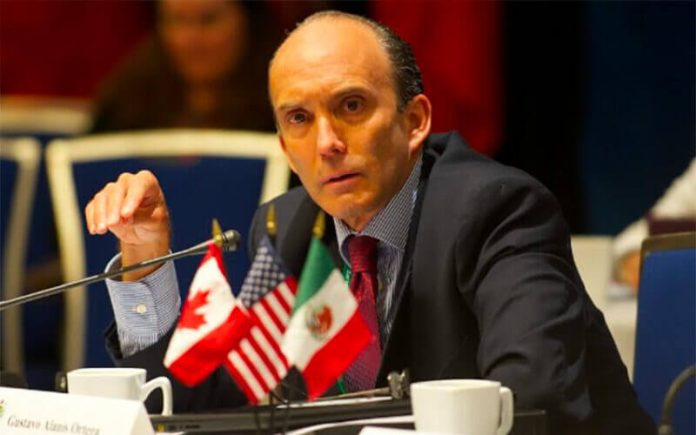
Center for Environmental Law president Gustavo Alanís said Mexico only signed the pact after pressure from environmental groups.
It was all over the news in Mexico on Tuesday: more than 100 countries had signed an international pact against deforestation, but Mexico was not on the official list.
A few hours later, however, a new list was released, this one signed by Mexico but apparently at the last minute and, according to some observers, only because of pressure by environmental groups.
Adding to the mystery of the affair was the fact that clarification of Mexico’s having signed the Glasgow Declaration at the COP26 climate change conference in Scotland came from the Ministry of Foreign Affairs, rather than the Ministry of Environment, whose minister was still in Mexico at the time.
At his morning press conference on Wednesday, President López Obrador questioned how Mexico could not possibly have signed an agreement which he claimed was inspired by his reforestation program Sembrando Vida (Sowing Life).
“Where do you think [the deforestation accord] came from? From Sembrando Vida; they said that Mexico didn’t sign onto the reforestation program … we proposed [it],” the president said, observing that it is “the most important reforestation program in the world,” adding, “There’s no other country in the world that is investing $1.3 billion a year in reforestation.”
López Obrador also thanked Foreign Minister Marcelo Ebrard for representing the country’s interests at COP26 — even though he wasn’t there. The president appears to have confused the climate conference with last weekend’s October G20 summit of world leaders in Rome, which the foreign minister did attend, where he pleaded for funds to help developing countries address climate change.
Environmentalists criticized both the nation’s tardy acceptance of the reforestation accord and the president’s Sembrando Vida project.
The president of the Mexican Center for Environmental Law (CEMDA), Gustavo Alanís Ortega, called the president’s statements a “flight of fancy,” saying that Mexico did not sign the reforestation accord until pressure from the domestic and international environmental community forced them to.
“There’s a very strong contradiction in Mexico asking for those resources and building a refinery, promoting carbon-based electric plants and with the electricity reform it is promoting the use of fossil fuels,” Alanís said. “With the Maya Train they are deforesting, with the Dos Bocas refinery they illegally cut down at least 80 hectares of mangrove and with Sembrando Vida they have deforested 72,000 hectares, so they are not being consistent. We are simply talking about yet another flight of fancy of the president of the republic.”
In the Glasgow Declaration, more than 130 countries agreed to reverse current deforestation trends by 2030. Even “climate rebels” including Brazil, Russia and China agreed to the accord, which some environmentalists criticized for its lack of ambition. Greenpeace, for example, called the 2030 deadline for change a “green light for another decade of forest destruction.”
The armed civilians also forced the state police officers to appear in a video in which they made statements defending criminal activity.
Armed civilians ambushed and detained eight state police Tuesday in Huejuquilla El Alto, a municipality in northern Jalisco, taking their weapons and forcing them to record a video before releasing them.
The police, traveling in two vehicles, were on a routine patrol on the highway to Valparaíso, Zacatecas, when a group of more than 50 armed civilians emerged from the brush and attacked them.
The officers surrendered to the much larger group of attackers.
The latter took 16 weapons, eight bulletproof vests, ammunition and four radios, as well as the officers’ patrol cars, one of which was later found riddled with bullet holes.
The civilians then forced the police to record a cellphone video making statements in defense of criminal activity, state authorities said.
“We categorically reject these statements and emphasize that they were obtained under coercion and threats to the lives of our police,” the Jalisco Public Security Ministry said on Twitter.
The ministry also reported that the eight officers are safe and will cooperate with official investigations into the incident.
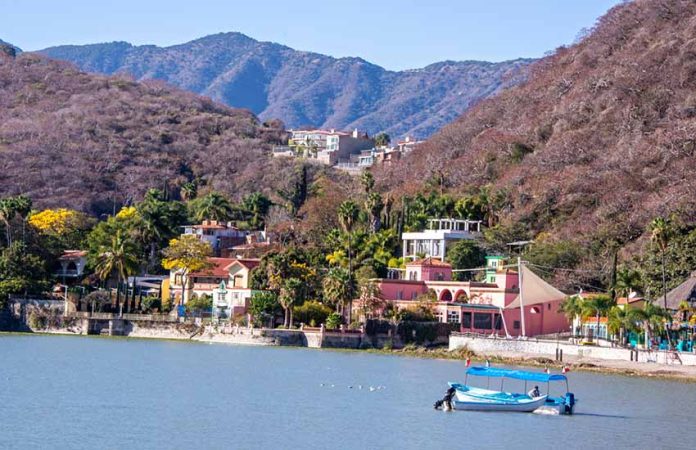
Ajijic and Lake Chapala have been attracting gringos since the 1940s. deposit photos
I live lakeside in Chapala, Jalisco. In all of Mexico, it’s the most picturesque, comfortable and enlightening place any Mexico-seeking expat could ever hope to find. It’s also quite common (when you’re living in paradise) to get drawn into like-minded social spaces, both digital and spatial.
On digital forums, I try to steer clear of the comment sections. But a recent conversation that erupted on an Ajijic chat site was just too juicy to swipe past.
On the surface, it was about a seemingly humdrum matter: poop in the lake.
The protagonist was an innocent expat wanting to “do something” about Lake Chapala and the surrounding area’s rainy season raw sewer overflows. This is a common yearly experience across Mexico (and parts of the United States).
This topic became one of the forum’s most talked-about crises. For an online community that traffics in selling toaster ovens and queries like, “Can anyone help me fix my remote control?” the comments veered to unexpectedly extreme expressions of angst. I took to distilling this vitriolic sewage–in-the-lake commentary, hoping to find the fault line of when and where we expats turn complaints into activism.
Earlier this month, Ajijic’s rains caused more problems than usual, but even in mild years, the rainy season can overwhelm the area’s sewer systems. Government of Chapala
While I found no evidence of anyone with a latent desire for more poop in the lake, it’s clear that the expat community is nowhere near to being on common ground regarding what to do about the issue. We seem to be caught in a swirl of doubt: being “sensitive” versus “don’t waste your time.” The result: with some exceptions, expat residents sit self-sidelined on issue after issue.
As a resident of one of the longest-standing colonies of Americans living anywhere outside the U.S. (American expats have been living here since the 1940s), I expected more multicultural activism. Perhaps a presidente municipal (mayor) whose grandfather was from Wisconsin? It would seem plausible, given the generations of lakeside living by Americans and snowbird Canadians.
However, we expats are still in another orbit from our Mexican neighbors. As shown by this particular social media uproar, when a community issue arises, we too often run for our respective ideological mother ships.
Most of us expats are here for the right reasons and will donate to causes in a generous fashion (giving both time and money). But too often we are susceptible to all this sunshine and the well-stocked shelves of the Super Lake market causing our ideologies to run amok.
It can take something like poop in the lake to reveal our true colors.
For those on one side (liberals?), it’s an abandonment of the credo “think global, act local.” In the doo-doo diatribe about Lake Chapala sewage, this group once again shoots themselves in the proverbial huarache (sandal).
Sometimes it takes a problem like poop in the lake to bring out an expat community’s vastly differing perspectives.
Being “sensitive” (and choosing to do nothing), these folks plop (so to speak) right into the “it’s not our country, be respectful” cushion of hypocrisy. I do appreciate one kind soul’s solution, however: that we all switch to compost toilets.
Bless the 1960s.
In the other corner (social conservatives?) are those who bring their First World problems and material hang-ups to their new Jalisco lakeside home. Mexico is a mere coincidental backdrop for living behind a wall, with better weather and Costco. This group harps about Mexico’s corruption and how nothing is ever going to change.
“Why bother?” becomes their answer to addressing local issues.
In between are those who worry that any form of public expression about local issues is illegal. (It’s not.) Others have come to realize that many Mexicans disdain confrontation, debate and public conflict resolution.
Put this together, and many of us just sit it out.
If they choose to, expats in Ajijic and other gringo communities can live behind walls and not truly acknowledge that they’re living in Mexico,
It’s not that we invaders only want to save the world by rescuing one stray dog at a time or by opening yet another bazaar for dead people’s belongings. We are a damn talented bunch. If you doubt this, spend an hour at Ajijic’s Open Circle get-together/lecture some Sunday morning: you’ll meet social crusaders, engineers, architects, scientists, teachers, writers, esteemed diplomats and true global citizens.
Ninety-five percent of us are gringos, starved (as is our lot) for information and insight. We are a great 60-and-over generation of listeners and learners.
But how do the “why bother” and the “let’s be sensitive” viewpoints come together? Do we “respect” Mexico and Mexicans when we withdraw to the do-nothing comfort zone? Do we exacerbate the problem when writing off expat activism as futile in the face of bad government, weak institutions and corruption?
I propose it’s time for a communal coming of age for Mexico expats. Learn some Spanish, get your residente permanente visa, vary your dining and drinking routine, make Mexican friends, volunteer, mentor kids and find a cause. Maybe then we act arm-in-arm with our neighbors in resolving shared afflictions.
Mexicans would cheer our taking notice of public nuisances. Even more would appreciate us working toward solutions.
Greg Custer has worked in Mexico tourism for over 40 years. He helps foreigners find their village in the sun at www.mexicoforretirement.com.
Mexico's National Autonomous University has gone right wing, according to the president.
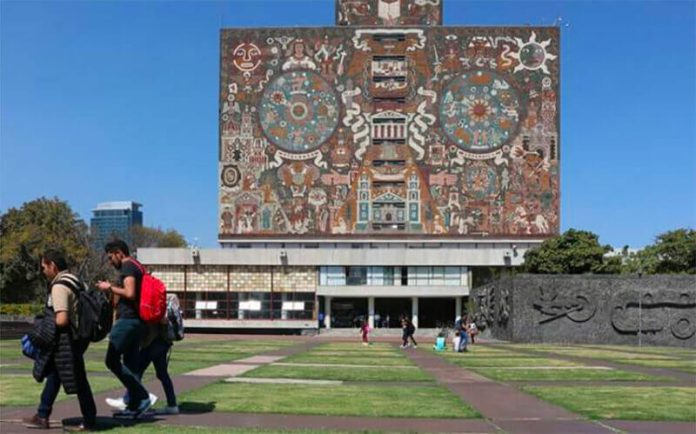
The sprawling campus of Mexico’s National Autonomous University (UNAM) was creeping back to life last week after COVID-19 lockdowns. Students in face masks ambled between faculties, others played Frisbee, while son jarocho fusion music from band practice filled the air.
At first glance, you wouldn’t know that the country’s largest university is caught in a political firestorm. Yet President López Obrador, one of its most famous alumni, has accused the institution of lurching to the right and becoming a defender of “neoliberalism,” an insult he levels at many of his opponents.
The attack was surprising. University graduates and students voted in large numbers for López Obrador when he took power in 2018. Many of his cabinet studied at UNAM — a public institution of the kind the president usually favours in a country where, he says, former governments tried to privatize education.
Some fear his outburst was an attempt to silence critics. The rhetoric also serves to bolster his image as a man of the people against intellectual elites. “It’s not about being neoliberal or not . . . everything in the last three years is about AMLO and the way he wants to be portrayed,” said UNAM linguistics professor Sabine Pfleger. “The only aim is to show he is a hero surrounded by enemies and he’s fighting them on every possible level.”
López Obrador’s offensive came weeks after Mexico’s attorney general sought the arrest of 31 academics, members of a government-funded advisory board, several of whom are UNAM alumni. They were accused of funneling public money into a private entity to buy property and vehicles and pay salaries.
Had a judge not denied the warrants, citing a lack of evidence, the group of physicists, economists and others would have been thrown into a maximum-security prison reserved for those who commit the most serious crimes, including drug lord Joaquín “El Chapo” Guzmán, who escaped via a tunnel in 2015.
UNAM rector Enrique Graue called the charges against the academics “an absurdity.” As for the president’s accusations against UNAM, the university said it had always respected different points of view and was committed to turning out socially-minded citizens.
The request for arrests prompted international outcry, with scholars from the U.S. and across Latin America writing in support of the group. One of those targeted, economics professor Gabriela Dutrénit, said the board’s spending was audited internally and externally, and described the case as “irrational” but still an ordeal. Still, prosecutors have vowed to try again.
The president’s diatribes against UNAM, delivered at his daily morning press conferences, and the heavy-handed tactics of the attorney general, appear to some to be a sign of a growing squeeze on dissent. Ana Alegría, an 18-year-old business administration student at UNAM, feared that the president “wants to take away the autonomy of our university.” She added: “It would be difficult, but even so it’s alarming that he has that idea.”
Supporters of the president, who swept to power on an anti-corruption platform, insist his goal is to make society more equal and help the more than 40% who live in poverty. It isn’t hard to find people who sympathize with his rhetoric — he has an approval rating of 64%. He says he respects UNAM’S autonomy.
Since coming to power López Obrador has axed several projects and institutions, claiming they were tainted by corruption. Yet critics say the real targets are often those who challenge the president’s policies, and that as a result anyone who puts their heads above the parapet feels at risk. A regional director at the publicly funded Center for Research and Teaching in Economics lost his job last month after publicly supporting beneficiaries of an academic program that is under threat from the government.
Despite backing from colleagues, Dutrénit said that academia is as polarized as the rest of society; split between those who support the president’s policies and those who don’t. Some academics feared repercussions if they spoke about the subject to the Financial Times on the record. Maybe that’s sign enough of the times.
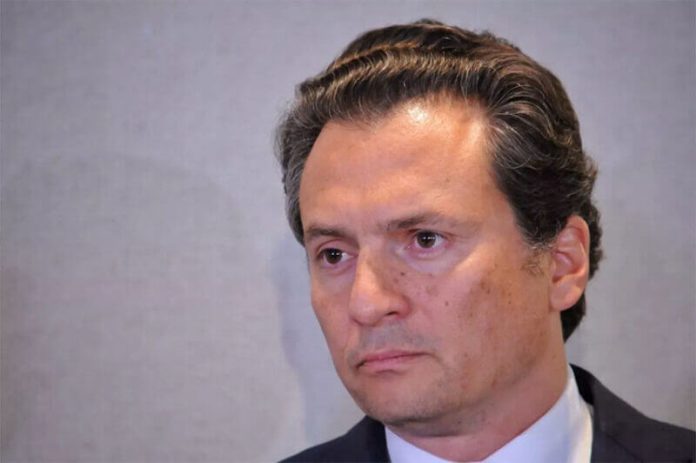
Emilio Lozoya faces charges of criminal association, money laundering and bribery.
A federal judge ordered the imprisonment of former Pemex CEO Emilio Lozoya on Wednesday, bringing to an end alleged preferential treatment the erstwhile state oil company boss has received since his extradition to Mexico on corruption charges in July 2020.
Although Lozoya – whose cooperation with the federal Attorney General’s Office (FGR) and apparent poor health had kept him out of preventative custody – was required to wear a tracking bracelet, check in periodically with authorities and surrender his passport, Judge Artemio Zúñiga ruled that he is a flight risk.
His ruling came after an prosecutor argued in favor of the former official’s imprisonment on the grounds that he has access to at least 2 million euros (US $2.3 million) in a recently detected foreign bank account that he could use to flee Mexico and go into hiding in a country such as Germany, where his wife lives.
The prosecutor also noted that the United States will open its land border to nonessential travel on November 8, and asserted that Lozoya, Pemex CEO from 2012 to 2016, has contacts that could allow him to obtain travel documents in a false name.
Lozoya, who attended Wednesday’s hearing, faces criminal association, money laundering and bribery charges in connection with corruption cases involving Brazilian construction company Odebrecht and Mexican steelmaker Altos Hornos de México. He has admitted to arranging for bribes to be paid to others but claimed in testimony provided to the FGR that former president Enrique Peña Nieto and ex-cabinet minister Luis Videgaray coerced him to do so.
Lozoya has accused dozens of other former and current officials of corruption, including ex-presidents Felipe Calderón and Carlos Salinas, and a group of National Action Party (PAN) lawmakers that includes state governors and 2018 presidential candidate Ricardo Anaya. The former PAN lawmakers allegedly received bribes in exchange for supporting the previous federal government’s structural reforms.
Judge Zúñiga said he had been in favor of remanding the former Pemex chief in preventative custody since the case against him began. However, his imprisonment had not been possible because the FGR – which gave Lozoya protected witness status – didn’t request it, he said.
The judge noted that Lozoya was given the opportunity to collaborate with authorities but ruled that he hasn’t done enough to help prosecutors in their corruption probe in the Odebrecht case. He asked the FGR to take care to protect Lozoya in Mexico City’s Reclusorio Norte prison because some people against whom he has made accusations, such as former PAN senator Jorge Luis Lavalle, are being held there.
A lawyer for the ex-Pemex CEO said after the hearing that he will appeal the preventative custody ruling. He also said that his client continues to cooperate with the FGR.
During the hearing, Lozoya offered to forfeit two properties to Pemex to compensate for dealings with Odebrecht that allegedly resulted in him receiving US $10.5 million in bribes in exchange for facilitating a juicy contract for the Brazilian firm.
He said the properties belonged to his family and provided copies of their deeds but didn’t reveal where they are located or their value. However, the offer was rejected, and FGR prosecutors clarified that their intention in seeking preventative prison for Lozoya was not to pressure him to pay compensation.
As he awaits trial, Lozoya will be held in the same prison as several notorious drug traffickers as well as former Veracruz governor Javier Duarte and lawyer Juan Collardo, who formerly represented Peña Nieto.
Opposition lawmakers have accused federal authorities of giving preferential treatment to the former Pemex chief since he arrived in Mexico from Spain, where he was arrested in February 2020. Their criticism of the authorities heightened last month after Lozoya was seen dining at a high-end Mexico City restaurant.
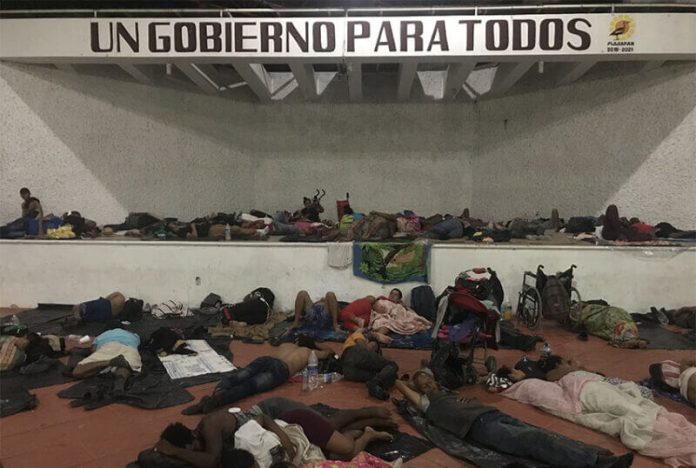
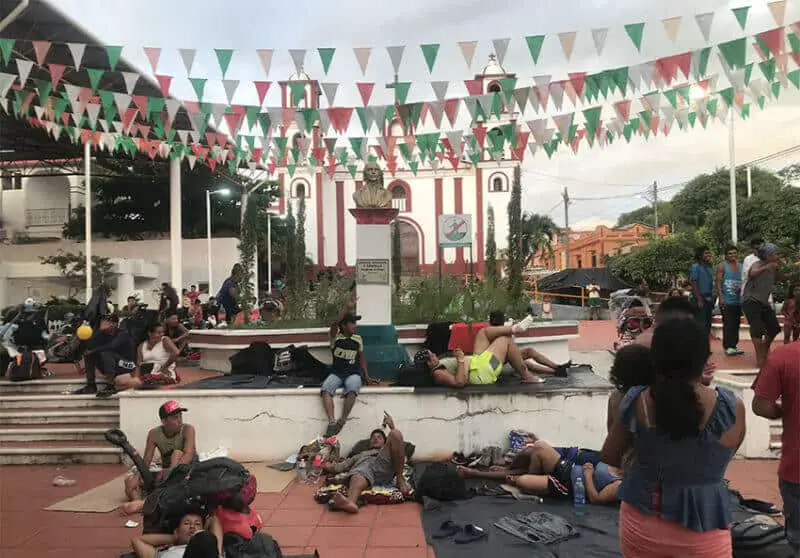
Migrants sleep under a sign that says 'A Government for Everyone' in Pijijiapan, Chiapas. Ben Wein
The migrant caravan in Chiapas continued advancing north through the state on Tuesday, rested on Wednesday and welcomed a new member to its ranks.
The 2,500-odd migrants left the village of Hermenegildo Galeana at 4 a.m. Tuesday and hiked 28 kilometers to the town of Pijijiapan.
Tensions were high as the convoy approached the town where, just two days earlier, a Cuban migrant was killed and four others wounded —one critically — after National Guard troops opened fire on the pickup truck transporting them. It is not clear if those migrants had been traveling in the caravan.
But there was happier news to come: a Haitian woman gave birth to a baby in a Pijijiapan hospital. The infant was reported in good health.
Migrants rest outside the church in Pijijiapan. Ben Wein
The convoy initially set up in the Pijijiapan sports facility, where a candlelit vigil was held to commemorate Day of the Dead and the killing of the Cuban migrant. The group moved to a park in the evening due to concerns that the National Guard would enter the facility.
In the park, migrants were reminded of the time during the night: Westminster-like chimes issued from a clock in the park which, as in London, England, chimed every 15 minutes.
On Wednesday the caravan rested for the sake of young children, who are suffering from exhaustion and dehydration. However, organizer Irineo Mújica confirmed none was seriously ill.
The road beckoned for the migrants at 6 a.m. on Thursday, when they resumed their northward trek to Mexico City and the U.S. border.
Meanwhile, President Lopez Obrador expressed sympathy for the victims of the shooting at his morning news conference on Wednesday: “Some migrants were shot by the National Guard … there are other ways to detain those that are violating laws … They could have stopped them farther on, blocking their path without shooting,” he said.
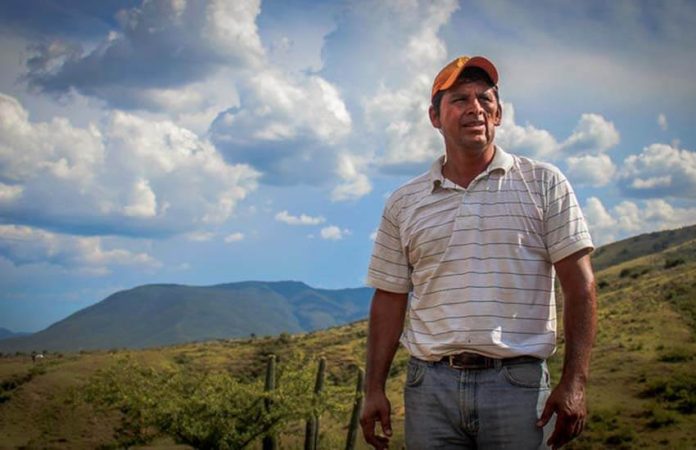
Eduardo Ángeles, owner of the Lalocura mezcal distillery in Santa Catarina Minas, Oaxaca. Lalocura
When I first encountered the mezcal brand of Eduardo Javier Ángeles Carreño, I thought that its name, Lalocura, must come from the Spanish la locura (madness).
Actually, it is an amalgamation of Lalo and cura (meaning “Lalo cures” or “Lalo healing”). Angeles is known affectionately as “Lalo.”
There are two reasons for the name.
“I include my name because ours is a mezcal with identity,” he says. “When I make it, I express who I am as an individual and the place from where I come.”
That’s the first reason. The second is that mezcal is used as traditional medicine in the Central Valleys area of Oaxaca, including being used as a disinfectant.
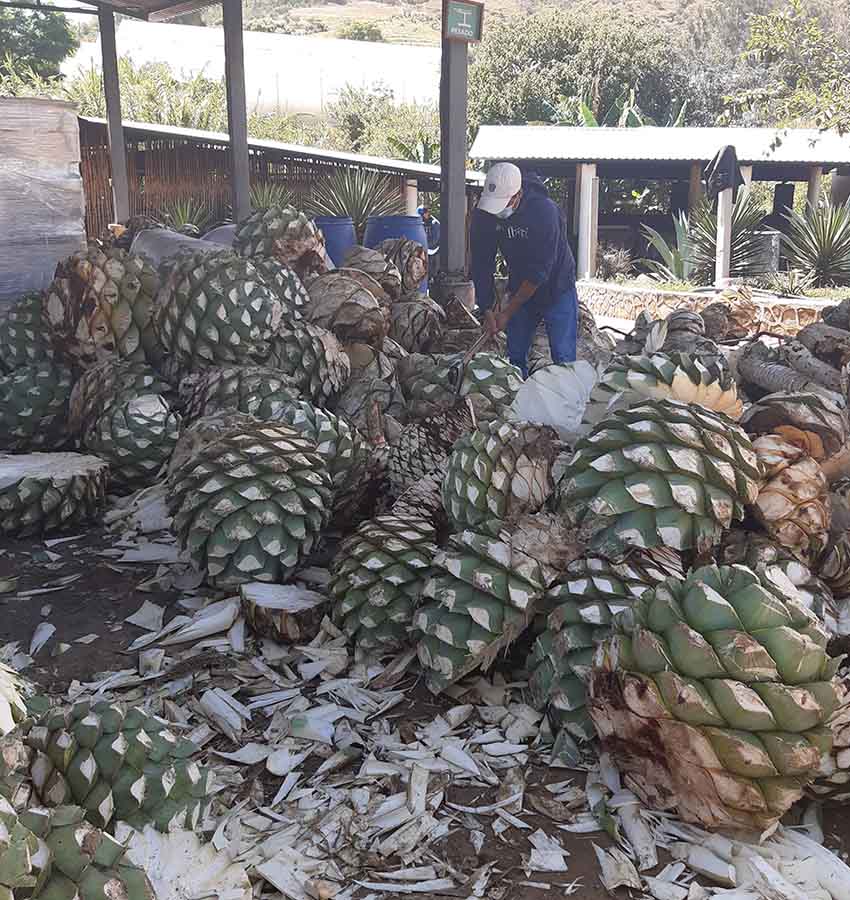
Piñas, or agave hearts, being readied for cooking. Leigh Thelmadatter
Ángeles officially founded the brand in 2014, but his story goes back much further than that. He is a fourth-generation mezcal maker, with his family producing the spirit for over 100 years.
He learned the basics working with his late father, Lorenzo Ángeles, and had no doubt that he would produce mezcal himself. He decided to study agricultural engineering in college, and the result has been the introduction of scientific concepts to the family business but with the aim of keeping traditional mezcal production sustainable and economically viable.
The first indication of his dedication to sustainability is at the homestead itself: located in the small village of Santa Catarina Minas, south of Oaxaca city, Ángeles’ home, distillery and other structures are built with adobe bricks containing bagasso, which is spent agave fiber that is normally the waste from the mezcal fermentation process.
Production at Lalocura remains the same as how Ángeles’ great-grandparents did it: local agave species are used. The plants are cooked in wood-fired pits. The cooked agave mash is fermented with yeasts that fall in naturally from the environment, and batches are always small, no more than 2,000 liters at a time.
But Lalo’s scientific training is evident as well in Lalocura’s practices, especially in its agave cultivation. In the past, makers collected wild plants, and whatever was ready to use was cooked and mashed together. Lalocura takes far more care in agave cultivation and harvest, much the way grape species for wine are handled.
And, yes, different types of agave have rather distinctive tastes.
A Lalocura single agave mezcal, this one made from tobalá chino agave. Lalocura
It is no longer viable to collect wild agave to make mezcal. Nature simply cannot produce enough, especially now that mezcal has attained international popularity. This means that Ángeles and other mezcal producers face two intertwined challenges: producing more agave and doing so sustainably, with minimal harm to the environment.
Agave reproduces in two ways, through seeds and through “pups” — small clones that grow from the mother plant’s root system. In the past, these pups were separated out to allow them to mature.
However, such plants grow nowhere near as large as those from seed, so Ángeles allows selected plants to go to seed, even though that means that they cannot be used for mezcal.
These seeds are genetically monitored for desired characteristics, and the seedlings from them are grown in nurseries, guarded by chickens and peacocks looking for any six-legged creatures that get past the screens protecting the plants. When the seedlings are large enough, they are planted in fields, where more domestic birds continue to tend to them. Fertilizer is provided by sheep and other farm animals fed the byproducts of agave and other crops grown among the massive plants on the more than 40 acres of farmland.
Organic agave farming means that plants take longer to mature — as little as six years and more than 30, depending on the species. But it results in a difference in taste, and organic practices make agave farming more sustainable in the long run.
Despite this, Lalocura is probably the only operation dedicated to this kind of farming in the area.
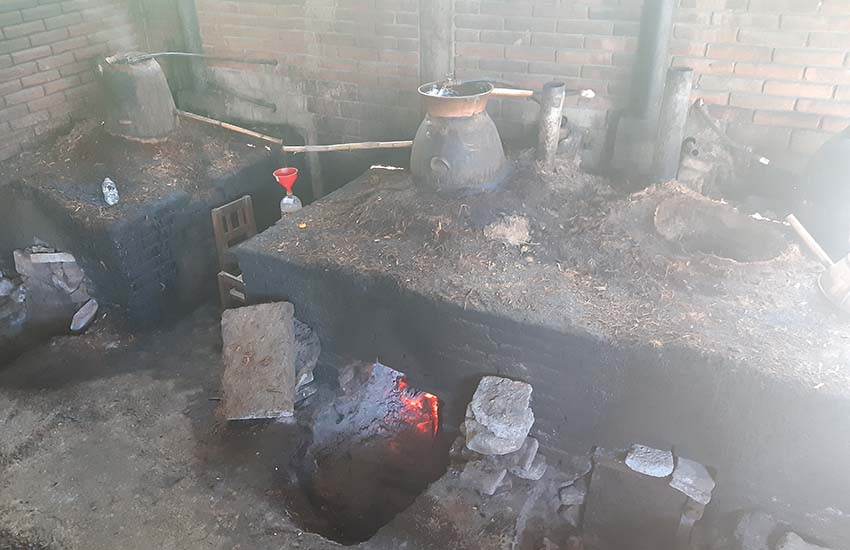
Distillation pots used to concentrate the mash into spirits. Leigh Thelmadatter
Lalocura is open to visitors, on the land adjacent to Lalo’s house. This area is only a small part of the palenque (a mezcal-producing operation), but it has been designed to educate visitors about all the processes that go into making mezcal, from planting to distillation. Workers here are highly knowledgeable; older ones have worked for the family for decades.
As mentioned earlier, different agave species produce different flavors. Lalocura produces two basic types: those using only one agave type and those that are blends called ensembles. Lalo’s knowledge of flavors and types rivals that of any wine connoisseur. Some bottles are quite expensive, but that is because they come from species that take a long time to mature.
In the end, Ángeles does not consider what he does to be particularly innovative; rather, he believes that he is fighting to preserve traditional mezcal production from “tequilafication.”
His biggest concern is what the popularity of mezcal could lead to: a growing market for mid-range and lower-priced mezcals pushing producers to industrialize — with all the cultural and environmental problems that can go with that.
Instead, Ángeles feels that it is important to educate the market about what real mezcal — “that with soul” — is about, in the hopes that traditional techniques and flavors can survive.
Leigh Thelmadatter arrived in Mexico 18 years ago and fell in love with the land and the culture in particular its handcrafts and art. She is the author of Mexican Cartonería: Paper, Paste and Fiesta (Schiffer 2019). Her culture column appears regularly on Mexico News Daily.
The third wave of the coronavirus pandemic has been on the wane for 14 weeks but Mexico could face additional large outbreaks, Deputy Health Minister Hugo López-Gatell said Wednesday.
“At all times we have to have a clear mind; there could be not just a fourth wave but fifth, sixth and seventh waves,” he told reporters at an event at the National Palace to launch Mexico’s influenza vaccination campaign.
“The United States is going through its seventh [wave],” the deputy minister added.
The federal government’s coronavirus point man said that an increase in case numbers could occur in winter because saliva droplets stay in the air longer when the weather is colder, increasing the risk of transmission.
“So theoretically it could be that the cold season increases the probability of an increase of the virus, of any respiratory virus,” López-Gatell said.
“We have highlighted the joy that having 14 weeks of a reduction in the incidence of COVID-19 cases gives us, but … while there is COVID activity in the rest of the world, in any country of the world including Mexico, there can be a re-emergence [of the virus],” he said.
“… We have to be expectant in that sense. The exact date [of a new outbreak] can’t be known. COVID still has very great variability in time and space, it doesn’t have a predictable pattern.”
In other COVID-19 news:
• López-Gatell said the federal government currently has no intention of withdrawing its recommendation that face masks be used in open spaces. He said the government wouldn’t stop recommending the use of face masks – indoors and outdoors – until there is a global stabilization of the pandemic.
Despite the government’s recommendation, President López Obrador is seldom seen wearing a mask.
• A total of 142,988 new coronavirus cases were reported in October, a 54% decrease compared to September and a 72% decline compared to August, which was the worst month of the entire pandemic for new infections with more than half a million registered.
The Health Ministry reported 10,860 COVID-19 deaths last month, a 40% drop compared to September and a 41% reduction compared to August. January was the worst month of the pandemic for fatalities with 32,729 reported.
• The Health Ministry reported 3,588 new cases and 269 additional COVID-19 deaths on Tuesday. Mexico’s accumulated tallies are currently 3.81 million and 288,733, respectively. Estimated active cases number 23,841.
• Almost 126.5 million vaccine doses have been administered in Mexico, according to the latest official data. More than 74.6 million people have received at least one shot, and almost 60.7 million of that number – 81% of the total – are fully vaccinated.
López-Gatell announced last Friday that all Mexican adults had been offered at least one shot. He said that 83% of adults were vaccinated, but the vaccination rate falls to about 60% if the entire population – adults and children – is considered.
• Only 20% of general care hospital beds set aside for coronavirus patients are occupied and just 16% of those with ventilators are in use, the Health Ministry said Tuesday. There are just under 3,300 hospitalized COVID patients across the country, according to federal data.