The iPhone 13 Pro costs 25,999 pesos (US $1,300) in Mexico.
An average Mexican professional has to work almost 50 days to afford the latest edition of Apple’s iPhone, an analysis by an international e-commerce platform found.
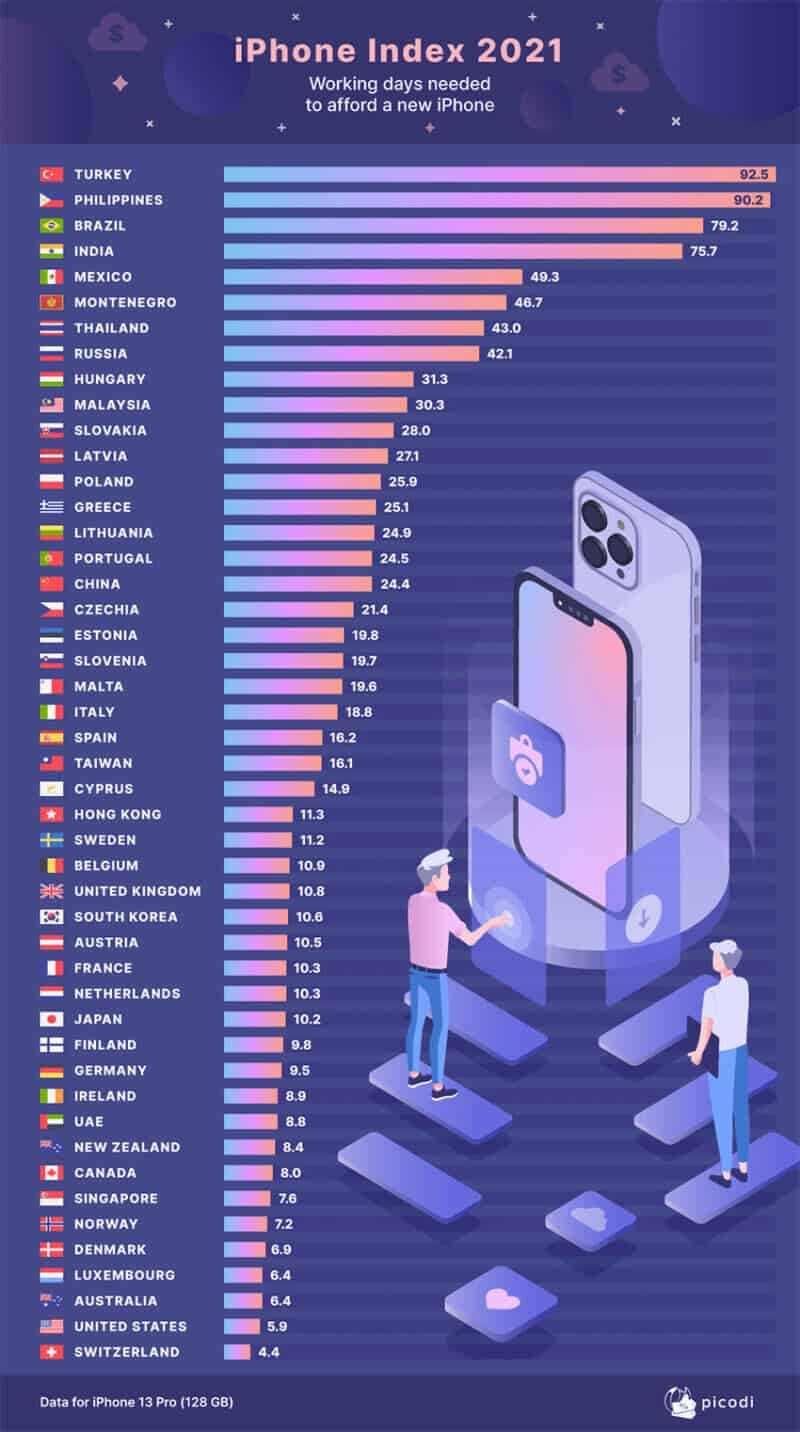
Picodi looked at iPhone 13 Pro (128GB) prices and average wages in numerous countries to develop its iPhone Index 2021, which determines how many days people need to work to buy Apple’s flagship product.
It found that an average Mexican has to work 49.3 days to afford the new phone, which costs 25,999 pesos (US $1,300) in Mexico.
The index used Mexican government data that shows that professionals earn 12,298 pesos (US $615) per month on average.
Millions of Mexicans earn significantly less than that amount, putting a new iPhone well out of reach.
Mexico ranked fifth to last in Picodi’s 2021 iPhone Index. Picodi
The index assumes that all of a worker’s earnings are put toward purchasing the cell phone.
The period for Mexico is 5.1 days less than it cost Mexicans to buy an iPhone 12 Pro in 2020, according to Picodi’s previous index.
Workers in just four countries included in the 2021 index – Turkey, Philippines, Brazil and India – have to work for a longer period to afford an iPhone 13.
Swiss workers have to work just 4.4 days to buy it, a shorter period than that needed by workers in all of the other 46 countries included in the index.
Ranking second is the United States, where workers can buy the phone after just 5.9 days of labor, followed by Australia (6.4 days), Luxembourg (6.4 days) and Denmark (6.9 days).
Migrants make their way across the Rio Grande near Ciudad Acuña.
There are more than 10,000 migrants in a makeshift camp beneath a bridge that connects Ciudad Acuña, Coahuila, to Del Rio, Texas, the mayor of the latter city said Thursday.
Bruno Lozano said 10,503 migrants were camping under the Del Rio International Bridge on the U.S. side early Thursday evening, an increase of more than 2,300 compared to Thursday morning. The size of the camp, whose conditions have been described as squalid, has grown rapidly in recent days: migrant numbers were in the hundreds, rather than the thousands, earlier in the week.
They crossed into the United States to seek asylum but face lengthy waits for their claims to be processed, and could be returned to Mexico in the interim, although they will likely be transferred to U.S. migrant facilities first.
About 20 migrants told the news agency Reuters that there has been scant food and water in the camp, where daytime temperatures are currently hovering around 40 C and there is little shade. Reuters said it witnessed hundreds of migrants wading across the ankle-deep Rio Grande to re-enter Mexico to purchase essentials they aren’t receiving on the United States side of the border.
Ernesto, a 31-year-old Haitian, said he and his three-year-old daughter hadn’t received any meals in the camp since arriving there on Monday morning. He made his fourth trip back to Mexico on Thursday to buy food and water but told Reuters that his money is now running out.
The Haitian said immigration agents have generally not bothered him during his shopping trips to Mexico, a stark contrast to the heavy-handed tactics they have recently used to detain migrants in the south of the country.
Other migrants showed Reuters numbered tickets they received from the United States Border Patrol (USBP) after crossing Mexico’s northern border. Several said they had been told by other migrants that they could be stuck at the camp for up to five days.
Jeff Jeune, a 27-year-old Haitian reselling bottles of water to make a bit of money, said he and his young family had been sleeping on the ground and were exhausted and hungry. He said he was worried his children could fall ill in the camp.
“My 10-year-old asks: ‘When are we leaving?’ He’s always asking that,” he said.
The Border Patrol said in a statement that it was deploying more personnel to Del Rio to facilitate “a safe, humane and orderly process” for migrants, who have swarmed to the Mexico-United States border since U.S. President Joe Biden took office in January.
Thousands of migrants, many of them from Haiti, have camped under the Del Rio International Bridge.
It also said that migrants have been given drinking water and towels and that portable toilets were available.
“To prevent injuries from heat-related illness, the shaded area underneath Del Rio International Bridge is serving as a temporary staging site while migrants wait to be taken into USBP custody,” it added.
Some residents of Del Rio, located in a county won by former U.S. president Donald Trump at last year’s election, said the federal government appeared to have abandoned its border security obligations.
“Are they doing anything to stop them coming?” one woman asked Reuters while looking down at the camp from the bridge.
The answer to that question in Mexico is yes, as the National Guard and immigration agents has detained hundreds of migrants traveling in at least four caravans that left Tapachula, Chiapas, in late August and early September.
Some have been sent back to Guatemala, yet more than 2,000 kilometers to the north, migrants are still streaming into Ciudad Acuña.
El Siglo de Torreón reported that hundreds of migrants, some with babies and/or small children, are arriving in buses on a daily basis. Almost immediately after arriving in the northern border city, they cross the Rio Grande to seek asylum in the United States, the newspaper said.
Some migrants told Reuters they chose to cross into the U.S. from Ciudad Acuña because the river is shallow and there is less cartel activity than some other border areas. Mexican officials and migrants believe that more asylum seekers will make their way to the U.S. via the border city in the coming days.
During the Trump and Biden administrations, migrants who have reached the United States have routinely been expelled to Mexico under a health order put in place at the beginning of the coronavirus pandemic. But a U.S. district judge ruled Thursday that the order is unlawful because expelling asylum seekers denies them “the opportunity to seek humanitarian benefits” they are entitled to under immigration law.
Handed down by Judge Emmet Sullivan, the ruling takes effect in 14 days. However, it applies only to families and not single adults, who represent a sizable portion of migrants recently detained by the USBP.
Olimpia Coral Melo, one of world's most influential people.
Activist Olimpia Coral Melo Cruz has been named one of Time magazine’s 100 most influential people of 2021, thanks to her work to outlaw revenge porn in Mexico.
When the Puebla native was 18, her then-boyfriend filmed her having sex — without her consent, content that he later distributed on the web. As the video spread through social media in her community, Melo tried to commit suicide three times, but eventually found solace in the words of her mother.
“We all have sex. Your cousin, your sister, me. The difference is that they see you do it. That doesn’t make you a bad person or a delinquent. You just enjoyed your sexual life like any other person. Shame is when you have robbed or killed someone,” Melo’s mother told her.
Melo eventually decided to report what happened to the authorities, but her attempts only drew derision from an official who said that she since she was not drugged or raped, there was no crime. That was when she realized that things needed to change. She began compiling testimony from other victims of revenge porn and founded the National Front for Sorority to prevent abuse and support victims.
Her activism led to the approval of “Olimpia’s Law,” which prohibits the distribution of sexual content without the consent of those involved. The federal law, which was passed in April, punishes revenge porn distributors with up to six years in prison.
“I hope that she inspires people around the world to not only take up this cause but also speak up for themselves,” activist Amanda Nguyen wrote in Melo’s Time profile. “It can be difficult to be a survivor, speaking up about something so personal, but Melo Cruz’s impact will not only be meaningful right now, it will be remembered in history — and history is on her side.”
Others named to the Time list this year were the formerly royal couple Prince Harry and Meghan, actor Kate Winslet, gymnast Simone Biles, U.S. President Joe Biden and musician Bad Bunny.
A confrontation between a group of armed civilians and security forces in Coahuila left nine civilians dead on Thursday afternoon.
State police were patrolling the Anáhuac-Colombia highway in Hidalgo, a municipality located on the border with Texas, when they were attacked. The aggressors fled but the security forces followed and with the support of additional agents and the army, the attackers were located.
According to a state press release, when the security forces caught up with the armed civilians, the group once again attacked in a confrontation that left nine of the latter dead. Several others managed to flee.
Security forces took possession of two of the aggressors’ vehicles, including one with improvised vehicle armor known as a monstruo or narco tank. They also seized 10 weapons, including a Barrett .50 caliber semi-automatic sniper rifle.
The incident occurred in the same area where state police prevented 30 trucks carrying gunmen from entering Coahuila on August 25. After exchanging fire, the trucks fled back toward Nuevo León. Three officers were injured in the conflict.
Historian Camilla Townsend, whose book Fifth Sun examines accounts of the conquest written by the Mexica, appears with history writer Gerard Helferich in a talk hosted by the San Miguel Literary Sala.
The San Miguel Literary Sala continues its monthly online offerings in September with workshops and an online discussion on September 19 featuring two historians who have written extensively about Mexican and Latin American history.
Camilla Townsend, a history professor at Rutgers University and the author of the 2019 award-winning book Fifth Sun, a new look at the history of the Spanish conquest of Mexico based on long-ignored indigenous accounts written at the time, will appear in a live streamed talk entitled “A New History of the Aztecs” with nonfiction history writer Gerard Helferich, author of Humboldt’s Cosmos: Alexander von Humboldt and the Latin American Journey That Changed the Way We See the World and Stone of Kings: In Search of the Lost Jade of the Maya.
Townsend won the McGill University Cundill History Prize for Fifth Sun in 2020. She is also the author of Malintzin’s Choices: An Indian Woman in the Conquest of Mexico.
The authors’ discussion on the conquest, part of the Literary Sala’s Distinguished Speakers Series, can be seen live via videoconferencing software on September 19 from 6 p.m. to 7:30 p.m. CDT. Viewers will have an opportunity to ask questions of the speakers afterward. Tickets must be purchased in advance.
The Literary Sala will also be hosting four online workshops for writers this month. All the classes are live and interactive for participants via videoconferencing software.
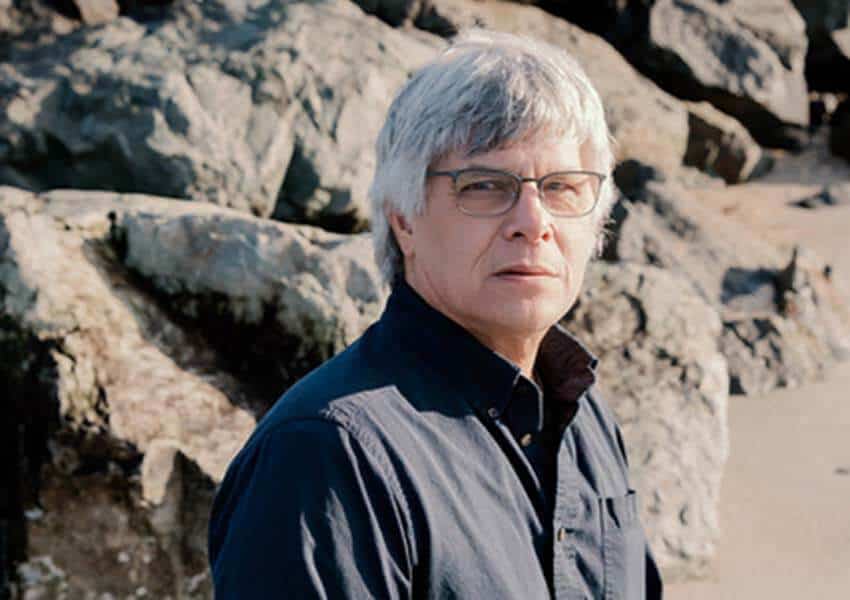
Author Terry Persun will lead the online workshop “Breaking the Rules of Fiction” on September 20 and 22 for the San Miguel Literary Sala.
Listings below are all given in Central Daylight Time:
September 20 and 22, 3 p.m. to 4:30 p.m. — Dinty W. Moore: “Memoir in Small Doses: The Brilliance of Writing Briefly.” The author and essayist will teach participants about flash prose and how writing in 1,000-word chunks teaches the “cooking” skills for a longer book-length banquet. With in-class writing prompts and reviews of brilliant examples of flash prose, you will learn how to focus and complete your larger project. Moore’s nonfiction books include Between Panic and Desire and To Hell With It.
September 20 and 22, 5:30 p.m. to 7 p.m. — Terry Persun: “Breaking the Rules of Fiction.” Persun will show workshop participants how to be storytelling rebels, breaking the standard writing edicts while still writing stories with memorable characters, conflicts and settings. Persun’s long list of fiction in several genres includes Backyard Aliens and The NSA Files.
September 21 and 23, 3 p.m. to 4:30 p.m. — Michael Bazzett: “Tell Me a Story: Evoking Narrative in Poetry & Vignette.” Bazett will help you explore how story is evoked in modes other than a straight narrative. Students will participate in playful exercises and explore how honoring the narrative impulse creates leaner, more engaging writing. Bazzett’s poems have appeared in Ploughshares and The American Poetry Review.
September 21 and 23, 5:30 p.m. to 7 p.m. — Joe Gillard: “What’s Your Author Brand?” In this introductory how-to class, learn what an author brand is, how it’s used in the industry and why authors need a brand or to further develop the one they have, whether they’re a poet, a memoirist, a science writer or a romance novelist. Gillard has experience in digital marketing, social media, public relations and reputation management.
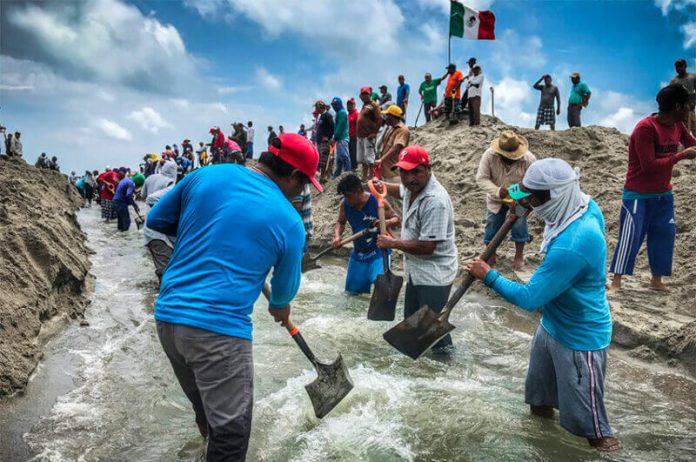
Residents of San Dionisio del Mar relieve flooding by opening a channel between a lagoon and the ocean.
Heavy rain in the Isthmus of Tehuantepec region of Oaxaca caused flooding in several communities this week.
One of the worst affected areas is San Mateo del Mar, a small municipality on a thin strip of land between the Pacific Ocean and Laguna Superior.
Neighborhoods near the lagoon, such as Santa Cruz, Barrio Nuevo and San Pablo, have suffered the worst flooding, a local fisherman told the newspaper Reforma.
Residents of San Mateo, located 30 kilometers south of Salina Cruz, say they have received no assistance or aid from authorities despite their homes and the streets of the town being inundated with water for days.
They issued an appeal for help to federal and state authorities accompanied by photographs of the situation they face, Reforma reported.
The fisherman, who asked not to be identified, said there was knee-deep water in the streets and people’s homes. Residents are concerned that the flooding will cause fresh water to be contaminated with sewage, he said.
“It’s certain that the little fresh water [we have] in wells for consumption is beginning to be contaminated,” he said, adding that approximately 18,000 residents depend on the water sources.
The fisherman asserted that the Oaxaca government has only dispatched aid to Santa María del Mar, a neighboring municipality. He also said that people with infected feet due to their submersion in water for days cannot access adequate medical treatment.
“… The clinic doesn’t have supplies, health personnel aren’t there 24 hours, the doctors come and go,” he said.
San Mateo Mayor Bernadino Ponce hasn’t been seen in the flood-affected areas, the fisherman added.
“We’re demanding that resources or benefits directly reach the community authorities … not that pseudo politician. We’re asking the navy, the army and Civil Protection authorities to help families,” he said.
Communities in another municipality on the banks of Laguna Superior have also endured flooding. In the absence of government support, residents of San Dionisio del Mar, including members of several fishing cooperatives, banded together to alleviate flooding in communities such as Pueblo Viejo and Huamúchil.
Assisted by about 15 Zapotec residents of the nearby municipality of Juchitán – where flooding has also occurred – the indigenous Ikoots people of San Dionisio used shovels and picks to dig a channel between the overflowing Laguna Superior and the Pacific Ocean to give the excess water a route to flow out to sea.
That work should have should have been completed by state authorities with heavy machinery, the newspaper El Universal reported, but they didn’t show up to do it despite being urged to do so since Sunday.
The residents finished the work at about 4:00 p.m. Wednesday and subsequently placed a Mexican flag in the sand next to the trench in recognition of the 211th anniversary of the start of the War of Independence against the Spanish and the cooperation of the Ikoots people for the common good.
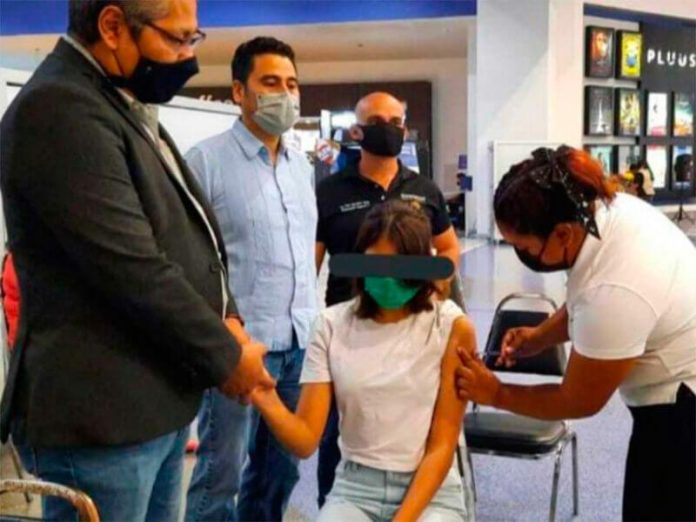
A 14-year-old girl is vaccinated in Nuevo León after obtaining an injunction.
Nineteen of Mexico’s 32 states have first-dose COVID-19 vaccination rates above 70%, the Health Ministry reported Wednesday.
Mexico City, the country’s coronavirus epicenter since the beginning of the pandemic, has the highest coverage among the eligible population with 93% of adults having had at least one shot.
Querétaro ranks second with 92% followed by Quintana Roo (86%) and Yucatán and Sinaloa (both 85%).
Five other states have rates of 80% or higher. They are Baja California Sur, Chihuahua, San Luis Potosí, Baja California and Tamaulipas.
Nine other states have rates above 70%: Zacatecas, Aguascalientes, Durango, Nuevo León, Sonora, Hidalgo, Colima, Coahuila and Nayarit.
The national vaccination rate is 69% with 61.4 million adults having received at least one shot. If Mexico’s population of children is taken into consideration, the country’s vaccination rate falls to just below 50%.
Minors haven’t been vaccinated in Mexico with the exception of a small number of adolescents who have obtained injunctions ordering they be given the shot. However, the number may rise.
An opposition politician in Nuevo León said Wednesday that injunctions for vaccination have been registered on behalf of 1,800 youths in Nuevo León.
Meanwhile, the Health Ministry reported 7,040 new cases on Thursday, lifting Mexico’s accumulated tally to just under 3.55 million. The official COVID-19 death toll rose by 433 to 270,436, a figure that the government has acknowledged is a significant undercount.
There are just under 80,000 estimated active cases across Mexico, a significant decline compared to the peak of the delta variant-driven third wave last month. Deputy Health Minister Hugo López-Gatell said Tuesday that the pandemic is now on the wane in all 32 states.
López Obrador applauds Cuba President Díaz-Canel during Independence celebrations on Thursday.
President López Obrador has repeated his call for the United States to lift its trade embargo on Cuba in yet another show of support for the communist island nation.
“The government I represent respectfully calls on the United States government to lift the blockade against Cuba,” he said at an Independence Day event on Thursday attended by Cuban President Miguel Díaz-Canel and new United States Ambassador Ken Salazar, among other dignitaries.
“Because no state has the right to subjugate another people, another country,” the president said.
“… Hopefully President Biden, who possesses sufficient political sensitivity, acts with nobility and puts an end to the policy of grievances against Cuba forever. … Grudges have to be left behind, [the United States] has to understand the new circumstances and seek reconciliation. It’s time for brotherhood, not confrontation,” López Obrador said.
The president rides in the military parade in Mexico City Thursday with the the heads of the armed forces.
Speaking in Mexico City’s central square after a military parade to mark the 200th anniversary of the end of the war of independence against the Spanish, Lopez Obrador praised Cuba’s defense of its revolution for 62 years.
“We can agree with the Cuban Revolution and its government or not but to have resisted 62 years without subjugation is an undeniable historic feat,” he said.
“Consequently, I believe that the people of Cuba, for their fight in defense of the country’s sovereignty, deserve the prize of dignity,” AMLO said.
Speaking at the same event, Díaz-Canel – the first foreign leader to address a Mexican Independence Day ceremony – said that Cuba will always remember Mexico’s support during trying times.
“Cuba will always remember your expressions of support, your permanent call for the lifting of the embargo,” the Cuban president said.
The military parade Thursday in the zócalo in Mexico City.
In a 13-minute address, he spoke of a “significant cultural exchange” between Cuba and Mexico, noting that Fidel Castro, Ernesto “Che” Guevara and Cuban independence hero José Martí all spent time here.
The president also acknowledged that the two countries have a sporting relationship built on a shared love for baseball and boxing.
He said his invitation to attend the Independence Day celebrations “has an immeasurably greater value in times in which we are suffering the ravages of a multidimensional war, with a criminal blockade opportunistically intensified in the middle of the COVID-19 pandemic with 240 [new] measures.”
“… In parallel, we are facing an aggressive campaign of hate, disinformation, manipulation and lies assembled on the most diverse and influential digital platforms that ignore all ethical limits,” Díaz-Canel said, referring to online opposition to his government.
“Under the fire of this total war, the solidarity of Mexico with Cuba has awakened in our people greater admiration and the deepest gratitude,” he said. “… Viva México! Long live the friendship between Cuba and Mexico.”
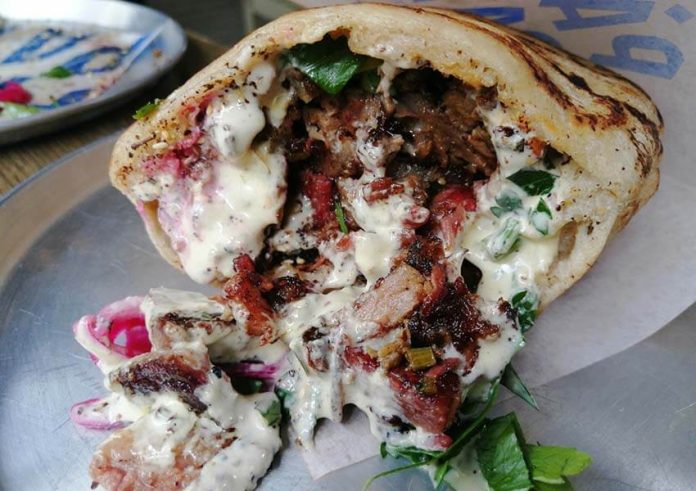
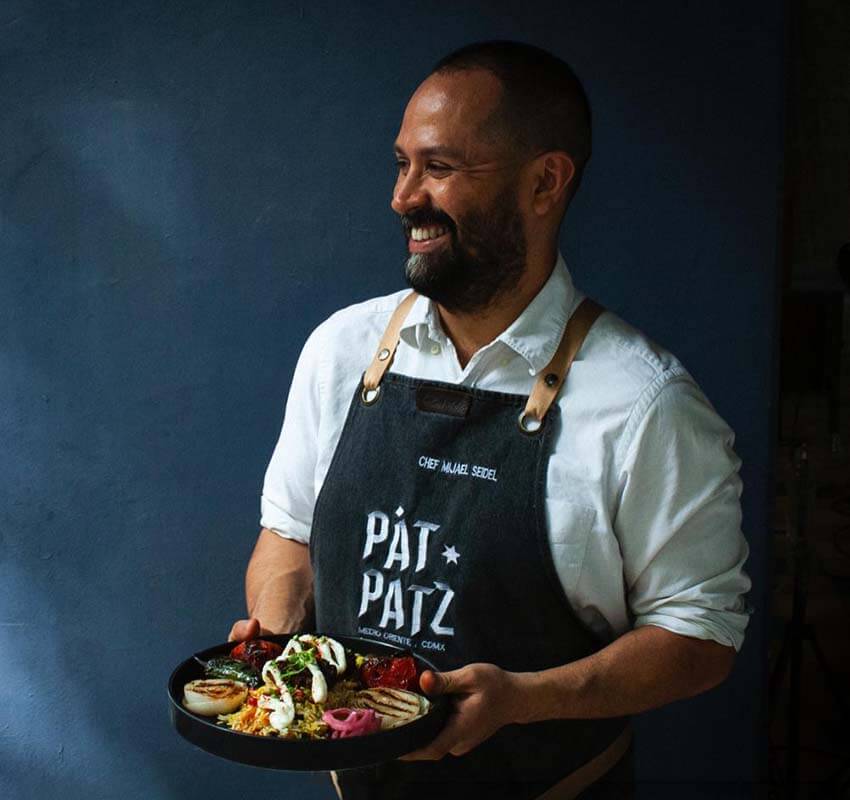
Pat Patz's chef Mijael Seidel plays with the adaptations to the traditional cuisine of Middle Eastern migrants around the world, hence this beef brisket and falafel pita.
It started with one man’s singular obsession for a plate of chicken.
“I moved to Astoria, Queens, and right out of the subway station on 31st Avenue, there was this food cart. As soon as you got off the train you could smell it, the chicken, and I was crazy about it. I probably ate there three times a week for the 10 years I lived in New York,” says Mijael Seidel, owner and head chef of Pat Patz restaurant in the Roma neighborhood.
The cart was the Palestinian-owned King of Falafel and Shawarma. Promising that he would be going back to Mexico and not be competition, Seidel offered to pay the owner, a man named Freddy, for that chicken recipe.
“He came back and said, ‘I can sell you the chicken recipe — for $7,000.’” Seidel’s infectious laughter gets the better of both of us. “And I only had like 1,000 saved, so …”
His personal quest, as he landed back in his native Mexico, became to discover that chicken’s secret.
Chef and owner Mijael Seidel traveled to countries like Greece and Turkey to get inspiration for Pat Patz restaurant’s unique Middle Eastern cuisine.
He watched interviews of Freddy, who had become famous in 2010 after winning New York City’s Vendy street vendor award. He added and subtracted spices. He dug into cookbooks — and found a lot of guinea pigs.
“My mother had this rule: if you invite friends over, don’t cook anything you’ve never cooked before … and I was just doing the opposite every week.”
This all went on in the city of Colima, where Seidel founded a graphic design company with his then-wife. They were living in his native city to be closer to the beach and nature, but instead, Seidel found himself behind his computer. His mind would drift back to the foods he loved in New York as he reworked recipes in his head.
“[I needed] to verify that what I was making made sense in any way,” he says. “Is it close to the original? Is it far from the original? Because I knew that my flavor came from New York, and New York is already an adaptation. I remember when I was living in New York and trying to find Mexican food how nothing, even if it was cooked by Mexicans, tasted like it was supposed to. Sometimes the produce doesn’t have the same punch. You needed to add stuff to complement the flavor profile that the ingredients should have but they don’t.”
He cooked weekly meals at a friend’s kung fu dojo, sold falafel from an old hot dog cart, made ghormeh sabzi (Iranian stew) and shawarma in a local brewpub, all while seeking the flavors of his memories.
“When I was eight, this Israeli woman who was living in Colima made [hummus] and brought it to the house, and I was like, ‘This is great. It’s chickpeas, but they’re lemony and salty and tangy.’ That is actually the hummus I am trying to replicate now.”
The restaurant’s decor varies from casual dining to hip neon. It also boasts a terrace popular with diners.
The obsession had moved far beyond chicken at this point. For a decade, Seidel dissected falafel and experimented with perfect harissa. He discovered sumac and measured and remeasured the right proportions for lamb and beef kebabs.
Meanwhile, all his money was stolen at a catering event. He tore a muscle in his shoulder so badly he couldn’t cook, fought and broke up with his wife, fought and broke up with his business partner, lost the hot dog cart and his equipment, walked away from a takeout business and finally struck out on his own.
Now Seidel sits under Pat Patz’s terrace, packed this Sunday afternoon with diners. His smile is that of a man who is exhausted but happy — perhaps not surprising: he opened in March 2020, at the start of the COVID-19 pandemic, but the year also brought him an award from Food and Wine enEspañol, when in October they named him one of the year’s best new chefs.
“It’s a lot of work,” he says, immediately launching into his plans for chickpea shakes and Persian rice plates, as well as his dreams of an open grill and making kebabs from across the Middle East.
Of late, he’s accepting the nuances that make his food unique. A few years into his project, Seidel went to Turkey and Greece — to find the most traditional versions of his dishes.
“I kept thinking: mine is an adaptation. What does it taste like in its original form? So I was like, where are they doing the trendiest, most forward-thinking kebabs in Turkey right now? And I found some places that I liked — and I tasted the food, and it tasted like Pat Patz because the people behind the counter were North Africans living in Istanbul, sharing with Turkish people and combining ideas. And people liked it and were lining up.
Some classics are too good to mess with much: Pat Patz’s baklava.
“And of course I tasted the more traditional stuff, and I was like, ‘It’s good, but it’s missing the punch I’m used to.’ The same thing in Greece: [I found] a place that was a mix. It was run by Israelis, Palestinians and Greeks, and it was a different variation but the same highlights of flavors.”
The food at these places was good because it was an adaptation of an adaptation. So Seidel went with his gut, literally. Pat Patz today combines the flavors of the Middle Eastern immigrants that span the globe as well as the tang and punch he loves in Mexican cuisine.
“Nobody can come to my restaurant and say my kebab is too tangy or how come it has chiles in it because I discovered that … they can have all the stuff I am putting in them,” he says.
“This is just like how we used to make it at home,” a friend says about Pat Patz’s Israeli salad — a bright burst of tomato, cucumber, sumac vinaigrette and parsley. An Armenian who grew up in Boston fed by her Russian Jewish grandmother, she knows a lot about adaptations.
“This Moroccan girl once told me that she could finally move to Mexico because she had found something that reminded her of home,” Seidel says. “That kind of confirmed to me that I wasn’t so lost in what I was preparing.”
Pat Patz restaurant can be found at Chiapas street #122B, Colonia Roma Norte. Contact them at 56 3257 3769.
Lydia Carey is a regular contributor to Mexico News Daily.
Tequila production increased more than 40% in the first eight months of the year, guaranteeing that a new annual production record will be set in 2021.
Data from the Tequila Regulatory Council (CRT) shows that 348.7 million liters of Mexico’s most famous tipple were produced between January and August, a 41.8% increase compared to the same period of 2020, a year in which production rose 6% to an annual record of 374 million liters.
“We’re doing very well in production,” said CRT director Ramón González Figueroa, adding that he expects production in 2021 to exceed that of 2020 by between 20% and 25%.
“We’ll finish [the year] with high numbers despite [production] slowing down a little in December,” he said.
González said tequila exports between January and August rose 21.9% to 220.2 million liters, or 63% of production.
“… The main consumer is the United States with 86% of export volumes [going there], followed by Germany, Spain, Canada, Australia, Colombia, France, Latvia, the United Kingdom and Italy – countries that continue consuming tequila despite the pandemic,” he said.
Made from the blue agave plant, tequila has “denomination of origin” protection and can only be legally produced in certain municipalities in five states: Jalisco, Guanajuato, Michoacán, Nayarit and Tamaulipas.
The main production center is the town of Tequila, Jalisco, located about 60 kilometers northwest of Guadalajara. Tequila is Mexico’s third biggest agri-food export after beer and avocados.
Tequila and mezcal exports were worth US $1.15 billion in the first five months of 2021, according to the federal Agriculture Ministry.