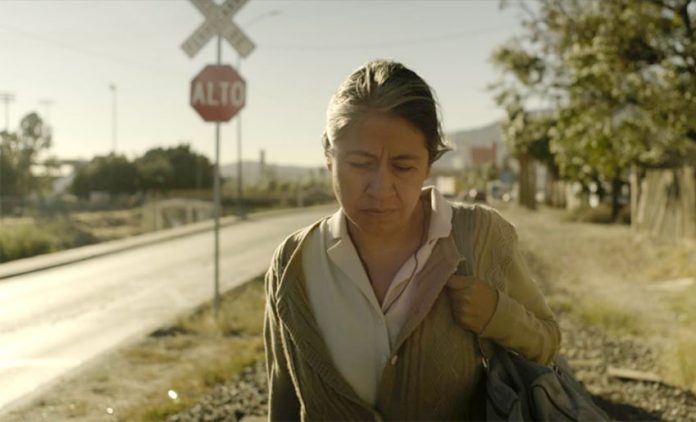
Actress Mercedes Hernández plays the role of Magdalena, who sets out to search for her son.
An award-winning Mexican film about a mother’s search for her missing son will begin screening in cinemas this Thursday.
Sin Señas Particulares (rendered in English as Identifying Features) is a low-budget film directed by Fernanda Valadez that won best picture at the 2020 edition of the Morelia International Film Festival.
It recounts the story of Magdalena, a mother whose son disappeared while traveling north from Guanajuato to seek a better life in the United States. She also heads north but to try to find out what happened to her son. During her journey she comes across other people who are also looking for their missing loved ones, a common situation in Mexico where there are more than 90,000 missing people.
“Magdalena embarks on a journey to find her son, who disappeared on his way to the Mexico-U.S. border. Guided by her strong will, she travels across the desolate landscapes of today’s Mexico, where victims and perpetrators wander together,” says a Morelia film festival synopsis of the movie.
Magdalena, who has never before left her home town and doesn’t know how to read or write, is confronted with a “corrupt and saturated [justice] system,” according to a review by the newspaper El País.
Identifying Features – Official Trailer
Despite what she is told by the authorities, she refuses to accept that her son is dead because files she is given about his supposed death make no mention of his identifying features.
The film, which also won prizes at the Sundance and San Sebastián film festivals, takes viewers on an “almost hypnotic visual experience,” El País said. It has a soundtrack capable of accelerating or slowing down the pace of the film at will.
The script was co-written by Valadez and Astrid Rondero, who was once a student of the first-time feature film director.
The former said that the film alludes to the period after former president Felipe Calderón launched the militarized war on drug cartels in late 2006. Thousands of people subsequently disappeared, and kidnappings remain a major problem in Mexico today, although the crime was down 29% in the first half of 2021.
“Mothers of the victims became detectives and activists, and they obtained more information than the authorities at times,” Valadez said, referring to the years when Calderón was in office.
Magdalena is played by Mercedes Hernández, who won the best actress prize at last year’s film festival in Morelia.
Unlike some other Mexican films that are based on true stories, Sin Señas Particulares tells a fictional story albeit one that is comparable to countless real-life ones.
Valadez said the acclaim for the film was unexpected. “We weren’t prepared [for that]. It’s a very small film with a small budget. … As we didn’t have expectations, we had the freedom to tell a story without thinking about what would happen later at festivals or with an audience,” she said.
Hernández also appears in La Civil, which received an eight-minute-long standing ovation at Cannes, as well as Somos, a Netflix series based on a story published by investigative news agency ProPublica that revealed the U.S. Drug Enforcement Administration’s role in setting off a massacre in northern Mexico in 2011.
A bull went on the rampage among spectators at an illegal rodeo in Puruándiro, Michoacán, on Sunday after it escaped from its enclosure.
Witnesses reported that at least 10 people were injured by the bull at the “La Salud” bullring, even though such events are officially banned due to the Covid-19 pandemic.
Videos of the incident, which were uploaded onto social media, showed the bull jump over the weak fence which was meant to contain it. A number of people were knocked down including a woman who was trapped underneath the animal. Spectators close to the barrier were rammed and others screamed and fled.
Women and children were among the crowd.
Panic spread around the arena while staff tried in vain to contain the animal. In one video an onlooker can be heard shouting that one of the people in danger was a man in a wheelchair.
Embestida de toro deja al menos 10 lesionados durante jaripeo en Puruándiro, Michoacán
Municipal authorities have admitted that a license was granted for the event and have stated their commitment to investigate why it was granted. The rodeo involved the sale and consumption of alcohol, dancing and a performance of music typical to the region.
Michoacán went from green to yellow on the coronavirus stoplight map on July 19.
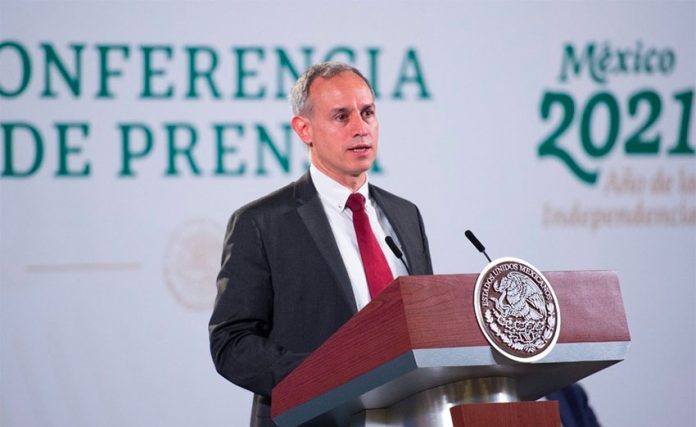
Vaccine reduces Covid's impact, said Deputy Health Minister Hugo López-Gatell.
Ninety-seven percent of Covid-19 patients who are currently hospitalized haven’t been vaccinated, Deputy Health Minister Hugo López-Gatell said Tuesday.
Speaking at President López Obrador’s regular news conference, the coronavirus point man noted that just over 48 million Mexicans have received at least one vaccine shot, a figure that represents about 53% of the adult population.
“The vaccine has a very, very significant protective effect, especially in reducing serious Covid situations. Ninety-seven percent of people that are in the hospital today due to Covid didn’t get vaccinated,” López-Gatell said.
“… Getting vaccinated is very important,” he said, urging people who have not yet had a shot to do so.
“… There is a positive effect of vaccination [shown] in real data,” the deputy minister said while presenting information that showed declining Covid-19 death rates. “Vaccination reduces the impact of Covid-19.”
Mexico has the fourth highest official Covid-19 death toll in the world – 241,279 as of Monday – but fatalities during the third and current wave of the pandemic have been significantly lower than those recorded in the first and second waves.
There were more than 17,000 reported Covid-19 fatalities in each of June, July and August last year as a result of the first wave, while the second, and worst, wave caused death tolls of almost 20,000 last December, nearly 33,000 in January – the worst month of the pandemic in terms of both cases and deaths – and over 27,000 in February.
July of this year was the second worst of the pandemic in terms of reported cases – almost 329,000 – but Covid-19 deaths last month, at 7,859, were 76% lower than the January peak.
Hospitalizations have trended upwards recently as the coronavirus – especially the highly contagious delta strain – finds vulnerable people to infect, but occupancy rates haven’t reached the levels seen at the peak of the second wave.
Nevertheless, the Covid-19 wards in many hospitals have reached maximum capacity. Federal data shows that 124 hospitals across Mexico have 100% occupancy rates for general care hospital beds. The rate is 90% or higher in 34 other hospitals.
In Guerrero, hospitals in Acapulco, Chilpancingo, Ometepec and Zihuatanejo are all under extreme pressure, according to Governor Héctor Astudillo, while hospitals in Puerto Vallarta, Jalisco, are in the same situation, said Governor Enrique Alfaro.
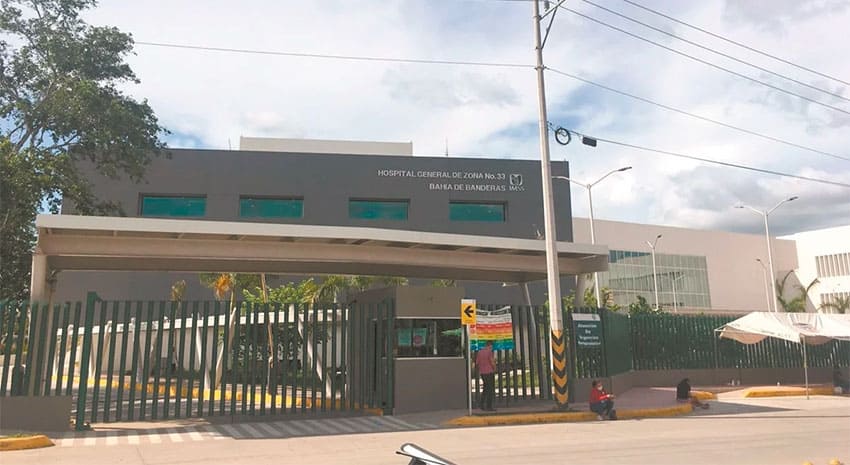
Bahía de Banderas hospital in Nayarit has been overwhelmed.
Hospitals in Vallarta have come under increased pressure because the IMSS #33 hospital in nearby Bahía de Banderas, Nayarit, is overwhelmed with Covid-19 patients.
Federal data shows that saturated hospitals are located in many states, including Guanajuato, Mexico City, Guerrero, Nuevo León, Chihuahua, Veracruz, San Luis Potosí, Durango, Jalisco, Nayarit, Baja California Sur, Yucatán and Puebla.
“… As is the case in the metropolitan area of Guadalajara, the vast majority of hospitalized people in Puerto Vallarta are young people and those older than 40 who haven’t been vaccinated,” the Jalisco Health Ministry said in a statement.
The percentage of Covid-19 patients infected with the delta strain is unknown but given that the highly infectious variant is spreading widely in Mexico it is likely to be high.
An internal Centers for Disease Control and Prevention document that was made public last Friday said that delta spreads as easily as chickenpox and disease caused by the variant is “likely more severe” than that caused by other strains.
The United States public health agency cited research in Canada, Singapore and Scotland that showed that people infected with the delta strain were more likely to be hospitalized than Covid-19 patients infected with other variants earlier in the pandemic.
But disease experts who spoke with the Reuters news agency said the research in all three countries was based on limited study populations and has not yet been reviewed by outside experts.
“… The experts said more work is needed to compare outcomes among larger numbers of individuals in epidemiological studies to sort out whether one variant causes more severe disease than another,” Reuters said.
In Mexico, ensuring that hospitals have enough capacity to accommodate another influx of Covid-19 patients is of more immediate concern than determining conclusively whether delta causes more severe illness or not.
To that end, López-Gatell said Tuesday that the country is once again in the process of reconverting hospitals to increase their capacity to treat Covid patients.
The Health Ministry reported Monday that 48% of general care hospital beds set aside for coronavirus patients are occupied while 39% of those with ventilators are in use. However, those rates could increase quickly as tens of millions of Mexicans remain unvaccinated even as the delta strain fuels a growing third wave.
According to Health Ministry estimates, there are currently just over 120,000 active cases across Mexico, down from a record high of almost 138,000 on Saturday, but that number will likely spike on Tuesday afternoon after new confirmed cases are reported. Throughout the pandemic, reported case numbers have dipped on Sundays and Mondays due to a drop-off in testing and/or the recording and reporting of test results on weekends.
Mexico’s accumulated case tally currently stands at 2.86 million, while the Covid-19 fatality rate here based on official numbers for infections and deaths is 8.4 fatalities per 100 cases. Among the 20 countries currently most affected by the pandemic, Mexico has the second highest case fatality rate after Peru, according to data compiled by Johns Hopkins University.
Mexico’s mortality rate is the 21st highest in the world at 189.1 Covid-19 deaths per 100,000 people. Peru ranks first on that list followed by Hungary and Bosnia and Herzegovina.
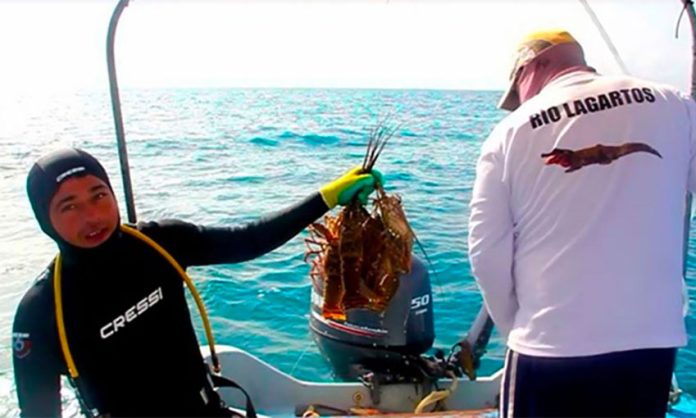
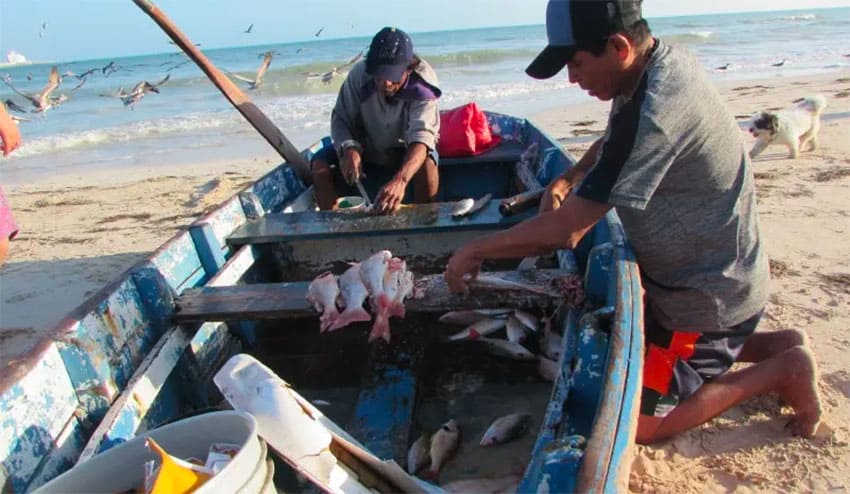
A Yucatán fisherman with lobster, the most popular species among poachers.
Illegal fishing off the northern coast of Yucatán is out of control but authorities are doing little to stop it, according to local fishermen.
The problem is particularly bad in the southern Gulf of Mexico off the Costa Esmeralda, or Emerald Coast, a stretch of coastline where towns such as Progreso, Telchac Puerto, Dzilam de Bravo and Río Lagartos are located.
“Poaching is terrible, that’s the reality. … There are no longer any fish,” Carlos Puga, leader of a fishing cooperative in Río Lagartos, told the newspaper Milenio.
He said illegal fishermen work day and night throughout the whole year and are depleting stocks of fish and other marine creatures that legal fishermen depend on for their livelihood. Authorities carry out few operations to clamp down on the practice, he said.
“We can patrol at day but how can we at night?… It’s terrible and now there’s not just a few of them [illegal fishermen], there’s excessive poaching and now they’re attacking us from two sides,” Puga said.
Fishermen say authorities are doing little to stop poachers.
“They come here from the west [Campeche] and they’re starting to arrive from the east [Quintana Roo]. There is illegal fishing in Quintana Roo and they come as far as here, Río Lagartos,” he said.
Puga said that illegal fishing will remain a problem while wholesalers continue to buy seafood such as lobsters and octopus during the closed season for those species. Most of the illicitly-caught product is shipped to Mexico City, Guadalajara and foreign markets, he said.
“… There’s a mafia, that’s the truth,” Puga said, adding that large-scale illegal fishing has been occurring for “three or four seasons.”
Milenio accompanied two Río Lagartos fishermen/lobster divers on a recent fishing trip, and while they were able to catch some 20 kilograms of lobster and grouper they recalled catches of 40-60 kilograms at the same time in previous years.
José Santiago Vallejos Marrufo, the fishing boat’s owner, and Gaspar Medina Gómez, his right-hand man, said they sometimes return to shore empty-handed because stocks are so depleted by illegal fishing.
“… There are good days and bad days. … We know we can fail but we can also win,” said Vallejos.
Asked whether illegal fishing angered him, he responded: “Well, yes but what can we do.”
Milenio sought to discuss the issue with the Yucatán delegate of the National Aquaculture and Fisheries Commission last week but Mauro Cristales Márquez said he couldn’t offer any comment in the lead-up to Sunday’s referendum over whether past presidents should be investigated for crimes they may have committed while in office.
Similarly, President López Obrador claimed in May that the government couldn’t respond to the nationwide drought because election silence rules in the lead-up to the June 6 elections prevented it from doing so.
Dulce María Sauri, president of the federal Chamber of Deputies and a former interim governor of Yucatán, was prepared to speak, telling Milenio that illegal fishing is an “extremely complex” issue but one that must be combatted.
The ministries of the Environment, the Navy and Economy all have responsibilities in the fight against the practice, she said.
Illegal fishing also occurs in other parts of the country – including the upper Gulf of California where the critically endangered vaquita marina porpoise lives. The United States NGO Oceana revealed in June that the practice was putting endangered species at risk in seven protected areas. Scorpion Reef, located due north of Progreso, was found to be the worst affected area, with 106 vessels recorded in a place where no type of fishing is allowed.
While much of the illegal fishing off the coast off Yucatán goes unpunished, there have been some arrests and seizures of illegally caught seafood. Most recently, two men were arrested last weekend by Yucatán police while transporting 720 kilograms of octopus, whose extraction is currently prohibited due to a closed season in the state.
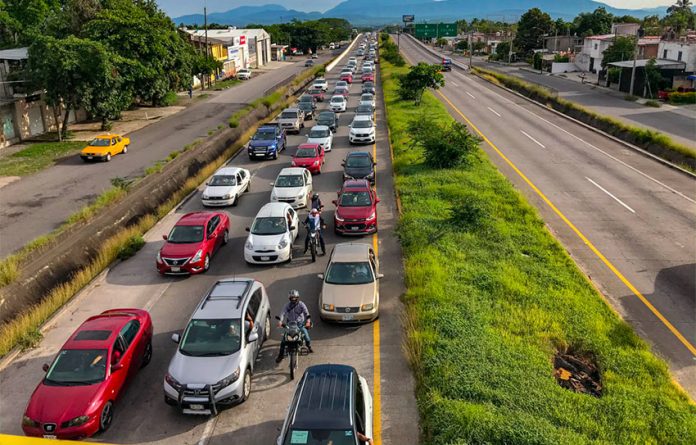
Traffic backed up Saturday on the Colima-Guadalajara highway.
Teachers in Colima blocked a highway in the state capital on both Saturday and Monday to demand the payment of their salaries after the outgoing Governor José Ignacio Peralta said last Thursday that no money was available.
The protesters used tractor-trailers, cars and other vehicles to obstruct traffic for more than three hours on both days on Colima-Guadalajara highway.
The local head of the SNTE teacher’s union, Heriberto Valladares Ochoa, said the money for salaries for the second half of July was used instead to pay off bank debt. “Insensitively, [Governor Peralta] preferred to take the resources already budgeted by Congress for our pay to deal with the liabilities with the banks,” he said.
The governor said last Thursday that the state was too short of funds to pay salaries for state workers and pensions, affecting 8,000 people. “We are not in a financial position to to pay the second half of July,” he said, and argued that the insolvency was due to the Covid-19 pandemic rather than financial mismanagement. He added that the pandemic had necessitated the use of 1 billion pesos (about US $50 million) for short term loans.
“I know the repercussions this generates, people have payment commitments … but we have explored each and every possible option,” he said. He added that federal law left him with no choice but to pay off the loans before the end of his mandate.
The state Congress has summoned Peralta and former state finance minister Carlos Arturo Noriega to appear before Congress on Wednesday to explain the hole in the public purse.
Peralta’s mandate ends on October 31. For the first time in more than 70 years, Colima elected a governor from a party other than the Institutional Revolutionary Party (PRI) in the June 6 election. Morena candidate Indira Vizcaíno Silva will assume the post.
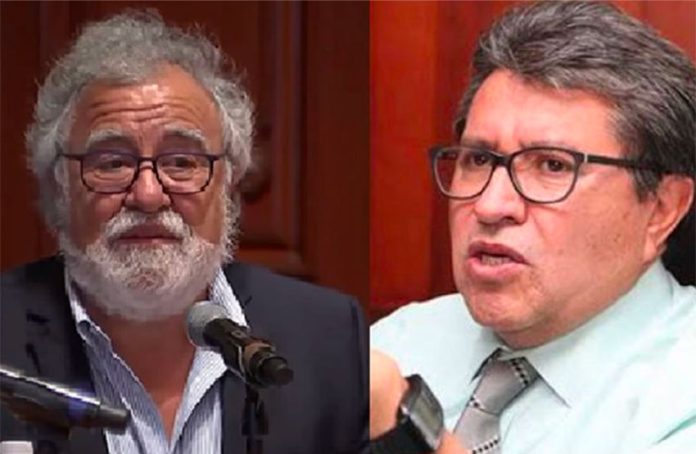
Encinas, left and Monreal clashed over a delay in removing a federal deputy's immunity.
A senior federal official has rebuked lawmakers for not moving quickly to revoke the legal immunity of a federal deputy accused of sexually assaulting a minor.
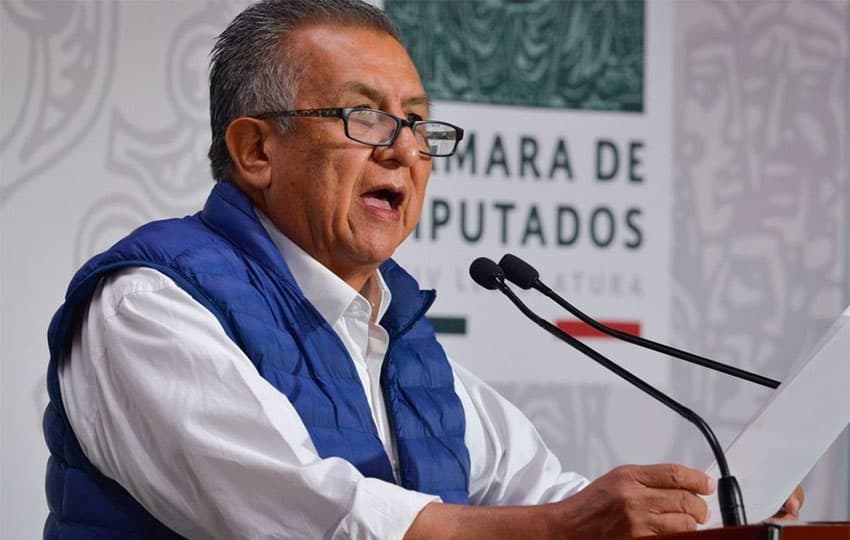
Saúl Huerta, a deputy with the ruling Morena party, is accused of assaulting a 15-year-old boy at a Mexico City hotel earlier this year. Authorities in the capital filed an application with the federal Congress to remove his immunity so that they can proceed against him.
Speaking in the Senate on Monday, Deputy Interior Minister Alejandro Encinas criticized senators and deputies for delaying a vote over whether Huerta should be stripped of his immunity from prosecution, a process known as desafuero.
“… We very much regret that the matter of desafuero of the Deputy Saúl Corona, accused of rape and sexual abuse, has been excluded from the extraordinary period of [Congress] sessions,” he said.
Encinas asserted that lawmakers are sending a “very negative” and “contradictory” message in not moving quickly to strip the deputy of his immunity because government and elected officials have a responsibility to be the main proponents of the eradication of sexual assault.
Deputy Huerta is at the center of a sexual assault case.
The process has been delayed several times since it began shortly after the assault accusation surfaced, triggering accusations by opposition politicians that the Morena party was attempting to slow the process.
Huerta, who represented Puebla in the lower house of Congress, has maintained that he is innocent and that the crime he is accused of was fabricated to harm his reputation. He didn’t contest the June 6 elections and will leave public office at the end of this month.
An audio recording of Huerta speaking to the mother of the boy he allegedly assaulted was published by Imagen Televisión in April.
“Don’t destroy me,” he pleads with her on repeated occasions. “Let’s reach an economic agreement. … I’m begging you, help me; you’re going to destroy me. I’m a good person,” Huerta said. His alleged victim was working on his campaign for reelection as a flyer distributor.
Ricardo Monreal, Morena’s leader in the Senate, rejected Encinas’ reprimand, asserting that the Congress will not tolerate impunity.
“No! I don’t accept your complaint, Mr. Alejandro Encinas,” he said. “… We’re not going to allow any impunity. … For your knowledge, there won’t be impunity in the Congress and in the Senate we won’t protect anyone, no one at all.”
The senator said the Congress’ permanent commission will convene on Tuesday to schedule a new extraordinary period for next week at which the desafuero of Huerta and Mauricio Toledo, a Labor Party deputy accused of illicit enrichment, will be considered.
“I give you my word, nobody’s case will be shelved, and that’s why I don’t accept your complaint. We’re doing our job [and] as we respect your job, we would also like our job to to be respected,” Monreal said.
“Decisions here are taken by a qualified or simple majority. Once again I give you my word that we won’t cover up for anyone,” he said, adding that Morena will take “pertinent decisions in benefit of justice so that nobody [who committed a crime] goes unpunished.”
Prior to Encinas’ appearance in the Senate, Mexico City Attorney General Ernestina Godoy was critical of the Congress’ failure to promptly consider the desafuero of Huerta and Toledo.
“At the Mexico City Attorney General’s Office we don’t accept the determination adopted by the permanent commission … to exclude from the schedule … analysis and a vote on … the withdrawal of immunity,” she wrote on Twitter last Friday.
“There is still time to correct this terrible determination if all the political parties decide to place this issue on their priority agenda. Politics cannot be divorced from justice,” the Attorney General’s Office said in a separate tweet.
The electricity tariffs for homes paying the high-consumption domestic rate (DAC) in Mexico City and the state of México have risen by 20.9% in annual terms, according to data from the Federal Electricity Commission (CFE), and are likely to continue to rise.
The DAC applies to households which exceed a monthly average of 250 kilowatt-hours (kWh) over a year.
This month the DAC price per kWh was set at 5.50 pesos, which marks an increase of 20.9% in annual terms, the highest annual increase recorded since data became available in 2007.
The regular fixed tariff for electricity also increased, rising 6.9% to 120.9 pesos.
A consultant at energy company Becquerel Power, Ulises Rivera Pérez, said the increase in tariffs results from a rise in gas prices in the United States last February, as natural gas is one of the primary energy sources used to generate electricity.
He added that rates are likely to continue increasing gradually for the rest of the year.
Extreme cold temperatures in Texas last winter caused a huge spike in natural gas prices as, by some estimates, nearly half of the state’s production came to a halt. In February 2020, the monthly average price of natural gas recorded at the Houston Ship Channel was US $1.87 per million British Thermal Units (BTU). The price shot up to $56.34 per million BTUs in February 2021, and hit its peak at $400 per million BTUs on February 17.
Price fluctuations in U.S. natural gas can have drastic knock-on effects for the import reliant Mexican market. About 95% of the gas consumed in the country is imported from the United States.
CFE finance director Edmundo Sánchez said the shortage of natural gas due to the Texas freeze cost the state-owned company 65 billion pesos. It left some northern states, and almost 5 million people, without power.
Remittance payments, the country’s most important source of foreign income, broke the US $4-billion mark for the fourth consecutive month in June and were up 25.5% for the month in annual terms.
The $4.44 billion was received through 11.301 million transactions.
The $23.61 billion received in remittance payments in the first six months of the year also represents the highest for the first half of any year, and was up 22.4% over last year.
The average remittance received was $393.
The president has previously described those who send foreign currency home from abroad as “heroes.”
Latin America economist at Goldman Sachs, Alberto Ramos, said U.S. policy was one key driver of the rise in remittance payments, as well as factors which reflect poorly on the Mexican economy. “The drivers of remittances from the United States result from the generous fiscal transfers to support wages and incomes in that country, the competitive level of the dollar against the Mexican peso, and the deep contraction of activity and employment in Mexico,” he said.
The Bank of México predicts that remittance payments will finish the year 21.7% higher than in 2020, at a total of around $49.4 billion.
CORRECTION: The numbers for June didn’t quite add up in the previous version of this story due to rounding. In addition, the total for the month was $4.44 billion, rather than $4.43 as first reported.
It is said that the word guaymas means “throwing arrows at the head” in Cahíta, the linguistic family encompassing the languages of the Yaqui and Mayo pueblos of Sonora.
Guaymas is where an airplane named Sonora threw bombs, by hand, at the federal warships that were striking down the Sonoran revolutionaries on May 30, 1913, during the first aeronaval attack in world history. The heroic aircraft ended its days in Guadalajara — boneless, forgotten, with broken wings and rebaptized La Guajolota.
Guaymas is the ancestral land of the Guaimas people — a branch of the Seri (Comcaac) or “people of the sand” in Cahíta — who wore pelican feathers and skins and fished, hunted and gathered the fruits of the land. It was a pueblo band that survived surrounded by the Yaqui in the south, the Seri to the northwest and the Apache in the far north until they finally faded away, merging seamlessly with the Yaqui and Pimas Bajos in the 19th century.
Guaymas is located just 11 kilometers from Empalme’s police station, where Charlie Chaplin surreptitiously wed Lillita Louise MacMurray on November 24, 1924. The British actor was forced to marry after being threatened with scandal, and the law, by the mother of Spanish descent of a bride who had become pregnant at the tender age of just 15 and who had played the part of a “flirting angel” in Chaplin’s 1921 film, The Kid. A railroad love affair in Empalme, the unlikely junction of two paths.
I keep among my trinkets a copy of Charlie and Lillita’s marriage certificate, which for years accompanied the huge black-and-white photograph of the immortal mime — atop a fireplace I never ignited during my refuge as a lonely bachelor in Guaymas long, long ago.
The biplane turned air bomber, The Sonora. During the Mexican Revolution, anti-government forces used it to drop explosives on their enemies from the air. Ministry of Culture
Guaymas is the desert, the sea, the sky; estuaries, bays, mangroves and sunrises and sunsets ignited by fire. It is the intertidal zone, where every day the sea and the land merge in a slow-motion waltz, somewhere between the highest and lowest tides. Guaymas is Estero Tastiota, Bacochibampo Bay, the Sleepy Lion, El Cochori, San Carlos Bay, Vícam, Pótam and Bay of Lobos.
Guaymas is Estero del Soldado, the protected area in San Carlos that’s a favorite home for American migrant birds that a band of brave university professors from the Tecnológico de Monterrey saved from certain death at the hands of unscrupulous developers — a fate that Estero Miramar could not escape because of the developers’ gluttony and because the professor’s band had dispersed.
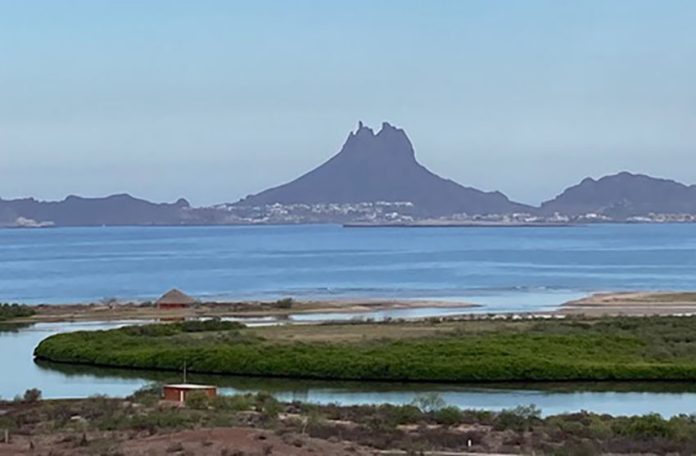
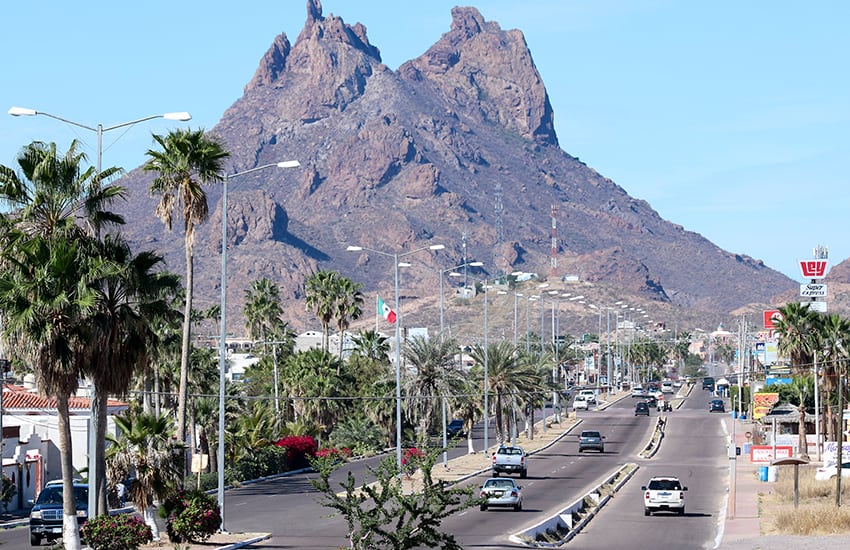
Guaymas is the Teta Kawi (sometimes called Tetas de Cabra, or goat tits), the heart of an extinct volcano sculpted by the winds and shadows of time — tekalaim in the Yaqui language, the enormous tongue-shaped mountain of the serpent that breastfed us all.
Guaymas is Mexican giant cardón, saguaro, and jumping cholla cacti; ocotillo and elephant, mesquite, palo verde, ironwood and jito trees. It is the gila monsters, rattlesnakes, scorpions, Mexican bed bugs and yellow-bellied sea snake — the one that has a paddle tail to swim backward and forward.
Guaymas is fin whales, orcas, bottlenose dolphins, sea lions, leptocephalus larvae that slowly eat themselves as they grow old and skulls of undescribed pigmy beaked whales floating in bars on lonely beaches. And, of course, Guaymas is endearing amigos from both sides of the border and a white-headed British gentleman.
About 482 years ago, on September 14, 1539, Francisco de Ulloa arrived at Guaymas’ enchanting bay. The great Spanish navigator, explorer, and overachiever was the first person to sail the entire coast of the Baja California peninsula, only to be devoured by the waters of the Pacific Ocean in his ship, the Trinidad. He was the captain who baptized the Gulf of California first as the Vermillion Sea, then as Mar de Cortés in honor of Hernán, the conquistador and his boss.
The extinct volcano Teta Kawi looms over San Carlos in Guaymas. deposit photos
Guaymas was founded as San José de Guaymas on August 31, 1669 by José de Gálvez y Gallardo, visitor-general of New Spain — he eventually became the Marqués de Sonora and Viscount of Sinaloa — who arrived in Sonora with the impossible mission of subjugating the indomitable Seri, Pima, Ópata, Sobaipuri and Apache.
The Spanish army came to Guaymas, seduced by the magnetic greed for pearls, gold and silver — invaders who tried time after time to take over the territory north of the Yaqui River. These fair-skinned European invaders were repelled time after time by battle-hardened Yaquis, for whom the most precious possessions weren’t metals but their natural resources.
Guaymas was officially named the “Heroic City of Guaymas” in 1935 in honor of the memorable Battle of Guaymas on July 13, 1854, which defended the seaport from the insurrection of French residents who wanted to establish an independent republic of Sonora.
They were led by Gaston de Raousset-Boulbon, a French pirate who, after sailing the Atlantic in 1850 from Bordeaux to America, heading to Mexico, made a stopover in the Panamanian Caribbean while it was still part of Colombia. That was the Guaymas of then 2,000 inhabitants, made up of mostly European and South American emigrants who, with the Guaimas and Yaquis, joined the Mexican army to defeat the French and execute by firing squad the despicable Gaston.
In downtown Guaymas, 161 steps from the statue of El Pescador, that giant fisherman who sits gazing at the horizon in case a foreign enemy dare invade again, is the heart of the only Plaza of the Three Presidents in the entire world: Guaymas-born Plutarco Elías Calles, Adolfo de la Huerta and Abelardo L. Rodríguez. Both the fisherman and the presidents’ statues were made by the Spanish-born nationalized Mexican Julián Martínez Soros.
Offshore, 2,000 meters deep, the Guaymas Basin bubbles forth primordial ooze from one of the greatest abysses of the Gulf of California, where, inch by inch, new sea floor is being built as I write this essay.
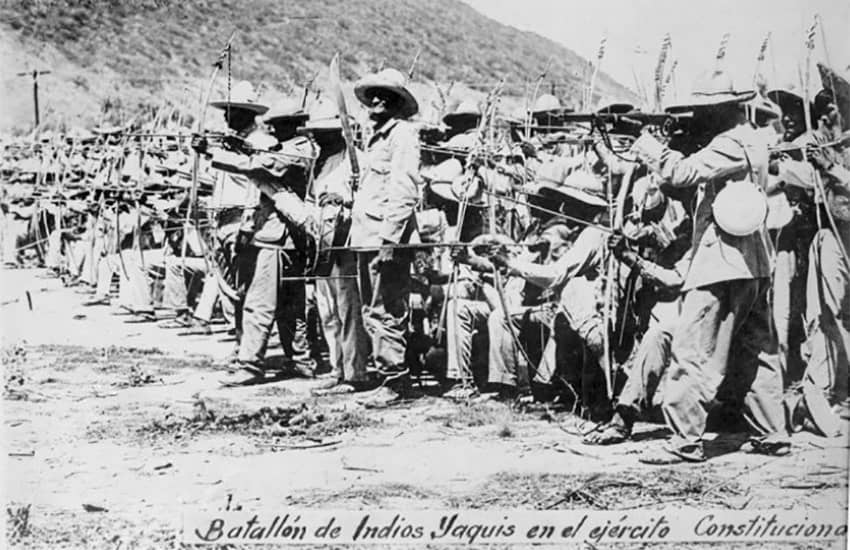
Yaqui battalion as part of the Ejército Constitucionalista, Sonora, July 1899. Casasola/INAH National Photo Library
Guaymas is the “Barca de Guaymas,” the most nostalgic song ever sung about the coastal port where John Steinbeck and Ed Rickets anchored on April 5, 1940, during their epic voyage onboard the boat Western Flyer, their adventures immortalized in the book Log from the Sea of Cortez, the narrative of two seagoing apprentices escaping debts, love affairs gone bad and evil gossiping tongues.
Upon arriving in Guaymas on August 2, 1979, 42 years ago today, I burned my ships. I’m Colombian by birth, Mexican by adoption and guaymense by heart. Here I surrendered to the sea, and here I found true love.
Here, at the Pearl of the Sea of Cortés.
To Patricia, Pía, Omar
Omar Vidal, a scientist, was a university professor in Mexico, is a former senior officer at the UN Environment Program and former director-general of the World Wildlife Fund-Mexico.
The new gas stations will be operated as Pemex franchises.
The federal government is set to announce the construction of a chain of state-owned gas stations along the route of the Maya Train railroad.
Pemex, the National Institute of Social Economy and the National Tourism Promotion Fund (Fonatur) will announce on Tuesday the construction of gas stations to be known as Gasolineras del Bienestar, or Well-Being gas stations, the newspaper El Universal reported.
The new gas stations on the 1,500-kilometer-long Maya Train route through Chiapas, Tabasco, Campeche, Yucatán and Quintana Roo will be built in conjunction with community landowners and local authorities. Federal authorities have already begun discussions with ejido (agricultural cooperative) authorities and visited potential construction sites.
The first Bienestar stations will be built in the south of Quintana Roo. One community likely to get one is Sergio Butrón Casas, a sugar cane growing community 30 kilometers west of Chetumal and just north of the border with Belize.
The aim of the stations will be to strengthen the “social and caring economy,” El Universal said. The number to be built is expected to be announced tomorrow.
Gabriel Guillermo Arellano Aguilar, a deputy director of Fonatur, which is building the Maya Train, said last month that the communities in which new gas stations are built will be responsible for managing them.
“[It’s] our commitment to provide support to them to guarantee their success,” he said.
The state oil company will supply fuel to the Bienestar stations, which will be Pemex franchises, albeit with a different name. Construction of the new stations will help boost the state company’s participation in the retail fuel market.
Out of almost 13,000 gas stations in Mexico, more than 7,200 operate under the Pemex brand but the company’s sales have declined in recent years as more private companies have entered the market.
President López Obrador announced last month that the state oil company would create a new division to be called Gas Bienestar to distribute LP gas directly to consumers.