Home Blog Page 1198

Vaquita porpoise sacrificed for political gain; observers fear extinction will follow

0
vaquita porpoise
The vaquita porpoise doesn't have a lot to smile about these days.

The federal government’s decision to scrap a no-fishing zone in the upper Gulf of California will likely lead to the extinction of the critically endangered vaquita marina porpoise, according to two environmental sector professionals.

Last week, Mexico officially abandoned its policy of maintaining a “zero tolerance” fishing zone that was implemented to protect the vaquita, of which fewer than a dozen are believed to remain.

The “zero tolerance” zone has been replaced with a sliding scale of sanctions if more than 60 boats are repeatedly seen in the area — where totoaba, a fish whose swim bladder is a delicacy in China and sells for thousands of dollars per kilogram, coexist with the vaquitas.

Many of the latter, the world’s smallest porpoise, have died after becoming entangled in nets set to catch the lucrative totoaba.

Kate O’Connell, marine consultant at the Washington D.C.-based Animal Welfare Institute (AWI), told the environmental news website Mongabay she feared the decision to abandon enforcement of the “zero tolerance” zone could be “the death knell” for the vaquita.

Totoaba fish
Vaquita in the Gulf of California are killed by gillnets laid for the lucrative totoaba, pictured, whose swim bladders sell for thousands of dollars a kilo in China.

“… The plan that has been proposed by Mexico will convert what should be a straightforward ‘no-go’ zone into a complex enforcement area with varying levels of monitoring and deterrence, depending on the amount of illegal fishing taking place in the area,” she said.

“The vaquita are being mismanaged to death,” O’Connell declared.

She said that gillnet fishing is technically still banned in the upper Gulf of California — the only place in the world vaquitas live — but predicted that it would nevertheless take place in the abandoned protected zone.

“Mexico’s fisheries authorities are indicating that they are either unable or unwilling to do all that is necessary to save the vaquita and are willing to accept a certain level of gillnet fishing activity,” O’Connell said.

“One hundred percent monitoring and enforcement of the fishing ban only kicks in once more than 50 illegal vessels are seen, or more than 200 meters of illegal gillnets are found in the area,” she said.

Despite her overall pessimism about the vaquita’s outlook, O’Connell said there was a “slight glimmer of hope” for the marine mammal “if an actual complete shutdown of gillnet activity in the area can be achieved.”

The Sea Shepherd Conservation Society's boat the Farley Mowat.
The Sea Shepherd Conservation Society’s boat Farley Mowat. The group plans to resume patrols soon to remove gillnets in the Upper Gulf of California.

“The few remaining vaquita appear healthy, and a number of calves have been spotted in recent years by researchers,” she said.

The executive director of Earth League International, a non-profit organization that has investigated totoaba trafficking, told Mongabay that the porpoises stand no chance of survival unless the Mexican government succeeds in eliminating totoaba cartels.

The move to abandon zero-tolerance enforcement could benefit local fishermen, but international totoaba traders — most of whom are Chinese nationals — will reap the biggest rewards, Andrea Crosta said.

“[They] will make a ton of money with even less risks than before,” he said.

Crosta charged that the abolishment of the no-fishing area is politically motivated, although the move won’t win the government any support from environmentally minded Mexicans.

“I think that the current populist administration in Mexico is concerned only about voters — certainly not about environmental protection and endangered species if this gets in the way of political gain,” he said. “And if the vaquita will go extinct, I am sure the current administration in Mexico will blame the administration before.”

The Sea Shepherd Conservation Society, which has carried out patrols in the Gulf of California since 2015, told Mongabay that it “remains committed to preventing the extinction of the vaquita” and planned to return to the area as soon as possible to resume gillnet removal efforts.

The Sea Shepherd vessel the Farley Mowat has been attacked on repeated occasions, including in January this year, when fishermen aboard at least five pangas threw lead weights and Molotov cocktails at both the crew and military officials on board. A fisherman whose boat broke apart upon colliding with the Farley Mowat died after sustaining serious injuries.

O’Connell said that AWI, the Center for Biological Diversity, the Environmental Investigation Agency and the Natural Resources Defense Council have all made urgent pleas to the international community to “both provide logistical and financial support to Mexico and to put pressure on the government by means of trade sanctions and other actions to ensure that the vaquita is saved.”

President López Obrador said in late June that sanctions against Mexico wouldn’t affect his government’s decisions on environmental issues because “we [already] have sufficient convictions for there to be justice and to truly defend the environment, not in a simulated or pretend way.”

But just weeks later, his government changed Upper Gulf of California fishing rules in a move that appears to doom the vaquita to extinction and calls such convictions into doubt.

With reports from Mongabay

Birth of Chapultepec wolf pups gives boost to breeding program

0
Three of the pups that were born in April at the Mexico City zoo.

The birth of five gray wolf pups at Mexico City’s Chapultepec Zoo in early April marked another step in the efforts to reintroduce the endangered species back into the wild.

The three males and two females are part of a four-decade, bi-national breeding program between the United States and Mexico.

The endangered species has been limited to captivity for decades, and breeding for genetic diversity is essential for them to regain their independence.

The Mexican gray wolf is North America’s rarest subspecies of gray wolf. It was listed as endangered in 1976 after being hunted, trapped and poisoned to the brink of extinction. From the 1960s to the 1980s, seven gray wolves — believed to be the last of their kind — were captured and the captive breeding program began.

Wolves started being released back into the wild in the late 1990s. The population has nearly doubled over the last five years, with the latest annual census finding about 186 Mexican wolves in the wild in New Mexico and Arizona.

However, in northern Mexico, the other part of the wolves’ historic range, reintroduction initially stumbled. An effort to reintroduce them to the wild in Sonora in 2011 ended in tragedy when all five wolves were poisoned. Another release was carried out in 2012 in Chihuahua, and those wolves now number around 40, most born in the wild.

In fact, their classification as “endangered” is a sign of progress: two years ago the species’ status was promoted from “probably extinct in the wild” to “endangered” due to the success of the breeding program. The program has brought the species’ population to around 540, of which 323 live in zoos. 

Back at Chapultepec Zoo, Rhi, the father of the pups, signals them to the arrival of breakfast, which takes the form of chicken and quail meat.

Zookeeper Jorge Gutiérrez, 58, is the man who feeds them. He has cared for Rhi since the wolf was born and has seen him form a pack with mother Seje. He watches as the five wolf pups stumble out of their den to eat. “It’s marvelous. What I am experiencing is something unique,” he said.

Fernando Gual, a veterinarian who serves as director of Mexico City’s zoos, said the Chapultepec Zoo also has a sperm and egg bank that provides backup for genetic material, from which Rhi was born, but that females like Seje are the best possible recourse. “This is our jewel … Every litter of pups is hope for the life of this species,” he said.

With reports from AP and The San Diego Union-Tribune

Querétaro’s gourmet producers plant seeds to grow an industry

0
Yakoe Nicol Tablado of Cava de Quesos Bocanegro
Yakoe Nicol Tablado of Cava de Quesos Bocanegro, a Querétaro cheese producer. Photos by Joseph Sorrentino

Mexico’s north-central state of Querétaro is finally starting to get some well-deserved notice for its wines.

The state’s vineyards have usually been overshadowed by Baja California, which currently accounts for about 90% of Mexico’s wine production, but they are expanding and more Mexicans are learning to enjoy the alcoholic beverage. It also doesn’t hurt that its artisanal cheese industry is also growing.

It’s actually a little surprising that Mexico doesn’t have a major wine industry, given that it’s the oldest winemaking region in the Americas. It dates back to 1524, when conquistador Hernán Cortés ordered grapevines to be planted.

One story — probably apocryphal — claims that Cortés wanted them because in celebrating their victory over the Aztecs, he and his soldiers had drunk all the wine they’d brought from Spain. Whatever the reason, Spaniards obeyed his orders, and the resulting vineyards did so well that wine imports from Spain fell off sharply.

This miffed the Spanish king, Charles II, and in 1699, he banned winemaking in Mexico, exempting only the Catholic Church’s sacramental wine. Although the ban was lifted after the Mexican War of Independence in 1821, Mexico’s wine industry continued to lag far behind its beer, tequila and mezcal industries.

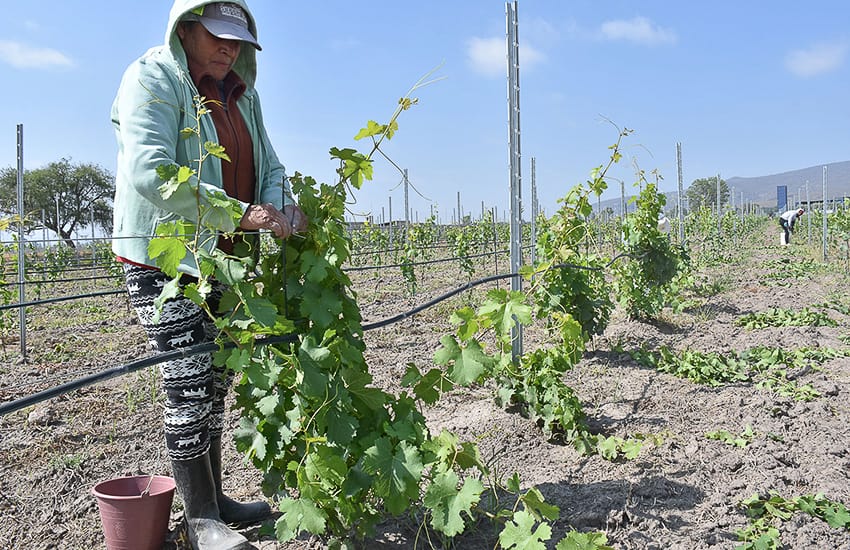
Vinaltura vineyards in Querétaro, Mexico
A worker tends vines at the Vinaltura vineyard in Querétaro.

But the number of wineries sprouting up in Querétaro these days is a testament to an increased interest in Mexican wines.

The first modern vineyards in the state were founded in the 1970s when the Redonda and Freixenet wineries — two of the largest in the state — planted their grapevines. They did this despite the challenges faced when trying to establish vineyards here.

For one, there’s the rain that arrives during the harvest season, which allows mildew to grow on the grapes.

“The mildew will poke through the grapes and ruin them,” said Tom Pence. He and his wife Tiffany have a total of 37 years experience in the wine industry.

They moved to Querétaro just over three years ago and have spent much of that time learning about the state’s wineries. Tiffany has her own blog in which she shares inside information about vineyards, creameries and what else Querétaro has to offer.

Some years, as much as 30% of the harvest can be lost to mildew. Hail, which also arrives during the harvest season, can destroy grapes.

To avoid such losses, Pence said, “The focus is on [growing] thick-skinned varieties — early ripening ones too.”

Another issue is the presence of large volcanic rocks, which are prevalent across the area.

“The vines struggle to grow, and the grapes will be smaller,” said Pence. However, he added that smaller grapes will lead to wines that are more what he calls “classically European” wines that are “more elegant, have nicer acidity.”

Despite the challenges, Querétaro now boasts more than 40 wineries.

Andrea Morena Durán has worked in some capacity in the wine industry for seven years and has been a manager at the Vinaltura winery for a little over a year.

Vinaltura’s first vines were planted in 2014. Its first production was in 2017, and they now turn out about 40,000 bottles of wine a year.

“We have a number of whites,” said Durán, “including sauvignon blanc, chenin blanc, and riesling. White wines and sparkling wines do the best because of the rain and the acidity of the soil.

“We do small fermentations for higher quality. We have three or four harvests of whites; we ferment them separately, then combine them.”

Doing this allows Vinaltura to produce the best white wines possible despite the challenges. “We have extreme weather and high acidity [in the soil],” she said, “and this is what gives Querétaro wines their specialness.”

Vinaltura also sells two rosés and six red wines but, like other wineries, in a more limited supply. Richard Hernández Jiménez, the sommelier at Puerta del Lobo winery for the last three years, pointed out why that’s probably the case.

For reds like cabernet, he said, “… the growing season is so long and the chance of hail is great. It has a thick skin — so that is good. But it takes too long to grow.”

Hernández sees part of his job as educating Mexicans about wine. “It is very difficult to change Mexicans’ minds,” he said. “Wines are dry, and the Mexican palate is accustomed to sweet things, to sodas or strong things like tequila.”

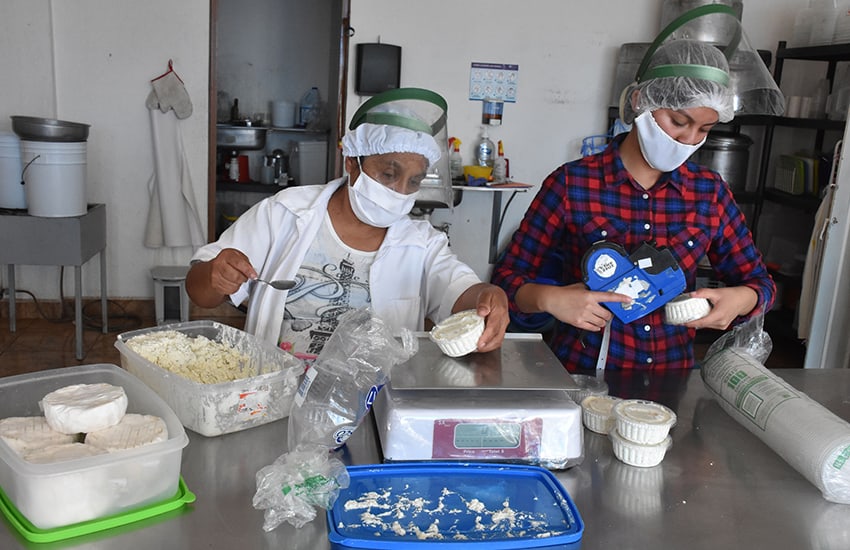
Workers at Queso La Biquette in Querétaro
Workers at Queso La Biquette in Querétaro prepare goat cheese for sale.

He brings newcomers along slowly. “We start with whites, the gentlest ones like sauvignon blanc, which is quite floral. Then we’ll move to rosés made from malbec or syrah.”

Eventually, he may even be able to get them to try a red like cabernet sauvignon.

Querétaro’s artisanal cheese producers nicely complement the state’s vineyards, and they are also introducing Mexicans to something new. Cava de Quesos Bocanegro opened eight years ago and at first sold only fresh cheeses.

“Basic Mexican cheeses like quesillo, manchego, queso fresco,” said Yakoe Nicol Tablado, son of the business’s founder and manager. Then, six years ago, they built a cava (cave) and began selling aged cheeses.

“It is hard in Mexico to sell [them],” he said. “We are trying to introduce Mexicans … to the flavors that Europeans really like. I think we are being successful.”

Bocanegro offers a tasting that includes several of their cheeses, ranging from mild to strong flavors, and includes some vegetables and bread. Local wines and beer are also available.

Isabel Esteve Denaives is a veterinarian who has a soft spot for certain animals. “I like goats,” she admitted. She must because she now has a herd of 75.

She’d been selling goat milk for years but struggled to make enough money to continue. So she decided to start making and selling cheese. A person of French Mexican heritage, she spent a year in France learning how to make goat cheese.

Three years ago, she opened Queso La Biquette (biquette is French for “small goat”), introducing Mexicans to something new.

“It is not typical in Mexico to have this type of cheese,” Esteve said. “Cheese made from cows is a part of Mexican gastronomy; people cook with those cheeses. This cheese is more for the table. We try to educate Mexicans on how to eat this cheese and enjoy it.”

Although not certified as organic, Esteve said she doesn’t use antibiotics or preservatives. “Our production is all manual,” she said. “No machines.”

La Biquette also offers tastings with six types of goat cheese. The mildest, and what most people think of when they think of goat cheese, is queso fresco and the strongest is one called tomme, which has a sharp, earthy flavor.

As the wineries have expanded, so have their offerings.

“Wine bars, restaurants and tours of the vineyards and creameries started about four years ago,” said Tiffany Pence. They also have tastings.

• Querétaro has its official art, wine and cheese route that you can follow on your own, but there are also a number of companies that offer tours. More information about its wineries may be found at www.avq.com.mx.

Joseph Sorrentino, a writer, photographer and author of the book San Gregorio Atlapulco: Cosmvisiones and of Stinky Island Tales: Some Stories from an Italian-American Childhood, is a regular contributor to Mexico News Daily. More examples of his photographs and links to other articles may be found at www.sorrentinophotography.com  He currently lives in Chipilo, Puebla.

Oaxaca street vendors unhappy after 1,500 removed by police

0
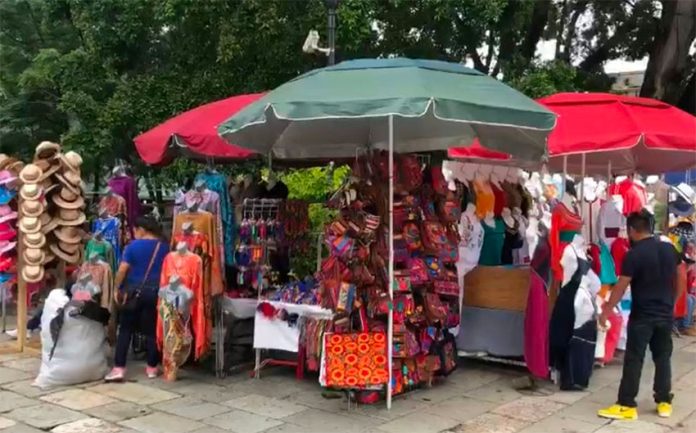
Vendors' stalls in Oaxaca's zócalo.

Two hundred street vendors set up their stalls in the historic center of Oaxaca city on Saturday in defiance of efforts to clear the area of unregistered stalls. The move came just two days after the local government sent out a 500-strong security force to remove 1,500 stalls that lacked licenses.

Municipal authorities ordered the removal of all unlicensed stalls on Thursday, bowing to pressure from local business owners, and erected metal barriers to prevent sellers from reentering. It had been estimated that there were more than 3,000 unregistered stalls in the historic center.

The following day, the vendors tried to enter two of the city’s central squares, which had been cordoned off by police. On Tuesday, disabled vendors, some of whom walked on crutches, marched on the central square arguing they had no other form of income and that they do not set up fixed stalls.

Some sellers insist that the council is refusing to recognize their permits, which cost as much as 24,000 pesos (about US $1,200), and that seasonal permits for 5,500 pesos had also been rejected.

A group of vendors, led by Carmen Luján from the Independent Merchant’s Union, marched on government offices in protest on Saturday and said they would remain in the main square. Luján has requested dialogue with Mayor Oswaldo García Jarquín and Governor Alejandro Murat, due to what the group has described as the “incompetence” of municipal authorities.

Mayor García said that unlicensed vendors would no longer be tolerated and that no new permits would be made available until a review of every permit had been completed.

He has also denied that the stalls had been removed to placate a production company set to film in the city center.

Meanwhile, Governor Murat has proposed a plan to introduce mobile stalls to prevent fixed stalls being set up.

However, he made clear that formal business owners would be prioritized. “We have to strike a balance. We have to find how to create social benefit for people, while also putting formal traders first, the ones that pay, and then the the informal traders,” he said.

The governor added that it was important to regularize informal sellers to give them legal protection from groups charging them fees. “[It will] end the corruption of groups and leaders who charge floor fees for selling in public spaces, without having any legal power to do so,” he said.

With reports from Milenio, Imparcial Oaxaca and El Universal

Tourism minister has high expectations for international visitor numbers

0
tourists on the beach
Tourism authorities predict a 30% increase in summer visitors arriving by air from the US.

International tourist numbers this summer will rebound strongly from last year’s pandemic-induced slump, the federal Tourism Ministry (Sectur) predicts.

Tourism Minister Miguel Torruco said his ministry made visitor number projections for July and August based on three possible scenarios. He didn’t reveal Sectur’s forecasts for optimistic and pessimistic scenarios but 20.2 million tourists are expected in a conservative one.

That would represent a 178% increase compared to July and August last year, when approximately 7.4 million international tourists came to Mexico, Sectur said.

The ministry predicts that tourists will spend just over 49 billion pesos (US $2.4 billion) on accommodation, a 48.5% increase compared to 2020. It forecasts average hotel occupancy of 52.2%, 36% higher than last summer.

Torruco noted that travel analytics firm ForwardKeys projects that visitor numbers this summer will actually be higher than in 2019.

Based on an analysis of airline ticket sales between January 1 and June 23, the Spanish firm predicted that air arrivals to Mexico will be 31.9% higher than in the same period of 2019.

Sectur cited projected increases in visitors from four key countries: a 30.4% increase in air arrivals from the United States – the No. 1 source country for international visitors to Mexico; a 27.6% increase from Spain; a 21.3% increase from Switzerland; and a 5.2% increase from France.

The airports in Puerto Vallarta, Los Cabos and Cancún will receive the highest number of U.S. tourists over the summer, according to ForwardKeys.

United States citizens are already flocking to Mexico with a new record of almost 1 million Americans arriving in May.

“The northern neighbors have greatly aided the tourism sector in Mexico,” said Juan Gomez, insights analyst at ForwardKeys.

“Our air ticketing data has consistently shown the popularity of flights from the USA to Mexico since the summer of 2020, particularly on routes to Los Cabos in Baja California, Cancún and Puerto Vallarta,” he said.

Gomez said that “keeping borders open during the pandemic is key” to a strong tourism recovery as is “widening your air network.”

“Air connectivity is a key driver for demand. Currently, airlines are offering just 6% fewer seats than in 2019 for all international routes to Mexico in July and August,” he said.

Mexico doesn’t require incoming travelers to show negative Covid-19 test results, get tested on arrival or go into mandatory quarantine. The absence of restrictions has been cited as a key factor in Mexico’s strong tourism recovery compared to many other countries.

Americans are coming here in large numbers even though the United States Centers for Disease Control and Prevention recently warned U.S. citizens of high rates of Covid-19 in Mexico and advised them to reconsider plans to travel here.

Mexico is currently recording its highest daily case numbers since the start of the year as the Delta strain of the virus drives a third wave of the pandemic. Hospitalizations and deaths are down compared to the first and second waves but Mexico continues to record hundreds of fatalities on a daily basis.

Mexico News Daily 

Oaxaca lawmaker celebrates ancestral dish, enjoys hearty meal of field rat

0
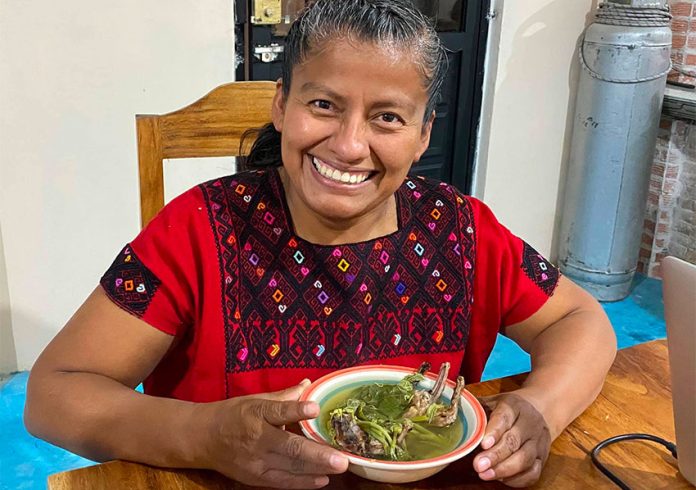
Deputy Irma Juan Carlos
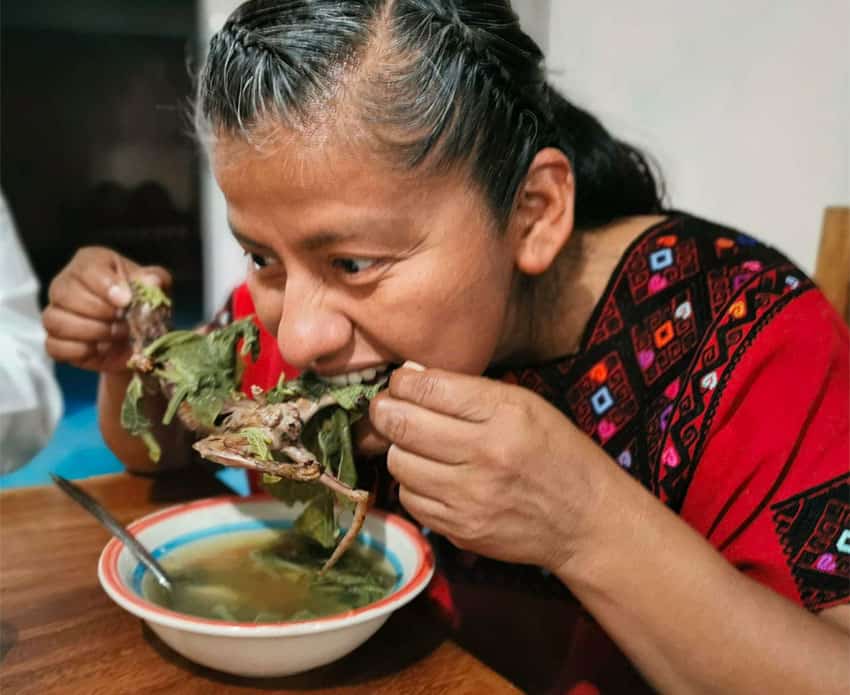
Deputy Irma Juan Carlos appears eager to savor her soup.

A federal deputy for Oaxaca displayed her appreciation for the culture of a town in Chiapas by sharing photos showing her dining on a treasured dish: field rat soup accompanied by some leafy vegetables.

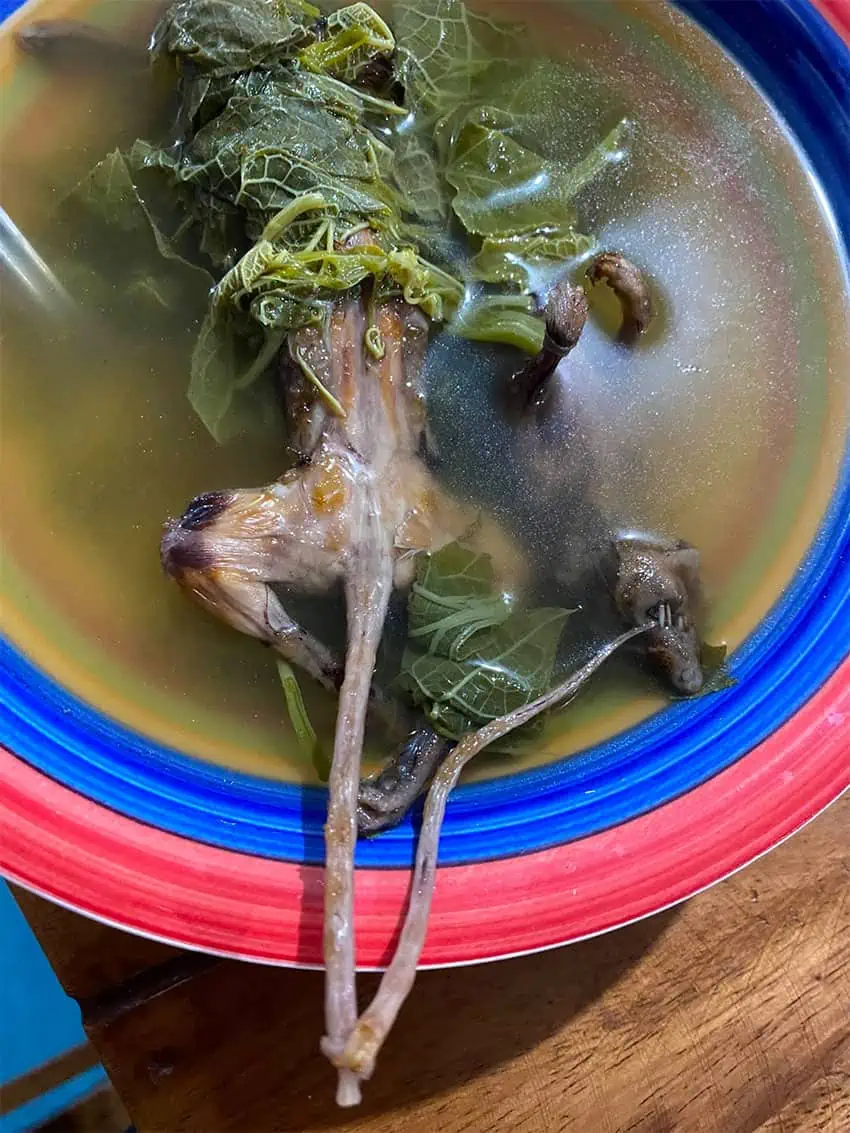
Irma Juan Carlos of Teotitlán de Flores Magón appeared in photos on social media with a radiant smile as she sat before a bowl containing an easily identifiable rat. Under another photo of her enjoying the delicacy a caption read, “Sampling the ancestral food of our brothers from the town of Oxchuc, #ratademonte [field rat].”

The post also attested to the rat’s nutritional value: “This ancestral dish is 95% protein, all the protein that a human being needs.”

The dish has become one of the region’s most popular; its low price is a selling point for local families. It has been consumed for generations due to its high protein content and as a medicinal remedy to relieve the common cold.

Field rat is not considered an unhealthy option given that the small creatures feed only on herbs, roots and seeds.

irma juan carlos field rat soup
Provecho.

Apparently the dish is easy to prepare. One recipe suggests boiling the field rat in water along with some chayote, and adding a little salt. The meat becomes soft and the broth remains almost translucent.

One social media user confirmed its culinary value. ““What delicious meat! It really is a delight. My grandparents fed me that when I went on vacation … Enjoy the meal!”

However, another user expressed distaste. ““Let’s hope they are not going to be like the bats,” the reader wrote, in reference to the alleged cause of the Covid-19 pandemic.

Deputy Carlos is president of the Indigenous Peoples Commission in Congress and is of Chinanteca origin, an indigenous group in Oaxaca. According to the Ministry of Culture there are 133,374 speakers of Chinantecan languages. They are more likely to refer to themselves as jmiih, meaning speakers of the ancient language.

With reports from El Universal and Uno TV

The field rat is very rat-like in appearance
The field rat is very rat-like in appearance, but eats better than other varieties.

US extends border closure for another month, restricting nonessential travel

0
mexico us border
Closed for another month.

The U.S. government on Wednesday extended the closure of land borders with Mexico and Canada to nonessential travel such as tourism through August 21 even as officials debate whether to require visitors to have received a Covid-19 vaccine.

The latest 30-day extension by the Department of Homeland Security (DHS) came after Canada announced on Monday it will start allowing in fully vaccinated U.S. visitors on August 9 for nonessential travel after the Covid-19 pandemic forced a 16-month ban that many businesses have called crippling.

DHS said on Wednesday it “is in constant contact with Canadian and Mexican counterparts to identify the conditions under which restrictions may be eased safely and sustainably.”

One difficult question for President Joe Biden’s administration is whether to follow Canada’s lead and require all visitors to be vaccinated for Covid-19 before entering the United States, sources briefed on the matter told Reuters.

Mexico’s Ministry of Foreign Affairs, which has been hopeful that the U.S. would agree to discontinue the border closure, said bilateral talks would continue to that end. It also noted that the accelerated pace of vaccinations in the border area will help speed the process.

The White House plans a new round of high-level meetings this week to discuss the travel restrictions and the potential of mandating Covid-19 vaccines for visitors, but no decisions have been made, the sources said.

The review comes amid increasing concern among U.S. officials about the Delta variant. U.S. health officials have reported sizable increases in Covid-19 cases and deaths, with outbreaks occurring in parts of the country with low vaccination rates.

The White House last month launched interagency working groups with the European Union, Britain, Canada and Mexico to look at how to eventually lift travel and border restrictions.

Businesses in Canada and the United States, particularly the travel and airline industries, have pushed for an end to restrictions on nonessential travel between the two countries, which were imposed in March 2020 early in the pandemic.

Since then, the land border has remained closed to all nonessential travel.

Unlike international air passengers, travelers crossing U.S. land borders do not need negative Covid-19 tests.

The Canadian Chamber of Commerce, a business group, criticized the latest U.S. extension. It said the U.S. move “flies in the face of both science and the most recent public health data.”

“It’s hard to see how allowing fully vaccinated Canadians to enter the U.S. poses a public health threat when travel within the U.S. is unrestricted,” the organization said.

The United States has continued to extend the restrictions on Mexico and Canada on a monthly basis since March 2020.

The U.S. land border restrictions do not bar U.S. citizens and lawful permanent residents returning to the United States. As in prior extensions, DHS said it could still seek to amend or rescind the restrictions before August 21.

With reports from Reuters

Pirates strike Campeche oil platform, steal tools, supplies, crew’s belongings

0
The Sandunga platform in the Bay of Campeche.

Armed thieves attacked a privately-owned oil platform in the south of the Gulf of Mexico late Monday and made away with equipment and personal belongings of rig workers.

Navy sources told the newspaper Milenio that at least five armed men arrived aboard two speed boats at the Sandunga oil platform, located in the Bay of Campeche and owned by the company Goimar.

They boarded the platform and stole tools, supplies, self-contained breathing apparatuses, camera-equipped diving helmets, diving suits, flippers, boots and workers’ personal belongings.

Rig workers, who reported hearing gunshots, took refuge in a secure area of the platform as the robbery took place, Milenio reported. They notified the navy of the heist and two vessels were deployed to search for the thieves.

The search continued into the early hours of Tuesday morning but the thieves and their boats were not located.

Attacks on oil platforms by modern-day pirates are common in the Gulf of Mexico. Rigs owned and operated by state oil company Pemex have been targeted on numerous occasions.

“We fear for our lives,” Martín Gómez, who has worked on state oil company rigs for almost three decades, said last year.

A 2020 study found that the response by the navy to oil rig attacks is usually slow, with vessels taking up to seven hours to reach the crime scene, giving pirates plenty of time to escape.

That was the case on Monday night, according to the head of a consulting firm that specializes in merchant marine matters.

“We ask the maritime authority [the navy] … to carry out permanent patrols and stay in the [Bay of Campeche] area so that the response time is not four hours,” said Faustino Suárez Rodríguez.

With reports from Milenio 

Whirlpool to invest US $120 million in Coahuila plant

0
The company's factory in Ramos Arizpe
The company's factory in Ramos Arizpe will be expanded this year.

U.S. electrodomestics company Whirlpool has announced a US $120-million investment at its plant in Ramos Arizpe, Coahuila.

Most of the amount will be used to expand the manufacturing facility by 30,000 square meters by 2024, increasing capacity for a new production line for french door refrigerators and creating 1,000 new jobs. The factory currently employs 2,945 workers.

Whirlpool plans to produce 300,000 of the french door refrigerators per year once the line is in operation.

The remaining $10 million will boost production of the company’s side by side fridges by about 10% from 2022, directly generating 130 jobs.

The investment takes the company’s total spend in Mexico this year to over $150 million following a $28 million commitment to plants in Apodaca, Nuevo León, and Celaya, Guanajuato, which will create an estimated 280 jobs.

Regional president Juan Carlos Puente said developing local economies is a priority for the company. “For Whirlpool it is essential to contribute to the development of the regions in which we are present. We are delighted to be able to carry out this important investment project … that will allow us to provide the best quality of electrical appliances, grow as a company and create jobs that support the development of the inhabitants of the region,” he said.

However, Puente added that most of what is produced at the plant would be destined for foreign shores. “A large amount of what we are doing in Ramos Arizpe is for export, for the United States and Canada; over 90% of this investment will go there … We export to more than 100 countries from here and we want to continue expanding our horizons,” he said.

Whirlpool is a Fortune 500 company with annual revenues of close to $20 billion. It was founded in Michigan in 1911 and entered Mexico in 2002.

With reports from Forbes México, El Financiero and Milenio

Jalisco governor launches broadside against health minister over Covid strategy

0
alfaro and lopez-gatell
Alfaro, left, called López-Gatell 'completely irresponsible.'

Jalisco Governor Enrique Alfaro on Tuesday took aim at federal Deputy Health Minister Hugo López-Gatell for a lack of flexibility with regard to the rollout of Covid-19 vaccines.

After a meeting with federal officials at the National Palace in Mexico City, Alfaro asserted that the pandemic czar is refusing to alter the vaccination strategy to deploy a greater number of vaccines to locations that need them most due to growing coronavirus outbreaks and rising hospitalizations.

He cited Puerto Vallarta, a resort city on the Jalisco coast, as one example of a city to which greater numbers of vaccines should be dispatched.

The governor claimed that López-Gatell’s “stubbornness” was a barrier to an effective vaccination plan that can be changed depending on the coronavirus situation in different parts of the country.

An effective plan, Alfaro charged, is one in which inoculation is “concentrated on where the [coronavirus] problem is growing” in order to protect people’s health and the economy. But the federal government’s pandemic chief is not interested in modifying the current plan, he said.

Coronavirus cases and deaths in Mexico
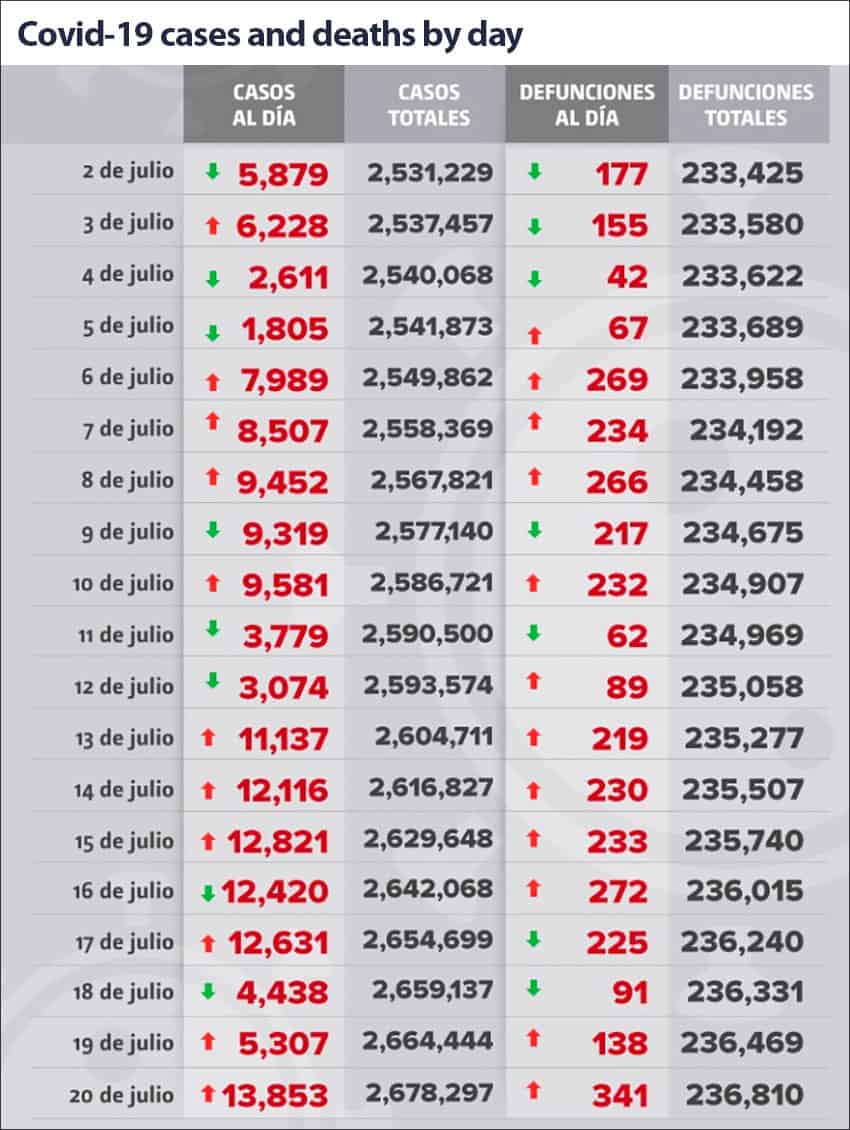
Coronavirus cases and deaths in Mexico as reported by day. milenio

“López-Gatell’s stubbornness is absolute, I said it to the Interior Minister [Olga Sánchez] as well. We believe it’s unacceptable that we’re continuing to see this attitude from the deputy minister, … who has been like this during the entire pandemic. He truly is a completely irresponsible person,” Alfaro said.

He said that he would continue to insist on the need for states to be involved in decisions about where vaccines should be deployed. Hospitalizations of Covid patients are on the rise in Puerto Vallarta but there is no plan to ramp up vaccination in the city, the governor lamented.

“It truly is a matter of common sense. … In Vallarta, for example, the number of hospitalizations shot up and we’re suggesting that we can focus vaccination efforts on this very important tourist destination … because the level of risk there is greater,” Alfaro said.

“The response [from the federal government] is that there is no response, we think that is unacceptable and … it once again proves not just the kind of official this man [López-Gatell] is but also the kind of person he is,” he said.

Alfaro, an independent governor formerly affiliated with the Citizens Movement party, has been an outspoken critic of the federal government’s management of the pandemic, and claimed a year ago that López-Gatell allocated a red light to Jalisco on the coronavirus stoplight map “because he felt like it.”

He has also accused the deputy minister of making politically motivated decisions in his management of the pandemic and asserted that his “impulses” have cost a lot of lives.

López-Gatell, a Johns Hopkins University-trained epidemiologist, has faced widespread criticism for his pandemic response but has retained the backing of President López Obrador.

Meanwhile, Mexico is amid a worsening third wave of the pandemic as the Delta strain of the virus circulates in many if not most states. The federal Health Minister reported 13,853 new cases on Wednesday and 341 additional Covid-19 deaths.

The accumulated totals stand at 2.67 million cases and 236,810 fatalities, while there are almost 86,000 active cases across the country, according to Health Ministry estimates. Despite the recent surge in cases, hospitalizations and deaths are down in comparison with the first two waves due to vaccination.

The Health Ministry reported Tuesday that more than 565,000 doses were administered Monday, lifting the total number of shots given to 55.1 million. Just over four in 10 adults – 43% – have received at least one vaccine shot and the majority of older Mexicans are fully vaccinated.

With reports from Reforma