Home Blog Page 1259

A newbie to cooking with chiles? Give mild, flavorful chipotle a try

0
To complement chipotle's smoky flavor, roast the tomatoes in these beef fajitas on a Mexican comal griddle.
To complement chipotle's smoky flavor, roast the tomatoes in these beef fajitas on a comal.

In Mexico, it’s easy to feel intimidated by the big stacks of dried chiles at your local mercado — I know I do and have for years.

But chipotles — those deep, dark smoky red ones, about 3–4 inches long, often with a whitish stem — are the most basic and, actually, familiar: they’re just smoked, dried jalapeños.

Ripe jalapeños, that is, that have matured, turned red, slightly dried out naturally on the vine and deepened in flavor. Those green jalapeños we use all the time? Turns out they’re not ripe yet.

While chipotle mayonnaise is what brought this pepper into the limelight outside of Mexico, chipotle is such an integral part of Mexican cuisine that we’ve been eating it all the time and never knew.

Mole, adobo, fajitas, the best salsas and cream sauces all contain chipotle in one way or another. Google recetas chipotle and prepare to be overwhelmed.
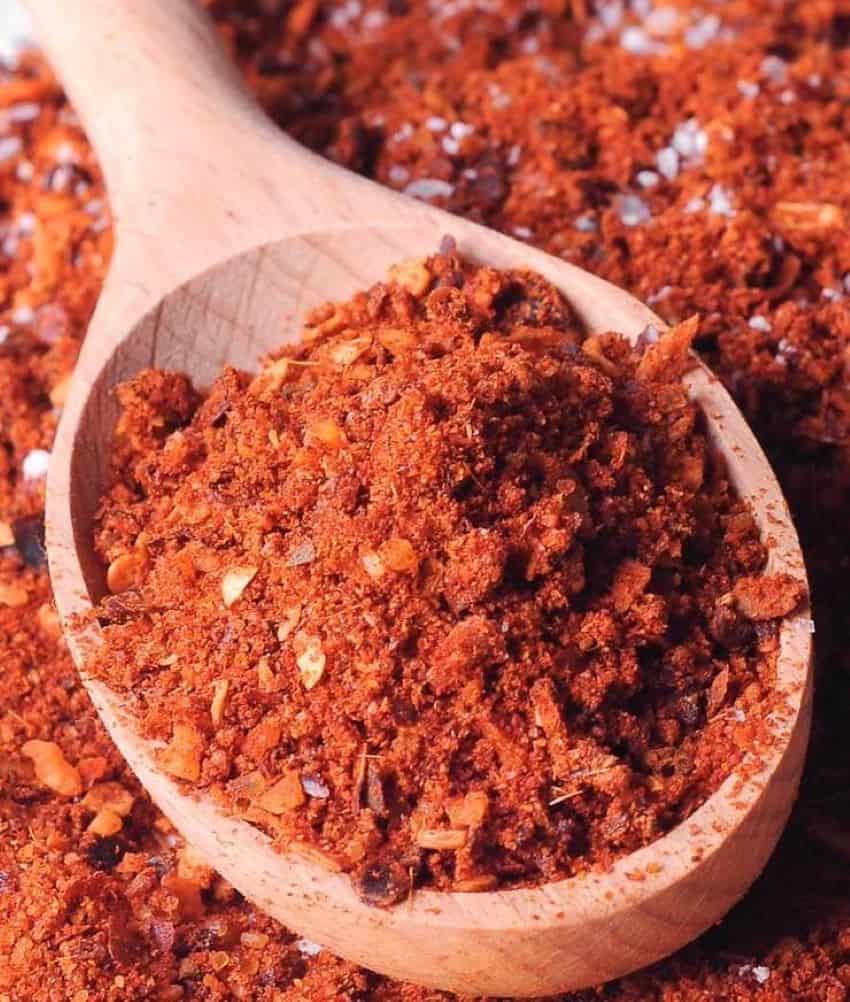
Chipotle comes dried, in cans with tomato sauce, as flakes or in a powder that livens up even the simplest dish.

The easiest way to use chipotle is with a can of chipotles adobados — pickled and spiced, dried chipotle peppers. Just a spoonful of the rich tomato-based sauce in any kind of soup or chili, pasta sauce or meat marinade will jazz up the flavor and add a complex, earthy smokiness that’s irresistible.

Like their younger, immature selves, the heat of chipotles is mild but delicious. I’ve learned to keep a couple of cans in my pantry to brighten up even the simplest dish.

While foodies everywhere love to smoke foods for the flavor, in generations past, smoking was used to preserve foods. Some historians believe the Aztecs were the first to make chipotles, as they also smoked meats; the name comes from a Náhuatl word that means, simply, “smoked chile.”

It takes about 10 pounds of jalapeños to make one pound of chipotles.

Chipotle can be found as powder, flakes, whole chiles or canned as adobados. You can buy the whole chiles and play with them: grind them yourself, mash them in a molcajete (a Mexican mortar and pestle). Add them chopped, whole, dried or rehydrated to your favorite recipes.

Some folks like to add a bit of chipotle to brownies or other baked goods, to balance the sweet with savory. Like any chile, the heat varies individually, so start with a little!
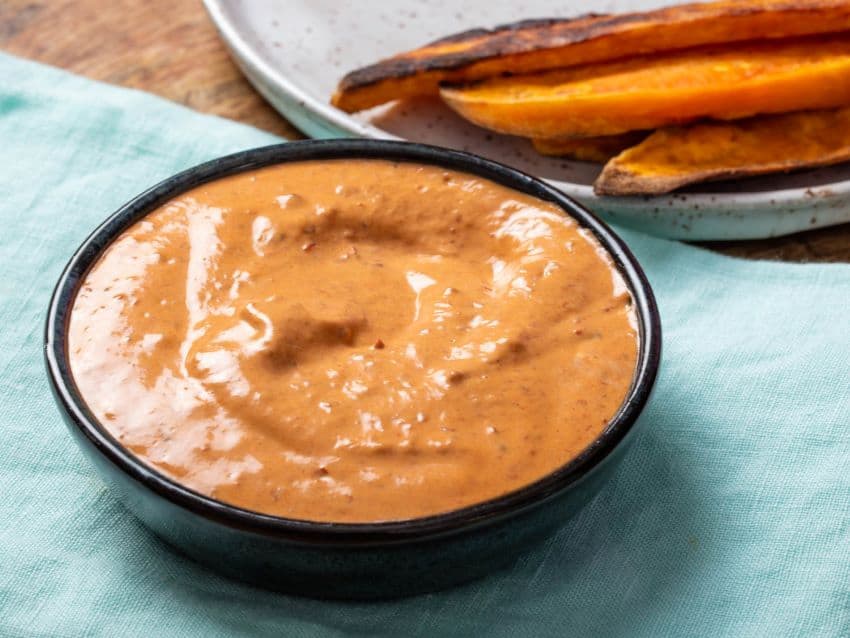
While chipotle mayonnaise brought this pepper into the limelight outside Mexico, the chile plays a much bigger role in Mexican cuisine.

Chipotle Seasoning

Use on salmon, chicken or roast veggies; sprinkle over bacon, popcorn or soft cheeses or use as a rub for meats.

  • ½ Tbsp. crushed, dried chipotle pepper
  • 1 Tbsp. chile powder (chipotle or any other chile)
  • 1 Tbsp. plain or smoked paprika
  • 1 tsp. ground cumin
  • 1 tsp. garlic powder
  • 1 tsp. oregano
  • 1 tsp. ground coriander
  • ½ tsp. salt

Mix all ingredients together. Store in an airtight container for up to 4 months.

Chipotle Mayo

  • ¼ tsp. salt
  • 1 large or 2 small chipotle peppers in adobo, seeded
  • 1 tsp. sauce from canned adobo chiles
  • ¼ cup mayonnaise
  • ½ cup plain yogurt, crema or a combination

Using a mortar and pestle, mash garlic with salt to a smooth paste. Add chipotle peppers; mash again. Stir in chipotle sauce, mayonnaise and yogurt and mix well. —nytimes.com

30-Minute Chipotle Chicken Chili

  • 3 Tbsp. olive oil
  • 2 medium onions, diced
  • Salt
  • 2 jalapeños, seeded and minced
  • 3-4 cloves garlic, minced
  • 2 tsp. ground cumin
  • ½ tsp. oregano
  • ¼ tsp. cayenne
  • 1 lb. ground chicken
  • 2 chipotles adobados, finely chopped
  • 3 (15-ounce) cans white beans, drained and rinsed
  • 3 cups chicken broth
  • 1½ cups corn
  • 1/2 cup fresh cilantro leaves, chopped
  • Garnish: avocado, tortilla chips, limes

In large saucepan, heat oil over medium heat. Add onion and 1 tsp. salt. Cook, stirring, until softened, 6–8 minutes. Add jalapeños, garlic, cumin, oregano and cayenne. Cook about 1 minute.

Add chicken; cook until just cooked through, about 4 minutes. Add chipotles, beans and broth.

Bring to simmer; cook 10–15 minutes to blend flavors. Add corn, season to taste. Stir in cilantro, garnish and serve. — seriouseats.com
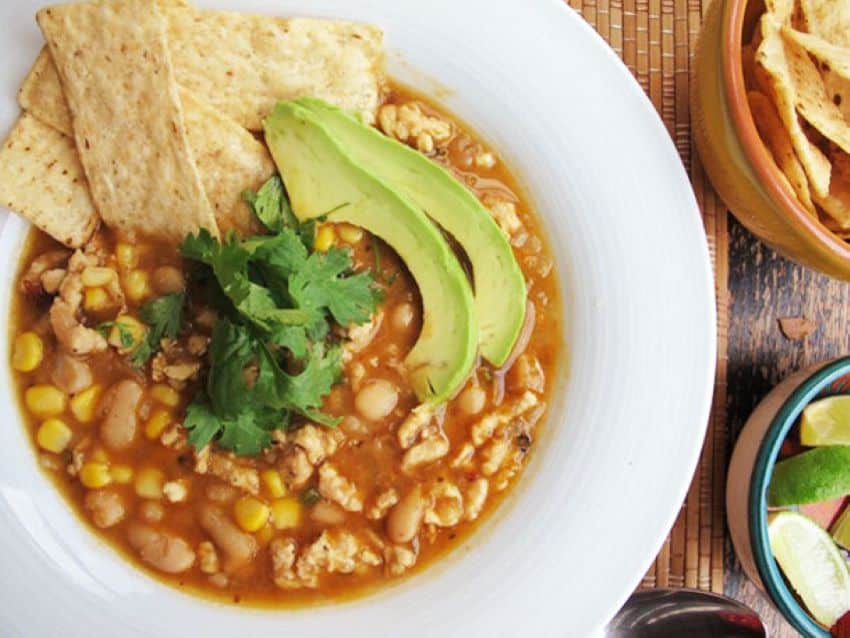
This chili uses chicken instead of beef.

Mashed Chipotle Sweet Potatoes

  • 2 lbs. sweet potatoes, about 4 medium
  • 1-2 chipotles adobados
  • 1 cup milk
  • ¼ cup maple syrup
  • ¼ cup butter
  • ½ tsp. each salt and pepper

Boil or bake sweet potatoes until tender. In food processor or blender, puree chipotle with milk. Transfer to saucepan, add maple syrup, butter, salt and pepper. Bring to a simmer, stirring to melt butter. Add sweet potatoes to pan and mash; then beat with a hand mixer till smooth.

Spicy Beef Fajitas

  • 1 kilo beef for fajitas
  • ½ kilo tomatoes
  • Olive or vegetable oil
  • 2 chipotles adobados
  • 1 white onion, cut into thin strips
  • 1-4 cloves garlic, minced
  • Salt

Roast tomatoes on a comal until skin is browned. Mash, mix or grind tomatoes with garlic and chipotles. Grill beef and onions in a pan with oil as needed, then add sauce to meat and cook for about 10 minutes to blend flavors.
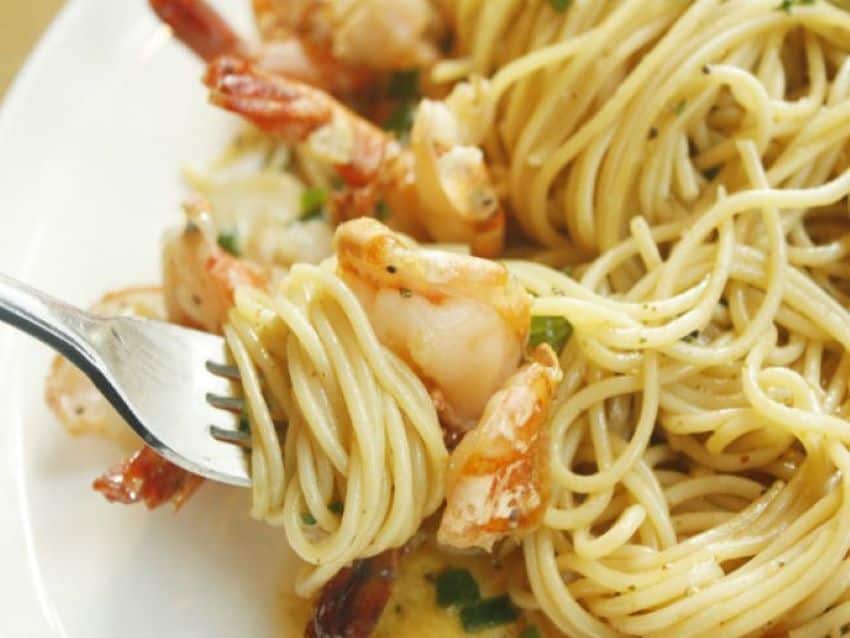
Chipotle can add a nice kick to dishes you wouldn't expect, like this shrimp pasta.
Chipotle can add a nice kick to dishes you wouldn’t expect, like this shrimp pasta.

Shrimp-Chipotle Pasta

  • 500 grams (1 box) spaghetti
  • ½ kilo shrimp, shelled and cleaned
  • 1 onion, finely chopped
  • 2-4 garlic cloves, minced
  • 4 tomatoes
  • 1 small can of marinated chipotles
  • Salt and pepper
  • ½ package cream cheese
  • 4 Tbsp. olive oil
  • ½ cup grated Parmesan cheese
  • ½ bunch parsley or cilantro, finely chopped

Cook pasta al dente. Drain, reserving 1 cup of cooking water. Stir 1 Tbsp. olive oil into pasta to prevent sticking; set aside. Roast tomatoes on comal or directly over flame for about 10 minutes till softened and blackened. Place tomatoes, chipotle, cream cheese and ½ cup of pasta cooking water in a blender; process till mixed.

Sauté onion and garlic, add shrimp; cook, stirring for 3–4 minutes over medium heat. Add chipotle mixture, stir well, then add pasta. Add salt and pepper to taste. Cook, stirring, till heated through. Serve with Parmesan and fresh herbs.

Janet Blaser is the author of the best-selling book, Why We Left: An Anthology of American Women Expats, featured on CNBC and MarketWatch. A retired journalist, she has lived in Mexico since 2006.
Busy port of Manzanillo is causing traffic chaos, making travel dangerous

0
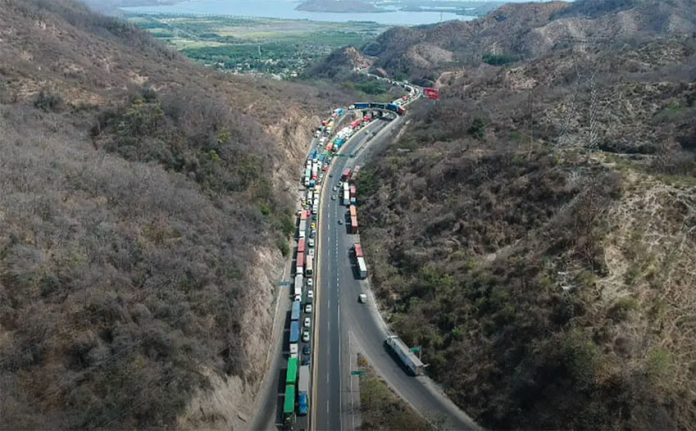
Heavy truck traffic is causing problems in Manzanillo.

Demand for cargo truck access to the port of Manzanillo, Colima, is causing traffic chaos and making road travel in the area dangerous, with further disruption predicted on Wednesday.

The Manzanillo-Colima highway is one of the most accident prone in the country because of trucks carrying cargo. On April 21 Jesús Quezada Navarro, who ran for local office in 2018, died on the scene after a truck hit two cars. Diana Pineda Parra, a candidate in the upcoming elections, was wounded.

On April 27 a container dislodged from a truck and fell on top of a car.

“The risk is constant. You can be going along just fine until you cross trucks that are in a bad state, or have containers that are not well secured. It doesn’t depend on us,” said Roberto Regla Bautista, who travels frequently to and from Manzanillo.

Resident Magaly Solis Crisantos described the danger she faces on a daily basis. “I have had various incidents and a few scares, because the trucks show no respect and invade the opposite lane,” she said.

On one freeway queues reached 20 kilometers on Saturday when customs officials were on vacation for Labor Day. Disruption is predicted for Wednesday when officials will work a half day for May 5 celebrations.

The congestion is exacerbated by trucks traveling to other unofficial ports nearby, according to a source at the port of Manzanillo, who requested anonymity.

Resident Arnoldo Saucedo Figueroa described the traffic. “You can be stuck between the trucks for up to five hours, there is an alley … and it is being used [as an alternative route] but it is in poor condition, and we have even seen trailers with containers going through there,” he said.

The port of Manzanillo is the third largest in Latin America for shipping, and is the principal commercial route to Asia across the Pacific Ocean.

First quarter activity suggests the port will return to the growth it saw before the Covid-19 pandemic, when more than 3 million containers were transported annually.

Residents are asking for authorities to intervene to help relieve the heavy traffic.

Sources: Milenio (sp),  AF Medios (sp)

Of 9 measures recommended to protect women, only 2 have been implemented

0
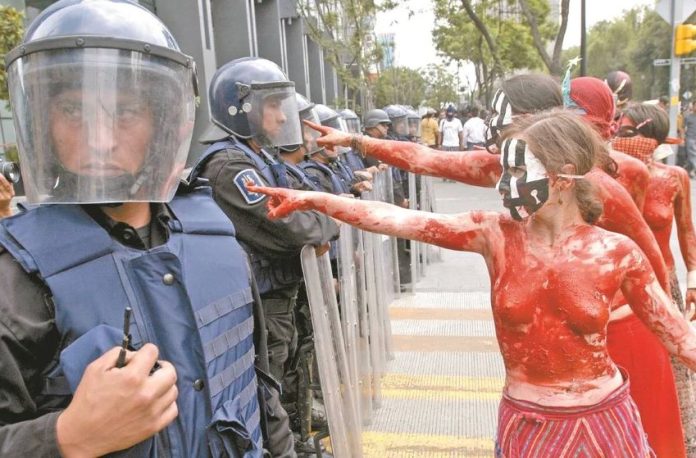
Feminist protesters in an unrelated demonstration face off against the National Guard.

It has been more than two years since the Inter-American Court of Human Rights notified the federal government of its resolution with respect to a 2006 case in which more than two dozen women were sexually assaulted by police in México state. But of nine measures it recommended only two have been implemented, according to the victims.

In May 2006, residents of San Salvador Atenco mounted a protest against a restriction banning flower vendors from a market in Texcoco, México state. The residents blockaded a highway and faced off against hundreds of state and federal police in several violent confrontations. Two people died and 26 women, who were among more than 200 arrested, were sexually assaulted by police.

At a press conference to mark the 15th anniversary of the Atenco case, victims of the police abuse asserted that seven of nine measures recommended to the government by the human rights court in December 2018 have not been implemented.

One of them was to strengthen the Mechanism of Monitoring of Cases of Sexual Torture Against Women, a legal instrument.

Sofía de Robina, a lawyer with the Center Prodh, a human rights organization advising the victims, said no progress on strengthening the mechanism has been made since October 2019, and its “functionality has been nonexistent.”

“We have continued documenting the persistence of this practice [sexual torture] against women, many of whom are in prison,” she said.

Another recommended measure was the creation of an independent organization to monitor the use of force by government security forces. De Robina said the Ministry of the Interior has not summoned the Atenco victims to any meeting to discuss the progress toward the creation of such an organization.

“… The Mexican state responded to the court that the institutions [security forces] already have internal control organs and the Federal Auditor’s Office [oversees them],” she said. According to the government, an observatory body to monitor the use of force “could affect the secrecy of an investigation,” de Robina said.

The victims said the government’s response proved that it has no intention to comply with the court’s recommendation.

According to the victims, the other five recommendations were: carry out a thorough investigation into the case that looks at the actions of all police involved; investigate the role of high-ranking state and federal officials; publicly acknowledge the state’s responsibility in the case; offer medical and psychological treatment to victims; and cover the costs of the civil society organization (Center Prodh) that has assisted the victims.

The only recommendations with which the government has complied, according to the victims, is to pay compensation and to publish the court’s resolution.

The Inter-American Court of Human Rights has no power to sanction states that don’t comply with its recommendations.

“… We’ve turned to four different [federal] governments to demand justice, and the four have taken us to the limit of injustice,” said Bárbara Méndez, referring to impunity in the Atenco case.

“We want what happened in 2006 to be cleared up so that [something similar] never happens again,” the victim said.

Source: El Universal (sp), La Jornada (sp) 

Centuries-old religious folk art finds new subjects in Covid-19 pandemic

0
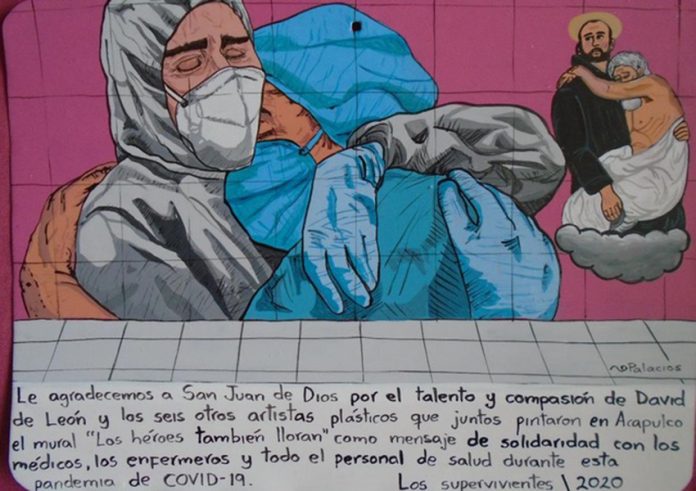
This exvoto thanks St. John and the artists who painted a mural in Acapulco thanking Mexico's health workers.

I fell in love with Mexican folk art while working toward my undergraduate and graduate degrees in Latin American studies at the University of Kansas. Later, during frequent business trips to Mexico, I visited many of the country’s fine museums and learned more about this art, its diversity and the culture it reflects.

One type in particular, the exvoto (sometimes called retablo), captured my imagination.

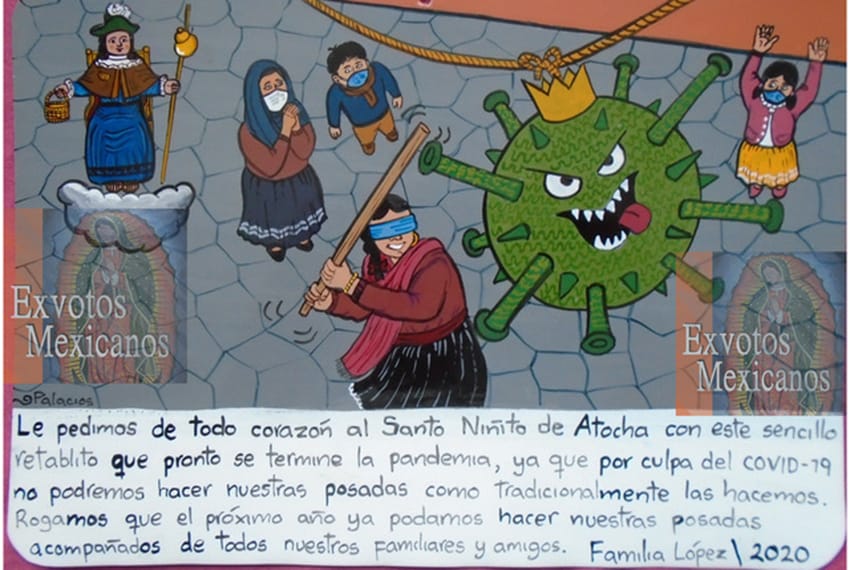
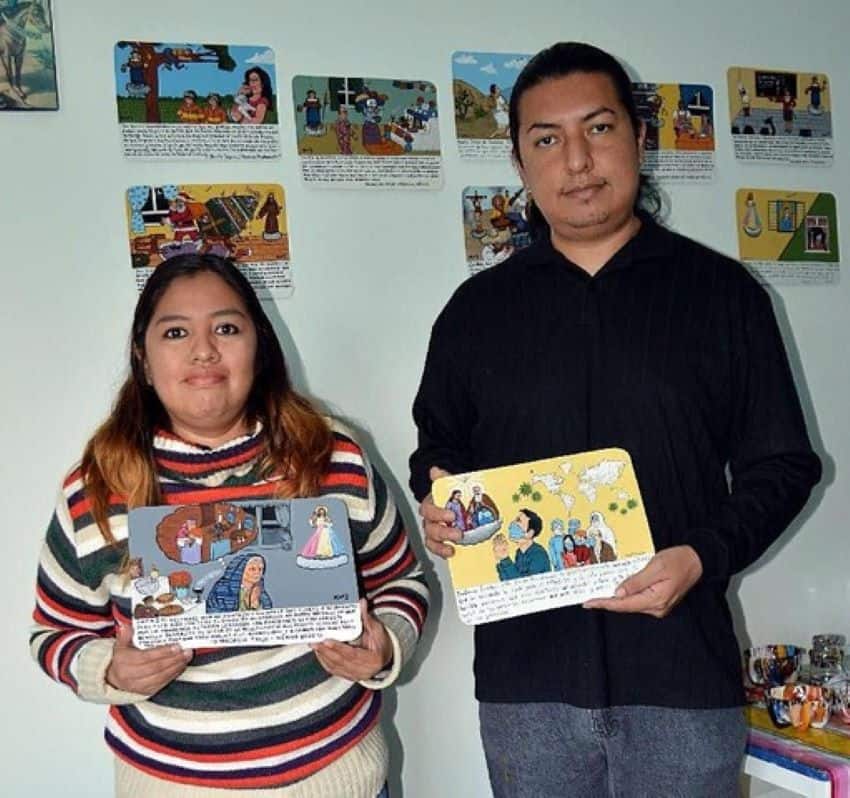
An exvoto is a votive painting, examples of which first appeared in the 16th century and became very popular in the 19th. Painted on a piece of metal somewhat larger than a standard United States car license plate, each exvoto gives thanks for, or in some cases requests, divine help in solving a problem or saving the petitioner from some sort of harm.

A few just show an appreciation for some unsolicited development or occurrence.

Whatever its nature, each exvoto depicts the saint involved and an illustration and written description of the favor granted or the miracle or action performed. Usually painted for a fee by an untrained individual with limited education and artistic training, the petitioner hangs it in a church or in the home.

Modern exvotos often use humor, like this one that depicts a Covid-shaped pinata, praying for the pandemic to end so people can have posada parties again.
Modern exvotos often use humor, like this one that depicts a Covid-shaped piñata, praying for the pandemic to end so people can have posada parties again.

These traditional exvotos focus on health concerns or surviving life-threatening situations. The ones I find most appealing are set within the context of some historical event, such as a soldier giving thanks for not having been killed or wounded in a particular battle.

I also am partial to those that, in addition to giving thanks for whatever reason, reveal some aspect of daily life of everyday people, such as street, village and farm scenes.

I always wanted to own some of these — not for their antiquity, but rather for the history and culture of Mexico they evoke. Unfortunately, I only ever found ones I liked in museums. Several years ago, however, I discovered that a number of artists continue to paint exvotos, albeit with a more modern perspective.

Health issues remain a favorite subject, for example, but they often reflect previously unknown medical conditions being treated in a modern hospital instead of the home.

More interesting, perhaps, are the other subjects many of these exvotos address — ones seldom, if ever, seen in those painted prior to, say, 1950.

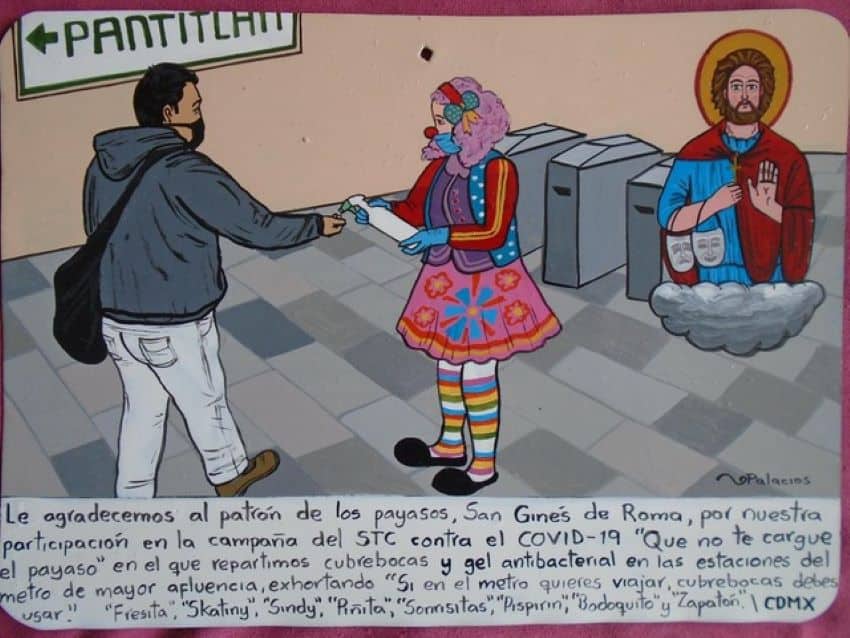
Many highlight important historical events, legends, folk dances, customs, and indigenous traditions. Others treat subjects from popular culture, such as disliked national and foreign politicians, television and movie personalities or lucha libre wrestlers and other sports athletes. Then there are those that address serious social issues, such as unemployment, emigration, prostitution, gay rights and the status of women.

This exvoto thanks the patron saint of clowns and refers to a Covid-19 safety campaign in Mexico City.

The actual events portrayed in these modern exvotos, along with the names of petitioners, generally are fictitious. It is not inconceivable, however, that most of them could have taken place.

Some contemporary folk artists have been criticized for painting scenarios contrary to traditional Christian teaching, a prime example being a prostitute petitioning a saint for a favor.

However, the religion of many Mexicans is a mixture of pre-Conquest indigenous beliefs and the faith introduced by the Spanish. A national survey conducted by the National Autonomous University found that 95% of respondents pray, at least occasionally, for the intercession of the Virgin of Guadalupe, who is a common figure evoked in these works.

Since it is doubtful that all of these people lead exemplary lives as defined by an established church, such exvotos represent authentic expressions of faith well within the context of Mexican spirituality.

Another criticism leveled at times against contemporary exvotos is that some treat life-and-death situations with too much humor. It is my experience, however, that “too much humor” and “Mexican” do not go well together. As a people, they are addicted to humor, which is one aspect of the culture that I find so appealing.

No subject is off-limits except, perhaps, national symbols. A favorite topic treated with humor is death which, given the current pandemic, is not far from anyone’s mind.

Former US Ambassador to Mexico Christopher Landau thanked the Virgin of Guadalupe in his exvoto, evoking a tradition going back to Renaissance Venice.
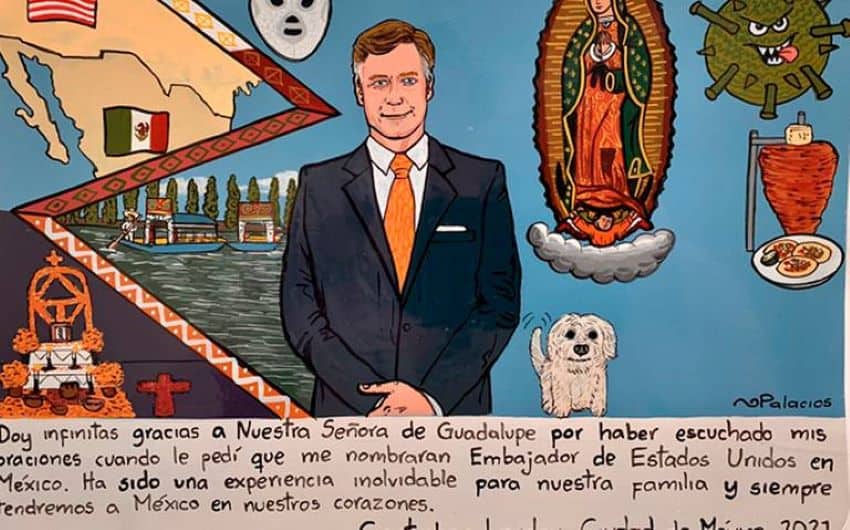
Former US ambassador to Mexico Christopher Landau thanked the Virgin of Guadalupe in his exvoto, evoking a tradition going back to Renaissance Venice.

Unlike the popular view held in the U.S., death is viewed in Mexico simply as a continuation of life on another plane, best illustrated by the Day of the Dead celebrations. Nowhere is the treatment of death with humor more evident than in the calaveras literarias, funny epitaphs of varying lengths and poetic resonance written for lovers, friends and relatives who are still among the living.

I collect the exvotos collaboratively painted by contemporary folk artist Flor Palomares and her husband Gonzalo Palacios of Puebla. They recently made the rounds on social media for having painted four exvotos commissioned by Donald Trump’s outgoing ambassador to Mexico, Christopher Landau, perhaps thinking of a tradition going back to Renaissance Venice, when officials in high positions commissioned the paintings to give thanks to the divine for having achieved their post. Landau, who commissioned his before leaving his Mexican posting in January, thanked the Virgin of Guadalupe.

Over the years, Flor and her husband and I have become good friends, and during my yearly visit to Puebla we enjoy sitting together in one of the city’s outdoor cafes discussing possible subjects for new paintings.

The pandemic has kept me at home, but we have continued to brainstorm ideas via emails and phone calls. After I saw their first work depicting the coronavirus, we started to collaborate on paintings focused on the Covid-19 pandemic.

Over the last year, our collaboration has resulted in a number of works focused on different aspects of people’s reactions to it.

Some represent our combined efforts. For those exvotos, I came up with the ideas, wrote the narratives and roughly (very roughly) sketched the pictorial parts. Flor and Gonzalo were left with the far more difficult task of executing them, as shown here with the English translations of the narratives.

The artists: Flor Palomares and her husband Gonzalo Palacios.

For additional information on these artists and their works, you can see their work on Gonzalo’s Facebook, Instagram or Twitter. Their exvotos can be purchased on their Etsy store, or you can contact them directly via email at exvotosmexicanos@gmail.com to commission one yourself.

Mexico News Daily

López Obrador flouts constitution in battle against Mexico’s institutions

0
amlo in zocalo
When AMLO won the 2018 election he promised Mexicans change in accordance with the established legal order.

Nearly three years ago, there was electricity in the air when Andrés Manuel López Obrador stepped up to the microphone in Mexico City’s main square to address a crowd.

He had just channeled deep disgust over corruption into a landslide election victory and in a message designed to appease those who feared he was a dangerous populist, the new president promised to deliver “profound change, but in accordance with the established legal order.”

As the halfway point in his term approaches, he still wants to transform Mexico. But his vow to respect the law appears increasingly tenuous.

In the space of a week at the end of April, he caused controversy by endorsing a two-year extension to the Supreme Court chief justice’s term despite questions over the constitutionality of the move. He then pledged to scrap autonomous institutions whose rulings he disagrees with and accused opponents of “conspiring against democracy.”

He says he is upholding the will of the people — something he insists past governments failed to do.

“Mr. López Obrador believes the popular mandate he won in the elections is sufficient for his projects to pass … that it gives him permission to violate the constitution or break laws,” said Ana Laura Magaloni, a constitutional expert.

However, polls show Mexicans are also dissatisfied with the economy, crime and his handling of the coronavirus pandemic.

The president says he respects the constitution but justice comes first. As he put it two years ago: “The constitution establishes that there must be justice. Justice is above everything. If you had to choose between the law and justice, don’t think too hard, pick justice.”

In supporting an extension of the Supreme Court president’s mandate, many believe López Obrador has crossed a line and is compromising the respected institution’s integrity.

Others see it as a way of eliminating potential opposition to his reform agenda: the president needs court approval to continue his efforts to undo landmark 2013 energy reforms that he sees as a key part of his drive to rebuild a strong state apparatus, eradicate corruption and put the poor first.

The constitution bans presidential re-election and with the pandemic complicating his progress, Alejandra Cullen, a political analyst, saw the Supreme Court move as a way of López Obrador “sounding out” the prospect of extending his own term, despite his regular insistence that he would leave office in 2024. “You can’t read it any other way,” she said.

López Obrador
López Obrador wants to have as few checks and balances as possible, one analyst says.

“I think he wants to have as few checks and balances as possible,” she added.

Indeed, within days last week, López Obrador lashed out at an electoral court ruling preventing two candidates from his Morena party from running in gubernatorial elections on June 6.

He said the sanction was out of proportion with the men’s failure to clarify pre-campaign spending amounting to US $950 in one case, and $700 in the other, and was a denial of their right to run for office — something on which he said the people should have the last word.

“This is an attack on Mexico’s incipient democracy,” he said. “Democracy is respect for the will of the people.”

López Obrador has since stepped up his attacks on other institutions, such as the competition watchdog and transparency institute, calling them a “monster” that needs getting rid of.

Luis Estrada at Spin, a consultancy, said it was part of an intensifying campaign to discredit them in the run-up to the important midterm vote in June, in which the president is widely expected to cry foul if his candidates do not win.

All 500 seats in the lower house of Congress, where López Obrador has a majority, are up for election, as well as 15 governorships.

Although polls put Morena comfortably ahead, opposition parties have teamed up in parts of the country and have mounted credible challenges to the party in some areas, setting the stage for a tense race.

“The post-election conflict has already started,” Estrada said.

© 2021 The Financial Times Ltd. All rights reserved. Please do not copy and paste FT articles and redistribute by email or post to the web.

Concern over deficient turtle protection triggers US ban on shrimp imports

0
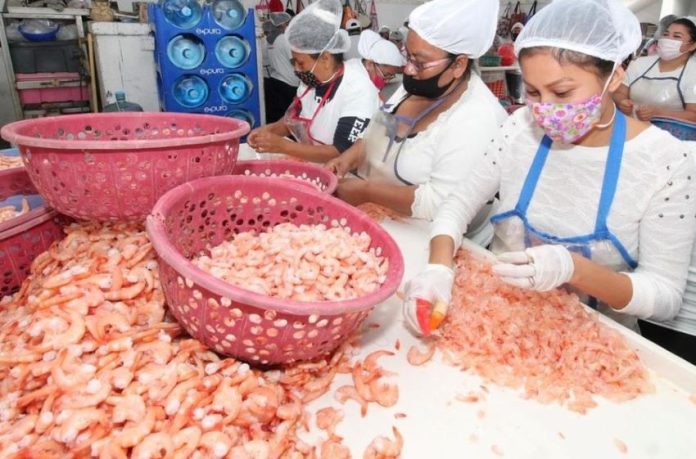
Fishing industry workers peeling shrimp in Tampico.

The United States has suspended Mexico’s certification to export wild-caught shrimp to the U.S. due to inadequate sea turtle protection measures, a move that could cost the industry about US $300 million annually.

The State Department said it suspended Mexico’s certification because its sea turtle protection program is no longer comparable to that of the United States.

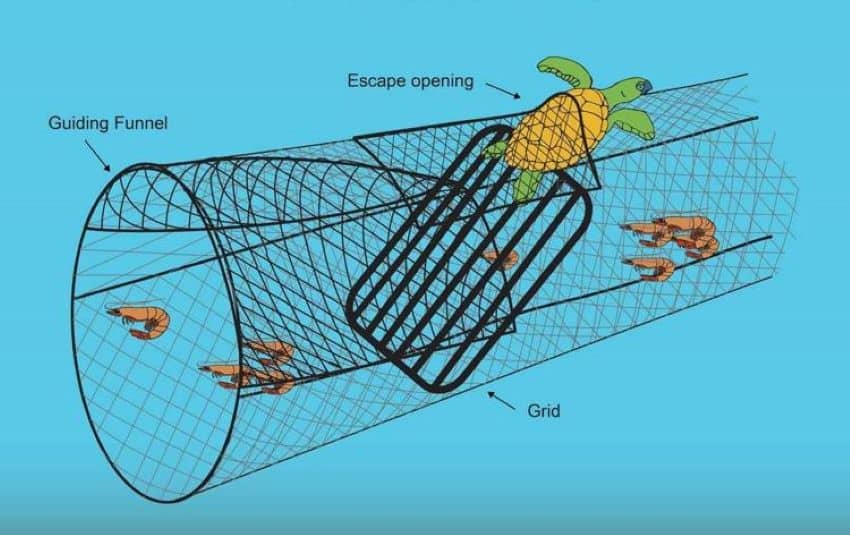
Mexico’s Agriculture Ministry (Sader) said in a statement that United States authorities conducted verification visits to fishing ports in several Mexican states between 2019 and 2021 and detected “deficiencies” in the use of turtle excluder devices (TEDs) on 106 shrimp nets.

Among the ports visited were Mazatlán, Sinaloa; Puerto Chiapas, Chiapas; Puerto Peñasco, Sonora; Tampico, Tamaulipas; Lerma, Campeche; and Puerto Juárez, Quintana Roo.

After the current federal government took office in December 2018, the National Aquaculture and Fisheries Commission (Conapesca) disbanded a group of officials that provided training to fishing crews on the correct use of TEDs.

Excluder devices attached to shrimping nets allow an inadvertently captured sea turtle to escape.
Excluder devices attached to shrimping nets allow an inadvertently captured sea turtle to escape. Australian Fisheries Management Authority

In light of the ban, Sader said that Conapesca, the environmental protection agency Profepa and the Ministry of the Navy are carrying out preventative and corrective measures with a view to recovering certification as soon as possible. One measure is the provision of training to shrimp fishermen to ensure that sea turtles are not taken in by shrimp trawler nets.

The agriculture ministry said that a “more aggressive program of inspection and oversight” will be established to ensure that shrimp fishing in Mexico complies with United States requirements. The ministry added that U.S. authorities have demonstrated a willingness to reinstate export certification as soon as possible. For that to occur, Mexico will have to request a verification visit at the start of the new shrimping season in September, according to Sader.

“… The ports that will be inspected as a priority are Mazatlán, Puerto Peñasco, Tampico and Campeche, according to preliminary information from the United States government,” the ministry said.

It also said it will be essential to present to United States authorities by August documental evidence of the actions carried out by the Mexican government to ensure that sea turtles are not caught in nets.

Sader said that “during the time that the certification suspension lasts, which coincides with the closed season for this species, dragnet shrimp cannot be exported [to the United States] for any reason.”

If the suspension were to remain in effect for a year, Mexico — the world’s seventh-largest shrimp producer — could lose export revenue of about US $300 million.

Total shrimp exports to the United States in 2019 were 30,000 tonnes, according to the ministry.

Humberto Becerra Batista, head of the National Fishing Industry Chamber, said the United States’ suspension was regrettable as the shrimp industry provides employment for thousands of people and is a large foreign currency earner. He also said the shrimp industry is committed to sustainability and the protection of sea turtles, six of seven species of which are considered endangered or threatened.

Mainly located in Sinaloa, Sonora, Tamaulipas, Nayarit and Baja California, Mexico’s shrimp fishermen send about 80% of their exports to the United States, with smaller quantities going to countries such as China, Japan, Malaysia, Singapore and France.

Source: Zeta (sp), Milenio (sp), AP (en) 

Mexico becomes world’s leading exporter of strawberries

0
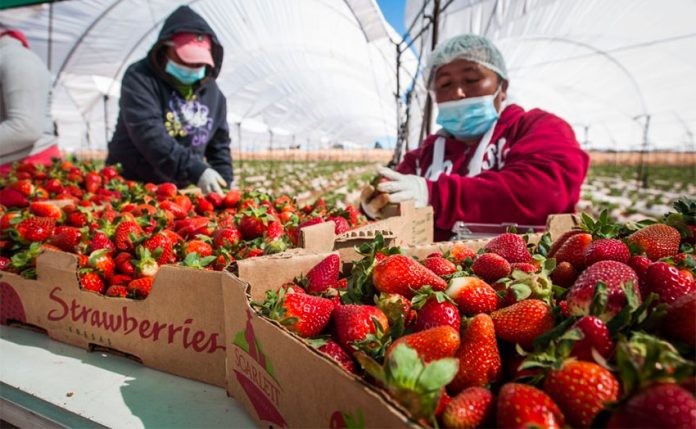
farmworkers and strawberries
Strawberry exports totaled US $851 million last year.

Mexico exported more strawberries than any other country in 2020, knocking Spain off its perch.

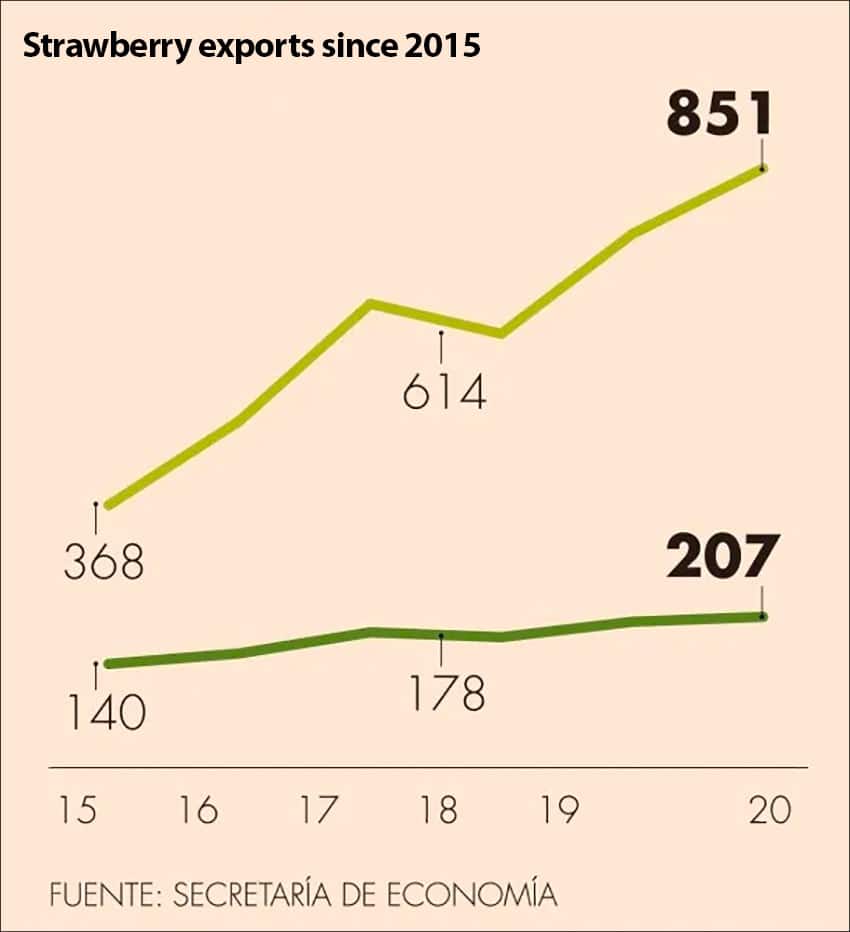
Strawberry exports raised over US $851 million last year, an increase of 12.4% on 2019.

Spain had held top spot for more than two decades, but saw only $646 million in international sales in 2020. The United States was in third place with $477 million.

The Mexican strawberry industry is dependent on U.S. demand: of all its strawberry exports last year, 99.3% went to the United States, which is the world’s biggest importer.

Spain largely exports to other European countries.

strawberry exports
Strawberry exports in millions of US dollars are indicated in light green; in dark green volumes in thousands of tonnes. el economista

The Mexican market overcame obstacles caused by the Covid-19 pandemic such as the availability of manpower and the near disappearance of the food service industry, to which 15% of the fruit is normally sold.

Demand remained robust amid producer fears that wider unemployment would make strawberries less attainable for consumers, because they are considered an impulse buy.

In fact, the pandemic contributed to a rise in purchases of foods that are perceived as healthy, according to the United States Department of Agriculture. U.S. government contributions to unemployment checks and the one-time payment to taxpayers also helped support demand.

Mexico’s strawberry market eclipsed the Belgian market in 2012, the Dutch in 2016, and the U.S. market in 2019.

Source: El Economista (sp)

Quintana Roo regresses to orange risk level on state coronavirus map

0
It’s back to high-risk Covid orange in Quintana Roo despite over 170,000 vaccinations statewide. The number of cases in the Cancún area rose 14%.

Quintana Roo regressed on Monday to high-risk orange from medium risk yellow on the state government’s coronavirus stoplight map as case numbers increase in the resort city of Cancún.

The state had already reverted to orange on the federal stoplight map a week ago. The Quintana Roo government has its own stoplight system to guide the reopening of the state economy.

Governor Carlos Joaquín said the orange-light restrictions will remain in effect until at least Sunday.

As of Monday, hotels, restaurants, archaeological sites, theme parks and public transit are permitted to operate at 50% capacity while beaches, public parks, cinemas, theaters, shopping centers, department stores, casinos, places of worship, hair and beauty salons and factories are all limited to 30% capacity. Bars, cantinas and nightclubs must close during the orange-light period.

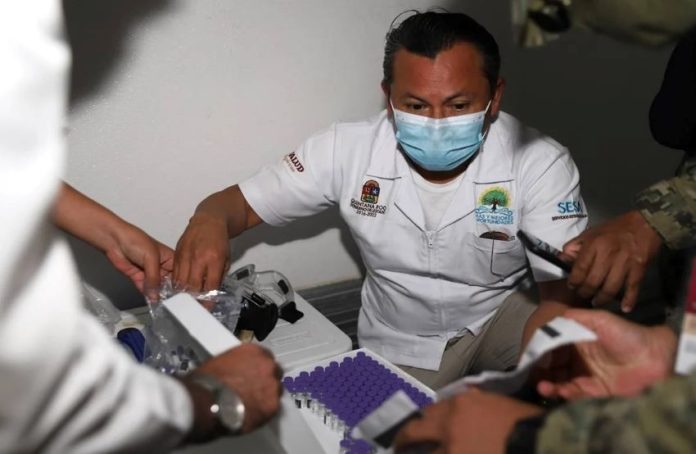
Authorities will seek to ramp up Covid-19 testing this week and roll out vaccines in areas where they are most needed. The state government will also complete deep cleaning of public spaces and carry out patrols to ensure that citizens are complying with health protocols such as social distancing and the wearing of face masks.

The state government made the decision to switch to orange even though several municipalities, including Isla Mujeres, Puerto Morelos and Lázaro Cárdenas, didn’t record any new coronavirus cases during the past week.

However, new cases increased 14% in the municipality of Benito Juárez, which includes Cancún. Quintana Roo recorded 556 new infections between April 26 and May 2, pushing the accumulated case tally to 23,381. There are an estimated 705 active cases, while the official Covid-19 death toll is 2,623.

Joaquín said that hospital occupancy levels are not currently a concern because they are below 20% both in the northern and southern regions. However, he warned that the situation could change quickly if case numbers continue to rise.

According to state government data, 19% of hospital beds set aside for coronavirus patients are currently occupied in Benito Juárez (Cancún) and Solidaridad, which includes Playa del Carmen. The occupancy level is 5% in Othón P. Blanco, which includes state capital Chetumal, and 2% in Tulum. The hospital occupancy rate in the state’s seven other municipalities is 0%.

Meanwhile, Mexico’s accumulated case tally rose to almost 2.35 million on Sunday with 1,093 new cases recorded. It was the lowest daily case tally since April last year. The official Covid-19 death toll rose to 217,233 with 65 additional fatalities reported, also the lowest daily total since April 2020.

The national hospital occupancy rate is 11% for general care beds and 16% for those with ventilators. As of Sunday night, just over 18.3 million vaccine doses had been administered in Mexico, a figure that represents 14 shots per 100 people.

Source: El Economista (sp) 

Navy seeks 1bn pesos to build high-speed boats to combat narcos, other threats

0
navy interceptor vessels
Modernizing the fleet from interceptors to immediate response vessels is seen as being of 'vital importance.'

The navy has requested more than 1 billion pesos (US $49 million) to build 30 high speed immediate response vessels to combat threats in Mexican waters.

The new fleet would tackle illegal fishing, narco trafficking, arms and explosives trafficking, piracy and terrorism and would help protect state economic assets.

The navy has 72 boats for domestic vigilance missions, some of which have ended their service period according to international regulations. Their Polaris I interceptors have been in service since 1999.

Modernizing the fleet from interceptors to immediate response vessels is of “vital importance,” the navy said.

“We require 30 new immediate response vessels, as these have the necessary qualities: high speed and perfect maneuverability in shallow waters, which are ideal for undertaking chase and intercept operations,” it added.

“This type of boat will allow us to increase the capacity to respond to potential threats in strategic zones to intercept, identify, and in certain cases, destroy whatever target impinges on the interests of the navy,” said a cost efficiency study.

The vessels will also provide early alerts to ocean patrols that safeguard 55 strategic facilities belonging to Pemex and the Federal Electricity Commission.

Other benefits include naval training for national and international defense, protection and logistic support for merchant and naval vessels and job creation during construction.

The navy envisages a financing cycle requiring 337 million pesos each year until 2023.

Source: Milenio (sp)

Artisans’ longstanding partnership falls victim to its own success

0
Amate paper painting by unknown artist
Amate paper painting by unknown artist. Travel By Mexico

Most visitors to Mexico have likely seen the popular and affordable Mexican souvenir of bright paintings on a dark-brown, rustic paper. These look like something that has been done for centuries, but in reality they are the result of a recent merger of two separate indigenous handcraft traditions.

The bright painting is done by the Nahua peoples, who inhabit the Balsas River area in the state of Guerrero. Originally, these images were used to decorate traditional pottery, but they were transferred to the new paper medium.

Meanwhile, the paper is made by an Otomí population centered in the tiny village of San Pablito, part of the Pahuatlan municipality in the Sierra Norte mountains of Puebla.

Both peoples live in highly isolated areas that have managed to keep many of their traditions. So how did the two even find out about each other’s work?

Tourism may drive most of the demand for handcrafts today, but their importance in Mexico arose after the Revolution as part of a national identity (mexicanidad) promoted by the government. This created a market for handcrafts in Mexico City, which just happens to be between the territories of the two communities.

Painting on amate paper by Nahua artist Marsiano Vargas at the Museo de las Culturas Populares in Mexico City.
Painting on amate paper by Nahua artist Marsiano Vargas at the Museo de las Culturas Populares in Mexico City. Karen Elwell (Flickr)

Essentially, each learned about the other at the market.

Sometime before the 1970s, someone got the brilliant idea of painting the Nahua pottery designs onto the Otomí paper.

For the Nahua, this has a number of important advantages: the painted motifs account for most of the pottery’s value. A flat surface is easier and quicker to paint on. Perhaps most importantly, paper is much easier to transport to market and easier for buyers to take home.

The Nahuas’ interest in the paper was that it gave the paintings a historical and traditional look, something that is extremely important in handcrafts and indigenous products. For the Otomí, their Nahua buyers provided something they needed, bulk purchasers that made commercial paper production economically viable.

Sounds like a win all around … but not quite.

Producing the paintings and the paper that they are on has become economically crucial for both groups, even vital. Because of cost, the paintings themselves are done with commercial acrylics, which pushed out traditional paints and pigments long ago.

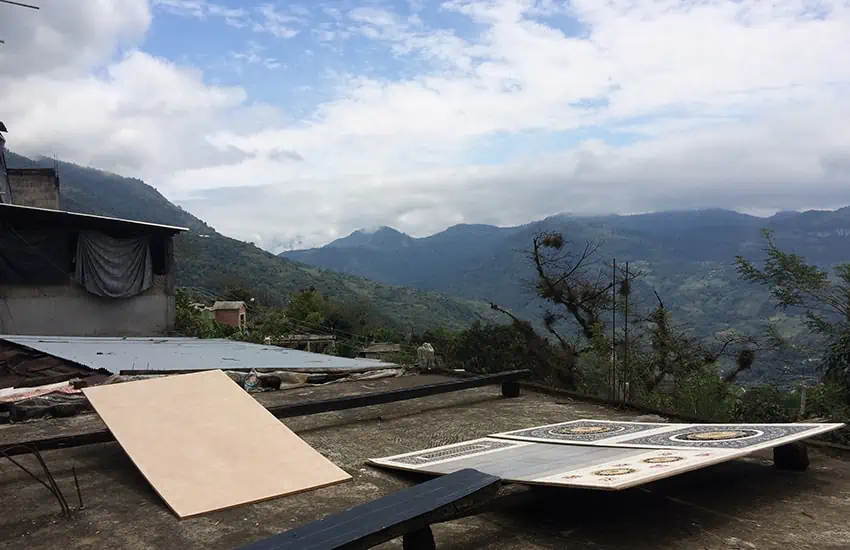
Amate paper drying in the sun in San Pablito, Puebla.
Amate paper drying in the sun in San Pablito, Puebla. Luis Fernando Orozco Madero Wikimedia Commons

But the real issue comes with the paper, called amate.

In the pre-Hispanic period, it was extremely important, not only for documentation but also for religious ceremonies. This religious importance led the Spanish to abolish its making, with only a few, highly isolated communities such as the Otomí in the Sierra Norte able to continue making and using it in secret.

This preserved the technique of taking the inner bark from various types of ficus family trees and pounding them together to make sheets. Unfortunately, the commercialization of these sheets has decimated the trees that produce the bark.

The ficuses that produced the lightest and most prized paper were wiped out about 40 years ago, followed by just about the rest of the family of trees, according to handcraft expert and author Marta Turok. Any naturally light amate paper made today from ficus is from bark brought from Central America.

As tropical ficus trees in that part of the world grow slowly and with some difficulty, most of the bark used today comes instead from an entirely different species, Trema micrantha (locally called jonote). It accounts for about 80% of the bark pounded in San Pablito.

This tree grows fast and has a wide range, from Florida to Argentina. In Mexico, it grows in poor soils and is prevalent in the east of the country. It is often used as a shade tree on coffee plantations in Puebla. In fact, most of the harvested bark is from such coffee plantations.

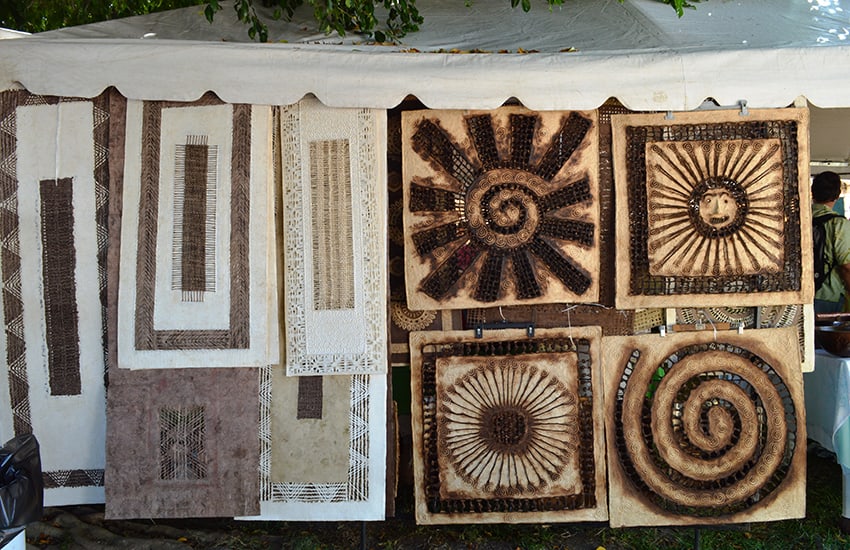
San Pueblito Otomi amate paper art at the Feria Maestros de Arte in Chapala, Jalisco. These works are more profitable for the Otomi than selling blank paper.
San Pueblito Otomi amate paper art at the Feria Maestros del Arte in Chapala, Jalisco. These works are more profitable for the Otomí than selling blank paper.

Paper makers used to get this jonote bark themselves from the surrounding area, but at this point in time, the local ecosystem has long been stripped. Instead, amate paper makers rely on jonoteros, who have to bring bark to this isolated Otomí mountainside village from ever farther away.

There is some interest in cultivating jonotes for their bark, but this requires some training. There is also concern that growers would put in the two to five years needed for harvestable trees only to have the bark stolen.

There is one other problem with the jonote bark: it is tougher than ficus bark and requires caustic soda to soften it and chlorine to lighten it. (Worse chemical dyes are used to create all kinds of colored paper.) The use of these substances has caused serious problems in the small valley’s watershed.

Ecologically, the easy answer would be for the Nahuas or someone else to find a substitute for the amate paper that would give the “timeless” look that bark paper does. But then this would pull the rug out from under the Otomís’ only source of outside income. It may happen anyway sooner or later, as the difficulties of producing the paper drive up prices beyond what the Nahua can pay.

The tough question for outsiders is “Should I buy the amate paper paintings?” There is no easy answer.

Perhaps the least benign market is the largest one — the market for making blank sheets — as it uses up the most resources with the least economic benefit for the Otomí. There has been some shift in San Pablito to making amate paper decorative works, usually with light-dark contrast. This still means the use of chemicals, but the result is a finished product that brings in more money.

Several universities and others are still trying to find ways to make the paper production more economically and ecologically viable. As for the Nahua, they still make pottery, much of which is quite exquisite but less profitable.

Leigh Thelmadatter arrived in Mexico 18 years ago and fell in love with the land and the culture in particular its handcrafts and art. She is the author of Mexican Cartonería: Paper, Paste and Fiesta (Schiffer 2019). Her culture column appears regularly on Mexico News Daily.