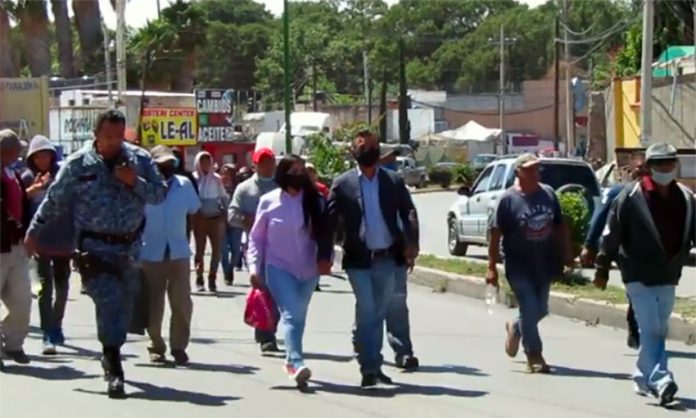
The mayor of Ixmiquilpan, center, is punished for unfinished projects.
Residents of a community in Ixmiquilpan, Hidalgo, were not pleased with the performance of the mayor, so they made him go for a long and supposedly humiliating walk.
Mayor Pascual Charrez Pedraza, whose term ends this year, has failed to pave streets in Ignacio López Rayón, claim residents, who gathered Monday outside city hall holding banners denouncing the mayor and demanding an audience with him.
Charrez had promised to pave the streets in 2018, but the work has yet to be completed, the angry crowd said.
In accordance with indigenous Otomí custom, they forced the mayor to walk 20 kilometers from city hall to their town so he could see the unpaved streets for himself.
Such a walk is considered a form of humiliation according to the Otomí, the inhabitants of the region before they were subjugated by the Toltecs and later the Aztecs.
“We come to look for the mayor since a project started in 2019 has not been completed. He is leaving and has not complied,” said one angry resident, who noted that the unfinished paving project is the only thing the mayor has done during his administration
Resident Ángel Martínez Montúfar noted that during his campaign the mayor indicated that he was going to remodel the garden in the main square.
“Pascual Charrez boasted that he would bring a unique marble from Italy, and he even presented the project to residents and the priest,” he said, adding that Charrez had also promised to build a medical clinic with funds from the mayor’s office but neither of those projects proceeded.
The mayor is the brother of former federal deputy Cipriano Charrez, who is currently incarcerated in a Pachuca jail on charges of attempting to murder Pascual Charrez, who is no stranger to controversy himself.
On June 18 Hidalgo Governor Omar Fayad Meneses linked him and 16 others to the fuel theft ring Los Hades in a presentation to President López Obrador, for which Charrez demanded a retraction and an apology.
“This is slander. Politics is a very complicated environment and there must be a collaborator who does not like me, not everyone does, and someone may have passed a tip on to the governor,” Charrez said of the accusation.
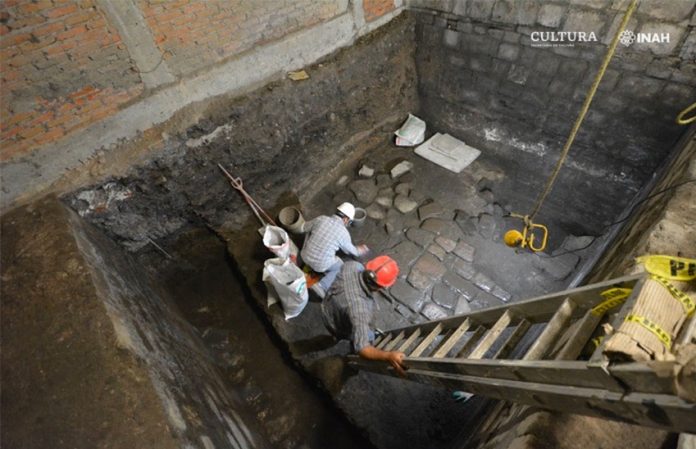
Archaeologists excavate and clean stone floor dating back to the early 16th century. Raúl Barrera R./PAU-INAH
Archaeologists in Mexico City have uncovered remains of a pre-Hispanic palace once occupied by several rulers of the Aztec capital of Tenochtitlán.
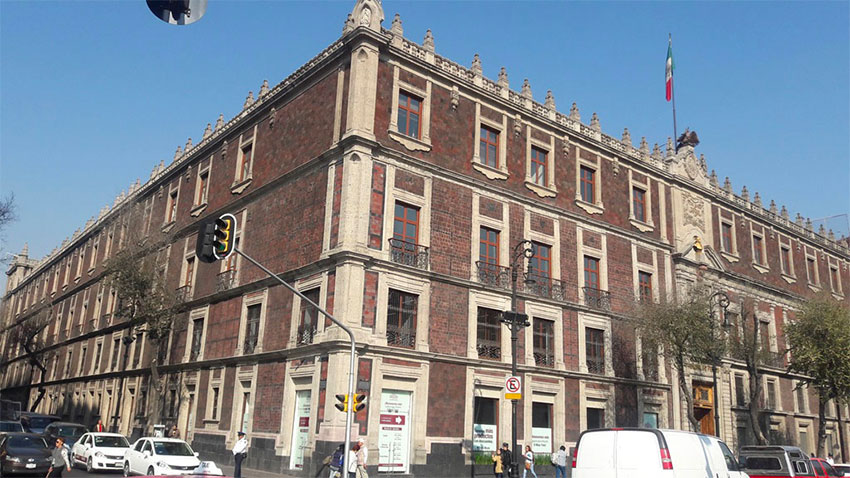
Specialists with the National Institute of Anthropology and History (INAH) found remains of the Palace of Axayácatl while excavating the courtyard and an adjacent room of the Nacional Monte de Piedad pawnshop, a stately 1755 building located a stone’s throw away from the Metropolitan Cathedral in the historic center of Mexico City.
During renovations of the building, INAH urban archaeologists found numerous basalt slabs that are believed to have been part of an open plaza of the palace occupied by Axayácatl, the sixth ruler or tlatoani of Tenochtitlán, and his successors.
Axayácatl, ruler ofTenochtitlán between 1469 and 1481, was the father of Moctezuma II and Cuitláhuac, who were the ninth and 10th rulers , respectively, of the Aztec, or Mexica, capital.
Moctezuma II is believed to have been killed on the balcony of his father’s palace in 1520, possibly by stone-throwing Spaniards.
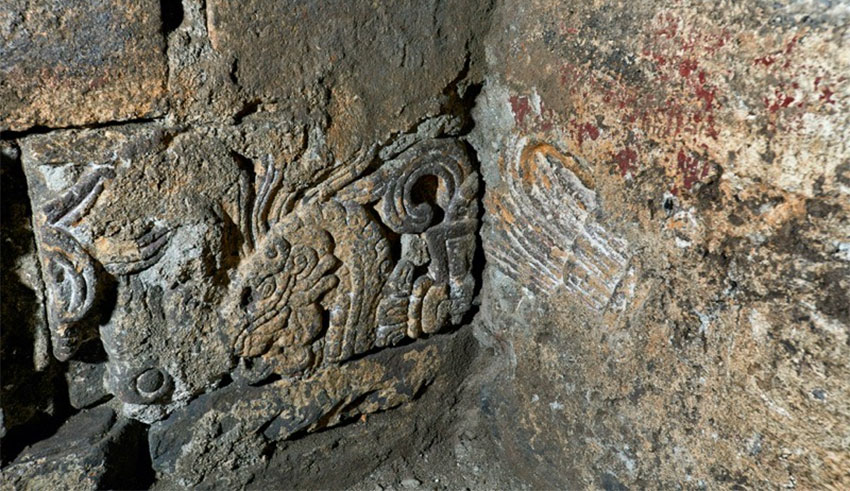
Stones engraved with images of Quetzalcóatl, the feathered serpent god. Oliver Santana/Nacional Monte de Piedad
He and other tlatoanis, including his brother Cuitlláhuac, were also held captive in the palace by Spanish conquistador Hernán Cortés and his men after their arrival in Tenochtitlán in 1519.
In a statement published on Monday, INAH said that in the same location archaeologists also found the remains of a house Cortés ordered to be built in the early 1520s and subsequently occupied.
Built using materials of the Palace of Axayácatl after it was razed, the home later became the first cabildo, or government house, of the colony of New Spain, INAH said.
Urban archaeologists were carrying out an archaeological salvage project at the Monte de Piedad building between September 2017 and August 2018 when they found the remains of both the palace and Cortés’ home, INAH said.
They first came across a room built from basalt and tezontle, two volcanic rocks commonly used in construction in Mexico. Further analyses concluded that the room was part of the house occupied by Cortés after the fall of Tenochtitlán in 1521.
Archaeologists concluded that the materials used to build the room came from the Palace of Axayácatl. Two of the stones used in the room’s construction were engraved with glyphs, including one of Quetzalcóatl, a feathered serpent deity worshipped by the Mexica people.
The Monte Nacional de Piedad, where the palace remains were found. Raúl Barrera R./PAU-INAH
Archaeologists also found ceramic remains that dated back to both pre-Hispanic and early colonial times.
More than three meters below the floor of Cortés’ home, archaeologists Raúl Barrera and José María García found the remains of another floor built from basalt slabs that dated back to pre-Hispanic times.
“Given its characteristics, the specialists deduced that it was part of an open space in the former Palace of Axayácatl, probably a courtyard,” INAH said.
The institute said that the discovery of the palace remains beneath the pawnshop was not a surprise because “historical sources” guided the archaeologists to its location.
Archeologists are now endeavoring to learn more about both the Palace of Axayácatl and Cortés’ home in a “post-dig research phase,” INAH said.
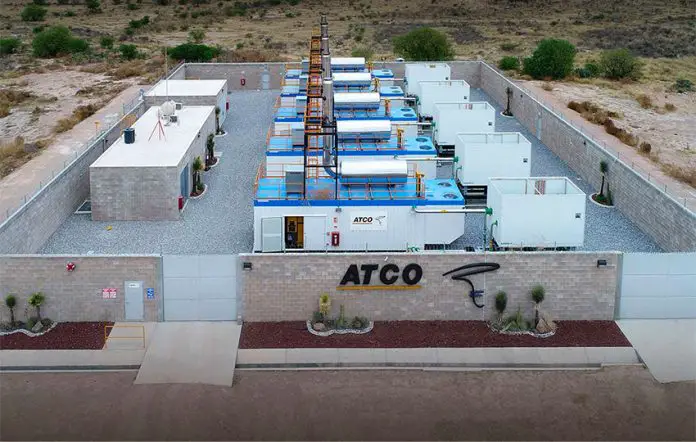
A distributed power generation system installed by the Canadian firm Atco in San Luis Potosí.
On the same day as the new North American free trade agreement came into force, a group of Canadian energy investors wrote to their government to warn that Mexico could already be violating the three-way pact by failing to respect existing contracts.
The companies Canadian Solar Inc, Atco Ltd, Northland Power Inc and JCM Power wrote to several senior officials on July 1 to express concern that their investments in Mexico were under threat.
In a letter seen by the news agency Reuters, the companies said that decisions to suspend national grid trials for new renewable energy projects and to limit the development and operation of privately-owned power stations could pose a risk to their projects in Mexico.
The four companies, which have several projects in Mexico including solar and hydroelectric ones, argued that Mexico risked violating provisions in the United States-Mexico-Canada Agreement, or USMCA, and other trade deals to which it is a party.
They urged the Canadian government to take up the issue with officials in Mexico.
A spokesman for Canadian International Trade Minister Mary Ng, to whom the energy companies also wrote, said the government is worried about the issues the energy investors raised.
“Canada shares these concerns, as Canadian companies have invested close to [US] $9 billion in the energy sector, including over $3.1 billion in renewable energy,” Ryan Nearing said.
He said Ng had raised the concerns with Mexican Economy Minister Graciela Márquez in late May and that the two agreed to maintain dialogue. Nearing also noted that Canada’s embassy in Mexico has engaged with the Mexican government on the matter.
The decision of the four companies to write to the Canadian government came six weeks after Canada and the European Union sent letters to the Mexican government to warn that energy policy changes could have an adverse impact on renewable power projects worth billions of dollars.
Energy companies and environmental organizations have also launched legal action against measures that seek to make it more difficult for private and renewable projects to operate in the Mexican energy market.
An energy reform enacted by the previous federal government in 2014 opened up Mexico’s energy market to private and foreign companies but President López Obrador, a staunch nationalist, appears determined to give the state-owned Federal Electricity Commission more control of the electricity sector.
The president has accused former governments of showing bias toward private companies, a situation he says caused electricity rates to rise. López Obrador has sought to renegotiate contracts worth billions of dollars in order, he says, to get a better deal for citizens.
Private companies that operate in Mexico, some of which are Canadian, have denied the claim that they have unduly raised prices, while the antitrust regulator, Cofece, has warned that the government’s actions will cause rates to go up.
Canada has been the third biggest foreign investor in Mexico over the past two decades, according to Mexican government data that shows that only the United States and Spain invest more.
In 2019, Canadian investment in Mexico exceeded $2.9 billion, the data shows, a figure that accounted for almost 9% of total foreign investment in the country.
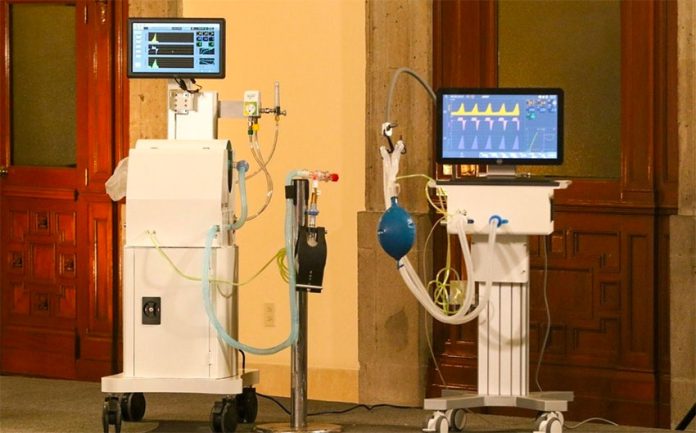
The two science council ventilators were unveiled Tuesday at the National Palace in Mexico City.
President López Obrador today presented two new ventilator models designed for seriously ill coronavirus patients.
The National Council of Science and Technology (Conacyt) built the devices with help from private organizations and universities. Speaking at his morning press conference, the president applauded Mexican innovation as a way for the country to avoid depending on “international solidarity” in its fight against the coronavirus pandemic.
Health Minister Jorge Alcocer was also upbeat.
“It has been possible to build two types of highly specialized ventilators, accessible to everyone, in response to the most urgent needs in this scenario of the pandemic. While reducing expenses and increasing efficiency we strengthen our technological presence and gain national sovereignty,” he said.
One ventilator model is called Gätsi, which means “sigh” in the indigenous language Otomí, and the other has been dubbed Ehécatl 4T or “God of the Wind” in Náhuatl, the president said.
The latter costs 70% less than the current market price of such ventilators, and 500 more units have been ordered. The device has a microcontroller capable of calculating and applying the necessary pressure during patient ventilation cycles.
The Gätsi ventilator, made in conjunction with Dydetec, a private software and hardware design company, is 60% cheaper than commercially available models and has a microprocessor control system that allows it to be adapted for adult or pediatric patients. Five hundred units of this model will also be produced.
Both ventilators are designed with control, pressure and volume sensors, are easy to clean, were tested on artificial lungs and biological systems and meet international specifications.
The cost for 1,000 ventilators will be 259 million pesos, around US $11.5 million, a unit cost of $11,500.
“In five months we achieved what usually takes between three and five years to develop,” said María Elena Álvarez-Buylla, director of Conacyt. “Scientific sovereignty and technological independence are how this government responds to challenges. We are seeing the birth of a national industry to save lives.”
Another made-in-Mexico respirator was announced in May by the National Institute of Health Sciences and Nutrition. It designed and built a product, in partnership with private sector partners in Nuevo León, with a cost of $10,000, the first of which were expected to be delivered this month.
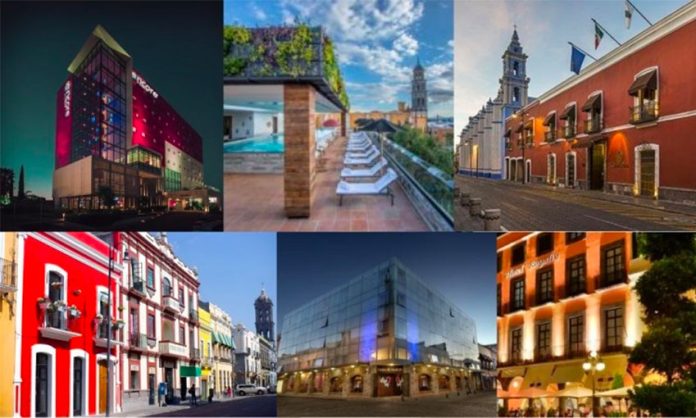
Some longstanding hotels in Puebla are on the verge of bankruptcy.
More than 40 hotels in Puebla’s historic center — some of which have been operating for as long as 100 years — are on the verge of bankruptcy due to the coronavirus, says the president of the local hotel association.
Manuel Domínguez Gabián said the affected hotels, which employ 1,500 people in the state capital, have already cut back on staff, but low occupancy rates of around 5% aren’t helping ease the financial burden the pandemic has caused. Normally at this time of year occupancy would be around 65%.
“For the association, it is worrying that businesses that have been around for two generations are about to close. We would lose a part of our history,” Domínguez said.
Taking out loans would not suffice as they would only cover payroll, he says, and urged state and municipal authorities to step in and help.
The association predicts at least 10 hotels will permanently shutter by August unless the economy is reopened, especially in the commercial and residential Angelópolis district. Puebla is currently at the maximum risk level for the coronavirus under the federal government’s stoplight system.
One of the hotels that has dismissed more than 100 employees and closed is the Hotel Royalty, which has been in operation since 1943 and is located in front of Puebla’s cathedral. Domínguez says the Royalty hopes to reopen in January or February 2021 after remodeling and will hire back its staff.
Other independent hotels are considering selling to national chains that are more economically resilient, Domínguez said.
Fifteen hotels closed permanently at the beginning of June due to bankruptcy, and 300 people were let go.
As of Monday, Puebla had 14,349 confirmed cases of the coronavirus and had seen 1,799 deaths.
For at least two years residents of three communities in Hidalgo have been complaining about their water, which has become contaminated due to leaks caused by petroleum theft along the 50 kilometers of pipeline that traverses the area.
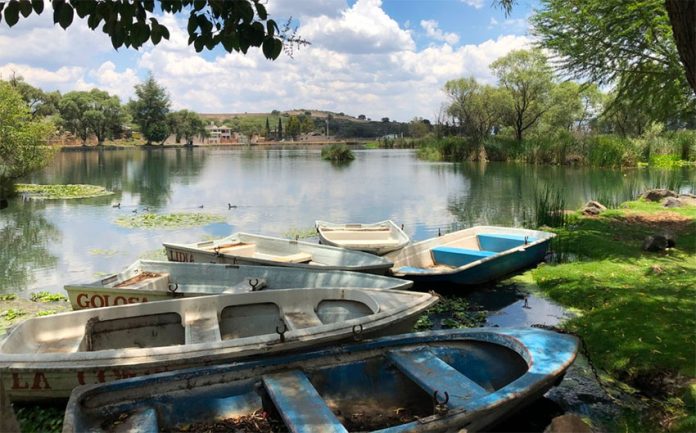
The water source for the 10,000 residents of San Juan Hueyapan, Santa María Nativitas and Guadalupe Victoria is Hueyapan Lake, which is also where residents used to fish and swim, but now it smells of petroleum.
Residents had once considered their water to be pure and were accustomed to drinking out of the tap, but now that water comes out brown, full of sediment and foul-smelling, they say.
“We began to notice because my mom had a headache and her stomach hurt, and she said to me ‘Hey, every time I come here and I drink water my tummy hurts.’ We noticed that when we put water in a tray or something it always remained dirty … as if it had mud,” María Isabel Espinoza told the newspaper Milenio.
“People began to have hair loss problems, irritation, gastrointestinal problems, the situation is serious,” said resident Gavino Ortiz.
In November 2018, after authorities declined to take action, residents decided to block the flow of water from the lake to their homes to avoid becoming ill.
Officials suggested installing a pump to bring water in from another source, but because the municipality was in debt to the Federal Electricity Commission that option was discarded.
A neighboring community managed to build a separate system to bring water in, but it had to be abandoned after it was discovered that the source they were pumping from was also contaminated.
In Guadalupe Victoria, residents must contend with brown, smelly water which stains any receptacle in which it is placed.
“The information that the municipality gives us is that the water is supposedly suitable for domestic use and I don’t know where domestic use would start because ultimately you brush your teeth and bathe with this water and many people continue to cook with it because they can’t afford to buy water for daily use,” said Guadalupe Elizalde.
In February, a judge ordered local, state and federal authorities to supply communities in the area with water “in quality and quantity,” but any progress toward that goal has been derailed by the coronavirus pandemic.
Health standards have taken on a whole new meaning since coronavirus.
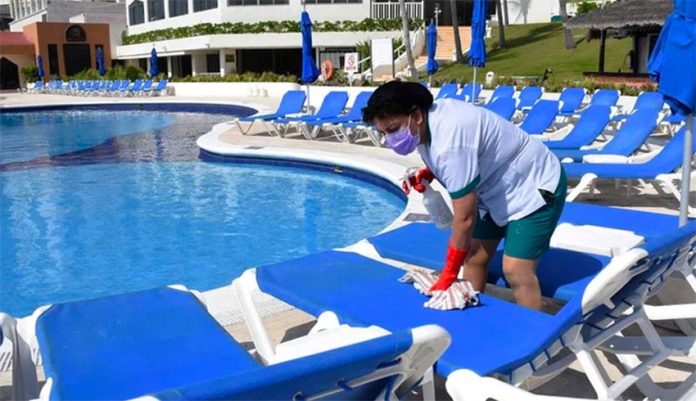
The Ministry of Tourism (Sectur) has developed a new sanitary certification system to draw foreign visitors back to Mexican tourist destinations.
The “Punto Limpio” (Clean Point) designation, which is an update to a similar program implemented during the swine flu pandemic of 2009, is earned by establishments that meet government hygiene standards after taking a free two-month course, Tourism Minister Miguel Torruco announced at a virtual press conference on Monday.
To create the new program, guidelines were reviewed and revised, new protocols were introduced and feedback was sought from several agencies. The new certification has the endorsement of the ministries of health, labor and social welfare as well as Mexico’s coronavirus czar, Deputy Health Minister Hugo López-Gatell.
The program is designed for a variety of tourism-related businesses, Torruco said, including hotels, cafés, car rental agencies and travel agencies. “With this model, tourist agencies will be able to provide tourists with a model of safety and hygiene, and greater confidence is generated among travelers,” he said.
Businesses adopting the measures defined in the Clean Point guidelines will have to incur costs, warned the president of the National Tourism Business Council (CNET), Braulio Arsuaga.
The Ministry of Tourism’s seal of hygienic approval.
“The seal and the processes that are being established will give us an important differentiation, and without a doubt we will have to apply them. This will imply certain costs for the industry; however, there is no intention of transferring this to the final consumer,” he stated.
In May, the World Travel and Tourism Council (WTTC) launched the Safe Travels program for tourism destinations that comply with hygiene and sanitization standards based on recommendations by the U.S. Centers for Disease Control and the World Health Organization.
Thus far Quintana Roo, Baja California Sur, Yucatán, the Riviera Nayarit, Jalisco, Campeche, Tabasco, Tamaulipas, Sinaloa, Oaxaca, Michoacán and Guanajuato have qualified for the global health designation.
Currently, 1,250 establishments have obtained Mexico’s Punto Limpio certification, which is valid for two years. Participation in the program is voluntary, and businesses that do not choose to participate can operate normally.
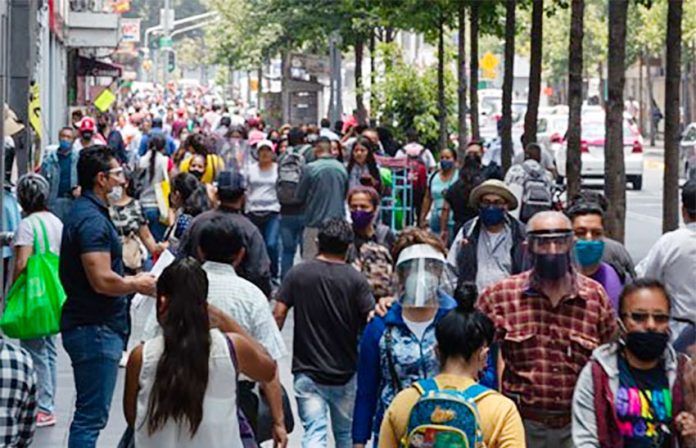
Efforts to limit crowds in Mexico City have been unsuccessful since businesses began reopening two weeks ago.
Mitigation measures failed to keep the basic reproduction number for coronavirus below 1 in 15 states between the end of May and the end of June, a situation that allowed local epidemics to grow.
Data presented by health officials at Monday night’s coronavirus press briefing showed that the reproduction number (the number of people each infected person infects) was above 1 between May 28 and June 26 in Baja California Sur, Coahuila, Colima, Durango, Guanajuato, Hidalgo, Nayarit, Nuevo León, Quintana Roo, San Luis Potosí, Tamaulipas, Tlaxcala, Veracruz, Yucatán and Zacatecas.
Deputy Health Minister Hugo López-Gatell noted that in states where there is a reproduction number of 1, or R1, the size of the local coronavirus epidemic will remain unchanged.
“The epidemic will continue, it won’t end but it won’t increase either,” he said.
If the reproduction number is above 1, the size of the epidemic will grow and if it is below 1 it will decrease, López-Gatell said.
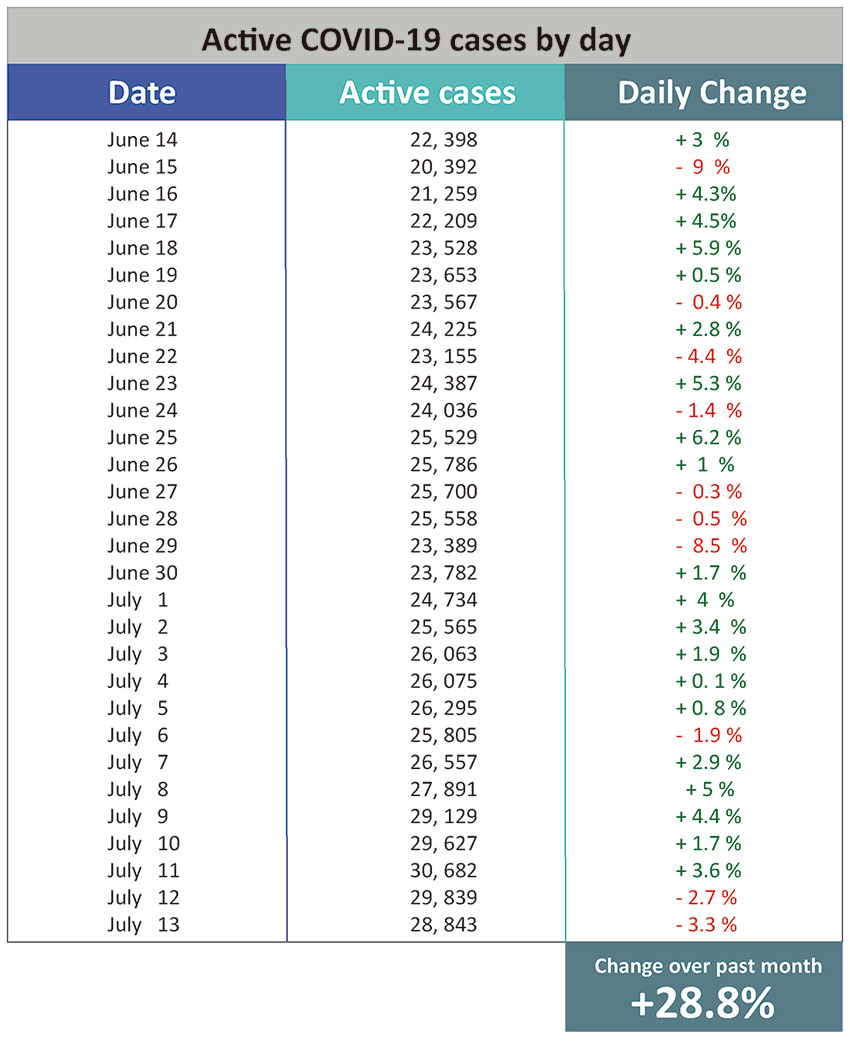
Active coronavirus case numbers in the past month show a steady increase. mexico news daily
The deputy minister stressed that a reproduction number below 1 is needed in order to “begin to control the epidemic,” adding that the purpose of presenting the data for each of Mexico’s 32 states was not to scold state governments for their management of the coronavirus crisis nor apportion blame to them.
“What we’re presenting here is not a reprimand in any way, … it’s a technical reality. Achieving control [of the pandemic] is a huge challenge for society and for governments,” López-Gatell said.
He also said that it’s likely that Covid-19 will remain a threat for two or three years.
“We’re talking about two or three years in which [the virus] will return again and again in small, medium-sized or large outbreaks. It’s important to be aware that prevention doesn’t just depend on general instructions from the government nor on a prohibition on occupying public spaces or carrying out activities,” López-Gatell said.
It is “very advisable” that people make changes to their everyday lives in order to mitigate the risk of contracting coronavirus, he added.
Across Mexico, the number of people confirmed to have been infected since the beginning of the pandemic exceeded 300,000 on Monday.
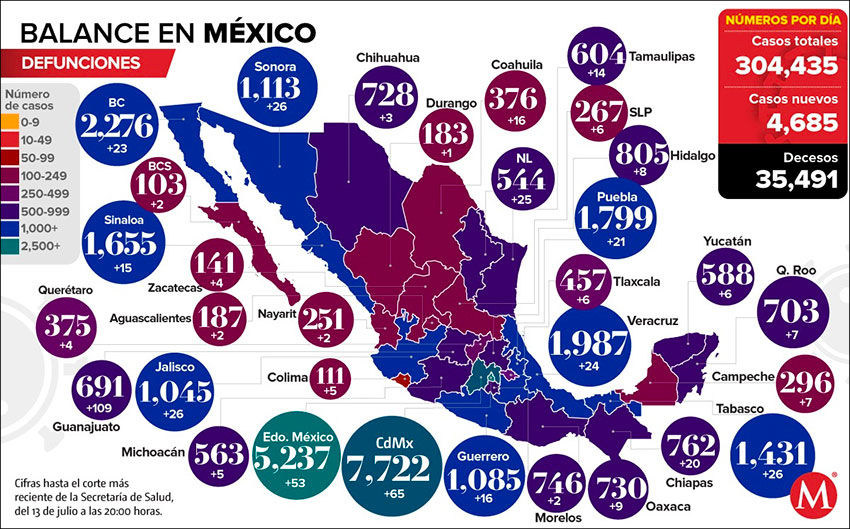
Covid-19 death figures as of Monday. milenio
Health officials made no mention of the accumulated case tally nor the Covid-19 death toll at last night’s press conference but data published on the federal government’s coronavirus website showed that the number of confirmed cases in Mexico had risen to 304,435 with 4,685 additional cases registered.
An additional 485 Covid-19 fatalities were also registered, lifting Mexico’s death toll to 35,491.
Of the confirmed cases, 28,843 are considered active, meaning that many people tested positive after developing coronavirus symptoms in the past 14 days.
The number of active cases has increased by 28.8% over the past month, peaking at more than 30,000 last Saturday before declining slightly on both Sunday and Monday.
There are also 76,824 suspected coronavirus cases across the country, meaning that the results of that number of tests are not yet known.
Mexico City continues to lead the country for accumulated and active coronavirus cases even though the reproduction number in the capital dropped below 1 in June. It has recorded 58,114 confirmed cases since the beginning of the pandemic, of which 4,195 are currently active.
Most of those present observed coronavirus health protocols when President López Obrador ate at a Mexico City restaurant on Monday.
The capital also has the highest Covid-19 death toll in the country, with 7,722 confirmed fatalities as of Monday.
Squash and prosciutto, grilled and served with mint sauce.
It seems I’ve always had a love/hate relationship with zucchini. Not hate, really — more of a pronounced ambivalence coupled with the feeling that I’m often forced to choose between it and broccoli as the only ways to get some green into my system. Así es.
As another of my quarantine-in-the-kitchen activities, I’m trying to change that mindset. My research has turned up some very interesting and amusing info about this humble FRUIT. Yes, although treated and cooked like a vegetable, botanically speaking zucchini is a fruit. (Who knew?!) It’s the ovary of the flower, and although both male and female plants produce flowers, only the female flowers go on to produce fruit.
Squashes were first documented in Mesoamerica (the area from Central Mexico south through Guatamala, Honduras, Nicaragua and Costa Rica); and the predecessor to modern-day zucchini was called ayokonetl in Náhuatl. It made its way to Europe in the 16th century, where it took several hundred years to develop into the zucchini we know today.
The Italians enthusiastically adopted the tender green squash, calling it zucchino (masculine) or zucchina (feminine), derived from zucca, the word for squash or pumpkin. “Zucchini” is the masculine plural, used in many countries, and courgette and marrow are used in France, Quebec, the U.K., South Africa and throughout Asia and New Zealand.
Whatever name you use, choose the smallest, youngest, freshest zucchini you can find, as then the flesh is firm and the seeds have not developed as much. It’s those seeds that make the squash watery, bitter or fibrous. And you want them to be firm, not rubbery.
This zucchini pizza crust is tasty enough to eat on its own.
Some chefs say another way to combat the bland mushiness so often associated with zucchini is to cook them fast, at high heat, in whatever recipe you’re using. That traps in the juiciness and allows their natural buttery flavor to remain. Some also recommend salting the sliced squash before cooking — like you’d do with cucumbers — to draw out some of the water and “firm up the flesh.”
Here’s how: slice zucchini however the recipe calls for. Place in a colander or bowl and sprinkle generously with salt. Let sit for at least an hour. Blot the slices with paper towels to remove the excess salt and moisture, and then continue with your recipe.
Zucchini Crust Pizza
This crust is so good you’ll be tempted to just eat it as is!
Toppings: tomato sauce, cheese and standard pizza toppings
Preheat oven to 400 F. Oil a 10″ pie pan and coat lightly with flour. Combine zucchini, eggs, flour, mozzarella, parmesan, herbs and 1 Tbsp. oil in a bowl and mix together thoroughly. Spread mixture in prepared pan and bake 35-40 minutes or until golden brown. Halfway through baking, remove from oven, brush with remaining 1 Tbsp. oil. Return to oven. Remove crust from oven; let cool for 10 minutes before using a spatula to loosen it from the pan. Add pizza toppings and bake again for 10 minutes until heated through and cheese melts.
Grilled Squash Ribbons & Prosciutto with Mint Dressing
1 tsp. finely grated lime zest
¼ cup fresh lime juice
¼ cup chopped mint
2 garlic cloves, very finely chopped
¼ cup extra-virgin olive oil, plus more for brushing
Salt & freshly ground pepper
2 medium zucchini
2 medium yellow squash
6 oz. thinly sliced prosciutto
Light grill or preheat a grill pan. In a small bowl, combine zest and juice with mint, garlic and the ¼ cup of olive oil. Season with salt and pepper; set aside. Using a mandoline or wide peeler, slice squash very thin lengthwise. Thread zucchini, yellow squash and prosciutto onto four pairs of 12-inch skewers, folding slices back and forth. Lightly brush vegetables and prosciutto with olive oil and season generously with salt and pepper. Grill over high heat until the squash ribbons are lightly charred, about 1½ minutes per side. Serve with mint dressing.
Zucchini Tomatillo Bisque
A smooth, satisfying soup with a bit of heat.
2 Tbsp. olive oil
2 Tbsp. butter
2 cloves garlic, minced
2 medium onions, chopped
6 medium zucchini, chopped or coarsely grated
1-2 medium dried colorado or ancho chiles, seeded and chopped
1 jalapeño, seeded and chopped
6 tomatillos, husked and chopped
6 cups vegetable or chicken stock
5 corn tortillas
1-2 Tbsp. fresh lime juice
1/3 cup cilantro leaves, chopped
Salt and pepper
In large saucepan, heat oil and butter, add garlic and onions and sauté until softened. Add zucchini, chiles and tomatillos, stirring until heated through. Add stock, bring to boil, then cover and simmer 20 minutes. Tear tortillas into pieces and add to soup; stir in lime juice and cilantro. In a blender or food processor, purée soup in batches until smooth. Return to pan and heat through. Add salt and pepper to taste. Serve topped with sour cream, crumbled tortilla chips and cilantro. – “More Recipes From A Kitchen Garden,” by Renee Shepherd
Combine zucchini with pine nuts to make this pound cake.
Zucchini & Pine Nut Pound Cake
10 Tbsp. butter
3 small zucchini
1 lemon
4 eggs
1¼ cup sugar
1 tsp. vanilla
2 cups flour
1 tsp. salt
1½ tsp. baking powder
2/3 cup pine nuts
Melt butter over low heat. Without salting, grate zucchini coarsely and set aside. Preheat oven to 425. Zest the lemon and juice; set aside. Blend eggs, melted butter, sugar and vanilla in a food processor, then add zest and lemon juice. In a bowl, mix flour, salt and baking powder, then add this in batches to the mixture in the food processor. Beat till smooth, return to bowl and add grated zucchini and pine nuts. Grease and flour a loaf pan and pour in batter. Smooth the top, bake for 10 minutes, then lower temperature to 350 and bake for another hour. –Roger Verge’s “Vegetables in the French Style”
Janet Blaser has been a writer, editor and storyteller her entire life and feels fortunate to be able to write about great food, amazing places, fascinating people and unique events. Her first book, Why We Left: An Anthology of American Women Expats, is available on Amazon. Contact Janet or read her blog at whyweleftamerica.com.
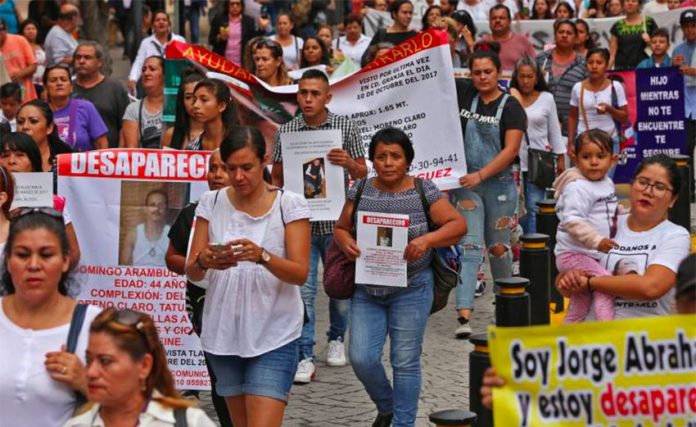
Presented by Interior Minister Olga Sánchez and Deputy Interior Minister Alejandro Encinas, the new CNB report says that 97.9% of the more than 73,000 people currently missing disappeared after 2006, the year in which former president Felipe Calderón launched the so-called war on drugs.
The remaining 2.1% of missing people disappeared in the years between 1964 and 2006.
Since the former year, a total of 177,844 people have been reported as missing, of whom 104,643, or 58.8%, were located. A total of 98,242 missing persons, 93.9%, were found alive, while 6,401 of those located, 6.1%, were dead.
Encinas said that 63,523 people have been reported as missing since the current federal government took office at the end of 2018. Of that number, 35,652 people have been located, he said.
That means that 27,871 people who were reported missing in the past 1 1/2 years are still unaccounted for.
The states with the highest number of missing person reports during the federal government are, in order, México state, Jalisco, Tamaulipas, Veracruz and Sinaloa.
Encinas said that 1,146 hidden graves containing 1,682 bodies have been exhumed in the 19 months the administration led by President López Obrador has been in power. Just over 42% of the exhumed bodies – 712 – have been fully identified, he said.
Almost 60% of the hidden graves found between December 2018 and June 2020 were located in just five states — Veracruz, Sinaloa, Colima, Guerrero and Sonora. Crime gangs have a strong presence in all five.
While the federal government and state authorities have faced criticism for not doing enough to locate Mexico’s many missing persons, the former appears to be making progress in arguably the most prominent abduction case in recent years.
The government announced last week that the remains of one of 43 teaching students kidnapped in Guerrero in 2014 had been identified by forensic scientists at the University of Innsbruck in Austria.