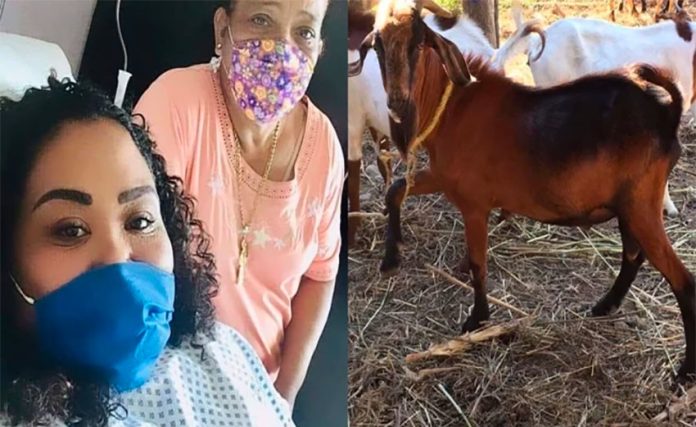
Rodríguez and her mother are raffling the billy goat to pay for her next operation.
Law student Carmen Rodríguez Domínguez has a unique fundraising strategy to help her pay for a desperately needed kidney operation. She’s raffling off a goat.
On Thursday, Rodríguez, 32, announced the raffle on her Facebook page, posting a photo of a spry-looking brown billy goat named Cruz, along with a photo of her debit card so purchasers could deposit money to her account.
One hundred tickets were sold at 50 pesos each, all were spoken for by Friday evening, raising a total of 5,000 pesos toward the cost of her operation, which is 50,000 pesos (about US $2,230).
The young woman’s ordeal began on June 1 when she went to the doctor while suffering excruciating pain. Tests and X-rays showed that her right kidney was infected and not functioning correctly.
“I left crying with my mom, so many things were going through my head, I came out of the doctor looking for a urologist, and she confirmed that my kidney was damaged and was not working,” she wrote on Facebook.
By June 5 she had undergone her first operation.
Another surgery was performed on June 17, depleting the family’s savings.
Rodríguez, who lives in Ciudad Victoria, Tamaulipas, is currently catheterized, which she says causes her significant pain. The third operation needs to happen very soon, she says, within the next six weeks before the catheters need to be replaced.
The idea to raffle off a goat was her mother’s, Rodríguez says, and mother and daughter, who have already raffled off a cake, plan to continue raising funds by selling meals and desserts in order to meet their financial goal.
Classmates have also created a Facebook page, Unidos Con Carmen, where friends, acquaintances and even strangers have donated to her cause.
“I know that we are in difficult times, that some of us do not have a good job, but I know that the contributions people have made come from the bottom of their hearts and I personally thank them infinitely for their support,” she wrote on Facebook.
Rodríguez’s bank, Santander, got wind of her situation and yesterday posted to Twitter that more information would be forthcoming as to how they could help her meet her 50,000-peso goal.
They also indicated that they would like to award the young woman a scholarship.
“We have already talked to her and soon we will be offering support,” said Marcela Espinosa, Santander’s director of sustainability. “We know there is always an opportunity to make a difference in someone’s life and our best wish is for Carmen to get better.”
Rodríguez, an A student, said that before she became ill she was focused on finishing her studies and starting her career, which has been temporarily derailed by her medical problems.
“From my heart, I thank everyone who has helped me,” she said, “because I very much want to live.”
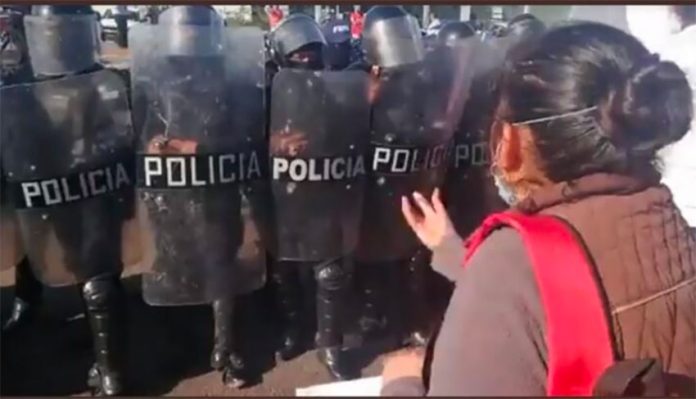
Riot police were called in to control Guanajuato march.
A large squadron of police in riot gear moved against a protest by families of missing persons in Guanajuato in the state’s capital city Friday.
Photos and footage of the incident show women holding up photos of their missing loved ones as police, clad in helmets and carrying shields, forced them back.
At least five women were arrested in the clash, and one suffered a leg injury after a struggle with officers.
As news of the arrests and injuries spread, the Mexico office of the United Nations High Commissioner for Human Rights called on the state government to investigate and respect the families’ right to demonstrate.
Through its social media accounts, the National Human Rights Commission also condemned police actions, urging the governor to respond to them and “address the legitimate issues they are claiming.”
Around 8 a.m. Friday, family members of missing persons who belong to the group “A Tu Encuentro,” or “Until You Are Found,” walked from the bus station, located near the toll booth on the Guanajuato-Silao highway, to the Santa Fe roundabout at the entrance to the city.
Wearing t-shirts and carrying banners with the names and faces of their missing daughters, sons, husbands and fathers, the protesters took to the street in what was initially a silent march. The demonstrators, the vast majority of whom were women, wore masks and respected social distancing as they marched.
Upon reaching the roundabout, cars were parked in the street to block vehicular traffic and marchers called on Governor Diego Sinhué Rodríguez Vallejo to take action.
“Diego, we have arrived, we are waiting for you, we have always sought dialogue. We have told you that our missing family members deserve to be treated with respect,” they proclaimed while denouncing the appointment of Héctor Díaz Ezquerra to the state’s Missing Persons Commission. “We want an explanation of why you selected a business administrator to be in charge of the commission. We will not accept it because that person is not capable,” said one of the women as the protest began.
They were met by police who asked them to move the vehicles blocking traffic and continue their protest in the roundabout’s plaza, but the women said they would not budge until the governor appeared to address their concerns.
In response, officers called in tow trucks and began pushing protesters out of the street as several struggles ensued.
In addition to the arrests, paramedics were called to attend to a woman who had allegedly been pushed to the ground by police.
Lawyer and activist Roberto Saucedo Pimentel said a claim for abuse of authority by police may be filed by the women who were “re-victimized by the state government” in the incident.
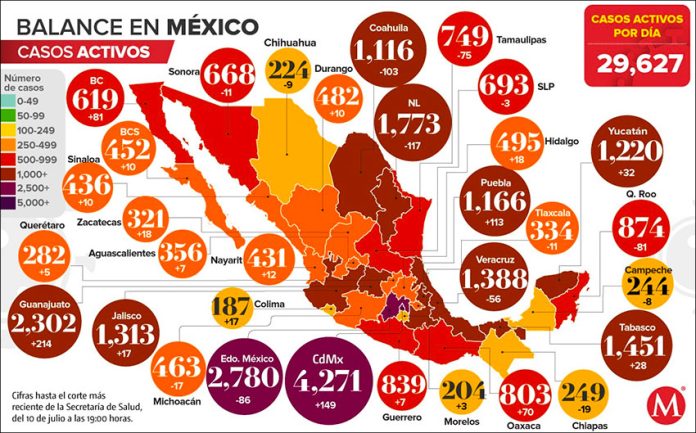
The federal government did not update its weekly coronavirus “stoplight” map for the first time since its debut in May, and coronavirus czar Hugo López-Gatell puts the blame squarely on states for inconsistencies in their data.
“We can’t present a national stoplight map when there are gaps in our information,” he said.
“There are states in which the information we have on hand as reported through official channels, such as laboratory data, is not consistent. We are going to evaluate this with the states and rethink things in this regard,” López-Gatell said in Friday evening’s press conference.
“If there is a deficiency of information because the data is not produced on time, or worse because it is distorted, that is why it is not possible to have appropriate monitoring,” López-Gatell noted, adding that one factor in inaccurate data is the lag in reporting testing results.
Although López-Gatell would not say which states had supplied incorrect data, he did note that in the past week that the number of confirmed coronavirus cases rose 29% in Quintana Roo, 17% in Campeche and 15% in Yucatán, and expressed his concern about states reopening too quickly.
Meanwhile, Cristian Morales of the Pan American Health Organization indicated that Mexico is experiencing an “extremely complex situation” and noted that the population is confused by the stoplight map. It is meant to be a guide for when states should reopen and relax coronavirus restrictions and has been criticized by state governors in the past.
Morales told the United Nations Information Center in Mexico that the health emergency is troubling because Covid-19 cases and deaths continue to increase and because of the economic and social impact of the pandemic.
A World Health Organization (WHO) official said it was important to strike a balance between containing the disease and allowing economic activity.
“The blind reopening, regardless of the data, could lead to situations that nobody wants,” said Mike Ryan, executive director for health emergencies, when asked specifically about the situation in Mexico.
“We fully understand the pressure that some governments are suffering, but I recommend seeking a balance between the containment of the coronavirus and the reopening of activities,” he said.
“Reopening in moments of intense community transmission leads to difficult situations that can affect an entire country” and push health systems like Mexico’s to the limit, the WHO expert warned.
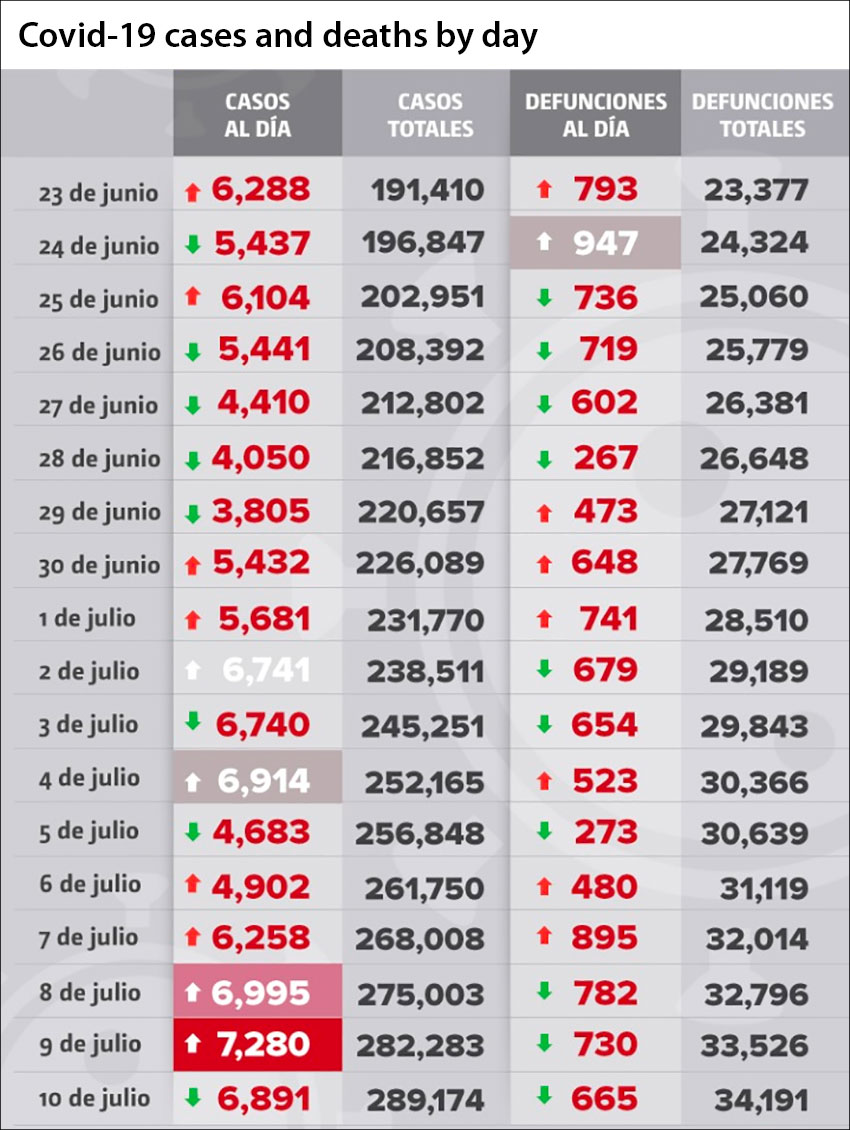
The daily tally of coronavirus cases and deaths. Deaths are numbers reported and not necessarily those that occurred each day. milenio
López-Gatell responded Friday to Ryan’s comments by reminding the evening press briefing that it had been been made clear “at all times that there was a risk of new outbreaks as a consequence of a resumption of activities.”
But it was the federal government that began announcing economic reopenings in mid-May amid warnings that it was too early. One notable announcement was that over 300 coronavirus-free municipalities would be free to ease restrictions.
A month later the list of so-called “municipalities of hope” had dwindled to just 60 as the virus continued to spread.
López-Gatell’s announcement regarding the delay in releasing the stoplight map will likely draw further criticism of the federal government’s tendency to blame others for the health crisis and its effects. The first came from former president Felipe Calderón.
Instead of recognizing the errors associated with limited testing, a hasty economic reopening and the “bad example” set by authorities who refuse to wear face masks, “now they want to blame the states,” said Calderón, who accused the government of prioritizing “political polarization” over public health.
According to the Ministry of Health, the number of confirmed coronavirus cases in Mexico rose Friday by 6,891 for a total of 289,174. There were another 665 deaths reported, bringing that total to 34,191.
One week ago, when the federal coronavirus map was last updated, 17 states were at the orange level, indicating high risk, and 15 were at the red, maximum risk level.
Yesterday, Mexico City and Quintana Roo declared their own stoplight designations. The former said the city would remain high-risk orange but some areas with high case numbers would be designated maximum risk red effective next week.
Quintana Roo, declared orange last week, announced that the southern region of the state would revert to red, meaning restrictions would be applied in Felipe Carillo Puerto, José María Morelos, Bacalar and Othón P. Blanco.
Artists Standing Strong Together, a collective of independent artists founded in March to provide support during the coronavirus pandemic, has announced a fourth night of storytelling aimed at adults.
Mexican storyteller and musician Valentina Ortiz, from La Huacana, Michoacán, will join storytellers from across the United States in a Zoom event that will also be live-streamed on YouTube. Viewers are invited to bring a beer, and their ears, to the watch party.
Promotional material for the event describes the art of storytelling as a “verbal movie, creating images in your mind through the turn of a phrase, the use of words and the facial expressions and gestures” of those telling the tales. Scheduled story topics include sex, murder, romance and obsession, among others.
The event is free and begins at 10 p.m. ET on Saturday. Zoom participants must register in advance and will be invited to be part of the session’s virtual after-party.
Mendoza: hospital occupancy has grown to 103 patients from 30 in just a month.
Baja California Sur (BCS) remains at the orange, high-risk level for the spread of the coronavirus with new cases mounting and hospitals pushed to the brink.
“There are no more doctors and nurses available to attend to additional patients in all institutions of the health sector,” Governor Carlos Mendoza Davis said Thursday.
“At the beginning of June, we had an average of 30 coronavirus patients hospitalized throughout the state, just over a month ago. In these first days of July, the occupancy has grown to 103 patients. A similar story arises in the use of ventilators, whose availability decreases as infections grow,” he said.
The municipal government in La Paz is also reeling from an outbreak of the coronavirus as 24 workers at city hall have tested positive, as has La Paz Mayor Rubén Muñoz Álvarez, who announced his diagnosis on Thursday and is self-isolating at home, BCS Noticias reports.
Government Secretary Álvaro de la Peña Ángulo announced yesterday that across the state 969 people have been sanctioned since the health crisis began for failing to comply with coronavirus restrictions, and 78% of them chose to do jail time rather than pay a fine of up to 8,000 pesos, about US $356.
“In La Paz there were a total of 205 offenses, of which 203 people were sanctioned with a 36-hour arrest; only two of them preferred to pay a fine, and none chose to pay with community service work,” De la Peña said.
The greatest number of offenders were cited in Los Cabos, where 352 people were sent to jail and 57 were fined.
Only one person in the state, a person cited in Loreto, decided to serve out their punishment doing community service work.
As of Thursday, BCS had 2,109 confirmed cases of the coronavirus and 95 deaths.
Fish out of waters
Fisherman Andrés Camacho was treated to a rare surprise when he found a silvery keta salmon in his net on July 5, Excélsior reports.
The commercial fisherman caught the salmon near Puerto Nuevo, a tiny fishing village in the municipality of Mulegé, and posted a photo to his Twitter account, wondering whether the fish had made its way to Baja after escaping from a fish farm in Chile.
It is more likely the fish swam down from up north, as salmon are common in the waters off the United States Pacific Northwest and Canada, and have occasionally been caught in Southern California.
In 2013 a female coho salmon was caught near Las Barrancas in Comondú.
Turtle takers
Early this week three men in Loreto were detained by officials from the National Fisheries and Aquaculture Commission who spotted them in possession of four live sea turtles as they landed their boat on La Negrita beach.
The men, hailing from Tijuana and Mulegé, were handed over to the Attorney General’s Office and charged with committing a crime against the environment.
BCS Noticias says Profepa seized the turtles in order to release them back into the sea.
Papers, please
Want to go camping on one of Los Cabos’ long stretches of isolated beaches? The Ministry of the Environment and Natural Resources (Semarnat) discourages it but will allow camping if you first file for a special permit, which takes a few days to issue. The permit is free, and can be applied for online or in person at the Semarnat offices in La Paz, as the agency has no offices in Los Cabos, Cabo Mil Noticias reported.
Permit-holders must have their document at the ready as beaches will be patrolled, Semarnat officials said. All beaches in BCS except those in Los Cabos remain closed.
Busted
On July 7, LaTribuna de Los Cabos reported that the Mexican navy seized five packages containing 146 kilos of methamphetamine from a courier service trailer at La Paz’s Pichilingue port. Its street value was estimated to be nearly US $1.5 million.
Officers ran the packages through an X-ray machine and discovered what appeared to be a powdery substance, later confirmed to be meth, as well as 396 grams of marijuana. An investigation into the drugs’ origin is ongoing.
That same day, according to Excélsior, a bus traveling from La Paz to Tijuana was stopped at a military checkpoint in Loreto.
Soldiers searched the bus using a narcotics detection dog that alerted on several cardboard boxes stowed in the bus’s luggage area. The boxes contained 432 sealed cans which were labeled as food, but upon opening them officers discovered they actually contained a total of 105 kilos of meth.
Also busted
State legislator Perla Flores Leyva admits that she was wrong for sending her husband and son to Paris on the government’s dime last year, calling the purchase of the 55,292-peso (US $2,459) airline tickets an “error.”
“I paid for it dearly, I wouldn’t do it again,” Flores says, adding that she has since paid the government back through payroll deductions. She said other legislators have been known to take pleasure trips and charge them to the government, BCS Noticias reported.
“I heard that they want to impeach me for those tickets, but it is not a crime and it is not a cause for impeachment since I paid for them,” Flores said, claiming that news about the purchase was leaked by political opponents.
The launch of a Tenochtitlán-class patrol vessel in Tampico.
Patrol vessels, tugboats and shrimp boats are among the more than 100 watercraft built at Naval Shipyard No. 1 in Tampico, Tamaulipas, over the past 65 years.
Located on the Gulf of Mexico in the south of the northern border state, the naval shipyard is the most productive among seven in the country, according to its project director, Captain Jesús Manuel Gómez Álvarez.
The shipyard was established in 1930 but its boatbuilding records only date back to 1955. Gómez, a 30-year veteran of the navy, told the newspaper Milenio that 104 hulls and entire ships have been built at the yard since then.
The boatbuilding process has changed over the years, he explained, noting that naval boatbuilders now use cutting-edge technology that allows them to complete their work more quickly. Gómez also said that the shipyard now employs both male and female workers among its 600-strong workforce whereas in the past boatbuilding was considered the exclusive pursuit of men.
The naval captain explained that boats are built upside down, a strategy he said makes it easier to weld the different parts of a vessel together.
When a boat is ready to be launched, an official ceremony is held, Gómez said, explaining that the required electrical and plumbing work is undertaken once a vessel is in the water.
After a vessel is fully equipped and naval engineers have verified that everything is working as it should be, it is delivered to its final destination, he said.
More recently, a Oaxaca-class patrol vessel was completed and launched in the Pánuco River, which flows into the Gulf of Mexico. It is currently undergoing testing prior to delivery and deployment.
Patrol vessels such as those built at Naval Shipyard No. 1 are used for a range of purposes including ocean surveillance, search and rescue missions and disaster relief.
The entrance to the cave, high above the Santiago River.
“Yes, we were in La Cueva Cuata for six hours and never got to the end of it; finally crawled out at two in the morning!”
Inspired by that report from a friendly stranger, we began our search for La Cuata Cave, which — we had been told — was set in a precipice overlooking the Santiago River in the Santa Rosa Valley, which is located about 50 kilometers northwest of Guadalajara.
It was January of 1990, in “the dead of winter,” but as we drove down the winding road into the deep Santa Rosa Canyon, we were pleasantly surprised to find all sorts of tropical fruits already ripening. We made our way through sleepy pueblitos with strange names like Achio and Chome, past tamarind trees, golden fields of corn, flowering apricot trees and enormous mango trees drooping with fruit. Throughout the dry season, the many springs in the area keep the vegetation eternally green — and the roads eternally muddy.
A local resident named Arnulfo had heard of La Cuata and was willing to take us to the cave, though he had never actually entered the place and was none too anxious about doing so now. Leaving our Jeep under a shady mango tree, we hiked northwest along a narrow trail that passed banana plants and papayas until suddenly we caught sight of the majestic barranca in the distance.
“The cave is right at the edge of the precipice,” explained Arnulfo. “I just hope I can find it …”
Surveying the guano-flavored lake.
That problem resolved itself a few moments later when we came upon a rancher who introduced himself as Don Guadalupe, “the one in charge of visitors to the cave.”
Well, we couldn’t quite believe we’d found a tourist cave in this lonesome spot, so we pried Don Guadalupe for more information.
“Pues, people come to this spot to pray, because, bueno, there’s something special about it. You see, when the world comes to an end — and it’s coming very soon — only seven places will be spared, and this cave is one of them! People call it La Cuata but we call it La Cueva de Tequilizinta.”
Pulling out my pocket agenda, I inquired as to the precise date when the world would be ending. “Why, in 1998!” exclaimed our guide with a knowing look.
A little while later, the trail ended right at the base of a sheer wall. Facing us was a dark hole in the cliff side and around the bend to the right was a drop of a good 100 meters straight down to the Santiago River.
I stepped into the cave entrance and I removed my pack. “Here’s the cave!” I shouted to my compañeros coming up the trail.
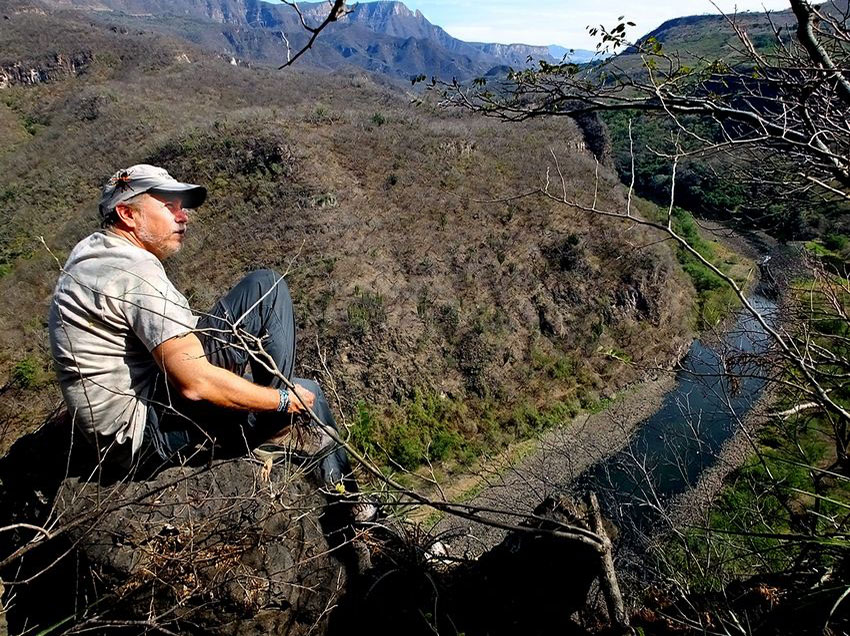
View of the Santiago River from the Tequilizinta lookout point.
“No, this isn’t it,” said Don Guadalupe. “We have two caves here. That’s why they’re called Cuevas Cuatas. The one we want is right above this one,”he said, pointing straight up.
Since this cave was located in a sheer cliff wall, my wife Susy queried how we were supposed to get to another spot above us. Don Guadalupe gestured toward the edge of the precipice: “Just follow me!”
Hugging the wall, this hardy little man began to edge his way right over the long drop down to the Santiago River. The rest of us looked at one another, gulped hard and, with Susy in the lead, cautiously followed our guide, imitating his every move and trying not to look down. After a few meters, the “trail” mercifully switched back and we moved upward to the entrance of La Cueva de Tequilizinta.
The mouth of the cave had been converted into a kind of chapel, complete with altar smothered in candles. Something told me the first prayers said there were probably of thanksgiving for having made it alive. Beyond the altar, the passage disappeared into darkness. Half crawling and “Groucho-walking,” we followed a sort of trail marked by many, many muddy footprints. The passage was about four meters wide and anywhere from a foot to just over a meter high.
We arrived at a fork. “Go to the left, not the right!” warned Don Guadalupe, explaining that the right-hand passage led to a trampa — a trap — devised by the Indians who had used this cavern in ancient times. Naturally, we pressed him for details.
“The last person who went that way stepped onto a rock that operates on a swivel. As soon as he put his weight on one end of it, the rock flipped over and that man slid down a chute that shot him out of the cliff wall. They found his body down by the riverside.”
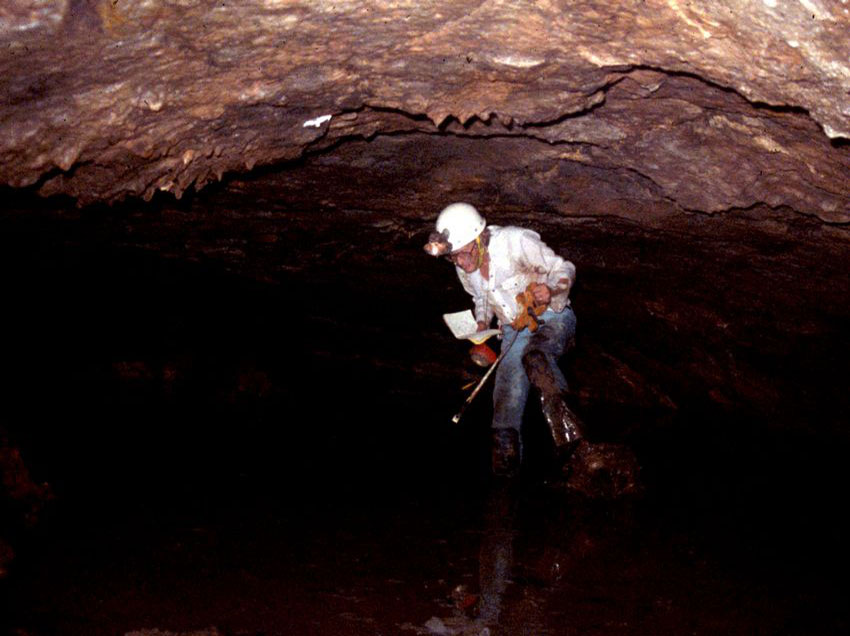
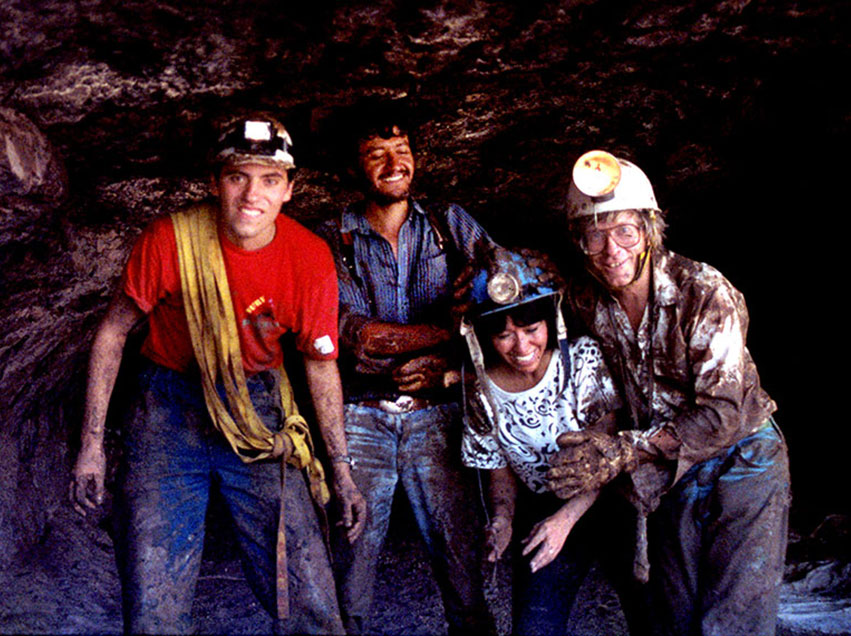
Members of the Zotz Caving Club enjoy the mud inside the Sticky Room.
Naturally we heeded this warning and followed the left fork to a totally dark room where there was another altar — and plenty of mud.
Several weeks later we were back at Tequilizinta Cave with several friends. This time we had brought survey equipment and a length of nylon webbing to which we planned to tie Jesús, one of our compañeros who had volunteered to go first into the “Deathtrap” passage.
Groucho-walking once again, we made our way further and further from the entrance and daylight to the Y where Don Guadalupe had sternly warned us to keep left.
This time, however, we turned right and after some 30 meters we came — not to a violent death flying through the air, but to the edge of a wide pool of shallow water in which were floating numerous globules of gooey, black, vampire bat droppings. As I happened to be wearing tennis shoes, I was elected the honor of splashing around in this foul-smelling drink to see if the passage continued. It didn’t, but then the question came up: how are we going to survey this little lake?
“Well, John, seeing that you are already standing in it …”
Have you ever tried to survey an underground lake by yourself? Especially a smelly lake with a ceiling so low you can’t stand up straight? I won’t vouch for the measurements I took, but who’s ever going to check them out?
[soliloquy id="116768"]
One unexpected benefit from mapping the “Black Lake” was the discovery of lava stalactites on the roof. Both of Las Cuevas Cuatas, this one and the cave directly beneath it, turned out to be the very first lava tubes ever surveyed in Jalisco.
Having found nary a sign of the infamous death trap, we surveyed our way back to the Y and followed the other passage right into El Pasaje Chicloso, the Sticky Room, where the cave finally came to an end. As we dragged our bodies and bags of gear through the thick mixture of mud and clay — a veritable Paradise for Pigs — our flashlights, compass, tape and boots all slowly turned into indistinguishable globs of mud — and so did we.
On later visits to La Cueva de las Cuatas, we explored the top of Tequilizinta Mountain, where we discovered the long abandoned homes of the religious community that had once held ceremonies inside the cave and who, according to Don Guadalupe, “left Tequilizinta to follow a new Messiah, all of them except me.”
The hike to Tequilizinta is described in Outdoors in Western Mexico and you can find the driving and hiking route on Wikiloc. If you go for a visit, be sure to walk to the edge of the precipice, located only 25 meters east of the last house in the ghost town, for a spectacular view of the Santiago River, and just in case the world comes to an end while you’re up there, rejoice: you couldn’t be in a better place!
The writer has lived near Guadalajara, Jalisco, for more than 30 years and is the author of A Guide to West Mexico’s Guachimontones and Surrounding Area and co-author of Outdoors in Western Mexico. More of his writing can be found on his website.
Mexican health workers are more likely to die from Covid-19 than their counterparts in countries such as the United States, China, Peru and Brazil, data shows.
In a new report, the non-governmental organization Signos Vitales (Vital Signs) said that 2.6% of all Covid-19 fatalities in Mexico between May 22 and June 9 were medical personnel.
The figure is more than six times higher than the United Kingdom’s rate of 0.4% and more than five times higher than China’s rate of 0.5%.
The deaths of health workers in the United States from Covid-19 account for 0.54% of all fatalities from the disease in that country, Signos Vitales said, while the rates in Peru and Brazil are 0.86% and 1.22%, respectively.
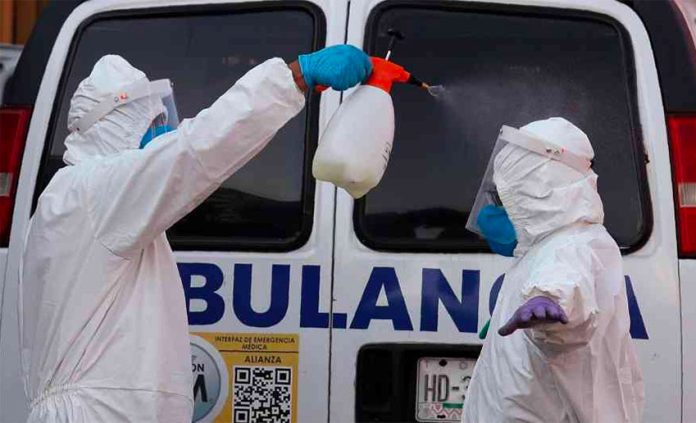
The report said that health workers in Mexico have had greater exposure to the coronavirus than those in other countries due to a lack of personal protective equipment (PPE) and training in the treatment of infectious diseases.
Signos Vitales also said that 71.3% of 1,915 health workers it surveyed were afraid of dying from Covid-19. Just under three-quarters rated the government poorly for its response to the pandemic.
The NGO also reported that 32,388 of 154,863 people confirmed to have been infected with the coronavirus to June 16 were health workers. In other words, two or every 10 infections detected were among medical personnel.
Speaking at the presentation of the report on Thursday, former federal health minister and Signos Vitales member Salomón Chertorivski said the government was too late in providing sufficient PPE to health workers, increasing their risk of contracting the coronavirus.
“It took a long time to arrive even though we had 2 1/2 months to prepare and learn what other countries did. … The first equipment … [came from] private donations,” he said.
The Signos Vitales report also apportioned blame to the government for the high rates of coronavirus infections and deaths among health workers.
“The first victims of the tardy and inefficient response of the authorities were health personnel,” the report said.
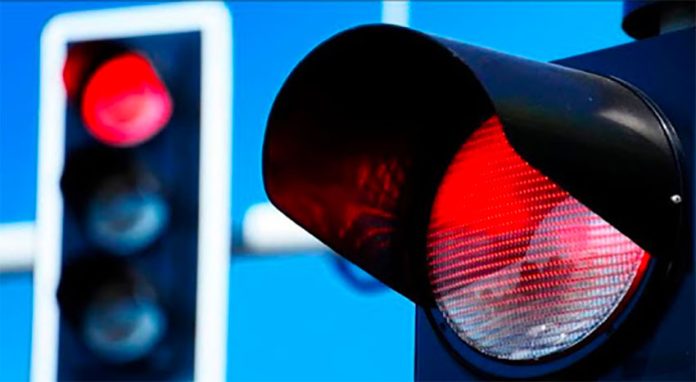
The light is about to turn red in southern Quintana Roo.
Authorities in Quintana Roo announced that “red light” coronavirus restrictions will apply in the southern half of the state next week due to an increase in case numbers and high occupancy levels in hospitals.
Restrictions will tighten in the municipalities of Felipe Carillo Puerto, José María Morelos, Bacalar and Othón P. Blanco, where the state capital Chetumal is located.
Hotels, restaurants and theme parks in the four municipalities are among the businesses that will only be permitted to operate at 15% capacity. Offices will be permitted to open with 25% of their regular workforce while the “red light” restrictions remain in place but bars, nightclubs, cinemas and theaters must close.
Quintana Roo Governor Carlos Joaquín said that the reimplementation of stricter restrictions in the state’s south was necessary because of the high number of cases and limited health infrastructure.
The Caribbean coast state was allocated an “orange light” on the federal government’s current “stoplight” map, used to indicate the risk of coronavirus infection, but Quintana Roo authorities issue their own risk assessment every Thursday.
While the south of the state will move back into the red next week, the north, which includes the popular tourist destinations of Cancún, Playa del Carmen and Tulum, will remain on “orange light” restrictions between July 13 and 19.
Hotel occupancy rates in the tourism-dependent state are still very low but Quintana Roo Tourism Minister Marisol Vanegas said Thursday that it’s predicted they will increase to 60% in the final month of the year.
“It’s already being estimated that we’ll have occupancy of about 60% or perhaps a little higher in December,” she said. “This means that we’ll have jobs for a lot of people in the state.”
Study indicates the capital's pollution is costly in terms of lives and the economy.
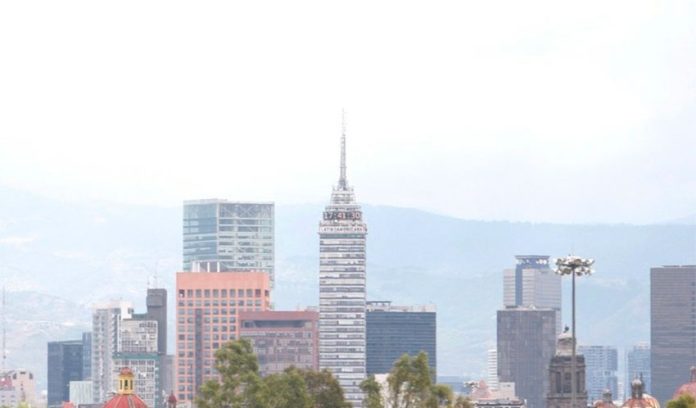
Air pollution in Mexico City is costly, according to a new tool.
It has been linked to about 11,000 premature deaths so far this year while its economic cost is estimated to have been US $5.5 billion in the first six months of 2020.
The findings are the result of a tool that measures real-time air quality, developed by the Southeast Asian office of Greenpeace and IQAir AirVisual.
Currently, Mexico City ranks No. 18 on the live air-quality chart of the world’s most polluted cities.
“The figures show that work to improve air quality in the city must be strengthened to reduce emissions in the industrial and transport sectors through greater public investment and stricter regulations,” said Carlos Samayoa of Greenpeace Mexico.
One way forward, says Avinash Chanchal, a climate activist at Greenpeace India, is a firm commitment to green energy sources. “Instead of lengthening the life of the fossil fuel industry, we should invest in renewable energy sources such as wind and solar,” Chanchal said.
In a statement, Greenpeace noted that there is strong evidence that long-term exposure to air pollution increases the risk of serious infections and death from Covid-19. Chronic exposure to air pollution is also associated with ailments such as hypertension, diabetes, cardiovascular diseases and chronic lung diseases.
Thus far in 2020, Greenpeace researchers say that air pollution has caused the loss of an estimated 98,000 lives in the world’s five largest cities, which includes Mexico City, with a combined economic toll of US $56.5 billion.