Home Blog Page 1524

Have we reached the peak yet? Coronavirus predictions sow confusion

0
López-Gatell
López-Gatell: 'He knows how to put on a show.'

“The peak of the pandemic is now a mountain range,” a Mexican Twitter user said last week referring to the federal government’s changing predictions about when the coronavirus outbreak will reach its highest point.

“The peak of infections will be next week – it doesn’t matter when you read this,” read a meme featuring a photograph of coronavirus czar Hugo López-Gatell sporting a beaming grin.

Since early May, López-Gatell, deputy minister for health promotion, has been saying that the peak coronavirus infection period is imminent, although he has stressed that Mexico is not going through one sole pandemic but rather numerous local epidemics as a result of its large geographical size.

As a result, there is not a single national epidemic curve but rather a series of curves for Mexico’s numerous cities and states. New infections are on the rise in some and decreasing or stabilizing in others.

Therefore, different predictions for when different cities will hit the peak of their local epidemics are perfectly valid, although López-Gatell said last week that if the epidemic curves of all 32 states come together as if they are one, the greatest transmission of the coronavirus will occur in the first two weeks of July.

As the aforementioned Twitter post and meme indicate, López-Gatell and the government more broadly have confused much of the Mexican public with the predictions they have publicly presented about when the pandemic will peak. They have indicated on different occasions that Mexico as a whole is on the cusp of the peak infection period even though the pandemic is not behaving uniformly across the country.

In addition to announcing varying predictions about when the contagion peak will occur, López-Gatell has claimed on several occasions that Mexico’s case numbers are stabilizing even as the government’s own data shows that they are trending upwards.

On May 5, he said “the epidemic is slowing down” and “we’ve flattened the curve,” an assertion that was promptly challenged by a National Autonomous University (UNAM) epidemiologist.

López-Gatell made a new “curve-flattening” claim at the Health Ministry’s nightly coronavirus press briefing on May 25 even though case numbers had continued to show steady growth.

The deputy minister has clarified that his assertions refer to a flattening of the curve in comparison with what would have hypothetically occurred had Mexico not implemented coronavirus mitigation measures such as the suspension of nonessential economic activities and the national social distancing initiative. The government’s actions have reduced new cases by as much as 75%, he has said.

However, “a flattening of the curve” in comparison with what might have happened is not how the term is commonly used.
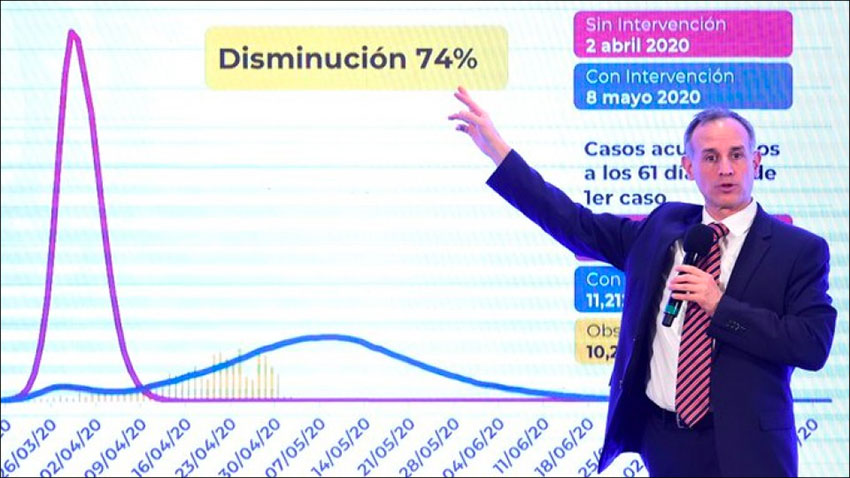
This flattened curve is based on the government's estimate of what might have happened without implementing measures to control the virus's spread.
This flattened curve is based on the government’s estimate of what might have happened without implementing measures to control the virus’s spread. It’s not how the term is commonly used.

While there is no way of knowing for certain just how effective Mexico’s mostly non-enforceable coronavirus mitigations have been in reducing new infections, hard data shows that case numbers have more than doubled since López-Gatell’s May 25 “curve-flattening” claim.

On that date, the Health Ministry reported that Mexico’s case tally had increased to 71,105. Last night it said that confirmed cases numbered 159,793, an increase of 125% in just over three weeks. An analysis by the Johns Hopkins University confirms that the epidemic curve has not been flattened in Mexico.

But while data shows that Mexico’s coronavirus outbreak has grown quickly in recent weeks, the real size of the pandemic here is undoubtedly much larger because testing rates remain low.

Sebastian Garrido, coordinator of the data science unit at CIDE, a Mexico City university, told the news agency Bloomberg that no one actually knows where Mexico is currently placed on the epidemic curve.

Mexico has made scant efforts to test widely for Covid-19, focusing almost exclusively on people with coronavirus-like symptoms. As a result the percentage of tests that come back positive in Mexico is much higher than in countries that test more widely.

Earlier in the coronavirus crisis, the Health Ministry provided estimates about the real size of the pandemic based on data about possible and confirmed coronavirus cases collected at 375 medical monitoring stations.

López-Gatell said in April that there were likely about eight undetected cases for each confirmed one, according to the data collected by  the sentinel surveillance system. If the same estimate applied today, around 1.3 million people in Mexico would have had Covid-19 since the start of the pandemic.

However, the government has not provided any sentinel system updates since April and López-Gatell said in May that it was no longer the principal means of measuring the pandemic because it was no longer practical, given the higher rapidity with which new cases were occurring.

The deputy minister continues to acknowledge that the size of the pandemic is much bigger than official data indicates but no longer presents extrapolated data that undoubtedly has the potential to alarm the population.

Instead, as Bloomberg notes, López-Gatell has sought to diffuse public panic by using his “nice-guy demeanor” and “knack for breaking down complex ideas into easily understandable bits” during his nightly press briefings.

Those attributes have helped him to become the most popular federal official, according to polls, but critics argue that they have also allowed him to conceal the true magnitude of the coronavirus problem, which in turn has made the outbreak worse and placed more lives at risk.

“He knows how to communicate and he knows how to put on a show,” Laurie Ann Ximenez-Fyvie, head of a molecular genetics laboratory at the National Autonomous University, told Bloomberg.
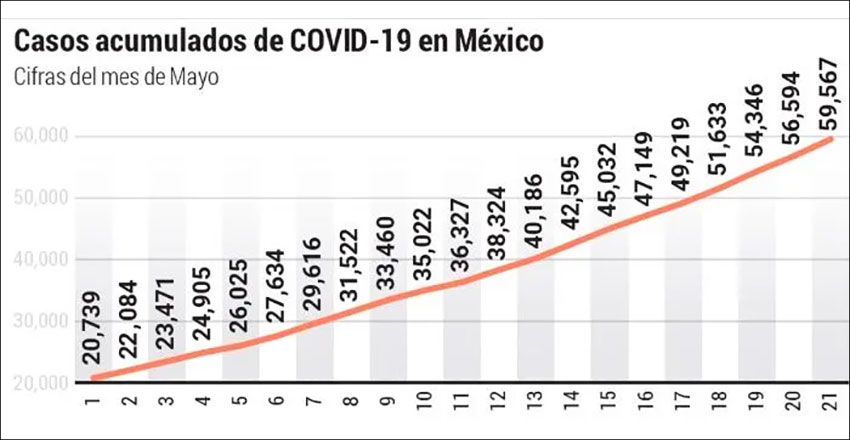
May's case numbers: not much sign of flattening here.
May’s case numbers: not much sign of flattening here.

“He has his talking points and he uses them to convince people that this is under control,” she said.

Just as the real number of Covid-19 cases in Mexico is unknown, so too is the number of deaths from the disease.

While accurately counting coronavirus fatalities is undoubtedly much easier than accurately counting cases, there is compelling evidence that the former are being drastically underreported in Mexico City, the country’s coronavirus epicenter.

An analysis by the independent organization Mexicans Against Corruption and Impunity of death certificates issued in the capital between mid-March and mid-May suggests that four times more people died from Covid-19 in the period than the number officially reported.

Several media reports have also claimed that Covid-19 deaths in Mexico City are much higher than the numbers disclosed by authorities.

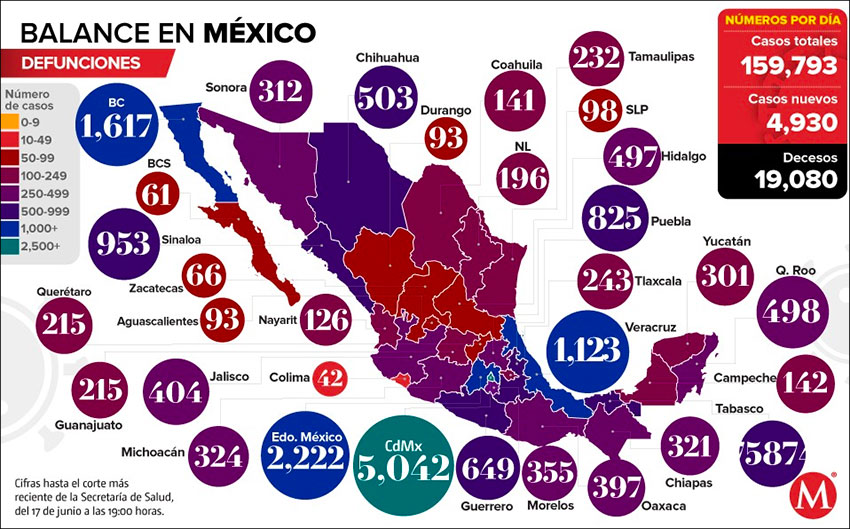
As of Wednesday, Mexico City had officially recorded 5,042 coronavirus-related deaths but Nexos Datos, a data analysis organization, found that 17,310 more death certificates were issued in the capital between March 30 and June 7 compared to the  average for the same period over the past four years.

Researchers said it is unlikely that all of the excess deaths could be attributed to Covid-19, explaining that some were likely the result of people not seeking timely medical attention. However, the 124% surge in deaths in Mexico City almost certainly means that Covid-19 fatalities are being significantly underreported.

Alejandro Macías, the federal government’s czar during the swine flu pandemic in 2009, charged that the federal government is not deliberately underreporting deaths, telling Bloomberg: “They’re not doing it on purpose; they’re not hiding bodies somewhere. It’s just that they haven’t figured out how to do it properly. The systems weren’t ready for this.”

Garrido, the CIDE data scientist, noted that there is a delay in reporting deaths, a point that López-Gatell emphasized after more than 1,000 deaths were reported on June 3.

He said that the lag is likely caused by outdated systems – all the data the federal Health Ministry reports comes from the authorities in the 32 states – as well as legal and medical requirements to certify deaths.

If a suspected Covid-19 patient dies before he or she is tested, and is not tested subsequently, a committee of medical specialists analyzes the case and makes a decision about whether the fatality should be attributed to the disease and added to Mexico’s official coronavirus death toll.

Some Covid-19 fatalities have not shown up in the official death toll for days, weeks or even months after they occurred.

Mexico currently has the seventh highest death toll in the world with fatality No. 20,000 likely to be recorded this week.

The most recent estimate from López-Gatell was that the death toll could reach 35,000, or as many as 60,000 in a worst case scenario, a significant increase from the prediction of 6,000 fatalities he offered in early May.

The Institute for Health Metrics and Evaluation at the University of Washington in Seattle is currently estimating almost 52,000 deaths by August 4.

But despite the alarming predictions, rising case numbers, spiraling death toll and a warning from the World Health Organization last week that Mexico is going through “one of the most complex and dangerous moments of the epidemic,” the economy is beginning to reopen and more and more people are returning to their regular everyday activities.

In central Mexico City, where the streets are gradually returning to their old chaotic self, many residents are taking precautions to protect themselves from the possibility of coronavirus infection by practicing appropriate social distancing and wearing face masks but others appear oblivious to the risk – hugging, shaking hands, high-fiving, fist-bumping and getting up close and personal with friends and strangers alike.

More coronavirus peaks are undoubtedly still to come.

Mexico News Daily
Michoacán adds 140 new patrol vehicles to its police fleet

0
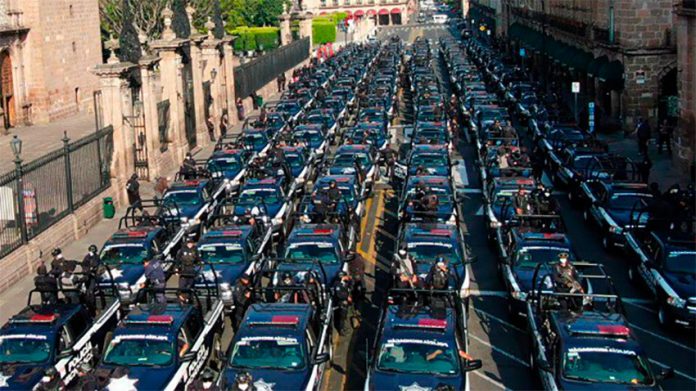
Michoacán's new police vehicles on parade.

The state of Michoacán announced it is adding 140 patrol vehicles to the police fleet, bringing the total number of new patrol cars purchased during the tenure of Governor Silvano Aureoles to 1,049.

The delivery of the new vehicles is part of Aureoles’ plan to strengthen public safety in a state where drug cartels are fighting for control of drug trafficking routes.

The patrol units will be distributed in Lázaro Cárdenas, Apatzingán, Coalcomán, Jiquilpan, Uruapan, Zamora, La Piedad, Huetamo, Zitácuaro and Morelia.

“The challenge we have is to make this institution the best police force in Mexico, with more and better officers, with more infrastructure and equipment, with better wages and benefits, and with more intelligence work to achieve together the Michoacán that we want,” said Aureoles.

In addition to the new vehicles, Aureoles has installed 6,000 security cameras, opened eight new police barracks and built a 31,000-square-meter command center, the largest such building in Latin America, the governor said.

In recent years, the state has also allocated resources to the professionalization of police forces, and Michoacán now has 6,250 trained officers, 5,050 more than it had at the beginning of the Aureoles administration in 2015.

Hours after the press conference announcing the purchase, Zamora’s police chief and another officer were ambushed and killed on the Mexico City-Guadalajara highway.

Source: El Universal (sp), La Voz de Michoacán (sp), La Jornada (sp)

Coronavirus cancels firefly viewing season in Tlaxcala

0
Fireflies at the sanctuary in Tlaxcala.

Tlaxcala’s Ministry of Tourism has announced that the 2020 firefly viewing season has been canceled due to concerns over the coronavirus. 

Last year some 127,000 tourists flocked to the firefly sanctuary in Nanacamilpa de Mariano Arista, located around 80 kilometers east of Mexico City, to view the millions of luminescent insects that put on a dazzling display of lights at dusk from June through August. 

The cancellation of the season means a potential loss of some 48 million pesos (US $2.13 million) to local tour operators and tourism-related businesses that have sprung up since the first firefly tours were offered in 2011.

Tourism Minister Anabel Alvarado Varela explained that the decision, made in consultation with representatives of the tourism sector, was made out of concern for the health of residents and visitors and also because antibacterial gel and other sanitizing products are harmful to the delicate insects.

Alvarado added that the break will help the sanctuary come back even stronger next year by allowing the species to reproduce unhindered by the distraction of visitors. 

Some 150 police, Civil Protection agents, National Guardsmen and other law enforcement officials will be deployed to patrol firefly habitats and ensure tourists don’t venture out on their own or congregate in groups that put their health at risk. 

The 200-hectare firefly sanctuary will also use the time to make improvements to the habitat. Also, certified guides plan to provide virtual tours and a digital platform will be developed to provide scientific information about the life cycle of the firefly and the benefits the species and the ecosystem will enjoy during this break. 

The virtual marketing of fireflies is part of a larger campaign by the Ministry of Tourism called “Enjoy Tlaxcala from Home,” which promotes tourist attractions, culture, history, gastronomy and art in the state through videos and photos posted to social media.  

As of June 17, Tlaxcala had 1,849 confirmed cases of the coronavirus and had seen 243 deaths.

Source: 24 Horas Puebla (sp) 

As with most crimes, aggression against health workers goes unpunished

0
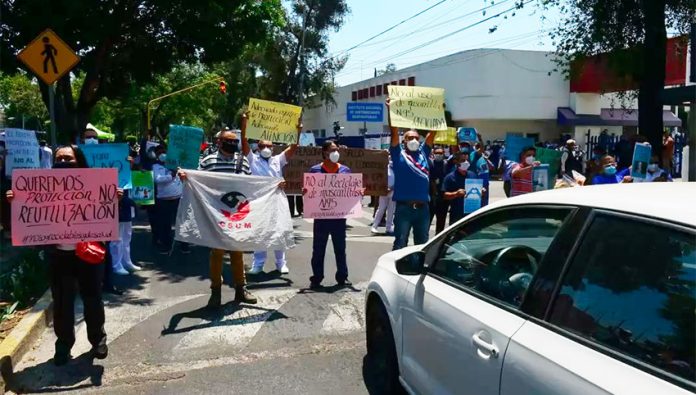
Medical workers in Mexico City protest aggression.

Federal lawmakers claim that 94% of attacks on doctors, nurses and other medical personnel in Mexico go unpunished and are calling for authorities to take the assaults seriously.

Federal human rights officials say there have been 52 reported cases of assault on medical staff in 22 states.

Yet members of the Permanent Commission of Congress, which sits when Congress is in recess, say that only three people have been arrested in those cases. 

They noted that the Mexican Social Security Institute (IMSS) alone has registered 21 attacks on nursing personnel in 12 states.

Nurses and women are the most frequent targets, the commission says, noting that 80% of attacks have been committed against nursing personnel, of which 70% were women. Seven such attacks have occurred in Jalisco alone. 

“The form of the attacks is varied: they spray [bleach], deny them access to public transportation or commercial establishments, and even make death threats with firearms,” ​​members of the commission said.

There have also been threats made to hospitals themselves dating as far back as April, when residents of the town of Axochiapan, Morelos, threatened to burn down their local hospital if it accepted patients infected with the coronavirus.

In Nuevo León, an unidentified person poured a flammable liquid on the doors of a new hospital in Sabinas Hidalgo while in Villa de las Rosas, Chiapas, people armed with sticks and stones vandalized a hospital and burned an ambulance as medical staff ran and hid from the enraged mob.

In Las Margaritas, Chiapas, townspeople beat a doctor whom they accused of not having cared for a patient who died of the coronavirus. 

Hospitals in Tecamachalco, Puebla, and the sate of México have also been damaged.

In April, not long after the assaults began to increase in frequency, the office of the United Nations in Mexico decried attacks against health personnel and highlighted the importance of their work.

Violent assaults on medical personnel and hospital infrastructure have triggered the deployment of police and nearly 2,000 members of the National Guard to guard 176 IMSS hospitals across Mexico. Some 232 soldiers have been dispatched to protect eight other hospitals and 38 warehouses where medical supplies are stored.

Source: El Financiero (sp), La Silla Rota (sp), El Dínamo (sp)

Mexico among 15 countries that have not flattened the Covid curve

0
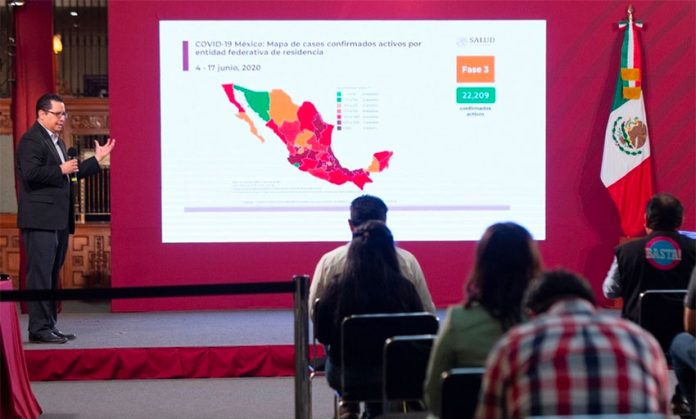
Epidemiology chief José Luis Alomía presents the latest coronavirus information on Wednesday night.

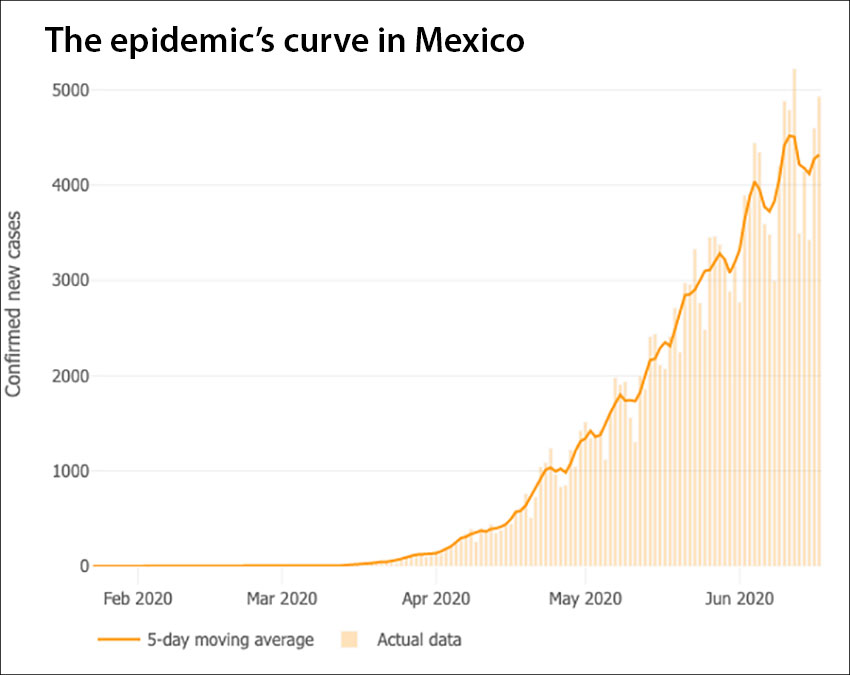
Among the 20 countries currently most affected by Covid-19, Mexico is one of 15 that has not had success in flattening the epidemic curve, according to an analysis by Johns Hopkins University.

The university’s analysis shows that daily confirmed case numbers are trending upwards in Mexico, Brazil, the United States, India, Peru, Chile, Pakistan, Egypt, South Africa, Colombia, Iraq, Indonesia, Bangladesh, Ecuador and Saudi Arabia.

In contrast, daily case numbers are decreasing in Russia, the United Kingdom, Iran, Italy and Canada.

Since the beginning of the pandemic in Mexico, the Health Ministry has reported a total of 159,793 and 19,080 deaths. More than 4,000 new cases have been reported on six of the past 10 days and more than 5,000 cases were reported on one.

Both Deputy Health Minister Hugo López-Gatell, the government’s coronavirus point man, and President López Obrador have asserted that the epidemic curve has flattened in Mexico.

The number of new cases confirmed daily.
The number of new cases confirmed daily. The five-day moving average is shown in dark orange. johns hopkins university

However, the former has explained that the assertion refers to a flattening of the curve in comparison with what would have hypothetically occurred had Mexico not implemented coronavirus mitigation measures such as the suspension of nonessential economic activities and the national social distancing initiative.

At the Health Ministry’s coronavirus press briefing on Wednesday night, López-Gatell presented the epidemic curves for several cities across the country.

He said the number of new cases reported daily has peaked in the Mexico City metropolitan area – the country’s coronavirus epicenter – but stressed that the epidemic is still very much active.

“The epidemic has not ended and those of us who live in the Valley of México, we’re 23% of the Mexican population, [need to] know that we still have significant epidemic activity,” López- Gatell said.

He said that about 4,60o coronavirus patients are currently hospitalized in the Mexico City metropolitan area, a figure that has remained steady for more than three weeks.

In Baja California, which has recorded the fourth highest number of cases among Mexico’s 32 states and the third highest Covid-19 death toll, new infections are declining in Tijuana, López-Gatell said, while state capital Mexicali is in a period of “intense transmission” due to a new outbreak.

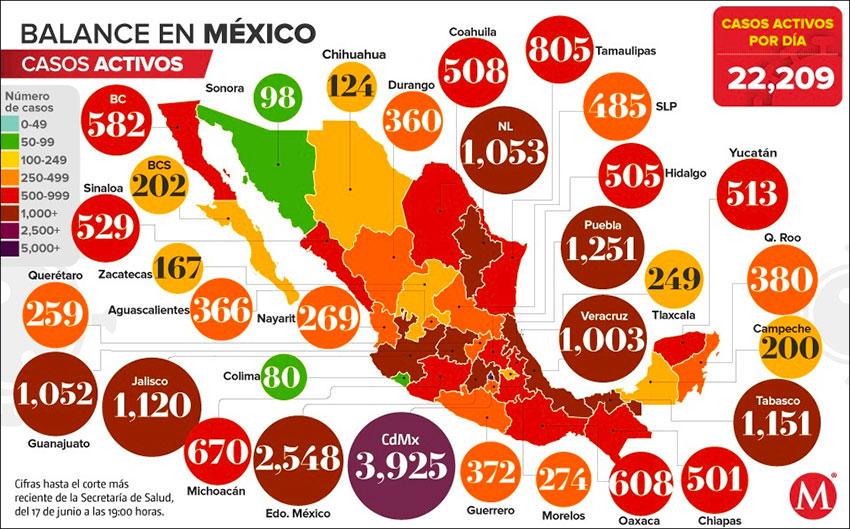
Active cases as of Wednesday evening.
Active cases as of Wednesday evening. milenio

The deputy minister said the epidemic curve in Cancún, Quintana Roo, where hotels reopened last week after being closed for more than two months, is trending downward and that new hospitalizations of Covid-19 patients are also declining, albeit slowly.

The pandemic has lasted longer than predicted in Culiacán, Sinaloa, while case numbers in Veracruz city reached higher levels than expected but are now on the wane, López-Gatell said.

Case numbers in Acapulco, Guerrero, also exceeded expectations but the epidemic curve is now showing signs of flattening, he said, adding that hospitals in the resort city remain under significant pressure.

The coronavirus epidemics in Guadalajara, Jalisco, and Monterrey, Nuevo León, are in a clear ascent phase, López-Gatell said, while new infections are declining in Oaxaca city.

Earlier in the press briefing, Director of Epidemiology José Luis Alomía reported 4,930 additional Covid-19 cases – the second highest number reported on a single day – and 770 deaths.

Of the almost 160,000 cases confirmed since the start of the pandemic, 22,209 – 14% of the total – are currently active. Alomía said that the results of more than 59,000 Covid-19 tests are not yet known and that more than 441,000 people have been tested.

Covid-19 deaths recorded as of Wednesday.
Covid-19 deaths recorded as of Wednesday. milenio

He also said that there are 1,846 suspected Covid-19 fatalities in addition to the 19,080 that have been confirmed.

Mexico City’s official death toll passed 5,000 on Wednesday, although the real number of Covid-19 fatalities in the capital is believed to be much higher. More than a quarter of all coronavirus-related deaths in Mexico occurred in the capital, data shows.

Three states have death tolls above 1,000: México state, with 2,222 fatalities; Baja California, with 1,617; and Veracruz, with 1,123.

At the municipal level, the Mexico City boroughs of Iztapalapa and Gustavo A. Madero rank first and second, respectively, for deaths followed by the Baja California cities of Tijuana and Mexicali.

Source: Reforma (sp), Milenio (sp) 

Expats help feed needy in Baja, Guanajuato and Quintana Roo

0
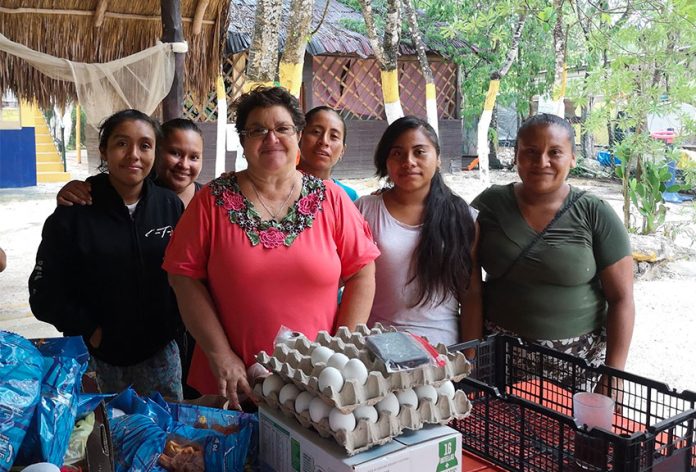
These women have been cooking hot meals for more than 70 days for more than 220 people in Playa del Carmen at a a soup kitchen supported by the Seaside Rotary Club.

Expats who have begun initiatives to assist their communities hit hard by during Covid-19 quarantines often end up forming connections with local Spanish-speaking residents who help them identify neighbors in need.

Expats Jenny and Steve McGee moved to Centenario, a community in La Paz, Baja California Sur, barely two months before shutdowns began. As strict quarantines put thousands of area residents out of work and hungry, the McGees decided to help their neighbors by forming Food for Families.

“Within three weeks, we saw a desperate need here in La Paz and neighboring areas,” said Steve McGee.

New in town, their challenge was finding the people who needed help. Their campaign took off once they began working with the owners of local businesses, Mexican locals who helped the McGees identify and spread the word to over 50 families it now provides with regular care packages. To date, the group has raised US $7,000 and provided over 1,000 such packages, or despensas.

In Cabo San Lucas, the Los Cabos Missions for Christ, founded in 2017 by Brian and Jacqueline Ruple of Ohio, has been steadily addressing residents’ needs since the destructive flooding caused that year by Tropical Storm Lidia. In the face of widespread joblessness caused by the Covid-19 shutdown, they began providing despensas of food and other supplies to about 400–500 families with the help of local pastors.

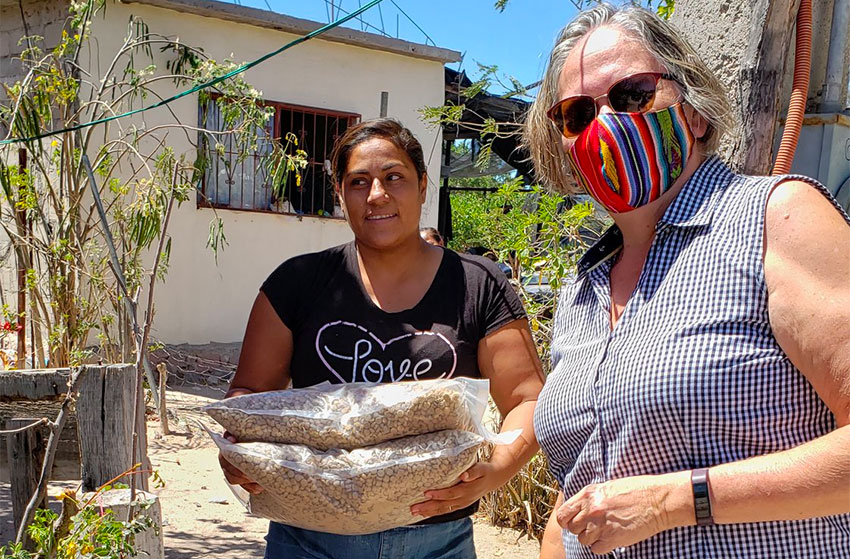
A Food for Families recipient with donated supplies in La Paz, Baja California Sur.

The group has recently shifted gears after learning that many recipients have run out of propane and water with which to cook food and is currently supplying community kitchens like Comedor Shalom in the Caribe neighborhood with buffet-style meals instead.

In March, the Playa del Carmen Seaside Rotary Club began distributing despensas of food, necessities and prepaid grocery cards to over 1,000 families in the area, relying on longstanding connections with school officials, community leaders, and other local charitable organizations formed over years of charitable work in the community.

When it found out about people going hungry in the nearby community of Puerto Aventuras, it identified a local connection and began a community kitchen that is feeding 150 people hot meals four days a week. In a recent video posted on its Facebook page, it cited “community ambassadors” as crucial allies in finding at-risk families and institutions in need.

In San Miguel de Allende’s Guadalupe neighborhood, families and business owners going back generations in the colonia and a newer expat population have formed stronger bonds in the face of Covid-19 shutdowns, thanks to a citizens group, Por Amor a la Guadalupe, that encourages neighbors — both Mexican and expat — to help each other.

Formed two years ago by its president, María Elena Rincón Llamas, the group connected with its expat neighbors last year when Cate Poe, a former community and labor organizer in the U.S., began to bring her neighbors into the group.

The connection has borne fruit during the pandemic, Poe says. Thanks to donations from both Mexican and expat Guadalupe residents, the group is supplying families in need with food bought from neighborhood mom-and-pop businesses whenever possible and providing free masks to residents who need them.

The masks are sewn by colonia seamstresses that the group is paying and are made with fabric donated by residents themselves. 

Mexico News Daily

With no competition, Mexico wins seat on UN Security Council

0

Mexico has won a seat on the United Nations (UN) Security Council, the UN announced on Wednesday.

Mexico was elected unopposed as the representative for Latin America and the Caribbean for the council’s 2021-22 sitting period. It will be the first time that Mexico has had a seat on the 15-member Security Council since the 2009-10 period.

Mask-wearing diplomats representing the UN member countries cast secret ballots at allotted times on Wednesday in the General Assembly hall in New York. A total of 187 member countries supported Mexico’s candidacy to be a non-permanent Security Council member while five nations abstained from the vote.

Even if a country faces no competition for the seat it is contesting, it must still be supported by more than two-thirds of the General Assembly in order to be elected.

Foreign Minister Marcelo Ebrard welcomed Mexico’s election in a post to Twitter.

“I have the honor to report that Mexico has been elected with 187 votes to be a member of the United Nations Security Council. Great recognition for our country in the whole world. Congratulations!!!!”

The UN announced that India, Ireland and Norway had also been elected as non-permanent council members for two-year terms. India was elected unopposed for the Asian seat while the two European nations beat out Canada for the two western seats that were up for grabs.

A second round of voting will be held Thursday to fill the last vacant seat, with Kenya and Djibouti vying to be the Security Council’s newest African representative.

The council, the United Nations’ most powerful body, is charged with upholding international peace and security. It has five permanent members – the United States, Russia, China, the United Kingdom and France – and 10 non-permanent members elected by the UN General Assembly for two-year terms.

A seat at the council table gives countries a strong voice on a range of security issues such as international conflicts, terrorism and the threat of nuclear warfare. The council is the only UN body that can make legally binding decisions such as imposing sanctions on countries and authorizing the use of force.

It will be the fifth time that Mexico has had a seat on the council after serving in 1946, 1980-81, 2001-02 and 2009-10.

Source: El Financiero (sp) 

In April and May, 164 businesses a day shut down by coronavirus

0
One of many stores closed by the coronavirus in the city of Guanajuato.

The coronavirus crisis forced the permanent closure of an average of 164 businesses per day in April and May.

Data from the Mexican Social Security Institute (IMSS) shows that a total of 9,984 formal sector businesses shut down for good in the two-month period – 6,689 in April and 3,295 in May. The combined figure is equivalent to 42% of all new businesses that opened in 2019.

The total number of formal businesses in Mexico at the end of May was 997,767, according to IMSS.

Experts say that the coronavirus-induced economic slowdown and the lack of financial support from the government were the main factors that caused the closure of almost 10,000 businesses in just two months. Mexico shed about 900,000 formal sector jobs in the same period.

Jesús Rubio, a public policy researcher at the College of the Northern Border in Monterrey, said that a lot of businesses, especially small and medium-sized ones, simply didn’t have enough cash flow to meet their fixed expenses and as a result were forced to close.

He predicted that the economic recovery will be slow and that more businesses – restaurants and entertainment venues, in particular – will close due to lower demand for their goods and services.

The government is offering loans of 25,000 pesos (US $1,120) to help businesses weather the coronavirus storm but has acknowledged that many small business owners haven’t even applied because the amount is too small. It has rejected calls for businesses to be allowed to defer their tax obligations until the worst of the economic crisis is over.

Armando Guajardo Torres, president of the Mexican Employers Federation’s labor commission, said that more government support is needed if further business closures and job losses are to be avoided.

He said that it would likely be two years before the total number of formal businesses in Mexico returned to the level seen at the start of 2020.

José Luis de la Cruz Gallegos, general director of the Institute for Industrial Development and Economic Growth, a think tank, said that once IMSS publishes information that indicates the sectors in which the shuttered businesses operated, the government will be able to better target financial support.

But even though the economy is predicted to contract by about 8% this year, President López Obrador has ruled out increasing public debt to support the private sector, stressing that he wants to keep the nation’s finances healthy.

Source: Reforma (sp) 

Growing amaranth is an ancestral tradition that continues in Mexico City pueblo

0
Making alegría in Tulyehualco, a center for the cultivation of amaranth.

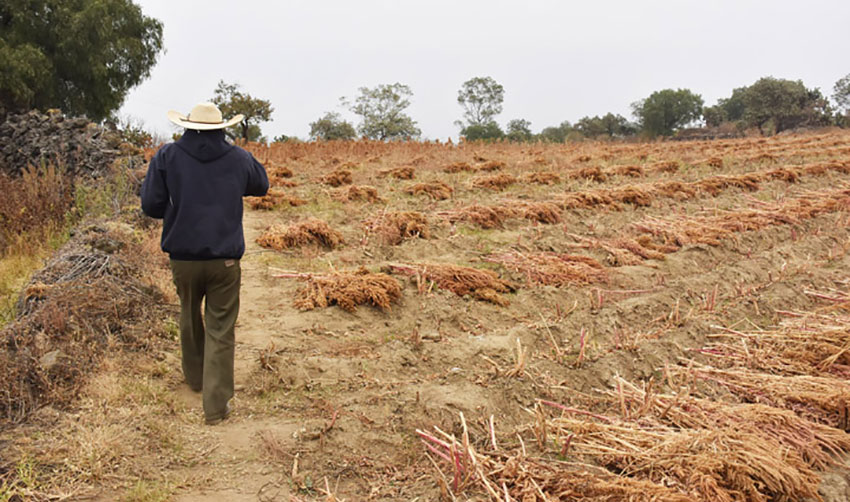
Alejo Ávila Camacho surveyed his field of amaranth plants, now turned a bright red and ready for harvesting.

“Tulyehualco,” he said, “is the place for amaranth.” Its complete name is Santiago Tulyehualco, one of 16 pueblos that make up the borough of Xochimilco, located in the southern part of Mexico City, and it’s known as a center for amaranth cultivation.

Ávila estimates that 200 people in the pueblo grow it. “We have planted here since our ancestors,” he continued. “Every pueblo has its own traditions, customs. Here, it is amaranth.”

Amaranth is one of the few plant species whose leaves and seeds can both be eaten. Its leaves are a good source of beta carotene, proteins and ascorbic acid and are also high in calcium and iron and can be eaten raw, in salads, or cooked. The seeds, which are toasted prior to eating, are high in protein, fiber and antioxidants and are a good source of calcium and a number of other minerals.

This has led to its promotion as a superfood in Mexico, where it has a long history. But that history almost ended after the Spanish Conquest.

Alejo Ávila in his field of amaranth plants.

Mayans first cultivated amaranth, which is actually a group of about 60 species, in the state of Oaxaca between 8,000 and 10,000 years ago and it was a critical part of the indigenous diet, along with corn and beans. In addition to being an important food source, many indigenous cultures in Mesoamerica considered amaranth to be a divine plant and it had a major role in religious ceremonies.

Aztecs used amaranth seeds to create idols representing their gods and, during ceremonies, these idols were eaten. This proved to be a serious problem for the Spanish who found it blasphemous because it was too similar to the Catholic Church’s ritual of communion. And so they prohibited the plant’s cultivation.

Another possible reason for the prohibition was that the idols were red and it was thought that the color came from mixing the seeds with the blood of sacrificial victims, something that would further upset the Spanish.

There are differing opinions about that in Tulyehualco. “Our ancestors, our grandparents, said that the Mexicas used to mix amaranth with blood to make their idols,” said Ávila. “Our ancestors saw this.”

But Camilo Morales Granadas, one of the owners of Sabor de Amaranto in Tulyehualco, doesn’t agree. “Mexicas mixed amaranth with a red tuna (the fruit of the nopal cactus) that produces a very intense red. We know this because we in the pueblo have this knowledge.”

There’s no definitive proof either way.

Amaranth plants ready to harvest.

The Spanish may have also banned amaranth because of its important role in indigenous diets and because it was eaten by Aztec warriors before battle. Depriving people of it could weaken a population. Whatever the reason, fields of amaranth were burned, its cultivation was banned and anyone caught growing it risked having their hands chopped off or losing their life.

Amaranth survived because it was grown clandestinely in parts of what had been the Aztec empire and by the Mayans in the mountains of Oaxaca. Tulyehualco’s residents have benefited from its survival.

Amaranth is harvested in late December in Tulyehualco and during that time, Ávila’s days start in the early morning. “It must be cut when it is not so hot,” he said. “When it is hot, the seeds will fall out when you cut.” He uses a small sickle to cut the stalks using a quick upward motion, then places them in small piles on the ground where they’ll dry in a week or so. The dried stalks are shaken over a canvas to release the seeds, which are then toasted and made into a variety of products.

The Féria de Amaranto — the Amaranth Fair — has been held in Tulyehualco since 1971 but was canceled this year because of the pandemic; with luck, it should return next year. The fair’s a great place to sample all the different ways amaranth is used, and although that wasn’t possible this year, stores are still open and offering a wide selection of products.

Diana Concepción Bravo has been selling amaranth products for 45 years. “Alegría is probably the most popular item,” she said. “It has nuts, amaranth, cranberries, fruit and honey. Also, obleas, and atunero, which a small, round cookie.” The store is also stocked with several varieties of churritos, tasty amaranth sticks flavored with lime, chile, cheese or nopal.

While most people know about the sweets and snacks made from amaranth, there are also healthier options. “We want people to consume amaranth as a food, as they did before, not just as a sweet,” said Morales Granadas. “We want to use it in part to return to our roots, our culture.”

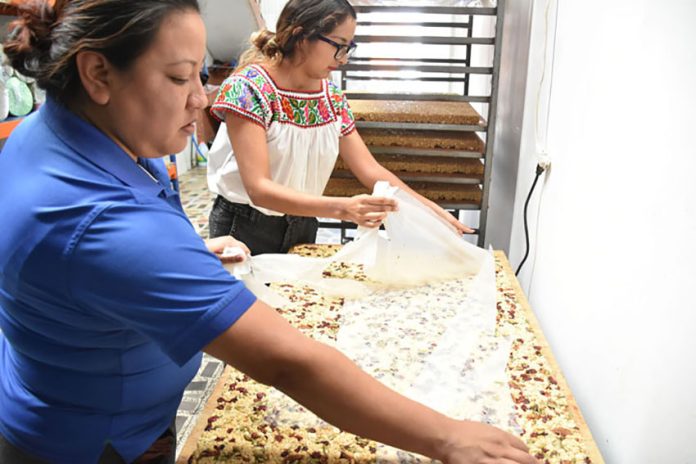
A woman makes amaranth wafers called obleas.

His business sells amaranth powder (used to make a protein drink), pancake mix, amaranth bars and granolas. It’s even possible to buy hamburgers made from amaranth.

And now there’s another popular way to consume amaranth: beer.

“Amaranth beer is very new. It is an artisanal beer,” said Carlos Arzuvida, the manager of Domingo Santo restaurant, located just off Mexico City’s zócalo. “It’s completely different from other beers. Most beers are heavy; this is light with a dry, sweet and creamy taste.”

His restaurant sells a beer simply called “Amaranto” made by Cervecería Aztlán while Sabor de Amaranto in Tulyehualco sells an amaranth IPA and a brown ale.

Downing a few of these tasty brews often makes a person feel like belting out Cielito Lindo, a popular song written by Quirino Mendoza y Cortés, a native of Tulyehualco.

Joseph Sorrentino is a frequent contributor to Mexico News Daily and lives in San Gregorio, Xochimilco.

Ending confinement could cause health system’s collapse: doctor

0
Mexico City residents are getting out more after two months of confinement.

President López Obrador’s call for people to come out of home confinement despite the ongoing coronavirus pandemic could cause Mexico’s health system to collapse, says the president of the National Federation of Medical Schools.

In an interview with the newspaper El Financiero, Dr. Belinda Cázares Gómez said the president’s remarks are a reflection of his desire to reactivate the economy as quickly as possible.

Noting that a lot of people are in “very precarious” financial situations, Cázares acknowledged that reopening the economy is important but warned that it could cause coronavirus infections to spike.

“We don’t even know if we’ve reached the peak [of the pandemic] yet,” she said.

“Unfortunately, the risk of relaxing … the confinement is that there will be a lot more infections. Hopefully it won’t happen but the risk is clear and the future looks very ominous because the health system could collapse even though they’ve opened some hospitals that had been abandoned,” Cázares said.

The doctor said the coronavirus pandemic in Mexico has exposed the poor condition of the health system, which she blamed on years of neglect.

“We can’t blame this government, the health system wasn’t created a year and a half ago,” Cázares said.

National data presented by the Health Ministry on Tuesday night showed that 46% of general care beds set aside for patients with serious coronavirus symptoms are currently occupied, while 39% of those with ventilators are in use.

However, the occupancy levels are considerably higher in states with large coronavirus outbreaks.

Just under three-quarters of general care beds are currently occupied in hospitals in Mexico City and México state, while more than 60% of those with ventilators are in use in those two entities as well as Baja California.

Mexico has recorded almost 155,000 confirmed cases of Covid-19 since the start of the pandemic despite low testing rates, while more than 18,000 people have lost their lives to the disease.

Source: El Financiero (sp)