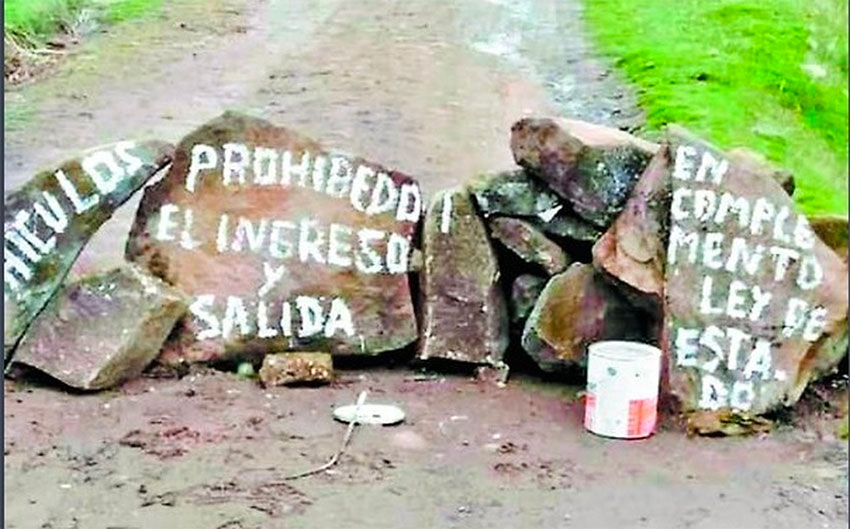
More than 220 small towns and municipalities across 10 states in Mexico have shut their borders to outsiders due to fear of the spread of the coronavirus.
While trucks bringing supplies and some service providers are allowed past the often barricaded checkpoints, any other visitor is decidedly persona non grata.
In Baja California Sur, Oaxaca, Guerrero, Morelos, San Luis Potosí, Veracruz, México state, Sinaloa, Michoacán and Quintana Roo access to certain communities has been severely limited.
In Tlaxiaco, Oaxaca, residents who travel outside the community have to present a medical certificate that guarantees they are virus-free before they can return home.
One hundred communities in the state have locked down their borders, according to state ombudsman Bernardo Rodríguez Alamilla. Fifteen regional bus lines in Oaxaca have halted service as a result.
Access prohibited, reads the message on a pile of rocks.
In addition to these restrictions, in at least 70 municipalities a curfew has been imposed to keep people off the streets after dark. In Zimatlán de Álvarez, Oaxaca, a woman who left her home to sell ice cream was jailed and fined by local police.
Some communities have banned entry for migrants returning to their home cities after working in the United States, and anyone who has visited Mexico City.
In Tecolutla, a resort town on the Gulf of Mexico in Veracruz, the local government issued a statement warning that “for security reasons and to ensure the health of all, people and tourists are informed that vehicles and foreigners may not enter this municipality as part of coronavirus preventative measures. We appreciate your understanding and support, please postpone your trip, we will be waiting for you another time.”
In Guerrero, 166 communities in 68 municipalities have closed access.
San Luis Potosí has six municipalities with security checkpoints to keep out non-residents.
Small towns in Baja California Sur are also not allowing visitors in, including San Juanico, San Javier, Miraflores, Cabo Pulmo and Mulegé.
Residents of Todos Santos took it upon themselves to close both northern and southern access roads into their town, blocking the roads with vehicles, piles of dirt and hazard tape. Food and other supplies are still welcome in this Pueblo Mágico, or Magical Town. Visitors are clearly not.
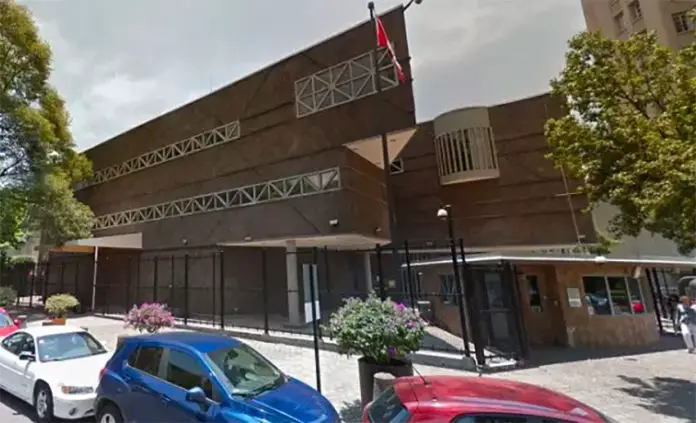
The Canadian embassy in Mexico City advises citizens to head home.
The Canadian Embassy has made a call for its citizens to return home as soon as possible in order to avoid the most virulent stages of the Covid-19 outbreak in Mexico.
“Canadian travelers in Mexico: there is a strong possibility that [Mexico] will soon enter phase three of the [Covid-19] pandemic,” the embassy tweeted on Friday morning along with an infographic titled “Go home!”
The embassy is unsure how the intensification of the outbreak will affect international travel and listed possible outcomes that may affect Canadian citizens’ ability to return home during phase three.
“We strongly recommend that you consider commercial options to return to Canada now while they are still available,” the embassy said.
Flights to Canada currently scheduled for May or June could end up being canceled and airlines may decide to restrict their international service even further.
Aeroméxico and Interjet have both cut back service to their international destinations in response to the global pandemic.
“If you choose to remain in Mexico, you may be required to shelter in place for an indeterminate period,” the infographic reads.
Those who do decide to stay could experience difficulty obtaining essential products and services and/or face harsh restrictions on movement. They also might find that their insurance may not cover their travel or medical expenses, should such services be needed.
Furthermore, the embassy is functioning at limited capacity, making it more difficult to provide consular services during the crisis.
The embassy asked Canadian citizens in Mexico to register with the Canadians Abroad service in order receive important updates during the pandemic.
The U.S. ambassador made a similar call to citizens in late March, saying that they should “think long and hard” about whether they want to be in Mexico during the most severe stage of the outbreak.
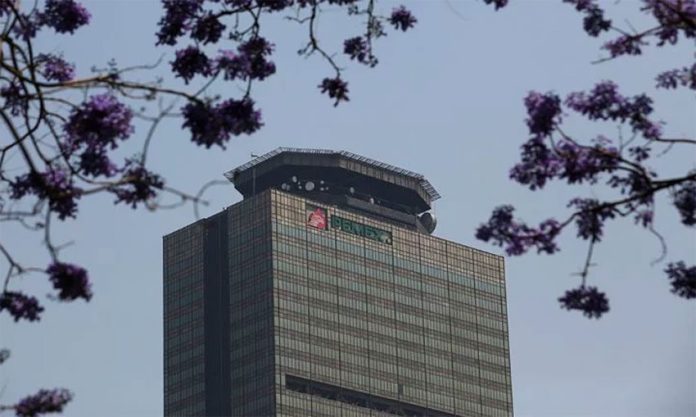
Mexico’s state oil company has become the world’s largest “fallen angel,” a borrower whose credit rating is downgraded from investment to junk.
After Fitch Ratings downgraded the company to junk status on Friday, Moody’s Investors Service did the same soon after, lowering the company’s rating from Ba2 to Baa3.
The downgrades, not unexpected, will likely trigger the sell-off of billions of dollars in bonds by investors mandated to hold assets of investment quality.
“It’s likely that next week we will see strong outflows from Pemex bonds,” said Luis Gonzali, a portfolio manager at asset manager Franklin Templeton.
Moody’s said the government’s responses had been “insufficient to effectively address both the country’s economic challenges and Pemex’s continued financial and operating problems” and cited decisions by President López Obrador such as cancelling the new Mexico City airport and his response to the coronavirus pandemic.
The director of a financial think tank blamed financial mismanagement and López Obrador’s reversal of the previous government’s efforts to reopen the oil and gas industry.
“Over the next days, this will likely cause an outflow of capital and a depreciation of the peso,” said Jorge Sánchez of Fundef. “It’s also a serious blow to the public finances of Mexico, and ends up showing that governments are not good administrators.”
“Mexico is in an economic crisis.”
On Thursday, Pemex chief financial officer Alberto Velázquez told the news agency Reuters: “We believe that in the short term we will achieve the metrics required to improve our creditworthiness. The most important thing is that we are convinced that what we are doing is right.”
The downgrade is not likely to have any impact on Mexico’s economic policy. The president has consistently criticized the ratings agencies for their downgrades and accused them of failing to take into account the elimination of corruption and fuel theft.
He said early last year that “investors with ethics know very well that Pemex is a solid company because now it’s being managed with honesty.”
Finance department officials said the government can still access international and domestic financing with favorable conditions.
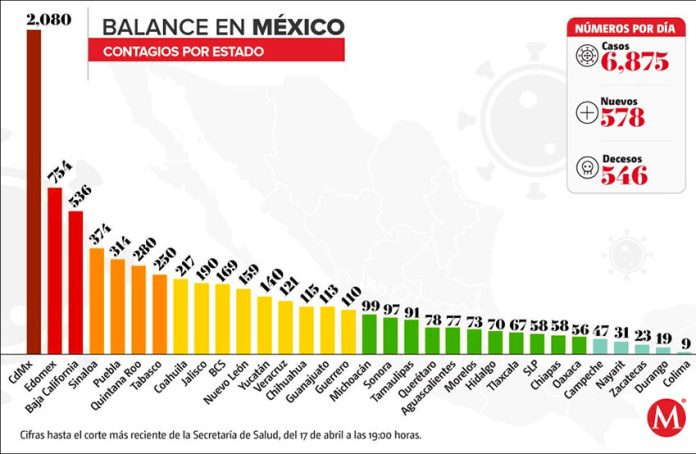
Coronavirus continues to gain ground in Mexico, with the most recent data from the Ministry of Health showing that the number of people infected has surged to 6,875 and the number of deaths to 546.
In the past week alone, cases across the country rose by 2,991 and deaths by 313.
For the second consecutive day, Mexico City, the state of México, Sinaloa and Puebla topped the list with the highest number of deaths. As of April 17, Mexico City had recorded 136 deaths, México state 49, Sinaloa 43 and Puebla 37.
Mexico City has more than 2,000 reported infections, followed by México state with 754 and Baja California with 536, mainly in the large border cities of Mexicali and Tijuana. Among those infected in Baja California are 30 doctors. State officials estimate that only 60% of residents are respecting quarantine guidelines, and hospitals are bracing for an estimated 15,000 total cases when the virus reaches its peak.
Durango, Nayarit, Zacatecas and Campeche have all reported fewer than 50 confirmed cases of coronavirus. Colima is the only state with fewer than 10 cases, currently registering seven, and just marked its first two deaths.
Two states have seen more than 20 fatalities, seven states have seen more than 10, and 17 states are still reporting deaths in the single digits. Seventy percent of those who died were men, a trend that is playing out across the globe.
Dr. José Luis Alomía, general director of epidemiology at the Ministry of Health, indicated that national infection rate per 100,000 residents is 5.37. However, Mexico City, Baja California Sur and Quintana Roo have infection rates nearly four times the rest of the country, at around 20 per 100,000 residents.
So far, 28,126 people have tested negative for the virus, and 2,627 people — about 38% of those infected — have recovered.
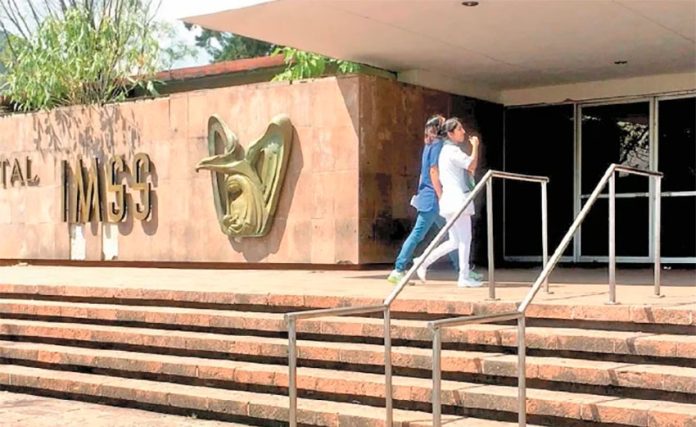
The Mexican Social Security Institute (IMSS) intends to dip into its own reserves to buy almost 15,000 pieces of medical equipment for the exclusive treatment of patients with Covid-19.
In a letter sent to the federal Finance Ministry (SHCP), IMSS requested urgent authorization to spend just over 5 billion pesos (US $210.8 million) on 14,975 pieces of equipment.
Obtained by the newspaper El Universal, the letter says that almost 1.6 billion pesos will be used to buy 3,477 vital signs monitors, while just under 1.5 billion pesos is earmarked for the purchase of 979 ventilators that can be used with both adult and child patients.
IMSS said that it would spend just over 518 million pesos on 264 portable X-ray machines, just under 383 million pesos on 600 medical carts, 234.4 million pesos on 9,000 pulse oximeters (devices that monitor the level of oxygen in a patient’s blood) and 54.4 million pesos on 126 basic ultrasound machines.
An additional 87.4 million pesos would be spent on 529 hospital beds including 100 intensive care beds.
The total expenditure outlined is less than 5 billion pesos but IMSS said that prices could rise due to variations in the exchange rate between the Mexican peso and the United States dollar.
The request for spending approval comes after IMSS asked the SHCP in late March to sign off on its use of just over 3.6 billion pesos to purchase 2,500 ventilators and 4,121 vital signs monitors for the treatment of Covid-19 patients.
IMSS recently acknowledged that it has a deficit of that number of monitors, which are essential for the care of critically ill Covid-19 patients.
Foreign Affairs Minister Marcelo Ebrard announced last week that the government had purchased 5,272 ventilators from a range of countries but didn’t specify how many would go to IMSS hospitals.
In addition to needing more medical devices, health workers say that IMSS and other public hospitals also require additional supplies and personal protective equipment (PPE).
IMSS director Zoé Robledo said on Wednesday that 80% of the institute’s hospitals have at least enough supplies to continue treating Covid-19 patients for the next week.
In 1994 it was the Tequila Effect. Today it's the Gaucho Effect.
Locusts, properly called cicadas, reappear predictably every 13 and 17 years. Sovereign debt crises are less predictably regular.
The last one appeared in 1994, 26 years ago, and the one before that in 1980, 40 years ago. The next one will occur any time now. In fact its epicenter may be traceable to even before the coronavirus outbreak.
Mexico has been historically so materially affected by sovereign debt crises that the 1994 one was popularly dubbed by the financial press the “Tequila Effect” as it spread from country to country. The finger on the next one should point to Argentina, where the “Gaucho Effect” has already begun, with default a reality.
There are some similarities between prior crises and the impending one, but fortunately for affected banks and countries there are also some differences, positive and negative.
A debt crisis occurs when a sovereign nation cannot pay its debts to foreign lenders. Typically it starts in one country and then spreads to many. In the past, the most materially affected have been in Latin America, in particular in the heavily indebted nations of Brazil, Argentina, Ecuador and Mexico.
Non-hemisphere countries such as Yugoslavia joined in during the early 1980s debt crisis, as did almost all the other nations from the Rio Grande to Patagonia.
In the early 1980s I was the CEO of a regional U.S. bank, materially (more than 10% of assets) affected by sovereign defaults, and as a consequence materially involved in seemingly endless rounds of loan renegotiations and reschedulings.
Sovereign lending had been so profitable and trendy in banking circles that I often lectured on its cost/risk benefits at a prominent U.S. graduate school of business. The industry tone was set by the then-CEO of trend-setting Citibank, who stated that sovereign nations do not default. He was wrong. Citi suffered and if sleepless nights had been on the bill, I would have suffered for being wrong, too.
The commodities price boom which started in the 1990s afforded relief to many rescheduling countries, and the chief difference between then and now is that the world economy today is depressed and expansion and its typically rising prices for everything from copper to oil are on few economists’ horizons. The rolling surge in oil prices for oil exporters such as Mexico and then-solvent Venezuela erased the vestiges of the first and second crises from the books of involved banks, and apparently also from their institutions’ historical memories.
A potentially beneficial difference between then and now is that “then” took place in a high interest rate environment and this was reflected in high, renegotiated interest rates. “Now” base rates on which lending margins are calculated are at recent historic lows, so at least initially set rescheduled loan interest rates will be relatively low.
Another “now” benefit, at least to a handful of countries, is that the remitted proceeds of millions of their nationals working overseas to countries such as Mexico will cushion the foreign exchange shock. In a typical, at least typical pre-coronavirus year, money sent back to the home country ranged from an estimated US $30 billion for heavyweight Mexico to a still significant $10 billion for far smaller Guatemala.
Devaluations are also historically part of the disruption debris of rescheduling. In 1994 Mexico’s peso collapsed: the now-collectible 100,000-peso notes are a stark reminder of the chaos in foreign exchange markets. At today’s exchange rate, the bills would be worth almost $5,000, not the $5 currently quoted by one dealer in obsolete banknotes.
Again, on a positive note, banks in Europe and North America have recently undergone “what if?” examinations, called stress tests. Although the exams no doubt role-played developing country debt rescheduling, they equally doubtless did not foresee a coronavirus-type calamity.
Mexico is the object of a double whammy. A recent Woodrow Wilson Center report from Mexico City pegged the interest tab on state-owned oil monopoly Pemex at $11 a barrel, slightly over half of today’s price for benchmark West Texas Intermediate crude oil, and well over half the price of Mexico’s higher-sulfur Maya grade. This whammy joins coronavirus.
If I were to guess, or perhaps think wishfully, the renegotiated NAFTA trade accord will be Mexico’s lifeline, with Mexico displacing China as chief supplier to the U.S. of everything from rubber sink stoppers to pre-fabricated factories.
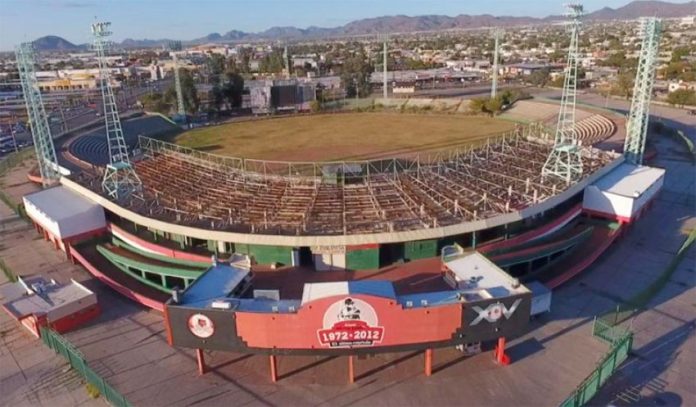
As the coronavirus crisis threatens to take more lives and inflict heavy economic damage, the federal government has ponied up 511 million pesos (US $21.5 million) to complete the purchase of a baseball stadium in Sonora, triggering a barrage of criticism on social media.
Sonora Finance Minister Raúl Navarro Gallegos said on Thursday that the federal development bank Banobras had transferred the funds for the purchase of the Héctor Espino stadium in Hermosillo. The state will spend the resources on pensions, public security, hospital infrastructure and medical supplies, he said.
President López Obrador announced last August that the government would pay the state just over 1 billion pesos to purchase the baseball stadium in Hermosillo and another in Ciudad Obregón.
The stadiums will become baseball schools, offering regular middle school and high school classes in addition to training would-be major league stars. The possibility of allowing private companies to build hotels and shopping centers in the stadium precincts was also under consideration, said López Obrador, whose favorite sport is baseball.
The news that the sale for the Hermosillo stadium has been completed sparked an outpouring of critical commentary on Twitter.
Clemente Castañeda, a federal senator with the Citizens’ Movement party, called the government’s outlay “irrational and insensitive” considering that the country is in the middle of the coronavirus pandemic.
“The deficiencies in the health sector are many and resolving them is not among [López Obrador’s] priorities. He’s making a mistake by not devoting all his efforts and resources to saving lives,” he said.
The Jalisco senator said that the 511 million pesos spent on the stadium could have been used to purchase 472,000 protective suits for medical personnel treating Covid-19 patients.
Ricardo Alemán, a prominent journalist, also delivered a scathing assessment of the stadium purchase.
“Without a doubt López Obrador is making history! Thousands of people dead and he spent millions on a baseball stadium. It leaves him in the class of idiots like Nero, Hitler, Mussolini, Stalin and close to the criminal [Idi] Amin of Uganda! Or no? And idiots who deny that he is a danger for Mexico abound!” he wrote on Twitter.
The president and the government were also heavily criticized by hundreds of other Twitter users who said that the money should have been spent on personal protective equipment (PPE) and supplies for frontline health workers.
Medical personnel across the country have held numerous protests to demand PPE as Mexico’s Covid-19 outbreak worsens and health workers in at least 15 states are threatening to go on strike if the director of the Mexican Social Security Institute (IMSS) does not provide them with the equipment they need to protect themselves.
Margarita Ibarra demonstrates the right way to wash hands: 'I’m not saying you have to scrub them until they bleed, but you have to do a thorough and vigorous job.'
Dr. Margarita Ibarra is a member of the Nephrology Department at Guadalajara’s Civil Hospital and since the appearance of Covid-19 her life has changed drastically.
“Now my life is shaped by rituals,” she says. “I have rituals to follow at the hospital, rituals to follow at home and yet more rituals which get me from one to the other.”
The atmosphere is tense at the hospital, she tells me. “We are all using masks and face shields and everyone on the staff — at absolutely every level — is following the same procedures as I am, day after day because we must constantly act as if we we have been in contact with someone who was positive.”
One of the rituals is getting dressed before entering the hospital’s Covid-19 unit. Although Dr. Ibarra is not assigned to the unit she, like the staff of many other departments, often has to enter the unit to help patients with non-virus problems. Her comments:
“Not only is it important to know how to put on your overalls, face mask, and so on, but far more important is knowing how to take them off, so you won’t end up contaminating some part of your body or your clothes or shoes.”
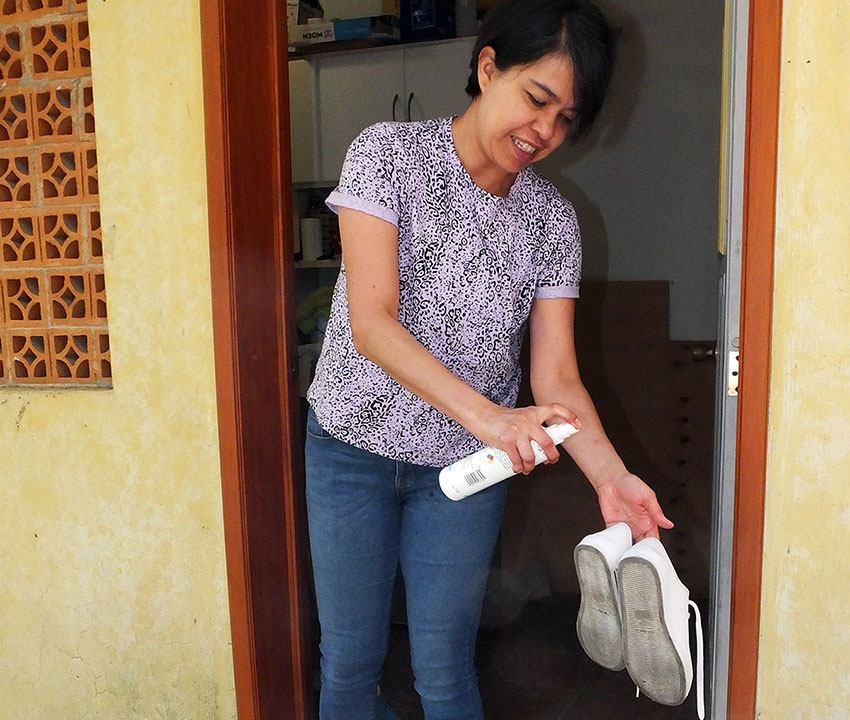
Dr. Ibarra sanitizes her hospital tennis shoes at the entrance to her laundry room. ‘I have one pair of shoes for home, one for work and another for traveling from one place to the other.’
These things are so important, she says, that somebody is permanently stationed at the entrance “to check that you did everything right and when you come back out, there is somebody else with a clipboard and a checklist. Did you dispose of your gloves and face mask properly? All of this is to avoid wasting precious protective gear and to prevent contamination.”
Many people, says Dr. Ibarra, are going in and out of the Covid-19 unit, “maybe from neurology, endocrinology or from my department, nephrology, because those patients don’t have just the virus, they have all sorts of other diseases too. But there is a rule that no one individual can stay in there more than five to eight hours. Then he or she will be obliged to leave and, if necessary, somebody else will take his or her place and, of course, there will be a total change of protective gear.
“I enter that unit only occasionally. Mis respetos to the people who work there full time.
“Because of this, our resources are being used up very quickly! Overalls, face masks, etc. are sanitized and can never be used again, except for the face shields. A shield can be assigned to one person and reused, but only after sterilizing it. All the other items are thrown away, so they are being consumed really fast, and if we start getting swamped with patients, we are going to run out. So we are very careful about how we are using these things.”
Other rituals apply when Dr. Ibarra leaves the hospital to head home.
“I need to remove my shoes, my pants and other clothes. I spray all the colored clothing with alcohol and my tennis shoes and white clothes with chlorine and put all of it into a bag. Then I put on a pair of transit slippers.
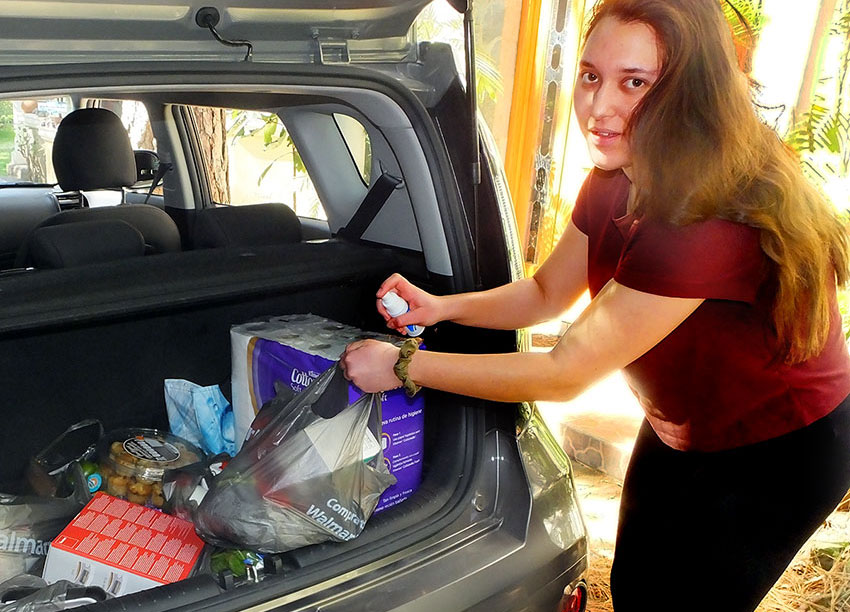
Xela Lloyd Ibarra is in charge of disinfecting each bag of groceries before carrying it into the house.
“Upon arrival at home, I go straight from the car to my laundry room. Here, my colored clothing goes into a bucket of soapy water and the whites and tennis shoes go into another one full of water dosed with chlorine. I have yet another container for face masks, plastic bags, etc. which go into chlorinated water and eventually into the trash. Then I take off my traveling slippers.
“Now, still in the laundry room, I wash my face and hands, not quite ‘until they bleed,’ but close. Next I take a shower and wash my hair, because you never know if a droplet from an infected person got onto your hair or in your ear or maybe on your neck. Finally I put on my house clothes and shoes and start interacting with my family: cooking and doing my normal housework.”
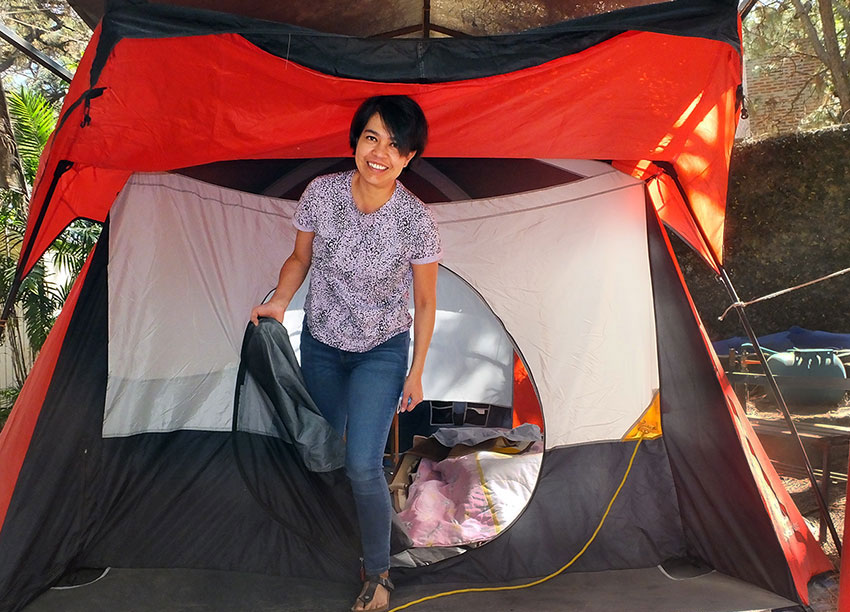
“But even family interaction is affected. “At night,” says Dr. Ibarra, “I say goodbye to my family and go out into the yard by myself. I sleep alone in a tent to limit risks to my husband who had a lung problem in the past.”
These procedures, said the nephrologist, are being followed by everyone at her hospital. “Every nurse, every doctor, every policy maker and every janitor, all of them are changing and disinfecting clothes before they leave. In spite of that, some are being mistreated when they take the bus to go to work, just because of their uniform, because people think they are carrying the virus.”
“Nothing,” says Dr. Ibarra, “could be farther from the truth. We who work at the hospital are far more careful about preventing contagion than anybody else you’ll find on a bus.”
“We are following all these rituals because we health workers consciously consider ourselves asymptomatic carriers of the virus and, in fact, everybody everywhere ought to assume the same thing whenever we step out of our houses and every time we go back home to our loved ones.”
Ibarra shows off the tent she sleeps in every night.
I asked Margarita Ibarra whether Jalisco is ready for the next phase of the pandemic, in terms of ventilators and hospital beds, for example.
“As for ventilators,” she told me, “every other day we get an update on their number. Right now, we have over a hundred of them, but more than half may be in use at any given moment. Just like in normal times, people are still having accidents and getting sick from other diseases.
“In respect to hospitals, we have five in Greater Guadalajara, but whether they will be enough depends totally on whether all of us behave correctly and do the right thing. We think we can succeed if people stay in their homes. But if things get out of hand, if all five hospitals get filled to the bursting point, then I just don’t know what we’re going to do. This is the truth and this is why we want the general public to stay home.”
When asked about people who are ignoring the stay-at-home instructions and trying to slip off to the beach, Dr. Ibarra suggests they pick up a telephone and talk to someone they know in another country. “I did that and found out a good friend from Spain just lost his father to Covid-19. What especially hurt our friend was that his father died not surrounded by his loved ones, but all alone in an empty hospital room … and now his mother is in quarantine.
“Right now the lives of all the healthcare providers in Mexico are in jeopardy. Please — just stay home!”
The writer has lived near Guadalajara, Jalisco, for more than 30 years and is the author of A Guide to West Mexico’s Guachimontones and Surrounding Area and co-author of Outdoors in Western Mexico. More of his writing can be found on his website.
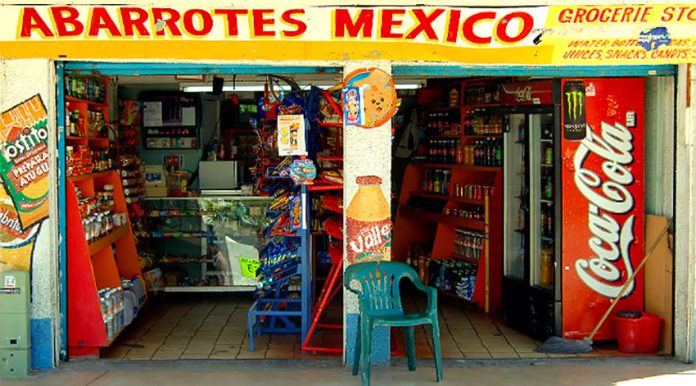
Businesses such as tienditas that are suffering due to the coronavirus crisis could get some technological help from BBVA Next Technologies.
The company, which specializes in advanced software, has launched “Tech4Change,” an initiative designed to help stores transition to online sales, inviting the public to submit proposals for an online platform and app.
Tech4Change’s parent company is the Banco Bilbao Vizcaya Argentaria (BBVA), a Spanish bank and financial services companywith a large presence in Latin America, including Mexico.
“We want to thank the quick response and collaboration received from the more than 700 people who have signed up to help in the development of ideas with their knowledge and experience in technology. Participation in projects is currently closed,” says a notice posted on the company’s website.
The project consists of creating a platform that supports logistics and acts as a portal for online orders for businesses such as small stores, markets and pharmacies that currently do not have the necessary infrastructure to market their products virtually.
Crowd-sourcing a short-term solution to keep businesses afloat during the pandemic is both a practical and altruistic approach to challenging financial times.
One feature of the project will seek to let shoppers know how busy their favorite stores are, thus avoiding an in-person visit, and risk of infection, when there are crowds.
The platform will be based on the information available on Google and would work off of a user’s zip code to show in real-time how many people are shopping at establishments closest to their home.
Miguel Castillo, head of the BBVA Next Technologies program in Mexico, explains the project this way: “Through this initiative we want to put our knowledge and experience in technology at the service of society, taking advantage of the digital tools we have at our disposal and the internal structure that we have generated within the company to facilitate a culture of continuous innovation, which now allows us to do our bit to combat this global crisis. ”
Two days after cutting Mexico’s sovereign rating to just one level above non-investment grade, Fitch Ratings downgraded both the state oil company Pemex and the Federal Electricity Commission (CFE) on Friday.
Today’s additional cut leaves Pemex with a long-term rating of BB- with a stable outlook. Fitch also cut CFE’s rating by one notch to BBB-, the agency’s lowest investment-grade level.
“Pemex and CFE’s rating downgrades reflect these companies’ direct linkage to Mexico’s sovereign ratings,” Fitch said in a statement.
The rating agency noted that the state oil company’s rating is three notches below Mexico’s sovereign rating, explaining that its latest downgrade was the “result of the continued deterioration of its stand-alone credit profile (SCP) … amid the downturn in the global oil and gas industry, Fitch’s lower oil price assumptions and the weakening credit linkage between Mexico and Pemex.”
“Pemex’s SCP deterioration reflects the company’s limited flexibility to navigate the downturn in the oil and gas industry given its elevated tax burden, high leverage, rising per-barrel lifting costs and high investment needs to maintain production and replenish reserves,” Fitch said.
The company is saddled with US $105 billion in debt and is predicted to see a decline in its oil revenue due to low prices even though it is partially protected by a large hedging program.
The price of Mexico’s export crude plunged to its lowest level in 21 years late last month at $10.37 per barrel. It closed 37% above that level on Thursday but at $14.17 per barrel is a long way short of the $55 per barrel price seen in the middle of January.
The company’s production cost last year was $14.20 per barrel.
CFE’s rating, Fitch said, is the same as that of the sovereign “given its strong linkage to the government and the company’s SCP.”
The utility reported in February that it had overdue customer debt of 55 billion pesos (US $2.3 billion) at the end of 2019, a 22% increase compared to the end of 2018.