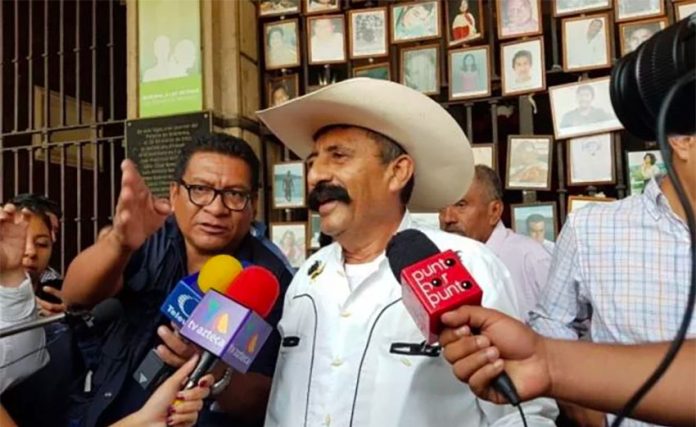
Jorge Zapata expresses dismay over the painting of his grandfather.
Descendants of Emiliano Zapata announced they will sue the painter of a nude and feminized portrayal of the revolutionary general, as well as the Secretariat of Culture and the Palace of Fine Arts for using the painting in a promotion for an upcoming exhibition.
Zapata’s grandson, Jorge Zapata González, said the painting “denigrates the figure of the general” and is harmful to the image of Mexican heroes.
He said some people wanted to go to the Palace of Fine Arts and burn the painting, “but we are respectful of the institutions and we are going conduct ourselves in the best way, but we are not going to allow the figure of the general to be denigrated.”
Accompanied by family and descendants of other revolutionary figures at a press conference outside the state government place in Cuernavaca, Morelos Palace, Zapata said that depicting the “Strongman of the South” in a homosexual way was disrespectful to the history of Mexico.
He said that without his grandfather, the “purest and most noble icon of the Revolution,” the very government employees that posted the painting wouldn’t have the jobs they have today.
“If General Zapata or General Villa hadn’t led the Revolution, these dimwits wouldn’t be in the spots they occupy today. And they’re repaying him by denigrating his image in a place as important as the Palace of Fine Arts?” he said.
He and others behind the proposed lawsuit aim to use the legal recourse to settle the dispute in a way that does not break friendly ties with the government of President López Obrador.
“We’re investigating what’s behind this and in the lawsuit we’re going to do everything necessary to avoid problems,” he said.
Zapata added that although there may be thousands of paintings that depict the general in various forms, such as the one by Cháirez, he believes that such a painting should not be exhibited in a place like the Palace of Fine Arts.
“People will respect General Zapata or we will make them respect him,” he said.
The death toll due to an ammonia spill near the border of Guerrero and Michoacán on the weekend has risen to nine.
The initial number was five but Michoacán Public Security Secretary Israel Patrón Reyes announced Monday that four more victims had died in hospital.
The spill occurred Friday night when a double-tractor-trailer transporting 30,000 liters of ammonia rolled over on the Siglo XXI highway near the Infernillo Dam at La Unión, Guerrero.
The victims were travelling aboard a bus that was forced to stop by the accident and became trapped in a toxic cloud of gas emitted by the tanker.
Among the dead is Eva Montiel García, a nursing student who got off the bus to treat exposed victims, many of whom survived, but she died hours later.
Also dead is a 2-year-old girl who was among several children who were exposed to the toxic chemical.
Patrón said a preliminary investigation indicated that mechanical failure was responsible for the crash.
Some of the victims reported that their insurance refused to cover the costs of treatment, but Michoacán Governor Silvano Aureoles Conejo said his administration is looking into the matter.
Aureoles added that 1,500 people in the community of Infernillo were evacuated to avoid exposure.
The Siglo XXI highway near the accident was reopened to traffic on Sunday.
Negotiators from the three trading partners at a meeting last week in Washington.
Mexican officials will meet with negotiators from the United States and Canada in Mexico City on Tuesday to work on the final changes to the new North American free trade agreement.
Economy Secretary Graciela Márquez, Foreign Affairs Secretary Marcelo Ebrard, foreign affairs undersecretary for North America Jesús Seade and Ambassador to the United States Martha Bárcena are to meet with a U.S. delegation led by Trade Representative Robert Lighthizer and senior White House adviser Jared Kushner and a Canadian team headed by Deputy Prime Minister Chrystia Freeland.
According to the news agency Bloomberg, the three countries have reached an agreement to make changes to the text of the United States-Mexico-Canada Agreement (USMCA) in the form of an addendum, and a ratification vote could be held in the U.S. Congress as soon as next week.
President López Obrador told reporters on Tuesday morning that negotiators from the three countries will sign off on the changes today.
Mexico and the United States have engaged in recent days in intense negotiations over potential changes to clauses on labor enforcement, steel and aluminum, biologic drugs and internet services, the news agency Reuters reported.
López Obrador last week rejected a proposal that would allow the United States to carry out inspections of Mexican businesses to ensure compliance with new labor laws including legislation that guarantees free and secret ballots for the election of union leaders.
He said on Monday that U.S. officials had accepted Mexico’s proposal to establish dispute resolution panels to review labor law compliance.
Ebrard said that a U.S. proposal that stipulates that 70% of steel used in automaking must be “melted and poured” in North America could be included in the trade pact addendum but stressed that Mexico won’t accept such a rule for aluminum because Mexico lacks any production of the metal.
In the United States, Democrats in the House of Representatives have reached a preliminary deal with trade unions and the White House on a revised version of the USMCA, according to the Associated Press.
However, House Speaker Nancy Pelosi, who has the authority to bring on a lower house vote on the USMCA, said Monday that a deal to finalize the trade pact was “not quite finished yet” but “within range.”
Lawmakers from both the Democrat and Republican parties say that ratification of the pact would be more difficult next year because the presidential election campaign will be in full swing and U.S. President Donald Trump could face an impeachment hearing.
For his part, Trump told reporters Monday that he was hearing “very good things” about the USMCA and that “a lot of strides” had been made in the negotiations.
“. . . I’m hearing from unions and others that it’s looking good and I hope they put it up to a vote and if they put it up to a vote it’s going to pass, a lot of Democrats want to pass it too and we look forward to that . . . It’s replacing probably the worst trade deal ever made, which was NAFTA, and this is one of the best trade deals ever made for our country . . .” he said.
Secretary Márquez said Monday that the Mexican Senate – which approved the USMCA in June – will have the opportunity to review the addendum and will be required to pass it before the trilateral trade pact can take effect.
She predicted that the United States will ratify the new trade agreement by December 20 and that it will come into force in the first half of next year.
The USMCA, which is to replace the almost 26-year-old North American Free Trade Agreement, sets out rules for trade between Mexico, the Unites States and Canada that is worth US $1.2 trillion annually.
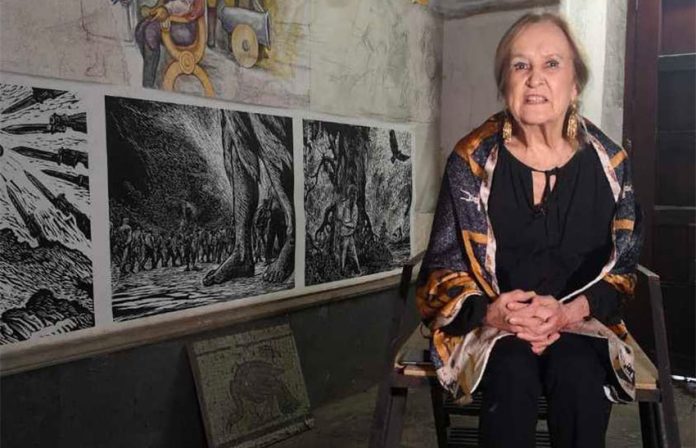
Rina Lazo Wasem, the last living assistant to muralist Diego Rivera, has died at the age of 96.
Born in Guatemala City in 1923, Lazo won a scholarship to study art in Mexico. She could have studied anywhere, but chose “La Esmeralda,” the National School of Painting, Sculpture and Engraving, specifically for the opportunity to meet and work with Rivera and Frida Kahlo. That scholarship included a plane ride to Mexico City, something special in 1946.
Little did Lazo know that she would not only have the chance to meet Rivera and Kahlo, but her life would be forever connected with theirs.
Lazo began her studies in Mexico like any other student at La Esmeralda. She stated in an interview in the summer of 2019 that she initially found it hard to break into the various social circles of Mexican students. Her very first friends turned out to be Americans studying on the GI Bill.
After taking a number of classes in different fields, she decided to focus on mural painting, in part because she did not expect to be in Mexico more than the year and a half of her scholarship.
Lazo and one of her murals.
Her first mural class was with Andrés Sánchez Flores, who had worked as an assistant to Rivera. Impressed with her dedication and discipline, he recommended her as an assistant to his maestro even though she had been there only a few months. She became part of a group that worked on Rivera’s mural Sunday Dream at the Alameda Park, painted on the wall at the then Hotel del Prado.
Her workdays there were long, waking up before dawn to take a bus from the new Polanco neighborhood to the worksite and heading home the same way as late as midnight. During the time she began not only to absorb Rivera’s painting style and techniques, but also much of his artistic theory, in particular that art needed to be for the people and have an important message for them.
Lazo quickly stood out among all the assistants and got Rivera’s attention. He called her “a painter of great talent, my right hand, and the best of my assistants.” She worked with Rivera as an assistant for the next 10 years until his death in 1957.
Before then, her life became intertwined with his socially. His acceptance of her as an artist broke just about all social barriers for her. She was a regular guest of Rivera and Kahlo, meeting Mexico City’s artistic, intellectual and political classes. She also met her husband through the famous couple.
Arturo García Bustos was one of Los Fridos, a group of four disciples of Frida Kahlo, who painted with her at the Blue House in Coyoacán, where the couple met. Later, they married and moved into what is called the La Malinche House (the home built by Spanish conquistador Hernán Cortés for his indigenous interpreter, advisor and lover, La Malinche)to be near their teachers.
At that time, the house was in ruins so renovating and preserving the old mansion became a lifelong project for the couple and is now a national heritage site.
Rivera’s death did not mean the end to Lazo’s career. She continued to paint canvas works, but is best known for her murals in Mexico and Guatemala. Her work in Guatemala includes Tierra Fértil (Fertile Land) at the San Carlos University Museum.
Her best-known work in Mexico is a replica of the Bonhampak Mayan murals at the Museum of Anthropology in Mexico City, done in 1964, along with another mural in the same museum based on the Popol Vuh. Her murals had social and political themes, while her canvas works focused on portraits, landscapes and still lifes.
Interestingly, Lazo never really considered herself a “foreigner” in Mexico. She preferred to emphasize the cultural similarities between Guatemala and Mexico, especially the Mayan heritage they both share. She had both Mexican and Guatemalan citizenship.
She received many awards for her work during her lifetime, including the Order of the Quetzal from the Guatemalan government. On December 7, 2019, the National Institute of Fine Arts organized a homage to the artist’s life at the museum housing the first mural she did with Diego Rivera so many decades before.
She was extremely generous with interviews and never seemed to tire of keeping the memory of Mexican muralism alive. Her gratitude to Rivera and Kahlo never diminished over her long life.
Despite her age, her death came as a surprise to friends, family and colleagues because she was extremely active up to the day before.
She is survived by one daughter, Rina García Lazo.
Guests enjoy wine festival on the beach at Zihuatanejo.
In recent years I have noticed a concentrated effort by government, locals and foreigners alike to position, Zihuatanejo as “the” place to be.
It seems that nearly every month there is something going on, such as gastronomical events (like the tiritas festival and clandestine dinners), craft beer tastings and world-class week-long extravaganzas like Sailfest and the International Guitarfest. It is hard to find a month where an important festival is not taking place.
Enter another event, Expo Vino, now in its third year, conceived by local businessman and sommelier Miguel Quiroz Arroyo. Born and raised in Zihuatanejo, he started the festival with the idea of featuring the portfolio of wines his wholesale company carried for many years.
I caught up with Quiroz prior to the festival at his wine shop, Rivello Bar & Wine on Nicolas Bravo in the heart of downtown Zihuatanejo, which had opened a few months before. Coupled with the success of his Wine Expo, Quiroz felt that that Zihuatanejo was ripe for a wine tasting room of its own.
His idea was to educate the general public, both locals and tourists alike, on the many wines they carry from around the world. When I walked in, Quiroz, a member of the national sommeliers’ organization Onsom, was teaching a wine class to hospitality and tourism students from the Technological University of the Costa Grande in the nearby town of Petatlán.
Organizer Quiroz and MC Carlos Rio.
I immediately noticed the similarities of Rivello Bar & Wine to the wine shops and tasting rooms I had just visited in Spain and Portugal this past fall, an observation Quiroz confirmed that had inspired him during a recent visit to Italy and France. On Thursdays, customers can book their own private wine tasting party for the reasonable price of 200 pesos for a minimum of four people and a maximum of 10. And for Quiroz, it was a perfect complement to the festival itself.
Along with a few hundred people, I bought my festival ticket (early bird price of 400 pesos, 600 pesos at the door). I arrived to find numerous tables dotting the beach at the Sotovento Beach Club, set against the beautiful bay of Zihuatanejo as its backdrop.
Expo Vino 2019 featured wines from Portugal, Spain and Italy as well as from Chile, the United States and Mexico. Attendees were treated with tastings of everything from “green wine” from Portugal to Malbec from Argentina, and a wide array of sparkling wines, merlots and pino grigios to name a few.
To make things feel even more exclusive, there were special tastings with four featured sommeliers — Marianna Jiménez, Santiago Soto, Leo Corredor and organizer Quiroz. I attended the tasting with Jiménez who spoke about two wines by Bodegas Arraez. Even though the lecture was in Spanish, it was easy enough to follow – possibly the delicious wine served had something to do with that!
Several local restaurants served tasty food options such as shrimp chow mein, sliders and sushi, perfect for wine pairing and easy enough to carry while moving from table to table, sipping, talking and, of course, drinking wine.
The finish to the night included music by the ever-popular group Vertical Classic Rock. As we danced the evening away, I thought two things — what could possibly be better than the moon, the stars, wine and music? And that I am already looking forward to Expo Vino 2020.
The writer is a Canadian who has lived and worked in Mexico for many years.
The president and other officials on tracks to be occupied by the new train.
Members of farming cooperatives in Quintana Roo want the federal government to clear longstanding debts before entering into discussions about ceding land for the construction of the Maya Train.
Ponciano Genaro Martín Esquivel, a member of the Felipe Carillo Puerto ejido, said that there are six cooperatives that are still waiting to be compensated for land that was expropriated for the construction of Highway 307 between Chetumal and Cancún.
The money owed to the ejidos dates back to the end of former president Ernesto Zedillo’s six-year term in 2000, he said.
According to the ejidatarios of the Xmabén, Chacchoben, Andrés Quintana Roo, Sun Yax Chen, Hazil and Felipe Carrillo Puerto cooperatives, the government owes more than 200 million pesos (US $10.4 million) in unpaid compensation.
Esquivel said that members of his ejido are not opposed to construction of the new railroad, which will run through five states in southeast Mexico. However, he added that they had sent a letter to President López Obrador to advise him that they will not continue negotiations to cede land until the compensation issue has been settled.
Esquivel said the chief of the National Tourism Promotion Fund (Fonatur), which is managing the Maya Train project, has indicated that the government wants between 300 and 500 hectares of Felipe Carrillo Puerto ejido land for construction of the railway.
Fonatur director Rogelio Jiménez Pons has acknowledged that the compensation issue needs to be resolved before negotiations can continue, adding that the agency he heads is working to that end.
“There are at least three cooperatives that are owed money although it’s the Secretariat of Communications and Transportation that has the debt. We are interested in the matter being resolved as soon as possible and are taking steps for that to happen,” he said.
Jiménez said that the cooperative members are within their right to demand the compensation, charging that they were treated unfairly by past federal governments.
Feminists responded on Friday to a video in which players of the under-17 team of the Mexico City soccer club América mocked the feminist anthem A rapist in Your Way.
A video emerged last week that showed a handful of teenage América players in a locker room laughing and dancing to the chant written by the Chilean feminist collective Las Tesis that condemns rape, sexism, impunity and the “oppressive state.”
Club América said it would investigate the incident and punish the players who took part. The club also said that its youth teams would attend an awareness course that covers violence against women, machismo and social media best practices.
“We are cooperating and attentive to whatever the disciplinary commission of the Mexican Soccer Federation may decide,” Club América said in a statement.
The statement didn’t satisfy the Las Del Aquelarre feminist collective, which demanded a public apology from the owner of the club.
“A statement is not enough . . . because [the players] mocked thousands of women who have disappeared and been raped . . .” the collective said.
Feminists gathered Friday at the Glorieta de los Insurgentes plaza in Mexico City, where they burned the América flag and wrote a message to the club on the ground that translates in less offensive words to “screw you.”
The feminists also took part in a rendition of A rapist in Your Way in which the words were altered to accuse soccer players, among others, of being rapists.
The emergence of the Club América video last week was quickly followed by two others that also mocked the chant that has been performed in cities around the world and across Mexico in recent weeks, including in Mexico City’s zócalo on November 29.
In one of the videos, two men who appear to be Mexican marines gyrate and swivel their hips to the chant. The footage, which seems to have been recorded in military barracks, was especially “troubling,” the Associated Press said, “given that Mexican soldiers and other security forces have repeatedly been implicated in human rights abuses including torture and rape.”
The Navy Secretariat said in a statement that it was investigating to establish the identity of the “presumed members” of the force. The department sought to distance itself from the men’s actions, stating they don’t represent the navy’s “institutional posture.”
A third video mocking the chant was shared on Instagram by MC Babo, frontman of the well-known, Monterrey-based hip-hop group Cartel de Santa. The footage shows scantily clad women dancing suggestively to a soundtrack of A rapist in Your Way sung by male voices. The video also shows a frightened woman with her hands tied surrounded by a group of masked men.
Maynné Alexa Cortés, a 26-year-old feminist psychologist, told the Associated Press that the videos show “not a single ounce of empathy” and that gender-based violence is “made invisible” among many men. “They do not understand what is going on.”
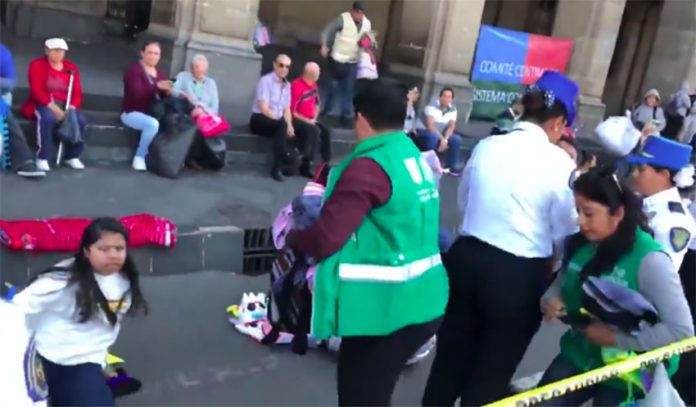
City officials clear vendors from the street on Sunday.
Indigenous street merchants in Mexico City plan to appropriate a popular feminist chant to protest their removal from the street Sunday and the confiscation of their products.
Members of the Triqui indigenous group from Oaxaca’s La Mixteca region were removed from an area in the city’s historic center, and the goods they were selling were seized by security forces.
In response to the expulsion, the merchants blocked 20 de Noviembre avenue in protest on Monday, causing traffic chaos in the area.
Leader of the merchants guild of the Cuauhtémoc borough of Mexico City, Diana Sánchez Barrios, said that around 5,000 people would perform their own version of the feminist anthem A Rapist in Your Way in the zócalo on Monday afternoon.
“The only thing we’re asking for is social justice . . . the right to work. We’re self-employed and because of that it’s very important to have a legal framework so that they don’t keep abusing this right,” said Sánchez.
She said she hopes the performance would convince Mexico City Mayor Claudia Sheinbaum to return to the dialogue table and offered a warning for what will happen if she refuses.
“On Thursday we’ll set up our booths in the zócalo, and although we know that they’re going to beat us up, we will not be moved. I want to make this clear,” she said.
Mexico City official Arturo Medina expressed regret for Sunday’s removal of the merchants and said their demands have been dealt with. He said they were offered other spaces in which to sell, but did not accept them.
“They were given the opportunity to sell at the Monument to the Revolution and in the Santo Domingo Plaza,” he said. “[But] They have not agreed to set up shop there. We have the infrastructure ready.”
“They want to be [in the zócalo], but we have other activities going on there . . .” he added.
He added that an officer accused of violence during the removal on Sunday has been suspended from his duties.
If you’re one of those people who can’t or don’t want to eat refined sugar but still want a sweetener now and then, it is likely you’ve been happy to discover stevia, a naturally sweet plant whose leaves can be ground and used to sweeten just about anything.
Pure stevia is about 200 times sweeter than sugar and gets its sweetness from natural compounds in the plant called steviol glycosides.
Is it better than “real” sugar or artificial sweeteners like Splenda? Well, it’s certainly safer and more natural, and has no calories (or nutritional value). Some people, myself included, detect a slight bitter aftertaste that’s unpalatable, but the majority of folks who use it swear by it.
Splenda, the most common low-calorie artificial sweetener, is 450-650 times sweeter than sugar. It’s created chemically in a base of sucralose — an indigestible artificial sugar — by replacing some of the atoms in sugar with chlorine. Now I have to say that all makes me shudder, but hey, to each his own.
Back to stevia. The bad news is that a flood of products claiming to be stevia have saturated the market. Sadly, stevia products available in Mexico are not above suspicion. There’s a lot of money to be made by jumping on the newest food trend bandwagon, and Mexico’s labeling laws are notoriously lax.
And food manufacturers know the average consumer is too busy to read labels: “Studies show that the color of the packet is the most important factor in sweetener selection.”
Here’s an example: the little green and white packets of “Svetia” contain only 2.5% crystallized stevia in a base of 97% other sugars. The ingredients list, in the teeniest, tiniest font on the back, says: dextrose, fructose and a complex phrase that means “crystallized” stevia. And this in a product approved by the AMND, the Mexican Association for Diabetic Nutrition!
So do your homework, folks – your health is worth the effort! Especially if you’re diabetic, read labels carefully and spend the little bit of extra money to get what you’re really looking for.
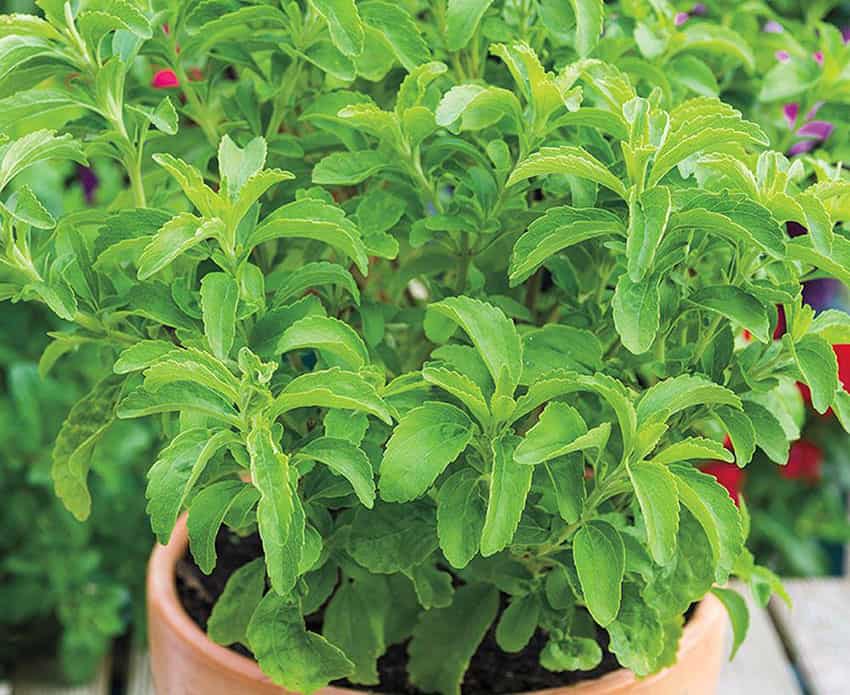
Another option is to find a local grower and make your own sweetener from fresh stevia leaves (not the stems or flowers). You can even grow your own – stevia is a pretty, leafy plant that’s easy to grow, in containers or in the ground, especially in Mexico, where it’s a perennial. And turning the leaves into a sweetener is as easy as drying and grinding them, or cooking them into a simple syrup or extract.
Bear in mind that you can’t just replace sugar with stevia in baking; whatever you’re making won’t have the same texture or browning, and you’ll need to tweak the temperature (lower) and cooking time (longer). Searching on Google will yield an abundance of adjusted recipes. This YouTube video has step-by-step instructions on harvesting and making stevia powder and liquid sweetener.
If you buy stevia powder, it will be white because of the extraction process, and about 300 times sweeter than sugar. Homemade stevia powder – from dried and ground leaves – will be a lovely green color, slightly less sweet and not as bitter as the store-bought.
Stevia is easy to grow, in containers or in the ground.
While you can just crumble the dried leaves by hand to make a fine powder, an electric coffee grinder works best. (Of course, one that’s not used for coffee!) Sweeteners made from fresh dried stevia leaves will have a dark green color and may tint whatever you use them in a little bit.
Here are some basic conversions, but you’ll have to find the amount of stevia that’s to your sweetening taste. Just remember, a little goes a long way!
Conversion chart
1 cup sugar = 2-4 tsp. stevia leaf powder or 1 tsp. stevia extract.
1 tsp. sugar = Pinch of stevia powder or 2-4 drops stevia extract.
Fresh stevia powder
Pick leaves off stevia plant, discard stems. Dry leaves for about 12 hours in the sun or use a food dehydrator. Once leaves are dry, grind them in a food processor or coffee grinder to make pure stevia powder.
Stevia extract
1 glass jar with a tight-fitting lid
Dried stevia leaves, crumbled or powdered
Vodka or rum
Using a ratio of 2 parts stevia to 3 parts liquid, place one cup of stevia in the jar and cover it with 1-1/2 cups of the alcohol. Shake the mixture well and let it sit at room temperature for 24 hours. Strain through muslin or a coffee filter, then simmer the mixture on low heat for 30 minutes, stirring regularly, to remove the alcohol. Be careful not to boil. Remove from heat, cool and store in a dark colored bottle for up to 6 months or indefinitely if refrigerated. —Recipe courtesy www.preparednessmama.com
Stevia syrup
½ cup dried stevia leaves, crumbled
2 cups warm water
Place stevia and water in a glass jar and let steep (unrefrigerated) for 24 hours. Strain leaves from mixture. Cook the remaining liquid on low heat, reducing to a concentrated syrup. Store in an airtight container in refrigerator for up to six months.
Liquid stevia sweetener
¼ cup pure stevia powder (made fresh, not from packets)
1 cup warm water
Place in glass jar, shake till mixed. Let sit on counter for 24 hours. Refrigerate and use to sweeten drinks, etc.
Janet Blaser of Mazatlán, Sinaloa, has been a writer, editor and storyteller her entire life, and feels fortunate to write about great food, amazing places, fascinating people and unique events. Her work has appeared in numerous travel and expat publications as well as newspapers and magazines. Her first book, Why We Left: An Anthology of American Women Expats, is available on Amazon. Contact Janet or read her blog at whyweleftamerica.com.
The body of a woman killed in front of a primary school last week.
The San Miguel de Allende government and Mayor Luis Alberto Villarreal “only care about protecting rich people and tourism.”
Those are the words of Isael González, director of a program that steers young people away from violence and the use of drugs.
He told the newspaper El Universal that young people from marginalized neighborhoods in the tourism-oriented colonial city are killed every week in drug-related homicides.
“There are deaths every week related to the crystal [methamphetamine] market. They’re young people from marginalized neighborhoods aged between 13 and 28,” González said.
“The government and Mayor Villarreal don’t care about young people dying, they only care about protecting rich people and tourism.”
A case in point is the murder of a man in May. A 26-year-old bartender, father and drug addict identified only as Sebastián by El Universal was shot 24 times by two men who broke into his family’s San Miguel home.
His cousin Mariana said that state police took a couple of hours to arrive at the home and that during their visit they searched Sebastián’s room.
“There were remains of marijuana, three small bags of cocaine and a jewelry bag filled with pure methamphetamine. An officer said that we were victims of the circumstances, and as there were no weapons, no more drugs or signs of trafficking, his work ended there,” she said.
Mariana said that she and Sebastián’s sister reported the murder at state police offices. The last contact the family had with police was at the end of June, she said.
“After that we didn’t hear from them again. There were no more efforts, they didn’t question any witnesses, nobody has been ordered to stand trial,” Mariana said.
The failure to arrest the killers in the case is not unique among the 76 homicides committed in San Miguel de Allende between January and November.
Mariana, the cousin of a murder victim, claims little was done to investigate the killing.
Indeed, Mayor Villarreal said in a radio interview in July that most homicide investigations “haven’t proceeded” because they were considered “settling of scores” and “the vast majority of those murdered had criminal records.”
In another interview, he said that murders in San Miguel de Allende were related to drug trafficking. However – as police noted – there was no evidence that Sebastián was a drug dealer.
The number of murders in San Miguel has tripled this year compared to 2018 but it’s not the only crime that is on the rise: the incidence of burglaries, drug trafficking, malicious injury and fraud have all increased since 2016, according to official statistics.
In addition, there were two femicides in each of 2018 and 2019 and for the first time ever, a case of extortion was reported this year, El Universal said.
Villarreal last week rejected a story by the news agency Bloomberg that drug cartels have infiltrated San Miguel but the federal Attorney General’s Office (FGR) said in a report earlier this year that the Jalisco New Generation Cartel and the Santa Rosa de Lima Cartel are engaged in a turf war in the city.
According to the FGR, the former cartel is responsible for most of the acts of extortion and the latter is the main instigator of violence. The arrest of 10 suspected members of the Santa Rosa Cartel in San Miguel in October is also incongruent with Villarreal’s claim that cartels have not moved into the city.
In addition, Mexican and foreign residents challenge the mayor’s assertion that organized crime groups are not operating.
An unidentified shopkeeper whose business is located in the historic center described this year as “extremely violent” and asserted that all crime in San Miguel is related to drug trafficking and the cartels.
He told El Universal that he and most other residents have changed their daily routines out of fear, explaining that they don’t wear any jewelry and avoid certain areas of the city at night.
“I’ve been told extortion stories,” the shopkeeper added.
“There are neighbors who have approached me to ask for advice, people who had always worked without problem find that they now have someone suddenly arriving at their establishment wanting something that they have. The authorities deny it, they say that nobody has approached them to report extortion but what happens when you report it? They kill you,” he said.
German mechanic Matthias Heyer, one of more than 10,000 foreigners who call San Miguel home, said the situation in the city is becoming increasingly “brutal.”
He told El Universal that he took the decision at the start of the year to employ armed security guards around the clock to protect his workshop on the outskirts of the city. Heyer also said that his sister was assaulted outside a cantina and that other people he knows have suffered the same fate.
He added that the sound of gunfire is becoming more common in San Miguel, his Mexican friends and employees are scared that they will be victims of crime and three or four of his foreign customers have left the city.
The 49-year-old asserted that “when someone dies, nothing happens here,” claiming also that if one person involved in the trafficking of drugs is killed, three more dealers come into San Miguel to take his place.
“[The problem] is like a hydra and I feel that the authorities are doing nothing,” Heyer said.
A local gangster and meth addict identified only by the nickname Jaguar also said that violence is on the rise in the Guanajuato city, which last month was named Mexico’s best destination by Food & Travel Mexico magazine for the second year in a row.
“. . . San Miguel and the neighborhoods are now rougher, more violent. Almost everyone [involved in crime] uses a firearm . . .Things are rougher because of drugs. There are a lot of shootings and a lot of deaths . . .”