Home Blog Page 1704

Wanted narco’s legacy is 30 active businesses operating in Guadalajara

0
Caro Quintero has been a wanted man since he was released in 2013.

Family members and associates of drug lord Rafael Caro Quintero opened more than 30 businesses in Guadalajara, Jalisco, while the cartel founder and convicted murderer was serving a 40-year prison term.

The still-active businesses extend across real estate, fuel distribution, mining, beer, new and used car sales, restaurants, fashion, footwear and beauty products, according to a report published Tuesday by the newspaper El Universal.

Twenty-five members of Caro Quintero’s inner circle – 15 associates and 10 family members including the former Guadalajara Cartel leader’s ex-wife, four of his children and a woman believed to be his current partner – were allegedly involved in the creation of the businesses using illicit funds.

The convicted murderer of a United States Drug Enforcement Administration (DEA) agent accumulated a fortune of close to half a billion US dollars, El Universal said, but it is unclear how much revenue the Guadalajara businesses have generated for his family and associates.

Caro Quintero was arrested in Costa Rica in April 1985 for the homicide earlier the same year of DEA agent Enrique “Kiki” Camarena.
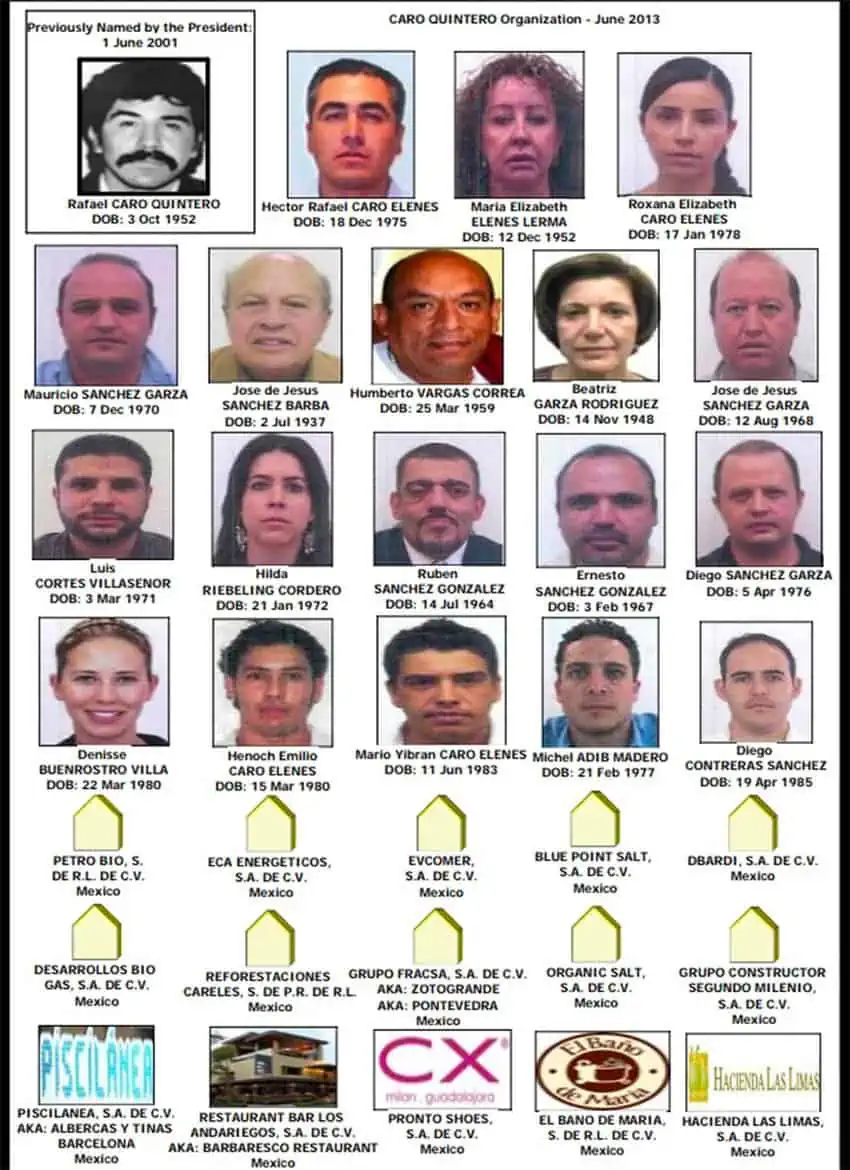
The Caro Quintero organization in 2013.

He was convicted and sentenced to 40 years in jail but was released in 2013, 12 years early, after it was ruled that he was improperly tried in a federal court when the case should have been heard at the state level.

A new arrest warrant was issued soon after Caro Quintero’s release, and in 2018 he was placed on the FBI’s 10-most-wanted list and a US $20-million reward was offered for information leading to his capture.

But the notorious criminal has evaded arrest, and U.S. law enforcement officials said last year that he had returned to the narcotics business as a leader of the Sinaloa Cartel.

However, in an interview published in April 2018 by the news website Huffington Post, Caro Quintero denied that was the case and also recanted his admission of guilt for Camarena’s murder.

Family members of the 67-year-old ex-leader of the now-defunct Guadalajara Cartel have also attracted the attention of U.S. authorities.

All 10 members of his family who were allegedly involved in the establishment of the 30 Guadalajara businesses are on the black list of the Office of Foreign Assets Control (OFAC), a financial intelligence and enforcement agency of the United States government.

Diana Altagracia Espinoza Aguilar, believed to be Caro Quintana’s current partner, was added to the list in 2016. She was allegedly involved in the creation of 24 of the Guadalajara businesses.

Associates of the fugitive have also appeared on the OFAC black list although four were removed in August.

Diana Aguilar has also attempted to benefit financially from the use of the former capo’s full name: Rafael Caro Quintana was registered as a trademark with the Mexican Institute of Industrial Property in 2017, El Universal reported.

Aguilar, a former beauty queen and mother of Caro Quintana’s fifth child who was previously imprisoned on organized crime charges, is listed as the sole financial beneficiary of the commercial use of the trademarked name.

Source: El Universal (sp) 
Michoacán artisan’s embroidery sales soar after Facebook post

0
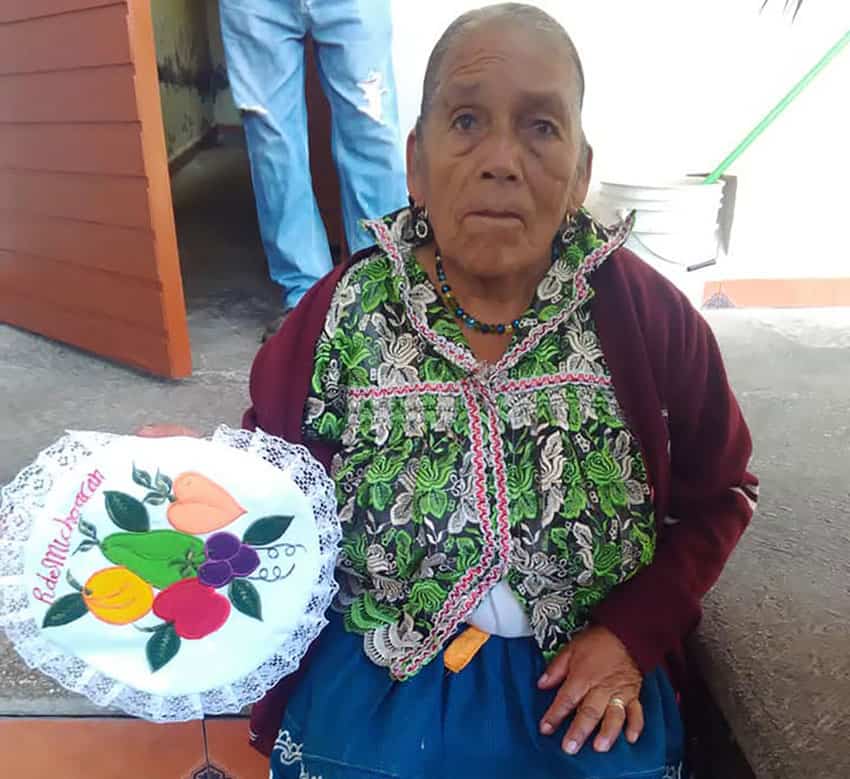
One of the photos that caught readers' attention on Facebook.

An artisan from Michoacán saw the sales of her hand-embroidered napkins soar after a local business owner promoted her work on Facebook.

Doña Adela Vidales, a Purépecha woman from the town of Turícuaro, was sitting in downtown Uruapan looking dispirited when Leopoldo Álvarez saw her.

A Purépecha himself from Pamatácuaro, Álvarez felt moved to ask her what was wrong.

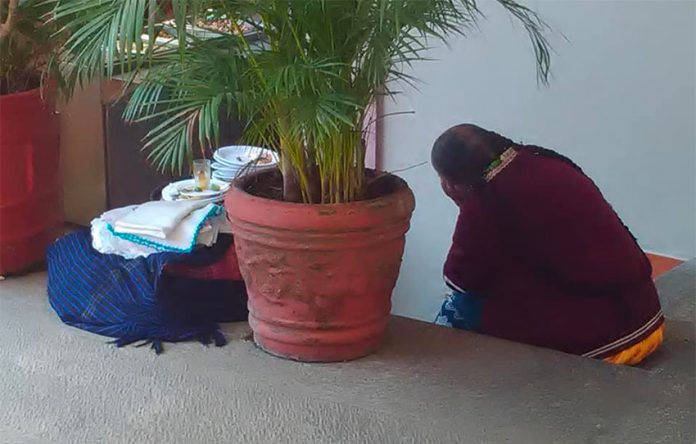
“She looked sad. I took two photos of her back and I asked her why she was sad, and she told me that she hadn’t sold anything . . .” he said in an interview with the newspaper Milenio.

Later, he posted the photos he had taken on Facebook, writing: “Doña Adela was sad because she hadn’t sold her artisanal napkins, and I told her that I was going to promote her products on social media . . . I invite you all to buy from her, she works in downtown Uruapan . . .”

Doña Adela and her embroidery.

The next day, Doña Adela’s napkins sold out.

As of Tuesday, Álvarez’s post had earned over 2,500 likes and 619 comments, and had been shared more than 8,000 times.

“I didn’t think it would have such reach,” he said.

After many followers asked him how to contact Doña Adela, he went to Turícuaro to find her.

“I went back to see her and we spoke. She told me that the next day . . . she went to work and sold everything that day and even finished early . . . people even wanted to take pictures with her,” Álvarez said.

The owner of a catering business, Álvarez said he was happy to help Doña Adela.

He said he plans to promote the work of all artisans of his hometown of Pamatácuaro, who make wooden spoons, whisks and palm frond baskets.

“I’d like to benefit my community, the artisans, that was my intention with Doña Adela, because there are many more artisans like her who live off their sales.”

Source: Milenio (sp)

European-made grand piano a surprise discovery in the Sierra Madre

0
The piano in the Sierra Madre.

One of the pleasures of driving through remote parts of Mexico is expecting or hoping to find the unexpected.

During six transits over 18 months to Guatemala I’ve encountered a unique Mothers’ Day celebration in a cantina in Ensenada, a moving — and far removed from Halloween and trick or treat — All Saints celebration in Zitácuaro and, on the most recent, the Treasure of the Sierra Madre.

Of course I found it in the Sierra Madre, and of course I won’t disclose its exact location.

Treasure comes in many forms. The Sierra Madre treasure’s form today is not bags of gold dust like the ones Bogart lost in the movie, but a spectacularly beautiful and extraordinarily valuable European grand piano, posing regally but totally incognito in a hotel lobby. In a mining town.

Maybe worth over 2 million pesos (US $100,000), a modern treasure.

Move over Steinway and Yamaha. From the late 1700s on, the most prized pianos in the music world have come from the ateliers of the French Erard family, so how did one end up in Mexico’s Sierra Madre?

If pianos could talk, I’d ask it whether it was made for a honky-tonk, a touring culture show featuring a soprano and a Shakespeare reader or the drawing room of the home of a lucky prospector.

Did it get to Mexico from France with the help of burros or mules? Or was it moved inch by inch by a band of struggling laborers like a piano I know in Guatemala that took weeks to deliver to a mountainous road-less destination?

As the photo suggests, the Erard family were also famous for making harps, and true Erard pianos have a distinctive harp feature. The sounding board is polished hardwoods, no doubt of European origin, adding measurably to an image of beauty.

“They’re supposed to be beautiful. It’s part of the act,” according to John, my co-pilot and pianist (and harpist).

Maybe one of the world’s piano sleuths can answer my questions.

I have the serial number.

The writer is a Guatemala-based journalist.

Narcos force 1,000 families to seek refuge in Guerrero

0
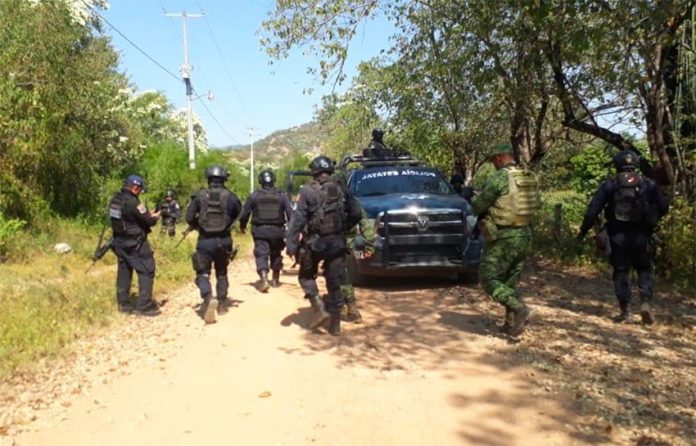
Police at a murder scene in Zirándaro.

Over 1,000 Guerrero families are living as refugees after fleeing their homes due to threats they received from the La Familia Michoacana cartel.

The families are staying in Zirándaro, where Mayor Gregorio Portillo Mendoza said three people had been kidnapped on Sunday and Monday.

He said the kidnappers travel to communities and force local men to arm themselves and go with them. As a result, residents have been fleeing their villages in order to avoid the kidnappers, who also rob families of their homes and vehicles, he added.

The families have fled from at least 14 communities located within the municipality of Zirándaro, and are being provided food and shelter by the local government.

Portillo complained that although federal and state authorities are aware of the insecurity in his municipality, they have not provided support to combat the cartel. He said that around 50 young men have been forced to join the cartel so far this year.

[wpgmza id=”236″]

He said Guerrero Governor Héctor Astudillo promised on Monday to send a contingent of state police and National Guard troops within hours, but none had arrived by Monday evening.

But an official in the Zirándaro municipal headquarters told Mexico News Daily on Tuesday that they had finally arrived.

Source: Reforma (sp)

Mexico needs boost in infrastructure spending to fuel ‘growth it deserves:’ Slim

0
Carlos Slim receives the National Engineering Award from President López Obrador.

Mexico needs a “jolt” in infrastructure spending to trigger economic growth, business magnate Carlos Slim said on Monday.

In an address after receiving the National Engineering Award from President López Obrador, Slim highlighted that China has spent 12% of GDP on public works during the past decade and asserted that Mexico needs to boost its own outlay on infrastructure in order to stimulate the economy.

“We need a jolt, a transformation, a change that allows us to start to have the growth that our country deserves,” he said, adding that people’s purchasing power also needs to increase in order to have sustained economic expansion.

Slim said that infrastructure projects are especially important in the southeast, where the government is planning to build the Maya Train and a new oil refinery, and develop a trade corridor across the Isthmus of Tehuantepec.

As a starting point, the government and private sector should together aim to reach annual investment of 5% of GDP in infrastructure (926.86 billion pesos or US $47.9 billion, according to statistics agency Inegi) and the latter should take advantage of low-interest loans to fund their projects, he said.

“I believe that private investment [in infrastructure] can be substantial, the majority,” Mexico’s richest man said in an interview, adding that a lot of low-interest loans are available across the world.

“We have to take advantage of this funding . . . There is liquidity in the banking sector, there are a lot of resources so what needs to be done is to carry out the greatest number of projects possible,” Slim said.

The Grupo Carso chairman applauded the government’s plan to extend internet coverage to rural areas through the creation of a subsidiary of the Federal Electricity Commission.

“Now with your telephone, if you have an internet connection, you can take Harvard, Stanford or Khan Academy courses in the Tarahumara Sierra, a lot of off-site learning opportunities open up,” Slim said.

The tycoon said that his companies will have invested 36 billion pesos (US $1.9 billion) in Mexico by the end of the year and that the outlay “will be even bigger” in 2020 – “practically 25% of the investment we make in the world.”

Slim said in October that his companies would bid for Maya Train contracts and carry out telecommunications projects during López Obrador’s administration in Mexico and Central American countries.

Source: Reforma (sp) 

Mexico City man arrested after Canadian woman beaten in her Tulum hotel

0
Leslie York, before and after her ordeal in a Tulum hotel.
Leslie York, before and after her ordeal in Tulum.

A Canadian woman’s trip to paradise turned into a nightmare when she was attacked in her hotel room last week in Tulum.

Lexie York of Ottawa, Ontario, was beaten so badly while staying at Tulum’s Grand Bahia Principe resort that she required over nine hours of reconstructive surgery.

York, 29, arrived alone on November 10, planning to meet her mother there the next day.

Around midnight, York left her room to get something to eat. She met two couples also staying at the resort and remained with them in the restaurant until around 3:00am.

After she returned to her room, she heard a knock on her door. It was one of the men she had met at dinner, who authorities have since identified as Ricardo S.P., a 34-year-old chauffeur from Mexico City who was staying at the hotel with his wife.

Suspect in the beating of a Canadian woman in Tulum.

Through a translation app, he told York that his wife had heard screams coming from her room, and he had come to check on her.

She told him she was OK, but the man forced his way into her room and attacked her. She tried to scream, but he choked her and beat her in the face with his fist.

York lost consciousness during the attack and awoke with her eyes swollen shut. She managed to feel her way out of the room to seek help.

York was first taken to a private hospital in Playa del Carmen and later transferred to a hospital in Cancún. Local media reported she had been sexually assaulted as well as beaten.

Her mother arrived on November 11, and her brother Matthew York joined them the next day.

“She had nine hours of plastic surgery. She has nerve damage in her face. The swelling is kind of going down now, but at the time it was quite bad,” he told CBC News.

Lexie York remained in Cancún as of Monday, recovering from her injuries and it was not clear when she would be well enough to travel.

“Every time she lifts her head up she gets dizzy,” her brother said.

A spokesperson for Global Affairs Canada said the family is being provided consular services and that Canadian officials are working with Mexican authorities to resolve the case.

The Quintana Roo Attorney General’s Office said Ricardo S.P. had been arrested connection with the attack.

The Grand Bahia Principe resort issued a statement in response to the attack.

“As soon as the hotel was informed of the incident, staff immediately activated our internal security protocol, including providing urgent medical assistance and alerting the local authorities. We wish Ms. York a speedy recovery and hope that the authorities get to the bottom of this incident as soon as possible.”

Sources: CBC News (en), Mega News (sp)

Student, 19, sells pasties in his school to attend NASA program

0
Legoretta with his NASA certificate.

The Cornish pasty, introduced to Mexico in the 19th century by British miners, has helped a 19-year-old university student from Pachuca, Hidalgo, take another step toward achieving his goal of a career in the space industry.

Rafael Legorreta Castañeda, an aeronautical engineering student at the Metropolitan Polytechnic University of Hidalgo (UPMH), sold the snack on campus to raise funds to attend NASA’s International Air and Space Program (IASP) in Huntsville, Alabama, from October 27 to November 2.

In an interview with the newspaper Milenio, Legorreta, or “El Chico Paste” (Pasty Boy) – as he came to be known at his university – said that attending the program at the U.S. Space and Rocket Center was a dream come true.

“When we’re little, everyone’s dream is to be an astronaut and to get to know the National Aeronautics and Space Administration . . . [NASA astronauts] were the first to travel to the moon, so when I was told that I had the opportunity to participate in this program, I was very excited,” he said.

“Six months ago, the call-out to participate was published and the director of my degree program told me to enter so I did and I met the necessary requirements although I needed to cover the costs. That was difficult because I spent about US $4,500 but with the help of my parents and by selling pasties at university . . . I raised the funds to achieve this dream,” Legorreta said.

His attendance at the IASP couldn’t have been more successful: Legorreta, along with another UPMH student, Andrés Romero Badillo, won the program’s first prize for a project they created.

“We won . . . with a strontium hexaferrite project, it’s a highly magnetic material . . . and the purpose we gave to it was that, combined with paint, it can be a UV radiation insulator as well as a treatment against cancer, among other uses. The prize was that our material will go to space for nine months from Cape Canaveral in May 2020; then they’ll return it to us to continue with the research,” he said.

“Beyond the first place that we won, I feel proud to have achieved my goal [of attending the IASP] and to have represented my country, my state, my city Pachuca and my university, in a dignified way,” Legorreta said.

During the six-day program in Alabama, the UPMH student attended conferences and classes at which he learned about topics such as rocket design and the languages used at the International Space Station. Legorreta also had the opportunity to experience life as an astronaut in a space simulator.

“. . . It was really cool, a great experience,” he said, before offering some inspirational words to other young people.

“Sometimes we don’t have the money necessary to achieve our goals but that shouldn’t limit us or stop us from achieving them . . . Fight for what you think is impossible . . .”

Source: Milenio (sp) 

3-bus crash kills 13, injures 20 on Mexico City-Pachuca highway

0
The accident scene this morning on the Mexico City-Pachuca highway.

A crash involving three buses killed 13 people and injured 20 on the Mexico-Pachuca highway between Mexico City and Ecatepec late Monday night.

The accident occurred when the driver of a bus traveling north attempted to pass by driving on the shoulder. The vehicle slammed into the back of another bus that had stopped for passengers. The second bus then crashed into another that was stationary in front of it.

Initial reports counted nine dead, among them a three-year-old child. However, Civil Protection officials raised the count to 11 when rescue workers found two more bodies inside the wreckage.

The México state attorney general reported on Tuesday that two of the victims among the injured had died in hospital, bringing the total count to 13 dead. Only seven of the 13 had been identified as of Tuesday morning.

Ecatepec firefighters and Civil Protection officials arrived on the scene along with five paramedics units to tend to the injured and remove the dead from the wreckage.

The crash closed the Mexico-Pachuca highway into the early morning hours, and traffic was diverted onto an adjacent highway.

Sources: El Universal (sp), Aristegui Noticias (sp)

No more ice: Mexico City’s Christmas skating rink goes green

0
Christmas skating in Mexico City two years ago.

A skating rink will once again be set up in Mexico City’s central square in December for Christmas celebrations but for the first time ever it won’t be made of ice.

This year’s rink will have an acrylic surface, Mayor Claudia Sheinbaum told a press conference on Monday, explaining that the purpose of the change is to be environmentally-friendly and save public money.

She said that the ice rinks in the zócalo in recent years were expensive both to set up and maintain because they required a lot of electricity. The total annual outlay was around 30 million pesos (US $1.55 million at today’s exchange rate), the mayor said.

This year’s synthetic rink will cost the city much less “not just in terms of rent but also the electricity it consumes and the emissions it generates,” Sheinbaum said. “As I have said [previously], the environment has to be [considered] in our project.”

Christmas festivities at the zócalo will commence on December 15 and include performances by a children’s choir, Sheinbaum said, adding that the traditional Christmas lights that adorn surrounding buildings will use environmentally-friendly LED bulbs.

This year’s celebration will be different because it will be environmental conscious, she declared.

The Morena party mayor, a close ally of President López Obrador, said her government intends to decrease spending on Christmas festivities every year during her six-year term.

Source: Milenio (sp) 

Chichén Itzá 400 years older than previously thought

0
Chichén Itzá is older than previously thought.
The Mayan city is at least 400 years older.

The ancient Mayan city of Chichén Itzá was founded at least 400 years earlier than previously thought, according to the head of a team that is exploring and mapping cenotes, or sinkholes, on the Yucatán peninsula.

Guillermo de Anda, an underwater archaeologist and head of the Great Mayan Aquifer (GAM) project, told the newspaper Milenio that the conclusion is based on studies of carbon remains found in the Balamkanché cave beneath the Yucatán state archaeological site.

It was previously thought that the Mayan people inhabited Chichén Itzá from the year 525 AD but archaeologists now believe that the city’s foundation occurred around 100 AD.

“As archaeologists, of course, we have to base [our hypotheses] on material facts, on things we can analyze [to determine] their age. Precisely according to these specific elements, we’re reaching this specific conclusion,” de Anda said.

The hypothesis will be further analyzed at the First Mayan Aquifer Archaeology Colloquium to be held at the Chapultepec Castle in Mexico City on November 20.

De Anda described studying the Yucatán peninsula aquifer, and especially water tables beneath Chichén Itzá, as “fascinating.” The GAM team last year found hundreds of artifacts in the cave system known as Balamkú or “cave of the jaguar god.”

“. . . We found an altar in . . . Balamkú, where it had been determined that there were no burials but we’ve found and documented human bone fragments. We’re waiting to see what they correspond to, if it was [a place for] funeral rituals or [human] sacrifice. Both Balamkanché and Balamkú are at Chichén Itzá. They are two very important places . . .” he said.

The GAM team, made up of archaeologists, biologists, underwater photographers and cave divers, also discovered in 2018 a link between two systems of flooded caverns in Quintana Roo that together form the world’s largest underwater cave.

Source: Milenio (sp)