Home Blog Page 1717

At risk: 3 million businesses, 28 million workers, says Oxfam

0
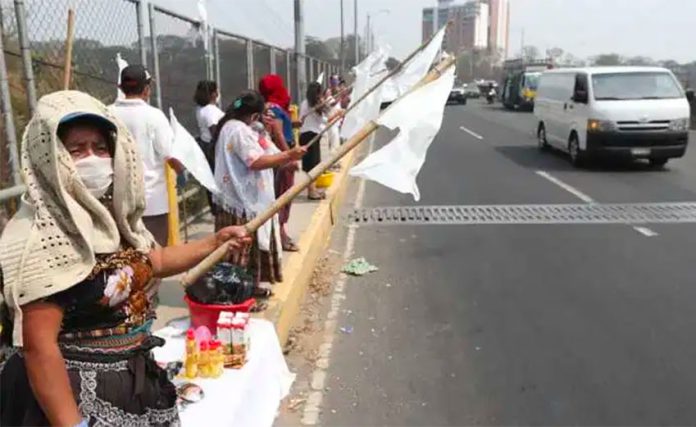
People line a highway in Guatemala on Saturday holding white flags to indicate they have no food. It may not be long before the flags appear in Mexico.

Three million businesses and 28 million workers could be at risk if the federal government doesn’t support them through the coronavirus crisis, according to poverty-fighting nonprofit organization Oxfam México.

The nonprofit predicts that 3 million businesses classified as nonessential by the government will potentially be affected in the short term by the economic downtown caused by the coronavirus pandemic and the measures put in place to limit its spread.

According to 2019 economic data, those businesses generate an annual economic spillover of 1.2 trillion pesos (US $49.5 billion), Oxfam said.

The report also predicted that 28 million workers employed in nonessential sectors could be at risk of losing their jobs or not making enough money to support themselves. The figure accounts for approximately 47% of Mexico’s entire labor force.

Of the 28 million workers at risk, 10 million already live in poverty as a result of low incomes, 16 million don’t have access to social security benefits and 5.4 million struggle to provide enough food for themselves and their families, Oxfam said.

As the figures indicate, some of the vulnerable workers – 85% of whom live and work in urban areas – are afflicted by two or three of the predicaments.

In light of the situation, Oxfam said the government needs to provide financial support to businesses so that they can maintain their workforces and keep employees registered with the Mexican Social Security Institute. For those who live day to day and don’t have access to social security benefits, the government should pay them a basic income during the crisis to cover essentials, the organization said.

Oxfam said that supporting businesses and providing a basic income for informal sector workers would cost less than 2% of GDP but substantially reduce the impact of the coronavirus-fueled economic downturn.

Due to the high levels of poverty and inequality in Mexico, the Covid-19 pandemic is causing three simultaneous crises, it said: health, economic and social.

The health crisis continues to grow, with more than 15,000 people having tested positive for the coronavirus, while the economic crisis is predicted to cause a steep contraction in 2020.

The federal government intends to increase spending on social programs and infrastructure projects to stimulate the economy during and after the pandemic but has announced scant support for business, triggering criticism from business groups and analysts.

President López Obrador continues to insist that “it’s not like before” when such support was tainted by corruption.

Source: El Financiero (sp) 
Coronavirus aid for Manzanillo said to be from Jalisco cartel

0
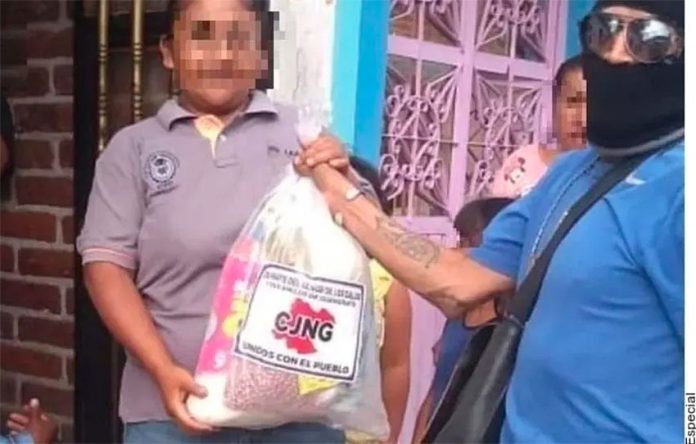
Cartel aid is delivered in Guanajuato.

Presumed members of the Jalisco New Generation Cartel (CJNG) disbursed basic food items and other necessities to poor residents of Manzanillo, Colima, over the weekend.

The armed men claimed to be members of the CJNG, the extremely violent drug cartel led by Nemesio “El Mencho” Oseguera. The packages they delivered to residents bore the cartel’s initials and other identifying images.

“What’s up, our people? We’re here handing out food and supplies to those in need in [the community of] Tapeixtle, in Manzanillo, Colima, on behalf of El Mencho,” says one masked man in a video posted to social media. The speaker and other masked men can be seen driving in a pickup truck holding firearms and holding packages of supplies on their laps.

In another video a man wearing a face mask hands over one of the packages emblazoned with the cartel’s logos, as well as El Mencho’s other nickname, El señor de los gallos (lord of the cocks).

He states that the food and supplies are “from El señor de los gallos, from Guadalajara, who helps his community due to the crisis they are experiencing, so you all know that we’re supporting the people.”

Calling the cartel “the four-letter company,” the masked man assured needy citizens that the drug kingpin is “with them.”

Upon receiving the products, one woman reportedly said the government had forgotten about them.

There have been stories recently of armed men believed to belong to various criminal gangs delivering food and supplies to those in need in states like Morelos, Guanajuato, Guerrero, Jalisco, Tamaulipas and Veracruz.

Despite the reports, federal Interior Minister Olga Sánchez Cordero claimed that the cartel charity in Colima was an isolated incident.

Source: Reforma (sp)

Shop owners attempt to avoid coronavirus closure order

0
mexico city store
Open for business but not openly.

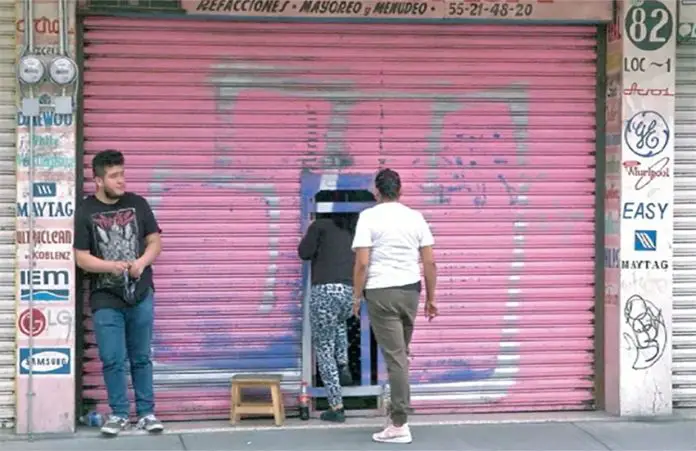
Although the government has ordered nonessential businesses to close, some Mexico City shop owners continue to operate on the sly, opening their doors clandestinely to passersby and whispering an invitation to enter, the newspaper El Universal reports. 

Others simply post their phone numbers on shuttered storefronts, doing business by appointment only. 

A violation of the closure guidelines can bring a fine from city inspectors who enforce the government’s guidelines, but it’s a risk many cash-strapped business owners on streets like Artículo 123 in the city center are willing to take. 

“If they catch us, they will fine us. We have to take care of ourselves,” says Delia, an employee at an appliance store.

Shop owners still need to cover their overhead, despite fines that can reach around US $3,500. 

Elsewhere in the city, a store selling motorcycle parts has taken precautions against the spread of the virus. All workers wear masks, they offer hand sanitizer at the store’s entrance and only allow three customers inside at the same time. Still, sales are down by 70%, an employee reports. 

And at Parque México, one of the capital city’s urban gardens, a popsicle shop shoulders on, albeit shrouded in plastic. There, workers wearing masks and gloves pass their products to customers through a gap in a plastic curtain. 

This would normally be the beginning of their high season as temperatures are on the rise, but the streets are for the most part empty. That situation is unlikely to change before at least May 30, according to government coronavirus guidelines.

Currently, Mexico City is one of the country’s epicenters of contagion and has seen 4,152 confirmed cases of the coronavirus, while 328 people have died.

Source: El Universal (sp)

Mexico City launches online platform to provide coronavirus data

0
Mexico City's new coronavirus portal.

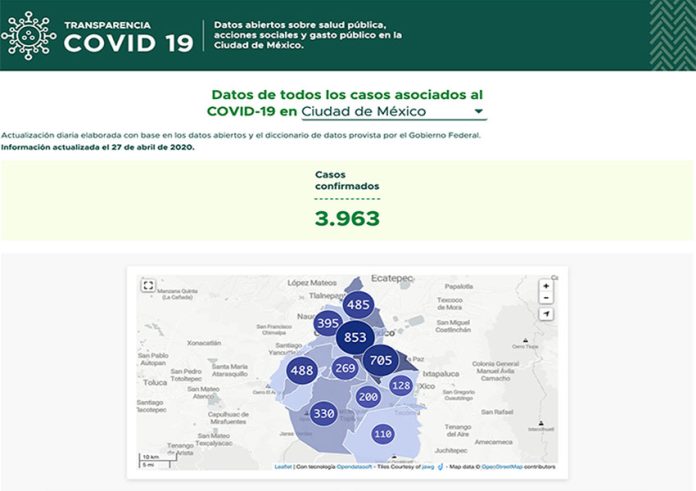
The Mexico City government has launched an online platform to provide data on the development of the Covid-19 outbreak in the city.

Mayor Claudia Sheinbaum told a press conference on Monday that the portal provides geographical information on the distribution of confirmed and suspected cases, organizing them by borough as well as hospital capacity, social programs and public spending.

It also provides specific information on how many people have been hospitalized in each borough and how many of those have been intubated.

The portal will be updated daily at 7:00 p.m.

The platform is meant “to establish a comparison point with the metropolitan area of the Valley of México,” making the information it contains “of the utmost importance,” said Ignacio Chapela of portal developer Centro GEO.

The portal can be found here, but the information is only presented in Spanish. Hospital availability, locations and other pandemic information can be consulted in English via the APP CDMX, also managed by the Mexico City government.

Despite soaring cases in central and southeast Mexico last week, President López Obrador said on Sunday that the coronavirus has been controlled due to the mitigation measures initiated by the government and the public’s general willingness to abide by them.

Source: Milenio (sp)

Coronavirus point man repeats reservations over value of face masks

0
Face masks
Face masks are not necessarily effective, nor are they convenient.

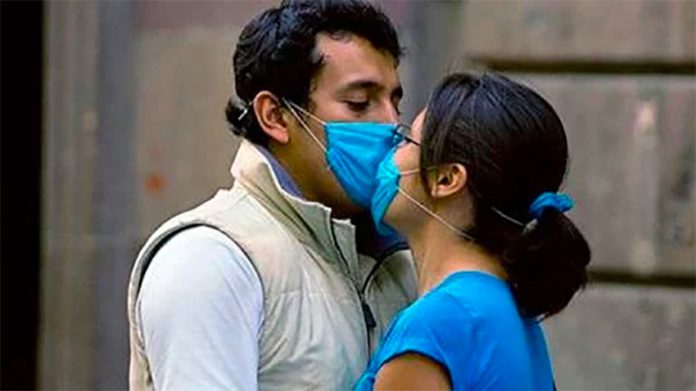
While face masks have become de rigueur during the coronavirus pandemic — and obligatory in many states, their efficacy depends entirely on their proper use, says the Deputy Health Minister Hugo López-Gatell.

On Monday he warned that simply wearing a mask does not mean that one is guaranteed to avoid contracting the virus. 

Masks can be effective for those who do have the virus to prevent them from infecting others, yet there is not yet enough scientific evidence to show whether people without the infection should use masks as a way to protect themselves against the coronavirus, he said.

The World Health Organization guidelines call for washing hands or cleaning them with an alcohol-based sanitizer before putting on the mask, which needs to cover the mouth and nose with no gaps. While wearing the mask you should never touch it, and single-use masks should never be re-used. 

According to an analysis by Mexico’s National Institute of Public Health, four out of six studies found that the use of masks did not reduce the spread of acute respiratory infections.

López-Gatell said that the masks can be uncomfortable, hot and itchy, and that people will take them off for those reasons, or to eat, therefore reducing their efficacy. Also, he pointed out, the virus can still enter through a person’s eyes. 

“Some people wear the mask for 15 minutes, and they take it off, they wear it as a hat, they touch their faces. And that’s where the biggest unknown is,” he said.

And some people can experience a false sense of security and neglect other essential coronavirus guidelines, like staying at home, social distancing and hand washing. 

Despite many states mandating the use of masks in public, it’s the latter measures that really help control the spread of the virus. “It does not seem inconvenient to me that some state health authorities recommend the use of masks,” López-Gatell said. “But if by paying attention to masks we start to reduce the other massive mitigation measures, we would be diverting attention and reducing the most effective ones.”

Source: El Financiero (sp), Expansión Política (sp)

Cartels believed hurting due to partial border closure

0
Both traffic and trafficking are down at the Mexico-US border.

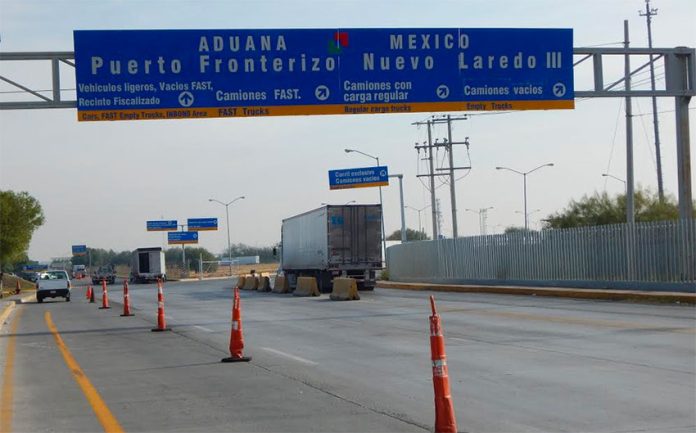
The prohibition of nonessential travel between the United States and Mexico has affected the ability of Mexican cartels to ship drugs north and dollars south, according to the U.S. Customs and Border Patrol (CBP).

CBP data reveal that from February to March, as the United States began to impose strict travel restrictions in the face of the growing Covid-19 outbreak, seizures of drugs and cash dropped substantially, as did the rate of human trafficking.

Seizures of cocaine, fentanyl, methamphetamine and heroin all decreased, while confiscations of marijuana rose slightly. The four harder drugs, whose movement appears to have been seriously affected, represent the bulk of sales for the drug cartels.

In March, as the pandemic began to seriously affect the United States and Mexico, the Pentagon deployed 500 additional troops to reinforce the more than 20,000 Border Patrol officers on the frontier.

This beefed-up military presence and the decrease in automobile traffic entering the United States lowered the number of drug mules smuggling contraband north.

“It’s not easy for the cartels to hide their shipments [during the health crisis],” said Víctor Manjarrez, former head of the Border Patrol offices in El Paso, Texas, and Tucson, Arizona.

The drug that has seen the biggest decline in movement and seizures is cocaine brought from Bolivia and Colombia, whose seizures fell by almost half, from 5.8 tonnes in February to 2.9 tonnes in March. This was followed by methamphetamine, which fell 31.3%, from 6.1 to 4.2 tonnes in the same period.

The amount of heroin confiscated at the border fell 16%, from 177.3 kilos in February to 149.2 in March, and fentanyl seizures fell 8.6%, from 126 kilos to 115.2.

The CBP has also seen a decrease in the movement of cash. Seizures fell 61.3% in March. U.S. authorities confiscated US $14.16 million in February, but that number fell to $5.48 million in the following month.

Source: Milenio (sp)

May 15 could see a return to normal in Jalisco: governor

0
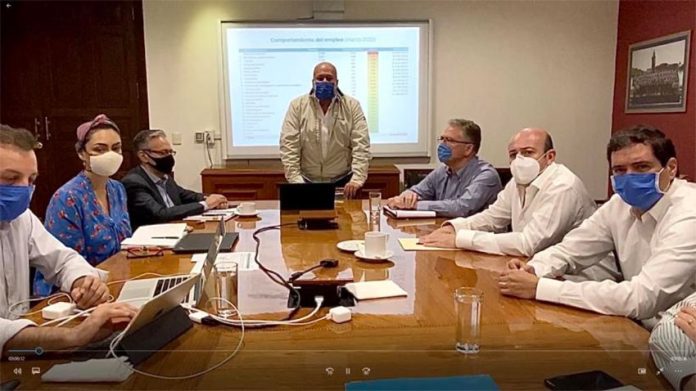
Governor Alfaro, center, at a meeting of senior officials on Monday.

Despite a continued rise in cases of the coronavirus, Jalisco Governor Enrique Alfaro Ramírez says that his state may be ready to ease pandemic-related restrictions as early as May 15. 

The forthcoming “Economic Reactivation Plan for Jalisco” will incorporate the advice of businesses, union leaders, specialists, academics and researchers, and will weigh both the economic and health consequences of a gradual reopening of the state, Alfaro announced.

Jalisco, with a population of around 8.25 million, has been under quarantine since March 17, a week before the federal government announced nationwide stay-at-home guidelines. It saw its first two confirmed coronavirus cases on March 14, and currently has a rate of infection of 3.6 per 100,000 residents. 

“We are going to start a process of a gradual return to a new normality; we understand that there is enormous economic pressure on many families,” the governor said.

The plan to reopen the state is still very much in draft form, he emphasized, and will depend on how the spread of the virus unfolds, but the governor said the public discussion over terms of lifting the quarantine could begin as early as next week. 

While health concerns remain at the forefront, economic pressure is also a factor weighing heavily in the governor’s mind. Measures to help small businesses, especially in the tourist sector, will be implemented in order to kickstart financial recovery. However, Alfaro cautioned that strict sanitary protocols would be the backbone of any plan for the gradual reopening of his state.  

The seven most affected areas of the country are Mexico City with 4,152 cases, the State of Mexico (2,455), Baja California (1,301), Sinaloa (795), Tabasco (819), Quintana Roo (653) and Puebla with 552.

Currently, Jalisco has 303 confirmed cases of the coronavirus and recorded 25 deaths, whereas 87 people have recovered.

Source: El Occidental (sp), Infobae (sp)

44 million live in the municipalities most vulnerable to coronavirus: study

0
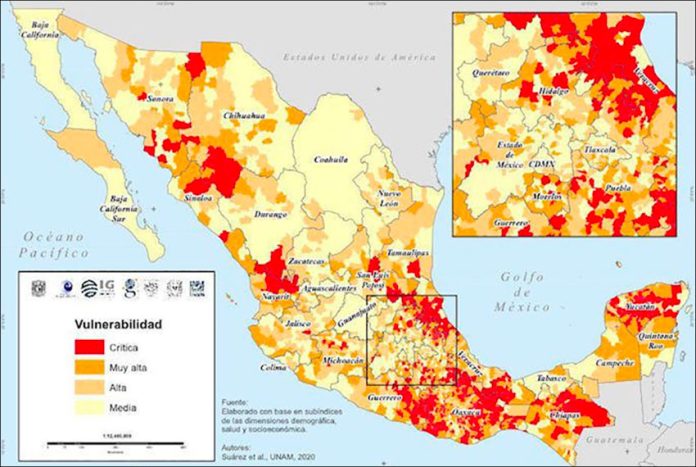
The municipalities deemed most vulnerable are shown in dark red.

Almost 44 million people live in municipalities that are particularly vulnerable to the coronavirus pandemic, according to a study by academics at the National Autonomous University (UNAM).

Entitled Vulnerability to Covid-19 in Mexico, the study found that 1,837 of the country’s 2,457 municipalities – 75% of the total – are critically, very highly or highly vulnerable to an outbreak of Covid-19 because they have a high percentage of residents aged over 60, have large indigenous populations, lack hospital services and medical personnel and/or are economically disadvantaged.

There are 607 municipalities considered critically vulnerable, of which 71 have already reported coronavirus infections; 611 municipalities with very high vulnerability, of which 131 have confirmed Covid-19 cases; and 619 highly vulnerable municipalities, of which 188 have at least one resident who has tested positive.

The most vulnerable municipalities are in Oaxaca, Guerrero, Chiapas, Yucatán, the Huasteca region of Puebla and Veracruz, southern Durango and the Sierra Tarahumara region of Chihuahua, the UNAM study found.

“The greatest vulnerability is concentrated in the country’s most marginalized municipalities, where access to health services is also limited,” said Manuel Suárez, a researcher at the UNAM Institute of Geography who contributed to the study.

“Infections must be prevented at all costs in these municipalities because … health services are practically non-existent,” he said.

While the majority of Covid-19 cases are currently concentrated in large urban areas such as Mexico City and Tijuana, the UNAM academics fear that the virus will also spread to vulnerable rural municipalities that have not yet been directly affected.

“It’s important to locate them and acknowledge them, to understand that they are particularly vulnerable,” said Samuel Ponce de León, a medical doctor and coordinator of the UNAM health research program.

The consequences of Covid-19 outbreaks in sparsely-populated municipalities with “very fragile economies” could be “particularly serious,” he said.

The academics said that maintaining and/or increasing measures to prevent the spread of Covid-19 to the country’s most vulnerable municipalities is imperative even if they have not yet recorded any cases.

They said that the possibility of lifting restrictions in municipalities with very few or no cases before the end of the health emergency period currently scheduled to run through May 30 – as Deputy Health Minister Hugo López-Gatell indicated could occur – must be carefully evaluated because such municipalities could remain vulnerable to new infections originating outside their borders.

Publication of the UNAM study comes as confirmed Covid-19 cases and coronavirus-related deaths continue to increase at a steady rate.

The federal Health Ministry reported 852 new cases on Monday, taking the total to 15,529, and 83 new fatalities, lifting Mexico’s coronavirus death toll to 1,434.

Director of Epidemiology José Luis Alomía said that there are also 8,614 suspected Covid-19 cases across the country and that more than 71,000 people have now been tested for the disease.

Of the more than 15,000 confirmed cases, 5,009 are considered active, meaning that those infected presented with symptoms  in the last 14 days.

Alomía said that 20% of just over 16,000 hospital beds across the country that have been set aside for Covid-19 patients are currently occupied. However, the occupancy level in the three states with the highest number of cases – Mexico City, México state and Baja California – is much higher at 56%, 42% and 55%, respectively.

Mexico City, where more than 4,000 people have now tested positive for Covid-19 since the first case was detected at the end of February, has also recorded the highest number of coronavirus-related deaths with 328.

Baja California follows with 167 and México state and Sinaloa with 122 deaths each.

Source: El Universal (sp), Milenio (sp) 

AMLO’s cuts will impact nearly 17,000 small, medium-sized businesses

0
amlo
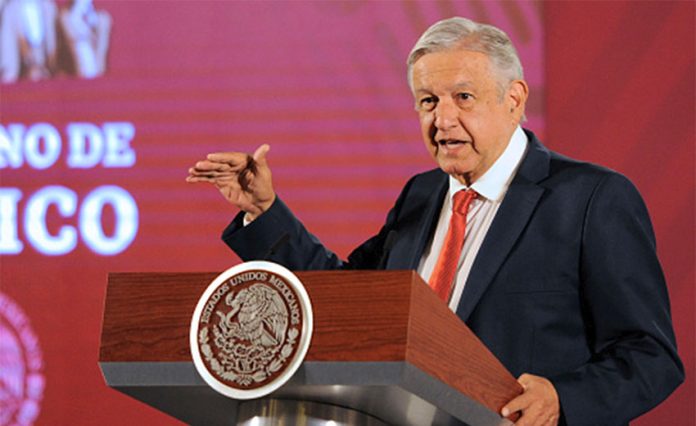
Yet more businesses will feel the pinch as López Obrador further cuts spending.

The spending cuts announced by President López Obrador to bolster expenditures on social programs and infrastructure projects amid the coronavirus crisis will have a negative impact on almost 20,000 businesses, the vast majority of them small and medium-sized.

López Obrador said last Wednesday that 75% of the federal budget approved for the payment of general services and the purchase of supplies will not be used in 2020, allowing 622.5 billion pesos (US $25.2 billion) to be redirected to infrastructure and welfare spending.

It follows that government suppliers will see their income affected. According to a government registry, 17,132 of 19,440 businesses that provide goods and services to the government – 88% – are micro, small and medium-sized.

The government’s spending cuts will therefore make it even more difficult for them to survive the sharp economic downturn caused by the coronavirus pandemic and the measures implemented to limit its spread.

Violeta Rodríguez del Villar, a researcher at the National Autonomous University who specializes in public finances, told the newspaper La Jornada that redirecting spending to social programs and infrastructure – López Obrador also announced that the salaries of high-ranking officials would be cut by 25% – is “laudable” but warned that more government supported is needed for business.

She said that the economy won’t grow if the government doesn’t widen its support to sectors other than the state-run petroleum industry, which the López Obrador administration continues to prop up via tax breaks and cash injections for the national oil company Pemex.

Government support “has to be considerably more diversified,” Rodríguez said.

Various economists and other financial experts have also been critical of the government’s failure to provide support for businesses as they face the coronavirus-induced economic shock.

The measures outlined by López Obrador last week are “completely insufficient,” said James Salazar, an analyst at CI Banco. “More targeted support measures are needed considering that there are sectors that are very badly hit.”

With the government providing scant fiscal policy support for sectors that have seen their revenue collapse, the economy is expected to contract sharply in 2020, with several financial institutions and international organizations forecasting downturns in the range of 5% to 10%.

Source: La Jornada (sp) 

Unfinished health facilities, tardy conversion plan hinder virus treatment

0
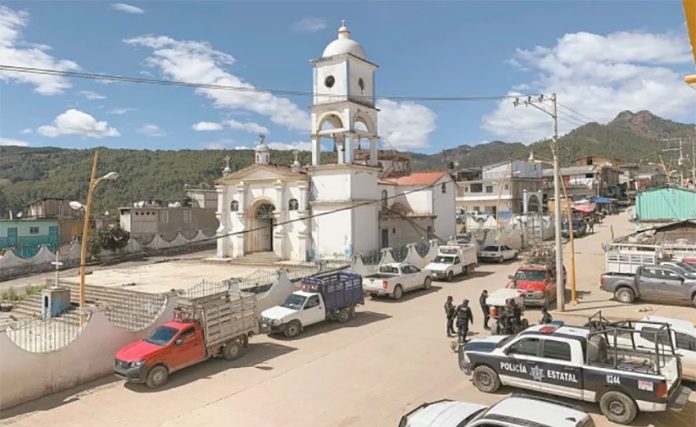
Treatment is eight hours away for people who live in Cochoapa.

Guerrero is ill-prepared to respond to the coronavirus pandemic given that many municipalities don’t have hospitals capable of providing critical care to Covid-19 patients. So many residents are hours away from health care facilities should they require urgent medical attention.

Making the situation worse is that the state government has not yet executed its plan to convert eight hospitals into specially-designated Covid-19 facilities.

Statistics already show that Guerrero residents are more likely to die from Covid-19 than Mexicans more broadly: there have been 29 deaths in the state from 200 confirmed cases, a fatality rate of 14.5% – more than 5% higher than the nationwide rate of 9.2%.

Part of the health care accessibility problem is that there are 10 incomplete health care facilities in the state.

Five of them are in Chilapa de Álvarez, located in the Montaña region east of the state capital, Chilpancingo.

One of the incomplete facilities is the general hospital, which is 85% finished eight years after construction began. However, the army was given the task last week of preparing it to receive Covid-19 patients although it is not known when it will be ready.

The other five incomplete facilities are a community hospital in Tlacoapa, clinics in Chilpancingo, Acapulco and Marquelia and the general hospital in Ayutla. The latter project is only 25% complete even though it was originally scheduled for completion in 2019.

With no facilities in Chilapa or the wider Montaña region currently equipped to receive coronavirus patients, residents requiring hospitalization for Covid-19 would have to travel to Chilpancingo.

For residents of Tlapa de Comonfort, the trip to the state capital takes five hours while for those in Cochoapa el Grande, it’s an eight-hour journey. The chances of survival for a critically ill coronavirus patient could diminish in minutes without adequate care let alone hours, leaving residents of medically-isolated communities particularly vulnerable.

The situation is similar for some residents of the Costa Chica and Costa Grande regions.

Residents of San Marcos and Copala in the former region, where there are already confirmed cases of Covid-19, and Coyuca de Benítez in the Costa Grande would have to be transported to Acapulco for treatment should they fall critically ill, El Universal said.

However, even in Acapulco they might struggle to find a hospital where they can receive the specialist treatment they require: state authorities are planning to convert eight hospitals into dedicated Covid-19 facilities, including two in the Pacific coast resort city, but Governor Héctor Astudillo has indicated that the conversions might not occur until May 23.

As things currently stand, no hospital in Guerrero is ready to confront a pandemic of the size of the coronavirus crisis, said Chilpancingo doctor Verónica Ortiz Zúñiga.

Even if the government goes ahead with the plan to convert eight hospitals for the treatment of Covid-19 patients, they might not have enough specialist medical personnel to staff them because specialized doctors are at a premium, she said.

She explained that there is only one specialist intensive care doctor at her workplace, Chilpancingo’s Raymundo Abarca Alarcón General Hospital, and seven or eight internists.

There are six beds in intensive care but only four of them are in working condition, Ortiz said, adding that there are only two ventilators in the ward.

With coronavirus cases rising quickly in Guerrero – case numbers increased by about 60% over the past week – hospitals in the state capital and elsewhere in the state could quickly become overwhelmed.

Thirty-five people have tested positive for Covid-19 in Chilpancingo, the second most affected municipality in Guerrero after Acapulco, where there were 92 confirmed cases as of Sunday.

Source: El Universal (sp)