The Secretariat of Health (Salud) has confirmed 12 cases of measles and is investigating over 500 more possible instances of the disease.
The number of confirmed cases could increase as the tests are processed.
The cases have been brought to Mexico by travelers from abroad, but Tourism Secretary Miguel Torruco said his department is not concerned about the disease.
The most recent case occurred in Playa del Carmen, Quintana Roo, in early August when a health worker was infected by an Austrian tourist. It was the state’s fourth this year.
Cases have also been confirmed in Chihuahua, Nuevo León, San Luís Potosí and México state.
All of the confirmed cases have been described as “imported,” primarily by tourists who visit the country unvaccinated. Studies revealed the viruses came from Europe and Africa, although there are six cases in which the source of the virus is still unknown.
Prevention and health promotion undersecretary Dr. Hugo López-Gatell Ramírez said that Mexico is potentially at risk for larger outbreaks of measles as vaccination rates have declined in recent years.
In the previous presidential administration, they fell to a “historically low” 70%, he said. Vaccination rates need to be as high as 95% in order to guarantee the prevention of outbreaks.
Mexico eradicated measles in 1996. There was one native case of the disease in 2006, but the country has not seen numbers like this year’s for decades.
López-Gatell stated that there are currently red-flag areas outside Mexico that could be cause for worry, such as New York City, which declared a public health emergency earlier this year due to an outbreak.
The Health Secretariat issued recommendations for the prevention of measles in April for people traveling to Europe and the United States, in which it listed specific U.S. states that had confirmed cases of the disease.
The office declined requests for an interview.
Despite the cases in Mexico having been brought by foreign visitors, Tourism Secretary Miguel Torruco Marqués told Mexico News Daily that his department is not concerned about the disease and there are currently no vaccination requirements for tourists entering Mexico from countries where measles is a problem.
Peace is coming to Mexico in spite of continuing crime, the security secretary said.
Public Security Secretary Alfonso Durazo told a press conference Friday that although the administration’s anti-crime strategy has not yet been successful at reducing crime levels, Mexico is getting closer to achieving peace.
“We are confident that the day is near when peace and tranquility will return, and that’s not wishful thinking,” he said. “Even though there are events with a level of brutality like that of Coatzacoalcos, we have the National Guard thanks to support from Congress, which will allow the state to guarantee peace and security.”
Durazo noted that security won’t be achieved overnight, and admitted that the National Guard still doesn’t have the numbers it needs.
“We have the Guard, but our short-term challenge is that it’s still not big enough to guarantee security,” he said.
There are currently 60,000 National Guard troops deployed around the country. Durazo said the government hopes to end 2019 with 80,000, and have 150,000 by 2021.
He added that although crime rates have not declined, the fact that they have not risen can be attributed to the administration’s policies.
“With the measures we’ve been taking in this government, we’re sure that we’ll be able to deliver good results to the public,” he said. “We can say that we’ve been able to halt the growth of the rates of most crimes.”
Cacho: 'It's equivalent to a sentence or sanction for doing my job.'
Journalist and human rights activist Lydia Cacho Ribeiro has now spent one month in “forced displacement” outside Mexico after attacks on her home in July.
On July 21, thieves broke into Cacho’s home, poisoned her dogs and stole electronic equipment containing her journalistic work.
Press freedom and human rights organization Article 19 denounced Cacho’s exile and the state of human rights and impunity in Mexico in a press release.
“It is unacceptable that in Mexico the survivors of torture and grave violations of human rights cannot count on a minimum guarantee [of safety]. Meanwhile, the perpetrators and their accomplices are guaranteed to be able to continue their criminal actions,” said the organization.
Courts are still processing injunction proceedings for Adolfo Karam, Mario Marín, and Kamel Nacif, the three men allegedly involved in Cacho’s 2005 kidnapping and torture. All three remain fugitives.
“It seems as though the interests that protect the politico-business mafia that makes up the international networks of pedophilia and human trafficking of minors are much bigger than any attempts to legitimize oneself before the law,” said Article 19.
Cacho is the author of The Demons of Eden (2005), which implicated businessmen Jean Succar Kuri, of Quintanaa Roo, and Kamel Nacif, the “denim king” of Puebla, in an international pedophilia ring.
“To be outside of my country is equivalent to a sentence or sanction for doing my job and searching for justice. I find myself in a situation of forced displacement with the subsequent violation of my human rights of integrity, liberty and security because of the incapacity of the Mexican state to protect me as a survivor of torture and to guarantee me justice,” the journalist said.
Article 19 asked the government to guarantee Cacho’s safety and demanded “that the Mexican state execute the orders of the federal Attorney General’s office with all due diligence, as there is no justification for delaying the arrests.”
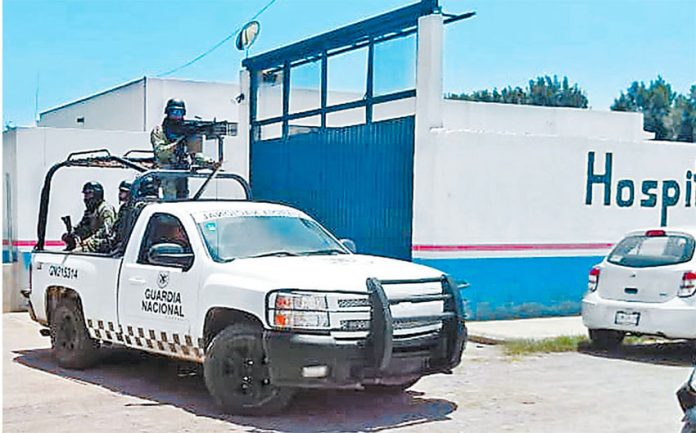
National Guard on patrol at a hospital where wounded hitmen were being treated after yesterday's gun battle.
The Jalisco New Generation Cartel (CJNG) yesterday fulfilled its promise to attack the Michoacán municipality of Tepalcatepec, leaving nine presumed cartel hitmen dead.
Convoys of pickup trucks filled with men and armed with Barrett 50-millimeter rifles began entering communities in the municipality around 7:00am, clashing with municipal police.
In the municipal seat of Tepalcatepec, the shooting ended around 10:00am but in the communities of Loma Blanca, La Estanzuela and Plaza Vieja, fighting continued for another hour and forced schools and businesses to close.
Residents said they called for help when the shooting began but security forces from outside the municipality did not arrive until noon.
Nine people were killed in the gunfire, while 11 others were wounded and 11 vehicles were damaged.
On August 13, a video circulated on social media showing 18 masked men who identified themselves as CJNG members threatening to attack territory held by former ally Juan José “El Abuelo” Farias Álvarez in Tepalcatepec.
Farias came to attention in 2013 as a leader of one of the self-defense groups that were fighting against the Caballeros Templarios cartel in the state. However, he has also been linked to the CJNG and its leader, Nemesio Oseguera.
According to some reports, the Michoacán self-defense campaign was really part of a strategy of the CJNG against the Caballeros Templarios.
“Our conflict isn’t against the people. We’re going to fight against ‘El Abuelo’ and anyone who helps him,’” one of the men in the video says.
Farias, who has been under suspicion for drug trafficking and other criminal activities for several years, has been arrested at least once, the most recent in May last year. But due to inconsistencies in evidence given by navy marines, who made the arrest, he was released. He returned home to Tepalcatepec to a hero’s welcome.
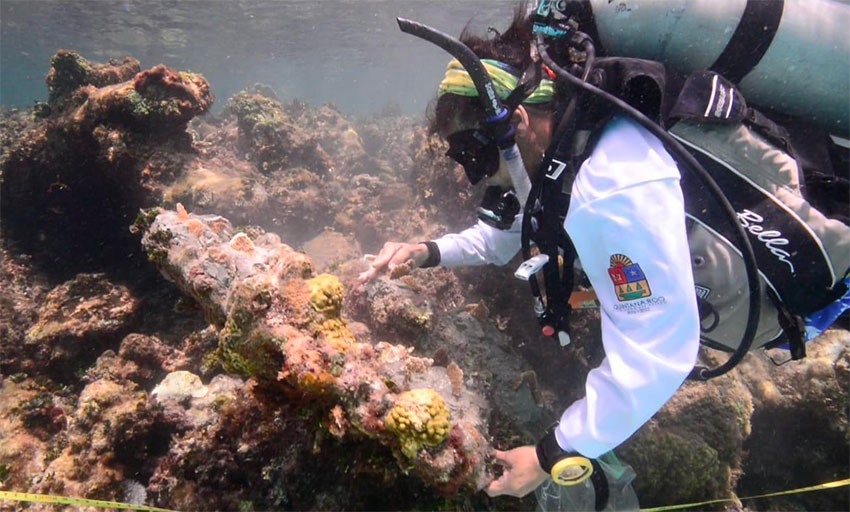
Three thousand colonies of lab-grown coral were planted in the Garrafón reef near Cancún, Quintana Roo, on Thursday.
The replenishment of the reef is part of a 12-million-peso environmental strategy of the Quintana Roo government, which is aiming to plant 265,000 coral colonies in reefs off the state’s coast by 2022.
More than 30 divers and a similar number of snorkelers completed Thursday’s mission, planting 11 different species of coral that was grown in the laboratories of the National Institute of Fishing, the National Protected Areas Commission and the National Autonomous University.
The Quintana Roo Environment Secretariat (SEMA) said in a statement that the Garrafón reef, located within the Isla Mujeres-Punta Cancún-Punta Nizuc Western Coast National Park, was specifically chosen for replenishment due to the devastation it suffered when Hurricane Wilma passed through the Caribbean Sea in 2005.
The reef restoration project began in 2017 after Governor Carlos Joaquín González pledged to plant the same quantity of coral as votes he attracted in the 2016 election.
Divers planted 3,000 colonies of coral on Thursday.
SEMA said that 27,676 corals have so far been planted at 12 different locations within four different reefs located off the coast of Isla Contoy, Isla Mujeres, Puerto Morelos, Playa del Carmen and Akumal.
Most of the coral has been grown through micro-fragmentation, a technique in which coral is broken into smaller pieces using a specialized saw.
That “stimulates the coral tissue to grow, allowing them to grow into clones at 25 to 50 times the normal growth rate,” according to an article about the technique published on the website Medium.
“Clone fragments recognize each other so instead of fighting each other for resources fuse together to form larger colonies. After four to 12 months the fully-grown corals are ready to be planted back into the ocean or fragmented to restart the process,” the article said.
SEMA said the lab-grown coral is monitored after it is introduced into the ocean, adding that results show that there is a 95% survival rate.
Large amounts of coral are dying off in reefs off the coast of Quintana Roo due to a bleaching phenomenon caused by overly warm water, while the arrival of large quantities of sargassum also affects reef health.
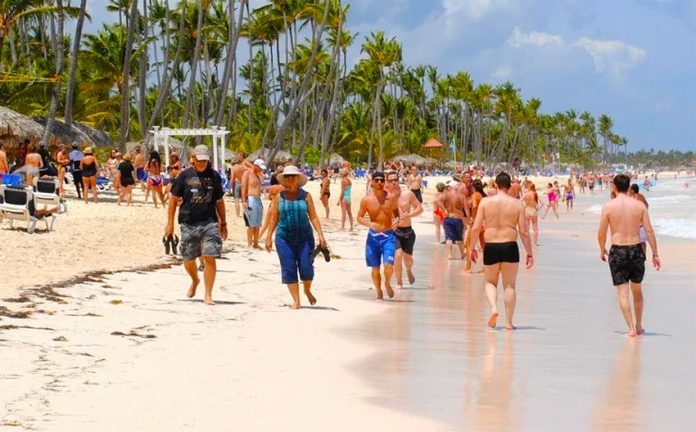
Punta Cana, Dominican Republic, is popular with US and European tourists.
The deaths of at least nine United States tourists in the Dominican Republic over the past year are providing a boost to Mexican tourism.
North Carolina travel agent Heather Di Pietro told the travel site Travel Market Report that she has “definitely seen a slight swing in clients revisiting Mexico as an option” as the result of the Dominican Republic deaths, some of which might have been caused by tainted alcohol.
“We have even had a few clients who booked months ago stating ‘anywhere but Mexico’ during the booking process, that have now switched their vacation to Cancún,” she said.
Travel Market Report said that statistics in its upcoming report 2019 Outlook on Mexico also show that travelers who disregarded the idea of coming to Mexico because of security concerns – or other issues such as sargassum or tainted alcohol – are now looking at the country again.
Just over half of the 800 U.S. travel agencies surveyed by the travel site said that clients who don’t want to visit the Dominican Republic because of news of the tourists’ deaths are now looking at Mexico.
“What’s happening in Punta Cana and the Dominican Republic right now definitely put Mexico back as the frontrunner again. Now, with all the Dominican Republic stuff, I push Mexico more,” said New Jersey travel agent Maria Tilton.
I am getting . . . higher bookings to Mexico because of the DR thing, but it’s not the way you want them.”
Michelle Bouzek, a travel consultant in Austin, Texas, who has been selling vacations to Mexico for 11 years, also said that she is seeing increased interest in traveling to Mexico.
However, Tilton acknowledged that Mexico still isn’t an easy sell because of the pervasiveness of violence in the news.
“Every time something happens in the media, it just sets us back 10 steps,” she said.
The anecdotal evidence that more Americans are looking at visiting Mexico comes the same week as the Visit México tourism promotion platform was relaunched with private sector funding.
The site’s new chief, Marcos Achar, expressed optimism that the updated platform will help to attract more visitors to the country.
Tourism experts said in March that the government’s decision to disband the Tourism Promotion Council will benefit other holiday destinations in the region such as Jamaica and the Dominican Republic.
However, that was before the deaths in the latter country hit the headlines.
Dominican Republic Tourism Minister Javier García told reporters in June that the deaths were not part of a mysterious wave of fatalities but a medically and statistically normal phenomenon that has been lumped together and sensationalized by United States media.
He said that autopsies showed that the tourists died of natural causes.
Magic mushrooms brought thousands of people to Mexico in the 1960s.
The Mexican Psilocybin Society, an advocate for legalization of the active ingredient in magic mushrooms, is sponsoring a march in Mexico City September. John Pint reports that the group hopes to get psilocybin reclassified, opening the door for research into its use in combating anxiety and depression.
August is mushroom month in many parts of Mexico. Recently, while hiking across a meadow in the highlands of Jalisco, I came upon a person crouching in the middle of the trail, examining some small brown mushrooms that had sprouted in droppings left by a passing cow.
“Do you know something about mushrooms?” I asked.
“Well, I know something about this particular toadstool. This is Psilocybe cubensis and it’s world famous.”
At that, I pulled the mini-recorder out of my camera bag and asked if I could record what he was about to tell me.
Psilocybe cubensis grows on cow dung which is “not too wet and not too dry.”
“You can record me,” he said mysteriously, “but you can’t take my picture and you can’t use my name.”
“OK,” I replied, “so what about these toadstools?”
“They are known everywhere as magic mushrooms,” he said. “They contain a chemical called psilocybin that was first analyzed by Albert Hoffman, the Swiss scientist who isolated and studied LSD. These mushrooms are found all over the world . . wherever you find cow or buffalo pies.
“People who consume them say the ‘trip’ doesn’t show you pink elephants, but makes you feel loved and ‘cleans your heart.’ So, this mushroom typically changes people in a good way and there are studies to back this up. Here in Mexico it’s been used for 3,000 years for sacred and medicinal purposes and was called teonanácatl (god fungus) by the Aztecs.
“In the 1960s crowds of young people from the U.S. used to flock to the village of Huautla de Jiménez in Oaxaca’s Sierra Mazateca to see a curandera (healer) named María Sabina who was an expert in the use of these mushrooms. Eventually celebrities like John Lennon, Mick Jagger and Bob Dylan turned up. But all that publicity did its damage and poor María Sabina ended up being thrown out of her own community.
“Curiously, today the village of Huautla is known more for its deep caves than it is for its mushrooms.”
Picking a mushroom: reach for the bottom of the stem; gently twist and pull.
My source went on to tell me that a micro-dose of psilocybin has been found to be very effective in alleviating depression and anxiety.
“These doses are very, very small. They don’t induce a ‘trip’ but nudge the user in a certain, very beneficial direction. They represent an alternative to expensive and addictive anti-anxiety agents such as alprazolam (sold as Xanax and Tafil), for example.”
He told me that people who take these micro-doses gain a sense of what their body needs or does not need. Alcoholics, for example, might start asking why they’re drinking and decide to give it up.
“You start seeing problems from a new perspective, from above. And you no longer feel stressed. If there’s a solution, you use it; if there’s no solution, you forget about it. And your creativity goes sky high.
“. . . a person who feels depressed, who feels that life is not worth living, who doesn’t want to get out of bed, takes a micro-dose and everything changes. This person says, ‘Wow, do you see the colors of those flowers?’ You start to value all the things that are around you; all the things you were taking for granted. So, you start changing and little by little to realize you are leading a better life. And this, in turn, makes life better for the people around you.”
This was a big eye-opener for me. I realized my informant knew a lot about the effects of micro-doses of psilocybin on depression, so I asked if he could share some cases of people who had tried it.
Mushrooms grown at home for micro-dose research.
“Yes, let’s take the case of someone we’ll call ‘Pepe Gonzalez’ . . . he had some issues . . . and decided to give it a try. After about three weeks, he said, ‘I don’t know if I’m going to continue to take this. I don’t feel any change.’ But his wife turned around and told him, ‘You stop taking those pills and I will divorce you on the spot!’”
My mushroom-expert friend continued: “I happened to speak to his son and mentioned that his father was taking psilocybin. ‘Oh ho!’ said the son, who was a very open-minded young man. ‘When did he start taking this? Three weeks ago, right?’ I told him that was exactly when his father had started and asked him how he knew. ‘Because,’ replied the son, ‘I saw a beautiful change in my father, a real transformation, and it started three weeks ago.’“
Psilocybe mushrooms can be found just about everywhere, but they are also classified as illegal just about everywhere. Nevertheless, a great deal of informal experimentation with them has gone on for some time. According to Scientific American, many psilocybin micro-dosers have reported that the mushrooms can increase creativity, calm anxiety, decrease the need for caffeine and reduce depression.
The website Pharmaceutical Technology reports that, in 2018, Compass Pathways, which studies psilocybin in treatment-resistant depression patients, “received the green light from the U.S. Food and Drug Administration for starting a . . . study with 216 patients, the largest clinical study ever done with psilocybin . . . . If successful, Compass will start a . . . trial with a view to file for approval in 2021.”
The report also cites a successful double-blind study at Johns Hopkins showing that some 80% of participants suffering from depression or anxiety enjoyed considerable relief for up to six months from just one dose of psilocybin.
“This,” says Pharmaceutic Technology, “is remarkable news considering that (most) depression medications on the market can take weeks or months to show effects, and sometimes these are modest and come with damaging side effects.”
[soliloquy id="88157"]
After learning about magic mushrooms, I was not at all surprised to read that the Mexican Psilocybin Society is sponsoring a march in Mexico City September 20 promoting legalization of psilocybin. It is now classified as a Type 1 drug — highly addictive and of no medical use. The group hopes to get it reclassified as Type 2, opening the door for research into its use in combating anxiety and depression.
If the society succeeds, raw materials for study will be easy to find. Many a time I have hiked to what I thought was the most inaccessible corner of Mexico and, just when I thought I was the only living creature in that remote spot, I would glance down and discover that I was standing in a cow pie.
The writer has lived near Guadalajara, Jalisco, for more than 30 years and is the author of A Guide to West Mexico’s Guachimontones and Surrounding Area and co-author of Outdoors in Western Mexico. More of his writing can be found on his website.
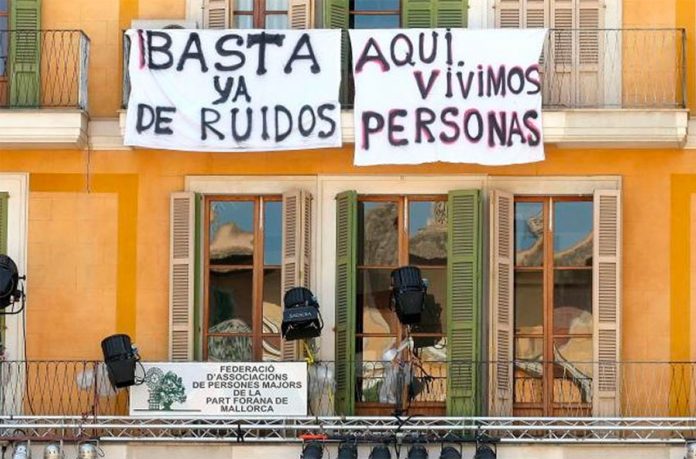
'Enough noise. People live here,' reads a sign in Mexico City.
Complaints about excessive noise are keeping Mexico City’s Environment and Zoning Prosecutor’s Office (PAOT) very busy.
The agency has filed more than 8,000 complaints about excessive noise since 2002 including 549 in the first seven months of this year. Over the past 17 years, noise pollution has been the second most common complaint filed with PAOT after land use violations.
In 2019, there have been 170 complaints about noise in the central borough of Cuauhtémoc, 69 in Benito Juárez, 63 in Miguel Hidalgo, 48 in Coyoacán and 42 in Iztapalapa. Excessive noise complaints in those five boroughs account for more than 70% of all such complaints filed across the capital’s 16 entities.
A PAOT report said that most complaints are about excessive noise emanating from bars, cantinas, restaurants, nightclubs and karaoke parlors.
Rosario Hernández, a resident of Roma Norte, a neighborhood known for hip bars and trendy restaurants, knows firsthand what it’s like to live with constant, excessive noise. She reached a breaking point in June.
Here’s one noise reduction measure.
Unable to sleep at 3:00am due to loud music emanating from the Bombay Club nightclub on Álvaro Obregón street, Hernández called police but was unhappy with their response and subsequently decided to file a complaint with PAOT.
“I don’t want to confront the owners or the staff of the establishment, I just want them to turn the music down when it’s very late. Every Friday and Saturday, it’s the same. People want to rest and live without noise. I’ve even had to take pills to sleep because of the noisy neighbors,” she said.
It’s not just loud music, however, that is disturbing the peace of Mexico City residents. Complaints about noise from factories, construction sites, traffic, aircraft and street vendors also keep officials busy.
Jimena de Gortari Ludlow, a professor of architecture and urbanism at the Iberoamericana University who has conducted research about noise in the city, said that in parts of the capital, such as the borough of Iztacalco, noise at workshops and factories is often the cause of complaints.
She told the newspaper El Universal that some operate at night and create excessive noise.
Among the ailments suffered by those exposed to constant, excessive noise are sleep disorders, concentration problems, stress and progressive loss of hearing, the academic said.
Traffic is a major source of noise in the city.
De Gortari said that PAOT has generally done a good job acting on the complaints it receives but argued that other government agencies should help to relieve its burden because it is “a small authority in terms of personnel.”
The Social Prosecutor’s Office and the Environment Secretariat should respond to complaints about noise in residential settings and on building sites, she said.
The academic explained that a shortcoming of the complaints system is that in order to impose a sanction against the person or business creating the noise, technicians from PAOT have to take a measurement to determine whether legal decibel limits have been exceeded.
However, when they take the measurement, the noise levels are not necessarily the same as the time to which the complaint referred, de Gortari said. She added that mobile phone recordings or measurements made by the complainants are usually insufficient evidence for authorities to take action.
PAOT chief Mariana Boy said that it is not viable for the agency to create a mobile app to make recordings of excessive noise and file complaints – as de Gortari has called for – “because we don’t have the technology to do it.
“Complaints have grown in recent months . . . but we continue to deal with each complaint that reaches us,” she said.
Boy explained that PAOT is also raising awareness about the harm excessive noise causes through its Bájale al Ruido (Turn Down the Noise) program.
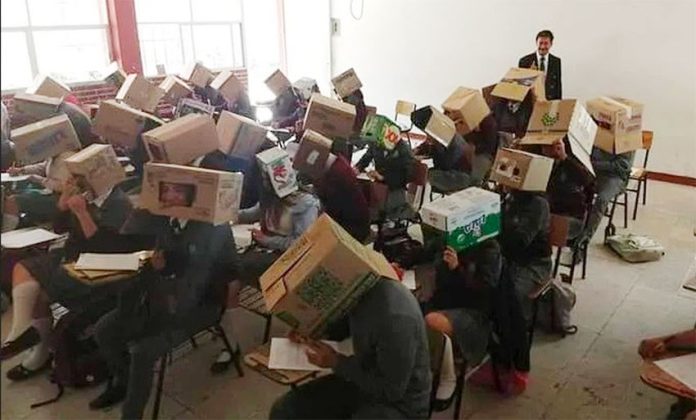
A Tlaxcala teacher found a unique way of clamping down on cheating during exams but parents were not impressed.
They are asking for the school’s principal to be fired after a teacher at the Cobat 1 school in Tlaxcala city put cardboard boxes on students’ heads as part of a strategy to prevent cheating.
They say the exercise violated their children’s rights. “. . . we denounce these acts of indignity, humiliation and physical, emotional and psychological violence to which students were submitted . . .” parents said in a social media post.
In a Facebook message, the school said it respects the human rights of the 1,500 students who study there, and denied that the cardboard box measure violated anyone’s rights.
The post also noted that the principal only participated in the activity as an observer, and that its purpose was not an evaluation, but a leisure activity that took place with the students’ consent and whose goal was developing their motor skills.
The newspaper El Sol de Tlaxcala reported that the same teacher gives a class in ethics and values. Two years ago he was investigated and temporarily suspended after an incident in which one student beat another unconscious while the teacher had stepped out of the classroom.