Home Blog Page 1765

Jalisco father says he will never tire of looking for his son, 21

0
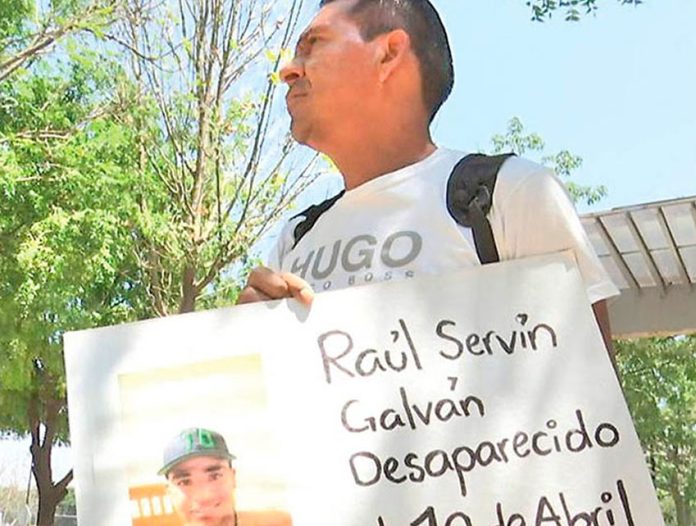
José Raul Servín continues the search for his missing son.

José Raúl Servín García says he will not stop searching for his son Raúl more than a year after his disappearance.

Raúl Servín was last seen on April 10, 2018 in Tlajomulco de Zúñiga, Jalisco.

His father returns every 15 days to his local medical forensic office to ask if they have received a body that could be that of his son.

“I keep searching. Actually, we go to many towns and forensic offices in the country with papers in hand and his DNA. I will not rest until I find him, however I have to do it,” Servín said.

He contends that his son was not a bad person, nor did he run with a bad crowd, as the staff at the Jalisco Attorney General’s Missing Persons Office has made him feel.

“Every time I go to find out something about my son, they are bothered just by seeing me,” he said. “Anything new? I ask. They just turn their angry faces, only because I go and ask.”

Disappearances are on the rise in Jalisco. There are an average of 14.5 cases per day this year, up from 8.9 in 2018.

According to the Center of Justice for Peace and Development (CEPAD), the number of disappeared or missing persons in the state totaled 3,579 in the first five months of 2019 alone.

Esperanza Chávez Cárdenas of the collective Por Amor a Ellos (For Love of Them) has been searching for her brother for five years.

“The authorities have not seen a problem of this magnitude and it has gotten out of their hands in the last eight months,” she said.

Jalisco currently has no laws to deal with forced disappearances. One was supposed to enter into force in July 2018, but the state Congress did not come to an agreement on it.

Chávez thinks legislators don’t deal with the problem because it does not directly affect them.

“I don’t wish what we’re going through on anybody, but they’re the experts in their field, and they don’t put themselves in the other person’s shoes,” she said.

As for José Raúl Servín, he merely asks authorities to do their jobs and “not revictimize us, saying that maybe my son was a bad seed, that he was a drug addict, that he was a thief, this and that. Those are their words.”

His son would have turned 21 last November.

Sources: Milenio (sp)
If there’s a medication shortage, bring it in by plane: AMLO

0
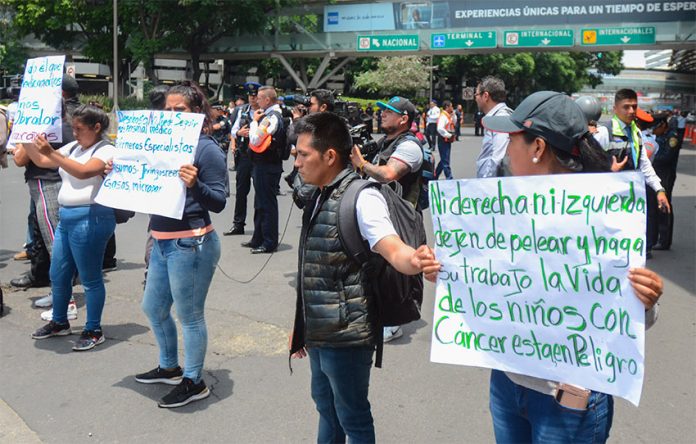
Protesting parents block traffic on Monday at Mexico City airport.

President López Obrador stressed on Friday that there should be no shortage of medications and that if there is, they should be brought in by plane if necessary.

“There is no reason to lack medications. If there aren’t medications, then bring them by plane, this is allowed. For this, yes, but not for going shopping or, like helicopters, for going golfing. But if it’s for going to the United States, to India or wherever to buy medicine, it can be done and in three or four days you’ve got them, if it’s for children’s or others’ lives,” he told reporters at this morning press conference.

(The reference to helicopters is probably with regard to an Institutional Revolutionary Party senator who flew in an armed forces helicopter to a meeting two years ago and later played golf. Another helicopter ride cost a senior official his job. The head of the National Water Commission used an official helicopter to fly himself and his family to the Mexico City airport while en route to a foreign vacation in 2015. David Korenfeld was forced to resign as a result.)

The president’s comments came after the Secretariat of Health faced a shortage of the cancer medicine Metotrexato in the Federico Gómez Children’s Hospital and other health facilities.

However, the situation was remedied on Tuesday, according to Social Security Institute (IMSS) director Zoé Robledo.

López Obrador blamed the problem on “dissident” suppliers.

“There used to be much corruption [in the purchase]. Despite the fact that they were paid 90 billion pesos for medicines and medical supplies, there weren’t medications in the health centers and hospitals. So they are upset, they are rebellious, and it’s a network, like everything, of interests, very strong and very powerful,” he said.

However, the supplier of the cancer drug said a shipment was delayed due to administrative issues with the government regulator.

The shortage of the chemotherapy drug triggered a protest earlier this week by parents of cancer victims, but their protest drew remarks from the health secretary that further angered them.

Jorge Alcocer said on Tuesday there was “a sufficient quantity” of the cancer drug Metrotrexato and that there was no “medical urgency.”

But the Children’s Hospital said there was indeed a shortage of the drug, and had been for 15 days. The head of the oncology department said about 40% of the hospital’s cancer patients were being treated with Metrotrexato.

The hospital administration said the shortage was due to a shipment of the medication not meeting certain federal standards.

The health secretary met with protesting parents on Thursday and apologized for his remarks.

Source: El Financiero (sp), El Sol de México (sp)

Judge approves extradition of Zetas cartel founder to US

0
Zetas co-founder González.

A federal judge has approved the extradition of Los Zetas cartel co-founder Jaime González Durán, who at one time was third in command of the gang after it split off from the Gulf Cartel.

Sixth District Court Judge Juan Mateo Brieba de Castro refused to grant a protection order to González, 47, who had appealed an extradition order issued by the Secretariat of Foreign Affairs (SRE) in March.

He is accused of conspiracy, drug trafficking and distribution and money laundering, among others. He is also believed to be linked to the murder of singer Valentín Elizalde in November 2006.

Brieba noted in his ruling that the SRE met all the requirements of the extradition agreement between Mexico and the United States and provided sufficient evidence to warrant the action.

The resolution pointed out that Foreign Relations Secretary Marcelo Ebrard did not violate González’s constitutional rights.

González was a member of the Special Forces Airmobile Group (Gafes), a former elite unit of National Defense that was in charge of locating and capturing narco-trafficking crime bosses.

In the late 1990s, he and 40 other Gafes soldiers defected and joined the Gulf Cartel, acting as the cartel’s military arm called Los Zetas. The Zetas split from the Gulf Cartel to form a rival cartel in 2010.

González was third in command of the Zetas and the chief crime boss in Reynosa, Tamaulipas, until his arrest by Federal Police in November 2008. He was convicted of organized crime and drug charges and sentenced to 35 years.

He was described by the federal Attorney General’s Office as one of the most dangerous and violent of organized crime members, and one of the most wanted by Mexico and the U.S.

Source: Milenio (sp)

Scientists issue alert over decline in coral spawning in Caribbean

0
Coral reefs are 'sending a message:' scientist
Coral reefs are 'sending a message:' scientist.

Scientists have issued an alert about a decline in coral spawning in the Caribbean Sea off the Quintana Roo coast but are doing what they can to assist reproduction and ensure the survival of coral reefs.

Scientists from the Institute of Marine Sciences (ICML) at the National Autonomous University and from the University of Guadalajara (UG) have detected that coral spawning in reefs that are part of the Mesoamerican Barrier Reef System has been on the wane since 2018.

The reef system extends from Isla Contoy, located off the northeast coast of Quintana Roo, to the Bay Islands in Honduras.

The arrival of large quantities of sargassum this year also affected the health of the reef, in which large amounts of coral are dying off due to a bleaching phenomenon caused by overly warm water.

Anastazia Banaszak, head of the ICML reefs unit, told the newspaper El Universal that the exact cause of the decline in coral spawning is unknown but asserted that it is clear that the coral is “sending a message” in response to a range of factors.

Spawning began to decline last year, says UNAM's Banaszak.
Spawning began to decline last year, says UNAM’s Banaszak.

Climate change and rising ocean temperatures cause stress for reefs, she said, explaining that coral grows and lives healthily when water is around 26 or 27 C. However, water temperatures in the Mexican Caribbean now exceed 31 C, Banaszak said.

The suffocation of reefs by large quantities of sargassum and stormy weather that affected the release of coral gametes are among other factors that could explain the downturn in spawning.

The range of pressures left Banaszak with the conclusion that “the future of reefs here is not good.

“In Puerto Morelos, spawning was incredible until 2017 but from 2018 we saw that it declined. This year, there was no spawning in Cancún and we saw less in Cozumel, Puerto Morelos and Punta Venado,” she said.

However, Banaszak and other scientists from the ICML and UG are not letting Mexico’s reefs die without a fight.

Pedro Medina Rosas, a marine biologist at UG, explained that since 2007, scientists have been intervening in the reproduction process of coral.

Once a year, during a full moon in summer, biologists and divers collect coral gametes from the sea with specially-designed nets, he said.

The gametes are then taken to laboratories where they are placed under lights in clean water whose temperature is conducive to the male gametes fertilizing the female ones.

Coral polyps are then born and grow in the lab until they are ready to be replanted in depleted and damaged reefs. The scientists subsequently monitor the lab-grown coral to determine the success of their assisted reproduction program.

Banaszak said that Mexican scientists have taught students from 13 countries about how to intervene in the spawning process and help to replenish sick reefs.

“It was a local project, we considered expanding to the Pacific, but it has exceeded expectations and become international. It’s replicated in the Dominican Republic, Cuba and Belize thanks to our dream team,” she said.

Source: El Universal (sp) 

Search commissioner: 3,000 secret graves found since 2006

0
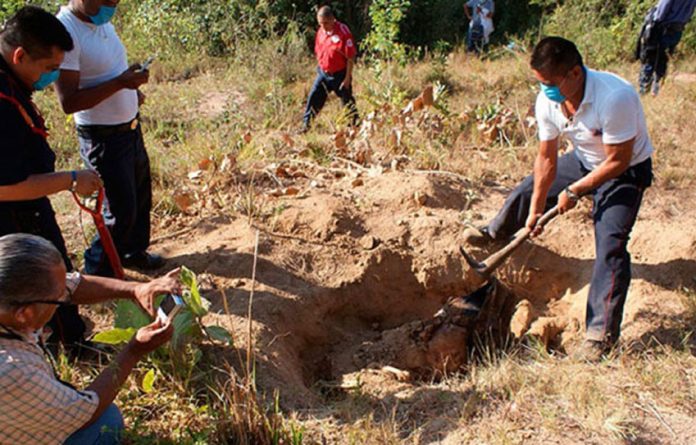
Volunteers dig up a grave in Veracruz in 2015.

More than 3,000 secret graves containing almost 5,000 bodies have been found since 2006, the national search commissioner said today.

Speaking at the presidential press conference, Karla Quintana Osuna gave the precise figures: 4,874 bodies in 3,024 graves.

“. . . It’s the first time that . . . the federal government has officially recognized the number of clandestine graves [that have been found] . . .” Quintana said.

She said the highest numbers of bodies have been found in Chihuahua, Durango, Guerrero, Jalisco, Nuevo León, Sinaloa and Tamaulipas.

In the nine months since the new government took office, 522 secret graves and 671 bodies have been found, the commissioner said.

Quintana said that 200 bodies have been identified in the same period, adding that the government will do all it can to support people trying to locate their missing family members.

“We reiterate our respect for the families who have been looking for their missing loved ones for a long time. It’s an obligation of the state to search for them,” she said.

The commissioner pointed out that 25 state-based search commissions have been established, while those for Sonora, Baja California Sur, Yucatán, Quintana Roo, Guanajuato, Aguascalientes and Chiapas are in the process of being created.

The government will provide 123 million pesos (US $6.1 million) in funding next month to assist the commissions in their search and identification efforts, Quintana said.

She added that a 90-million-peso center for human identification will be built in Coahuila and three forensic cemeteries will be established for the burial of unclaimed bodies. Two will be located in Zacatecas and the third will be in Durango.

Source: Reforma (sp) 

Real estate prices soar as Maya Train fuels demand for land along route

0
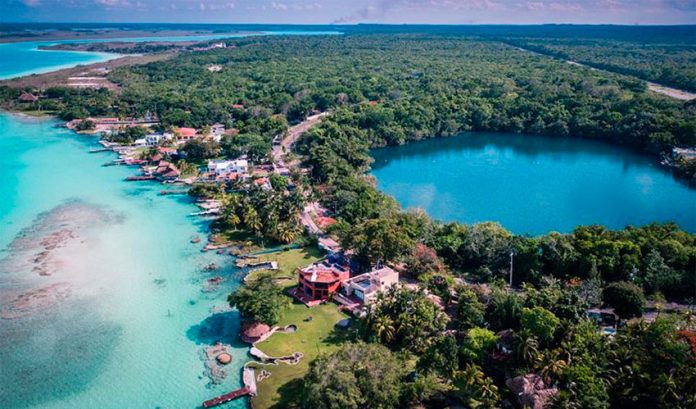
Real estate prices are soaring in Bacalar.

Real estate prices are soaring in southern Quintana Roo as investors seek to secure land near the proposed route of the Maya Train.

Amir Efrén Padilla Espadas, president of the College of Civil Engineers in the south of Quintana Roo, told the newspaper El Economista that after President López Obrador took office in December and the Yucatán peninsula rail project was confirmed, real estate agents began to sell lots adjacent to where the railroad will supposedly run.

Demand for properties along the route has caused the average cost of land in Bacalar – a municipality popular with tourists because of its lagoon – to increase from 1,000 pesos (US $50) per square meter to 4,500 pesos (US $220), Padilla said.

However, he explained that there is no guarantee that investors will get what they think they are paying for.

“It’s pure speculation because National Tourism Promotion Fund [Fonatur] officials have told us that they have at least three options for the location of the stations. What’s a fact is that there will be maintenance workshops in Chetumal but where they will be built isn’t decided,” Padilla said.

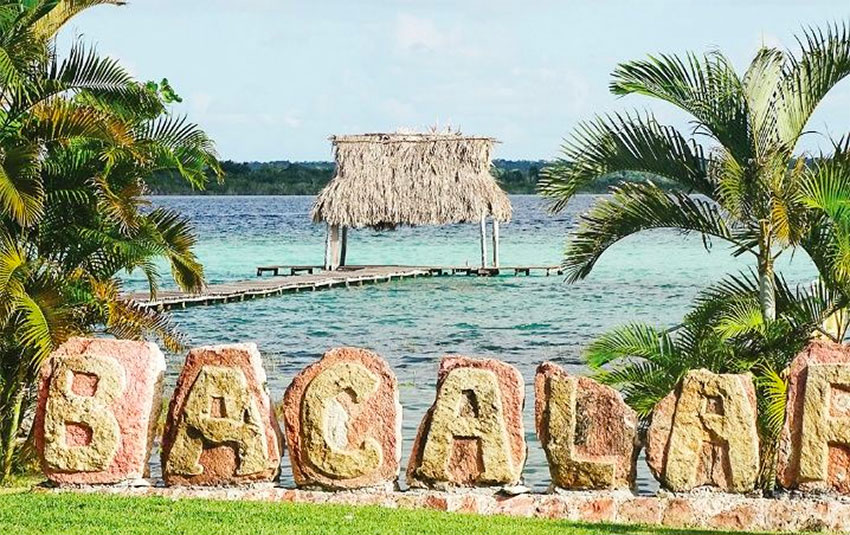
One of the train's 18 stations will be situated in Bacalar.
One of the train’s 18 stations will be situated in Bacalar.

“. . . Once the exact route of the railroad and the location of the stations is known it will be inevitable that the speculative phenomenon will intensify as has already started to happen in Bacalar, where the tourism boom and the announcement of a Maya Train station has quadrupled the value of a square meter of land,” he added.

Filiberto Buitrón Hernández, commissioner of the Bacalar ejido (cooperative), said that community landowners have received offers to buy their land from developers who intend to build hotels, theme parks and residential developments near the rail line.

“In the next ejido meeting, another project for Bacalar is going to be presented, we don’t know what it’s about yet but many others have already been offered to us. Some [developers] want to buy from 10 to 100 hectares to build hotels, mainly,” he said.

However, Buitrón said the landowners have rejected the offers they’ve received because they want to be partners in the development of the Maya Train and the infrastructure that will complement it.

To that end, the federal government has set up a trust through which community landowners can benefit from the rail project by offering their land for its construction.

Fonatur chief Rogelio Jiménez Pons said that 98% of ejidos along the proposed route have already granted right of way to the government for construction of the railroad.

In the case of Bacalar, officials from Fonatur, which is managing the project, explicitly asked community landowners not to sell their land, he said.

“. . . It was explained to them that everything will be through the trust. It appears that there was consensus and we will meet with them again to continue moving ahead,” Jiménez said.

Fonatur announced last week that three more stations, including one in Chetumal, will be added to the Maya Train line, bringing the total to 18.

The almost 1,500-kilometer-long railroad, which is scheduled to begin operations in 2023, will run through five states: Chiapas, Tabasco, Yucatán, Quintana Roo and Campeche.

It was originally forecast to cost between 120 and 150 billion pesos (US $6 billion to $7.5 billion) but the price tag has fluctuated as the route has been modified.

The project is forecast to boost tourism in southeast Mexico, while Jiménez said in May that the Maya Train will trigger real estate investment of at least 150 billion pesos (US $7.5 billion) .

Source: El Economista (sp) 

More than 5,000 bones found in secret cemetery in Culiacán, Sinaloa

0
Thousands of bones were found in Culiacán.

A search brigade in Sinaloa found more than 5,000 human bones — mostly from the hands and feet, according to preliminary analysis — and four bodies in clandestine graves in the municipalities of Culiacán and Mazatlán last week.

The first discovery took place at the La Primavera neighborhood of Culiacán, a wealthy residential neighborhood where bodies have been found in the past.

On Saturday, a brigade made up of family members of missing persons found bags containing more than 5,000 fragments of bones. A forensic scientist working with the brigade said the bones correspond to adults, adolescents and children, and the absence of complete bodies suggest that the victims were mutilated before being killed.

Juan Carlos Saavedra, who heads the state commission charged with searching for missing people, said that forensics will determine how many people’s bones were found at the site.

“The forensic scientists will determine it, they will count how many bone fragments there are . . . and how many people or how many hands were mutilated,” he said.

Two bodies were also found at La Primavera, both with gunshot wounds to the back of the neck.

Pieces of clothing were also found and the brigade has not ruled out that more bodies will be found there.

Later, another group that is also part of the brigade found two bodies in Playa de Cerritos in the municipality of Mazatlán. The bodies were buried around a meter under ground.

At both sites, forensic specialists from the state Attorney General’s Office removed the remains and turned them over to the Medical Forensic Service, which will begin the process of identifying them.

The state search brigade is made up of local search collectives throughout Sinaloa.

Source: Excélsior (sp), El Universal (sp)

Artisanal beer will have its own tourist route, smartphone app in Baja

0
Fauna beer's taproom in Mexicali.

Baja California will have a new tourist route based on artisanal beer beginning next month.

The route will be promoted via a smartphone app developed by beer conglomerate Grupo Modelo and the state’s Secretariat of Tourism.

The project is intended to encourage both domestic and international tourism to cities including Tijuana, Mexicali, Ensenada and Rosarito.

In the last two years, Baja California has experienced a boom in artisanal beer production. According to state Tourism Secretary Óscar Escobedo Carignan, there are 87 registered artisanal breweries and 40 more are in the registration process.

“Our state has grown to stand out on the national level in this arena, thanks to the creativity of our state’s brewers, the availability of raw material and also the influence of California, cradle of artisanal beer in the United States, with which we have worked to nurture the offering of this great touristic product,” said Escobedo.

Cinco Raíces in Ensenada.

Also planned in the near future is a museum dedicated to the country’s beer. The concept has yet to be fully developed, but it is planned to be located near the border with the U.S.

The app for the route, with information in both English and Spanish, will be launched at the end of September.

It will present information on local beers and their respective producers, many of which have tap rooms for tastings and food parings. It will also feature hotels and restaurants that offer beer-related experiences.

The Beer Route will be preconfigured in the app, but users will be able to change the routes to fit their own trips. It will also have a calendar of festivals, tastings, new beer launches and other events related to the beverage.

The application will have a connection to an e-commerce platform that will help artisanal brewers offer their products at the national level.

It will also have an educational section with recommendations for those with little experience with artisanal beers.

The app has been designed for users to keep on their phones after their trips, allowing them to personalize it and receive updates and other Baja California beer information.

There are currently 70 independent brewers participating in the project.

Source: El Universal (sp)

Workers rescued after platform goes awry 24 stories high

0
The upended platform, 24 stories up.

Two construction workers in Nuevo León narrowly escaped a 24-story fall when a cable snapped, upending the platform on which they were working.

The workers were replacing a broken window on the 24th floor of the Real Inn hotel in San Pedro Garza García when the cable broke, leaving the scaffold hanging almost vertically.

Other workers called the Civil Protection agency but when agents arrived, the two men had already been rescued by the hotel’s security and maintenance teams, who helped them climb through the window they were going to replace.

The Real Inn is located on Lázaro Cárdenas avenue in Villa de San Agustín. The municipality was the location of another accident last weekend when a woman fell 25 meters from her balcony while practicing yoga.

Source: El Universal (sp)

Report says AMLO to reverse stand on Pemex-private sector ventures

0
Joint ventures by Pemex would focus on deepwater reserves.

President López Obrador is poised to reverse his position and allow Pemex to resume joint ventures with the private sector in 2020, according to a report in the Financial Times.

The report cites an unnamed senior government official who said the president is set to reopen private exploration in deepwater oil reserves in the Gulf of Mexico.

“We are working with the president so farm-outs [joint ventures] can start up in 2020,” the official told the Times.

“For deep water, it would all be for the private sector,” he added, explaining that included the Trion project, for which Pemex has a partnership with the multinational company BHP.

The president’s aim, the Times said, is to kick-start investment and production in the oil sector and prevent the possibility of another credit rating downgrade for the beleaguered state oil company, which has debt in excess of US $100 billion. Fitch downgraded Pemex to junk status in June and if Moody’s follows suit, a huge sell-off of the company’s bonds would ensue.

“If he makes this [joint venture] announcement soon, it could be like a one-two punch in boxing after the approval of the pipeline deal,” said Mario López, an analyst at the consultancy Empra, referring to an agreement the government struck with three pipeline companies this week that settled a dispute between the parties.

“It would be the perfect combination, sending the right signals to the world that he is more open to the private sector. It could clearly reduce the risk of a downgrade if he manages to announce it before the end of the year.”

If would also be a major reversal in policy direction for the López Obrador administration.

The president was a staunch opponent of the previous government’s energy reform, which opened up the oil sector to foreign and private companies after almost 80 years of state control.

It was also intended to bring in expertise that Pemex did not have, particularly in deepwater drilling.

But upon taking office López Obrador put an end to joint ventures with Pemex and postponed oil block auctions.

Now, with economic growth slowing and investment stagnating, he is facing pressure to pacify investors.

López Obrador met on Wednesday with Claudio Descalzi, head of the Italian gas and oil company Eni, providing a sign that his attitude towards private investors could be less fierce than it once was.

Petroleum production in Mexico has been on the wane for a decade and a half and Pemex is continuing to struggle to boost production.

The government announced a US $5.5-billion rescue plan for the state-run company in February that was aimed at reducing the oil company’s financial burden and strengthening its capacity to invest in exploration and production.

However, financial institutions rejected the plan, describing it as insufficient and disappointing.

In July, the government presented a new business plan but many analysts said that it ignored the concerns of rating agencies and experts.

“It’s a very ideologically loaded business plan, it limits the participation of private companies in a big way and forces Pemex to do everything itself,” said Pablo Medina, vice president of Welligence Energy Analytics, adding that the state oil company needs “to take advantage of what the energy reform allows, leverage capital and stop trying to do it all by themselves.”

It appears that the president may have come around to that view.

Source: Financial Times (en)