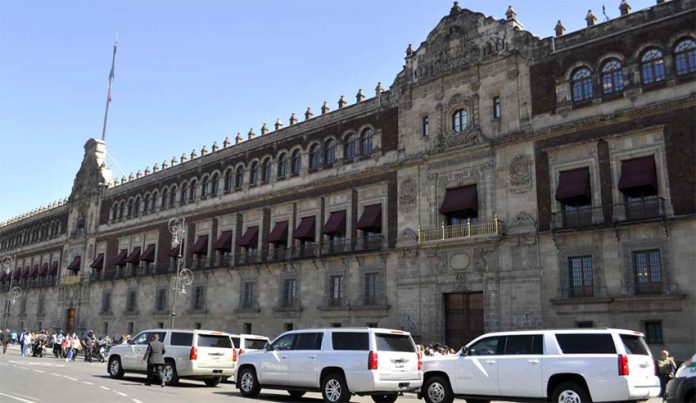
A spy camera was found in a meeting room in the National Palace, President López Obrador revealed Thursday morning.
“A few days ago, in one of the rooms in our offices, a sophisticated camera was found, one of those little-bitty ones, they were recording us,” he said in his morning address. “In a room here in the palace, not in my office, but one of the rooms where we have meetings.”
“And what do they accomplish with it? If what we talk about is totally legal, transparent, then there’s nothing they can use against us,” he added.
The president was questioned about longtime employees of Nacional Financiera (Nafin), a federal development bank, who allegedly inform adversaries of the government. He said he did not believe they were a problem, reiterating that they would not have anything to inform about.
“I don’t view it as a sensitive situation, because he who owes nothing fears nothing. There are times when we have meetings and we take care that we’re not being recorded, but the truth is that it shouldn’t matter to us, because everything we say should be in the public domain. Public life must be more and more public,” he said.
With respect to the camera, López Obrador said that his administration has not filed complaints about such matters, and it will not start now.
“Why get involved in this? You get rid of the camera and that’s it, move forward. These are practices of the old regime. Imagine investigating where it came from. I mean, I’m now working on a report, I don’t have time to busy myself with this.
“No, get rid of it and move forward. We’re going to keep working on what’s in front of us,” he concluded.
The federal government paid out more than 71 billion pesos (US $3.5 billion) to settle contracts for the canceled Mexico City airport project.
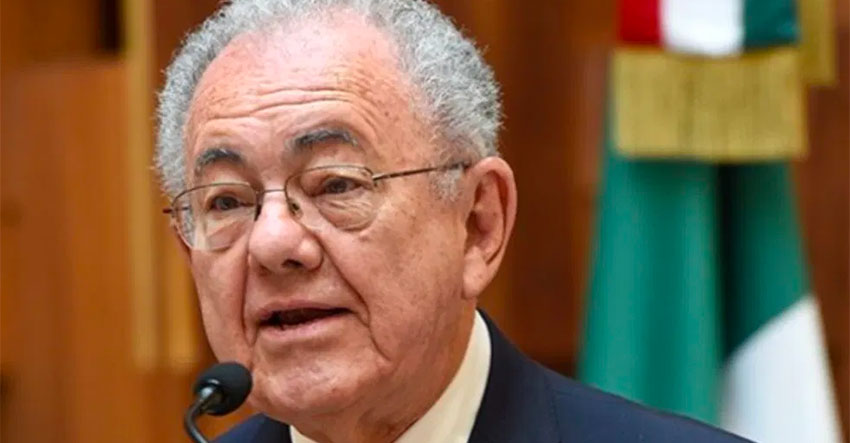
Communications and Transportation Secretary Javier Jiménez Espriú told a press conference yesterday that an analysis determined that 692 contracts had to be settled.
For work already completed at the abandoned airport site in Texcoco, México state, the government paid contractors 60.29 billion pesos, Jiménez said.
An additional 14.93 billion pesos in compensation was paid to contractors to cover the non-recoverable costs they incurred, meaning that the government forked out a total of 75.22 billion pesos to the builders of what was to be the previous government’s signature infrastructure project.
The payout represents 26% of the 285 billion pesos (US $14 billion) that had been allocated to build the airport.
“When we began this analysis, we calculated that the commitments would be about 100 billion pesos. Today we see that it turned out to be 25 billion pesos cheaper, which is good news,” Jiménez said.
He explained that because all the contracts have now been settled, the concession for the construction of the airport has been terminated.
The return of materials purchased – including huge quantities of basalt, tezontle and steel – allows the government to reduce its net loss by 4 billion pesos.
The materials could be used in the construction of the government’s priority infrastructure projects such as the Maya Train, the Dos Bocas oil refinery and the Santa Lucía airport, Jiménez said.
He said the canceled airport site can be converted into an ecological park once the government has resolved 60 injunctions filed against the government’s decision to scrap the project.
To terminate the concession for the Texcoco airport, the government also had to reach a deal with private investors.
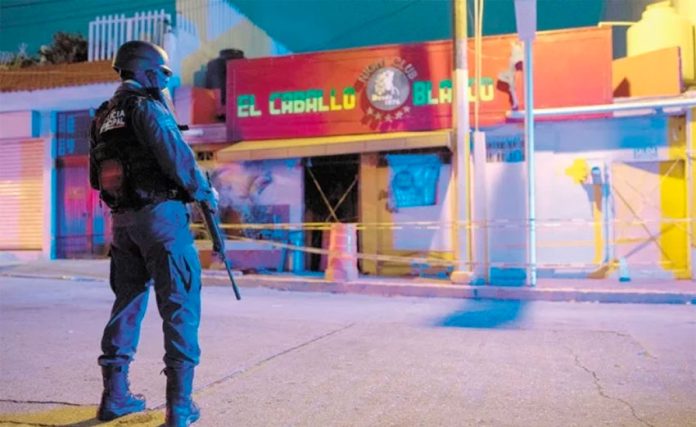
A police officer stands watch over the Coatzacoalcos crime scene.
The deadly attack on a Veracruz bar Tuesday has revived the animosity between Veracruz Governor Cuitláhuac García and Attorney General Jorge Winckler.
Winckler has denied a claim repeated by García and President López Obrador that one of those responsible for the attack in Coatzcacoalcos had previously been arrested and released by the Veracruz Attorney General’s Office (FGE).
García said that Veracruz police freed Ricardo “La Loca” N., presumed to be a low-level hitman for the Jalisco New Generation Cartel (CJNG) who is a suspect in several arsons, before he went on to carry out the Coatzacoalcos attack.
According to Winckler, Ricardo N. was arrested and released twice by the Veracruz delegation of the federal Attorney General’s Office (FGR), not by state authorities, once in July and once in August.
Friends and relatives of victims share their grief after Tuesday’s assault on Veracruz bar.
Winckler also questioned whether Ricardo N. was involved in the attack at all.
The attorney general was appointed by García’s predecessor, Miguel Ángel Yunes, a member of the National Action Party (PAN). The two officials have had a troubled relationship since García, a member of the president’s Morena party, took office.
Winckler has also been a target for criticism by President López Obrador, who called Wednesday for the Veracruz attorney general to be investigated, questioning his honesty.
He suggested that part of the country’s insecurity problem is dishonest authorities.
The bar attack was bad enough, López Obrador said, but another factor is that “there exists conspiracy [by organized crime] with authorities.”
The federal FGR began its own investigation of the Coatzacoalcos incident on Wednesday. In a statement on Wednesday night, the FGR conceded that it does not have conclusive proof that Ricardo N. was responsible for the attack, but it has connected him to at least five other similar arsons.
Winckler said Thursday that lines of investigation include a fight between rival gangs, extortion and revenge. Four people are believed to have been responsible.
Twenty-three people died at the scene and five more in hospital yesterday. Another eight victims remain in hospital.
The attackers threw gasoline and molotov cocktails inside the bar and sealed the exits before fleeing.
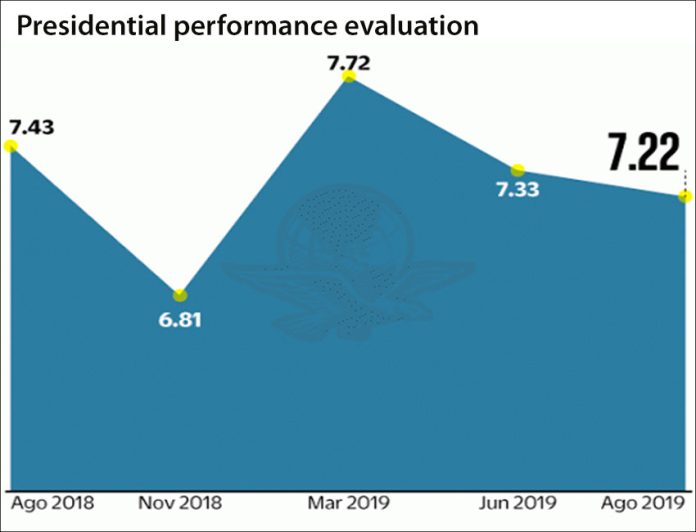
The president's performance rating on a scale of one to 10 from August 2018 to August 2019. el universal
Almost three-quarters of respondents to a new poll said they would vote in favor of President López Obrador completing his six-year term, while just under seven in 10 approve of his performance.
If a revocation of mandate vote was held today – as the president has pledged to hold three years into his administration – 74.1% of those polled by the newspaper El Universal said that would support the continuation of López Obrador’s term, while 19.3% indicated they would not.
The other 6.6% of respondents said they didn’t know which way they would vote.
The president’s approval rating remains strong at 69% although it has declined almost four points compared to El Universal’s June poll and 10 points since March.
López Obrador’s performance rating on a scale of one to 10 also slipped to an average of 7.22 compared to 7.33 in June and 7.72 in March.
Nevertheless, only 9.5% of respondents to the August survey said that they “totally disapprove” of López Obrador’s performance.
Seven in 10 said the president has demonstrated the capacity to solve the country’s problems even though 54% asserted that Mexico’s troubles have exceeded the government’s capacity to deal with them.
Six in 10 said they are optimistic that Mexico will continue to improve under López Obrador’s leadership, while one in five said that things will stay the same and 13% said that the country will get worse.
Just under two-thirds of those polled said they didn’t regret voting for López Obrador in the 2018 election, while just 5.9% of respondents said they did rue their decision.
Just under 22% of respondents said they didn’t vote for López Obrador in the presidential election, while 6.5% said that they didn’t vote at all.
Those numbers indicate that just over 70% of poll respondents voted for the president last year, 17% higher than the 53% support he garnered among all voters on polling day.
The AMLOve endures.
The survey also shows that the president scores much better than state governors and mayors in terms of rapport with the citizens they represent.
Just under 47% of respondents said they believed that López Obrador would take their petitions and proposals into account were they to meet with him face to face, while just 23% and 27% respectively said the same about their governors and mayors.
The poll also indicates that people believe that quality of life has improved under the current government.
Asked for an evaluation on a scale of one to 10, in which one is “very unsatisfied” and 10 is “very satisfied,” the average was 7.74 compared to 7.48 in June and 7.38 in March.
More than four in 10 respondents said their quality of life was much better or better than in recent months whereas only 16.5% said it was worse.
However, almost three-quarters of those polled said their family’s income had not increased in recent months, while just over one-quarter said it had. López Obrador stresses regularly that providing income support payments and welfare programs to the nation’s poorest and most vulnerable is a priority for his government.
Asked to name the government’s greatest achievement in its almost nine months in office, 25% cited social programs, 16% mentioned the crackdown on fuel theft and 8% referred to the fight against corruption.
Almost 10% more cited either the response to violence, or to drug trafficking, as the López Obrador administration’s No. 1 error, meaning that almost a quarter of poll respondents are unhappy about how the government is dealing with the security situation.
Despite increasing violence and a slowing economy, almost 12% of those polled said that the government hasn’t put a foot wrong.
On a personal level, López Obrador was rated highly for his management of public education, his governance skills and his efforts to combat poverty and corruption.
In contrast, his response to protests, the migration issue and the security situation found the highest disapproval ratings among poll respondents.
Almost six in 10 people said they didn’t agree with the government allowing migrants without documents to enter the country and seek asylum. Six in 10 said the government should block their entry to Mexico.
The international power tool company Milwaukee Tool will build a factory in Torreón, Coahuila, that will bring 2,600 jobs to the city when it starts operating in April 2020.
At a ceremony on Wednesday, Governor Miguel Riquelme welcomed the company to Torreón and said that construction will start on the US $86-million factory in September.
“Today, the city receives a message that will give us strength,” he said. “The company is going to do well, they will have qualified workers. I’m very happy that they chose Torreón. Here they will find stable labor relations, safety and qualified workers. We’re going to make sure they stay here.”
Riquelme added that the new factory will have a technological innovation center that will elevate the quality of the tools produced there.
Torreón Mayor Jorge Zermeño Infante thanked the the state government for its efforts to attract investment.
“Investments don’t happen by chance, they happen when there’s certainty, when there are elements that allow a business to have what it needs to open up shop,” he said. “I see the work the state government is doing to bring investment to Coahuila.”
Zermeño added that the company visited 15 cities around Mexico and the world before deciding on Torreón.
“I am thankful to the businesses who have been involved in this,” he said. “It is good for the Laguna region and good for Coahuila.”
Carlos Braña Muñoz, the president of a Torreón chamber of commerce, said the plans for the new plant are the result of an investment tour organized by the state government in China.
Founded in 1924, Milwaukee Tool became a subsidiary of the Hong Kong company Techtronic Industries in 2005.
One of the most-wanted criminals in México state was caught red-handed doing a low-level drug deal in Mexico City on Tuesday.
According to the city’s Public Security Secretariat (SSC), Israel “El Bucanas” Molina Monroy was spotted by police while exchanging drugs for cash with another man in the borough of Miguel Hidalgo.
“. . . two men were observed leaning against a blue Nissan Sentra that was the object of an investigation exchanging several bags . . . with green vegetable material inside for cash,” said the SSC in a statement.
When the officers approached the men and identified themselves they attempted unsuccessfully to flee in the vehicle.
The seller, who was found to be in possession of 39 plastic bags of what police suspect to be marijuana, was later identified as 39-year-old Molina, a former police officer in the México state municipality of Tultitlán.
He was wanted for the April 2018 murders of state homicide chief José Luis Mendoza Espinoza and his partner Orlando López Arrendondo. He was also wanted in connection with an incident where a body was abandoned near the Barrientos Jail in Tlanepantla last Thursday, with a message signed by the organized crime group La Unión de Tepito.
In December, the state attorney general published a most-wanted list of 47 people, which included Molina, offering a reward of 300,000 pesos (US $15,000) for information leading to his arrest.
His nickname is more than likely derived from a fondness for Buchanan’s whisky, but lost a couple of letters in translation.
Molina is not to be confused with Roberto de los Santos de Jesús, a suspected gangster in Puebla who shares the same nickname.
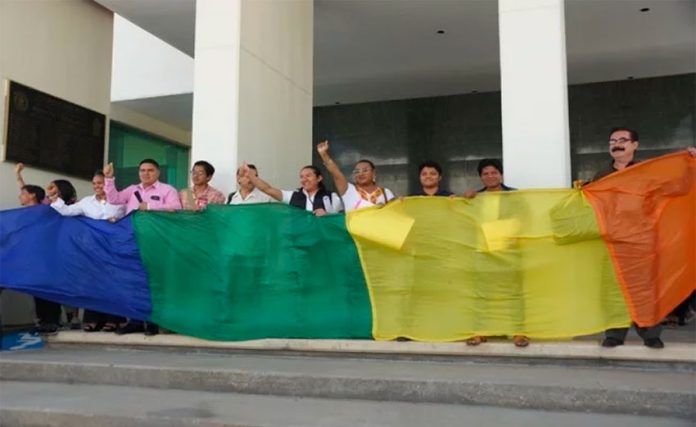
Supporters of the bill celebrate in Oaxaca yesterday.
The Oaxaca Congress approved same-sex marriage after a heated debate on Wednesday.
The final vote was 25 in favor and 10 against, which came amid protests for and against by the LGBT community and evangelical Christians.
The bill removes the definition of marriage as a union exclusively between a man and a woman from the state’s Civil Code.
“Marriage is a civil contract celebrated between two people who unite in order to celebrate a life in common, and to provide each other with respect, equality and mutual help,” the Civil Code now reads.
Evangelical pastors and like-minded citizens gathered Wednesday morning to protest the amendment, showing their support for the “original design” of the family, composed of a man and a woman.
Opponents of same-sex marriage demonstrate in the Oaxaca capital.
The Brotherhood of Evangelical Pastors of the State of Oaxaca (Copaceo) accused the Chamber of Deputies of imposition for promoting and authorizing a law that was not put to public vote, in spite of the fact that they had requested such a vote as early as April 2.
Members of the LGBT community condemned the protest, considering it a type of hate speech. When the law was approved, however, they were jubilant, celebrating in the esplanade of the legislature in San Raymundo Jalpan, south of Oaxaca City.
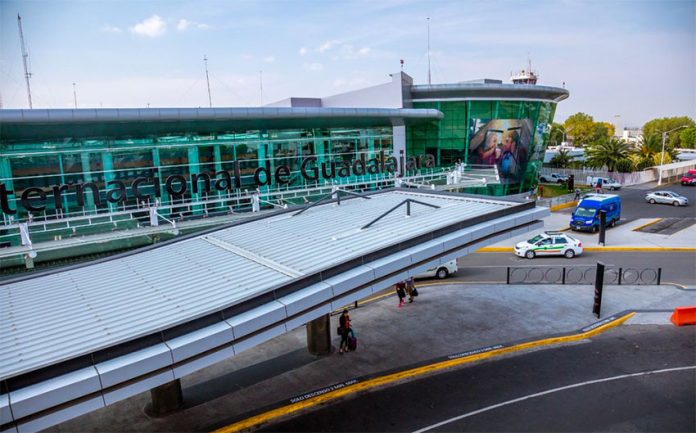
A long-running dispute over compensation for expropriated land will not prevent expansion at Guadalajara International Airport, the facility’s operator said, announcing that a second terminal and a new runway will go ahead.
Both will be built on land for which the airport operator already has a concession, circumventing the need to purchase it from community landowners engaged in the compensation dispute.
The Pacific Airport Group (GAP) presented a plan for the project to the federal Secretariat of Communications and Transportation (SCT) and pending approval, construction will begin in January. The project will be completed by 2025 at the latest.
Airport director Martín Pablo Zazueta Chávez said that the terminal and runway will be built on land included in a concession acquired by GAP 20 years ago.
“. . . We’re going to maximize the use of our lands and our concession,” he said.
“[The terminal] will have all the elements of modernity and cutting-edge technology. It will be a very functional building and will have the capacity to serve both national and international passengers,” Zazueta told the newspaper El Economista.
He explained that the second terminal will be accessed via a new, separate entrance. Having two terminals and a second runway will enable the airport to meet passenger demand for the next 25 years, Zazueta said.
He said construction will take place while the airport continues to operate but stressed that the builders and airport management will aim to minimize the impact of the work on passengers. However, Zazueta conceded that there are “complicated years” ahead.
The airport chief didn’t reveal how much the new terminal will cost, explaining that the price tag will be disclosed once the SCT gives the green light.
Construction of the new airport infrastructure was planned for a 137-hectare parcel of land owned by the community landowners of the El Zapote ejido (cooperative).
However, the landowners have refused to sell the land until they are paid compensation for 307 hectares of land that the federal government expropriated for the airport in 1951.
Their refusal to cede the land has held up plans to expand the airport in Mexico’s second largest city, where demand for airline services has more than tripled over the past two decades.
Zazueta said that when GAP began operating the airport 20 years ago, it handled about 4.3 million passengers annually.
Last year, 14.35 million people used the airport while in 2019 the number of passengers is expected to exceed 15 million for the first time.
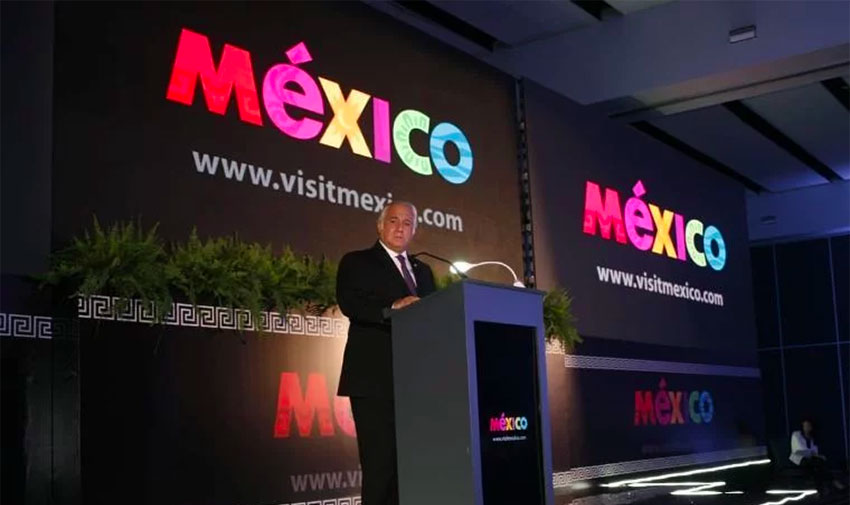
The Visit México tourism promotion platform has been relaunched with private sector funding.
Over the next five years, business will invest an estimated 1.8 billion pesos (US $90 million) in the website, which was previously administered by the now-defunct Tourism Promotion Council.
Tourism Secretary Miguel Torruco told a relaunch event yesterday that “not a peso” of public money will go to the site thanks to an agreement struck with the private sector.
The platform’s managers will seek additional investment from tourism service providers and a range of national and international partners, he said.
Google, Discovery Channel and hotel company Grupo Posadas have already committed to investing in the website, while the government’s Tourism Diplomacy Council will collaborate with the private sector on the digital marketing strategy for Mexico’s tourism sector.
Tourism Secretary Torruco announces new funding plan.
The strategy will be led by businessman Marcos Achar, who is the new chief of the platform.
In May, Achar and his business partners acquired the digital marketing company Braintivity, which previously had a contract with the Secretariat of Tourism (Sectur).
The updated Visit México site features pages for each of Mexico’s 31 states and the capital. Each page contains information about local destinations and attractions. Tourism companies will be able to offer their products and services to potential visitors.
Among the articles that are currently on the state-based pages are: Try the Lobster Tacos and other Rosarito Delights (Baja California); Breathe in the Fresh Air of the Chapultepec Forest (Mexico City); and Rejuvenate Yourself in the Ruins of Mitla (Oaxaca).
Information is available in 10 languages: Spanish, English, Russian, Portuguese, German, French, Italian, Japanese, Korean and Chinese.
Sectur said on Twitter that the new site has three main aims: digitalization and modernization of the tourism industry, promotion based on data and the attraction of more tourists through the provision of better information and more content.
Speaking at yesterday’s event, Achar stressed that the Visit México brand remains the property of the government but added that tourism companies, states and municipalities will now be able to make greater use of it.
He predicted that Mexico’s tourism industry will go from strength to strength as a result.
The tourism sector currently contributes about 9% of national GDP but to grow that figure, Achar contended that Mexico has to attract and receive visitors with offerings beyond tequila and mariachi.
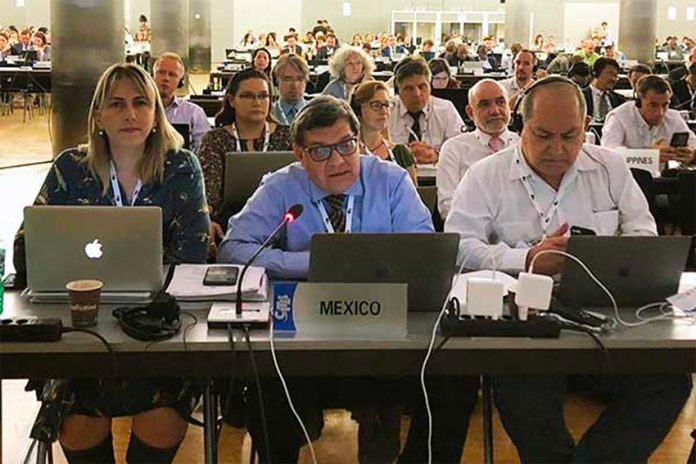
Mexico managed to avoid international sanctions for not taking more significant action to protect the vaquita marina porpoise in the northern Gulf of California.
However, after negotiations with the United States, China and Liberia in Geneva, Switzerland, the Mexican government was able to ease the measures of an ultimatum set by the secretary-general of the Convention on International Trade in Endangered Species (CITES).
Head of the federal environmental protection agency (Profepa), Blanca Mendoza Vera, promised the 183 member countries that her office would turn in reports every six months detailing the efforts taken to protect the vaquita and the totoaba, which is also endangered.
In exchange, the document was modified to exclude the warning that the export of Mexican species on the CITES list will be suspended if it continues uncontrolled poaching in the vaquita’s habitat. Such products include shark fins, bighorn sheep hunting trophies and mahogany wood.
The change in the text, however, does not mean that Mexico no longer runs the risk of commercial sanctions from the international community. It will have to show improvement in its efforts by next year’s meeting.
Mendoza had previously offered the assembly a report of Mexico’s actions in the region which were primarily the results of actions carried out by the previous government.
Mendoza also lamented the difficulties in prosecuting totoaba poachers. She noted that from January until July, 249 people had been brought before the federal prosecutor’s office for poaching, but only 33 were punished.
The totoaba is highly prized in China for its swim bladder, making it pound-for-pound more expensive than cocaine.