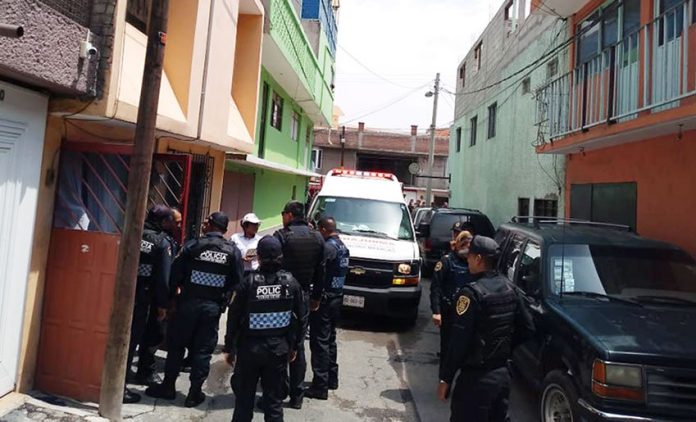
The Iztapalapa neighborhood where the pitbull attack occurred.
A toddler died yesterday after being attacked by a pitbull in Iztapalapa, Mexico City.
Witnesses said the young boy, almost 2 years old, climbed to the roof of a house with his mother when he was attacked by the dog, which reportedly lived on the roof and was kept tied up at all times.
The dog bit the youngster several times. When paramedics arrived he was pronounced dead.
Borough authorities took the owner of the dog into custody and the dog was secured by the animal services agency Agatan.
Animal rights organization Mundo Patitas A.C. lamented the attack, stressing that the dog was an innocent being that had been deprived of the most basic rights, and whose abuse, neglect and confinement atop a roof had taken its toll on an innocent child.
A security analyst doesn't expect the National Guard to make much difference: there have been almost as many military personnel doing the same thing without success.
An average of 94 homicides per day made the first half of the year the most violent on record, and security specialists are not optimistic that things will improve in the final six months of 2019.
There were 17,065 victims of homicide and femicide between January and June, according to National Public Security System statistics for the first five months of the year combined with figures for June that were published daily by the Secretariat of Security and Citizens Protection (SSPC).
When the 2,879 homicides recorded in December are added to the murder figures for this year, the total number of victims of violent deaths since President López Obrador took office is almost 20,000.
If the SSPC trend of underestimating homicide figures by 20% occurred again in June, not only will the total number of murders during López Obrador’s government exceed 20,000 but last month will go down as the most violent on record with more than 3,000 victims.
“The last year of [the administration of] former president Enrique Peña Nieto was bad in terms of the crime rate but 2019 is on the path to being [even] worse,” said security specialist Ricardo Márquez Blas.
“. . . It’s important to understand that we’re doing worse [in security] than the worst year [on record],” he added.
The states that have recorded the highest number of homicides during the seven months the government has been in office are Guanajuato, México state, Jalisco, Baja California, Chihuahua, Veracruz, Mexico City and Guerrero.
The Jalisco New Generation Cartel (CJNG), considered Mexico’s most powerful criminal organization, and the Santa Rosa de Lima Cartel are engaged in a turf war in Guanajuato to control fuel theft, extortion and kidnapping.
In México state, which currently ranks as the second most violent entity in the country, the CJNG, the Familia Michoacana, the Caballeros Templarios, the Gulf Cartel and the Nuevo Imperio gang are all fighting to control the drug trafficking trade, according to a report in the newspaper El Universal.
With cartel wars also raging in other states, Márquez believes that the murder rate will not decline by October, the month by which López Obrador forecast that the government’s security strategy will begin to yield results.
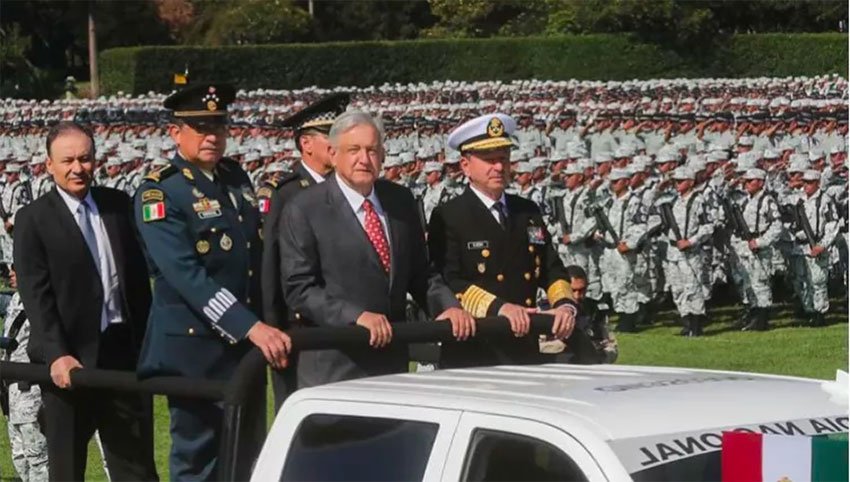
Flanked by the heads of the army and navy, the president inspects the National Guard on Monday. Behind them is Security Secretary Alfonso Durazo.
“In October, when we reach six months [since the president’s promise], there will be no essential downward change in terms of the crime rate, particularly for homicides. It’s going to continue, the statistics show that,” he said.
The security expert challenged the president’s claim that the deployment of 70,000 National Guard troops will improve the security situation, stating that “there were already 63,000 elements of the armed forces [engaged] in security tasks and that hasn’t had any positive impact.”
Márquez added that “the best example” of the failure of military personnel – which also make up the majority of National Guard members – to combat crime is Tijuana, Baja California.
“Kidnapping and femicides have gone up, and that has to do with the lack of resources. There is no priority in terms of investing [ in security] . . .” he said.
The director of the National Citizens’ Observatory, a crime watch group, told El Universal that the security situation has been “serious for a long time” and that a strategy with well-defined actions is needed to combat it. However, Francisco Rivas charged that the government hasn’t presented any such strategy.
“The problem is that this government doesn’t have a strategy, they’ve [tried to] explain . . . that there is a strategy but the truth is that it cannot be confirmed that one exists,” he said.
López Obrador has only shown “good intentions and a series of naiveties,” Rivas charged. “. . . His social policy, as it is set up, will not be able to reduce homicides . . .”
Jorge Alberto Lara Rivera, an academic at the National Institute of Criminal Sciences and a former assistant prosecutor at the federal Attorney General’s Office, charged that members of the government are not all on the same page with regards to security.
In contrast, organized crime groups understand it “perfectly” well, he said, adding that if the government doesn’t design adequate strategies to combat them “we’re going to continue seeing the same results.”
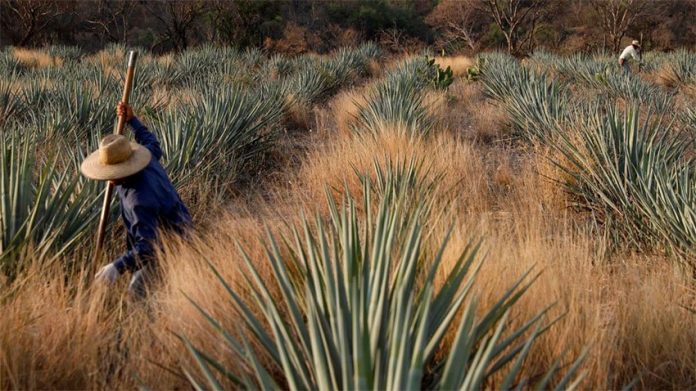
Tequila producers say that rising demand and increases in the price of agave are to blame for the drink getting more expensive over the last four years.
According to data from Iscam, a Mexican company that tracks prices of consumer goods, a bottle of tequila costs on average 438 pesos (US $23), 23% more than in 2015.
José Antonio Cebeira, an analyst at Actinver, a financial services company, told the newspaper El Financiero that one of the factors pushing up the price of tequila is rising demand for other agave products, like agave syrup.
“The causes are a strong demand for tequila which, because of the denomination of origin, can only be produced in some regions,” he said. “And also the success of agave syrup and sweeteners on the international level, all of this is pushing up the price of agave.”
The denomination of origin, which allows tequila to be made only from agave produced in five states, and the fact that agave plants can take as long as seven years to mature, limits the supply of the plant and makes it difficult for growers to respond to rising demand.
And agave is getting more expensive much faster than tequila. According to Carlos Riggen, professor of business at the Monterrey Technological Institute, the price of a kilo of agave went up eightfold over the past five years, from 3 pesos to 26.
Agave represents more than 60% of the cost of making tequila. So even as tequila has been getting more expensive, profit margins for tequila companies have declined an average of 50% over the last five years. Becle, Diageo and Brown-Forman, which own the brands José Cuervo, Don Julio and Herradura, are all reporting pressure on their margins because of the rising price of agave.
But many tequila companies have been making up for declining profit margins with increased sales. According to Mexico’s national statistics institute, Inegi, tequila makers produced 85.5 million liters in the first quarter of 2019, 48.4% more than in the same period five years ago.
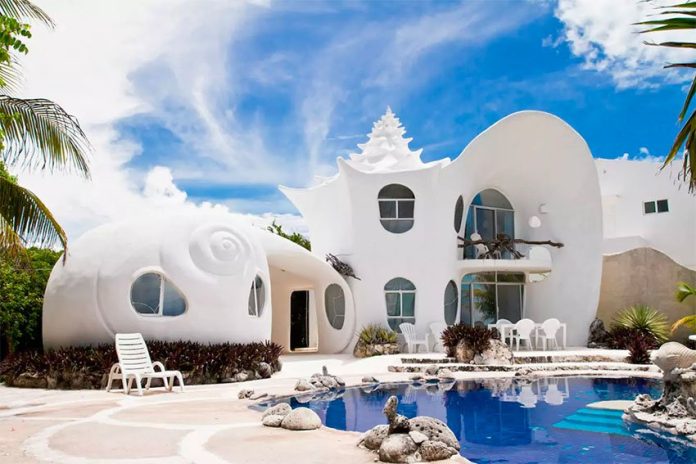
The Seashell House, an Airbnb rental on Isla Mujeres, Quintana Roo.
Airbnb brought five million international travelers to Mexico in 2018, according to a company document.
Based on internal surveys and data analysis, the document also revealed that Airbnb travelers in Mexico had a direct economic impact of US $2.7 billion last year, including money spent directly through the platform as well as on restaurants and other activities.
Across the world, Airbnb travel generated US $100 billion in 2018.
The company said a significant part of the money spent by travelers is connected to recommendations made by hosts. The report notes that 83% of Mexican hosts who were polled said they recommend cafes and restaurants to their guests, while 47% recommend daytrips and 66% recommend cultural activities. Four out of five Mexican hosts received five-star ratings, the highest on the platform.
Mexico saw more Airbnb revenues than any other Latin American country, and was in ninth place on the global ranking, below countries including the United States, France, Spain, Italy and the United Kingdom. Those five countries together accounted for 63.5% of the total economic impact of Airbnb in 2018.
The report also showed a significant increase in Airbnb trips to lesser-known destinations like Moldova, Vanuatu and New Caledonia.
An Airbnb press release stated that hosts keep an average of 97% of the price paid by their guests, but spend around 51% of what they earn on maintaining and paying for their homes.
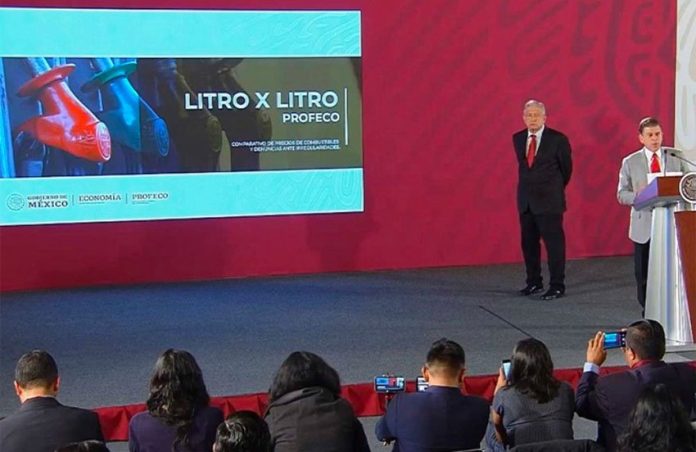
Profeco's director presents new app for motorists.
The federal consumer protection agency has designed and released a smartphone application intended to help consumers locate the cheapest gas stations.
Profeco director Ricardo Sheffield Padilla presented Litro x Litro Tuesday morning at the president’s morning press conference, where he told reportes that President López Obrador had urged him to design an app that would be able to account for the needs of consumers at the pump.
“The app has the ability to search according to the desires of the consumer . . . It can tell me where the most expensive gas stations are, which are the cheapest and exactly where all the mid-price gas stations are located . . . . It’s an easy-to-use app, a practical app.”
Sheffield explained that the app can search for regular, premium and diesel fuel options within a 19-kilometer radius. In addition, consumers can lodge official complaints against any irregularities in service or prices in real time.
“These complaints can be anonymous, or you can give us all of the information; you can even upload your gas station receipt.”
López Obrador said that the app will help the federal government uphold its promise to keep gasoline prices low for consumers.
“This system helps us to fulfill our promise that fuel prices will not increase, because even though we can guarantee fair prices at Pemex, sometimes the profit margins at the distribution point are excessive and this will help us to even out the prices.”
The president added that his administration will continue to support Profeco’s efforts to guarantee low fuel prices to citizens through measures like
He said “this empowerment [of consumers] is very important so that people have the information necessary to make their own decisions. This is competition and it allows us to ensure that those who offer services do not take advantage of consumers and that the consumers are the ones who ultimately decide.”
The Litro x Litro app is available at smartphone app stores.
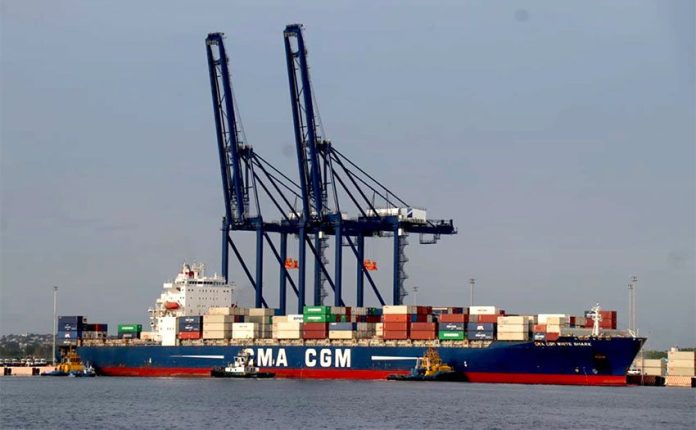
The New Port of Veracruz welcomed its first ship on Monday, the Maltese-flagged container carrier White Shark, in what was heralded as “a great day for the country.”
The vessel, which had come from northern Europe, dropped off and picked up containers at the new specialized container terminal (TEC) built by Hutchison Ports-Icave.
Jorge Lecona, Hutchison-Icave director for Mexico and Latin America, told reporters that the new terminal offers cutting-edge technology including blockchain and artificial intelligence.
“This is a great day for the country, for Veracruz and for Hutchison Ports, the entire port community, importers and exporters,” he said. “We deserve to have infrastructure as modern as we have today.”
The TEC is the first of a series of expansions to the Port of Veracruz, described as the most important maritime infrastructure project in Mexico in recent years.
With an investment of around 31 billion pesos (US $1.6 million), of which 80% came from private investors, the capacity of the port has nearly tripled from around 24 million tonnes of cargo to 66 million.
The next phase of the expansion project will bump capacity to more than 95 million tonnes. The new port occupies 1,113 hectares on land and sea, more than double the previous 554 hectares.
Veracruz port director Miguel Ángel Yánez Monroy said that a liquids terminal will open later this year, which will be used for imports of hydrocarbons. Agricultural and mineral terminals will open in the first quarter of 2020.
According to the general manager of Corporativo Enciso, a customs agent, the improvements to the port will allow imports to be shipped directly to Mexico from northern Europe rather than to ports in the United States and then on to Mexico by land.
Óscar Enciso Villarreal said the new port will create an industrial corridor that will create as many 150,000 jobs by 2024.
“We’re going to achieve a goal we’ve had for many years, which was to bring in the huge ships that didn’t used to come, and we’re also going to gain ground against all the cargo that goes to U.S. ports like Houston and crosses the border into Mexico,” he said.
“With the inauguration of this new specialized terminal, which is considered the biggest logistics project in the country, today is the day to take back the cargo that naturally belongs to the Port of Veracruz.”
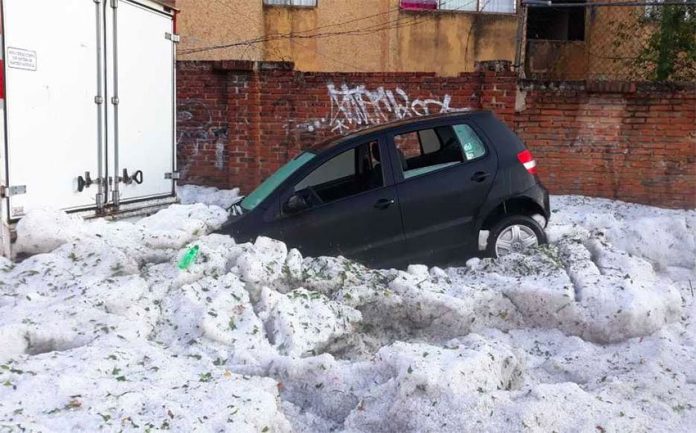
After parts of Guadalajara were buried in hail more than a meter deep on Sunday morning, Jalisco Governor Enrique Alfaro was quick to point his finger at climate change.
“I was witness to scenes I’d never seen before,” Alfaro wrote on Twitter. “Hail more than a meter high, and then we wonder if climate change exists.”
But according to meteorologist and television weather presenter Abimael Salas, the heavy hailstorm is not necessarily a consequence of climate change.
Writing in the newspaper Milenio, Salas explained that while a hailstorms in the middle of summer might seem unusual, they are in fact common.
The meteorologist said that summer months – which in much of Mexico coincide with the rainy season – are more favorable for hailstorms because “very warm and humid air rises violently” and causes atmospheric instability.
Water vapor then turns into tiny drops of rain that together form cumulonimbus, or vertical, clouds, Salas wrote.
As time passes, the droplets significantly increase in size and reach altitudes where the temperature is below 0 C, causing them to freeze within the cloud, where there are strong currents that force the newly-formed hail to either ascend or descend, he explained.
Descending hail comes into contact with “very cold water,” which causes it to again increase in size until “eventually air currents cannot hold it and it falls towards the surface” of the Earth, Salas said.
“The quantity and size [of the hail] varies considerably depending on the humidity and the degree of atmospheric instability,” he wrote.
In the case of Guadalajara, the meteorologist said that high humidity and high temperatures on Saturday, the city’s altitude – it’s more than 1,500 meters above sea level – and a low-pressure system that brought colder than usual air to the atmosphere combined to “considerably heighten atmospheric instability” and create favorable conditions for the formation of large quantities of hail.
Salas said the storm clouds also “generated intense rain that caused significant water streams, which due to the urban design of the area, dragged hail towards the lowest parts [of the city], where large quantities of ice accumulated.”
He added: “In phenomena as extreme as this, we’re tempted to exclusively blame climate change. However, that cannot be applied [solely] to [this] particular phenomenon – poor urban planning also has an influence.”
“As temperatures increase globally, the energy available in the atmosphere increases and [to that] we add the excessive growth of the population and large urban centers, many of which are located in areas of risk,” Salas wrote.
“Material damage and losses of human life tend to increase even though alert systems and meteorological forecasts improve as [has occurred] in recent years.”
AMLO dolls and other presidential souvenirs were on full display yesterday Mexico City’s zócalo, where street vendors expected to make a killing off AMLOFest, the first-anniversary celebration of President López Obrador’s election win.
Despite authorities’ attempts to block their access to the zócalo and surrounding streets, vendors persisted, drawn by the prospect of selling mugs, t-shirts, umbrellas and stuffed figurines bearing the president’s likeness to the thousands of presidential fans expected to attend the event.
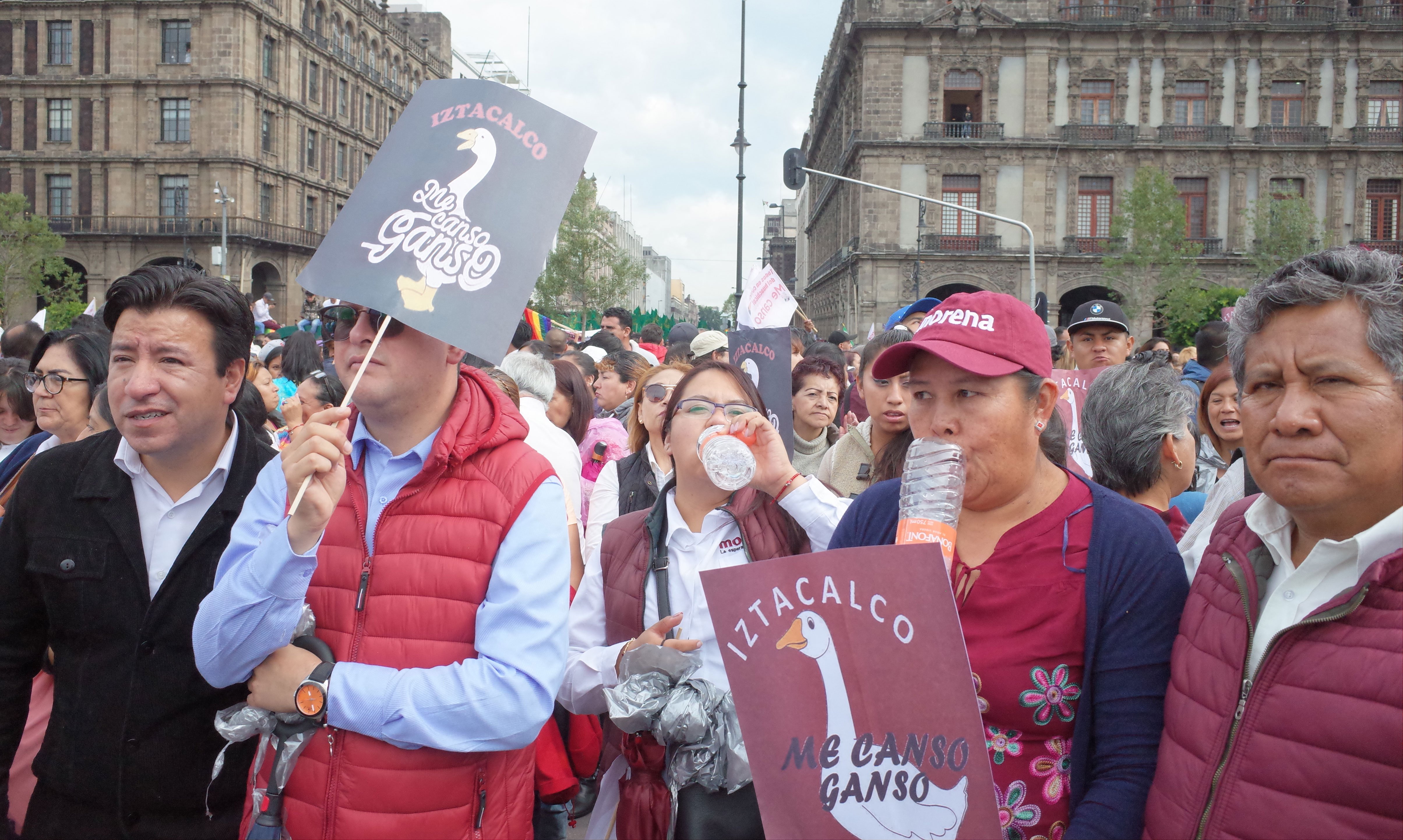
Many of the souvenirs bore the president’s most popular refrains, such as “Al pueblo de México le voy a cumplir” (“I will keep my promise to the Mexican people”), “Me canso ganso” (a popular colloquial phrase meaning “I am as good as my word” or literally “I’m tired goose”) and a common rhyming slogan among his followers, “Es un honor estar con Obrador” (“It’s an honor to stand with Obrador”).
Prices for the mementos ranged from 35 pesos for stuffed AMLO keychains, 70 pesos for presidential baseball caps, 80 pesos for t-shirts and up to 260 pesos for replicas of the president’s distinctive maroon vest.
The event also included performances by the Symphonic Band of Tlaxiaco, Oaxaca, flautist Horacio Franco and double bassist Víctor Flores, and Margarita Vargas, also known as the Goddess of Cumbia.
Tens of thousands of ardent supporters of President López Obrador flocked to Mexico City’s zócalo on Monday to hear him speak on the first anniversary of his victory in the 2018 election.
In a wide-ranging 90-minute speech, the president rattled off dozens of government achievements including the reduction of fuel theft – “down by 94%” – the introduction of new social programs, the disbandment of the Tourism Promotion Council, the revocation of the previous administration’s education reform, the creation of a special economic zone in the northern border region and the consolidated purchase of medications for the second half of 2019, which he said saved 2.7 billion pesos.
All told, the government has fulfilled 78 of the 100 commitments it made to the Mexican people when it was sworn in seven months ago, López Obrador said.
“Probably never has so much been done in such a short time,” he declared.
The president said the process to transform Mexico “has no return” and vowed to not take “one backward step” in pursuing his new vision for the country, which he encapsulated as an “economic power with a social dimension.”
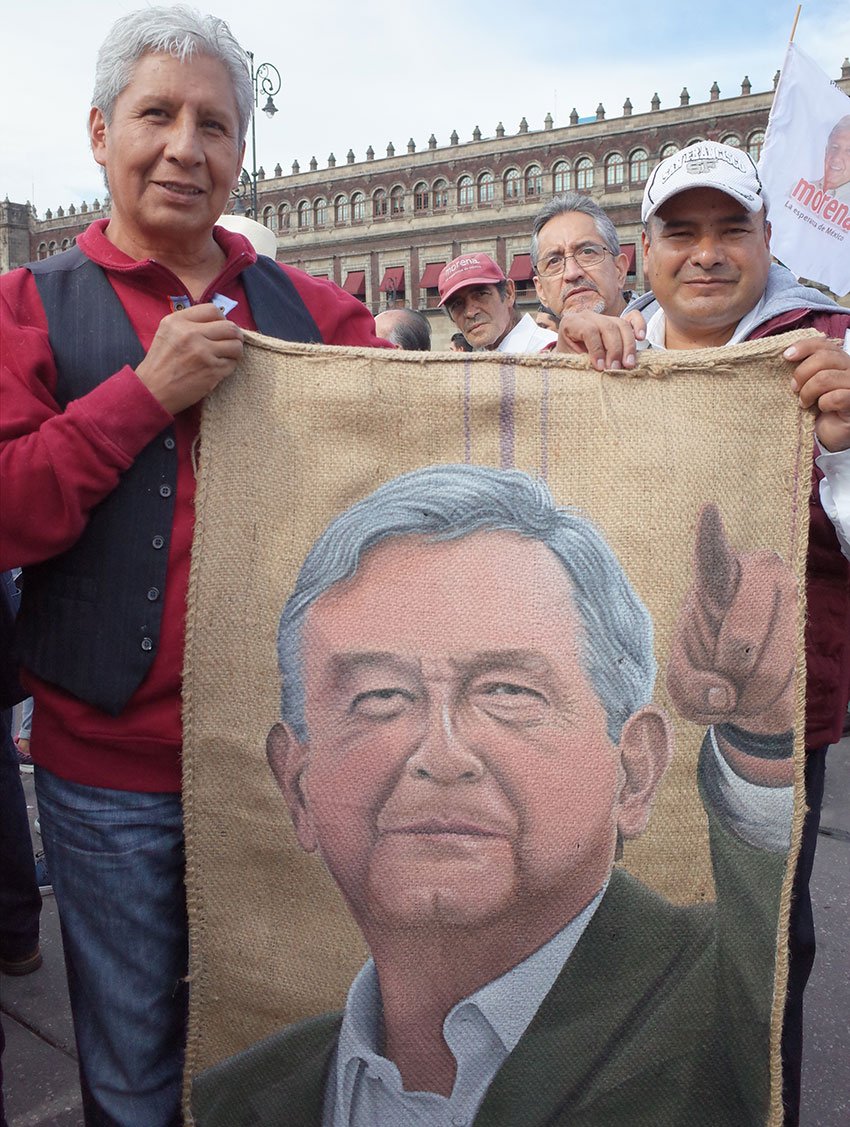
Artist González, left, with his portrait of López Obrador.
“We are authentic pacifists and transformers at the same time. In the defense of causes of honesty, justice and democracy, we’re not moderates, we’re radicals,” he said.
López Obrador – commonly known as AMLO – touted the austerity measures implemented by his administration, reciting his common refrain that “there can’t be a rich government with a poor people” and charging that the role of officials is to serve the people, “not to get rich.”
The president said the salaries of high-ranking officials have been slashed and highlighted that he earns less than half the wage of his predecessor. López Obrador also reminded his supporters that government-owned aircraft, including the luxurious presidential plane, have been put up for sale.
In total, the government’s cost-cutting measures have so far saved 113 billion pesos (US $5.9 billion), López Obrador claimed, stressing that public debt hasn’t increased during his seven months in office.
While most of the accomplishments listed by AMLO were met with warm applause and occasional chants of “presidente, presidente” broke out among attendees, the most boisterous acclamation came when the president underscored the government’s commitment to combating corruption.
López Obrador’s reference to his decision to cancel the new Mexico City airport at Texcoco, México state – which he opposed partially on the grounds that it was corrupt – was particularly well received, triggering chants of “es un honor estar con obrador” (it’s an honor to be with Obrador).
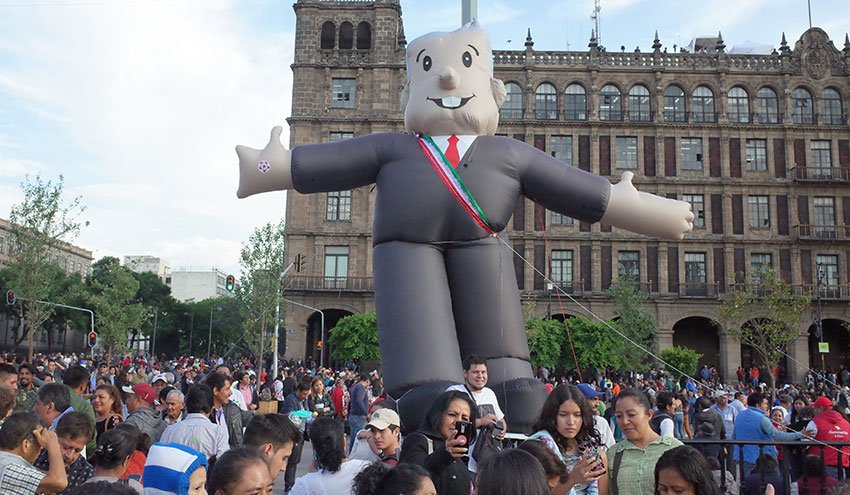
An inflatable AMLO watches over the celebration on Monday.
The president’s assurance that his government will restore the dried-up lakes at the site of the abandoned airport was also met with enthusiastic applause as were the commitments to build the Santa Lucía airport, the new refinery on the Tabasco coast and the Maya Train on the Yucatán peninsula.
With regard to the new airport project, López Obrador said that the “torrent of injunctions” filed against it by opponents of the government amounted to “legal sabotage.”
However, he pledged that construction will start this month, stating that “we’re being careful in the authorization process for the environmental impact study” in order to “not give them any excuse to continue” their opposition.
The president also spoke about the government’s efforts to address the root causes of migration both in Mexico and Central America.
He said that the leaders of G20 countries agreed at the recent summit in Osaka, Japan, to support the “Mexican proposal” to attend to the causes of migration with the implementation of a development plan for Central America.
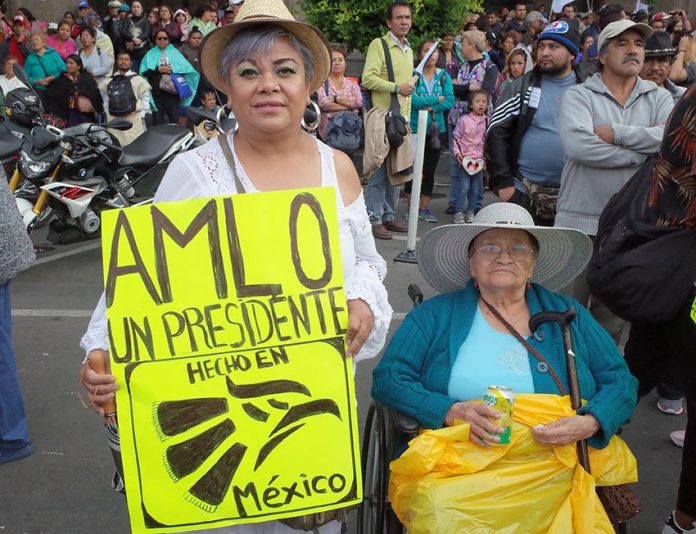
Their placards read ‘I’m tired goose,’ a favorite phrase of AMLO.
While López Obrador’s speech focused heavily on his achievements, he did acknowledge that the government still has a lot to do in the areas of public security, healthcare and the economy.
As he did on Sunday when inaugurating the National Guard, the president conceded that the high levels of violent crime inherited from past administrations haven’t yet come down. However, he expressed optimism that the new security force will soon make progress towards the pacification of the country.
The president stressed that his administration doesn’t tolerate human rights abuses of any kind, adding that it is dedicating time and resources to finding the nation’s more than 40,000 missing people.
“We won’t rest until we know the whereabouts of the young men from Ayotzinapa,” López Obrador said, referring to the 43 teaching students who disappeared in Iguala, Guerrero, in 2014.
Economic growth needs to improve but the peso hasn’t deteriorated and inflation has fallen, the president said, adding that US $10 billion in direct foreign investment came into the country in the first quarter of the year and remittances hit an all-time high in May.
López Obrador concluded his speech with an exuberant delivery of “Viva México” before attendees sang the national anthem.
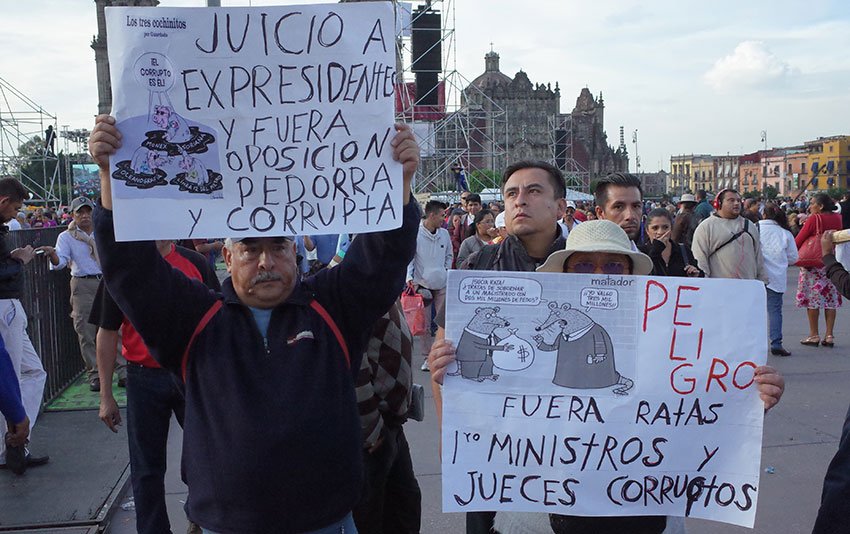
Signs demand justice for previous presidents and corrupt judges.
Among the crowd — officially estimated at 100,000 — was an artist and painting teacher from Ixtapaluca, México state, who arrived at the zócalo with a hand-painted portrait of the president on a jute sack, with which he proudly posed in photographs.
Gonzalo González told Mexico News Daily that López Obrador’s leadership serves as “an example to all Mexicans,” explaining that he is particularly impressed by the president’s decision to cut his own salary and not to travel outside the country while there are pressing issues at home.
He also said that he could now look at the National Palace – the seat of the federal executive – with pride knowing that it is occupied by an “honorable” president rather than the “corrupt” leaders of the past.
Leticia, a government employee from the borough of Coyoacán who declined to give her last name, cited the crusade against corruption and the introduction of new social programs as key achievements of the López Obrador administration, adding that it has also given “a voice to the people.”
She conceded that she was still concerned about insecurity but argued that the government needs to be given more time to combat the scourge, stating “it’s impossible to change the country in seven months.”
While detractors of the president were few and far between at yesterday’s so-called AMLOFest, López Obrador came under fire on the first anniversary of his election from several of his political opponents including the national president of the conservative National Action Party.
“[There is] nothing to celebrate,” Marko Cortés wrote on Twitter yesterday.
“Employment and investment have fallen, there is financial uncertainty, we have the worst [ever] security crisis and health services have suffered serious cuts. President López Obrador, don’t distract yourself with celebrations, concentrate your attention and that of the cabinet on working for the country.”
Cheap airfares and a strong dollar have made traveling for the weekend to Mexico City from the United States a real steal.
With fares such as US $200 from Los Angeles, $250 from Chicago and $300 from New York, all direct flights, mean you don’t have to plan a major sojourn to Mexico to eat some delicious tacos and salsa.
Add that to cheap, ubiquitous Uber service, the prevalence of Airbnb and a metropolis that is culturally and culinary on fire, and there aren’t many reason not to head to Mexico City for a long weekend. Your only problem is bound to be — where to start?
You won’t be able to do everything, but a solid three days can give you a taste of the city that will keep you coming back for more. Mexico City can be overwhelming, so don’t try to pack in too much at once. Remember, traveling isn’t just about checklists but also about checking out for a while.
Start out Friday with a roving, self-guided breakfast tour – a sweetbread at Pastelería Ideal, some café con leche at Café Popular, maybe a plate of chilaquiles verdes in the diner section of the Casa de los Azulejos (make sue to see the Orozco mural near the bathrooms).
Interesting dish at Limosneros.
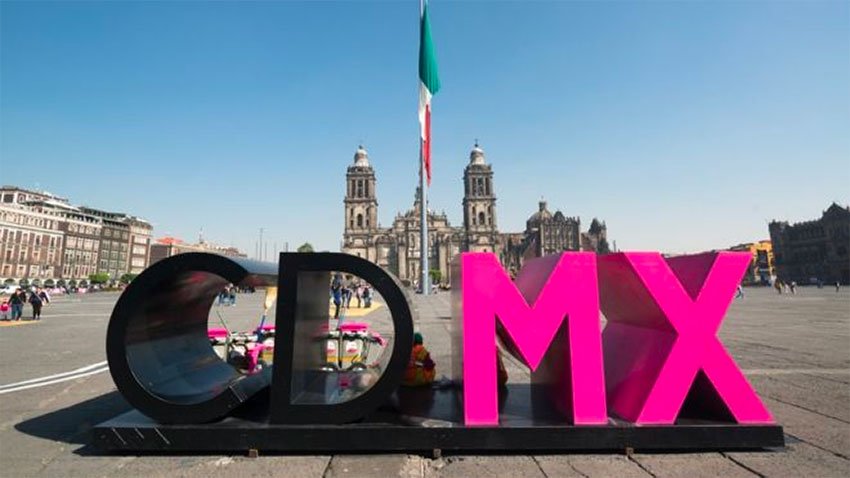
You’ll already be downtown (in the centro histórico) so best to start in the heart of the city and see the zócalo, Mexico City’s main plaza. This plaza was once home to the city’s most important market, El Parian, and these days hosts art events, festivals and often public protests.
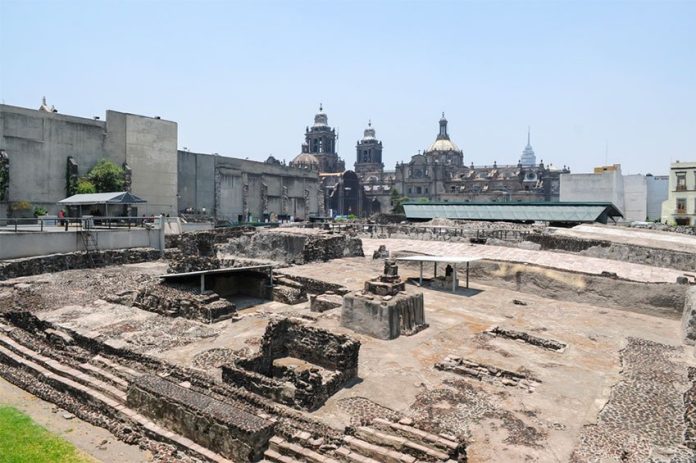
Take a peek at the Templo Mayor to get a feel for the city’s Aztec history, but maybe mix up mural viewing (most visitors just see the National Palace (which is admittedly beautiful) but by heading to the Antiguo Colegio de San Ildefonso or the Education Secretariat buildings you can see Rivera, Orozco and more.
For a slice of the city’s lesser-known history, check out the hidden Justo Sierra synagogue, now a museum, and take time to sit in the park across the street and try a nieve (ice cream) from the roving vendors.
Monica Unikel, a local Jewish historian, also gives Jewish tours of the centro each day at 10:00am; the meeting point is the synagogue. By sunset you should be ready to take the elevator up to the Torre Latinoamericana’s 41st-floor restaurant, have a glass of wine and get a 360-degree lesson on the breadth of the capital.
For dinner head to Limosneros for some classic Mexican tacos and snacks and a lively atmosphere. You can finish off your night there as they have a long list of mezcal, or pop in to the Gallo de Oro cantina for a draft beer and some romantic Mexican love songs.
On Saturday take a cab out to Bazaar Sábado in San Angel if you want to shop for art and antiques, stopping along the way at Las Tlayudas for an incredible Oaxacan-style breakfast. From San Ángel, Coyoacan is just a hop, skip and a jump away, so spend the afternoon wandering its cobblestone streets, making sure to have a churro and chocolate somewhere along the way.
The neighborhood’s main plaza is the center of all the action on the weekends so try Los Danzantes or another one of the restaurants that ring it and listen to the wandering musicians that pass by.
Coming back into town you might want to try and catch a show at Zinco (buy tickets in advance) or the new Jazzatlan Capital in Colonia Roma. If music is not your poison, head to Maison Artemisia for a craft cocktail.
Sunday morning you can get a few tacos de barbacoa early at the corner of Tonalá and León de las Aldamas streets in Colonia Roma. Then join the bikers, walkers and skateboarders in taking over Reforma avenue, walking up to the entrance of Chapultepec park, and heading left at the Monumento a los Niños Héroes.
This will take you on the outside loop of the park (about a 45-minute walk – make sure you see the Fountain of Nezahualcoyotl) and bring you around to the Museum of Anthropology, the Museum of Modern Art and the Tamayo Contemporary Art Museum, all worthy of a Sunday visit.
On Sunday afternoon head to Parque Mexico for a walk around Condesa and stop at Glace Bistro for one of their incredible ice cream flavor combinations. Alternatively, visit the Ciudadela market for some souvenir shopping and stop to see the seniors sway to danzón at the park across the street.
On Sunday evening take one of the city’s many taco tours or take it up a notch by doing some fine dining – Maximo Bistro, Sud 777, Pujol, Rosetta, or Azul Historico.
Where to stay? You can get a better feel for the city at small B&Bs or Airbnbs and many of the city’s most walkable neighborhoods have a plethora of both. Try Colonia Condesa for an upscale, bohemian experience, Polanco to be close to the museums and luxury shopping on Presidente Masaryk avenue.
Stay in Colonia Roma for artsy comfort and great food, and San Rafael to feel like a local. Coyoacan will give you small-town ambiance and the centro histórico will put you in the middle of a whirlwind of constant activity.
Cuauhtémoc and Juárez are both phenomenally located, with Juárez having more dramatic architecture and Cuauhtémoc more of an urban vibe. Santa María de Ribera has the gorgeous Moorish gazebo at its center and the geology museum, but Narvarte has thousands of taco stands. It’s always good to be near a Metro stop as the city’s mass transit, despite its (deserved) chaotic reputation, is an excellent way to get around the city.
My advice is that it’s better to focus your first trip on the city itself and skip Puebla or the pyramids or other day trips, but if this might be your only visit ever, the pyramids are a must. They are easy to do on your own with some basic Spanish by taking the bus from the Terminal de Norte, the city’s northern bus terminal.
There are, of course, millions of other things to do, eat, and see in Mexico City, but this quick and dirty itinerary for beginners gives you a sense of the city and its neighborhoods. There are also dozens of tours, cooking classes and other experiences if you prefer company (there are even folks who will be your morning running partner if you want one), but do make time for drink-sipping and lazy strolling – the city will always be here next weekend — you have time.
Lydia Carey is a freelance writer based in Mexico City.