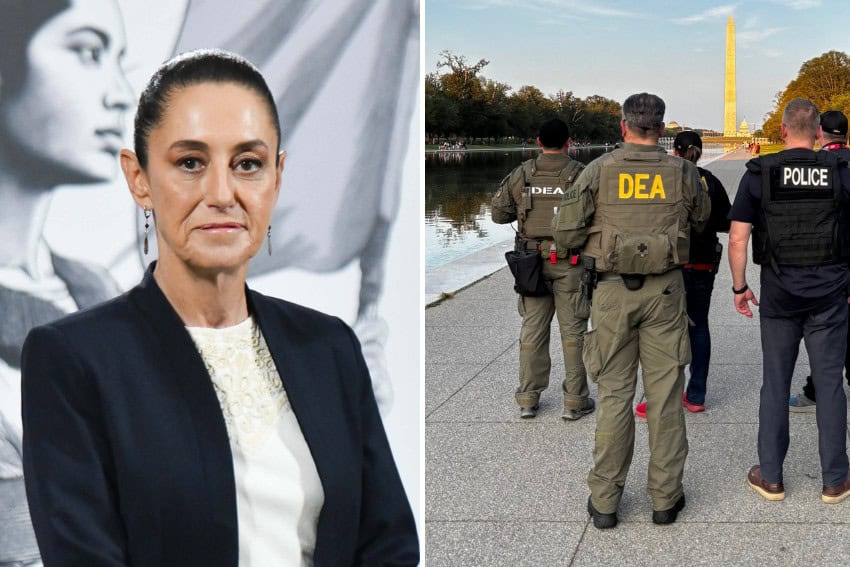
Journalist Charlotte Smith examines the fallout of the unexpected DEA announcement earlier this week, and what it means for Americans living in Mexico. (DEA)
The U.S. Drug Enforcement Administration’s recent announcement of Project Portero was meant to signal progress. Instead, it feels more like the exposing of something far more troubling. It feels like a glaring lack of coordination, or perhaps respect, between two governments that claim to be partners in the fight against fentanyl.
Billed by the DEA as a bold new joint initiative with Mexico to dismantle cross-border trafficking networks, Project Portero seems to have landed with a thud. Within a day, Mexican President Claudia Sheinbaum denied the operation’s very existence, thereby blindsiding observers, undercutting any illusion of bilateral unity, and exposing serious communication failures at the highest levels of international security coordination.
The DEA has announced what it called “a major new initiative to strengthen collaboration between the United States and Mexico in the fight against cartels.” The Mexican government has denied the existence of any such deal. (Mario Jasso/Cuartoscuro/ DEA/X)
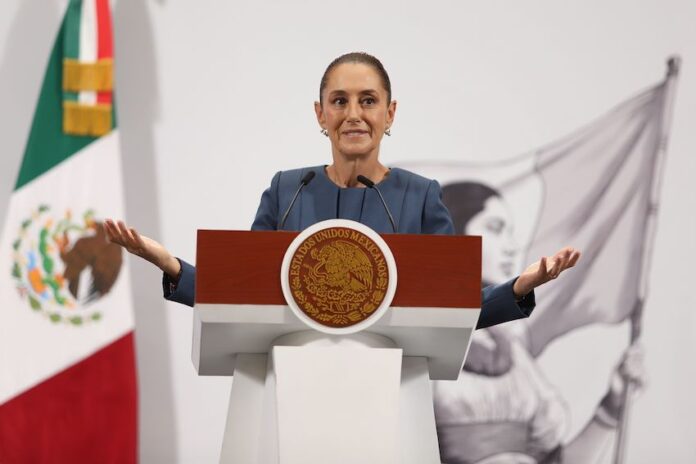
“There is no agreement with the DEA,” Sheinbaum stated bluntly during a press conference on August 19. “No federal institution, neither the Security Ministry, the National Guard, nor the Foreign Ministry, has signed off on anything resembling Project Portero.”
The DEA had characterized the initiative as an example of enhanced collaboration between U.S. and Mexican authorities. It highlighted joint workshops, shared strategy sessions, and an intention to target cartel “gatekeepers” key figures who facilitate the flow of synthetic drugs like fentanyl across the border.
According to the DEA, this initiative represented renewed synergy between two nations grappling with a transnational crisis.
However, Sheinbaum painted a much more limited picture. While she acknowledged that a few Mexican officers had recently attended a workshop in Texas hosted by U.S. officials, she insisted the event was “purely instructional” in nature. It did not, she said, represent any formal agreement, coordinated operation, or approved bilateral initiative.
Her remarks, while diplomatically worded, carried an unmistakable tone of irritation, and a firm reminder that any cooperation must follow established channels of approval.
“These types of announcements should not be made unilaterally,” she said. “Respecting national sovereignty is not negotiable.”
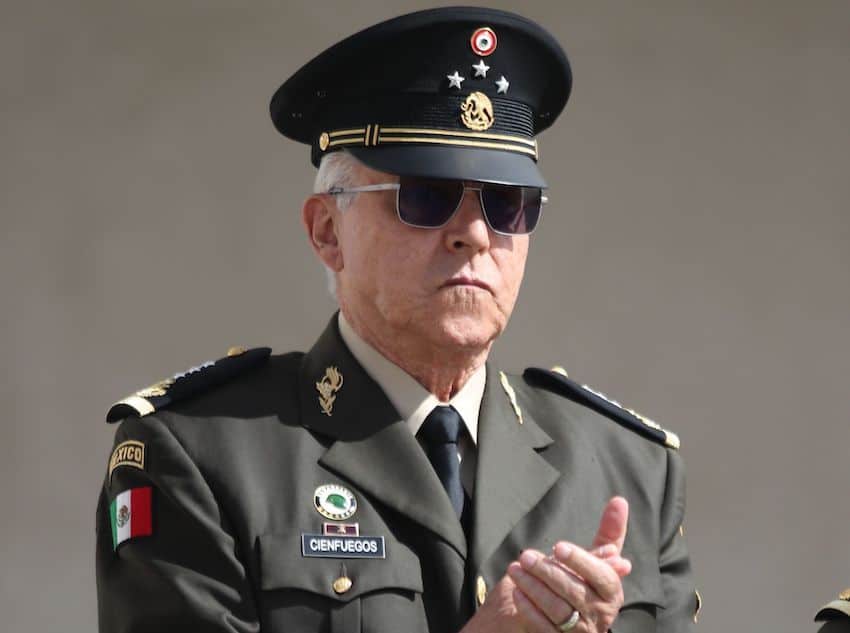
The U.S. arrest of former Defense Minister Salvador Cienfuegos cast a shadow over U.S-Mexico relations in 2020. (Cuartoscuro)
Although Sheinbaum entered office signaling a more open and pragmatic approach, she approved multiple high-level cartel extraditions to the U.S. in her first month. The sudden rollout of Project Portero may have undermined the trust required to sustain that cooperation. In a political environment still sensitive to perceived foreign overreach, the DEA’s announcement seemed tone-deaf at best, and diplomatically reckless at worst.
The DEA, as of this writing, has not issued any follow-up clarification, nor has it responded publicly to the Mexican government’s denial. For many, the agency’s silence has only deepened the uncertainty and frustration surrounding the episode.
While the controversy may seem like a bureaucratic squabble to some, for the more than 1.6 million Americans who live, work, or retire in Mexico, the implications are anything but abstract. Conflicting narratives between Washington, D.C., and Mexico City sow confusion about the actual level of law enforcement coordination on the ground, particularly in states plagued by cartel violence, extortion, and kidnapping.
Many U.S. citizens living in Mexico assume that behind-the-scenes cooperation between American and Mexican authorities provides a safety net, especially in those high-risk areas. But the fallout from Project Portero casts doubt on that assumption, revealing that some security initiatives may be exaggerated or even misrepresented without clear diplomatic backing.
Without clearly defined, legally sanctioned joint protocols, Americans abroad may not know who to contact or what kind of assistance to expect in a crisis. If a U.S. citizen is kidnapped or caught in cartel-related crossfire, will Mexican security forces coordinate with U.S. agencies? Will those agencies even be legally allowed to step in?
The Project Portero debacle also shines a light on a much deeper problem; a lack of effective, institutionalized communication mechanisms between U.S. and Mexican governments when it comes to sensitive security matters.
Who signs off on binational enforcement strategies before they are announced? What level of inter-agency review is required on either side? Are announcements like this coordinated through embassies, security liaisons, or simply left to individual agencies?
At best, the situation reveals a breakdown in bureaucratic process. At worst, it exposes fundamental disagreements about sovereignty, authority, and transparency.
While the DEA likely saw Project Portero as an opportunity to demonstrate proactive engagement with a key ally, the effect may have been the opposite. By publicly referencing a project without confirming Mexican approval, the agency may have embarrassed the Sheinbaum administration and soured diplomatic goodwill just as it was beginning to stabilize.
For Sheinbaum, the incident served as a high-profile opportunity to reaffirm her government’s position on foreign involvement in domestic affairs. “Cooperation, yes. Subordination, no,” she said, repeating a phrase that has quickly become a mantra for her administration and a clear boundary for future negotiations.
As of now, no joint operations under the banner of Project Portero are underway in Mexico. However, Mexican officials have indicated that they are pressing forward with the negotiation of a broader, legally binding bilateral security agreement; one that will spell out the terms of cooperation, information sharing, and operational authority more clearly and definitively.
Whether such an agreement will be reached in the near future remains to be seen. Domestic political pressure in both countries, especially amid rising violence and the ongoing opioid crisis, may either accelerate or complicate the process.
For Americans living in Mexico, the immediate lesson is simple but sobering. Do not assume that security cooperation exists just because one agency announces it. Binational law enforcement operations are inherently complex, politically sensitive, and often entangled in competing narratives.
Even when both sides have good intentions, miscommunication can create dangerous gaps in protection and support. Assumptions can be costly, and partial truths, even from official sources, can leave citizens exposed in moments of crisis. In the realm of international security, perception matters as much as policy. When one government declares an initiative underway and the other publicly denies it, the consequences extend far beyond the press conference podium. They reach into the lives of everyday people. The citizens, tourists, and retirees are left wondering what protection, if any, they can count on.
The fallout from Project Portero wasn’t just a diplomatic misstep, it was a warning. Americans living in Mexico deserve clear, coordinated, and verified information about their safety. They deserve a functioning framework of binational cooperation, not crossed signals and quiet confusion.
Both governments have a responsibility to do better. Not just for one another, but for the millions of lives caught in the space between them.
Charlotte Smith is a contributing writer with over 20 years of experience as a writer and editor. An award-winning journalist, she actively seeks out stories that resonate with the world around us, while also maintaining a travel blog focused on her life adventuring across Mexico, specifically the states of Jalisco and Nayarit.
Hundreds of thousands of copies of sensationalist "nota roja" newspapers are sold in Mexico every day. (Peter Davies)
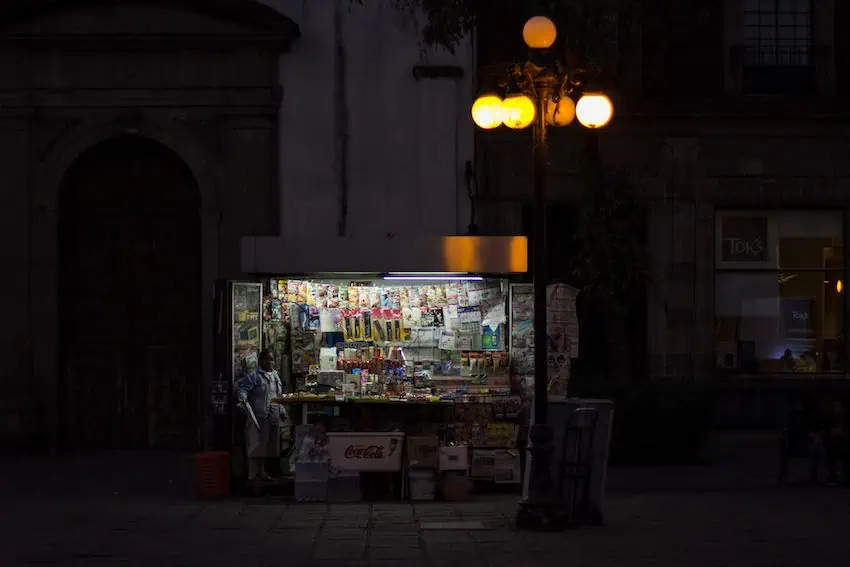
In late June — Friday, June 27, to be exact — I was walking in the historic center of Mexico City when I stopped at a sidewalk kiosk that sells newspapers and a myriad of other miscellaneous items.
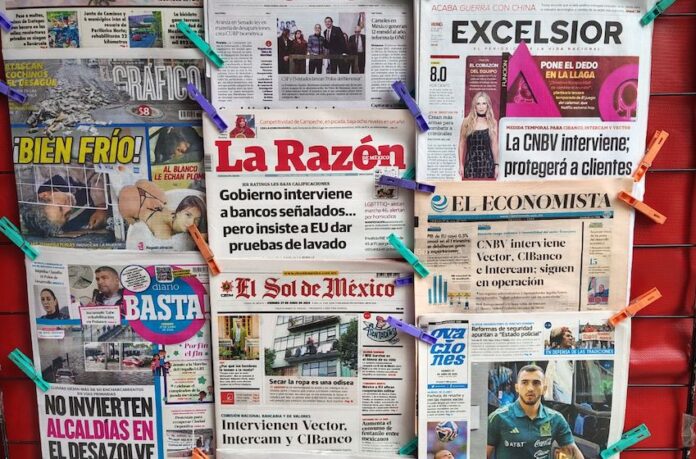
The selection of daily newspapers, neatly arranged on a metal frame and held in place with clothespins, had caught my eye. The front pages of several papers featured stories about the government intervention at three Mexican financial institutions accused of money laundering by United States authorities.
But one tabloid newspaper had a very different headline extending across the top of its front page:
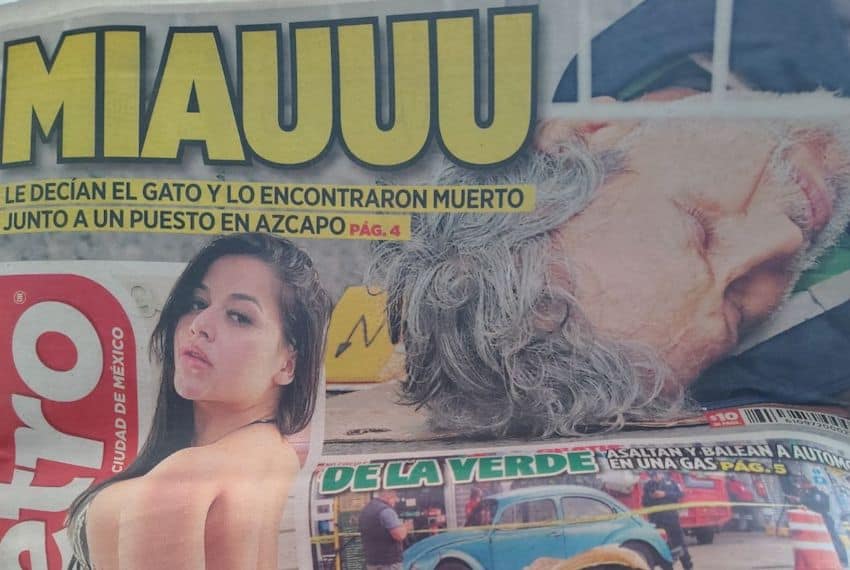
“MIAUUU” — the word in Spanish for “meow,” with a couple of extra vowels at the end for emphasis.
“They called him the cat and they found him dead next to a stall in Azcapo[tzalco],” read the deck (subheading) on the cover of the Mexico City edition of the Metro newspaper, published by Grupo Reforma.
To the left of a photograph of the man who was found dead in the northern borough of Azcapotzalco was another, very different image — one of a bikini-clad woman with the following text superimposed on her backside: “Porn star looks for boyfriend online.”
“They called him the cat and they found him dead next to a stall in Azcapo[tzalco],” reads the June 27th edition of the Mexico City edition of the Metro newspaper. (Peter Davies)Welcome to the world of nota roja journalism in Mexico, which focuses on violent crime, accidents and other adverse events, with gory, stomach-turning photographs often accompanying the sensationalist stories. Photographs of near-naked — or indeed naked — women also routinely appear in the pages of nota roja newspapers.
This kind of journalism is the bread and butter of Mexican tabloid newspapers such as Metro and El Gráfico, both of which are popular, if not highbrow, publications and cover news that is often not reported by the mainstream press.
A new genre is born
“On Sunday, November 17, 1889, one week after the attack on General Ramón Corona, El Mercurio Occidental astonished the readers of Guadalajara with a striking front page: alongside a portrait of the assassin Primitivo Ron, they printed what appeared to be the imprint of his hand in red ink, next to stains of the same color that resembled blood. People were left stunned at the sight of that cover. … Thus la nota roja was born in the country.”
“Unlike in other countries, where it is mainly known as yellow journalism or police reporting, in Mexico the local editorial tradition prevailed and the name nota roja — in honor of that front page [in 1889] — took strong root, [used] to identify information related to crimes, violence, and tragedies that is presented in a sensationalist manner,” Cruz wrote.
Similarly, the journalist Isai Monterrubio wrote in Gaceta UNAM, a publication of the National Autonomous University of Mexico, that the front cover of the Nov. 17, 1889, edition of El Mercurio Occidental “marked the starting point for one of the most emblematic genres of graphic journalism in our country: la nota roja, a record of horror.”
Thus, la nota roja has a rich history in Mexico dating back more than 135 years, with numerous publications — both newspapers and magazines — focusing on this kind of journalism throughout the 20th century and beyond.
Alarma! informed — and shocked — Mexicans for almost 50 years
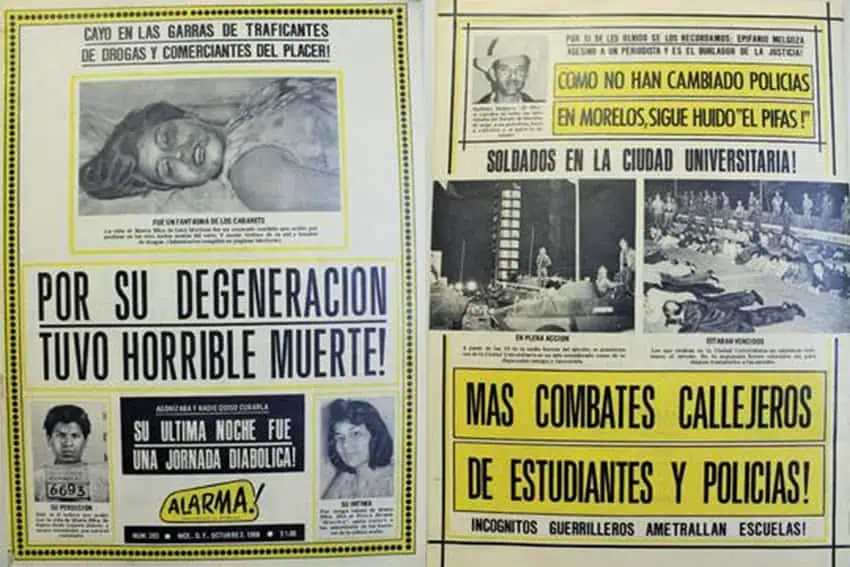
One of the most popular, and most shocking, nota roja publications was Alarma!, a magazine launched in the early 1960s, and relaunched as El Nuevo Alarma! in 1991 after a five-year hiatus.
Two editions of Alarma! that were published in 1968, a year of significant bloodshed — and abundant material for Mexico’s “nota roja” publications. (Archivo Histórico de la UNAM)
“The magazine really took off in 1964 with the story of Las Poquianchis, who were three women who ran an infamous prostitution ring in Guanajuato,” Miguel Ángel Rodríguez Vázquez, the now-deceased former editor of El Nuevo Alarma!, told VICE in late 2007.
“They were accused of committing 28 homicides. All of their victims were young girls who worked for them as prostitutes, and all of their bodies were found buried in Las Poquianchis’s backyard.”
Rodríguez told VICE that the 1985 earthquake in Mexico City was also a “huge story” for Alarma!, but soon after the “huge boost” in sales generated by the extensive reporting on the devastating natural disaster, the publication “was shut down by the government,” ostensibly due to “things like not printing the appropriate ‘adult only’ warnings on the cover or selling the magazine in plastic bags.”
The second incarnation of the magazine, as El Nuevo Alarma!, lasted more than two decades until 2014. Shortly after the publication of the final edition, Rodríguez died of a heart attack in a Mexico City Metro station, and consequently, as the magazine Chilango reported, became a nota roja story himself.
“People are interested in the kind of thing we publish,” he told VICE in 2007.
“I don’t think it’s an illness, I think it’s curiosity. People like to see what we’re made of inside. We have millions of photographs of cadavers with their intestines hanging out. … It’s really strange, and lots of people love to see that. Plus, if we don’t publish enough dead bodies in an issue, we get emails telling us that we were too conservative,” Rodríguez said.
Enrique Metinides, ‘the legendary master of la nota roja‘
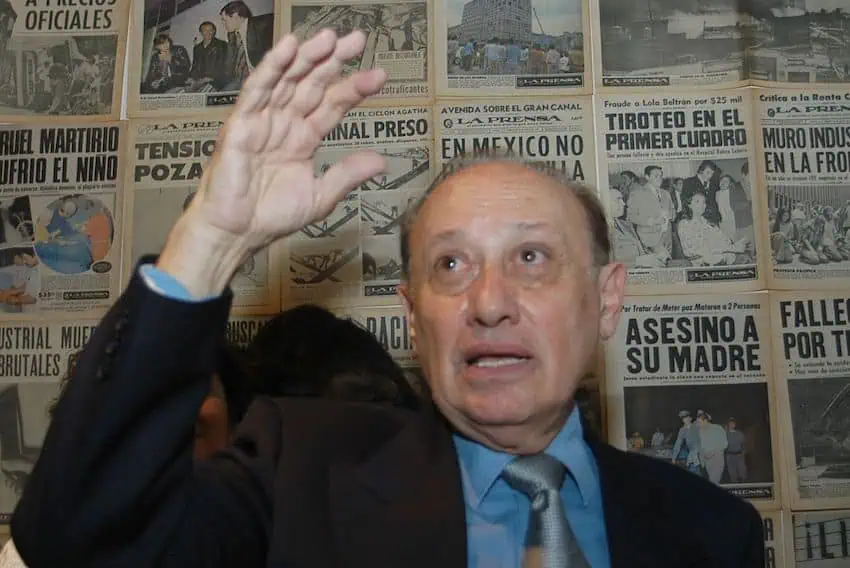
While thousands of people have contributed to the vast archives of nota roja journalism in Mexico, few, if any, of those contributors achieved the national and international prominence of Enrique Metinides, a photographer who started taking pictures of corpses when he was still a boy.
Born in Mexico City to Greek parents in 1934, Metinides was gifted a camera by his father when he was nine or ten and at age 12 took a photograph that was published on the front page of the newspaper La Prensa, where he became an apprentice photographer.
“El Niño” (The Boy), as Metinides was nicknamed in his early working days, went on to work for numerous nota roja publications over a five-decade career, including Alarma!
In a 2007 interview with VICE, Metinides, who passed away at the age of 88 in 2022, said that “the year after I started taking pictures, my dad opened a restaurant and the local cops used to go there for lunch every day.”
“I got to know a lot of them, and they started taking me to the station to take pictures of the people they arrested and the corpses they would pick up,” he said.
“… I really wanted to be a crime reporter at that age, and I used to collect crime stories from the press, from all around the world. … I started taking pictures all over the city,” Metinides said.
“… I worked for 50 years as a crime photographer. … In Mexico City there’s always been a lot of accidents and a lot of deaths,” he said.
Enrique Metinides, a renowned Mexican photojournalist who got his start in “nota roja” photography, had a unique way of framing the horrible accidents suffered by his subjects. (Germán Romero/Cuartoscuro)
Many of Metinides’ photos have an arresting power — they draw viewers in and make it hard to look away, even though their subject matter is often confronting.
One of his most famous images is that of a woman who was hit by a car and killed on Mexico City’s Chapultepec Avenue in 1979. The photo of the almost serene-looking woman, her head tilted between two poles, is shocking, yes, but also mesmerizing in its own way.
“Enrique Metinides was a very different photographer, … his style was extraordinary,” Trisha Ziff, a filmmaker who made the 2015 documentary “The Man Who Saw Too Much” about Metinides, wrote in the newspaper El Universal shortly after his death.
“… Metinides didn’t just take photos. He was also a witness of difficult events — accidents, crashes, violence in the city,” she wrote.
“… If his work is considered art, it’s because he made very different photographs to those we see among the nota roja photos today. Metinides had a different vision: blood almost never appears in his images, and he uses the moment to capture the whole story,” Ziff wrote.
“… Metinides had a lot of international recognition and received many prizes, including the Espejo de Luz, in 1997, the most important recognition of photographers’ work in Mexico,” she wrote.
“That niño, who was born on February 12, 1934 and who instead of playing with a ball entertained himself with his German Braun camera, passed away on May 10 at the age of 88 in his Mexico City, which he literally knew from the inside out, in its morgues and in its tragedies, which he portrayed with the dignity that art provides,” the obituary began.
“In a certain sense, the beauty with which he photographed the dead was his way of paying posthumous homage.”
‘Someone once called us raptors,’ but ‘we are human beings’
Understandably, nota roja journalism is not to everyone’s taste — and many people would probably argue that it shouldn’t be to anyone’s taste.
Unsurprisingly, those responsible for writing the stories and taking the often gruesome photographs that fill the pages of nota roja publications have faced criticism for their work.
“We have been told many times that we are insensitive,” Luis Manuel Acevedo, a veteran nota roja photojournalist, told UNAM Gaceta.
“Someone once called us raptors. People say those kinds of things about us; we are not like that, we are human beings,” he said.
According to Nelson Arteaga, a sociologist who has extensively researched issues related to violence, la nota roja provides “another narrative about violence in the country.”
He compared the journalism genre to other “forms of expression,” such as cinema, music and literature, all of which allow “the construction of narratives” about violence.
While it’s graphic, gruesome, sexist, sensationalist and salacious, there can be no denying the enduring popularity of la nota roja in Mexico.
Hundreds of thousands of copies of nota roja newspapers are sold in Mexico every day. A newspaper vendor in Mexico City’s downtown told me he sells far more copies of such newspapers than mainstream publications such as El Universal and Milenio.
A newspaper vendor in Mexico City’s downtown told Mexico News Daily that he sells far more copies of “nota roja” newspapers than mainstream publications such as El Universal and Milenio. (Galo Cañas/Cuartoscuro)
“In the end, [la nota roja] has a wide audience because violence crystallized into images communicates something to the public,” Arteaga told UNAM Gaceta.
“What I think would be wrong is if these kinds of magazines didn’t exist, because it would be like trying to hide something that’s there,” he said.
“Scandal and sensationalism are gasoline for an audience with a pyromaniac instinct and a lighter in their hands. What we call yellow journalism is the result of a market ready to consume stories overflowing with morbidity. And it is a thermometer of the level of violence and barbarity that a society is willing to endure.”
Octavio Paz, the only Mexican who has won the Nobel Prize in Literature, wrote in his book “The Labyrinth of Solitude” that while death for a resident of New York, Paris or London is a word that is never spoken “because it burns the lips,” a Mexican, in contrast, “visits her often, mocks her, caresses her, sleeps with her, celebrates her.”
“She is one of his favorite playthings and his most permanent love.”
What will you find in a nota roja newspaper today?
In addition to stories about violent crime and accidents, and pictures of naked women, nota roja newspapers such as El Gráfico and Metro publish crosswords, cartoons, classifieds, horoscopes, sports news, jokes and agony aunt-style columns, among other recurring features.
In the copy of El Gráfico I picked up in late June, one of the questions asked of “sexual consultancy” columnist Cecilia Rosillo was this: Does one’s pubic hair fall out as one ages?
“I’m truly intrigued,” the reader said.
Nota roja newspapers are also known for their ingenious — albeit sometimes unseemly — headlines.
Personally speaking, a couple of the most memorable headlines over the past decade or so have been “Ya es zombi” (She’s a zombie now), published on the front page of Metro after the 2018 death of The Cranberries singer Dolores O’Riordan, and “Tiembla Cabrón” (Shook like a motherfucker), also in Metro, after the powerful earthquake that shook southern and central Mexico on Sept. 7, 2017.
For those of you who are unfamiliar with the genre, and are interested in reading a few archetypal nota roja stories, here are translations of three articles from the June 27 copies of Metro and El Gráfico that I picked up in downtown Mexico City.
He uses up his last life
El Nahual dies at a market stall in the Pro Hogar neighborhood where he prowled around for 40 years
Mexico City – The man who died was called Víctor and he was well-known among the residents of the Pro Hogar neighborhood in the Azcapotzalco neighborhood.
However, only a few people knew his name. Almost everyone knew him as El Gato (The Cat) or El Nahual because they believed he had several lives.
Some said he was about 60, although his gray hair and the wrinkles on his face made him look older.
They say he was from Hidalgo, but he arrived in the neighborhood about 40 years ago and lived in the street since then.
“He wasn’t a bad person, he was doing well and he was active, but his problem was that he started taking drugs. At one point we gave him up for dead because he disappeared, but he suddenly came back about two years ago,” a man recalled.
Three months ago, he started having health problems and they worsened to the point that he couldn’t walk. When Thursday dawned he was stretched out on the corner of Street 12 and Street 15, where a watch salesman sets up his stall.
The salesman recognized him and tried to wake him up, but Víctor didn’t respond and he requested help. It wasn’t until 9 a.m. that police from the La Raza Sector and paramedics confirmed that his last life was gone.
Later, specialists from the Mexico City Attorney General’s Office arrived to begin investigations and remove the body.
– Metro
DiDi … ceased
The motorcyclist went out to pick up an order and was hit by a drunk driver
After leaving a fast-food establishment in the Azcapotzalco borough, a motorcycle deliveryman was hit by an SUV. The DiDi worker died, while police arrested the woman who was driving while intoxicated.
The day before yesterday, before the restaurant’s closing time, the deliveryman arrived at the business in the San Salvador Xochimanca neighborhood to pick up an order. After nine at night, he left the parking lot and headed toward Eje 3 Norte, Camarones Avenue.
But after leaving the location, he was hit by a speeding SUV. The woman at the steering wheel of the Jeep was unable to brake and ended up running over the deliveryman who was riding a low-powered motorbike.
The impact sent the body of the motorcyclist toward the road. Although witnesses stopped to help the man, he died before the paramedics arrived.
WASTED. The woman remained in the SUV until Azcapotzalco police arrived. After listening to her say what happened, the agents took her to the prosecutor’s office.
Witnesses said she was driving in an intoxicated state and was speeding. But it will be investigations that determine if it was alcohol that caused the accident.
The body of the DiDi deliveryman was taken to the morgue of the prosecutor’s office, where it is hoped it will be collected by relatives. Until now, the body hasn’t been identified by his family.
– El Gráfico
Eaten alive
She flaunts her outfit to go get tacos and the criticism pours in
The ex-XXX star, Aída Cortés, visited Mexico, where she didn’t miss out on the opportunity to be gluttonous with tacos. But she wore a very eye-catching outfit, which caused her to be eaten alive with criticism.
The Colombian, who managed to earn up to 120,000 dollars a month (a little more than 2 million Mexican pesos) with her explicit content, decided to turn her life around and dedicate herself to singing.
So she came to Mexico to promote her album. During her stay, Cortés uploaded a video where she is seen in a black corset, stockings and thong that left little to the imagination.
“My outfit to go out to eat tacos in Polanco, Mexico,” wrote Aída, but rather than positive comments, criticism pointing to her outfit appeared on her social media.
“Your outfit is very cute, but it wasn’t the right place to dress like that. You should have put on a casual outfit. It was a family place, not a brothel!” wrote an internet user.
Another said: “Change your life, but respect starts with your attire. It looks like you’re still doing the same thing.”
“You’re free to dress how you want, but in a family place … it’s not very appropriate,” others complained.
– El Gráfico
By Mexico News Daily chief staff writer Peter Davies (peter.davies@mexiconewsdaily.com)
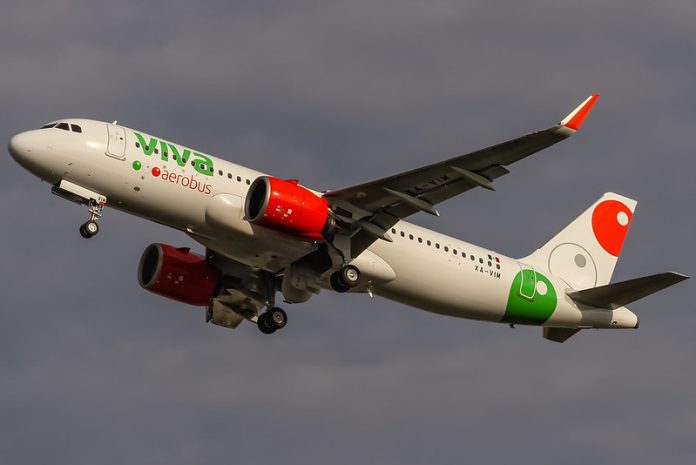
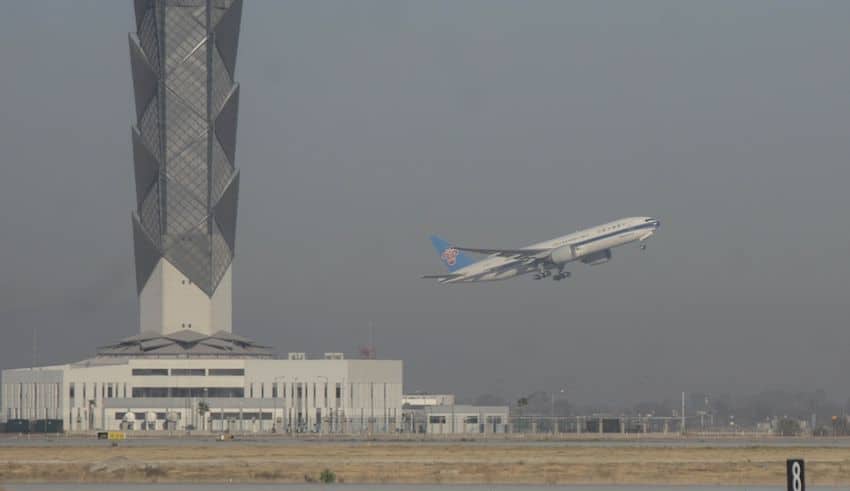
Viva's new U.S.-to-AIFA routes will take flight in November and December ahead of the 2026 FIFA World Cup, which will be co-hosted by Mexico, the U.S. and Canada. (Oliver Holzbauer/Flickr)
Low-cost airline Viva — formerly known as Viva Aerobús — announced two new international routes from Felipe Ángeles International Airport (AIFA) to Austin-Bergstrom International Airport (AU) and New York (JFK), starting this winter.
The route to Austin will begin on Nov. 20, and will operate three times a week: Tuesday, Thursday and Saturday.
The new flights will connect AIFA airport in México state to New York City and Austin, Texas. (Mario Jasso/Cuartoscuro)
Meanwhile, service to JFK will be seasonal and strategic. It will run from Dec. 12 through Jan. 11, with three weekly flights on Wednesdays, Fridays and Sundays. The route will subsequently return in June 2026, coinciding with the start of the FIFA World Cup. Both Mexico City and New York will be host cities for the competition.
“At Viva, we are preparing to connect Mexicans with various World Cup host cities and to welcome the wave of international tourists who will surely visit our country during this great event,” Viva CEO Juan Carlos Zuazua said.
The new routes join seven different routes the carrier announced in April between the AIFA and the U.S., as part of a strategy to strengthen international connectivity to AIFA. The destinations of those routes include Los Angeles, Dallas, Denver, Chicago, Houston, Miami and Orlando.
“We continue to boost this airport’s international connectivity, tourism, and opportunities for thousands of Mexicans with these new routes,” the General Manager of AIFA Isidoro Pastor Román said. “Thanks to the efforts of airlines like Viva, our staff, our location, and our first-class infrastructure, we are consolidating AIFA as the best option for flying in the Metropolitan Area of the Valley of Mexico,” he said.
According to Pastor, AIFA is projected to transport 7.3 million passengers in 2025, surpassing the previous record of 6.3 million set last year. However, it is still operating below its full capacity.
When the airport opened, officials expected to serve 20 million passengers per year. Yet in the more than three years from its opening in March 2022 to July 2025, the airport has served a total of just 13.5 million passengers.
Though the number of passengers remains low compared to the initial estimates, demand continues to increase each year.
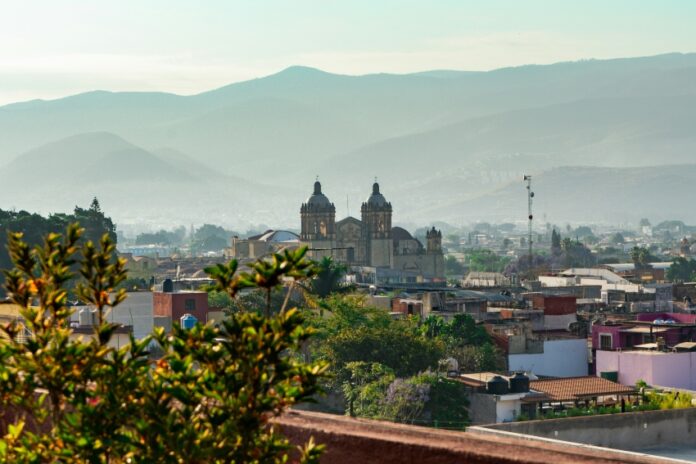
The city of Oaxaca is a book lover's destination — if you know where to look. (Caleb Bennetts)
Making my way to Salina Cruz, Oaxaca, recently to take the Interoceanic Train across the Isthmus of Tehuantepec, I spent two days in Oaxaca de Juárez, a city I hadn’t been to since 2019. Oaxaca was as charming as ever. However, without the first-time visitor’s rush to visit Hierve el Agua or Monte Albán, I was able to dedicate more time to my real tourism passion: visiting bookstores. Here are the best I found in Oaxaca (the city, not the state).
La Jícara Librespacio Cultural
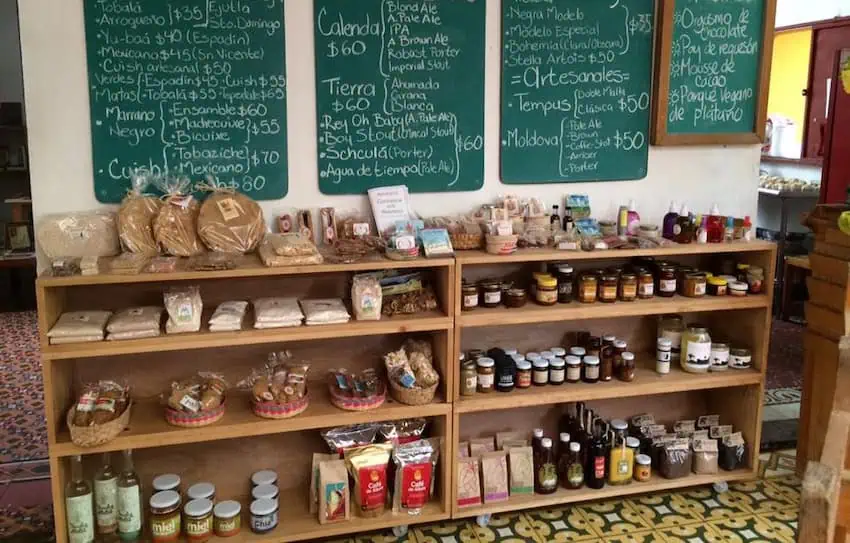
La Jicara sells more than just books, with a selection of local foods too. (Puente a la Salud Comunitaria/Facebook)
La Jícara, which celebrates its 16th anniversary this year, is the powerhouse on this list. Walk up its stone steps and you’ll be greeted by a corkboard offering months’ worth of workshops, concerts and author talks staged in the cultural center. You still won’t be among the books yet, but rather in the center’s restaurant, which serves delicious French fries and drinks that won’t hurt a poet’s wallet. In addition to a broad range of contemporary literature and social sciences from independent publishers across Latin America, I found a book by philosopher Fernando Martínez Heredia that I didn’t even know you could get in Mexico. The bookstore sells very underground Oaxaca-based magazines and prints in formats you never thought possible.
Walk across the covered-patio-cum-restaurant area and you’ll find not only a gift store selling local crafts but La Jicarita, the children’s section of La Jícara, which takes up a room on its own. In addition to an expansive selection of picture books in multiple languages, including bilingual editions of stories in Oaxaca’s Indigenous languages, La Jicarita also features a floor covered with toys so that young readers (or future readers) can play while their adults enjoy a meal or browse books over at La Jícara.
Porfirio Díaz 315, Colonia Figueroa
El Ático
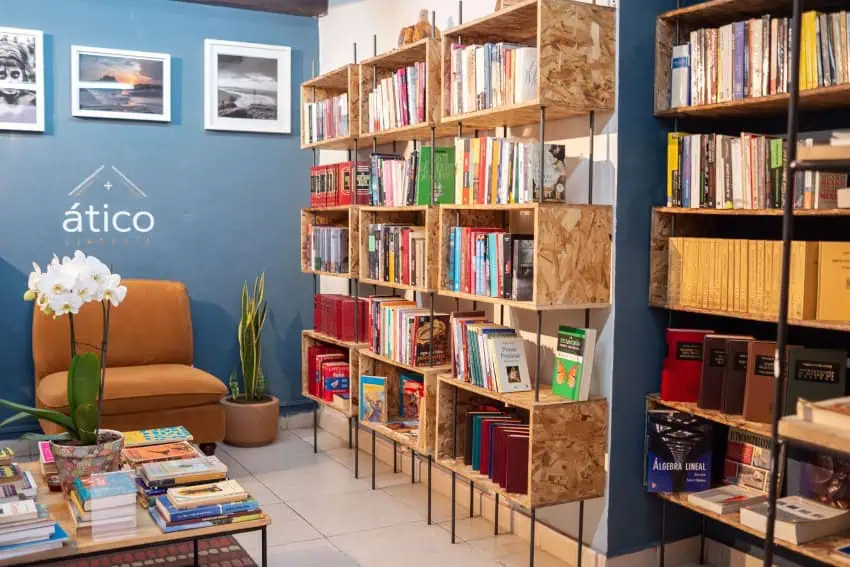
El Ático may be small, but it offers both classics and contemporary literature. (El Ático)
Steps away from La Jícara, you can duck down into El Ático, whose quirky side is immediately made evident by the hollowed-out 1960s-era TV on the sidewalk that serves as a shelf for the store’s discount offerings. The staff’s rapport with their customers and knowledge of the bookselling landscape was quickly apparent, with several people stopping in to pick up books they’d asked for previously and inquiring about hard-to-find editions that the bookseller on duty confirmed she had a connection for.
El Ático makes good use of its small space — a single room with shelves on every wall stocking classics and contemporary literature, including a good deal of international works translated to Spanish. It has a robust selection of books on local and state history, art and culture that are sure to please Oaxaca aficionados, as well as a shelf of bilingual children’s editions in regional varieties of Indigenous languages like Mixtec and Zapotec.
Porfirio Díaz 1105, Colonia Figueroa
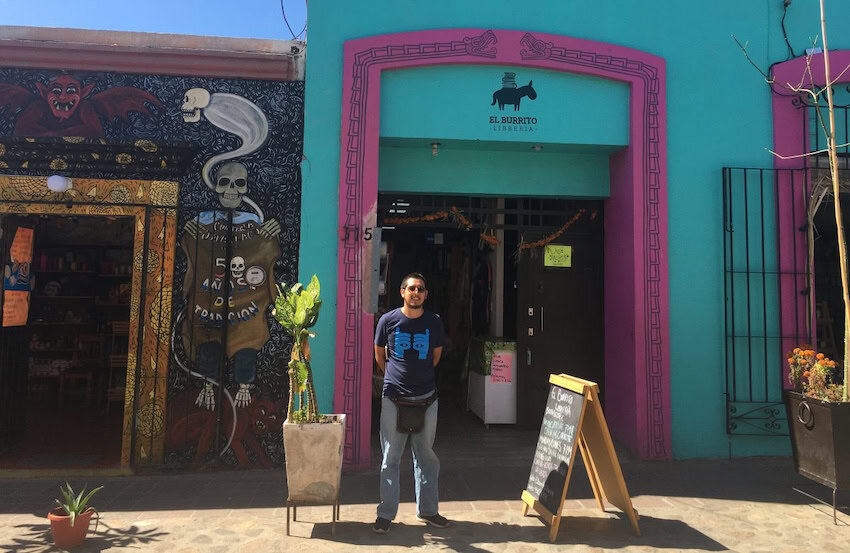
El Burrito
El Burrito packs a mighty cultural punch, carrying international, historic and even rare books. (Oro Radio)
El Burrito’s logo is a donkey with a stack of books on its back. According to owner Jorge González, it represents him. Before he had a bookstore, this FES Acatlán graduate sold books out of a sack on the pedestrian-only street called the Andador Turístico and through the beach towns of the Oaxaca Riviera.
“You can take anything away from a Oaxacan except the street,” González told me.
El Burrito’s owner is outspoken about social issues like gentrification, and González’s concerns are reflected in the store’s offerings. You’ll find not just vintage editions by storied progressive publishers like Ediciones Era, Losada and Grijalbo but also hard-to-find texts published by Mexico’s social movements as they were happening. These include magazines of the 1980s student movement at the National Autonomous University (UNAM). There are also rare editions, a great Oaxacan history section, and well-stocked French- and English-language shelves with contemporary titles like Gabrielle Zevin’s 2022 novel “Tomorrow, and Tomorrow, and Tomorrow.”
If you don’t find anything to your liking, a visit to El Burrito, located in the charming historic neighborhood of Jalatlaco, is still worth it. The bookstore, true to its community-building mission, hosts frequent reading circles and often participates in popular literary tianguis. And González sells a delicious, stomach-warming mezcal made by a palenquera aunt who brings her wares down from the hills.
Aldama 315, Jalatlaco
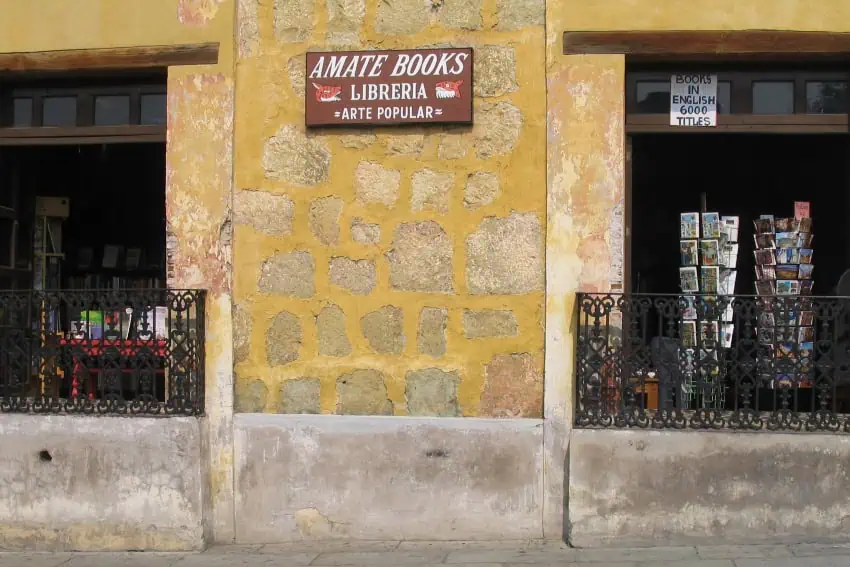
Amate Books
If you’re looking for good books in Oaxaca, start at Amate. The people who run this place know what they’re doing. (Amate Books)
Checking the shelves at Amate, just up the street from El Burrito — Oaxaca’s bookstores seem to stick close together — one thought was blaring in my mind: Whoever owns this place knows what they’re doing.
In Mexico, English-language book sections and bookstores broadly follow one of two patterns — the books are either good and used or new and terrible. Across Mexico City, you’ll be choosing between a book of classic poetry that’s falling apart or a brand-spanking-new, plastic-wrapped airport paperback. But the sweeping English-language selection at Amate Books is both good and new, and it’s obvious that the people stocking it are up to date on literature about Mexico. I spotted landmarks in history and sociology written abroad, like Charles Mann’s “1491” and Hilary Klein’s “Compañeras,” as well as English editions of Mexican classics like Carlos Fuentes’ “Old Gringo.” There were also cookbooks and tomes about the world of Mexican mushrooms.
The store on Calle Aldama is the second iteration of Amate, revived in 2023 after the COVID-19 pandemic obliged owners Henry Wangemann and Rosa Blum to close the store’s original downtown location. Besides reading material, Amate also sells Oaxacan folk art, a reflection of Blum’s many years as a gallery owner here. The masks closest to the door, I noticed, were priced differently from the ones on the next shelf over. Why the variance?
“These are danced,” a staff member told me, “and those ones haven’t been danced yet.”
Aldama 318, Jalatlaco
Two historic Educals
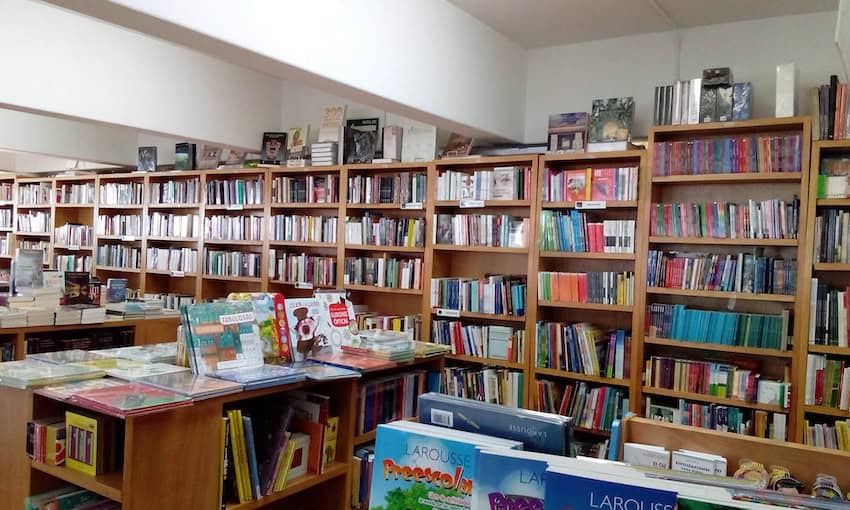
The Educals are government-operated educational bookstores. (Mexico es Cultura)
Location 1
Educal is the name of a state-owned business that functions as the federal Ministry of Education (SEP)’s book distributor, promoting readership and selling books out of its many locations across the country. The selection at these stores tends to be largely uniform, and that’s true at Educal’s two Oaxaca city locations as well. But even if you’re not interested in, say, the newest history book out from the Fondo de Cultura Económica, these stores are worth visiting on the strength of location alone.
Despite the ticket machine at the entrance, you don’t need a ticket to enter the famous Templo de Santo Domingo de Guzmán. That’s only necessary if you’re going upstairs to the Museum of the Cultures of Oaxaca. The lower level of the complex and its galleries are free, so walk yourself in and to the left, and you’ll find our first Educal.
With its tall ceilings and windows, books elegantly laid out on hardwood tables and reproductions of ancient Zapotec ceramics available for sale, there’s no better place in this church-convent to feel like the scholar-monks who once called it home.
Macedonio Alcalá s/n, Centro
Location 2
Our second Oaxaca city Educal store is found in a decidedly less spiritual place. Walking south from Santo Domingo down Calle Cinco de Mayo, you’ll find the Teatro-Casino Macedonio Alcalá.
Inaugurated in 1909, this gorgeous Art Nouveau building was constructed at the urging of Oaxaca’s elite, who wanted not only a place to socialize but also to put their city on the level of other state capitals. Their opera house couldn’t lack a casino, so the building came with dedicated rooms for billiards, dominoes, cards and chess, as well as a bar.
Educal, which you’ll find by turning onto Calle Independencia, occupies part of this recreational space. It’s not often you find a bookstore selling postcards of the same building it’s located in, but that’s par for the course when you’re selling books out of one of your state’s architectural landmarks.
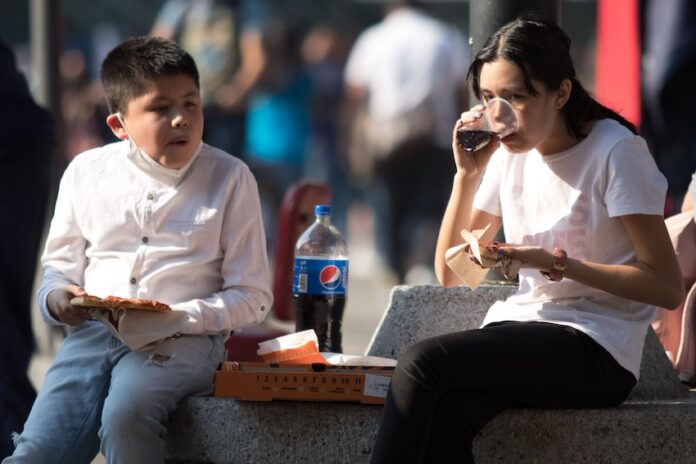
Seven in 10 children and adolescents consume soft drinks daily, even with breakfast, according to Mexico's health minister. (Graciela López/Cuartoscuro)
More than a decade after Mexico became one of the first countries to impose a tax on sugary sodas, the Health Ministry is set to launch a new campaign aimed at discouraging their consumption.
“Sometimes we think that health is only about care when we get sick and go to a health center or hospital,” President Claudia Sheinbaum said in announcing the campaign during her daily press conference on Tuesday. “[However,] health is related to care, prevention and particularly sugary drinks, soft drinks.”
Despite the tax, implemented in 2014, soft drink consumption is still excessive in Mexico, and the campaign will emphasize public education. Health Minister David Kershenobich said at the conference that Mexicans drink an average of 166 liters of soda per year, putting Mexico among the top countries for sugary drink consumption globally.
Seven in 10 children and adolescents consume soft drinks daily, even with breakfast, according to Kershenobich. He stressed that high levels of soda consumption are linked to the development of diabetes and cardiovascular disease, with a single 600 ml soda containing between 12 and 15 teaspoons of sugar.
In 2024, 190,000 deaths in Mexico were attributed to heart disease and 112,000 to diabetes.
“One wonders if we have a way to treat these people because we continue to have such a high mortality rate,” said Kershenobich. “And that’s where preventive programs come in.”
The Health Ministry plans to implement prevention campaigns focused on healthy consumption and education on nutrition from early childhood starting next week.
Programs such as the government’s “Live Healthy, Live Happy” initiative, which was launched by Sheinbaum on Feb. 25 to reduce the consumption of junk food and sugary drinks among children, are key to changing societal habits and tackling chronic diseases, according to Kershenobich.
Will the soda tax increase?
The emphasis at the press conference was on education, not taxation. But health experts from various institutions recommend introducing higher taxes on sugary drinks to reduce their consumption.
Judith Senyacen Méndez, the deputy director of research at the Center for Economic and Budgetary Research, said that introducing a 20% tax on the drinks could drive down consumption by between 16% and 19%, based on empirical evidence.
Meanwhile, Iván Bremeunea, the coordinator of the Fundar Center of Analysis and Research’s Tax Justice Program, said a 20% tax could reduce obesity cases by up to 970,000, in addition to generating annual revenue of over 104 billion pesos (US $2.5 billion).
While Mexico’s one-peso-per-liter soda tax (about 10%) did in fact reduce consumption at first, Bremeunea said that the current levy is no longer effective and must be increased. He said that even a further 6% increase in soda prices could reduce obesity rates by 3.2%.
The Mexican economy is now expected to start the second half of 2025 in negative territory after overcoming a technical recession in the first half of the year. (Luis/Unsplash)
Although the Mexican economy is expected to have grown by 0.1% annually in July, it fell by 0.1% on a month-over-month basis, according to preliminary data published by the national statistics agency INEGI on Tuesday.
The figures come from INEGI’s Timely Indicator of Economic Activity (IOAE), which offers early estimates of the results of the Global Indicator of Economic Activity (IGAE).
If the prediction is confirmed, the Mexican economy will experience its second contraction of the year, after a month-on-month decrease of 0.2% in March.
In the second quarter, Mexico’s economy grew by an estimated 0.7% on a quarterly basis and 1.2% annually. However, the economy is now expected to start the second half of 2025 in negative territory after overcoming a technical recession in the first half of the year.
After March’s month-over-month contraction of 0.2%, April posted marginal growth of 0.5% followed by 0% growth in May and June.
“Today’s results reflect a slight moderation in the performance of the main groups of economic activities (secondary and tertiary), with particular emphasis on the performance of secondary activities, as they remain in negative territory in their annual comparison,” the Mexican financial group Monex said in an analysis.
The industrial sector, a secondary economic activity, experienced a monthly contraction of 0.1%, as well as an annual decline of 1%, according to the INEGI estimates.
Mexico’s Finance Ministry has nevertheless decided to maintain its existing growth estimate range of between 1.5% and 2.3% heading into the 2026 Economic Package, which it must deliver no later than September 8.
Behind the economic growth data
Independent economic growth estimates vary, with the OECD predicting a GDP growth for Mexico of 0.4% in 2025, and Citi forecasting 0.3% growth.
The GDP outlook for Mexico has been revised upward, from 0.1% to 0.4%, the national president of the IMEF, Gabriela Gutiérrez, said on a conference call with the newspaper El Economista.
Víctor Manuel Herrera, the president of the National Committee for Economic Studies of the Mexican Institute of Finance Executives (IMEF), said that one factor contributing to the slight upward tick in the growth outlook was the postponement of United States tariffs on Mexican goods, which were expected to come into force on August 1.
“The announcements have been to implement the new tariffs, then cancel them, then postpone them, and in the end, there isn’t much change, with a few exceptions,” said Gutiérrez. “What this has done is interrupt export flows and then reactivate them.”
Also on Wednesday, Sheinbaum noted that several high-ranking foreign officials are planning to come to Mexico before the end of the year. (Daniel Augusto/Cuartoscuro)
At her Wednesday morning press conference, President Claudia Sheinbaum acknowledged that Mexican bank CIBanco has launched legal action against the U.S. government and once again railed against an announcement the Drug Enforcement Administration (DEA) made on Monday.
She also noted that she is expecting some very important visitors before the end of the year.
Here is a recap of the president’s Aug. 20 mañanera.
CIBanco has the ‘right’ to sue US Department of the Treasury, says Sheinbaum
“… They have the right [to do so],” Sheinbaum said.
The publication law.com reported on Tuesday that “litigation boutique Dunn Isaacson Rhee has filed a lawsuit alleging the Trump administration unlawfully blacklisted Mexico’s 20th largest financial institution under false money laundering allegations.”
“The complaint alleges the U.S. Treasury Department’s Financial Crimes Enforcement Network arbitrarily blocked plaintiff CIBanco S.A. from accessing the U.S. financial system in violation of the Administrative Procedure Act and Fifth Amendment to the U.S. Constitution,” the report said.
Law.com said that lawyers “deny the money laundering allegations on behalf of their client CIBanco, an international commercial bank headquartered in Mexico City.”
Beyond CIBanco’s lawsuit, Sheinbaum said that “the important thing” is that the U.S. Department of the Treasury has (once again) postponed the date on which sanctions against CIBanco, Intercam and Vector will take effect.
Treasury’s Financial Crimes Enforcement Network (FinCEN) said in a statement on Tuesday that it had “extended the effective dates for orders issued on June 25, 2025, prohibiting certain transmittal of funds involving three Mexico-based financial institutions.”
FinCEN said that “covered financial institutions” in the United States “will now have until October 20, 2025, to implement the orders prohibiting certain transmittal of funds involving” CIBanco, Intercam and Vector, “each of which FinCEN found to be of primary money laundering concern in connection with illicit opioid trafficking pursuant to the Fentanyl Sanctions Act and the FEND Off Fentanyl Act.”
Even though U.S. sanctions on the three financial institutions have not officially taken effect, many Mexico News Daily readers told us last month that they had experienced problems completing transfers to and from their CIBanco and Intercam accounts.
Sheinbaum: DEA statement ‘has nothing to do with reality’
Sheinbaum once again expressed her discontent with the DEA’s announcement of what it called a “bold bilateral initiative to dismantle cartel gatekeepers and combat synthetic drug trafficking.”
She said that a DEA statement announcing the supposed U.S.-Mexico initiative “has nothing to do with reality.”
“… The truth is I don’t know what their intention is [in] saying there is a special [bilateral] operation on the border when there is not,” Sheinbaum said.
“In any case, they will have to say why, say what their intention is,” she said.
Sheinbaum said on Tuesday that Foreign Affairs Minister Juan Ramón de la Fuente would seek an explanation from U.S. Ambassador to Mexico Ron Johnson.
Sheinbaum says Carney and Macron to visit Mexico this year
Sheinbaum told reporters that she has no plans for any more international trips in 2025.
However, she noted that several high-ranking foreign officials are planning to come to Mexico before the end of the year.
President Sheinbaum will receive French President Macron and Prime Minister of Canada Mark Carney (both standing to her right) in Mexico before the year ends. (Presidencia/Cuartoscuro)
“Remember that at the end of this month, next week, [government] ministers from Brazil are coming,” Sheinbaum said.
“The prime minister of Canada is coming. The president of France is coming, between now and December,” she said.
Bloomberg reported last week that Canadian Prime Minister Mark Carney “is planning to visit Mexico on Sept. 18, according to a person familiar with the matter.”
The news agency said that Carney is seeking “to boost trade and strengthen relations with the country amid punishing US tariffs.”
Sheinbaum didn’t say when French President Emmanuel Macron was planning to visit, but Deputy Foreign Affairs Minister María Teresa Mercado said last month that he was expected to come to Mexico at the end of November.
Asked whether U.S. Secretary of State Marco Rubio would come to Mexico this year, Sheinbaum said it was “probable” and indicated that the main purpose of a visit would be to “close” the new Mexico-U.S. security agreement.
The president has said that the agreement is “ready,” and based on four principles: sovereignty; mutual trust; territorial respect; and coordination without subordination.”
Rubio said in May that he “intended to travel potentially to Mexico” in “the next few weeks” along with “a couple of other cabinet members to sort of finalize some … areas of [security] cooperation.”
Three months later, the secretary of state still hasn’t made it to Mexico.
By Mexico News Daily chief staff writer Peter Davies (peter.davies@mexiconewsdaily.com)
Many respondents to a new MND survey about the popularity of San Miguel de Allende told us that they love the city but also notice the impact its international fame is having on the city's character and livability.(Lugtur)
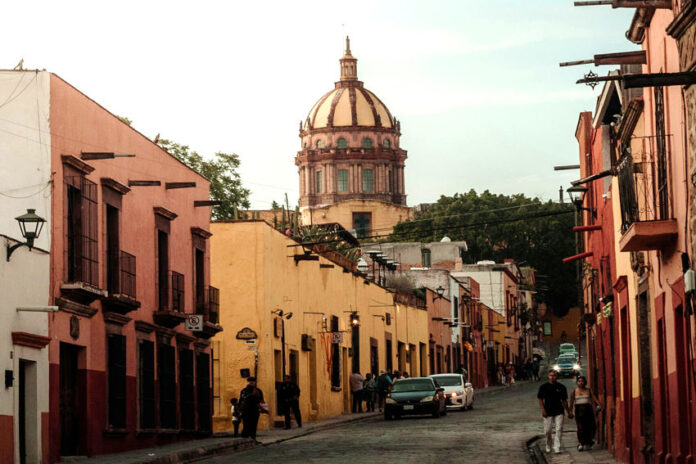
San Miguel de Allende’s recognition as the No. 1 City in the World for a second year in a row has put this colonial gem again in the international spotlight. Its charm, culture and especially the kindness of its people (as recently highlighted by MND CEO, Travis Bembenek) attract visitors from around the globe. Yet growth, tourism and development bring both opportunity and challenges, leading some observers to raise concerns about gentrification, strains on infrastructure and the city losing its very character that attracts so many there.
To understand how people feel about the city’s changes, we surveyed 278 individuals —from full-time residents to occasional visitors — about what they love, what concerns them and what their hopes are for San Miguel’s future.
For decades, San Miguel de Allende was a smaller city without much growth. In recent years, it has capitalized on its colonial vibe, thriving art scene and multiple traditions to attract visitors interested in a dose of what feels like an older Mexico. (Gobierno de San Miguel de Allende)
Who shared their voice?
Just over half of respondents (51.5%) said they live in San Miguel de Allende full-time, while another 20% reported being occasional visitors. Another 16.5% split their time as part-time residents.
Frequent visitors (6.6%) and those who had yet to experience the city (5.5%) rounded out the mix, ensuring insights that range from deeply rooted to admiring from afar.
Feelings about the city’s global acclaim
Nearly 45% of respondents felt very positive about the city’s renewed “best city in the world” status, with another 16% mostly positive. Yet 25% shared mixed feelings, reflecting the nuanced impact of international fame, while smaller groups remained neutral or concerned, highlighting the balance of pride and a sense of pressure on prices and amenities.
Below we share a sampling of readers’ responses, in their own words, with minor edits for space or punctuation.
Asked what they enjoyed about San Miguel de Allende, many respondents cited the community’s welcoming warmth but also worried that locals are being pushed out by commercial interests eager to profit off elite tourists and newer, wealthier residents. (Galo Cañas Rodríguez/Cuartoscuro)
What people love about San Miguel
1. The people
The kindness, warmth and community spirit of San Miguel’s residents were the most cited reason (90 times) that people said they love the city:
“When the city’s heart beats strongest is when the people of San Miguel de Allende and the surrounding campo [countryside] swell to bursting in its streets on any given holiday, festival or religious event… We are all welcomed here by a truly magical city and its loving people.”
“I love the respect and genuine kindness that people show for each other. The sounds of honking we endure back in California are replaced with nods, waves and smiles in SMA [San Miguel de Allende].”
2. Architecture and visual identity
Many respondents celebrated the city’s colonial streets, plazas and historic architecture for their beauty, walkability and sense of history:
“The architecture and history; I like the smaller size of the city.”
“The central plaza is usually full of locals with children and few tourists… Reminds me of the way it was 30 years ago.”
“Cleanliness of the city center, well-maintained sidewalks, awesome architecture…”
3. Culture, arts and events
Over the years, as San Miguel de Allende has attracted wealthier Mexican and foreign transplants, high-profile cultural events have come to the city with them, like the Guanajuato International Film Festival. (GIFF)
San Miguel’s festivals, galleries, music, and culinary experiences consistently impress:
“Culture, art, and the people!”
“Love the GIFF (film festival), food, music, vibe, and culture.”
“Since I am in the music scene, there are great musicians, venues and festivals.”
4. Climate, lifestyle and small-town charm
Many respondents mentioned factors like walkable streets, mild weather and a welcoming atmosphere contributing to the city’s high quality of life:
“I love the climate, the Parroquia, the restaurants and food, the accommodations, the relative affordability compared to American prices…”
“Although the city has become far more cosmopolitan… if you stay away from Centro, you can still find the SMA that was there 25 years ago.”
“It’s such a walkable city. I feel safe as a single older woman exploring street food, old buildings and neighborhoods.”
What people don’t love about San Miguel de Allende
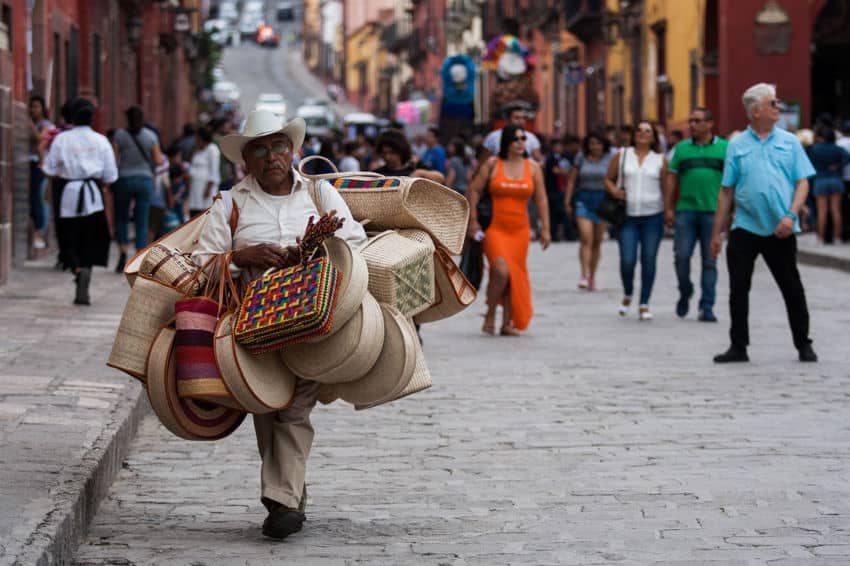
An elderly Mexican sells artisan bags to tourists in San Miguel de Allende’s downtown. (Galo Cañas/Cuartoscuro)
1. Tourism and overcrowding
Respondents often cited rising tourism as a threat to San Miguel’s authenticity and said it was straining the city’s infrastructure:
“With more tourism, I’m afraid San Miguel is turning into a tourist trap and will be overcrowded all the time.”
“What I do not love are entitled people who do not respect Mexicans and their traditions.”
“Hate that expensive shops, hotels and restaurants are taking over.”
2. Cost of living and gentrification
Many respondents worried that rising costs are pushing out longtime residents and changing the city’s soul:
“Hate the gentrification! The cost of living near Centro has driven long-time Mexican residents out, leaving only expensive boutiques.”
“Everything priced to match USD, locals cannot eat or drink or even shop at the City Market.”
“What I really hate to see is calles in Centro that once were primarily residential streets now overtaken by gringo-oriented commercial enterprises. Where do the original residents go?”
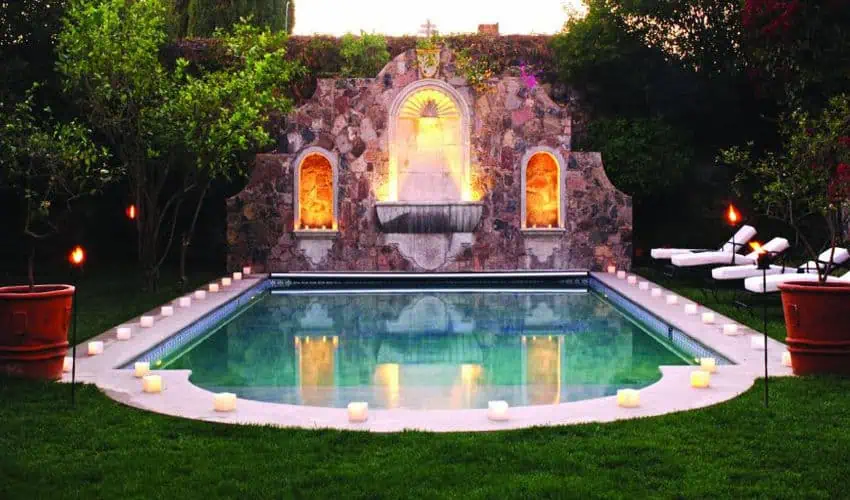
As tourism has exploded in San Miguel de Allende, luxury hotels and other businesses targeting wealthy clients have moved in to meet the demand. (Booking.com)
3. Infrastructure, services and governance
Growth in San Miguel de Allende is outpacing planning, creating concerns about safety, traffic and the pressure on public services:
“Lots of insecurity, little infrastructure, too many communities without access to basic services…everyday life for local residents will become unsustainable.”
“Traffic is often a consequence of poor urban planning, lack of alternatives and insufficient investment in mobility solutions.”
“I love the city, but I am concerned about too many people draining our limited water resources.”
Airport concerns
Many respondents tied infrastructure worries to the possibility of an airport coming to San Miguel de Allende. While 57.5% of respondents supported the idea (45% strongly), nearly one-third opposed it, citing potential negative impacts:
“The city’s charm lies in its historical streets and slower pace — an airport might disrupt that and bring too many visitors too quickly.”
“Don’t let overdevelopment fueled by an airport ruin SMA.”
“Of course an international airport would be a convenience, but I’m afraid it would have the same negative effect as cruise ships at major tourist destinations… A little inconvenience in getting here makes the reward sweeter.”
“It is a very small town for the amenities available. I would rather see train service to regional airports than a local airport. Train service would benefit more people.”
“An airport and international accolades will change the traffic and investment patterns. SMA will grow into a major internationally renowned city. Obviously, this will change its character.”
Currently, the closest cities you can fly into to reach San Miguel de Allende are León, Guanajuato, and Santiago de Querétaro, Querétaro. You then face at least an hour’s drive to San Miguel. (John McArthur/Unsplash)
Looking ahead: A city at a crossroads
While San Miguel de Allende’s world-renowned beauty, culture and warm community draw people from around the globe, preserving the city’s soul requires mindful growth, said respondents.
The responses we received reflect a community deeply proud of its home, aware of its challenges and nostalgic for the city’s past:
“San Miguel de Allende is truly special. Most days, I have to pinch myself to assure myself that I am not dreaming, I really live in this amazing place!”
“The inherent kindness here is such a relief for me and helps reinforce my decision to move my life to San Miguel.”
“It is still ‘authentic’ and very real… San Miguel de Allende is one of the true repositories of Mexican grace and hospitality. Viva San Miguel de Allende!”
“The town was funky with an exceptional arts community… The funk is diminishing.”
“Although the city has become far more cosmopolitan and sophisticated over the last 10+ years, it’s so far still managed to maintain its soul, and if you stay away from Centro, you can still find the SMA that was there 25 years ago.”
For San Miguel de Allende, success will mean balancing its cherished traditions, vibrant culture and welcoming community with the realities of modern life, ensuring that the city’s magic continues to thrive for generations to come.
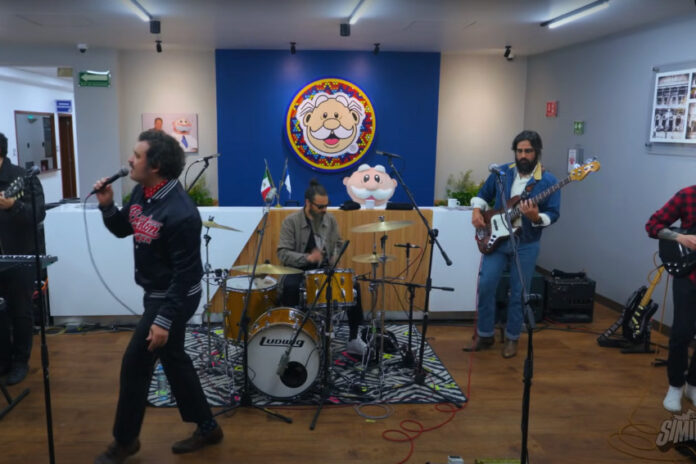
Dr. Simi's "Simisónico" concerts, here featuring Enjambre in the debut chapter on Aug. 7, are taped in the pharmacy chain's Mexico City headquarters. (Screen capture)
The Dr. Simi empire is growing once again — this time with the launch of “Simisónico,” a live-session music series from Farmacias Similares that spotlights Mexican performers in a style much like NPR’s Tiny Desk concerts.
Moreover, the new series serves as the official lead-up to the much larger SimiFest 2025, the second annual version of a multiple-act concert that debuted last November at Parque Bicentenario in Mexico City.
The first installment of “Simisónico” on Aug. 7 featured Enjambre, the two-decades-old rock band with Zacatecas roots that reportedly was the first act to be confirmed for SimiFest 2025.
Filmed inside the Farmacias Similares corporate offices in Mexico City, the tiny concert — though not as crammed as at NPR’s offices — featured Enjambre playing songs such as “Juguete,” “Angustias” and “Impacto.”
The clips quickly picked up steam on TikTok and other platforms. A life-size Dr. Simi doll can be seen sitting motionless behind the company’s front desk alongside a real-life receptionist (who is actually working), while a costumed Dr. Simi grooves to the beat among the small audience.
“Simisónico is the warmup before SimiFest,” Víctor González Herrera, CEO of Farmacias Similares, noted as the series launched. “The best bands of the current Mexican scene will be visiting us at our headquarters.”
The project underscores González’s broader effort to link his pharmacy chain’s usually lab-coated mascot, Dr. Simi, to youth culture, music and social causes.
Last year’s inaugural SimiFest raised funds for the SíMiPlaneta initiative, which supports reforestation and environmental cleanup projects in 23 Mexican states. SíMiPlaneta translates to YesMyPlanet.
This is in addition to the over 9,500 Farmacias Similares locations across all 31 Mexican states and Mexico City, according to Bloomberg and other sources.
As for the upcoming SimiFest 2025, it will be held on Saturday, Nov. 29 at Mexico City’s Hermanos Rodríguez Racetrack, expanding from one to two stages. Multiple media outlets say Enjambre is confirmed, although the group isn’t included on a concert poster that includes bands such as Empire of the Sun, Leon Bridges, Caloncho, Maribou State, Rhye, Roosevelt, Darius and others.
The charitable mission will continue in 2025, with proceeds from each ticket converted into an “environmental bomb” used for planting efforts, organizers said.
Tickets range from 1,647 pesos (US $88) for general admission to 4,270 pesos (US $228) for VIP.
As for “Simisónico,” organizers promise more sessions from “emerging and established Mexican talent” in the weeks ahead.
San Miguel de Allende's news this month includes announcements about the San Miguel Writers Conference, city infrastructure updates and the annual grape harvest season. (Chris Luengas/Pexels)
San Miguel de Allende is buzzing with new developments this month, from the announcement of a major national tourism summit to investments in infrastructure, technology, literature and wine. As the city continues to grow and evolve, we asked residents and visitors in a separate feature, how they feel about these changes. Read their perspectives here.
This month, the headlines reflect the city’s dynamic mix of tourism, culture and innovation. Here’s a look at what’s making news in San Miguel de Allende.
City to host National Tourism Summit
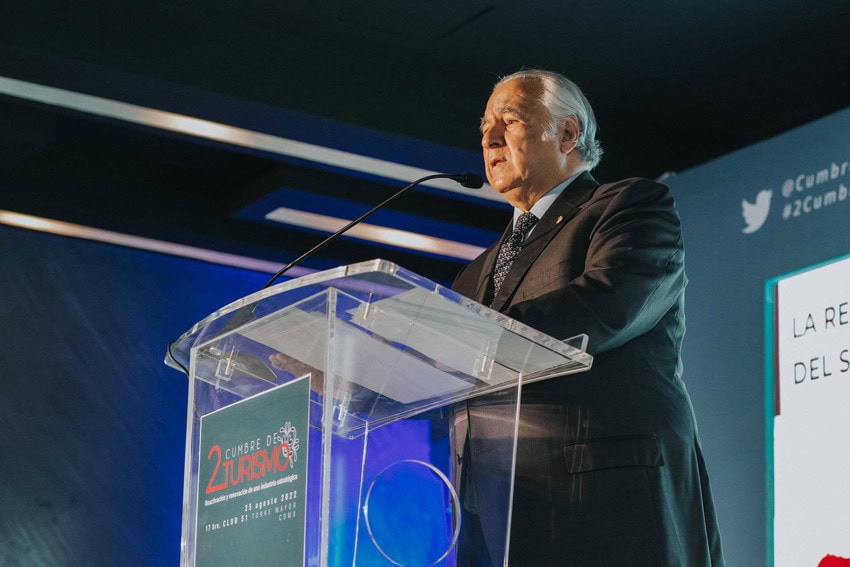
All previous iterations of the National Tourism Summit have taken place in Mexico City. (Cumbre de Turismo)
San Miguel de Allende will take center stage in Mexico’s tourism industry when it hosts the fifth National Tourism Summit from September 3–5, 2025. The theme this year is “The New Tourism: Culture and Prosperity.” It will be the first time the high-level tourism industry gathering has been held outside Mexico City.
Organized by CUMBRES HUB, a platform that connects leaders across sectors to engage in dialogue and develop strategies for sustainable growth, the summit will gather more than 120 government officials, legislators, investors and academics to discuss how cultural tourism can help position Mexico among the five most-visited countries in the world, and how the sector can be a catalyst for sustainable, equitable development.
The city’s host role comes at a time of strong tourism performance for the UNESCO World Heritage city. According to Jorge Olalde, president of the San Miguel de Allende Hotel Association, the city is maintaining its position as Guanajuato’s top destination for hotel occupancy.
“We’re currently at 42%, but the annual projection is 44%, which suggests the coming months could be very positive,” Olalde noted, referencing seasonal peaks due to festivals and upcoming fall holidays that could push San Miguel’s numbers even higher.
At the same time, city leaders are working to address perception challenges following the recent U.S. travel advisory discouraging travel to Guanajuato. San Miguel Mayor Mauricio Trejo Pureco described the alert as “extremely serious and dangerous,” warning of its potential impact on the state’s economy, which relies on tourism for 84% of its revenues.
In a recent address, Trejo highlighted the importance of seeing the city’s 16,000 U.S. expat residents as partners and friends, noting that each month they contribute thousands of free breakfasts, support cultural programs and help build community centers. The mayor also emphasized the value of sister-city partnerships with places like Palm Springs and Santa Fe as symbols of confidence in the city.
“We need to be hand-in-hand with each other,” he said, adding that fostering a culture of respect among all residents and visitors is the foundation for maintaining the city’s vitality and welcoming reputation.
Infrastructure projects aim to boost connectivity
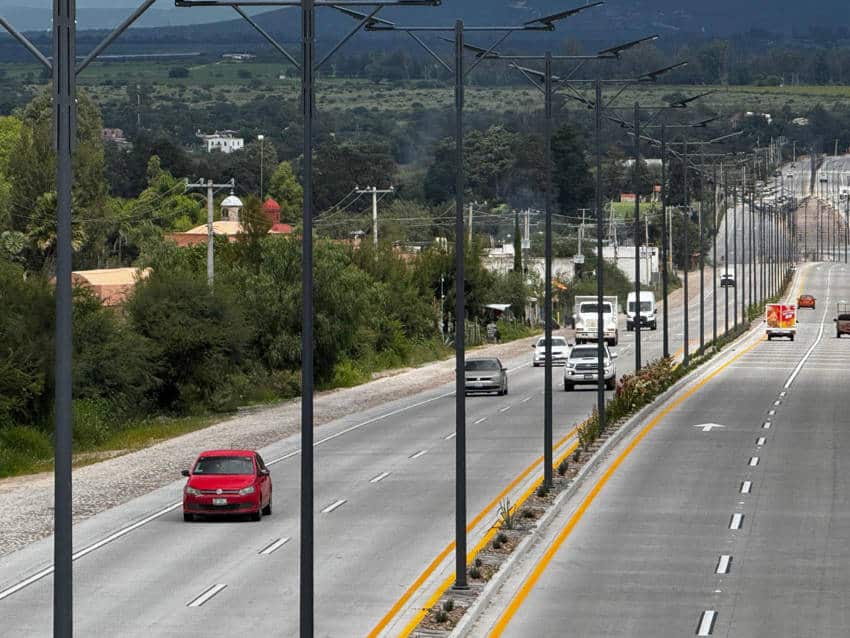
The long-awaited Bulevar de la Libertad, which connects San Miguel de Allende and Dolores Hidalgo, is now fully open to traffic. (Government of Guanajuato state)
La Libertad boulevard, which connects San Miguel with the town of Dolores Hidalgo, has officially opened its four lanes to traffic, marking a major step in improving connectivity between two of Guanajuato’s most notable municipalities. Built with hydraulic concrete, the 30-kilometer road includes a bidirectional bike lane, lighting, bridges, returns and other safety features.
The boulevard represents an investment of more than 3 billion pesos and is considered a vital step toward strengthening regional development.
Though the La Libertad project is still only 95.8% complete — with sidewalks, drainage, signage and landscaping pending due to recent heavy rains — state officials expect final work to be finished by September 10.
At the same time, a state legislator is pushing for the planned Guadalajara–Mexico City passenger train to include a stop in San Miguel de Allende, noting the city’s status as Guanajuato’s flagship tourism destination and the fact that existing rail tracks already run through San Miguel, meaning the corridor would mainly require rehabilitation and a station to return to service.
Currently, the train route is slated to make stops in the following Guanajuato cities:
Salamanca
Apaseo al Alto
Celaya
Irapuato
Villagrán
León
Together, these initiatives highlight how the city increasingly sees infrastructure as a cornerstone for its future, supporting its rapid tourism growth.
San Miguel strengthens its role as a tech hub with new ODATA center
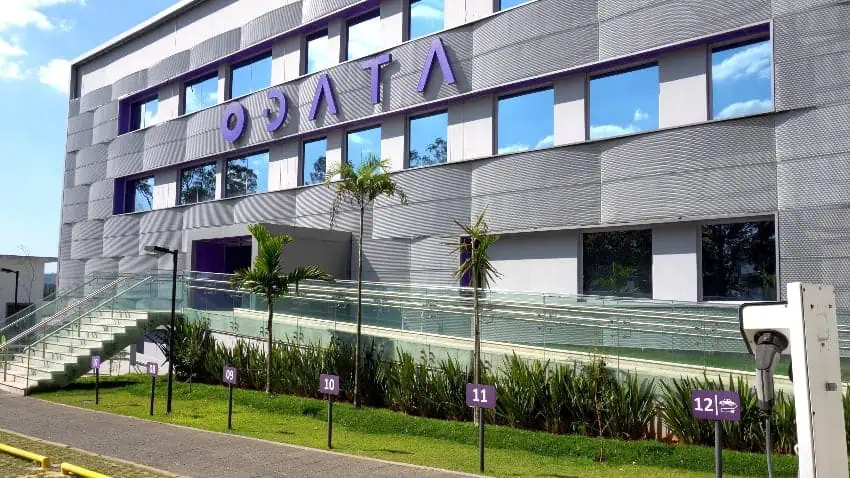
Brazilian company ODATA has built the largest data center in Mexico to date. (File photo/ODATA)
San Miguel de Allende has taken a major step into the digital economy with the opening of a new large-scale data center by the company ODATA on the city’s outskirts. The project represents a significant investment in technology and innovation, designed to enhance data connectivity not only locally but across Latin America.
ODATA has built several major data centers in Mexico and Latin America. These centers are essential for technologies like cloud computing, artificial intelligence and machine learning. The company aims to establish itself as the leading platform of interconnected data centers in Mexico and the region.
ODATA says its new center emphasizes sustainability and energy efficiency, creates 80 highly skilled jobs and positions Guanajuato as a growing tech hub, which helps diversify San Miguel’s economy beyond tourism.
2026 San Miguel Writers’ Conference announces star-studded lineup
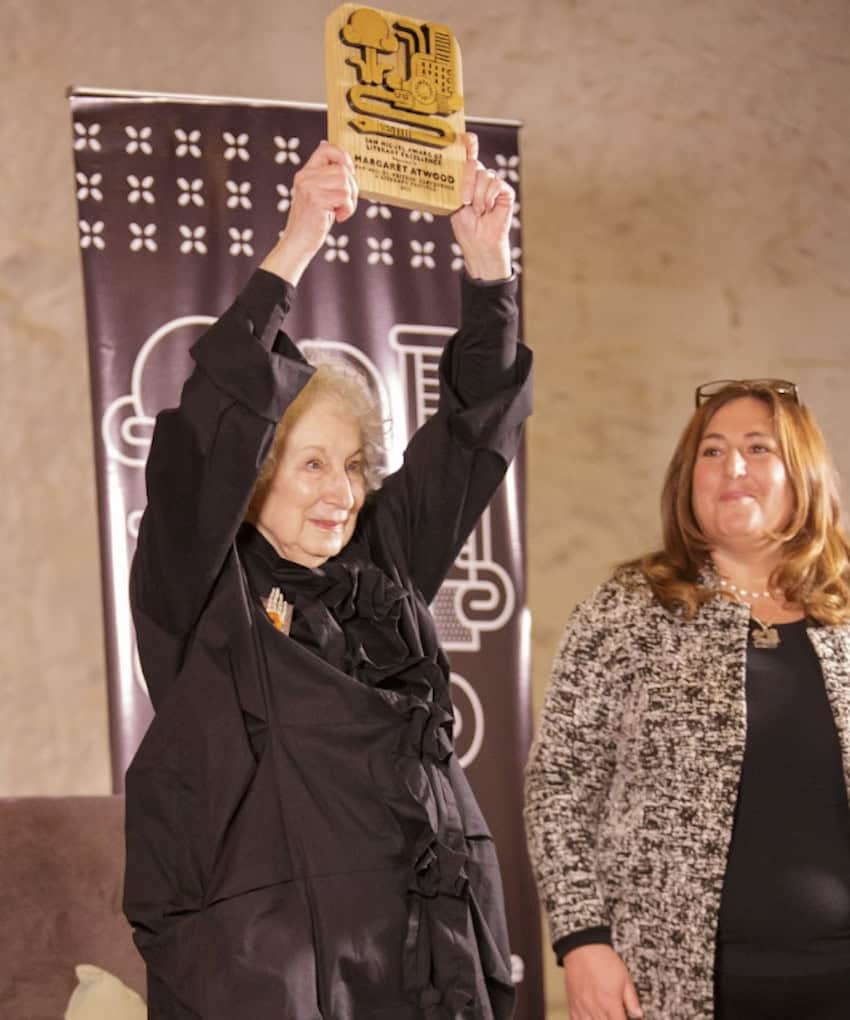
Last year’s event featured Margaret Atwood receiving the San Miguel Writers’ Conference Award for Literary Excellence. The 2026 edition promises to feature more major literary heavyweights. (File photo)
The newly released schedule features some impressive guests.
This year’s keynote speakers include Abraham Verghese, Chimamanda Ngozi Adichie, Rebecca F. Kuang, Emily St. John Mandel, Andrés Neuman and Mixe linguist Yásnaya Elena Aguilar Gil. Special guest and San Miguel local Sandra Cisneros will also join the teaching faculty at this year’s event.
The rest of the conference’s teaching roster features celebrated authors in both English and Spanish, including Eduardo Antonio Parra, Amaranta Caballero, Jean Kwok, Bonny Reichert, Christopher Bollen, Martin Fletcher, Ann Hood, and Hope Edelman.
In addition to the main program, the annual Writing Contest in poetry, fiction and creative nonfiction/memoir is now accepting entries in both English and Spanish until September 15. Winners will receive lodging, full admission to the conference’s workshops and events and lodging.
Discounted packages are available through September 1, with additional discounts for students, teachers, Mexican nationals and San Miguel seniors.
Time for the grape harvest celebrations
Viñedo San Miguel is just one of several San Miguel de Allende vineyards that will participate in the state’s grape harvest festivals. (Guanajuato state government)
San Miguel de Allende is a key player in Guanajuato’s 2025 Vendimias, the statewide grape harvest festival season, running Aug. 9–Oct. 18.
Alongside Dolores Hidalgo and Comonfort, San Miguel hosts some of the region’s most anticipated wine events, including vineyard tastings and celebrations at the Gran Reserva Fiesta and at Vendimia Santa Catalina.
The festivals highlight both tradition and growing international recognition. Local winery Viñedo San Miguel has earned prestigious awards this year, including a gold medal at the Decanter World Wine Awards in London, underscoring the state’s reputation as a rising force in global viticulture.
The Vendimias also provide a significant economic boost, with projections of over 12,000 attendees and a total economic impact of 11.6 million pesos for the 2025 season.
Patron saint festivities kick off with ancestral reseña ceremony
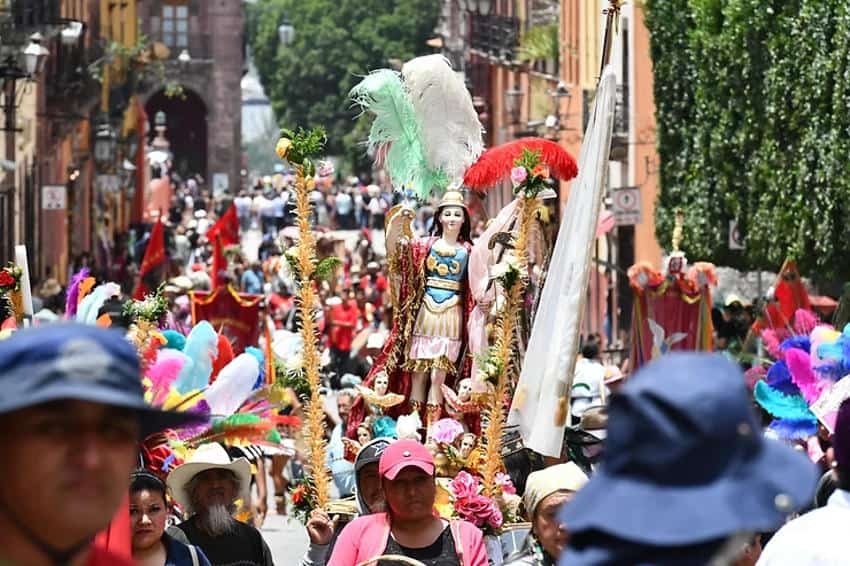
The reseña, a traditional kickoff to patron saint festivities in San Miguel de Allende in August, is a ceremony that dates back centuries. (San Miguel de Allende government)
San Miguel de Allende officially began its annual patron saint celebrations in honor of San Miguel Arcángel (St. Michael the Archangel) with the traditional Indigenous “reseña” ceremony, a ritual that dates back centuries. During the event this past Sunday, community leaders placed symbolic staffs on the atrial cross, seeking divine permission to carry out the festivities, which culminate on September 29, the Catholic saint’s feast day.
The city is celebrated for its deep Indigenous and religious roots, where centuries-old traditions have endured through adherence to values and customs passed down from the evangelizing friars. The ceremony this year featured offerings, processions and communal meals, involving more than 600 participants, including dancers, families, Indigenous community members and religious image bearers.
The end of the festivities will feature the traditional alborada, which this year continues into the early hours of Oct. 4 in the atrium of the city’s main church, the Parroquia de Arcángel San Miguel, and in the surrounding plaza, with a spectacular display of fireworks.
City prepares for peace march after shootings
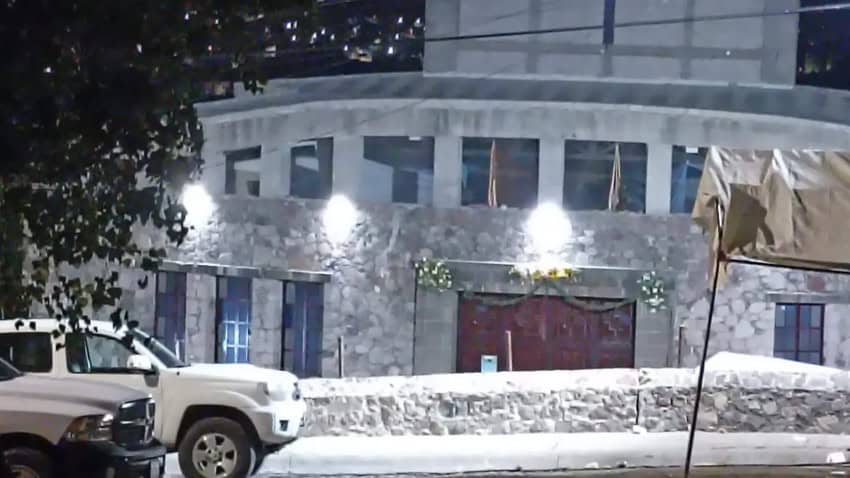
The shootings happened in the Infonavit Malanquín residential neighborhood early Monday during a traditional religious ceremony celebrated by residents annually. (El Sol de Bajio)
Following an armed attack early Monday morning in the city’s Infonavit Malanquín neighborhood during the annual Virgen de San Juan festivities, different sectors of civil society have called for a peaceful march this Friday, August 22, at 10 a.m.
The attack killed two people and wounded at least 17 others, one of whom, according to the newspaper Infobae, later died from injuries sustained at the scene.
Friday’s march will begin at El Cardo street and proceed downtown to the Parroquia de San Miguel Arcángel, where a message of unity and a call for peace will be delivered.
Organizers are encouraging families to bring candles, flowers or signs in the victims’ memory. The call has also been shared across the community to dress in black, “because our town is in mourning.”