A blockade designed to repel federal forces in Santa Rosa de Lima.
Residents of a cartel-controlled community in Guanajuato confronted soldiers and Federal Police officers Saturday, forcing the security forces to retreat.
A group of between 50 and 100 people – mainly women – shouted insults at the federal forces in Santa Rosa de Lima, a town in the municipality of Villagrán that is a stronghold of the Santa Rosa de Lima Cartel, a gang of fuel thieves.
“. . . We don’t want you here . . .” the residents yelled along with expletive-laden abuse, the newspaper Milenio reported.
To avoid an escalation of hostilities, the soldiers and police decided to leave Santa Rosa after which residents set tires at the town’s entrance to prevent their return.
The security forces had been carrying out patrols supported by two navy helicopters.
Saturday’s confrontation was not the first time that Santa Rosa de Lima residents have stood up against security forces.
On January 29, an anti-fuel theft operation in Villagrán that resulted in the seizure of at least 24 tanker trucks filled with gasoline, seven trailers and 5,000 liters of stolen fuel triggered a hostile response from residents who attempted to repel security forces with fiery blockades.
Two days later, a narco-banner appeared in Salamanca warning President López Obrador to remove security forces from the Guanajuato or innocent people will die.
The banner, signed by “El Señor Marro,” also said that “a little gift” had been left at the Salamanca oil refinery.
The gift, the government later confirmed, consisted of explosive devices left inside a vehicle parked in front of one of the refinery’s entrances. The explosives were removed before they detonated and were destroyed by authorities.
The gang is believed headed by José Antonio “El Marro” Yépez Ortiz, who has evaded capture even though federal authorities have a lot of information about him, including ranches he frequents, his closest criminal associates and the locations his gang targets to extract fuel from Pemex pipelines.
According to federal intelligence officials, the Santa Rosa de Lima Cartel is now expanding into Querétaro and Hidalgo to steal fuel from petroleum pipelines in those states.
This armored Suburban, once ex-president Peña Nieto's ride, received a lot of attention at the weekend auction.
Almost 90% of government vehicles put up for auction on the weekend were sold but the total funds raised fell well short of President López Obrador’s 100-million-peso (US $5.2-million) target.
A Nuevo León businessman made the two priciest purchases, picking up two armored vehicles previously used by former president Enrique Peña Nieto.
Enrique Herrera, owner of a security company in the northern border state, paid 1.9 million pesos (US $99,300) for a 2012 Audi A8 known as la bestia mexicana (the Mexican beast) and 1.6 million pesos (US $83,600) for an armored 2014 Chevrolet Suburban SUV.
Herrera said that both vehicles as well as an additional five he bought for another 1 million pesos will be available for rent or loan to the president and visiting dignitaries.
Herrera and his armored Audi, for which he paid nearly 2 million pesos.
The Audi will be rented for 40,000 pesos (US $2,100) a day, he explained, although if López Obrador wants to make use of it, he won’t pay anything.
Another vehicle that garnered a lot of attention from the bidders was an armored 2013 BMW X5 SUV that sold for 810,000 pesos (US $42,300).
The director of SAE, the government agency responsible for selling off the vehicles, described the auction as a “historic” event, explaining that a total of 329 people made bids.
“I understand that it was the greatest auction in the history of the SAE in terms of participants,” Ricardo Rodríguez said.
The 22 vehicles that weren’t sold will be available for purchase at another auction scheduled for April at which government planes and helicopters will be on the block.
The financial services firm has cut its growth forecast for Mexico.
Mexico’s economy expanded by just 2% last year, according to official statistics, the lowest GDP growth since 2013.
Data from the National Institute of Statistics and Geography (Inegi) shows that growth has now declined for four consecutive years.
In 2018, the tertiary sector – including retail, tourism and services – was the economy’s savior, contributing 63% of the total GDP of 74.12 trillion pesos (US $3.87 trillion). The sector grew by 2.8% to reach just under 46.9 trillion pesos (US $2.45 trillion).
Manufacturing and other secondary activities including mining and oil production contributed to 29% of GDP but the sector only managed growth of 0.1% compared to 2017 numbers.
According to Inegi’s revised and seasonally adjusted figures, secondary sector production totaled just over 21.6 trillion pesos (US $1.1 trillion).
The primary sector – including agriculture and fishing – performed better in growth terms, expanding by 2.3% to total production of 2.36 trillion pesos (US $123.3 billion).
That figure contributed to 3% of the Mexican economy with the remainder of GDP coming from the collection of taxes.
Overall 2018 growth of 2% was on or about par with forecasts from a range of financial analysts and institutions.
Goldman Sachs has now followed suit, cutting its growth outlook for Mexico by 0.2% to 1.5%.
The investment bank’s New York-based Latin American economists said in a note that sluggish global growth, trade tensions between the United States and China and a shift by central banks towards a more dovish policy stance were among the factors that meant 2019 growth in Mexico and other countries in the region will be weaker.
“The late 2018 and early 2019 growth momentum has been weaker than expected across a number of the large economies — Argentina, Brazil, and Mexico,” the note said.
The bank also said that strikes and gasoline shortages in Mexico during the first quarter of 2019 had contributed to slower growth than in the last three months of 2018. Month-long rail blockades in Michoacán cost the economy billions of pesos.
Goldman Sachs economists also pointed to declining petroleum and gas production and a slowdown in the construction sector as other factors that have hampered growth.
In the context of a slowing economy, the economists said that they expected the Bank of México to cut interest rates by 0.75% to 7.5% in the second half of the year.
“We do not rule out the first easing move taking place at the August, or even June meeting, particularly if the growth slump is deeper than expected,” they said.
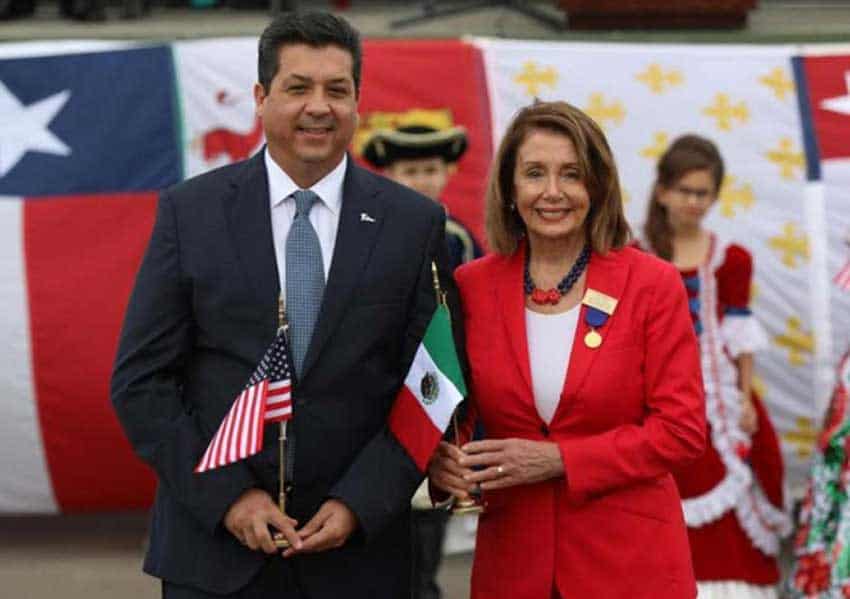
Governor García and Speaker Pelosi embrace at border crossing.
There were hugs at the border Saturday when Tamaulipas Governor Francisco García Cabeza de Vaca and United States House of Representatives Speaker Nancy Pelosi met on an international bridge linking Nuevo Laredo and Laredo.
The two were among several officials and dignitaries from both countries who took part in the hugging ceremony on the Juárez-Lincoln bridge to commemorate the birthday of George Washington.
Mexican and U.S. officials met in the middle of the bridge to exchange embraces and speak about the importance of the bilateral relationship between the two nations.
During the ceremony, Governor García said the U.S. and Mexico should find ways to better use their longstanding relationship to encourage economic growth and improve living conditions for families on both sides of the border.
Texas Secretary of State David Whitley said the ceremony was a symbol of the strong friendship between two countries that share not just a long history together, but a shared destiny.
García and Pelosi celebrate the bilateral relationship.
“I am proud to say that in the last three years, commerce between Texas and Mexico has increased and our future looks brighter than ever.”
Speaker Pelosi thanked Laredo Representative Henry Cuellar for inviting her to the bridge ceremony, saying she would remember it for years.
Security Secretary Durazo speaking on the program La Silla Roja.
Crime rates will begin to fall within the first six months of the term of the new federal government, the security secretary predicts.
In an interview transmitted online by the newspaper El Financiero, Alfonso Durazo said that within that timeframe – which will end May 31 – “there will be a turning point in the upward trend of crime rates in the country.”
Within three years, he said, the deployment of the national guard will enable the government to significantly improve Mexico’s security situation.
“We’re not saying that in six months we’re going to solve the incidence [of crime] and violence, of course not. Violence wasn’t generated from one day to the next and it’s not going to be resolved from one day to the next but we can guarantee that in the course of three years we will be able to restore the peace and tranquility lost in our country many years ago,” Durazo said.
The security secretary highlighted that the creation of the national guard was approved unanimously by the Senate although he acknowledged that the government had to modify its original proposal that the security force have a military command.
Durazo said that under the approved proposal, the head of the national guard could be someone from the Federal Police, a retired military leader, a current one who leaves his or her post to take on the new role or a civilian from outside Mexico’s official security apparatus.
The force will commence operations with 35,000 military police, around 17,000 Federal Police officers and approximately 8,000 marines, he explained. Ongoing training for national guard members will be a hallmark of the force, Durazo added.
He also stressed that members of the military will only assist in public security tasks for a maximum of five years after the national guard is created.
Asked to explain the realm of responsibility that the force will have, the secretary explained: “All elements that enter the national guard will have the role of guaranteeing security, life, freedom and people’s assets, in other words, public security – that’s going to be their fundamental responsibility. The national guard won’t have a national security role, that will continue to be a constitutional task that the army and the navy are in charge of.”
Durazo explained that the government plans to deploy national guard units to 266 different regions that have already been drawn up.
He called on lawmakers in the lower house of Congress to do the same as their counterparts in the Senate and give unanimous approval to the constitutional changes required. Recruitment for the force could begin in March, given approval by at least 17 state congresses, the final step in the process.
Newly-published crime statistics underscore the massive security challenge faced by the López Obrador-led government, which in two weeks will complete its first 100 days in office.
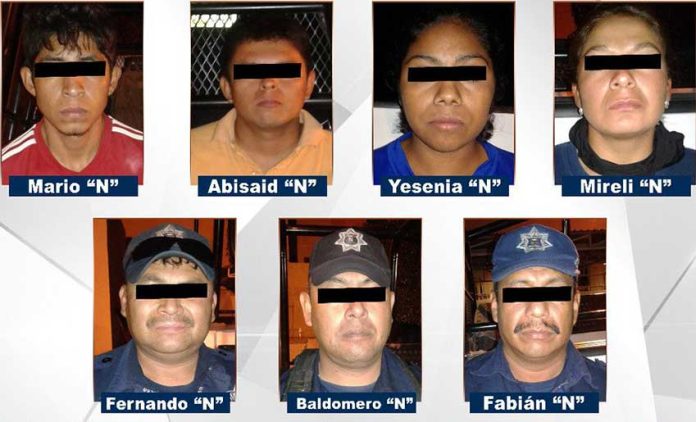
Seven of the gang members arrested Saturday in Guerrero.
Federal and state officials in Chilapa, Guerrero, arrested nine members of the violent criminal gang Los Rojos on Saturday and four of them turned out to be officers in the municipal police department.
Two of those arrested were minors, and all were allegedly involved in drug trafficking activities with the gang, which has been embroiled in a violent turf war with the Los Ardillos gang since 2011.
At the time of their arrest, the gang members were found in possession of seven firearms, ammunition, four cell phones, packages and bags containing marijuana and 62 small bags of cocaine.
The authorities also seized the police officers’ patrol truck.
According to state authorities, the Los Rojos gang is led by Zenén “El Chaparro” Nava Sánchez.
Last year, nine municipal police officers were murdered in Chilapa, including chief Isidro Casarrubias Tlaltempa, whose corpse was found dismembered in Chilpancingo several days after he was kidnapped.
Casarrubias was questioned by his captors on video, in which he declared that Chilapa Mayor Jesús Parra García had ordered his municipal police force to protect a local criminal gang.
Alfonso Cuarón’s Roma won three Academy Awards last night for best director, best foreign language film and best cinematography.
It was Cuarón’s second Oscar win for best director after winning it in 2014 with Gravity.
Fellow Mexican filmmaker Guillermo del Toro presented the award, along with an emotional hug.
Accepting the trophy, Cuarón said, “I want to especially thank you for selecting a movie that portrays the world’s 70 million domestic workers that do not have rights, people relegated to the background. As artists, we must look where others don’t. That responsibility is even more important when others encourage us to look away.”
Mexican actor Diego Luna presented the award for cinematography, congratulating Cuarón and his team for “an honest and vital portrait of Mexico City and the director’s childhood: a story of isolated women, absent men, social class and all things found in love.”
Cuarón paid homage to the foreign films that had inspired him in his childhood, like Citizen Kane and The Godfather, and expressed his thanks to the country of his birth and his children.
“Tonight’s nominees prove that we are all part of the same ocean. I’d like to thank my family, Mexico for being the shore that launched this film, and my children Olmo, Tess and Jonás for being the current that moves me.”
Nominee Yalitza Aparicio, who played the role of the film’s protagonist, was accompanied at the awards ceremony by her mother, whom the actress described as her principal role model in life, attributing her success to her mother’s example.
Mexico celebrated another success last night with Spider-Man, Into the Spider-Verse, which won best animated feature film.
Voters threw their support behind a thermal power plant in Morelos by voting 59.5% in favor in a weekend consultation.
President López Obrador today called the vote a success “because we know that the last government imposed the project without consultation. There was repression, and it created a movement opposed to the thermoelectric plant and the pipeline, but we had to tackle this issue, a 25-million-peso [US $1.31-million] project.”
The president had said previously that citizens would enjoy cheaper electricity if the plant, located in Huexca, Morelos, were put into operation.
Some communities in the area have been fighting the project for several years, and will probably continue to do so. An umbrella group of opponents rejected the consultation approach when it was announced, and said they would remain opposed regardless of the vote’s outcome.
One of the leaders of the opposition group was shot and killed last Wednesday in Amilcingo, a town near the site of the plant, but state authorities have said the murder was not connected with the power plant protest.
Protesters turned out on the weekend, burning and vandalizing a polling station in the municipality of Temoac.
In Cuernavaca, an individual stole a ballot box. The aggressor was arrested but later released.
Despite “provocations” the government was able to carry out the consultation, the president said, issuing a call to all to citizens to solve their differences in a peaceful manner.
“The best solution is democracy, not imposition or blockading polling stations and burning urns. Not that!”
Authorities did not divulge voter turnout in terms of percentage, but said 53,532 people voted.
The federal government’s delegate in Morelos said today that more citizens voted on the thermal plant than the consultation over the new Mexico City airport.
The next step in the process to begin operating the plant is a water quality and quantity study. López Obrador signed an agreement last week with UNESCO to determine whether its water treatment processes are adequate.
The president said the plant would not operate if the study finds that water supplies would be adversely affected.
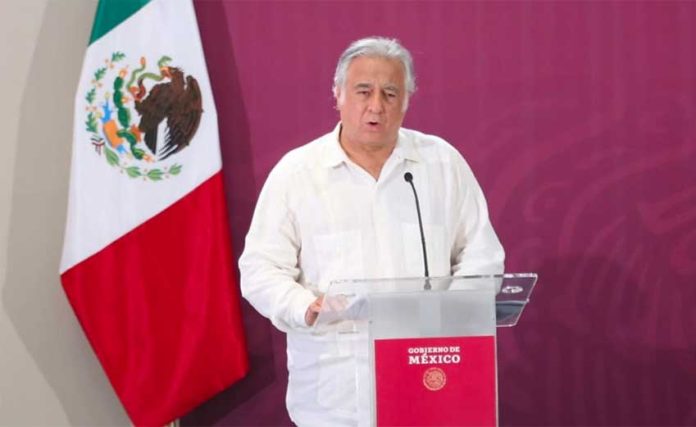
The federal government presented a six-year tourism strategy yesterday with five key goals, including construction of the Maya Train, increasing foreign visitors’ spending and strengthening the sector across Mexico.
Speaking at an event in Chetumal, Quintana Roo, President López Obrador said tourism contributed US $22 billion to the economy last year, making it Mexico’s third biggest foreign exchange earner behind the automotive sector and remittances by Mexicans working outside the country.
“That’s why it’s very important for us to maintain economic growth and continue creating jobs in the sector. We’re going to implement a plan to grow the whole country but we want to support tourism and at the same time support regions that are lagging behind in terms of growth, employment and well-being . . .” he said.
The tendering process for the Maya Train, a rail project that will connect cities in Mexico’s southeast, will begin soon, López Obrador said.
“I’m very happy that the Maya Train is being well accepted, that will help a lot. It’s a very important infrastructure project. We’re going to build it with the participation of the public sector, the private sector and the social sector. It’s an investment of around 120 billion pesos [US $6.3 billion],” he said.
The president pledged that the government will do all it can to enable investors to put their money into tourism-oriented projects “without bureaucracy, without corruption [and] without bribes.”
López Obrador also announced that the government will invest 600 million pesos to improve living conditions for tourism workers in Playa del Carmen, while future investments will be made in destinations such as Acapulco, Los Cabos and Puerto Vallarta.
He said that the secretariats of Security (SSPC), National Defense (Sedena), the Navy (Semar) and Tourism (Sectur) are working together to combat insecurity in tourism destinations, stressing that the safety of visitors is paramount in order for the sector to perform well.
In turn, federal Tourism Secretary Miguel Torruco said the goal of the new tourism strategy is to position Mexico – the world’s sixth most visited country – as a competitive and forward-thinking power in the sector.
Tourism can be a means of achieving “fair and balanced development among communities and regions,” he added.
In addition to strengthening the economy and development in Mexico’s southeast through the construction of the Maya Train, Torruco said the strategy aims to increase tourism earnings, develop less-visited destinations, stimulate domestic tourism and ensure that federal, state and municipal governments work together to develop the sector.
“We have to remember that the harsh reality is that we’re in 15th place for [tourism] foreign exchange earnings and 40th for spending per capita,” he said.
Torruco criticized both the Felipe Calderón and Enrique Peña Nieto governments for not achieving better rankings in both areas despite investing billions of pesos in the Tourism Promotion Council (CPTM), which the current administration has disbanded.
Mexico’s embassies and consulates in such countries will be responsible for promoting tourism through a program to be known as Operación Toca Puertas (Operation Door-knocking), Torruco said.
The tourism secretary also said the government will launch a program called Disfruta México (Enjoy Mexico) to stimulate domestic tourism.
The program builds on the Viajemos Todos Por México (Let’s All Travel Through Mexico) initiative implemented by the previous government and will entail entering into agreements with tour operators in order to offer low-cost holiday packages to Mexicans.
A pilot program known as Sonrisas por México (Smiles for Mexico) will offer low-income Mexicans the chance to travel free, Torruco said, pledging that “tourism will be a right for all.”
The government will also strengthen its capacity to capture tourism-related statistics such as hotel occupancy rates and museum visitor numbers.
Furthermore, Torruco said that Sectur is currently working with the Secretariat of Finance (SHCP) to regulate online accommodation platforms such as Airbnb.
New taxes are expected to be imposed on online booking platforms with the resources collected to be used for tourism promotion.
The Tourism Secretariat expects international tourism to continue to grow this year but statistics that show that international arrivals to Cancún declined last month, a cause for concern because the resort city is seen as a barometer of the overall tourism situation in the country.
Cancún and the Riviera Maya, along with Mexico City, account for 62% of all international tourism in Mexico, Torruco said, stressing that greater diversification of the sector is needed.
Inside La Mera Obrera, a restored warehouse in a blue-collar district of Mexico City. megan frye
The Mexico City neighborhood of La Obrera is always on the move. It begins each day with public transport darting this way and that, parents rushing to drop off and then pick up their children — working in between and often after, and ends each evening with taco stands flooding into the streets.
The typical bells and whistles (literally) that comprise daily life in the city are fluid in this neighborhood just south of the city’s historic center and east of the hipster haven La Roma (via Doctores).
Amid all this commotion is a new eatery that doesn’t quite blend in at first glance. Its spirited sunflower murals and classic marquee-style neon sign on the facade add some pizzazz to the busy avenue Eje 2A.
La Mera Obrera, as it’s called, is a market-style restaurant occupying the space of a sewing warehouse that had been empty for about a decade.
In the weeks before and since opening on February 7, curious neighbors and passersby popped in to take a look. Street art isn’t an uncommon sight in this borough, but the fact that a new business was going up in a long-abandoned storefront piqued interest.
The restaurant’s entrance and La Hornera, one of three kitchens. megan frye
“This place is emblematic for being a working-class neighborhood,” said manager Florencia Beati. “It’s known for being an area that had a lot of factories, such as those that made textiles, which have historically hired a lot of women. Actually there was a factory that fell during the September 19, 2017 earthquake right near here, where a lot of seamstresses died.”
La Mera Obrera is a gastronomic project headed by and employing women, and features three different kitchens: La Hornera, where pizzas and empanadas stand out; La Parrillera, home to grilled steaks and Argentinean choripan; and La Pescadera, which serves up a mango and fresh fish ceviche as well as baja-style fish tacos.
At the back of the restaurant stands the ample bar called La Quita Penas, which urges patrons to drink their sorrows away, be it with a mezcal cocktail or a gourmet agua fresca.
Women are making a lot of noise these days and it’s impossible to ignore them, Beati said. Though La Mera Obrera is not directly aligned with feminist movements, mostly because there is a wide misunderstanding in the world about what that term means, she says the idea behind La Mera Obrera is to promote equality.
“At first when we were opening, and especially when word got out that this was a place run by women, the first waves of shock came out and people said we shouldn’t open here because the neighborhood has a bad reputation,” Beati said.
“But in all cities, all over the world, there are neighborhoods that are considered dangerous. We are trying to break with that because what we have seen here in these past several months of getting things in order is that this is a united neighborhood, filled with people who care about each other.”
Pizza chef Angélica de la O at work. megan frye
And while La Mera Obrera is comparatively chic as a late-night eatery and bar in a working class neighborhood whose culinary offerings are mostly based in small mom and pop restaurants and sidewalk stand delights, it retains enough grit of its warehouse past that it doesn’t seem off-putting in the neighborhood.
Out of place? A little bit. But what would that really mean? Isn’t La Obrera also allowed a hot little spot to move into? Diners and drinkers were many during several hours on its second Saturday in business.
The music remains at a reasonable decibel level and the wooden beams seems to absorb any wrong notes or excessive volume, keeping the open space surprisingly well-suited for conversation.
Exposed brick leaves the warehouse vibe intact, and with splashes of color throughout and elegant chandeliers hanging from the ceiling there is a juxtaposition of old meets new. But in a way that offers both a seat at the table.
Paintings on the walls symbolize working women, with graffiti lettering that reads, among other things, “Cualquier mujer puede” (any woman can.) All art was completed under the direction of local artist Mora de Torres aka Viví Cabrón. The seating is a mix of round and picnic-style tables that seem like they could have come right out of a woodworking shop, each featuring a quote from a famous woman in history, such as Frida Kahlo, for example.
“This is a neighborhood where there are a lot of typical cantinas, spaces that are traditionally for men,” Beati said, adding that the motto of La Mera Obrera is “women always organized and united.”
Aguas frescas and the restaurant’s menu. megan frye
“This is a place opened by women, and operated by women. We are only women who work here. But this is a way to say ‘hello, we are here and we are all equal.’ There is no competition, no difference. There is friendship. We have a good vibe here. Society needs more spaces like this. When you go to Condesa, Polanco, etc. you find places where you will be attended only by men. Well, here, it’ll be by women.”
The promotion of equality goes deeper than simply offering jobs to women.
“We know that there is a lot of discrimination that people face when they look for work, especially in this industry,” Beati said. “There are women who say they can’t find work after a certain age, or they can’t find a job that is flexible enough to allow them to care for their children as well as earn the money they need. And trans women, forget it. They face such strong discrimination. But here we are proud to hire a diverse group of women, from all backgrounds.”
Angélica de la O grew up accustomed to the kitchen scene; her grandmother had a restaurant in the city’s Tepito neighborhood. She learned about gastronomy in other places as well, such as El Salvadoran restaurants in Montreal, Canada, and Mexico City’s popular Perro Negro pizza chain. Grateful to have learned her pizza making skills there, she’s ready to start anew at La Mera Obrera.
“I was surprised to see an advertisement for a place that was looking for women pizza specialists,” de la O said. “I’ve had great male colleagues, but the pizza places I have worked at are mostly dominated by men. There’s this idea that women aren’t strong enough to do all the work, like lugging 40-kilogram bags of flour around. But the idea here is that women can do it.
“Of course we can. The idea isn’t to under-appreciate the work that men do. It’s really to exhibit that women can also do the same work and that we can support ourselves with it.”
Though La Mera Obrera has only a few weeks in operation, de la O says she’s been thrilled with the turnout so far, and of course the customer feedback. There’s been a crowd every day and night, she said, and she believes that will only increase. The opportunity to take on a managerial role also appealed to de la O, not only for her sake, but to see that option for other women in general.
“We have wisdom among ourselves to dialogue and to solve problems, even though at times working with all women can be difficult because of our moods and temperament,” de la O said.
“But here we all support each other. We all help each other out if someone needs something. I love it. In some other places, you are limited in what you can do because men will say that you can’t do something, or you shouldn’t do something because you are a woman. But now to be the boss of the pizzeria, this is huge for me because I don’t see myself having that opportunity elsewhere in this city.”
Megan Frye is a writer, photographer and translator living in Mexico City. She has a history of newsroom journalism as well as non-profit administration and has been published by several international publications.