Christmas gifts with card signed by a jailed cartel boss.
Some residents of Sinaloa had a happy Christmas thanks — evidently — to the Sinaloa Cartel.
Dozens of trucks turned up last week in several rural towns in the municipalities of Salvador Alvarado and Mocorito and delivered holiday gift baskets.
Wrapped in clear plastic, the baskets came with a card bearing a short message: “Merry Christmas and a Prosperous New Year from your friend Cholo Iván.”
A similar distribution of gifts took place three months ago in the town of Ranchito, Angostura.
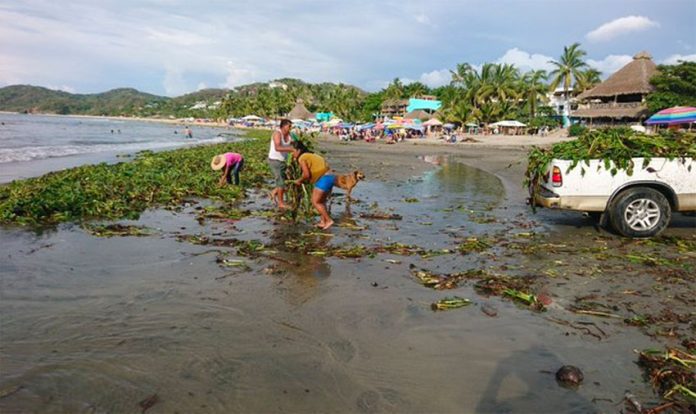
Victims of the Tropical Storm 19E received food supplies, mattresses, stoves and other appliances bearing a logo consisting of a black baseball cap with the initials JGL written in gold.
The donation of the disaster relief supplies has been attributed to the former chief of the Sinaloa Cartel, Joaquín Guzmán Loera, also known as “El Chapo.”
“El Cholo Iván” is Orso Iván Gastélum Cruz, identified as the Sinaloa Cartel’s former chief lieutenant and security boss. He was arrested with Guzmán in January 2016 and has been behind bars since.
But it appears his influence still reaches far on his former turf in Sinaloa.
Heavy snowfall closed the highway between Janos, Chihuahua, and Agua Prieta, Sonora, for more than three hours yesterday.
Sonora Civil Protection services (UEPC) said that Federal Police and Agua Prieta municipal police closed federal Highway 2 at Puerto San Luis at 5:30pm.
The highway reopened to traffic at 8:40pm, the UEPC said in a Twitter post, and urged motorists to drive with caution due to the slippery conditions and limited visibility.
The fourth winter storm of the season delivered snow and sleet to several parts of Sonora and Chihuahua yesterday, including the cities of Cananea and Nuevo Casas Grandes.
The National Water Commission (Conagua) said there is a possibility of more snow today in mountainous areas of the two states.
Temperatures below -5 C are forecast for mountainous areas of both as well as Baja California and Durango.
Below freezing temperatures are also forecast today for several other states in northern, western and central Mexico.
With a new cold front arriving on Friday, Civil Protection services have issued warnings for 46 Sonora municipalities due to the likelihood of already low temperatures dropping further.
Wreckage of the helicopter in which the governor of Puebla and four others died on Christmas Eve.
People who have blamed the federal government for the helicopter accident that claimed the lives of the governor of Puebla and her senator husband are a “mean” and “neo-fascist” minority, President López Obrador said yesterday.
At his morning press conference, López Obrador rejected accusations that his government was responsible for the Christmas Eve crash in which Governor Martha Érika Alonso, ex-governor Rafael Moreno Valle, a political assistant and two pilots were killed.
“As a matter of principle, we would never act against anybody,” he said.
The president said that his government is fully committed to finding out what caused the crash.
“There is a commitment and willingness of the federal government to know the whole truth. We are not going to hide anything, we have to know what caused this accident and this tragedy,” he said.
“So that there is no suspicion, the government . . . will appeal to an independent body from abroad, recognized and prestigious, to present a conclusion that we are going to make public to the people of Mexico.”
The Security Secretariat (SSPC) said in a statement issued later yesterday that the Transportation Safety Board of Canada, a government agency, would send two aeronautical experts to Mexico to participate in the investigation into the accident.
Jimmy Cancino, a civil aviation expert with more than 25 years’ experience, and Nora Vallée, a helicopter pilot with more than 30 years’ experience, will arrive at the Puebla airport today and start work tomorrow morning, the SSPC said.
Other aviation experts, including representatives of the Italian company that manufactured the Agusta A109 helicopter and engine-makers Pratt & Whitney, have already examined the crash site, located in the Puebla municipality of Coronango.
The government said on Tuesday that the investigation had not found any sign of explosive material on the aircraft, which hit the ground nose first. A witness said it was on fire before it crashed.
López Obrador also responded to questions about his absence at the funeral for Alonso and Moreno. He told reporters it was an act of prudence within the context of an atmosphere of hostility towards his government that has been created by its critics.
“I don’t like to beat around the bush . . . Yesterday [Tuesday] there was an [adverse] environment that the usual conservatives created, not all of them, but a minority who acted in a very mean way . . . They’re neo-fascist groups who are very angry about the triumph of our movement . . . They act anonymously, especially on social media,” he said.
“The right, the conservatives, in addition to hypocrisy and being very corrupt, are also mean. On social networks, they started to talk about the liability of the government I represent . . .” López Obrador added.
He called for people to calm down and to avoid speculating about the cause of the crash as the investigation takes place.
The president said that he had spoken to Moreno’s father to offer his condolences but that he hadn’t been in contact with Alonso’s family.
Federal Interior Secretary Olga Sánchez and Security Secretary Alfonso Durazo represented the government at the political power couple’s funeral, which took place in Puebla city on Christmas Day.
Alonso, 45, was sworn in as National Action Party (PAN) governor just 10 days before her death.
Her July 1 election victory was contested by her Morena party opponent, Miguel Barbosa Huerta, and other party officials, who alleged that the vote was plagued by irregularities. However, the Federal Electoral Tribunal ratified Alonso’s victory in a decision on December 9.
Moreno, who governed Puebla from 2011 to 2017, was accused of manipulating the poll in order to secure the governorship for his wife.
Artisans at work decorating ornaments in Tlalpujahua.
The small ex-mining town of Tlalpujahua (pronounced Tlal-pooh-how-a) is found just across the border from México state in Michoacán.
The town’s gold mine, Dos Estrellas, was the leading global producer of gold between 1908 and 1913 but closed in 1937 when a mining accident caused mudslides that buried one-third of the town.
The mine now stands as a museum, but Tlalpujahua has a new form of gold. It comes in the shape of locally-made glass Christmas tree ornaments.
Nowadays, visitors flock to the town to buy these artisan creations for their Christmas tree. For anyone who wishes it could be Christmas every day, Tlalpujahua is the place for you since these ornaments are found in stores throughout the year.
Go in June and there are stores complete with a welcoming Santa and an elf or two to guide you inside.
So how did this town that used to mine gold suddenly become the Mexican home of the Christmas ornament? The story goes back to the 1950s when Joaquin Muñoz Orta and his wife, María Elena Ruíz Villagrán, left Tlalpujahua for Chicago.
Ornaments on display during the annual fair.
During their time in the United States they learned the technique of glass blowing Christmas ornaments. After returning to Mexico in the 1960s, Joaquin Muñoz had the idea to start an ornament making company and so Adornos Navideños SA was born. What started as a small business went on to be a company with multiple factories and thousands of workers.
Almost 50 years on, in 2008, it was estimated that Adornos Navideños SA produced 38 million ornaments each year, of which some two-thirds were exported. There are now other factories in the town and around 400 smaller production houses with new ones popping up all the time. Despite the huge production, most of the ornaments are still artisanal rather than mass produced. The artisans blow the glass and decorate them by hand.
You can find glass ornaments in all shapes and sizes, colors and decorations in Tlalpujahua. There are green spheres with red glitter, silver droplets with gold dots, red and white swirled baubles and a seemingly infinite selection of color combinations. There is something for every taste, blown and decorated by hand. The prices are incredibly reasonable, even more so given the talent and time that it takes to make and decorate each ornament.
From September through December, the streets fill with people looking for the perfect adornments for their trees. That is when La Feria de la Esfera takes place and most of the ornament makers can be found in the Municipal Auditorium selling their wares. Visitors can also go to the workshops and watch the artisans making the glass ornaments from scratch, a process which is completed in four parts.
First, the glass is blown into the required shape by the glassblower, and then the base color is added. Once dry, they are delivered to the decorating stations, where glitter and other embellishments are added before the hanger is added to the top.
Once finished, they are packed into boxes to be sent around the world or sold locally. Unsurprisingly, the production of Christmas ornaments is the largest industry in Tlalpujahua, earning it the title as the Town of Eternal Christmas.
Tlalpujahua, Pueblo Mágico, or magical town.
It is worth a visit whether or not you want to buy the Christmas ornaments, however. It was declared a Pueblo Mágico, or magical town, in 2005 and when you arrive it is easy to see why.
Like many towns in Mexico, it sits around a picturesque main square. The narrow cobblestone streets, lined with adobe and pink stone houses with red tile or tin roofs, lead off from there in multiple directions, with some very steep ones leading up to the church that overlooks the town.
The Santuario del Carmen, which was built during the mining boom, has a beautiful baroque façade with intricately ornate carving. Inside, the sight is even more impressive, with the church decorated in pastel colors adorned with sculpted flowers. There is no wall without detail. It is hard to know where to look first.
Local children tell the history of the church to passing tourists in exchange for a small tip. At night, the church is lit up and can be seen from around the town.
Back in the town square, there is a small stall selling delicious gorditas made with maiz quebrado (literally broken corn, a name that refers to a technique of lightly crushing the corn to give a chunkier texture to the dough), and La Michoacana, the ice cream chain which began over 60 years ago in Tocumbo, Michoacán, has a small shop nearby too. Eating a Michoacana ice cream while visiting the town is a must.
Visitors who want to learn about the mining history should head to the Dos Estrellas mine and the Museum of Mining Technology. Here, visitors can discover everything about this mine, run mainly with French and English technology, with the majority of its excavations sent to England.
[wpgmza id=”123″]
While many mines closed during the Mexican Revolution, Dos Estrellas continued until the accident in 1937 that destroyed a large part of the town and killed hundreds of people. The museum is complete with artifacts from the time. Don a hard hat and you get to see inside.
To explore the world of mining in Mexico further it is worth taking a quick trip over state borders into the neighboring magical town of El Oro, which sits just inside México state. When gold was found in Tlalpujahua, mining companies were attracted to the area and also set up mines in the town now known as El Oro, or The Gold.
Heading to El Oro is like stepping back in time and you can easily imagine that you are no longer in Mexico but in the old mining towns of the U.S. The town has a western feel, with houses with tin roofs and outside awnings. There is also a mining museum to explore in El Oro as well as the old railway station that was used to move the precious metals out to the docks to be shipped out of the country.
Whether you are a lover of Christmas, a mining enthusiast or you just love exploring the beautiful towns of Mexico, a trip to Tlalpujahua and nearby El Oro should be on your list.
• Tlalpujahua is located 180 kilometers outside Mexico City and can be reached in about two hours and 45 minutes from the capital. Local taxis make the journey back and forth between Tlalpujahua and El Oro, an eight-kilometer trip that takes about 15 minutes.
Susannah Rigg is a freelance writer and Mexico specialist based in Mexico City. Her work has been published by BBC Travel, Condé Nast Traveler, CNN Travel and The Independent UK among others. Find out more about Susannah on her website.
Barbosa took office after former governor Martha Érika Alonso and her husband, ex-governor of Puebla Rafael Moreno Valle Rosas, died in a helicopter crash. (File photo)
The new governor of Puebla and her husband were killed this afternoon when the helicopter in which they were traveling crashed just outside the city of Puebla in the municipality of Coronango.
Martha Érika Alonso, who was elected National Action Party governor on July 1, was traveling with her ex-governor husband and Senator Rafael Moreno Valle.
Two other passengers are believed to have died as well.
Alonso’s election win was contested by her Morena party opponent, but the Federal Electoral Tribunal ratified her victory in a decision on December 9.
Tequila from Jalisco, mezcal from Oaxaca and gin from — Yucatán.
While the first uniquely Mexican spirit is well known and available around the world and the second is on the up and up both at home and abroad, the third is largely unknown.
But an entrepreneur working just outside Mérida is slowly changing that, one bottle of gin at a time.
Nine years ago, Roberto Brinkman Cámara became a partner at artisanal mezcal distiller Bruxo, where he developed his skills and knowledge of the spirit-making process.
But a year ago, Brinkman decided to move to his mother’s home state and strike out on his own by turning his hand to making a gin inspired by the region’s flavors.
Katún artisanal gin.
The result is Katún, the first ever Yucatecan gin, which is available in Mexico and also exported to England and Australia.
Every day, Brinkman gets up early to make the trip from Mérida to the neighboring municipality of Conkal, where his distillery is located.
Once there, he lights his still, takes a quick rest in his hammock and then gets to work making his increasingly popular product.
On an average day, Brinkman makes around 130 liters of gin using a 100% artisanal process. Most of his raw ingredients are home-grown.
“The majority of the botanicals we use are Mexican. I have to use juniper [berries] that are imported because no juniper is grown in Mexico and in order for it to be called gin it has to have juniper but all the rest of what I use, or the vast majority, is Mexican: the chiles, the citrus fruits, vanilla, achiote [annatto], allspice . . . many of the ingredients are from Yucatán,” he told the newspaper El Financiero.
During 2018, Brinkman sold about 4,500 bottles of his gin, each of which features a label inspired by primary elements of Mayan legends including the cardinal points, the sacred ceiba tree, the tolok, or iguana, and the jaguar.
A bottle of Katún gin costs 625 pesos (US $31) and is currently only available in Mexico via the company’s website or Facebook page.
Another large migrant caravan is on its way to Mexico but unlike those that came before it, this one isn’t headed for the United States’ southern border, according to a migrants’ advocate
“A new caravan of 15,000 people has already left Honduras for Chiapas,” said Irma Garrido, a member of the migrant advocacy group Reactiva Tijuana Foundation.
“We assume that this caravan . . . will pick up more people in El Salvador and Guatemala. But their aim is to arrive in Chiapas and request work there” on the Maya Train project and the reforestation announced by President López Obrador.
The new president has pledged that Central Americans who want to work in Mexico will be given a work visa, while the governments of Mexico and the United States last week agreed to work together on a development plan in southern Mexico and Central America to curb migration.
The largest cohort is currently in Tijuana, Baja California.
The massive arrival of Central Americans in the northern border city triggered an anti-migrant backlash that manifested in a large protest, a confrontation between residents and a group of migrants in the coastal Playas de Tijuana district and Tijuana Mayor Juan Manuel Gastélum – dubbed Tijuana’s Trump – declaring that the caravan members are not wanted.
Garrido said that news of the “strong xenophobia” in Tijuana against migrants has reached those currently heading to Chiapas, insinuating that it was a factor in their decision to remain in the southern state.
However, she said that some members of the new caravan would likely travel later to Mexico’s northern border and seek to enter the United States.
Those already there face a long wait to file asylum requests as the United States government has introduced a daily “metering” system that limits the number of asylum cases U.S. border authorities will hear.
Stranded on the border, an increasing number of migrants have crossed or attempted to cross the border illegally to turn themselves in to border patrol agents and circumvent the lengthy wait for an opportunity to apply for asylum.
But last week, United States authorities announced that migrants who enter the U.S. and seek asylum there will be returned to Mexico to await the outcome of their claims.
Mexico’s Secretariat of Foreign Affairs (SRE) responded that it would cooperate with the United States policy change, announcing that it would take back some non-Mexican migrants although it added that the right to reject or admit the entry of foreigners will be retained.
It is unclear how many migrants would be shipped back to Mexico but the head of the National Immigration Institute (INM) said his agency would not be able to receive them in the short term.
However, Foreign Affairs spokesman Roberto Velasco said the new rule would apply only to new asylum applicants and not those who have already entered the U.S.
Pyramid of 425 Barbie dolls on display at a restaurant in 2009.
Since 2003 the lives of thousands of girls in rural Mexico have been made brighter thanks to a retired Californian who loves to crochet.
Upon her retirement in 1990, Geri de Moss returned to a long-neglected hobby and began crocheting afghans and doilies.
She kept at it for 10 years, after which, she says, “All of the family had a generous supply of afghans and my husband — who is celebrating his 90th birthday this year — said we had enough doilies to put ‘doilies on top of doilies.’ I had garnered many blue ribbons from the county and state fairs, had sold and given away many of my creations and was looking for another avenue in which to use my crocheting expertise. Thus, the beginning of the Barbie Doll Adventure.”
Geri took a look at her great-granddaughters’ hand-me-down Barbie dolls and began looking for patterns to make new clothes for them. “At a local rummage sale,” she says, “I came upon an old instruction book for making knitted and crocheted Barbie doll clothes, which I purchased. It is still in use, although over the years I have learned to create some of my own designs to supplement the original patterns. As the girls grew older, they began losing interest in the Barbies and I needed another outlet.”
The De Mosses had spent decades driving around every part of Mexico. When they finally got tired of touring, they chose the pueblito of Rincón de Guayabitos, Nayarit, on the Pacific coast, 46 kilometers north of Puerto Vallarta, as the perfect place to spend their Decembers, far from the hustle and bustle of the big cities.
Mother and daughter get a Barbie doll in Oconahua, Jalisco.
During the Christmas holidays of 2003, Geri crocheted clothes for a dozen Barbie dolls and gave them to a friend to distribute to local girls. The next year the number had increased to a couple of dozen and the following year the Guayabitos Homeowners Association collected 100 dolls.
Since then the number has kept on growing until it reached 1,150, the number of Barbies handed out in 2013 to girls living in humble villages on the coast or in the nearby mountains. At first, Geri and her friend Dawn Bevins were the only ones crocheting outfits for all of these dolls.
Soon they had the help of a dozen ladies, assisting them year after year in the tasks of cleaning up the used dolls, doing their hair and clothing them, not to mention managing the rather complex logistics of getting them all the way to Rincón de Guayabitos.
Says Geri de Moss, “The donated dolls have come by the boxful from the north and south, east and west of Canada and the U.S.A. During the past several years, I’ve had suitcases stuffed full of naked Barbie dolls arrive from Ontario, Alberta and British Colombia. Dolls from Alaska were donated though publicity sent out to all of their Lutheran churches. Two of the loaded down suitcases, from eastern Canada, were gathered by ladies working in their local hospitals, who asked their staff to donate used dolls. We get boxes coming from Seattle, Washington and Minnesota. One year I received two boxes from school children in Baltimore, Maryland, through their teacher.”
How long does it take to make an outfit for a Barbie doll? Geri, who is a fan of American football, says, “It takes the length of a typical game: three hours, more or less, depending on the difficulty of the outfit. Some of the fancier, more complicated designs may take a couple of games to complete.”
Once the dolls began arriving in the mail, Geri’s problem was getting them to Mexico.
Geri de Moss, California retiree, with four schoolgirls.
“I fly to Rincón de Guayabitos and can’t bring all those dolls with me,” said Geri, “so I put out word on the internet that I was looking for someone who could bring them down by car. A man named Rick contacted me and offered to be my “Barbie mule.” That was maybe 12 years ago and ever since, Rick has been one of my best buddies.”
Rick the Barbie mule lives in California and every year receives boxes of dolls from all over the U.S. and Canada. “When I would arrive at Customs,” he told me, “they used to give me weird looks as soon as they discovered all those naked Barbies in the back of my car. So I got smart and now I leave them inside the original packages, sealed up, addressed and stamped, just as I received them. I figured: why make things easier for the Aduana? All of this had them running in circles because, as you know, Customs people are always asking, ‘Are you carrying any packages you got from someone else?’ “
Rick is now one of several Barbie mules who, for a while, were transporting about 800 dolls a year to Mexico. And — it should be mentioned — the beneficiaries of the project are not just girls. “I usually bring down a case of Hot Wheels,” says Rick, “so the boys don’t feel left out. I mean, what boy likes getting a pair of socks for Christmas?”
The Barbie doll, by the way, was born on March 9, 1959 at the American National Toy Fair, and like so many Americans, she was actually an immigrant, virtually identical (at first) to the Lillie doll, made in Germany in the late 1940s and, according to Time magazine, based on a “blonde bombshell” cartoon character in the Hamburg tabloid, Bild-Zeitung.
It is interesting to note that the German doll was initially sold to adults but quickly became popular with children who enjoyed dressing her up in outfits which could be purchased separately. In 1956, Ruth Handler, co-founder of Mattel, spotted some Lillies in Switzerland and bought three of them, recognizing the market potential of a doll that girls could dress in the latest fashions and role-play in different careers.
She renamed the doll after her daughter Barbara and the rest is history. Today, well over a billion Barbies have been sold, but not many of them are recycled like those collected by Geri de Moss.
Geri de Moss, in dark green dress at center, with her volunteers.
“This year,” says Geri, “we only did 180 Barbies and this was thanks to the generous help of my core group — Millie, Linda and Kris, and to the groups that distributed them — the Christian church in La Penita, nurse Vicky in Tuxpan, Mateja’s restaurant, the Los Ayala helpers for their Three Kings Day celebration, and Michelle and Ana in Oconahua, thanks to a little help from Rick the Barbie mule. Will we do this again next year? Right now I can’t say. Let’s see what 2019 brings.”
While next year’s plans are still unknown, the success of this year’s distribution can clearly be seen on the happy face of the very last little girl to receive her Barbie — Michel de León Reyes of Oconahua, Jalisco. “Gracias,” she said. “Que bonita sorpresa!” — what a beautiful surprise.
[soliloquy id="68034"]
The writer has lived near Guadalajara, Jalisco, for more than 30 years and is the author of A Guide to West Mexico’s Guachimontones and Surrounding Area and co-author of Outdoors in Western Mexico. More of his writing can be found on his website.
President López Obrador announced Saturday that the federal government will invest 2.5 billion pesos (US $125.8 million) in 2019 to pave roads in Oaxaca.
At an event in the state’s Sierra Norte region, the leftist president said that he doesn’t want private companies to do the work but local residents.
The government’s aim is to better connect rural communities to larger towns while simultaneously creating local jobs.
“Of the 570 municipalities in Oaxaca, fewer than 300 have paved roads to their municipal seats . . .” López Obrador said.
The president charged that he has inherited a machinery of government from the past administration that is like an “old rheumatic bull that moves slowly,” hampering the delivery of funds.
But López Obrador pledged that his government will deliver the money directly to communities in a timely manner while also ensuring that there is no corruption.
At Saturday’s event in the municipality of San Juan Evangelista Analco, he handed out checks to some local authorities.
“. . . If we deliver the resources and they are managed well, you help me to govern. That’s democracy,” López Obrador said.
He explained that the federal government will continue to provide funding in subsequent years up to a ceiling of 14 billion pesos (US $704 million) so that all roads in Oaxaca are paved.
The funds, he said, were can be provided because “there’s no corruption anymore, there are no luxuries [and] the presidential plane has gone.”
The Morena party leader called on state residents to leave their disagreements and differences to one side and instead unite and work together for the development of Mexico.
The funding for unpaved roads in Oaxaca is part of the federal government’s 78-billion-peso (US $3.9-billion) National Highway Infrastructure Program, which intends to build new roads, finish incomplete projects and maintain existing highways.
López Obrador described Mexico as a “public works cemetery,” and pledged that his government will complete unfinished projects including an upgrading of the Isthmus of Tehuantepec highway between Salina Cruz, Oaxaca, and Coatzacoalcos, Veracruz, and the Mexico City-Toluca passenger train.
Zedric Ivan Escalante, an undersecretary in the Secretariat of Communications and Transportation (SCT), said the government’s investment in infrastructure would generate 800,000 direct and 200,000 indirect jobs.
Also present at the announcement was Oaxaca Governor Alejandro Murat, who acknowledged that past presidents hadn’t visited the Sierra Norte region of the state in recent years to which many of those in attendance responded, “neither have you.”
Murat, who governs for the Institutional Revolutionary Party (PRI) that was unceremoniously tossed out of federal power at the July 1 election, was booed throughout his appearance and labelled a “thief.”
López Obrador defended the governor, saying that while he respected the people’s “dissidence,” what Mexico needs is unity.
“. . . Are we going to keep fighting? The homeland is first. As young people say: Ya chole [that’s enough] of that. We’re all going to unite.”
Antonia Valderrama is believed to be Mexico's oldest person.
The oldest person in Tlaxcala and the second oldest in Mexico passed away last weekend in San Miguel Pipiyola, Españita. María Isabel León Ramírez had turned 112 last summer.
Her death was announced on Saturday in a radio news broadcast in San Martín Texmelucan, Puebla, where her family asked that the government of Tlaxcala pay homage to her.
The newspaper Tabasco Hoy reported that León’s age had been validated by the United States-based Gerontology Research Group.
In a database of Mexicans aged 110 or over, León was the second oldest person after Antonia Balderrava Ocampo of Guerrero, who will turn 114 in April, although her age has not been officially validated.