The offending photo that was used in an advertising campaign.
A mezcal industry group has called on a maker of the spirit to withdraw advertising that has been called racist.
An image of a fair-skinned woman on a horse flanked by four indigenous women appeared on social media late last month to promote the company Mezcal Oro de Oaxaca.
The young woman, a social media influencer with 205,000 followers on Instagram, also posted a photo of herself in an agave field with two other models.
The two-photo post linked to Mezcal Oro de Oaxaca’s Instagram profile and featured the hashtag #orodeoaxacaexperience, which appears to have been created as part of a wider social media campaign for the company.
Scores of other Instagram users were critical of the post for its allegedly racist content.
“Who are the [indigenous] ladies? Your retinue of servants? Because that’s what it looks like. Another brand, again, making a pig’s ear of it. There’s a campaign behind this, there would have been creative people who approved what you’re doing . . .” Food Police MX wrote.
Twitter user Pilar Rosas offered that it was “horrible that Mezcal Oro de Oaxaca is continuing to fuel racial stereotypes in its ‘advertising campaigns.’”
Luis España, president of the National Chamber of Mezcal, said he wrote to the company to ask for an explanation about the advertising and to request its removal from social media.
“We can’t intervene in the company’s advertising policies but in this case . . . [the photos] generated a lot of noise and ridicule for the [mezcal] industry, which is why we decided to intervene to ask for an explanation and for the errors to be rectified,” he said.
Mezcal Oro de Oaxaca responded that it decided to use the photograph in question because it showed an authentic “Mexican” moment.
The indigenous women featured in the image voluntarily approached the horse-riding female model to ask if they could appear in a photo with her, the company said.
Appointments give AMLO more control, critics warn.
The four people chosen by the federal government to fill positions on the governing body of the Energy Regulatory Commission (CRE) will result in a loss of autonomy for the regulator, experts warn.
President López Obrador announced yesterday that he had appointed Luis Linares Zapata, Norma Leticia Campos, José Alberto Celestinos and Guadalupe Escalante to CRE commissioner roles.
Gonzalo Monroy, managing director of theconsultancy firm Monroy Energy, said the appointments were political and showed that the CRE was losing its independence and instead becoming “captured” by government interests.
Luis Miguel Labardini-Deveaux, a partner at energy sector consultancy Marcos y Asociados, said that the CRE appointees were selected because of their proximity to the federal government and “loyalty” to López Obrador.
Both men agreed that the appointments are designed to ensure that the CRE doesn’t oppose the decisions the government takes in relation to the state oil company and the Federal Electricity Commission (CFE).
Labardini-Deveaux said López Obrador’s intent is to return to a time when Pemex and the CFE were not just energy companies but also their own regulators.
“The president wants a mixed economy but one in which Pemex and the CFE are preeminent and for that he needs a CRE to his liking, a less autonomous one,” he said.
Monroy contended that a less independent CRE is bad news for private and foreign companies that have entered Mexico’s energy market in recent years.
“For good or bad, the CRE was the guarantor of a level playing field, especially when you have such dominant companies – although no longer monopolistic – such as Pemex in the petroleum market and CFE in natural gas and electricity. You need an independent regulatory body so that private foreign or national companies [have the confidence] to invest,” he said.
George Baker, a Houston-based energy consultant and editor of the newsletter Mexico Energy Intelligence, said “the lack of a level playing field could put a brake on new investment in the [energy] sector.”
The second adult might soon have to get off the bike in Morelos.
Three people — sometimes even four — on a motorcycle is not an unusual sight in Mexico but in Morelos it’s the motorcycle carrying two adult riders that has authorities concerned: many crimes are committed by a two-man team on a bike.
Governor Cuauhtémoc Blanco announced his support this week for a proposed law that would prohibit motorcycle riders from carrying passengers as a means to deter crime.
“I support [the proposal] and I hope that people are aware of [the situation]. I know that sometimes women accompany their husbands on their motorcycle, but we have to do this. Believe me, you can always find criminals on motorcycles when there are two people aboard.”
The governor cited statistics that indicate that 90% of homicides linked to organized crime are committed by men riding motorcycles. But Blanco reassured residents that the new law would not prevent children from accompanying their parents.
The proposal came from state security commissioner José Ortiz Guarneros, who said the state Congress would be asked to prepare legislation to make two adults riding a motorcycle a ticketable offense.
Ortiz said the security commission compiled an extensive list of stolen motorcycles that were later used in criminal activites. According to the list, in the last two months of 2018 and the first month of 2019, police inspected a total of 1,510 motorcycles in the state, and 400 turned out to be stolen.
The proposed law would not be the first of its kind. According to Bogotá, Colombia, security chief Jairo García, a similar measure implemented for three months in high-crime neighborhoods saw a 10% reduction in crime.
And the same restriction was imposed on motorcyclists in Honduras in 2014 for the same reason: criminals found them useful in their work.
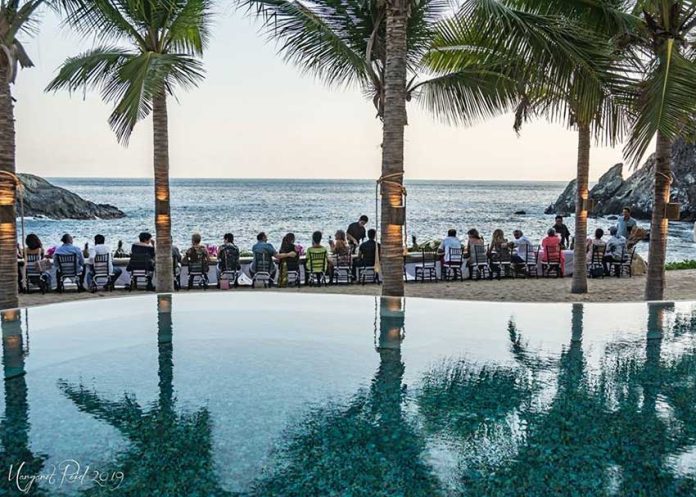
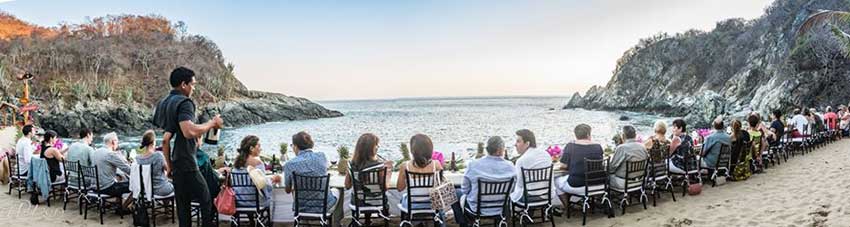
Clandestina dinner guests at Punta Garrobo, Zihuatanejo. margaret reid
March 31 marked four years and 20 Clandestina dinners hosted by brothers Antonio and Felipe Meneses, co-owners of Restaurante Angustino in Zihuatanejo, Guerrero.
After chef Felipe Meneses read about the formal affairs, which originated in San Francisco and then went on to London, England, and major cities in the United States, he decided it would be a success in Ixtapa-Zihuatanejo, too.
As his brother Antonio pointed out, it is their dream to make this part of Mexico a true gastronomical destination as well as the popular tourist destination it is today.
Each dinner has been hosted, as the name suggests, in a secret location. Guests arrive at the restaurant to enjoy a welcome cocktail before departing in prearranged vehicles to the location of the dinner. There they are wined and dined in the finest style for the entire evening.
The price is dependant on the location and menu, but guests can expect to pay between 2,000 and 2,700 pesos (US $100-$140) per person. The number of guests will vary between 20 and 60, making it truly exclusive as people vie for tickets at the once-a-month event during high season, December to April.
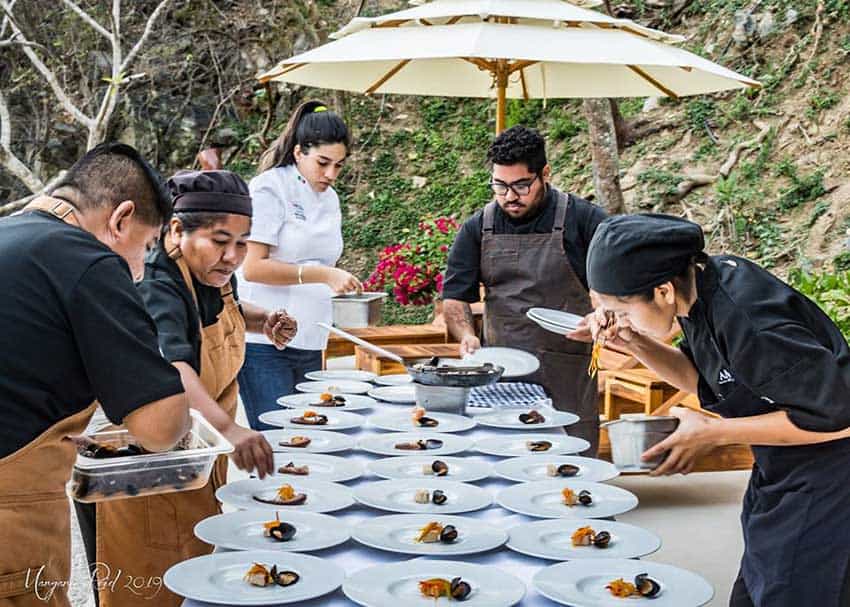
Restaurant crew prepares the plates. margaret reid
Past dinners have been held in locations such as the lighthouse at the tip of Las Gatas, a labor-intensive affair which required moving everything from tables, chairs and linens to food, flowers and guests on a dusty pathway.
Additional dinners were hosted at Zihuatanejo’s Archeological Museum and the infamous Patheon, that sits high on the hills of La Ropa beach. Still another used Ixtapa as a backdrop.
Depending on the menu, the brothers will often fly in special guest chefs from around Mexico to share their talents and expertise, and sometimes offer surprise entertainment for the evening.
At the museum Clandestina, for example, the young man sitting next to me rose half-way through dinner and did an amazing operatic version of Besame Mucho.
As I joined others on the patio at Angustino’s for what was to be the final Clandestina this season, I was as much in the dark as everyone else as to where the dinner was going to be held. Finally, when everyone had arrived, we departed in pre-arranged vehicles.
On the way I asked Antonio about the future of Clandestina dinners for the area. He explained that despite what might seem a hefty price tag, the dinners did not break even as a business for them, especially once all the expenses were factored in, such as airfare and accommodation for the visiting chefs, flowers, linens and, of course, the price of labour, food and wine.
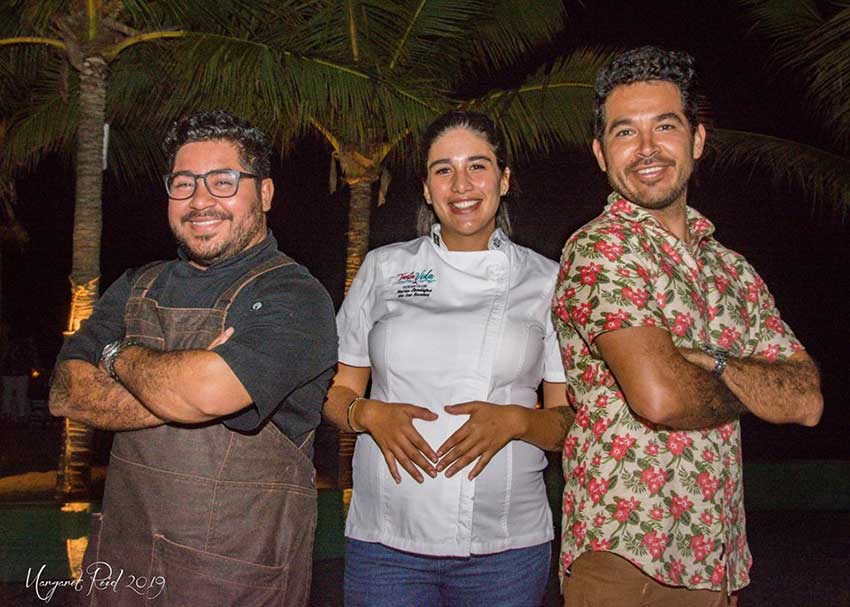
Clandestina creators, from left, Felipe, Nori and Antonio Meneses. margaret reid
So why do it?
The whole point is to build up awareness of Ixtapa-Zihuatanejo gastronomically. Eventually, the brothers hope, other restaurants in the area with world-class chefs (and there are many) would choose to participate.
As Antonio’s car wound up the hills heading towards Playa la Ropa, I played a guessing game as to where the event would be held and discarded each guess as we passed it and began to climb. I knew there were several locations high above Las Gatas that would be suitable for a Clandestina, but we had passed all the places I thought it might be held.
Finally, we took a road I hadn’t even known existed and moments later we arrived.
The first thing that struck me was the incredible and breathtaking view of the beautiful Punta Garroba resort and condominiums. Far below I could make out the long linen-clad table which was, I learned, decorated by artist Miguel López Vázquez from Mexico City.
A beautiful staircase brought guests down to a stunning swimming pool on the manmade beach overlooking the surf and rocks below. The bar rested to the right where the staff worked to prep the plates for dinner.
Last dinner of the season, at Punta Garrobo. margaret reid
And then it came time to eat.
As each creative as well as delicious dish was presented and paired with an appropriate wine, chef Felipe explained them. It was love at first bite — from the first course, a seafood bouillabaisse, followed by tortellini in squid ink, plus a fish dish, to a beef dish with hibiscus and peppers.
The last course, a confection of chocolate and pistachio created by Antonio Meneses’ wife chef Nori, was the perfect end to an amazing dinner.
The writer is a Canadian who has lived and worked in Mexico for many years.
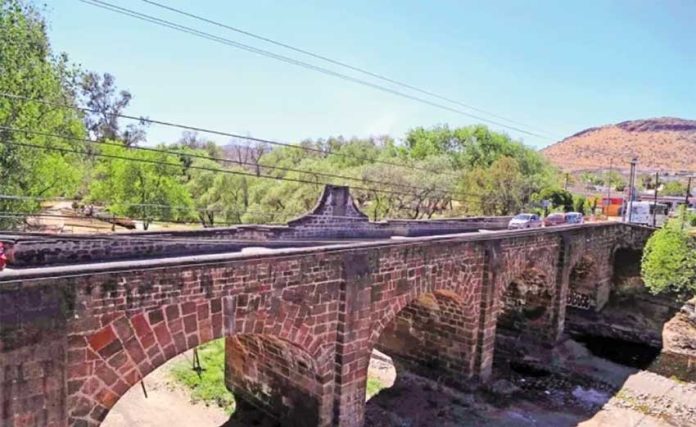
The National Institute of Anthropology and History (INAH) has approved a project to restore a historic bridge in San Juan del Río, Querétaro.
El Puente de la Historia, or the Bridge of History, is a 110-meter-long bridge built in the early 1700s across the San Juan river.
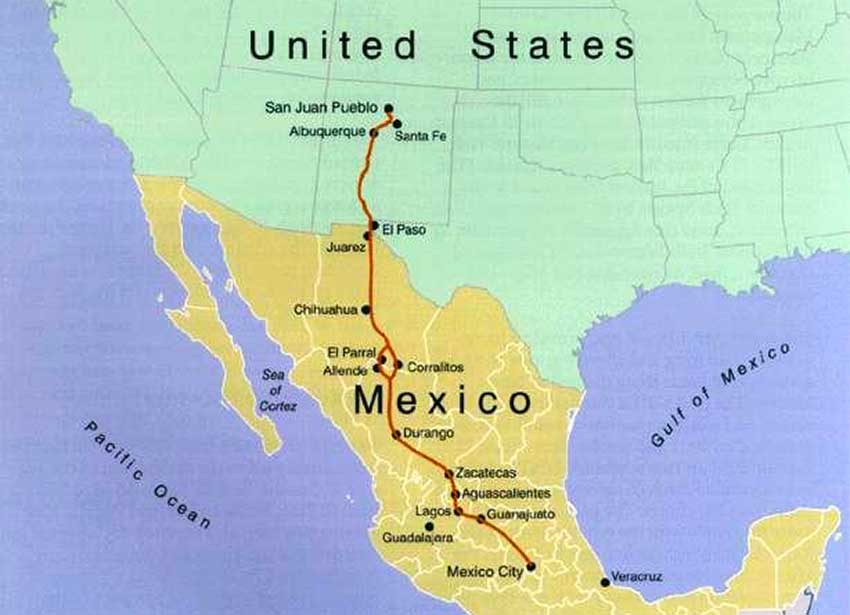
It marks the entrance to the Bajío region of the country for northbound travelers and was also part of the 2,560-kilometer Camino Real de Tierra Adentro (Royal Road of the Interior Land), a trade route between Mexico City and San Juan Pueblo, New Mexico, from 1598 to 1882.
The Camino Real route was declared a UNESCO World Heritage site in 2010 but the bridge has significant structural damage that is exacerbated by vehicular traffic.
Work to restore it will be carried out by the Querétaro Secretariat of Urban Development and Public Works.
Route of the Camino Real, between Mexico City and Santa Fe, New Mexico.
The department’s chief said that authorities at all three levels of government have given the green light for the project.
“The project was approved and has permits from different federal authorities: INAH, the National Water Commission, the Secretariat of the Environment, [as well as] state authorities and the municipality of San Juan del Río . . .” Romy Rojas Garrido said.
To allow the extensive restoration work to occur, Rojas said, a new vehicle bridge will be built next to the existing one, explaining that it will allow the restoration and subsequent preservation of “one of the oldest and most important and monuments in the country” and also “provide a solution to San Juan del Río’s transportation problems.”
Land surrounding the bridge will be beautified and turned into public space.
The Camino Real route, including El Puente de la Historia, is one of 35 UNESCO World Heritage sites in Mexico.
Among the others are the historic centers of Mexico City, Puebla, Oaxaca, Morelia and Zacatecas, the Palenque, Teotihuacán and Chichén Itzá archaeological sites, the whale sanctuary of El Vizcaíno, the monarch butterfly biosphere reserve and the agave landscape and ancient industrial facilities of Tequila.
The ex-mayor in better days and his wife, now in custody.
The wife of a former mayor has been arrested after allegedly attempting to disconnect her husband from life support in a Durango hospital.
The state attorney general’s office said Nora Lucila, the wife of former Canatlán mayor Eugenio Rodríguez del Campo, was caught while disconnecting her husband’s oxygen and other tubes at a hospital in the city of Durango.
Her husband has been hospitalized since 2016 with Lou Gehrig’s disease.
The ex-mayor’s family had previously requested that Lucila be placed under special surveillance. She was accused of putting rat poison in her husband’s food over an extended period.
On another occasion, she reportedly attacked her husband in his hospital bed, leaving him with bruises and cuts.
Authorities said Lucila, 44, could face a charge of attempted homicide. Her husband was mayor of Canatlán from 2007 to 2010 and prior to that was the state director of urban development.
The central Mexico volcano Popocatépetl has been hogging the headlines recently, but experts warn that a second volcano also poses a high risk, this one in Chiapas.
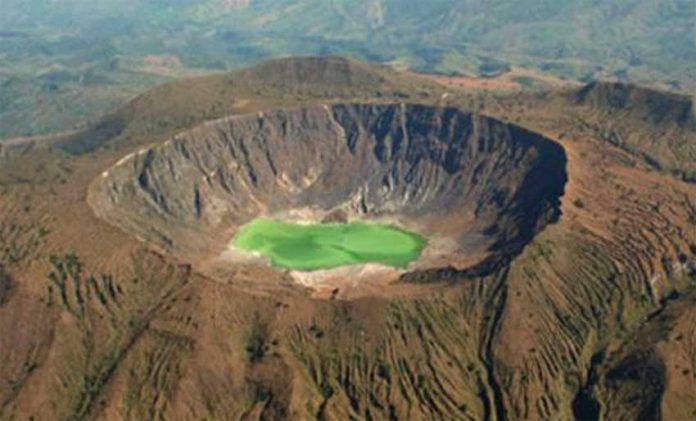
Located in the northwestern part of the state, the Chichonal volcano lies in a mountainous region between the municipalities of Francisco León and Chapultenango.
It is just 75 kilometers from the cities of San Cristóbal de las Casas and Villahermosa, the capital of the neighboring state of Tabasco.
There was a major eruption of the volcano in 1982, which left a crater a kilometer across and more than 200 meters deep, and a lake of acidic water.
[wpgmza id=”177″]
Yesterday, the Civil Protection office announced that it will start reinforcing its security protocols in five municipalities surrounding Chichonal.
The agency said that given the possible eventuality of seismic and volcanic activity, the surveillance and monitoring of Chichonal should be a priority.
The agency announced that it will soon start to organize drills so citizens know what to do if there is an eruption.
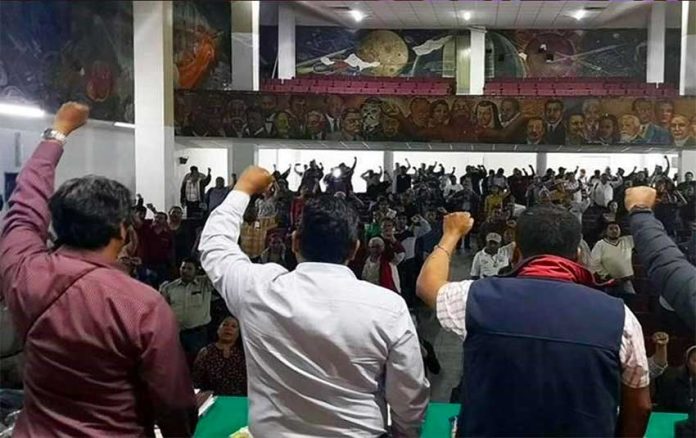
Teachers affiliated with the dissident CNTE teachers’ union can now take time off for demonstrations and blockades — and get paid.
The previous federal government docked teachers’ salaries if they were absent from the classroom but President López Obrador said yesterday that teachers have the right to protest and earn their salary.
“No, no, no,” he said, “there will be no discounts to salaries; teachers have the right to protest . . .”
He pointed out that job action has not been an issue. “. . . in the time we’ve been in government there have been no frequent strikes, children have continued to have classes and there has been no major issue.”
The president stressed that “this is what democracy is like; when there are no more strikes it means that the political system is dead . . . there must be demonstrations, different points of view . . . this is democracy.”
López Obrador also explained that his administration is considering analyzing a rule that prohibits the payment of salaries to teachers assigned to positions in the union. At present they must be physically present in the classroom to get paid.
The policy was part of the 2013 educational reforms, “and we are for its complete cancellation, all of its policies.”
That’s what CNTE members are hoping as they begin another protest today outside the Chamber of Deputies. A spokesman said teachers will continue to protest until “not even a comma remains” of the education reform of 2013.
The union threatened to shut down the legislature as they did several times last month if their demands are not met.
Union leaders had announced that 40,000 teachers would march at today’s rally, but the newspaper Reforma said about 1,500 turned up.
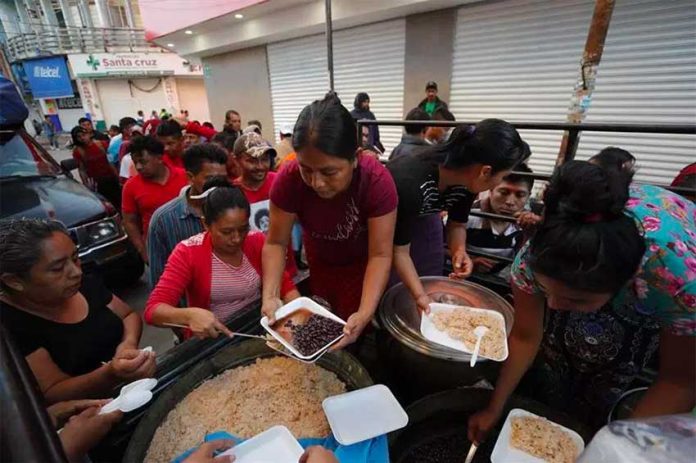
Many migrants who arrived last fall were given food and shelter by communities en route. Support for the travelers has declined since.
After the arrival of more than 100,000 migrants in the past several months — 76,000 in February alone, a poll reveals that Mexicans might have had their fill.
Nearly 60% of respondents to a survey conducted by the newspaper El Universal said the presence of undocumented migrants was harmful for their communities, while 51% said that president López Obrador should prevent their entry into the country.
The negative perception of Central American migrants grew from 34.2% six months ago, when El Universal conducted a similar survey, to 58.2% this time around.
When migrants started arriving in caravans late last year, only 37% of respondents were opposed to the government granting them free entry. Today, that figure is 62%.
The percentage of Mexicans willing to offer shelter to the undocumented migrants in their homes dropped from 47% to 29%.
With regard to the threat by the United States that it will close its southern border if the flow of migrants is not halted, 49% believed the threat, and 44% did not, while 24% believed the president should confront the United States president.
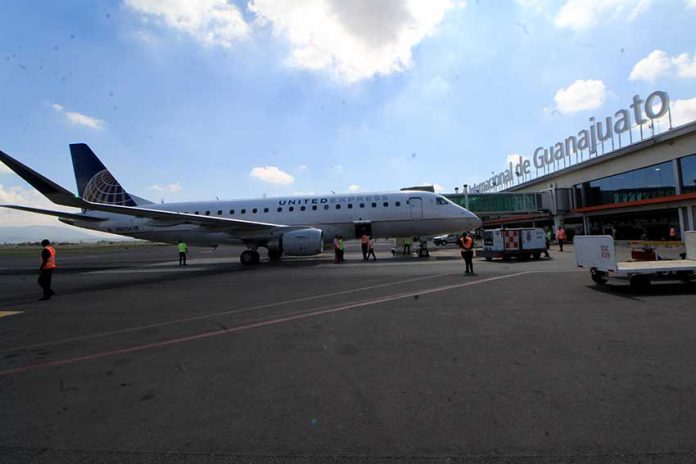
A band of armed thieves stole US $2.4 million worth of United States and Canadian dollars in just three minutes at Guanajuato International Airport Wednesday night, more than double the amount initially reported.
Between six and eight masked men in a truck disguised with a fake Aeroméxico logo breached security to enter the runway area, where they intercepted an airport service vehicle that was in the process of delivering the cash to a waiting plane.
The money had arrived at the airport in a PanAmericano armored truck at around 8:00pm Wednesday in order to be sent to Mexico City.
The armed men stole 14 of 18 bags of cash from a sole unarmed PanAmericano guard and two airport employees traveling across the tarmac in a luggage transport vehicle.
The thieves then loaded the money into their truck, drove to the perimeter of the airport property and knocked over a fence to escape.
Airport operator Grupo Aeroportuario del Pacífico said in a statement that the thieves entered the airport, carried out the brazen heist and left within a period of three minutes.
Shortly after the incident, police found the truck that was used in the robbery and recovered two of the stolen bags of cash. They later found two more bags of cash in another abandoned vehicle.
Federal and state police as well as the army conducted a joint search operation but there have been no arrests.
Federal Police yesterday set up checkpoints to inspect vehicles entering and leaving the Guanajuato airport as part of wider measures to bolster security at the facility.