Home Blog Page 2092

Ecoshell has been converting corncobs into plastic alternative for 10 years

0
Ecoshell's plant in the state of México.

Although little has been done to encourage green alternatives and consumers prefer cheaper and well-known non-biodegradable options, a México state-based firm has been successfully producing corncob-based plastics for a decade.

Ecoshell was born in a classroom while founder Carlos Camacho was completing the fourth semester of his industrial engineering course.

“Corn has properties that are very similar to those of plastic, and we found that it was a product that could compete in cost and quality and offer a sustainable alternative to plastic,” the entrepreneur told the newspaper El Financiero.

Camacho’s process crushes corncobs and mixes them with a starch-based biopolymer. The resulting substance is melted down and small pellets are obtained. These can be used to fabricate bags, cups and many other bioplastic-based products and utensils.

The resulting eco-friendly products are also microwave-safe. Depending on how they are disposed of, they can last between 90 and 240 days.

One of Ecoshell’s first clients was Walmart, which currently purchases 300 boxes of its product every week. Other clients are supermarkets Chedraui and Superama, chain drug stores Farmacias San Pablo, restaurants including Olive Garden and Wings and hotel chains One Fiesta Americana and Mayan Palace.

To keep up with demand Ecoshell requires 2,000 tonnes of corncobs per month, which are transformed into 10 to 15 million products in the firm’s México state factory.

Ecoshell’s strongest market is domestic: it operates nine distribution centers and 18 warehouses throughout the country. The company also exports to the United States, Jamaica, Dominican Republic, Guatemala and Chile, and is preparing to enter the European market.

“If one compares, foam plastic is cheap and has been in the market for a long time; people are used to it and it’s not easy for them to opt for an ecological product. Biodegradable products make up 2% of the disposable utensil market,” said Camacho.

The government has fallen behind, he said, and there are no incentives for environmentally-friendly products. On the other hand, Querétaro, Veracruz and recently Guadalajara have made more advances, he added.

Source: El Financiero (sp)

Science council to create research center out of white elephant in Tlaxcala

0
Plaza Bicentenario, from white elephant to research and innovation center.
Plaza Bicentenario in the city of Tlaxcala.

An ambitious cultural project in Tlaxcala that was abandoned in a quarrel between two governors will get a new lease on life.

The National Council for Science and Technology (Conacyt) has come to the rescue, while at the same time breathing new life into the state’s education, science and industry sectors.

The 400-million-peso (US $34 million at the time) Plaza Bicentenario was a project of National Action Party Governor Héctor Ortíz, whose term ran from 2005 until 2011. But after Institutional Revolutionary Party candidate Mariano González succeeded him as governor, the project was all but abandoned.

The last time the 10,000-square-meter complex of theaters, exhibition halls and amphitheaters was used was for Ortíz’s final report as governor in 2011.

In the intervening years the white edifice has fallen prey to the elements and vandalism.

Conacyt said the facility will become the Tlaxcala State Center for Technological Research and Innovation, or Citlax for short.

The cultural facilities are to be modified to house top scientific infrastructure and encourage a collaborative relationship with several industrial firms in the central Mexico state.

Conacyt will operate five research centers in a collaborative effort that will benefit science, technology and innovation.

One of the goals of Citlax is to consolidate Tlaxcala’s human resources and link them with the automotive, chemical and textile industries.

Governor Marco Mena said Citlax will propel education by allowing top researchers from around the country to interact with teachers and students from Tlaxcala.

Source: El Universal (sp)

Four robbery suspects lynched in Tabasco

0
Signs such as this have appeared in several communities to warn criminals they will be lynched if caught.

Four men were lynched yesterday in Tabasco, presumably for stealing a motorcycle.

Police were alerted to the incident after receiving a call that three bodies had been found hanging from a tree in Arroyo Hondo, Macuspana.

A fourth body was found on a road near the scene of the hanging. The man of about 40 appeared to have been dragged for some distance along the road and beaten. The other three men were aged between 16 and 30.

The state government issued a statement reminding the public that everyone has a right to be judged and sentenced by a competent authority, and that those who take justice into their own hands by lynching are responsible for intentional homicide and must answer to the charge.

Source: El Universal (sp)

Driller accuses government of collusion with Pemex over contract corruption

0
An Oro Negro drilling rig.

A Mexican oilfield services company has accused the federal government of using the Attorney General’s office (PGR) to intimidate and destroy it through a criminal investigation.

In an open letter published in The New York Times, Oro Negro charged that an embezzlement probe against it was launched in retaliation for refusing to pay bribes to the state oil company Pemex in order to obtain contracts.

The company said the accusation that it embezzled funds it received from private investors which it should have used to pay bondholders — as charged by the PGR — is “frivolous, lacks foundation and is a manifestation of the permanent campaign [of the government of] Mexico to harass, persecute and destroy Oro Negro.”

The company claimed that Pemex conspired with bondholders to cancel its contracts for oil platforms it operated so that the latter could take over the rigs and negotiate their own agreements with the state-owned company.

Signed by a lawyer for the company and American and European shareholders, the letter also said that Oro Negro has recordings of high-ranking former Pemex officials in which they admit that their company was seeking to destroy Oro Negro because it refused to pay bribes.

In turn, Pemex said in a statement yesterday that Oro Negro’s claims are unfounded and that any recordings should be submitted to authorities so that their authenticity can be assessed.

It also questioned why the information hadn’t been made public earlier.

Pemex refuted Oro Negro’s claim that it had been “destroyed” because it had been locked out of the oil exploration market for refusing to pay bribes.

“The facts refute that version [of events] because in 2016 and 2017 Pemex offered the same terms to Oro Negro as it did to many other suppliers of oil platforms,” the statement said.

“. . . The other companies accepted the terms set by Pemex while Oro Negro decided not to . . . Pemex denies any discrimination against Oro Negro.”

The statement also said that “Pemex will continue to defend itself from the unfounded claims against it and against the Mexican government . . . because in good faith and within its legal rights, it sought to renegotiate its contracts with Oro Negro . . . after the slowing down of the petroleum market.”

Oro Negro, the state oil company said, “took the unilateral decision to reject Pemex’s terms and decided to initiate the process to declare itself bankrupt.”

In addition, it said that “Pemex is of the firm belief that Oro Negro is deploying a strategy in international media to compensate for a series of strategic errors that said company has committed and because of the deficiencies in its legal case against Pemex.”

Oro Negro initiated legal action against Pemex last month for the unfair and unlawful treatment it alleges it received and, according to the public letter, United States shareholders are seeking at least US $700 million in damages while European shareholders are claiming US $300 million in compensation.

“Mexico frequently shows no respect for the rule of law and uses all its organs, including agencies responsible for enforcing the law, at its discretion and to destroy those who refuse to participate in corruption,” the letter charged.

The state oil company said it will defend itself in Mexican and international courts “with full confidence that the result of the legal process will be favorable to it.”

Source: Animal Político (sp), Milenio (sp), El Economista (sp), Forbes (sp)

Late diagnosis of violin spider bite could cost baby his toes

0
Violin spider blamed for child's bite.

Doctors in Nayarit believe they have saved a 10-month-old baby’s leg after he was bitten by a violin spider.

Kevin Cataño was bitten last weekend in Acaponeta but his condition was not diagnosed until a discoloration of the skin appeared on several parts of his body, which was later diagnosed as necrosis.

At that point doctors at a clinic in Acaponeta began to suspect a spider bite and transferred the child to a hospital in Tepic. As he was being admitted, the boy suffered a seizure and cardiac arrest.

When it was determined that the bite was that of a violin spider doctors sought help from the the Federal Commission for Protection Against Health Risks (Cofepris) to obtain the necessary antidote, which was donated by the pharmaceutical laboratory Silanes.

The boy’s condition started to improve following administration of the antidote and despite an early assessment that the boy’s left leg would have to be amputated, physicians say the limb has been saved.

The only current risk is that he will lose his toes.

Medical staff have done more than treat Kevin for the bite.

Doctor Daniel Balderas said several of his colleagues have not only given their time but the money to pay for the medicine needed in their patient’s treatment.

He said the antidote had been sought in both Mexico and the United States but proved hard to find.

“. . . nobody had it, it’s not being produced. We were told that a synthetic antidote is in development, but for the time being hospitals . . . will have to resort to an alternative corticoid and dapsone-based treatment.”

The violin spider is also known as the brown recluse spider.

Source: El Universal (sp)

People and pelicans suffer under Baja California heat wave

0
A hot day in Baja California.
Hot weather in Baja California.

A sweltering heat wave in Baja California has cost the lives of seven people and temperatures are expected to remain above 30 C for the foreseeable future.

Three migrating pelicans also succumbed to the heat.

According to the state Health Secretariat, six people died of heat stroke in the capital city of Mexicali, while another died of heat exhaustion in Tecate.

Most of victims had been under direct sunlight at a time when the thermometers reached 38 C.

“With these deaths we have reached last year’s total of deaths caused by heat,” said a health official.

Hot weather has sent 29 people to hospital for heat-related illnesses: 15 suffered heat stroke, 13 suffered heat exhaustion and one person was admitted with severe sunburn.

The intense heat wave has sent the temperature dangerously close to 50 C in Mexicali, and not even a migrant bird species has had a respite.

Yesterday, 10 pelicans migrating south from the Salton Sea in California were beaten by the heat before they made it to the Sea of Cortés.

The 911 emergency line received reports of pelicans lying on the streets, triggering a deployment of federal environmental officials.

The birds were found dehydrated, and three had died. The remaining seven were transported to a local zoo were they are expected to recover fully.

Health and Civil Protection authorities throughout the state have warned the public to stay indoors as much as possible as a preventive measure.

Temperatures are expected to remain high but well below 40 C: highs around 32 C are expected around the state. Still, authorities warn people to remain hydrated and avoid performing exhausting exercises.

Source: Milenio (sp), La Jornada (sp)

New stock exchange begins trading, breaking a 43-year monopoly

0
BIVA, Mexico's second stock exchange, began operating today.

A new stock exchange launched in Mexico today after five years of preparations, breaking a 43-year monopoly on the public market.

The Bolsa Institucional de Valores, or BIVA exchange, joins the existing Bolsa Mexicana de Valores (BMV), or Mexican Stock Exchange (BMV), giving Mexico two exchanges for the first time since 1975.

The BIVA will trade the same instruments as the BMV including equities, debts and warrants, with the competition between the two expected to help drive economic growth.

The new exchange will offer a new source of financing to companies and more options for investors, the newspaper El Financiero reported today.

In its opening auction, the BIVA said that more than 100 buy and sell orders were issued and that the first entered into its system came from the brokerage firm Finamex.

The exchange uses technology provided by New York-based Nasdaq and, according to its corporate brochure, “BIVA is one of the most advanced exchanges in the world.”

BIVA CEO María Ariza told Nasdaq associate vice-president Mark Driscoll that BIVA’s “ambition is to be seen by Mexican and global investors as a technological and innovative stock exchange.”

In the interview — which is published on the Nasdaq website — Ariza said “we’ve triggered regulatory changes that have modernized the stock market in Mexico” and “we want to give the Mexican market and its companies more visibility around the world so that global investors can invest in new opportunities our country has to offer.”

She also said that BIVA wants to “completely reshape the way a company enters the public market and the whole experience of being a public company.”

The Harvard-educated CEO described technology as a “key player” for BIVA, explaining that modern exchanges use it for trading, surveillance, data analysis and distribution.

Ariza said that some of BIVA’s trading characteristics are protocols in line with international standards, broker dealer anonymity, block trading book, closing auction and full market depth of the books.

“In a continuously-changing world, where new technologies and asset classes come into play every day, we need to be at the forefront to give a better service to our clients and continue to attract new players into the markets. Nasdaq helps us to make this possible and continue growing,” she said.

Today’s commencement of trading is the culmination of a process that started more than five years ago.

In February 2013, the Mexican company Cencor submitted the project to create a new stock exchange to federal financial authorities and subsequently worked closely with the Secretariat of Finance, Mexico’s central bank and the Mexican Banking and Securities Commission towards its development.

In October 2015, the company formally applied for a concession to organize and operate the new exchange and the authorities granted approval in August last year.

This morning’s opening ceremony was attended by Finance Secretary José Antonio González Anaya, Cencor CEO Santiago Urquiza and Ariza, among other officials.

Mexico is the 15th largest economy in the world but ranks eight places lower in terms of market capitalization, according to the World Federation of Exchanges.

All 14 countries with larger economies than Mexico have at least two stock exchanges.

There are currently 146 listed companies in Mexico with a combined market capitalization of US $466.1 billion but with the entry of the BIVA, the number of public companies is expected to grow to 200 in the next three to five years.

Source: El Financiero (sp), Nasdaq (en), El Economista (sp)

Monarch butterfly expert led efforts to protect the insect’s Mexico habitat

0
Brower, expert on the monarch butterfly.

A prominent American scientist and foremost monarch butterfly expert who led efforts to preserve the Mexican winter habitat of the delicate orange-and black insect died last week at his home in Virginia.

Lincoln P. Brower was 86.

His wife, Linda S. Fink, said he had Parkinson’s disease.

According to an obituary published Sunday by The Washington Post, the Princeton and Yale-educated scientist made key discoveries about how the monarch butterfly protects itself by converting a toxic compound from the milkweed plant — its only food source — into a chemical compound that sickens its predators, mainly birds.

During his long academic career, which included teaching and research stints at three United States universities, Brower made more than 50 trips to Mexico to study the monarch butterfly in the mountainous forests of Michoacán and México state, where those from east of the Rocky Mountains migrate each fall.

“It has the most complicated migration of any insect known,” Brower told the Chicago Tribune in 1998.

“Somehow they know how to get to the same trees every year. It’s a highly specific behavior that is unique to the monarch butterfly.”

Brower first visited Mexico in 1977 and told the Tribune 21 years later that the experience was unforgettable.

“All of a sudden the color of the trees changed. I didn’t realize what I was looking at. It was like a wall, turning from green to gray. It was monarch wings, folded as they roosted — the underside of their wings are grayish,” he said.

“So, here was this wall of butterflies, and I just couldn’t believe it. For the first time in my life, I saw millions of monarch butterflies right in front of me. They were covering the trees, they were all over the boughs. They were on the trunks. They were on the limbs. They were on the bushes. They were everywhere. It is one of the most marvelous sights you can behold in the biological world.”

But during later visits, Brower began to see that the number of monarchs was shrinking and joined efforts by environmental groups to have the butterfly officially recognized as a threatened species.

In a 2005 interview with the Post, he said: “Why should we care? For the same reasons we care about the Mona Lisa or the beauty of Mozart’s music.”

The monarch’s Mexican habitat is now a UNESCO World Heritage Site located about 100 kilometers northwest of Mexico City on the Michoacán-México state border.

Officially called the Monarch Butterfly Biosphere Reserve, the site covers 56,259 hectares of rugged forested mountains and receives millions of butterflies every year.

Brower received an award from the Mexican government for his work to preserve the monarch and in 2016 was also recognized for his conservation efforts by the Center for Biological Diversity in the United States which gave him the E.O. Wilson Award.

Brower, who was born in Madison, New Jersey in 1931 and first fell in love with butterflies at age five, edited two books and was the author or co-author of more than 200 scientific studies.

He taught at Amherst College in Massachusetts and the University of Florida before becoming a research professor at Virginia’s Sweet Briar College in 1997. All told, the scientist studied the monarch for more than six decades.

Lincoln Pierson Browser is survived by Fink, his wife of 27 years and an ecology professor with whom he frequently collaborated on scientific projects, as well as two children from his first marriage, a brother and two grandchildren.

Source: The Washington Post (en)

Frida the earthquake rescue dog gets a statue in her honor

0
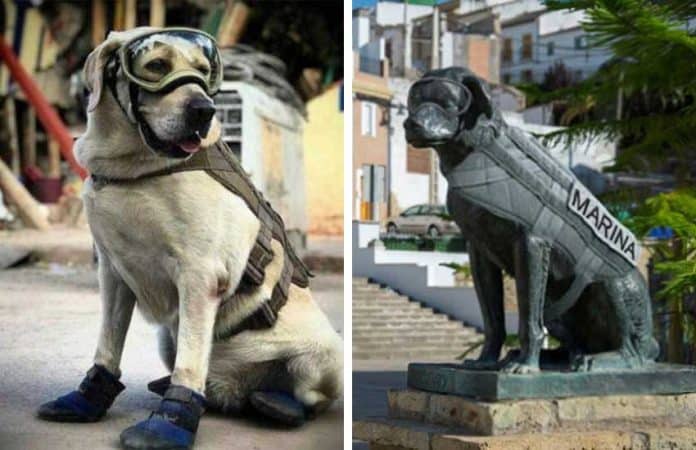
Rescue dog Frida, left, and her statue in Puebla.

The eight-year-old search and rescue dog that became a social media star and bona fide Mexican icon after last September’s earthquakes has been honored with a statue in Puebla.

Frida herself was on hand at the recent unveiling ceremony in the state capital’s Ecological Park, where the white Labrador — decked out in her customary protective goggles, blue booties and vest — put her highly-sensitive nose against her bronze replica to check it out.

Made out of unwanted keys, the statue of Frida stands next to another in the likeness of the dog’s trainer, Israel Arauz.

Both canine and master played key roles in the search efforts following the September 7 and 19 earthquakes that claimed hundreds of lives and devastated parts of southern and central Mexico, including Puebla where the monuments now stand.

In front of the two statues a plaque reads: “Memorable symbols of the strength Mexicans can have when we decide to come together for great causes.”

In her distinguished career of public service, Frida has helped to save the lives of 12 people who were buried under the rubble of buildings that collapsed in the 2010 Haiti earthquake and found 41 bodies of victims of a landslide in Guatemala in 2012.

She also contributed to rescue and recovery efforts after the Pemex tower explosion in Mexico City in 2013 and the 2016 Ecuador earthquake.

The Puebla statue is not the only piece of art that celebrates the heroic actions and achievements of Frida.

The navy canine unit sniffer has also been featured on t-shirts, in comic books and in a large colorful mural in the Mexico City neighborhood of Roma, clearly demonstrating that she has won over the hearts and minds of many.

For now, Frida continues to be at the ready to lend a paw if her skills, including her highly-sensitive sense of smell, are needed in the event of another natural disaster.

But in the future she could act as a mentor for younger dogs that are training to become Mexico’s next generation of highly-valuable and much-loved canine heroes.

Source: mexico.com (sp), CBS News (en)

New legislation will require taxis to be powered by renewable energy

0
A taxi in Querétaro: they may still be yellow but they'll be green too.

Taxis in Querétaro will be mostly green within five to six years, state lawmakers predict.

The Querétaro state Congress has approved a series of amendments to its mobility laws that will promote the use of renewable energy and electric vehicles by taxi owners.

The new regulations are among the state’s green policies, which have resulted in 45% of taxis — about 3,000 — in Querétaro city to be powered by natural gas instead of gasoline.

Lawmakers expect that in five or six years’ time 100% of taxis in the greater Querétaro metropolitan area will be powered by renewable energy sources.

The new regulation requires that all new taxi concessions issued this year go to electric vehicles (EVs). The law allows for hybrid vehicles to obtain a license throughout 2019, but in 2020 licenses will go to EVs only.

Taxi licenses and permits will also be reviewed, allowing for a single owner to have up to 10. If a taxi permit holder wants to operate a fleet larger than the 10-vehicle limit, the vehicles must be electric.

“The sale of taxi permits in the black market will no longer be tolerated,” said the president of the congressional mobility commission. If permit holders fail to comply with the EV-only regulation, their permits will be rescinded.

Taxi licensees will have between 10 and 16 years to renew their fleets, allowing for a gradual replacement of gasoline-powered cars with their environmentally-friendly counterparts.

Source: Milenio (sp)