Home Blog Page 2176

Election violence a worry but process not at risk: elections chief

0
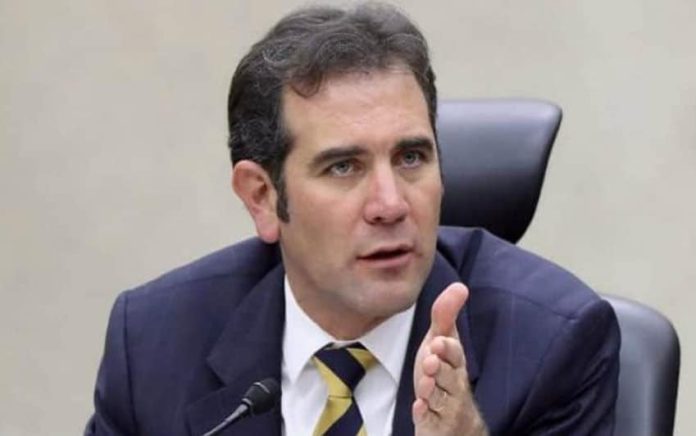
Electoral institute boss Córdova.

Despite an upsurge in political violence that has seen at least 47 candidates assassinated during the election process that began last September, the president of the National Electoral Institute (INE) has assured the Mexican public that the July 1 elections are not at risk.

“The violence was not set off by the electoral process, it was already there and that’s one of the big national problems that as a society we have to solve . . .  but that doesn’t mean that the elections are at risk of being derailed, the elections are going ahead,” Lorenzo Córdova Vianello said.

The INE president also called on authorities to guarantee security next Sunday so that citizens can go to the polls to cast their votes without incident.

“It’s important that all of the Mexican state’s security authorities, with which the INE has closely collaborated . . . carry out all of the essential public security measures so that the day of July 1 is — as it will be — a success,” Córdova said.

A range of current and former officials as well as presidential candidates have closed ranks by saying “ya basta or “enough’s enough“ to the political — and other — violence that is plaguing the country.

The leading judge of Mexico’s top electoral court, who on Thursday condemned the violence against candidates, spoke out again on the topic yesterday in a post to her Twitter account.

“I reiterate my call to the relevant authorities to investigate and sanction the acts of violence as well as guarantee security and an election day free of violence,” Janine Otálora Malassis wrote.

The former president of the forerunner to the INE — the Federal Electoral Institute or IFE — told the newspaper El Universal that violence during the election period is a bad sign for Mexico’s electoral health and that it is reflective of a growing problem of organized crime interfering in politics.

“I’m not saying that the democratic process in Mexico is controlled by organized crime, of course not, but I am saying that in some parts of Guerrero, Oaxaca, Chiapas, Tamaulipas, Michoacán, Chihuahua — generally in rural areas — organized crime is in charge and we’re seeing that clearly,” Luis Carlos Ugalde said.

He also said that it was a “fantasy” to believe that the electoral authority could do anything to put an end to the violence.

“What can it do? What the INE has to do is manage the polling stations and that’s it,” Ugalde said.

Mauricio Merini, a former IFE electoral councilor, said that political violence could act as a disincentive for people to vote next Sunday but charged that the best response to attempts at intimidation would be for people to go out to vote en masse.

Meanwhile, at a campaign event in Tamaulipas yesterday, leading presidential candidate Andrés Manuel López Obrador blamed the violence on the “corrupt regimes” of the ruling Institutional Revolutionary Party (PRI) and the National Action Party (PAN), which held power between 2000 and 2012.

The Morena party leader, who last week said it would take a miracle to stop him from winning, urged Mexicans to get out and vote despite the prevailing climate of violence.

Second-place candidate Ricardo Anaya, of the right-left For Mexico in Front coalition, urged all candidates to “firmly resist and under no circumstance waver” in the face of threats from organized crime.

This year’s elections are the biggest in Mexico’s history, with thousands of elected positions up for grabs at municipal, state and federal level.

Apart from electing a new president for a six-year term starting in December, voters will also choose a new federal Congress and residents of nine states will vote for a new governor.

According to Bloomberg’s poll tracker, AMLO, as López Obrador is commonly known, has over 50.8% support, just over double Anaya’s 24.8%.

Ruling party candidate José Antonio Meade remains in third place in Bloomberg’s poll of polls with 21.6% backing, although he published two surveys on his Twitter account last week that showed he had passed Anaya into second place.

Independent candidate Jaime “El Bronco“ Rodríguez is in a distant fourth place with less than 4% support.

The Spanish newspaper El País said earlier this month that according to an electoral model it developed, there is a 92% probability that AMLO will win. 

Source: El Universal (sp)
Second and third-place wins for robotics team at RoboCup

0
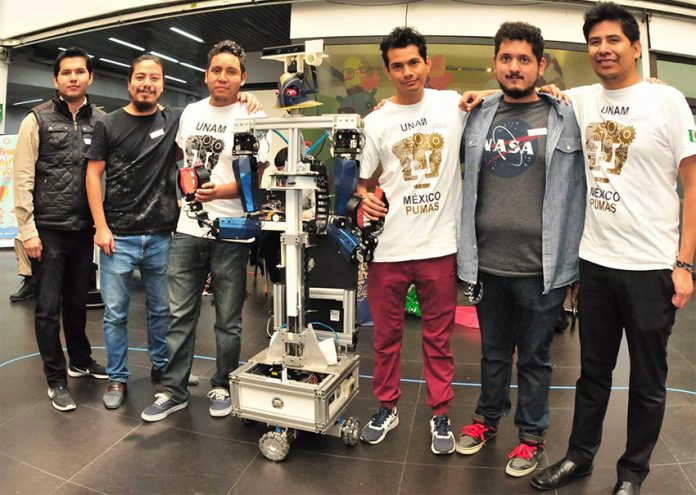
UNAM students and their robot, Justina.

Students from the National Autonomous University (UNAM) earned some awards this past week at the 2018 RoboCup, an annual robotics competition that was held this year in Montreal, Canada.

Mexican students won second place in both the OPL Service Robot and the DSPL Toyota Service Robot categories with their robots named Justina and Takeshi.

Both teams are part of the Pumas group, whose members are enrolled in the biorobotics laboratory at the UNAM Engineering School (FI), led by researcher Jesús Savage.

At the Montreal event, held June 18-22, there were more robots than people, 5,000 all told, built by more than 4,000 university students from 35 countries. The competition includes several categories, including rescue, virtual simulation and soccer matches.

The event is intended to promote the development of new robotic technologies.

Savage said UNAM students have been participating in RoboCup since 2006. In 2007 they obtained a third and fourth place, along with a prize for the best voice recognition and natural language system.

RoboCup was established in 1997 when its goal was to build a team of autonomous robots capable of winning a soccer match against the World Cup’s reigning champions by 2050.

The goal remains but the RoboCup Federation’s main purpose is to advance the state of the art of intelligent robots.

Source: El Universal (sp)

Chepe Express offers new Copper Canyon travel experience

0
The Chepe Express is a new Copper Canyon rail service.

A new incarnation of the train known as El Chepe is now offering a premium travel experience to tourists visiting northern Mexico and in particular Chihuahua’s Copper Canyon.

The Chepe Express started operations last month on the 653-kilometer railroad that links the capital of Chihuahua with the Pacific Coast city of Los Mochis, Sinaloa, via the Tarahumara Sierra.

Differentiating the six-car Express from other Chihuahua-Pacific (Chepe) trains that have run on the line since its inauguration in 1961 are its luxury reclining seats, a bar and lounge affording panoramic views of the surrounding landscape, a double-story restaurant car, a terrace and wifi internet service.

The train is divided into executive and tourist classes and unlike regular services, the Chepe Express only makes two stops: one at El Fuerte, a magical town in Sinaloa, and the other at Divisadero, one of the most popular places to alight to experience the beauty of the Barrancas del Cobre, or Copper Canyon.

The nine-hour journey starts and terminates in the tourist town of Creel rather than the city of Chihuahua as is the norm on regular-service trips.

Bar car on the new Chepe Express.

In the Urike restaurant car, diners can enjoy typical northern Mexican dishes prepared in a kitchen overseen by acclaimed chef Daniel Ovadia while in the bar, a variety of drinks and snacks are available.

The Chepe Express departs daily at 6:00am from Creel and arrives in Los Mochis at 3:05pm. The return journey departs at 3:55pm and arrives in Creel at 12:55am.

The train has a maximum capacity of 340 passengers and the Chepe website recommends making reservations four months in advance, especially if planning to travel during the high season (July/August, December and the Easter vacation period).

A full return trip (Creel-Los Mochis and back) costs 5,243 pesos (US $262) in tourist class and 8,400 pesos (US $420) in executive class. The prices for a one-way trip are 3,743 pesos (US $187) and 6,000 pesos (US $300) respectively.

Passengers can choose to stay overnight at either of the two stops and board the train the next day at no additional cost.

The Copper Canyon, located in the southwestern part of Chihuahua, is actually a system of six distinct canyons in the Sierra Madre Occidental.

The indigenous Rarámuri people, who are well-known for their long distance running prowess, are the traditional inhabitants of the region.

Source: Mundo Ejecutivo (sp)

Universities to promote academic, cultural activities in San Miguel

0
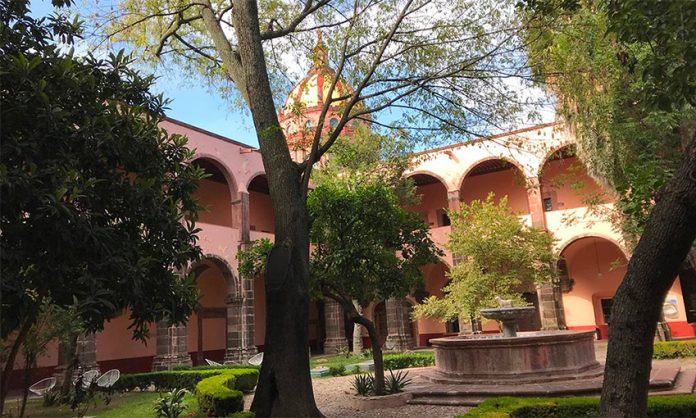
Bellas Artes cultural center is to receive support from two universities.

More academic and cultural activities are in store for San Miguel de Allende if an accord signed by two universities should bear fruit.

The chancellors of the National Autonomous University of México (UNAM) and the University of Guanajuato (UG) signed an agreement that both institutions will conduct activities that give new life to the Ignacio Ramírez “El Nigromante” Cultural Center, located in the Guanajuato city and known locally as Bellas Artes.

The signing took place during the bicentennial ceremony of the birth of Ramírez, a San Miguel lawmaker and writer who wrote under the pen name “El Nigromante.”

The agreement also calls for collaboration in academic, continuing education and research activities, and artistic and cultural promotion.

Speaking at the Ángela Peralta theater yesterday, UNAM chancellor Enrique Graue remarked that Ramírez was strongly critical of conservatism and a champion of education for the people and for women.

“It is important to highlight his courage in the times we’re living in. You can count on the full willingness of the National University to collaborate in any kind of cultural activity,” he said.

Chancellor Luis Felipe Guerrero of the University of Guanajuato observed that Ramírez was a promoter of education, and that his legacy mandates that universities continue to strive to become transformational spaces for the betterment of society.

The agreement with UNAM is more than a great cultural project, he said. Both institutions must collaborate in giving life to the values the liberal Ramírez fought for: fighting against inequality and exclusion, seeking a true separation of the powers of the state, fighting for women’s rights and striving for higher ethics in the public service.

The center at the heart of the new agreement was built in the mid-18th century as the cloister area of the Convent of the Immaculate Conception.

Mexico News Daily

Mexico dominates in match against South Korea, wins 2-1

0
A happy 'Chicharito' Hernández today in Russia.

Mexico has all but sealed its passage through to the second round of the World Cup in Russia after a 2-1 win today against South Korea in hot conditions in Rostov-on-Don.

Cancún-born Carlos Vela put El Tri in front in the 26th minute of the match with a penalty kick the team was awarded due to a South Korean handball.

Mexico’s most famous soccer export, Javier “Chicharito” Hernández, added a second goal to El Tri’s scoresheet in the second half to ensure victory after a breakaway play by the first match’s goal scorer Hirving Lozano, who again impressed with his pace and skill.

The goal was Hernandez’s fourth at a World Cup, taking him to the same level as Luis Hernandez as Mexico’s most prolific goal scorer at the premier international soccer tournament.

South Korean forward Son Heung-min scored a scintillating consolation goal in injury time but it was too little too late for the East Asian nation, which now cannot qualify for the first knockout stage of the tournament.

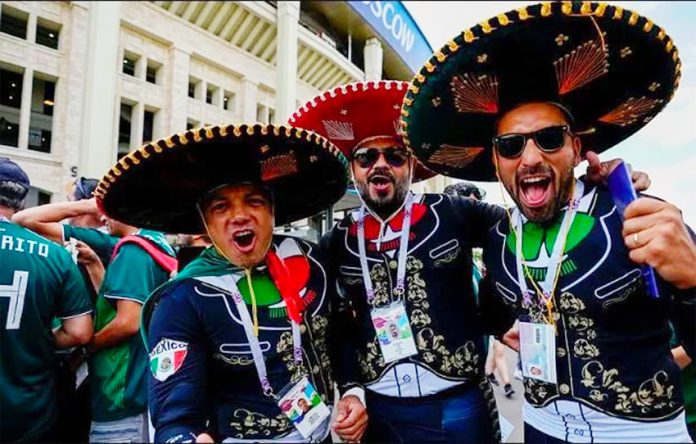
From the beginning of the match, Mexico dominated its opponent and the team’s supporters — who easily outnumbered Korean fans — were in full voice chanting, “We are the home team.”

Given the noise Mexico’s fans created and the sea of green shirts visible in the stands of Rostov Arena, it almost felt as though the match was being played on Mexican soil.

With a 2-0 lead in the second half, El Tri faithful took to chanting “Profe Osorio” in support of the team’s Colombian coach Juan Carlos Osorio, who before the tournament had been heavily criticized by pundits and a football-loving public for his tactics and management of the national team.

Despite their overall boisterousness, Mexico’s fans didn’t use their usual controversial “eh, puto!” chant during goal kicks taken by the South Korean goalkeeper.

The Mexican Football Federation was slapped with a fine of 10,000 Swiss Francs (US $10,120) after fans shouted the homophobic taunt during the team’s 1-0 victory over Germany last Sunday.

After the match — as is usual — passionate soccer fans spilled into the streets all over the country to celebrate the victory, including Mexico City where the capital’s annual gay pride march is also being held today.

While Mexico hasn’t yet technically qualified for the last 16, if Sweden draws with or defeats Germany in the match currently under way in Sochi, its spot in the second round will be confirmed.

Even if Germany wins, it would still be extremely unlikely that El Tri would not qualify for the second round of the World Cup for the seventh consecutive time.

Given the form the team has shown so far this year in Russia, however, fans will no doubt be disappointed if Mexico doesn’t at least make it through to an elusive fifth match for the first time since the World Cup was last held in Mexico in 1986.

If Mexico’s qualification isn’t confirmed today, the national team will have the chance to determine its own fate in its third and final group match against Sweden in Ekaterinburg on Wednesday.

Source: Milenio (sp), Reuters (en), ESPN (en)

Ayotzinapa: Attorney General criticized for inaction, rejects truth commission

0
Human Rights Commission head González.
Human Rights Commission chief González.

Inaction by the Attorney General has prompted the National Human Rights Commission (CNDH) to provide evidence to two federal courts to secure justice for a man it says was wrongfully arrested in connection with the Ayotzinapa case.

The organization filed amicus curiae (friend of the court) briefs with a federal district court and a federal circuit court — both located in Matamoros, Tamaulipas — because the federal Attorney General’s office (PGR) has done nothing to resolve the case of Erick Uriel Sandoval Rodríguez.

The CNDH issued a statement earlier this week charging that it “has undoubted evidence” that Sandoval was “wrongly arrested” by the PGR in connection with the 2014 disappearance of 43 teaching students from the Ayotzinapa, Guerrero, teacher training college.

The commission claims the federal department mistakenly identified him as the man known by the aliases of “El Güereque” and “La Rana” (The Frog).

The human rights group’s evidence includes proof that Sandoval’s physical appearance does not match that of the man that other detainees said was an accomplice in the disappearance of the 43 students.

In a new statement issued yesterday, the CNDH said it presented the courts with the documents and evidence it obtained in its own investigation which allowed it to establish that the PGR had arrested the wrong man.

The human rights group previously provided the PGR with “a file with certified copies of all the evidence it obtained” in relation to the case but said the federal department failed to correct its mistake.

In addition, the CNDH said that 17 other people including “relatives of the detainee and witnesses of the case” had filed injunction requests that have been ignored by the department and described “the silence of the PGR” as “incomprehensible.”

With the evidence that it gathered — which also includes personal details of the man alleged to be the real “El Güereque” and “La Rana” — now in the charge of the courts, the CNDH expressed its “conviction” that they would “issue a ruling in favor of justice.”

CNDH president Luis Raúl González Pérez said the “best response” that his organization hoped for was that the PGR “corrects the injustice” that it has inflicted on a man for whom there is no evidence of guilt.

He also said that a judge had previously ruled there was no evidence that justified Sandoval’s detention although the same judge raised the possibility that a tattoo that supposedly identified him had been removed.

We have already proved that there has been no tattoo removal because he’s not the [same] person . . .” González said.

Meanwhile, the PGR said yesterday that creating a truth and justice commission to undertake a new investigation into the abduction and presumed homicide of the 43 students — as ordered by another Tamaulipas-based federal court on June 4 — is impossible.

There is “a real, legal and material impossibility” to create the commission, the PGR said in the First Collegiate Tribunal of the 19th Circuit while presenting an appeal to an injunction granted to Miguel Ángel Landa Bahena, who is also accused of involvement in the disappearance of the students.

In an interview with the newspaper El Universal, acting Attorney General Alberto Elías Beltrán said the court’s ruling that a new investigation must take place is “a violation of the separation of powers” and that the PGR is analyzing its legal options to challenge the decision.

The amparo or injunction granted to Landa, who is also known by the alias El Chequel, ordered a new investigation into his alleged involvement in the students’ disappearance and for independent experts to determine whether he was tortured during the PGR’s investigation.

A United Nations report published in March said that 34 people were tortured in connection with the investigation and presented with “numerous physical injuries” that were medically certified and consistent with injuries resulting from torture.

Source: El Universal (sp)

Mexican fans’ soccer chant is no longer ‘Eh, puto!’ but ‘Eh, México!’

0
Some eager Mexican soccer fans.

As the South Korean goalkeeper approaches the ball to take a goal kick in Mexico’s second World Cup match in Russia tomorrow, fans have pledged that they will chant “Eh, México!instead of the familiar cry of “Eh, puto!”

Earlier this week, the Mexican team known as El Tri issued a plea via social media to its supporters to drop the popular chant after FIFA, international soccer’s governing body, announced disciplinary procedures on Monday following its use during the first-round victory against Germany in Moscow last Sunday.

The Mexican Football Federation was slapped with a fine of 10,000 Swiss Francs (US $10,120) Wednesday after FIFA reviewed evidence of the puto chant, which is used to taunt the opposing team’s goalie. Puto means faggot or male prostitute.

Outside the Mexican team’s hotel in Rostov-On-Don, where tomorrow’s match will kick off at 10:00am CDT, a group of El Tri fans assured a reporter from the newspaper El Universal that they won’t be using the “Eh, Puto!” chant.

“It’s not fun anymore. Instead of helping, it’s harmful,” they said. “It’s not a matter of being fined or that they could take our fan ID away, it’s a question of culture, that’s clear now.”

Asked what would replace the chant, the fans broke into an elongated cry of “Eh, México!”

If, on the contrary, the homophobic chant is heard at the stadium during tomorrow’s match or during upcoming encounters, the size of the fine could increase or in a worst-case scenario it could even lead to a deduction of points from the team or its expulsion from the tournament.

Three observers are attending every match at this year’s World Cup to report discriminatory behavior by spectators.

There were an estimated 30,000 Mexican supporters at the Luzhniki Stadium for Mexico’s first match and there is no doubt the team’s passionate fans will turn out in force again tomorrow.

The leader of one group of fans called “Más unidos que Nunca” (More united than ever) said that only a small minority of Mexican fans are responsible for starting the chant but added that they incite others around them.

“They’re small groups that continue to insist on doing it. They get caught up in the excitement . . .  they start shouting and other people follow them and that’s how it becomes so big,” Eric Gómez said.

On the pitch, a win against South Korea tomorrow would almost guarantee Mexico’s qualification to the knockout stage of the tournament.

El Tri will play its third and final group match against Sweden on Wednesday.

Source: El Universal (sp)

Home Depot’s new store in Querétaro is No. 123 in Mexico

0
Home Depot's new store in Querétaro is its fourth in the state.

The Home Depot’s new store in Juriquilla, Querétaro, an investment of 203 million pesos (US $10.1 million), is its 123rd in Mexico.

The store is the company’s fourth in the state and will generate 100 jobs.

“With this opening, The Home Depot achieves a total investment of 613 million pesos ($30.6 million) in the state of Querétaro. We continue with the commitment we’ve had for 14 years since we arrived in the state . . .” said Sergio Guitierrez Osuna, president and CEO of The Home Depot México.

New outlets are under consideration in the municipalities of Querétaro and Corregidora.

The company of the orange apron is planning to invest 1.7 billion pesos ($84.9 million) this year on the upkeep and modernization of existing stores and distribution centers and the construction of new ones.

Over the last 17 years the company has invested 31 billion pesos ($1.6 billion) in Mexico, creating more than 15,000 direct jobs throughout the country.

The company plans to invest $10 million over the next decade.

Sales in Mexico, where it has 15,000 employees, are more than US $1 billion a year.

Source: El Financiero (sp), El Economista (sp)

15 trucking firms have ceased operating due to insecurity: Canacar

0
Tanker trucks are petroleum thieves' prey.

Mexico’s trucking industry is shrinking due to insecurity on the nation’s highways.

The president of a national trucking association told a press conference yesterday that 15 trucking companies that hauled fuel for the state oil company Pemex have ceased operations due to insecurity.

Canacar chief Enrique González Muñoz said the number of firms had declined by 15% to 145.

He explained that truckers are subject to assault with weapons against drivers, paint thrown at windscreens to force the drivers to stop, rocks thrown at the trucks and and false checkpoints manned by thieves posing as police officers.

The situation has steadily worsened, taking approximately 700 trucks out of circulation between 2014 and 2017. Tanker truck theft rose 92% in that period. In the first five months of this year, robberies were up 14% over the same period last year.

González said each truck generates five jobs, meaning that 3,500 direct sources of employment were lost. The figure can be up to four times higher if indirect jobs are taken into consideration.

Canacar members explained that on average 16 tanker trucks carrying Pemex fuels are targeted every month by thieves. Each tanker carries 62,000 liters of fuel with a value of about US $1 million.

The truckers charged that the party least concerned with resolving the situation is Pemex itself. It receives the insurance money covering the lost fuel but the truckers must pay the deductible of $10,000 per event.

“Pemex doesn’t lose anything, and that’s why it doesn’t care; it is the only client we pay the deductible for, as if we were responsible,” said Canacar vice-president Refugio Muñoz López.

He added that elevated operating costs have to be added to the losses caused by insecurity because Pemex has made minimal adjustments to its payment structure.

Uriel Joffre Vega, a member of the hydrocarbons committee at Canacar, said the situation has not improved despite the association having “reported in a timely manner” the routes where most robberies occur.

Gónzález added that the thefts put the country’s fuel supply at risk, as his members distribute 30% of it.

Source: El Universal (sp), Milenio (sp)

Veracruz recovers Texas properties purchased with stolen funds

0
Governor Yunes in front of a house recovered by his government.

The government of Veracruz has recovered properties in Texas it says were bought with embezzled public funds, and is negotiating to recover more real estate in the Houston area whose owner was a cabinet secretary during the Javier Duarte Ochoa administration.

Governor Miguel Ángel Yunes Linares revealed in Houston yesterday that the five-bedroom lakefront house and an office complex in Woodlands were worth some 40 million pesos (US $2 million). The money had been stolen by his predecessor and close collaborators, he charged.

Another 21 properties are owned by a former unidentified secretary who lives in Houston, the governor said, and should be turned over to the state government.

Should he refuse, Yunes warned, the case will go to the courts and the former official will be incarcerated.

“There is someone who was a secretary in the Duarte cabinet who owns 21 residences. We’re already talking seriously with him, and if [the real estate] is not returned, he’s going to jail. I say this clearly, he’s going to jail,” the governor said.

An office complex was one of the properties recovered.

He said there are other properties owned by Duarte and his collaborators that the state is attempting to recover, including a house in Woodlands owned by Duarte’s sister-in-law, Mónica Macías Tubilla.

There is also real estate in Miami and New York and the state of Arizona and a condominium in Spain valued at 120 million pesos (US $5.9 million).

Yunes said the newly-recovered house in Houston will be sold and the proceeds invested in health infrastructure.

“We’re going to sell it and we’ll allocate it to health projects; it’s very probable that what we obtain here will be used to finish building the Nautla or Perote hospitals, or to build a clinic needed in the poorest area of Veracruz,” he said.

Yunes’ government filed civil lawsuits in Houston in February alleging that money diverted from state coffers had been laundered through real estate purchases in Texas.

Source: El Financiero (sp), Expansión (sp)