Home Blog Page 2175

Summer could be best in 10 years for supermarkets, department stores

0
More discounting is coming during the summer.

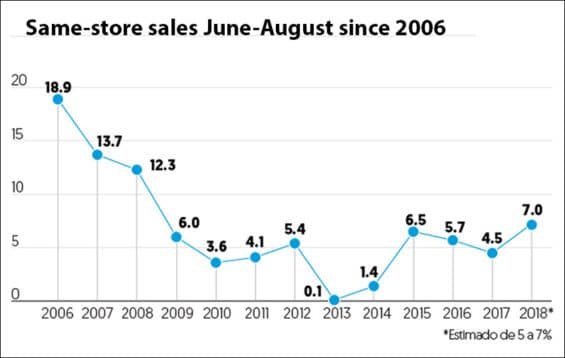
Predicted bumper sales at Mexico’s supermarkets and department stores between June and August could make this summer their best in 10 years, according to market analysts.

Sales will increase between 5% and 7% compared to the same period last year, analysts anticipate, with the World Cup in Russia and this Sunday’s elections expected to drive the surge in household expenditures.

“We expect that consumption will benefit from higher [pre-]election spending in the coming days, in addition to the World Cup, when there is significant demand for televisions as well as snacks and drinks,” said Valentín Mendoza, an analyst at the brokerage division of Mexican bank Banorte.

Another factor is the historically high level of remittances which have increased in value due to a weaker peso.

Even those without money in the pocket from abroad or elsewhere will spend more, according to a Tec. de Monterrey professor.

“Despite the increase in interest rates, at the end of the day Mexicans will consume more this summer and then they’ll worry about [paying back] the credit later . . .” Francisco Javier Orozco said.

In attempts to increase their share of the expected windfall profits, all of the nation’s large retailers have already started rolling out aggressive marketing strategies that include offering discounts on key products to get customers through their doors.

For Fathers’ Day, which was celebrated on June 17, supermarket chains Soriana and Chedraui went head to head on alcohol promotions.

The former offered three for the price of two deals on wine and liquor while the latter dropped their prices on all stock in the same categories by 30%.

All of the Walmart-owned chain stores have also started their summer promotional campaigns.

Its flagship store of the same name has started its “Rebajas para todos(Discounts for everyone) campaign with former soccer star Jorge Campos as its face.
Summer store sales
Summer store sales. el financiero

The company’s membership-only retail warehouse Sam’s Club is offering interest-free purchases and other bonuses, while its premium supermarket chain Superama is offering a variety of three for two deals.

Walmart’s discount chain Bodega Aurrerá is celebrating 60 years in business with a campaign entitled “60 años creciendo contigo” (60 years growing with you) and is offering reduced prices across its range.

Chedraui, Soriana and Comercial Mexicana (La Comer) are also offering a range of promotions, deals and discounts.

Not to be outdone, the department stores Liverpool, Palacio de Hierro and Sears are also intent on grabbing their slice of the sales action and have started their summer sales.

Liverpool began its “Gran Barata de Verano” (Great summer sale) on June 20, with discounts of up to 40% on a range of clothing and accessories.

The sale, which will conclude on July 31, also gives customers with a Liverpool card the option of buying now but not paying until October.

Palacio de Hierro will have discounts of up to 60% until July 12 and “double points” promotions for its cardholders while Sears will offer discounts of up to 50% until July 2 as part of its “WOW!” promotion.

Annual average sales growth for supermarkets and department stores in the three-month summer period has ranged between 0.1% and 6.5% over the past 10 years.

In 2008, however, sales spiked by 12.3% compared to the year before and in 2007 and 2006, growth was even stronger at 13.7% and 18.9% respectively.

An average spend at a Mexican supermarket is 1,550 pesos (US$78) made up of 95 different items, according to consumer knowledge company Kantar Worldpanel.

Source: El Financiero (sp)
Morena’s Sheinbaum leads by 13 points in Mexico City mayor’s race

0
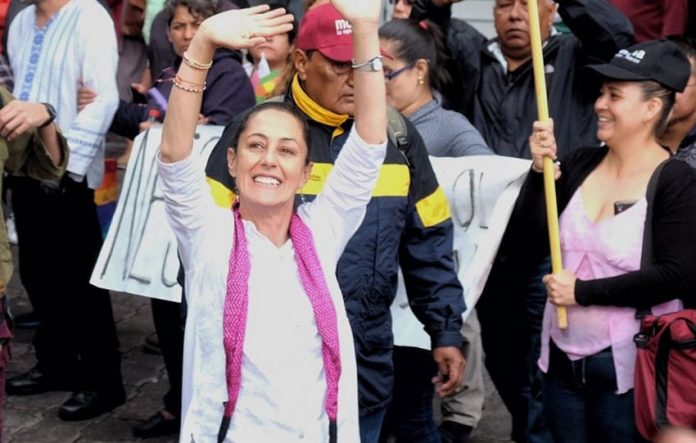
Sheinbaum: polls suggest she will be next mayor of Mexico City.

If the polls are right, voters across Mexico and in the nation’s capital will elect a new president and city mayor on Sunday who represent a political party that didn’t even exist five years ago.

Andrés Manuel López Obrador has a commanding lead in the race to become Mexico’s next president and in Mexico City, Claudia Sheinbaum is on track to become the next mayor.

Both candidates are running for a coalition known as Together We Will Make History, which is led by the leftist National Regeneration Movement or Morena party.

Morena was founded as a non-profit organization in 2012 and registered as a political party in 2014.

With less than a week until election day, the candidate widely known as AMLO has 46.3% voter support, according to today’s update of the Bloomberg poll tracker, while Ricardo Anaya is in second place with 26.5%.

The candidate for the right-left coalition led by the National Action Party (PAN) is just ahead of ruling party candidate José Antonio Meade, who has 24.7% support.

Independent candidate Jaime “El Bronco” Rodríguez, who took leave as governor of Nuevo León to contest the presidential election, is in a distant last place with just 2.9%.

A survey conducted by the polling firm Consulta Mitofsky put AMLO’s lead over Anaya at a slightly larger margin of 23%.

Another new poll — conducted by GEA-ISA — showed López Obrador with 44% voter preference, two points less than in its previous poll but still with a strong lead over Anaya, who had 28% support.

Meade rose five points in the GEA-ISA survey to 26%, just two points behind Anaya.

Both Meade and Anaya will be pushing this week to sell themselves as the second-place candidate in order to convince voters that they are the best choice for an anti-AMLO voto útil, or strategic vote.

However, their chances of closing the gap that separates them from AMLO appear slim. Bloomberg said “it looks like Lopez Obrador’s stars are aligned to win the presidential election and possibly sweep Congress.”

The official campaign period closes Wednesday. López Obrador will hold his final rally at Mexico’s largest sports stadium, the Estadio Azteca, in southern Mexico City.

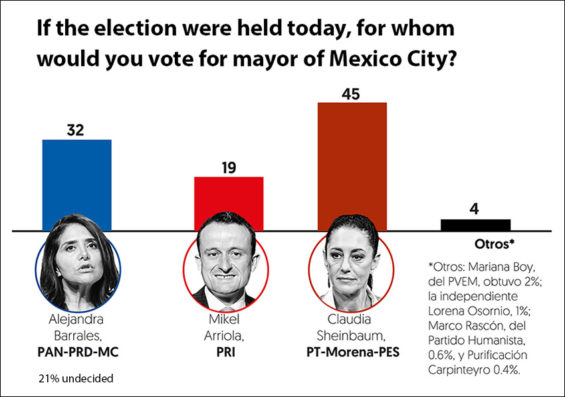
In the capital, Sheinbaum — who previously served as the head of government in the southern Mexico City borough of Tlalpan — has a 13-point lead over her nearest rival in the mayoral race, according to a poll conducted by the newspaper El Financiero.

The Morena candidate has 45% support while Alejandra Barrales of the right-left coalition For Mexico in Front is in second place with 32%. The candidate for the Institutional Revolutionary Party (PRI), Mikel Arriola, is in third place with 19%.

The four other candidates share the remaining 4% of voter preferences, according to the poll conducted between June 14 and 18 with 800 eligible voters.

The survey shows a tightening of the race compared to the last El Financiero poll, which showed Sheinbaum with a 20-point advantage over Barrales.

Morena is also on track to become the largest party in the city’s Congress, with 42% of those polled saying that they would vote for the party followed by 19% who said they intended to vote for the PAN and 15% who indicated a preference for the PRI.

The Democratic Revolutionary Party (PRD), which has governed the capital uninterruptedly since 1997, will be left as the fourth political force in the capital.

Sheinbaum leads in Mexico City poll.
Sheinbaum leads in Mexico City poll. el financiero

López Obrador represented the party as Mexico City mayor between 2000 and 2005 and contended the presidency in the 2006 and 2012 elections under the party banner, but later quit to head up Morena.

In addition to voting for a new president and mayor of Mexico City, voters will also renew the federal Congress and residents of eight states will elect a new governor.

Thousands of other state and municipal level positions are also up for grabs, including the head of government positions in the capital’s 16 boroughs.

A total of 100 candidates are vying to become the next mayor in those boroughs but of that number just seven hopefuls have provided declarations of their assets, business interests and tax records in accordance with the transparency initiative known as the 3de3.

Political violence has marred the electoral process, which officially began last September, but the president of the National Electoral Institute (INE), Lorenzo Córdova Vianello, has assured the Mexican public that the July 1 elections are not at risk. 

Source: El Financiero (sp), Bloomberg (en), Milenio (sp)

In this Veracruz municipality police don’t carry guns, only slingshots

0
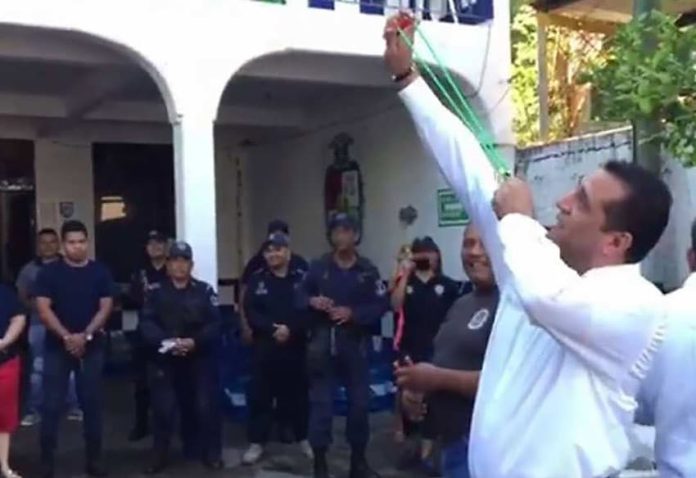
The mayor demonstrates the use of a slingshot in front of disarmed police.

Municipal police in Alvarado, Veracruz, whose weapons were taken from them by order of the state government, have been rearmed — with slingshots.

State police relieved their municipal counterparts of their guns and their duties on Friday on the grounds that they were not properly accredited police officers. Thirty officers, including the chief, were affected.

The state government also intervened in a similar manner in the municipalities of Ixtaczoquitlán, Ciudad Mendoza and Pueblo Viejo.

Claiming that the move was political, Alvarado Mayor Bogar Ruiz Rosas responded by handing out slingshots and stones to the unarmed police officers and advising them that their most powerful weapon was their vote.

Ruiz found it “strange” that the municipality’s autonomy was violated just one week before the elections.

“It’s clear to us that this is a totally political issue and we have to be prepared to carry out our work, professionally, as you have seen us do it,” he wrote on Facebook.

Governor Miguel Ángel Yunes Linares responded by stating that Alvarado’s municipal police are no longer permitted to participate in law enforcement operations, and that if they do they would be violating regulations and would be tried for it.

Yunes is affiliated with the National Action Party, while Mayor Ruiz was elected under a coalition between the governing Institutional Revolutionary Party and its long-time ally, the Ecological Green Party.

Source: El Universal (sp), e-veracruz (sp)

28 cops detained in assassination of Michoacán candidate

0
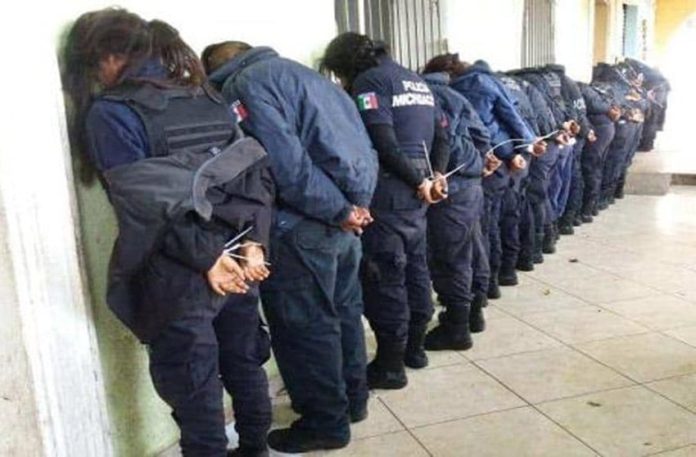
Ocampo's police force after their arrest yesterday.

The entire municipal police department of Ocampo, Michoacán, was taken into custody yesterday in connection with the investigation of last week’s assassination of a candidate for mayor.

State police arrested the 27 police officers and the chief under suspicion of ties with organized crime and the assassination on Thursday of Fernando Ángeles Juárez, who was running for mayor as the candidate of the Democratic Revolution Party (PRD).

An attempt to arrest the police officers was thwarted on Saturday when Ocampo Police Chief Óscar González García and other officers allegedly repelled the state police with gunfire.

The latter have now taken over policing in Ocampo.

On Saturday, a man was arrested in the investigation into the assassination of Alejandro Chávez Zavala on June 14.

Chávez was running for reelection as mayor of Taretan under a National Action Party-Democratic Revolution Party-Citizens’ Movement coalition.

State Attorney General José Martín Godoy said that ballistic tests linked the suspect with the attack on Chávez and his wife.

Godoy said that a dispute in the organization of a local fair may have led to the killing. He added that the slain politician had been the victim of extortion on two occasions, but there was no evidence that he reported the crimes.

Source: El Universal (sp), BBC (en), Milenio (sp)

In Tamaulipas, gunfire near governor’s house and a march for peace

0
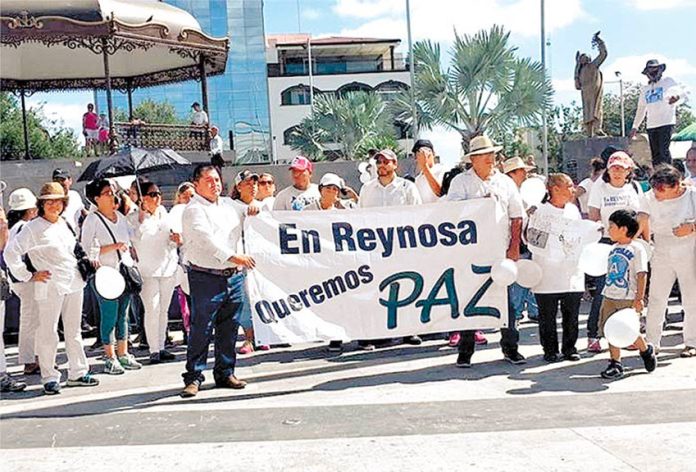
A peace march yesterday in violence-torn Reynosa.

Continuing violence in Tamaulipas saw gunfire near the governor’s house in Ciudad Victoria and a march for peace in Reynosa.

A few minutes before 5:00am yesterday, a state police patrol car was attacked in the vicinity of the official residence of Governor Francisco García Cabeza de Vaca, a home known as Casa Tamaulipas.

One of the police officers inside the vehicle was injured, the Public Security Secretariat (SSP) said.

An abandoned SUV that was found later had firearms and ammunition inside.

The SSP said preliminary investigations have shown that the shots fired at the police vehicle came from the SUV.

Local news outlets also reported that a threatening message was found near the official residence and addressed to the governor.

Later yesterday, about 100 people took to the streets of Reynosa to march for peace and protest the ongoing armed confrontations in the border town, one of which cost the life of a 14-year-old.

Jesús Hernández was killed by a stray bullet earlier this month, fired in the vicinity of the secondary school from which he was about to graduate.

The student’s parents led the march, which followed a route to the city’s main square and finished with a rally.

The protesters were dressed in white and carried signs reading, “We don’t want to be prisoners in our own homes, we want freedom,” and “Reynosa is mourning.”

Hernández’s father demanded that medical staff be assigned to every school in the city. He argued that his son received no medical attention and that there was no one at the school who could help him, leading to his death.

Source: Milenio (sp), Sin Embargo (sp)

Competitive fuel market is still some years off, analysts say

0
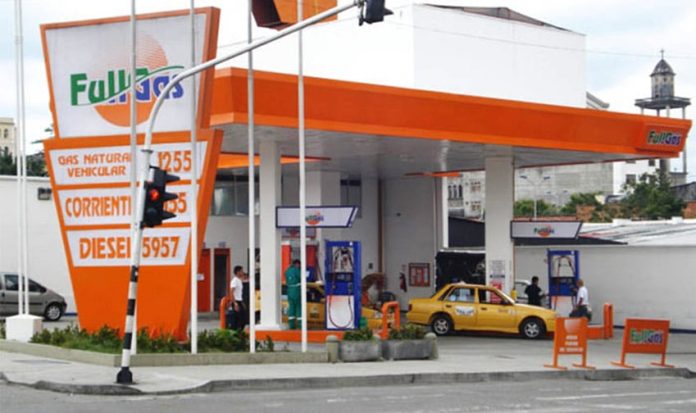
FullGas is one of Mexico's new gas station brands.

It will take another two to five years to attain a truly competitive fuel market with lower gasoline prices for motorists, according to industry specialists.

The federal government’s 2013 energy reform opened up Mexico’s retail fuel market to foreign and private companies and there are now more than 2,000 gas stations that operate under a brand other than the state-owned Pemex.

But the increased competition hasn’t translated into cheaper fuel prices as had been expected.

“It was thought that it would be faster but that’s not the case,” said Rodrigo Favela, a consultant and fuel market analyst.

Favela told the newspaper Milenio that based on experiences in other countries, creating a competitive market takes time.

In addition, greater competition in the retail fuel market is not enough on its own to generate lower fuel prices, according to Mexico’s central bank.

In its regional economies report for the last quarter of 2017, the Bank of México said greater investment is needed in the entire gasoline supply chain from the refinery to the gas station in order for prices to drop.

Sebastián Figueroa, CEO of energy operator FullGas, told Milenio that gas stations in the north of the country could start competing on price within one to two years.

He cited proximity to the United States, the presence of existing pipelines, greater ease with which fuel can be imported and lower logistics costs as factors that will likely see fuel prices drop more quickly there than in other parts of the country.

In central states, Figueroa predicted that it would be another three to four years before competitiveness among gas stations increases due to the need for more infrastructure while in the southeast of Mexico, it could take up to five years or more.

In the latter region, the development of the new infrastructure that is needed — such as pipelines —is more complicated because of geological factors, he said.

Considering that fuel prices have actually risen since Mexico’s previously monopolized fuel market opened up, Milenio asked the president of the Senate’s energy committee whether energy reform should be considered a failure.

Salvador Vega Casillas, of the opposition National Action Party (PAN), rejected that suggestion but said it was a mistake to liberalize fuel prices at a time when the value of the US dollar was high against the peso. Gasoline prices were fully deregulated by November 30 last year.

However, Figueroa said that if the government had waited any longer to free prices, more problems could have been created for the sector because a subsidized model is not sustainable.

He maintained that the reform is a positive for Mexico, charging that having only one participant in the downstream sector led to inefficiency whereas competition forces gas stations to offer better deals to motorists.

Federal Energy Secretary Pedro Joaquín Coldwell has also contended that an open and competitive market is the best way to achieve gasoline prices that are accessible to all Mexicans.

Favela explained that there are three main factors that determine the price of petroleum at the pump: international crude oil prices, the prevailing exchange rate and logistics costs.

In order to generate a more competitive market, he argued, all petroleum companies should have non-discriminatory access to the nation’s oil terminals and ports.

Despite opening up the domestic fuel market to new players, the majority of Mexico’s petroleum infrastructure is still controlled by the state oil company Pemex.

The average price of regular — or Magna — gasoline has risen 17% this year, according to the consultancy PETROIntelligence, from 16.24 pesos per liter at the beginning of January to 19 pesos. Prices were as high as 19.11 pesos on Friday in Guadalajara.

Source: Milenio (sp)

Semi completely destroyed after train wins another race

0
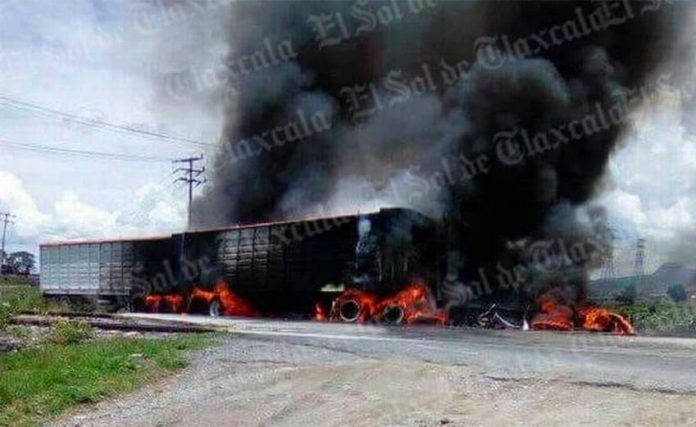
Truck burns after Saturday's collision with a train.

A semi-tractor and its two trailers were completely destroyed in Tlaxcala Saturday after the driver attempted to race a train to a level crossing.

The locomotive struck the cab of the truck, destroying it and catapulting the 23-year-old driver 20 meters away, Civil Protection officials said. He was transferred to hospital with various injuries and burns.

The truck burst into flame on impact with the train and was destroyed by fire, along with the trailers and their load of barley.

The accident occurred Saturday afternoon in Huamantla on the Huamantla-El Carmen Xalpatlahuaya highway.

Racing trains to a crossing is not uncommon and causes a few hundred accidents every year. Jalisco led the way in 2017 with 85 and 95% were estimated to have been caused by drivers racing to beat a train to a level crossing.

Source: Reforma (sp)

Watch out for the waves, lifeguards warn; swell causes fatality in Manzanillo

0
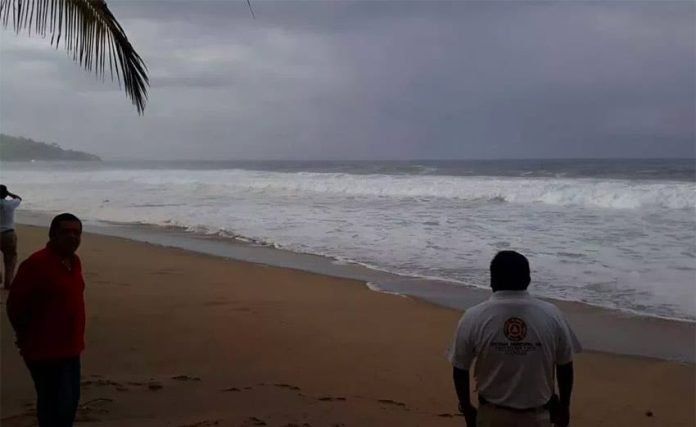
A lifeguard patrols a beach in Acapulco.

Authorities in Guerrero issued a warning yesterday that the danger continued from Pacific Ocean swells, large waves that have taken one life since a warning was first issued last Wednesday.

A tourist in Manzanillo, Colima, was swept off the beach and dragged out to sea by a strong current on Friday.

The 35-year-old man was in front of a hotel on the beach known as Playa de Oro.

“Unfortunately, there are people who go in the water not knowing the area,” said Mayor Juan Enrique García Pérez.

An officer with the tourist police said people become confident about entering the water when conditions appear calm, but the rip currents are common and dangerous.

Another officer said there have been several rescues. He observed that the summer season brings bigger waves that, when combined with the mar de fondo, become yet more dangerous.

The mayor said some beaches are very dangerous, and more so in the rainy season.

In Acapulco yesterday, a lifeguard warned that anyone who cannot swim should not approach the water. The waves are “very strong. Some are more than three meters high,” said Juan Carlos Ramos.

The warning of a swell, or mar de fondo, was issued for six states, from Chiapas to Jalisco.

Source: Televisa (sp)

Thousands of non-emergency 911 calls per day in Jalisco

0
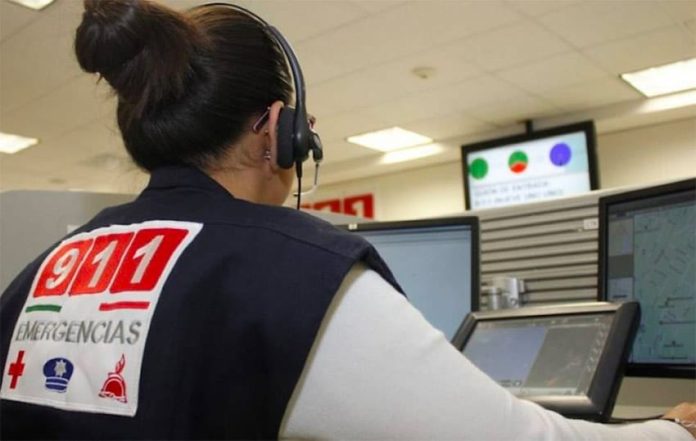
An emergency call center operator.

Non-emergency 911 calls are a big problem in Jalisco: every day about 20,000 calls are made to the state’s emergency telephone number, which since January 2017 has been 911.

But according to the director of the state’s emergency call center, the vast majority of those calls — about 18,000, or 90%  — are prank calls that don’t relate to real emergencies or were made in error.

“We have . . . a serious problem with inappropriate calls, children who are pretending to be obscene adults, people who dial the number by mistake and unfortunately we get about 18,000 [of those calls] per day,” Salvador Medina said.

In order to reduce the number of phony calls, Ceinco — as the state’s communications center is known — has developed an algorithm known as a “virtual expert agent” which detects numbers that have previously been used to make prank calls.

Instead of being transferred to a human telephone operator, callers from those numbers hear a recorded message that requests they not abuse the emergency number.

Under state law, improper use of an emergency number can result in a fine of up to 1,760 pesos (US $87). But due to the high number of prank calls, in the majority of cases the law is not enforced, Medina said.

He explained that the average length of an emergency call is one minute and 33 seconds, a period in which the operator determines which emergency service should be notified.

Once a person reporting a genuine emergency in the metropolitan area of Guadalajara hangs up, an average of 16 minutes elapses before assistance arrives at the requested address, Medina said.

However, he added that it is not uncommon for the emergency response to be delayed because of a shortage of ambulances and other emergency vehicles.

“We receive the calls and transfer them to the municipalities [but] on many occasions we find there is a lack of ambulances, a lack of police cars and that’s something that afflicts the service,” Medina said.

Jalisco’s problem with prank and improper calls is not unique to the state but rather representative of a wider problem in Mexico.

The federal Interior Secretary (Segob) commented on the problem in its first quarterly report of 2018 in which it emphasized that 911 is purely an emergency number and should not be used for any other purpose.

Among other reasons people called the number in the first three months of this year were to report blackouts and cuts to water service, Segob said.

Between January 1 and March 31, there were almost 22.8 million 911 calls made across the country but only 3.67 million calls, or 16%, related to real emergencies.

The most common single reason people called the number across Mexico in the first quarter of 2018 was to report the presence of a suspicious person.

The next most common reason was to alert authorities to the presence of an aggressive person and thirdly, to report car accidents in which nobody was injured.

Source: Milenio (sp)

Tonnes of sargassum removed from Quintana Roo beaches

0
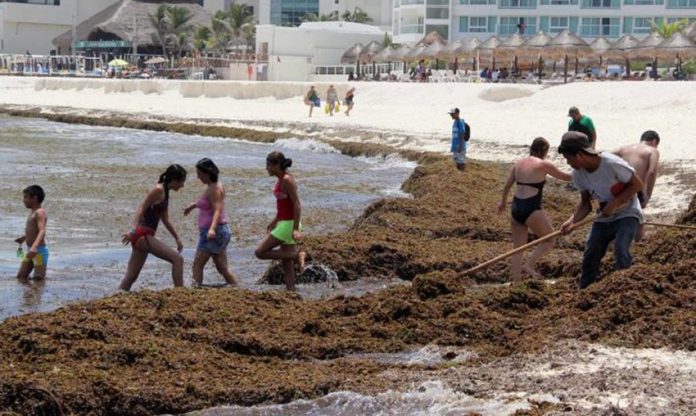
Sargassum clean-up in Quintana Roo.

Tonnes of sargassum left by Subtropical Storm Alberto between May 21 and 28 are being removed from beaches in seven municipalities of Quintana Roo, part of a coastal clean-up of organic and inorganic residues.

Complying with sargassum removal regulations, personnel from the state Secretariat of Ecology and Environment (Sema) started the efforts at the kilometer nine mark of the hotel zone of Cancún; the lighthouse zone in Mahahual in the municipality of Othón P. Blanco; and in Punta Piedra and Medial Luna Bay, in Tulum.

The work, carried out by hand and with the help of machinery, included the residential areas of Playacar Fase II and Punta Bete in Playa del Carmen in the municipality of Solidaridad; at Chen Río Beach, Cozumel; the Muelle de Pescadores of Puerto Morelos; and the North Beach of Isla Mujeres.

The federal government is paying for the removal project with 62 million pesos (US $3.08 million) from the federal disaster fund, Fonden. As of yesterday, the efforts had recovered more than 100 tonnes of both organic and inorganic material, said Sema chief Alfredo Arellano Guillermo.

According to a diagnostic report by Sema, the affected surface in Cozumel was 6,750 meters long, affecting 12 beach zones.

In Solidaridad, 10,600 meters of beach were affected by sargassum, 3,300 meters in Punta Bete and 7,300 in Playacar.

In Tulum, the impacted area was 6,750 meters long, encompassing Media Luna Bay and the Pescadores, Mezzanine and Tulum National Park beaches, and from the 8.2 to the 9.5-kilometer mark at Punta Piedra.

The storm also affected beaches to the south, leaving sargassum on 5,000 meters of coastline at Mahahual, Xcalak and Uvero.

Sema explained that the seaweed comes from the Sargasso Sea and is a phenomenon that affects the entire Caribbean Sea.” It also said a massive amount of sargassum is expected this year, more than was seen three years ago, which was also a bad year.

The sargassum’s presence on Quintana Roo beaches is not good for a state that relies heavily on tourism. One hotel operator said there have been some reservations cancelled, but the number is not high.

Source: El Universal (sp), Notimex (sp)