Home Blog Page 342

Analysis: ‘America First’ is not ‘America Alone’

9
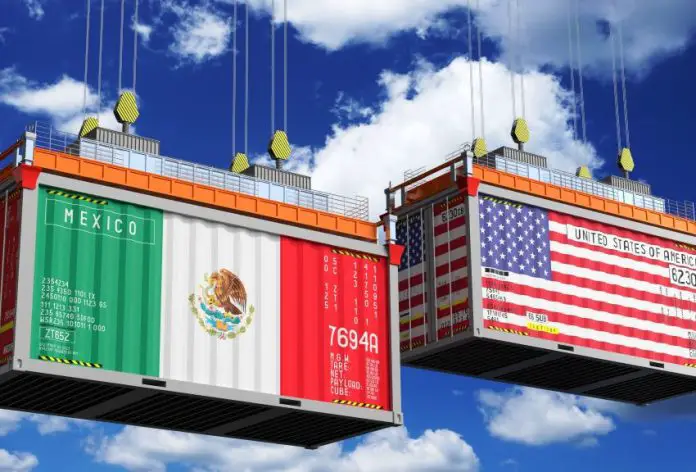
Illustration of two shipping containers hanging by cables in the air. The front of the container on stage left is painted with he flag of Mexico. The container on stage right is painted with the flag of the United States.
Despite new tariffs, Mexico's trade surplus with the U.S. increased between April 2024 and April 2025. (Shutterstock)

When evaluating international trade volumes and understanding the complexity of the production network, it becomes evident that further integration and increasing intraregional trade[1] are crucial to ensuring global competitiveness and increased capacity to address geopolitical challenges.

The United States and its USMCA partners’ total trade of goods and services exceeds $1.8 trillion, with a growth of over 50% between 2021 and 2023 (USTR, 2024). Today, the region goes beyond simple trade transactions to a co-production system. This results in a shared value model, contrasting with trade relationships involving economies like China or Vietnam, where integration is lower.
U.S. production chain Mexico
(Pedro Casas Alatriste & Arturo Martínez)

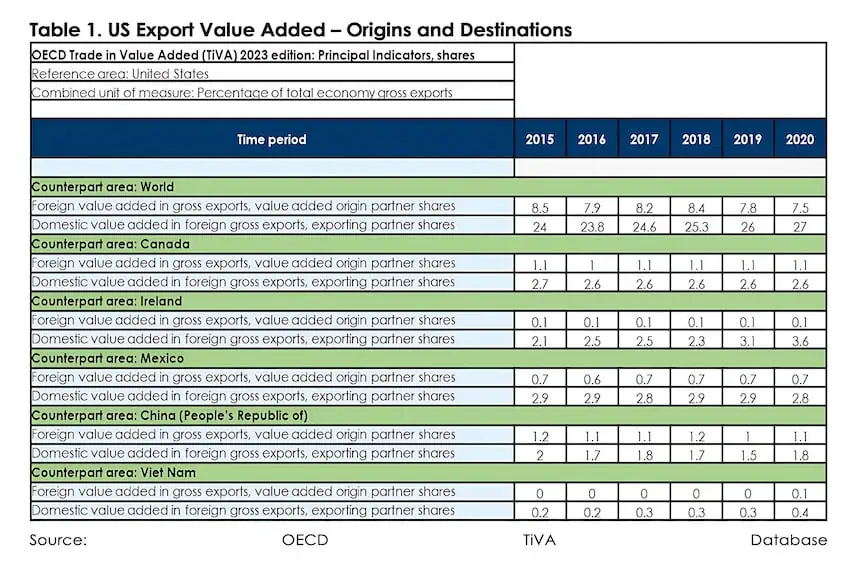
The most updated data set by the OECD (2023) presents information up to 2020. While many things have changed recently, this data allows us to analyze long-time trade relationships and trends. The first table shows the share of foreign and domestic value added[2] in U.S. gross exports, expressed as a percentage of total exports. 

Higher domestic value added simply means that there is a process of production and value generation in the U.S. over imports from a particular country. Canada and Mexico contribute an additional 2.6% and 2.8% of domestic value added to U.S. exports, respectively, while economies such as China (1.8%) and Vietnam (0.4%) show notably lower percentages.

This reinforces the notion that Mexico and Canada not only export finished goods but also serve as key players in the U.S. production chains, providing essential inputs that go over a robust value-add process in the U.S. to be later exported to other markets, yielding higher returns to the United States.  
U.S. production chain Mexico
(Pedro Casas Alatriste & Arturo Martínez)

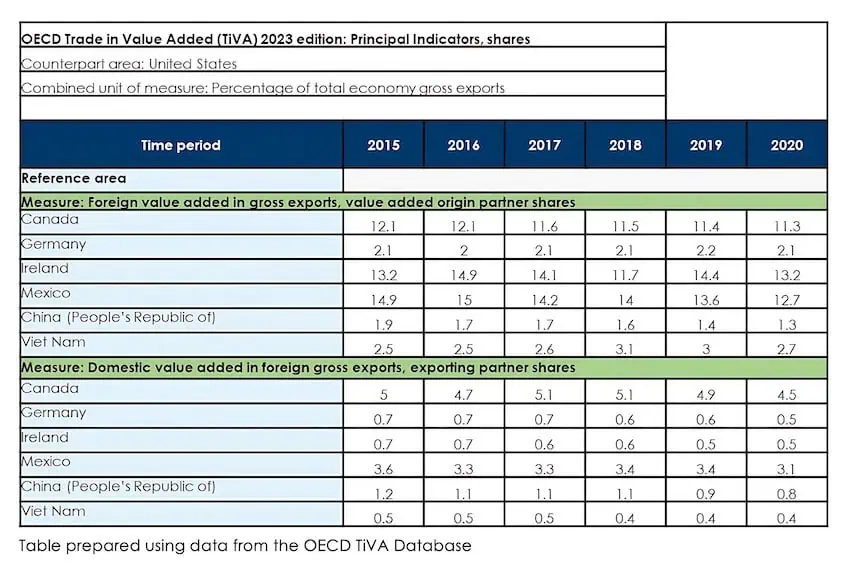
On the flip side, the second table shows the share of U.S. value added in exports from various countries and the level of domestic value-added built over products imported from the U.S. The result is crystal clear: The trade relationship between the U.S., Mexico and Canada is not limited to the exchange of finished goods but operates under a shared manufacturing model in which inputs cross borders multiple times before becoming final products — a defining characteristic of the USMCA.

Mexico and Canada’s exports have 11.3% and 12.7% of value-added originated in the U.S., respectively. In comparison, other countries such as China (2.7%) have a much smaller contribution. Additionally, when measuring each country’s domestic value added to U.S. imports, Canada added 4.5% and Mexico 3.1%, while Germany (0.5%), China (0.8%), and Vietnam (0.4%), show substantially lower levels.  

Mexico has built, over time, a productive integration with strategic industries such as automotive, electronics and manufacturing, which rely on a steady flow of intermediate goods. In contrast, countries like China and Vietnam have a more independent trade structure that is less tied to U.S. production, suggesting that their trade relationships rely more on finished goods than shared production processes. This should be fundamental when drafting future trade policy and its direct implications for the U.S. productive system. Not every trade relationship is the same. 
(Pedro Casas Alatriste & Arturo Martínez)

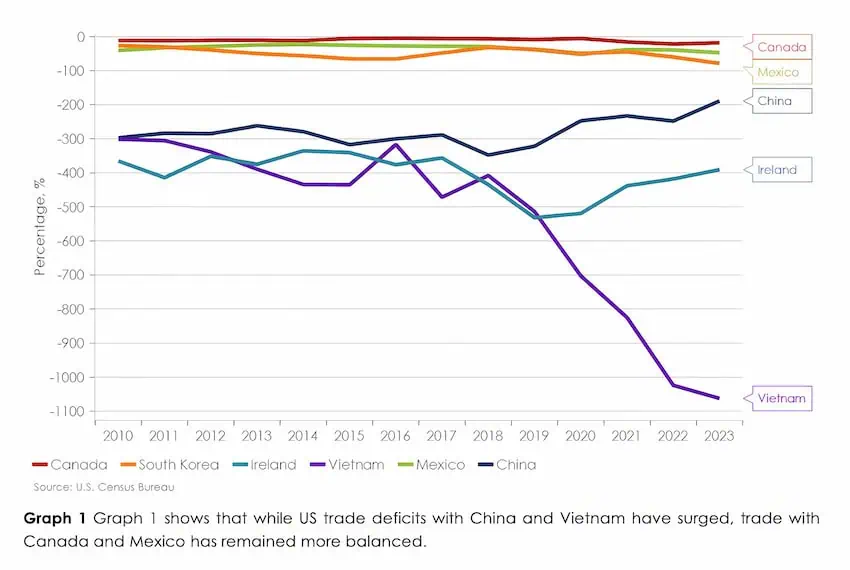
It is possible to evaluate the U.S. opportunity cost of its trade relations based on their exports and trade balances. In 2023, the U.S. recorded trade deficits with Canada and Mexico of -$64,262.70 million and -$152,473.5 million, respectively. However, when analyzing these deficits in relation to U.S. exports to these countries, they represent -17.10% for Canada and -50.80% for Mexico.

In contrast, trade with countries like China (-206.40%), Ireland (-526.10%) and Vietnam (-966.90%) shows disproportionate deficits compared to the U.S. exports sent to them. These figures highlight a heavy reliance on imports, creating a structural challenge for the US economy.

We’ve discussed the relevance of strong interconnectedness through multi-exchanges amongst our economies. SMEs are key players in producing intermediate goods and specialized products that enhance the competitiveness of shared value chains in North America. Also, it is essential to consider the following: “Across OECD countries, SMEs represent around 99% of all firms, are a main source of employment and generate 50% to 60% of value added on average. Moreover, SMEs are vital for nurturing local communities and driving economies’ and societies’ major transitions” (OECD, 2024).

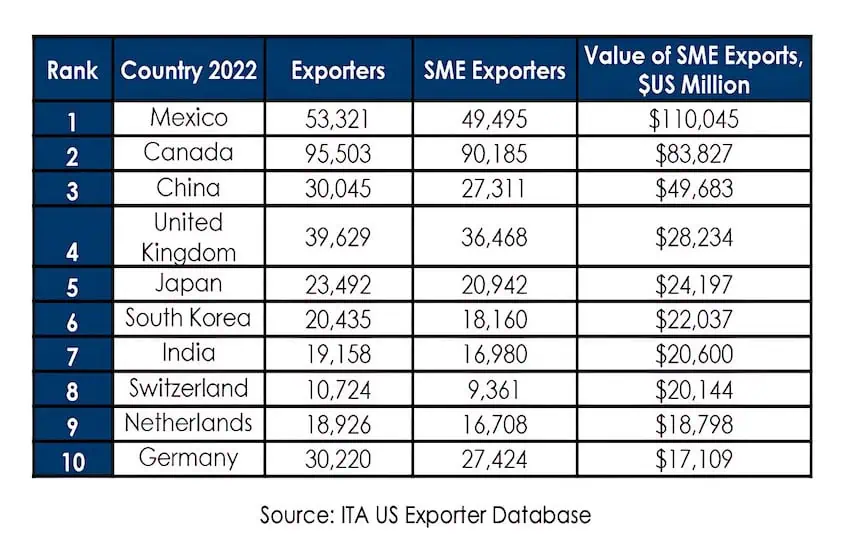
Unlike large corporations that dominate total export volume, SMEs make up 97% of all U.S. exporters and are critical players in supply chains. Many of these businesses thrive within the USMCA framework, where Mexico and Canada have become their top export destinations (ITA, 2022).
(ITA US Exporter Database)

In 2022, more than 90,000 U.S. SMEs exported $83 billion to Canada, while nearly 50,000 SMEs sent $110 billion to Mexico. These figures represent significant growth compared to previous years, reflecting the strong demand for U.S. products in both markets and the importance of regional productive integration while closing the argument that the “backbone” of the U.S. productive system is cemented on its regional integration (USTR, 2024).

While protectionist policies may yield immediate benefits for specific sectors, maintaining an open and fair trade and collaboration with its regional allies is key to long-term success. Co-production within North America is key to stable economic growth and rebuilding the U.S. industrial base. To thrive in a golden age, we must remain united as a block. 

This article was originally published by The Mexico Institute at the Wilson Center.

Pedro Casas Alatriste is currently the Executive Vice President and CEO of the American Chamber of Commerce of Mexico (AmCham). Previously, he served as the Director of Research and Public Policy at the US-Mexico Foundation in Washington, D.C., where he promoted issues such as Ally-Shoring, immigration in Mexico, integration of the binational workforce and regional competitiveness, among others. Before this role, he was the Coordinator of International Affairs at the Business Coordinating Council (CCE).

Arturo Martínez is the Technical Secretary of the Economics Committee of the American Chamber of Commerce of Mexico (AmCham).

Disclaimer: The views expressed in this article are solely those of the author and do not necessarily reflect the views of Mexico News Daily, its owner or its employees.


[1] International trade is increasingly concentrated around three major regions: Europe, East Asia, and North America. Together, they account for 85% of global trade. Yet, Europe and East Asia are much more regionally integrated when it comes to trade, than is North America. For example, 70% of European exports stay within Europe, and over 50% of East Asian exports remain within the region. North America, by contrast, only retains just over 30% of its exports within the region (The World Bank Global Indicators, 2023). This is largely due to our heavy reliance on East Asian imports, particularly from China.

[2] Value added reflects the value generated by producing goods and services, and is measured as the value of output minus the value of intermediate consumption. Value added also represents the income available for the contributions of labour and capital to the production process (OECD, 2024).
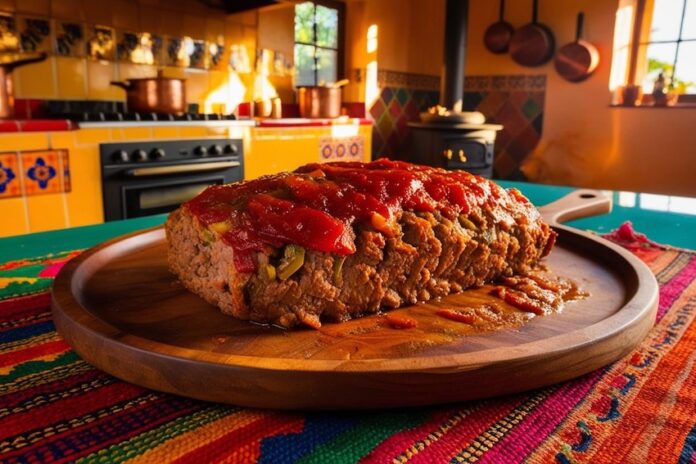
Who needs to warm themselves by the fire when you have this Mexican meatloaf?

6
Mexican meatloaf
All the tradition of the Midwest with all the zest of Mexico. (Canva)

The first recorded recipe for meatloaf appears in “Apicius,” a Roman cookbook dating back to the 4th or 5th century A.D. The Romans, ever the innovators in weird food and conquest, mixed minced meat with bread, wine-soaked grains and seasonings, then shaped it into a loaf-like dish. It wasn’t quite the knees-deep-in-ketchup classic of today, but it was the foundation.

Fast forward to medieval Europe, where meatloaf-like dishes became a way to stretch precious meat supplies. In the 19th century, German and Scandinavian immigrants brought their own versions to the United States, adding spices and binding ingredients like eggs. By the Great Depression, meatloaf became a staple of survival, bulked up with breadcrumbs, potatoes or whatever was on hand.

Several traditional salsas with their ingredients.
Trade potato and grains for salsa, chili and a dash of Mexican pizzaz. (Deposit Photos)

What’s next in the world of meatloaf? You guessed it: the Mexican version. We’re talking jalapeños, crushed tortilla chips and hot sauce, topped with a nice salsa glaze that should be equally sweet and spicy.

The beauty of Mexican meatloaf is that it respects the past while boldly ignoring its limitations. It understands the essence of meatloaf but refuses to settle for blandness. It demands color, spice and joy. It takes the classic American dish and reminds it to dance.

And honestly, isn’t that how food should evolve? The best recipes are like stories — tweaked, adapted, passed down with new flavors and new memories. It’s for the people who want their comfort food to have a little edge, a little kick, a little bit of that “whoa, I didn’t see that coming.”

So here’s to the unknown Roman genius who first decided to mash meat and bread together, and here’s to the spirit of reinvention. You lived through another day, you made something delicious out of whatever you had and now it’s got jalapeños in it. That, my friend, is progress.

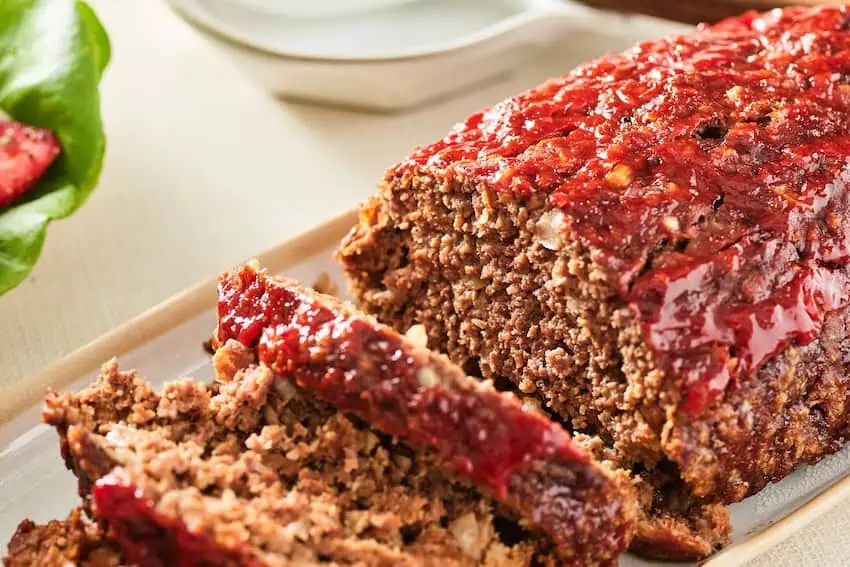
Beef meatloaf
The United States wouldn’t be the United States without meatloaf, but seeing as we’re in Mexico, why don’t we make some adaptations? (Beef – It’s What’s For Dinner)

Mexican meatloaf

Ingredients

For the meatloaf
  • 2 lbs ground beef (or a mix of beef and chorizo)
  • 1 cup crushed tortilla chips
  • 1 small onion, finely chopped
  • 2 cloves garlic, minced
  • 1 jalapeño, finely diced ( remove seeds for less heat)
  • 1 tsp cumin
  • 1 tsp smoked paprika
  • 2 tbsp hot sauce
  • ½ tsp oregano
  • 1 tsp salt
  • 1 tsp black pepper
  • 2 tbsp chopped fresh cilantro
  • 1 cup shredded cheddar or pepper jack cheese
  • 1 egg
  • ½ cup milk or heavy cream
  • 1 tbsp Worcestershire sauce
For the salsa glaze
  • ½ cup salsa (red or green, your choice)
  • 2 tbsp tomato paste
  • 1 tbsp honey or brown sugar
  • 1 tsp lime juice

Instructions

  1. Set your oven to 375  F (190 C). Grease a loaf pan or line it with parchment paper.
  2. In a large bowl, combine the ground beef (and chorizo, if using) with crushed tortilla chips, onion, garlic, jalapeño, spices, cilantro and shredded cheese.
  3. In a separate bowl, whisk together the egg, milk, hot sauce and Worcestershire sauce, then mix it into the meat mixture until well combined.
  4. Transfer the mixture into the prepared loaf pan, shaping it into a firm loaf.
  5. In a small bowl, mix salsa, tomato paste, honey and lime juice. Spread half of this mixture over the meatloaf.
  6. Place in the oven and bake for 45 minutes. After 30 minutes, brush the remaining glaze over the top and continue baking.
  7. Let the meatloaf rest for 5-10 minutes before slicing. Serve with rice, tortillas or a fresh avocado salad.

Stephen Randall has lived in Mexico since 2018 by way of Kentucky, and before that, Germany. He’s an enthusiastic amateur chef who takes inspiration from many different cuisines, with favorites including Mexican and Mediterranean.

Mexican troops head to US border: Tuesday’s mañanera recapped

4
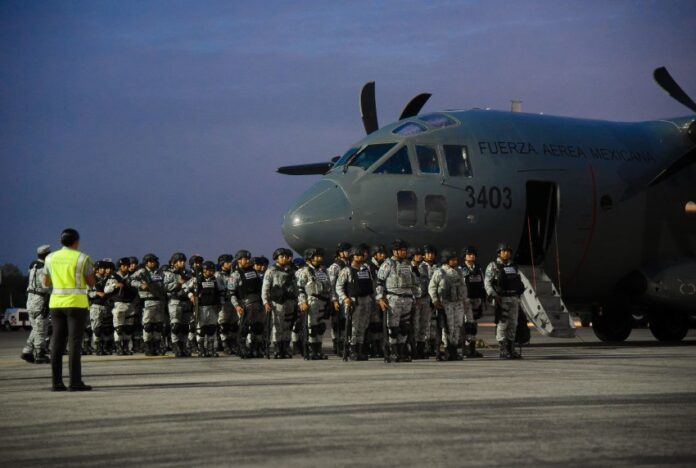
National Guardsmen in gray uniforms at dawn, standing in formation next to a Mexican Airforce carrier jet, waiting to board.
President Sheinbaum is sending 10,000 of Mexico's National Guard troops to patrol the Mexico-U.S. border as part of an agreement to delay U.S. tariffs on Mexico. (Galo Cañas Rodríguez/Cuartoscuro)

On Monday, President Claudia Sheinbaum committed to sending 10,000 National Guard (GN) troops to Mexico’s northern border as part of an agreement she reached with United States President Donald Trump that resulted in a one-month “pause” on the 25% tariff the U.S. government planned to impose on Mexican exports starting Tuesday.

At her morning press conference on Tuesday, Sheinbaum said that the deployment of the troops has begun.

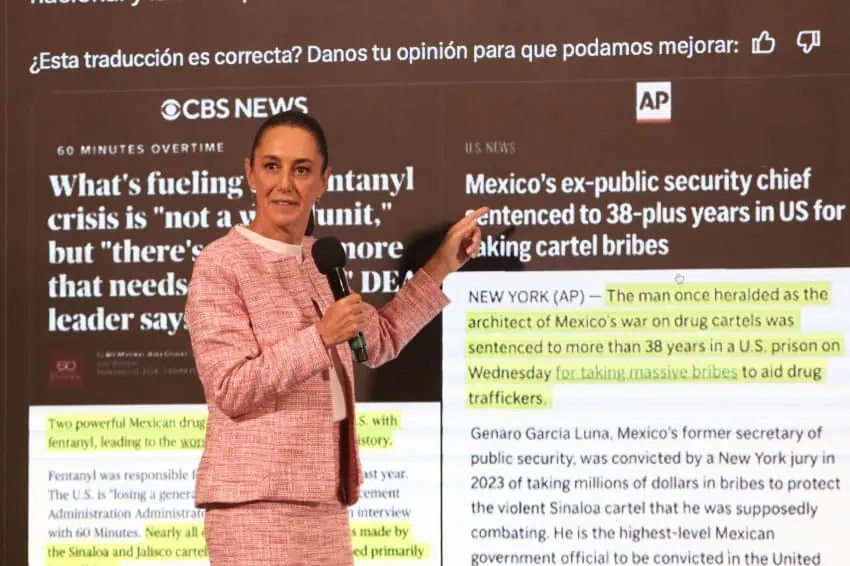
Mexico's President Claudia Sheinbaum standing in front of a projection screen with reprints of articles from CBS News and the Associated Press about Mexico's drug cartels and the fentanyl crisis.
President Claudia Sheinbaum showed parts of a presentation she said she shared with Donald Trump to convince him to delay tariffs. One of the conditions of that delay is that Mexico send 10,000 troops to patrol the Mexico-U.S. border. She is sending National Guardsmen. (Gustavo Alberto/Cuartoscuro)

She also spoke about a U.S. “spy plane” that flew in the vicinity of the Baja California Peninsula on Monday, and Ecuador’s decision to slap tariffs on Mexican exports.

Deployment of GN troops to northern border ‘doesn’t leave the rest of the country without security’

Sheinbaum told reporters that additional GN troops had started moving to the northern border region in keeping with her commitment to Trump.

She said that National Guard personnel deployed to parts of the country without major security problems, such as Campeche, were being sent to the border.

“Others who were in the southern part of the [northern] border states are going to the northern border,” she added.

Sheinbaum asserted that the deployment of additional troops to the northern border “doesn’t leave the rest of the country without security” because the GN has 120,000 members in total.

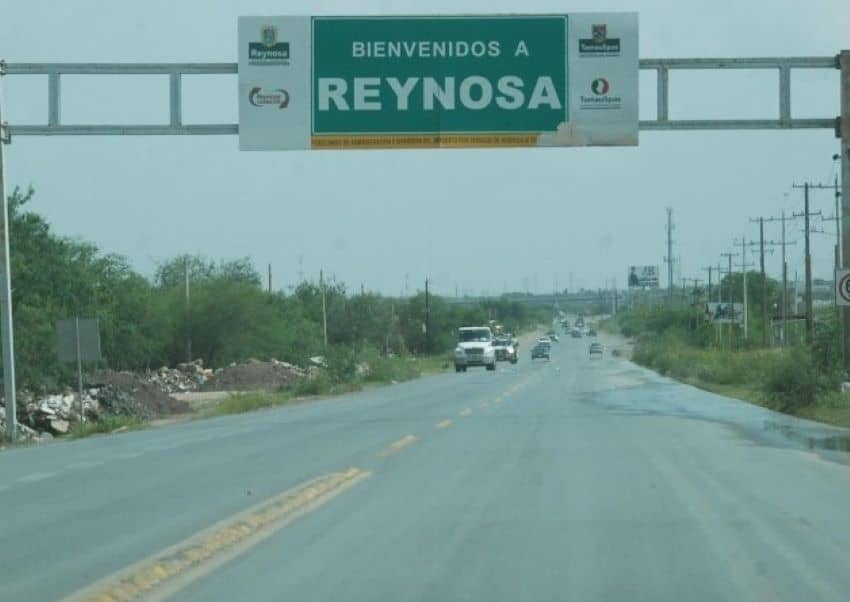
Image of a sparsely populated highway with a tractor trailer and other cars in the distance. In the foreground is a government highway sign proclaiming "Welcome to Reynosa" in Spanish.
The stretch of border highway between Reynosa and Nuevo Laredo known as La Ribereña. For more than a decade, it’s been plagued with kidnappings, smuggling and hijackings by organized crime groups. Guardsmen will now be patrolling there.

“We’re not leaving the states of the republic exposed, far from it,” she said.

“… [It’s just] a reorientation of forces,” Sheinabum said.

She said that the deployment of additional troops to the northern border will not just help the United States, but Mexico as well.

“The forces going there don’t just have the objective of patrolling customs so that fentanyl doesn’t get through, but will also help us strengthen security on the Ribereña highway, for example,” Sheinbaum said, referring to a highway in northern Tamaulipas.

“Yesterday, for example, [seven] bodies were found in San Luis Río Colorado, which is on the border in Sonora. We want to strengthen security there,” she added.

“[The deployment of troops] helps us as well, it helps to avoid fentanyl trafficking in the agreement we achieved with the United States, but it also helps security on the border,” Sheinbaum said.

“… It’s an agreement that is also beneficial for Mexico,” she said.

US spy plane flight near Mexico ‘not something strange’

The Defense Ministry reported on Monday that its Mazatlán Area Control Center had informed the National Center for the Surveillance and Protection of Airspace that it detected on Monday afternoon “a flight 83 km to the southwest of Cabo San Lucas, Baja California Sur, outside Mexican airspace over international waters.”

Mexican media reported that the aircraft was a United States Air Force “spy plane.”

The Defense Ministry’s post on Twitter reporting the U.S. “spy” plane.

El Universal newspaper said that the “highly specialized reconnaissance airplane has the capability to collect, analyze, and geolocate electromagnetic signals, in addition to providing critical intelligence for target selection and threat prevention.”

Sheinbaum stressed that the plane had not entered Mexican airspace, flying only in “international airspace.”

“It’s not something strange that there is a plane that flies in international airspace,” she said.

Asked whether the flight was related in any way to the agreement she reached with Trump on Monday, Sheinbaum was unequivocal.

“No, no, no. Nothing to do with it,” she said.

‘Shrimp from Sinaloa are more delicious than those from Ecuador’ 

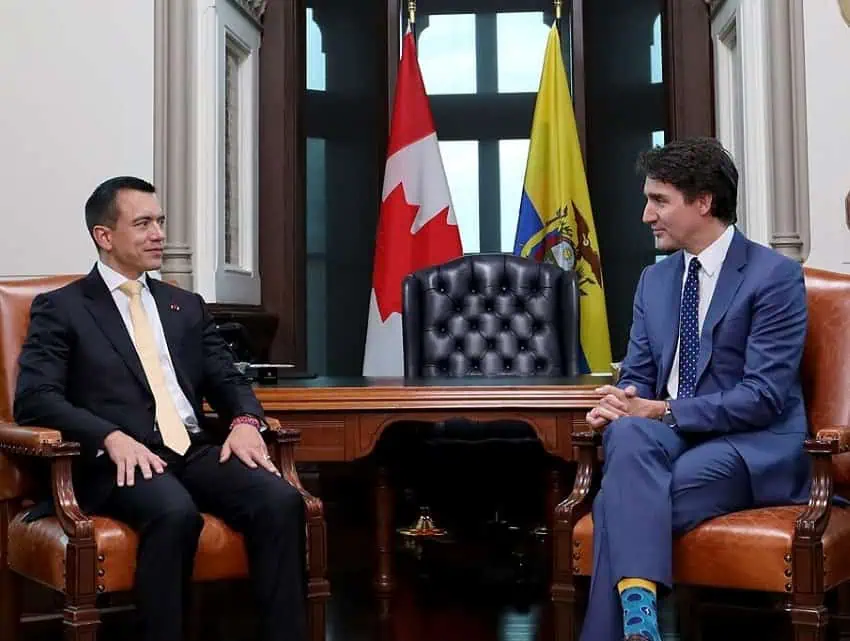
Ecuador's President Daniel Noboa seated across and to the side of Canada's Prime Minister Justin Trudeau. Each are in an antique style chair in front of a desk and chair, with the full-sized flags of Canada and Ecuador standing behind the chair. The two men are looking at each other. Trudeau haas his hands folded together in his lap while Noboa's hands are open, with one on each thigh, palms down. Both are smiling.
Ecuador’s President Daniel Noboa, left, with Canada’s Prime Minister Justin Trudeau in March 2024. (Govt. of Ecuador)

A reporter noted that the president of Ecuador, Daniel Noboa, announced tariffs of 27% on Mexican exports to the South American country.

Sheinbaum shrugged off the new duties, saying that she believed that shipments to Ecuador accounted for just 0.4% of Mexico’s total exports.

“Just with that, I’ll respond,” she said before emphasizing her belief that Mexico has little need to trade with Ecuador.

“Shrimp from Sinaloa are more delicious than those from Ecuador, it’s the truth,” Sheinbaum said.

“People from Baja California Sur are going to get annoyed,” she added.

The Mexican government broke diplomatic relationships with Ecuador in April 2024 after Ecuadorian police broke into the Mexican Embassy in Quito and arrested former Ecuadorian vice president Jorge Glas Espinel on corruption charges. Glas — who had been promised asylum in Mexico — had been holed up in the Mexican Embassy for four months at the time of his arrest.

By Mexico News Daily chief staff writer Peter Davies (peter.davies@mexiconewsdaily.com)

The charm of San Miguel’s Parque Juárez

3
(María Ruiz)

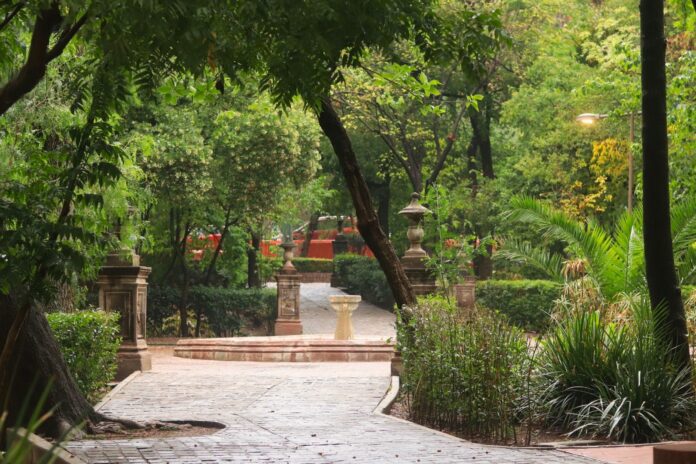
The green heart of San Miguel de Allende offers a cherished breath of fresh air and serenity. Even though the walking paths, fountains and gardens of Parque Benito Juárez are always impeccable, a visitor can easily sense they have stood the test of time. This beloved park is a serene retreat where visitors can unwind on its inviting benches, wander along its pathways, or play in its basketball courts and playgrounds. 

One of Parque Juárez’s most striking features is its French flair, typical of the Porfiriato era. This influence can be seen in the wide promenades and ornate fountains that were hallmarks of 19th-century landscaping with decorative wrought iron benches, sculpted hedges and elegant bridges. This design choice reflects the ambitions of the 40-year rule of Porfirio Díaz, which sought to modernize Mexico, including by emulating European aesthetics. To better understand this San Miguel icon, let’s take a look at the history of Parque Juárez, from its origins as a vibrant collection of orchards to its transformation into a beloved public park.

El Chorro, where it all began

(Sandra Gancz Kahan)

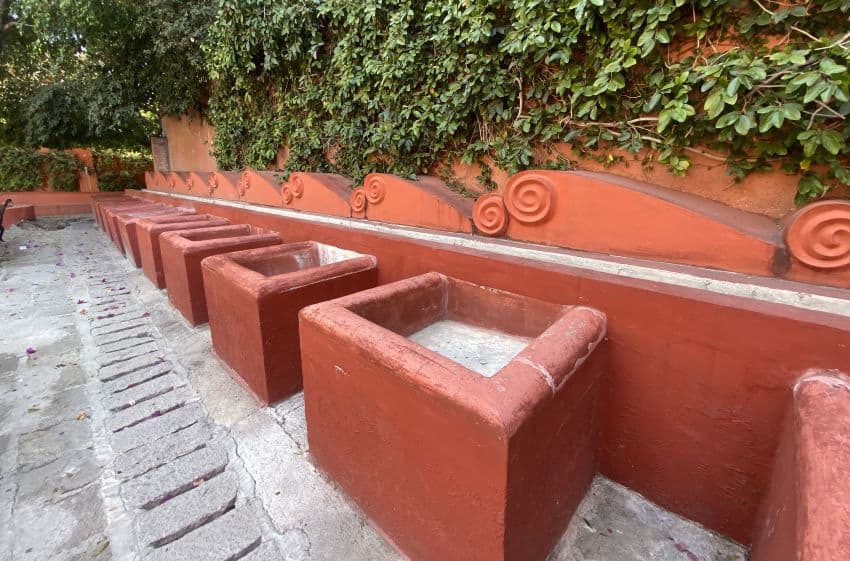
Adjacent to the park lies an area known as El Chorro. This historic spot is tied to one of San Miguel’s foundational legends: guided by thirsty dogs, the Franciscan friar Juan de San Miguel is said to have discovered a natural spring here in the early colonial period. This discovery led to the creation of the town of San Miguel el Grande in 1542, named after the friar. Located on the important Camino Real, the town became a key stop along the silver route connecting to Zacatecas.

The De la Canal family, famously wealthy in 18th-century San Miguel de Allende, left their mark on the city through majestic landmarks still standing today. Among their many contributions was the construction of public amenities at El Chorro, including a chapel, restrooms and washbasins known as Los Lavaderos. By harnessing the natural spring, they provided essential services to improve the community’s daily life.

A visionary mayor transforms the city

(Sandra Gancz Kahan)

In 1895, San Miguel mayor Dr. Ignacio Hernández Macías began purchasing orchards with the vision of creating a public recreational space that would also enhance the town’s air quality. This initiative involved careful planning to transform vegetable gardens, once sustained by the springs of El Chorro, into a beautifully landscaped park.

In 1904, the park was officially inaugurated and named in honor of Joaquín Obregón González, Governor of Guanajuato. The park’s design featured trees at the entrances, sculpted hedges and lawns. Decorative walls and columns surrounded the area, while ornately crafted bridges crossed the water stream. A vibrant field of sunflowers encircled an impressive central fountain, which was complemented by two large cisterns installed to ensure a steady water supply in case the natural spring ran dry. In 1917, the park was renamed to honor former President Benito Juárez, a pivotal figure in Mexico’s history.

New features

(Sandra Gancz Kahan)

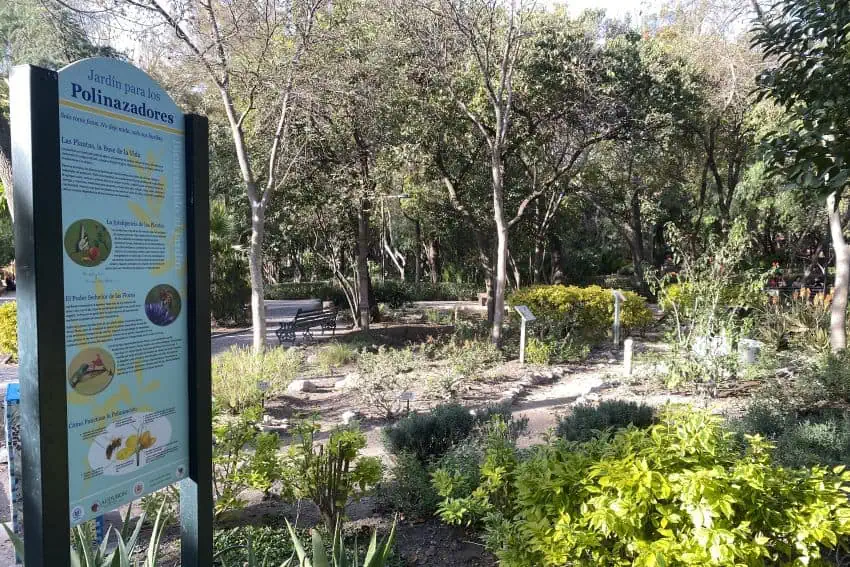
In 2015, the environmental organization Audubon de México created a pollinator garden within Parque Juárez, transforming a small area into a lush habitat for birds, bees and butterflies. This garden serves not only as a haven for the unsung heroes of the natural world but also as an educational space for visitors. Filled with plants that attract these essential creatures, the pollinator garden demonstrates the types of plants that can be incorporated into homes and schools. The initiative highlights the importance of preserving biodiversity and provides a tranquil spot within the park for nature lovers to appreciate the delicate balance of ecosystems.

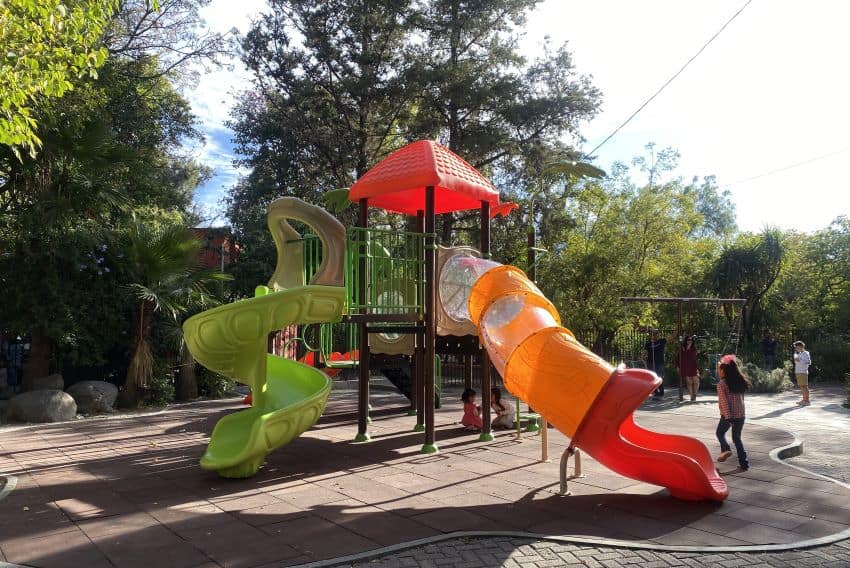
Since the 1960s, Parque Juárez has evolved to meet the needs of its community. Jungle gyms were built to provide children playgrounds. While many of the smaller fountains have been preserved, the central fountain was removed to make space for an open-air theater, which was later replaced by basketball courts. The springs of El Chorro eventually dried up, leaving the park’s stream active only during rainstorms. The park’s transformation reflects a balance between honoring its history and adapting to modern needs.

A place for everyone

(Sandra Gancz Kahan)

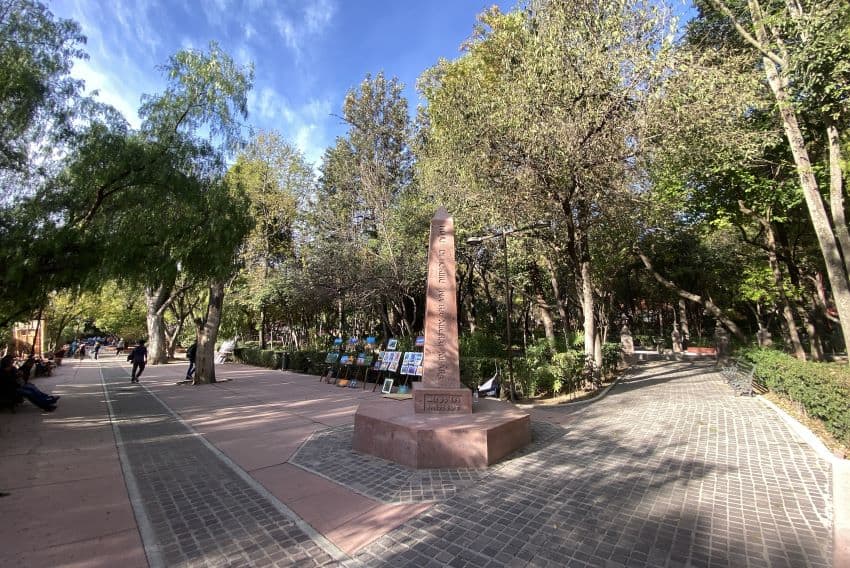
After marveling at the stunning Parroquia in San Miguel’s main square, a leisurely walk down Calle Aldama is the perfect way to get to Parque Juárez. Known as one of the most beautiful streets in the world, Aldama is a favorite backdrop for selfies and professional photo shoots that capture its stunning charm. At the end of Aldama, you’ll find yourself at the main entrance of Parque Juárez.

Once you arrive, the park envelops you in its own ecosystem, away from the city bustle. The weather feels different here, cooler and more humid among the lush plants and towering trees. The chirping birds perched in the canopy create a soothing symphony.

Parque Benito Juárez may not look the same as it did 100 years ago, but its spirit remains intact. Dr. Hernández Macías’s vision of a place where nature and recreation intertwine continues to thrive. Today, it is a central piece of San Miguel de Allende’s calm community pace. The park invites you to experience the charm and heritage of this enchanting town. As San Miguel continues to grow, the park stands as a reminder of the city’s commitment to preserving its natural and cultural treasures, blending past and present in a welcoming space.

Sandra Gancz Kahan is a Mexican writer and translator based in San Miguel de Allende who specializes in mental health and humanitarian aid. She believes in the power of language to foster compassion and understanding across cultures. She can be reached at sandragancz@gmail.com

Gulf of America? Two can play at that game

64
(Google Earth)

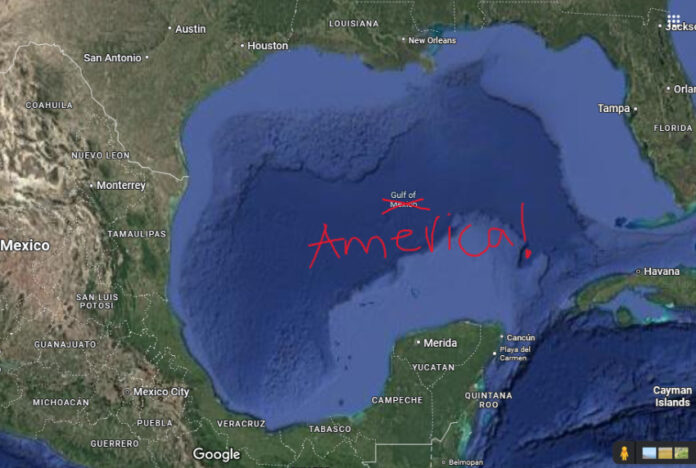
Among many of the shocking changes U.S. President Donald Trump has implemented is one that is downright silly. I speak, of course, of the “renaming” of the Gulf of Mexico as the Gulf of America.

Part of the reason it’s silly is because most U.S. citizens are so bad at geography that they’d be hard-pressed to identify the Gulf on a map.

(Reddit)

So far, it feels like we’re living inside of that irreverent 2004 movie “Team America: World Police.” I frequently double-check the URL when reading the news these days: am I reading The New York Times or The Onion?

But on this, it’s the ridiculous truth. In Mexico, we’ll see the original, internationally-recognized name. But connect to a maps platform in the United States, we’re told, the “Gulf of America” will appear.

I do not support this name change because it is silly and stupid, the equivalent of giving someone a mean nickname and breaking into the school records system to officially change it. But I do feel the need to point out that there are many Mexicans, as well as U.S. citizens, who like to say, “But we’re all Americans!” if someone dare refer to a US citizen as “American.” It’s preachy and annoying, and always induces an eye roll in me. Because look: Mexico is also “The United States of Mexico,” so we literally don’t have a name that’s all our own.

In the meantime, I’ve decided that we in Mexico might as well make some name change suggestions of our own. After all, why stop at the Gulf? Now, if we want a chance of them getting accepted in the U.S., they’d better be in English. Might they ever meet with the kind of tepid acceptance of “freedom fries”? There’s only one way to find out.

(Wikimedia Commons)

Below are some suggestions I’ve come up with while we’ve got the name-changing momentum. Let me know what you think!

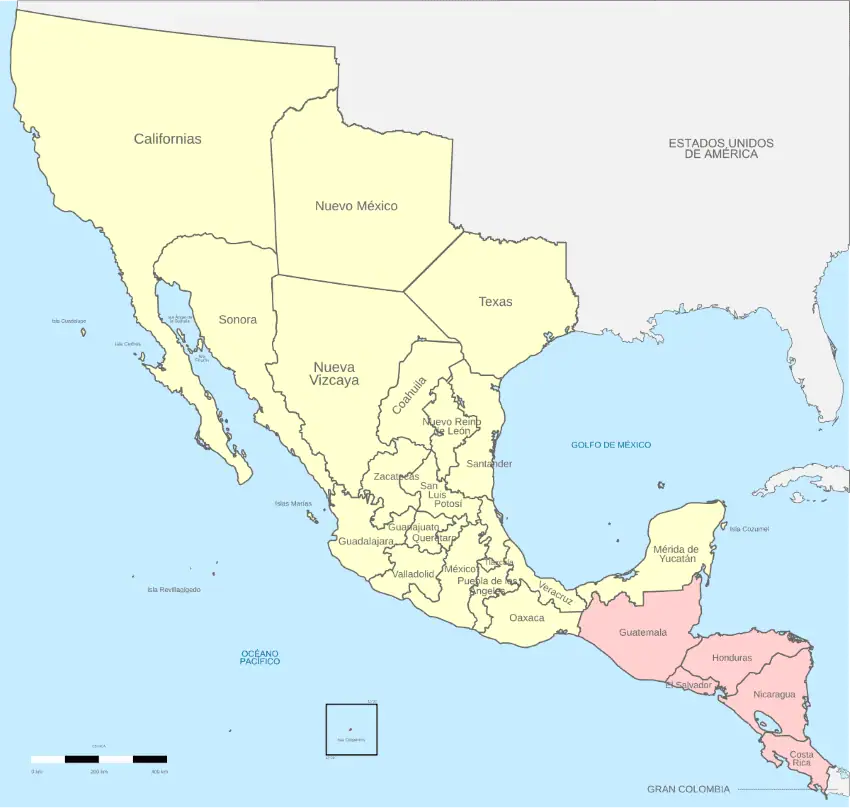
First, let’s start with the state names. As many of you surely know, what is now the southwestern region of the United States used to be most of Mexico. I don’t get too excitable about the politics of it since neither country was concerned with Indigenous peoples having rights to their land, but hey: this game is about pettiness, not justice.

Texas, of course, is one of the proudest states around. I saw it reflected in the road signs on my recent trip there: “Slow down, you’re already in Texas!” The story behind the name is that it was the name given to an early Spanish friar by the Caddo, whose homeland was East Texas. Supposedly it was their word for “friend.” There’s some debate regarding the truth of this story, but one thing that’s certain is that Texans pride ourselves on our friendliness. How about “Friendland”?

Florida! I sympathize with Florida because, like Texas, most reasonably smart and concerned citizens there get drowned out by all the much-better-advertised crazies. In Spanish, “florido” means “flowering” or covered in flowers, which is just lovely. So for Florida, here is my proposal: Flowery. It doesn’t exactly roll off the tongue, but we’re going for English-sounding here. It’ll do.

(Canva)

While we’re in Florida, actually, let’s discuss Mar-a-Lago. This is a curious name: in Spanish, “Mar,” is sea; “a” is a preposition that can mean “to” or “at”; and “lago” is lake. As a phrase, though, it sounds awkward without a “de” in front. Anyway, Sea-to-Lake would be its English version. But if climate change keeps going the way it has, we’ll likely be leaving it as “Sea” before long. Hopefully the neighbors are able to retreat before that happens.

Nevada means “snowed upon.” I would love to see something a little more exciting, though… How about Snowyliscious? It’s the home of showy Las Vegas, after all, so it seems like a good name to me. Speaking of Las Vegas… a vega is a meadow. “The Meadows?” It certainly sounds classier, and with name like Snowyliscious, they’re going to need all the help they can get.

Arizona: Arid zone. Well. That is not exciting. I’m having fun jazzing some of these other ones up, so Arizona, you’re next: Please Oh God I Need Some Water is your new name. Congratulations!

Time to move onto some city names now, which will be easier. I promise not to make them too crazy, because we don’t want to lose track, right? Here we go:

(Canva)

Los Angeles: The Angels. This is actually very romantic and I love it. No notes.

San Francisco is Saint Francis. You can also call it Saint Frank. For San Antonio, try Saint Anthony. San Jose can be Saint Joseph.

El Paso: The Pass. This sounds extra foreboding, and I think it would give this city way more street cred. It makes it sound like that place in “The Neverending Story” where Bastion has to go through those sphinx statues with laser eyes.

Alamo is the Spanish word for the poplar tree. There are cities named Alamo, but I think the fort should get this name, too. Remember the Poplar! This is not a bad phrase. We should remember trees!

To the readers who’ve made it this far: this is all a joke, of course. What’s the phrase? We laugh because we can’t cry? Actually, that might just be my own phrase; perhaps the rest of you have healthier coping mechanisms.

Let me know if I missed any jewels in the comments!

Sarah DeVries is a writer and translator based in Xalapa, Veracruz. She can be reached through her website, sarahedevries.substack.com.

When do the jacarandas bloom in Mexico? Earlier than they used to

0
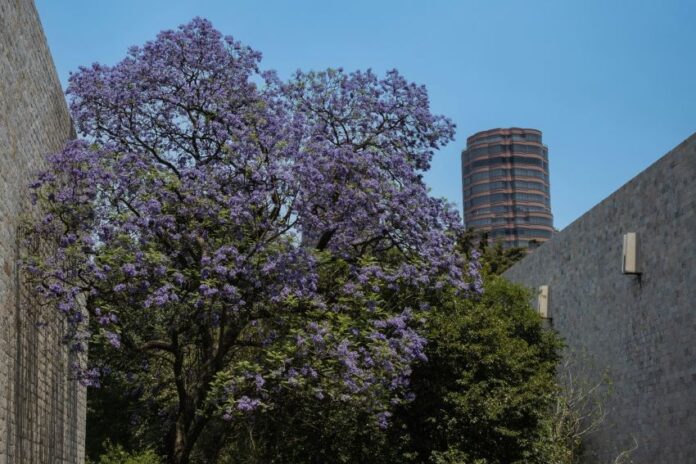
Jacaranda tree blooming in between city buildings.
The jacaranda tree is ubiquitous around Mexico City, where it was first brought to Mexico from South America in the 1930s. These days, it is found in other Mexican cities as well. (Alfonso Aguirre/Unsplash)

Every year, Mexico City residents eagerly anticipate the blooming of the capital’s jacaranda trees, signaling the beginning of spring. Typically, these iconic trees in Mexico’s capital bloom a few days before the spring equinox, but in recent years, they’ve got an earlier start. 

According to Dr. Héctor Benavides Meza, a researcher at the National Center for Disciplinary Research, Conservation and Improvement of Forest Ecosystems (CENID-COMEF), the jacarandas’ early blooming affects their growth and increases their vulnerability to drought, pests and diseases.

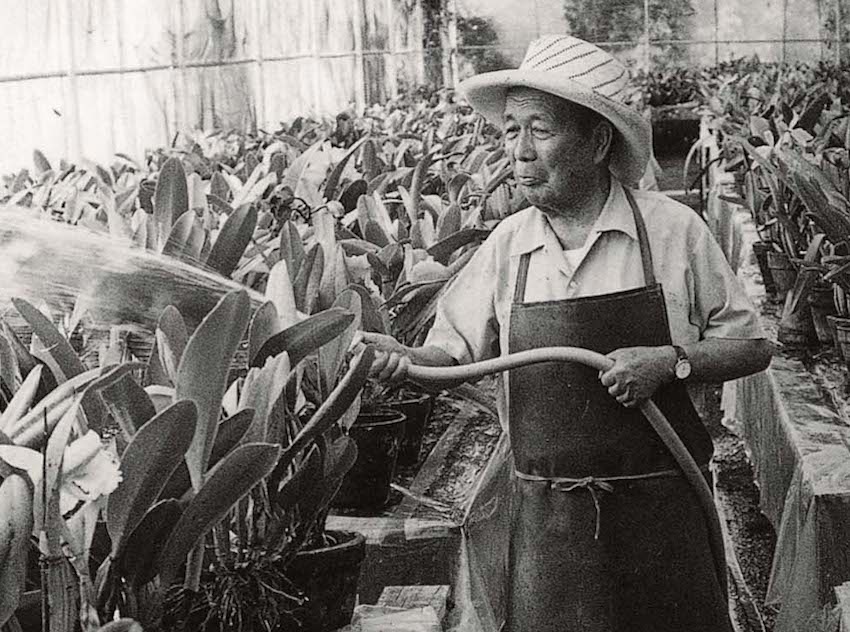
Tatsugoro Matsumoto watering plants
Japanese landscape architect Tatsugoro Matsumoto introduced one of Mexico City’s defining symbols — the jacaranda tree, which is originally from South America. (Matsumoto family)

“The jacarandas are warning us of climate alteration and of lower environmental humidity, a situation aggravated by the drought in which we find ourselves,” Benavides explained last year as scientists expressed concerns over the early blooming of the capital’s iconic trees.  

According to news outlet Chilango, blooming jacarandas have already been spotted in some areas of Mexico City’s historic center, including around the Palacio de Bellas Artes, as well as in some areas of the Benito Juárez and Cuauhtémoc boroughs. 

The National Autonomous University of Mexico (UNAM) posted on its official social media channels that early blooming of jacaranda trees reflects a phenomenon known as “early spring,” which UNAM says has been developing over the last 30 years. 

“Today, air and soil are warmer due to the rise of CO2 and greenhouse gases, which advances flowering,” a UNAM infographic explains. 

Early blooming affects other plants, leading to a mismatch with pollinators and reducing fruit and seed production, the UNAM said. However, insects and other pollinators do not depend on jacarandas, since they’re not native to Mexico. 

Jacarandas were brought to Mexico by Japanese immigrant Tatsugoro Matsumoto in the 1930s following a request from President Pascual Ortiz Rubio, who wanted cherry blossoms in Mexico City. Tatsugoro warned that the flower wouldn’t blossom, since winters in Mexico City are not as cold as in Japan.

Instead, he suggested jacarandas, originally from South America.

Through the years, jacarandas have become ornamental trees across Mexico City and other parts of the country due to the vibrant purple color of its flowers.

Follow this map to see jacarandas in Mexico City.

With reports from Chilango

Mexican producers exported over 110,000 tonnes of avocados for Super Bowl guac

2
Avocados Super Bowl 2025
According to a recent analysis by Wells Fargo, consumers in the United States are expected to pay 11.5% more for fresh avocados from Mexico this year. (John Cameron/Unsplash)

The Association of Avocado Producers and Packers Exporters of Mexico (Apeam) said that avocado producers in Mexico sent more than 110,000 tonnes of avocados — equivalent to over 250 million pieces of the green fruit — to the United States for this year’s Super Bowl on Feb. 9. 

This year’s figure is slightly lower than 2024, when Mexican producers sent 130,000 tonnes of avocados.  

Taste of Mexico: Aguacate

Apeam said that avocado exports reflect the efforts of thousands of Mexican workers, including producers, packers and field technicians.

“[The Super Bowl] significantly impacts both the Mexican and American economies,” Apeam told the newspaper La Jornada. “The entire process adheres to the strictest phytosanitary, safety, and quality standards, positioning us as leaders in worldwide avocado production.”

Approximately 80% of the avocados sent to the U.S. are grown in the state of Michoacán.  

“The Super Bowl serves as the avocado’s fiesta because that’s when we all celebrate it,” Héctor Avilés, general manager of Abokados, Mexico’s top avocado packing plant, told ESPN in 2024.

“In Michoacán, [the avocado is] celebrated on that day because there was a lot of work involved in the weeks leading up to it, and in the U.S., because [the avocado] is on people’s tables. I imagine cheese was once the top staple for families who watched the Super Bowl, but we know now that it’s avocados from Michoacán.”

Guacamole
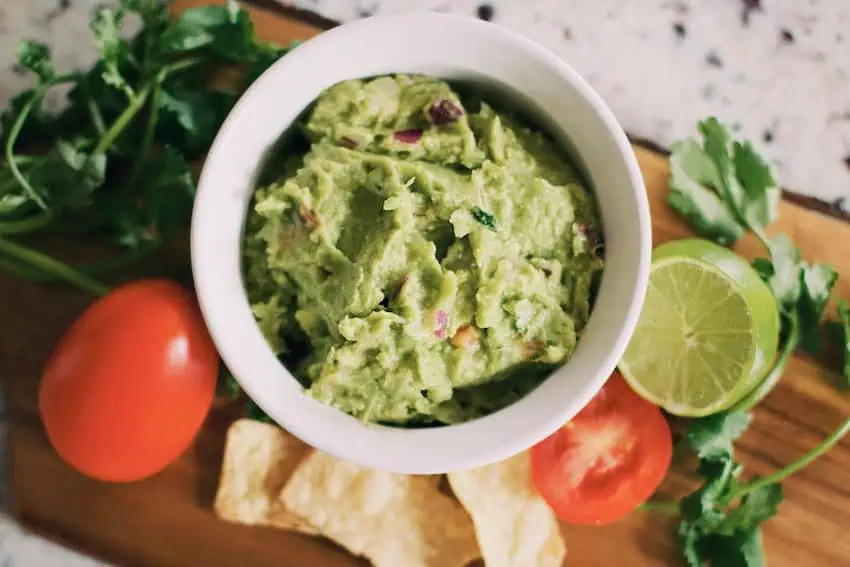
The Super Bowl in the United States is the Mexican avocado’s fiesta, because it’s the day when everyone celebrates it! (Tessa Rampersad)

The export process in Michoacán begins between the end of December and the beginning of January, when crops are ready to harvest. 

In January, producers from Jalisco announced the shipment of approximately 17,000 tonnes of avocados to the U.S. ahead of the Super Bowl. 

Mexican avocados have become a staple ingredient of Super Bowl snack tables, used mainly to prepare guacamole. However, avocados are popular with U.S. households year-round. According to Apeam, the annual consumption per capita of avocado in the U.S. is 4.1 kilograms, making it the largest consumer of avocados worldwide

With reports from La Jornada, El Imparcial and TV Azteca

Banxico survey lowers Mexico’s growth forecast for 2025 to 1%

0
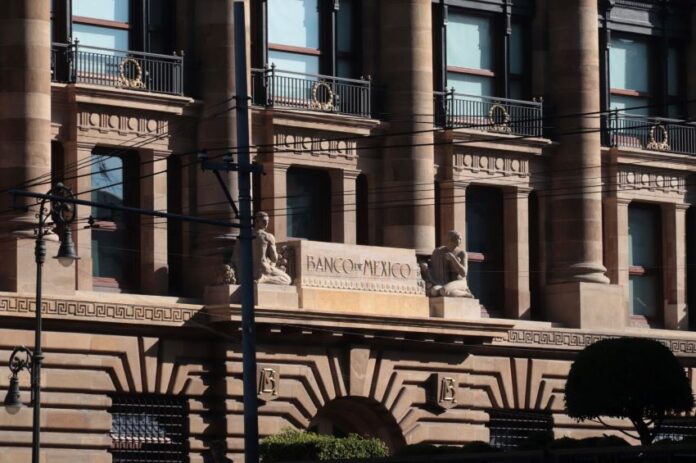
Facade of Bank of Mexico building in Mexico City, done in a classical style of architecture with arches, pillars, and balconies at each upper floor window
Mexico maintained its investment-grade credit rating despite the likelihood of an economic downturn. (María Ruiz)

Private sector analysts raised inflation expectations for Mexico for 2025 and lowered GDP growth forecasts to 1% in a new survey by the Bank of Mexico (Banxico) on Tuesday. 

The analysts surveyed decreased their economic growth forecast for the year from a median amount of 1.12% to 1%. Meanwhile, they raised their Mexico inflation forecast for 2025 from 3.80% to 3.83%. 

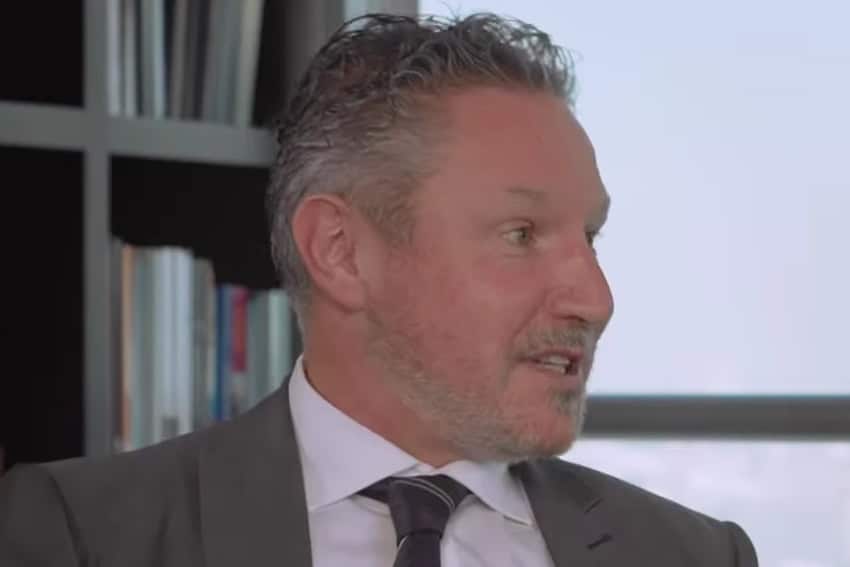
Closeup screenshot of Mark. R. Thomas, World Bank country director for Mexico, Colombia and Venezuela, speaking to an interviewer. A bookshelf filled with journals and books can be seen behind him.
World Bank Mexico director Mark. R. Thomas has said that Mexico’s water and energy availability problems, plus insecurity and recent constitutional reforms, are making Mexico less attractive to investors. (World Bank/Facebook)

The analysts also said they expect the peso to weaken slightly this year and next in comparison to the U.S. dollar. 

The survey polled 40 analysts between January 23–29, before the announcement of a month-long pause on U.S. tariffs on Mexican goods on Monday. This forecast may be revised depending on whether the 25% tariffs proposed by President Donald Trump on Mexican products are put in place. 

A January Banxico survey had already lowered Mexico’s economic growth forecast for 2025 from 1.20% to 1.12%.

Meanwhile, the World Bank expected Mexico’s economy to grow by 1.5% in 2025, and Cepal — the Economic Commission for Latin America and the Caribbean — pegged Mexico’s growth rate at 1.2%. 

By contrast, Cepal predicted a growth rate of 2.4% for the Latin American region. 

In addition to the potential imposition of tariffs on Mexican goods, analysts blamed several other factors for the pessimistic growth forecast. 

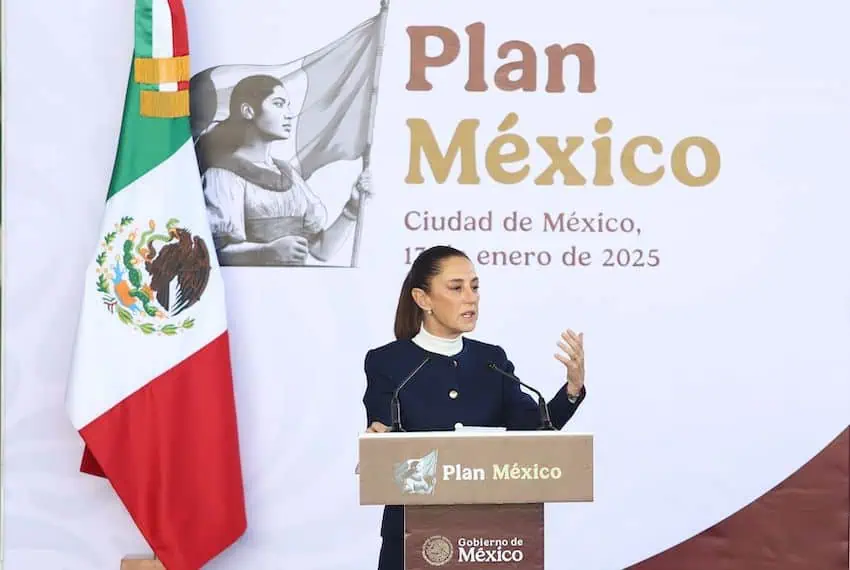
In addition to seeking increased foreign investment, one of Sheinbaum's 13 goals of Plan México is to provide access to finance to at least 30% of small and medium-sized businesses. "We're among the countries with the least funding for small and medium-sized companies," Sheinbaum said.
Mexico is trying to boost Mexico’s growth through President Claudia Sheinbaum’s new Plan México, which she announced last month. It aims to attract outside investment with ambitious infrastructure plans but also support Mexico’s small businesses and expand the regional market for Mexican goods. (Daniel Augusto/Cuartocuro)

Mark Thomas, World Bank country director for Mexico, Colombia and Venezuela, highlighted water availability, energy supply and the cost of land as concerns, as well as insecurity, government policies and constitutional reforms. 

Another factor analysts emphasized was that Mexico is not fully taking advantage of the nearshoring trend.

However, President Claudia Sheinbaum’s Plan México investment strategy, which she announced on Jan. 14, is expected to spur foreign investment in nearshoring activities and drive economic growth across Mexico over the next three years.

The plan aims to create new industrial corridors over all 32 of Mexico’s states, strengthen Mexico’s regional market, and introduce a law to cut Mexico’s amount of bureaucratic red tape, among other investment-friendly initiatives.

With reports from Reuters, Expansión and El Economista

Joining US, Canada designates Mexican cartels as terrorist organizations

17
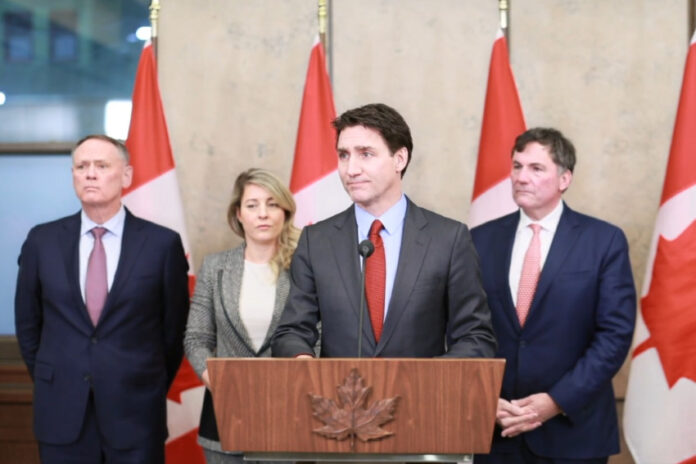
Prime Minister Trudeau announced the news following a phone call he held with President Trump on Monday, in which both agreed to pause new tariffs for 30 days.
Prime Minister Trudeau announced the news following a phone call he held with President Trump on Monday, in which both agreed to pause new tariffs for 30 days. (Screen capture)

As part of the border security plan it negotiated with the United States on Monday, Canada will designate Mexican cartels as terrorist organizations, prompting criticism from Mexican President Claudia Sheinbaum.

Seeking to avoid U.S. tariffs on Canadian exports, Canadian Prime Minister Justin Trudeau on Monday said he will implement a CAD 1.3 billion (US $900 million) border security plan and launch a joint task force with the United States to combat organized crime, in addition to labeling Mexican cartels as terrorist organizations.

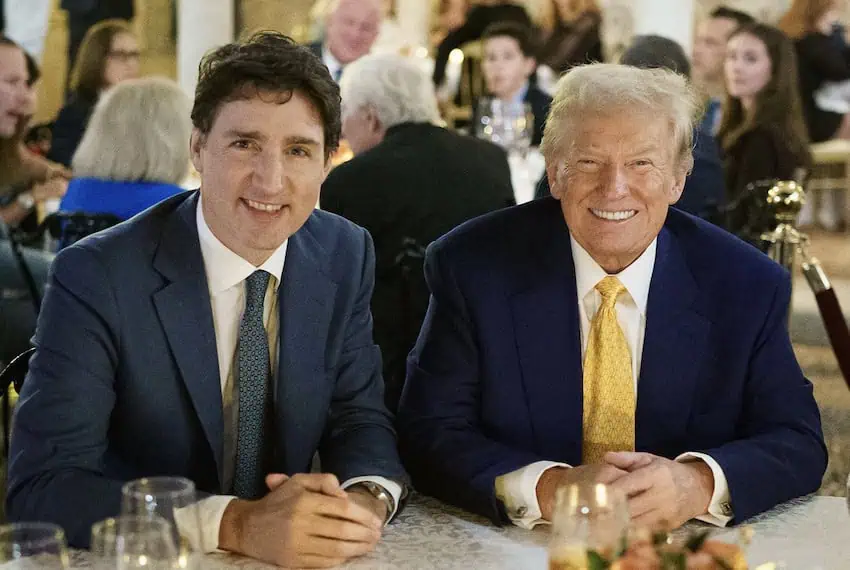
Trump and Trudeau
Friends again? For the next month, at least. (@JustinTrudeau/X)

Sheinbaum took exception to Trudeau’s announcement concerning Mexican cartels during her Tuesday morning press conference.

“We don’t believe that the terrorist designation is helpful,” she said. “There are other forms of cooperation and coordination with respect to our sovereignty that would better assist in combating the fentanyl crisis in the United States.”

Mexico also took steps this week to address its role in the fentanyl crisis in the United States where approximately 107,000 people lost their lives to a drug overdose in 2023.

Peter Navarro, senior trade adviser to U.S. President Donald Trump, lauded Mexico’s efforts to crack down on the influx of fentanyl into the United States, and said that Canada had started to understand that it needed to do more.

“Canada is making new commitments to appoint a Fentanyl Czar, we will list cartels as terrorists, ensure 24/7 eyes on the border, and launch a Canada-U.S. Joint Strike Force to combat organized crime, fentanyl, and money laundering,” Trudeau wrote in a post on X. The Canadian prime minister also signed a new US $200 million intelligence directive on organized crime and fentanyl.

Trudeau’s action against drug gangs follows in the footsteps of the U.S. president who, on Jan. 20, signed an Executive Order designating cartels and other organizations as “Foreign Terrorist Organizations and specially designated global terrorists.”

According to the news agency Reuters, Navarro said that Mexican cartels have been expanding rapidly in Canada, turning Canada into “a leading source of small, duty-free shipments of drugs. 

In addition, Navarro said, Canada must address visa issues that have allowed people on the “terrorism watchlist” to enter the United States.

The actions to bolster border security taken by the respective Mexican and Canadian governments resulted in a one-month delay of the tariffs proposed by Trump.

With reports from El Economista, El Financiero, BNO News, Infobae and Reuters

Sheinbaum receives praise for ‘acing’ tariff negotiations with Trump

7
Praise for Mexico's first female president rolled in on Monday after she announced that she had reached a deal with United States President Donald Trump averting 25% tariffs.
Praise for Mexico's first female president rolled in on Monday after she announced that she had reached a deal with United States President Donald Trump averting 25% tariffs. (Gustavo Alberto/Cuartoscuro)

An “undoubtable triumph” for President Claudia Sheinbaum. The Mexican president is a “very intelligent” politician. Sheinbaum “played it well.”

Praise for Mexico’s first female president rolled in on Monday after she announced that she had reached a deal with United States President Donald Trump that included a one-month postponement of the 25% tariff the U.S. government planned to impose on all Mexican exports starting Tuesday.

Side profile photo of Mexican President Claudia Sheinbaum at a press conference, standing in a parallel position to her admnistration's logo, a illustration in profile of a young Mexican Indigenous woman standing in front of the Mexican flag
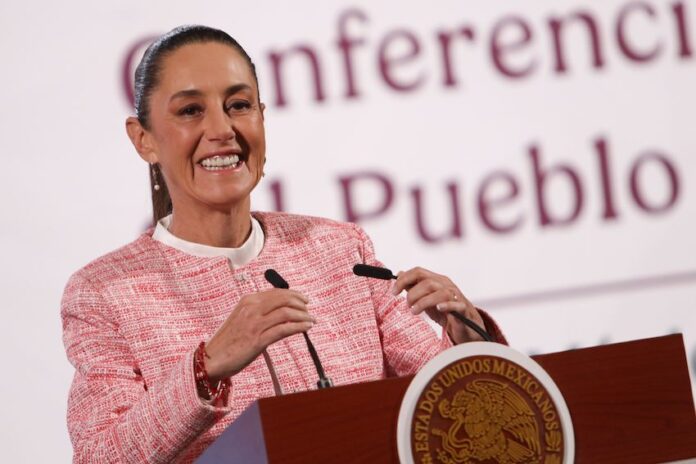
Economists, journalists and political scientists praised Sheinbaum’s “intelligent,” “strategic” and “measured” response to Trump’s tariff threats. (Mario Jasso/Cuartoscuro)

At least temporarily, the deal averted a crisis for the Mexican economy, which is heavily dependent on income derived from exports sent to the United States.

As part of the agreement, Sheinbaum agreed to bolster security at the northern border with the deployment of 10,000 National Guard troops “to avoid the trafficking of drugs from Mexico to the United States, in particular fentanyl.”

On his program for the media outlet Latinus, high-profile Mexican journalist Carlos Loret de Mola declared that “the president of Mexico bet and she won.”

“… She got another month, she won time, she won oxygen,” he said.

“… So the countdown begins again. It’s an undoubtable triumph for President Sheinbaum. It’s not easy to face up to the president of the United States, especially when we know he’s a man who knows no limits,” Loret de Mola said.

“The war wasn’t won, but a time bomb was defused, or better said minutes were added to the time bomb’s clock. It didn’t explode,” he said.

Sheinbaum’s management of the looming tariff crisis and the outcome she achieved impressed German Chancellor Olaf Scholz.

“I believe that the president of Mexico is a very intelligent politician,” he told reporters in Brussels on Monday.

“She played it cool,” Scholz said.

On the X social media platform, former Mexican ambassador to China Jorge Guajardo heaped praise on Sheinbaum’s management of the situation.

“President Sheinbaum played it well. Masterfully,” he wrote.

Guajardo, who also represented Mexico as consul general in Austin, Texas, said that Sheinbaum provided an example to other world leaders on how to deal with a tariff threat from Trump.

While the president said that her administration would respond to Trump’s tariff on Mexican exports with “tariff and non-tariff measures” of its own, she kept the details of the plan under wraps, in contrast to the Canadian government.

Lila Abed, director of the Wilson Center’s Mexico Institute in Washington, said that Sheinbaum “has taken a very cautious and strategic approach to the Trump administration.”

Similarly, political scientist Denise Dresser said Monday that the president “kept a very measured tone” after Trump announced his proposed tariffs. Since Trump took office on Jan. 20, Sheinbaum has said she will maintain a “cool head” when dealing with the U.S. government.

Abed, who was quoted in a Reuters report, noted that Sheinbaum has been “taking actions within her government to send a clear signal to the United States that it understands that fentanyl and organized crime are a top priority for the Trump administration.”

Ten thousand National Guard agents were sent to Mexico’s border states on Tuesday morning as part of the tariff deal Sheinbaum negotiated with U.S. President Trump.

In recent months, Mexican officials have stressed that they are already taking strong action against narcotics, touting arrests of high-profile cartel figures and large drug seizures, including the confiscation of more than 1 tonne of fentanyl in two busts in Sinaloa in December.

Kevin Hassett, director of the White House’s National Economic Council, said in a television interview on Monday that “one of the things we’ve noticed is that Mexicans are very, very serious about doing what President Trump said.”

The U.S. president wants more action from Mexico and Canada to stem the flow of migrants and drugs to the United States, and would also like to see a reduction in the United States’ trade deficits with its USMCA trade partners.

Abed described Trump’s pause on his proposed tariff on Mexican exports as a “temporary win” for Sheinbaum, which will be “dependent on her ability to produce immediate results on migration and on security.”

One factor in her favor is that encounters between United States immigration authorities and migrants at the U.S.-Mexico border have declined significantly in recent months.

Referring to the two weeks since Trump took office, White House Press Secretary Karoline Leavitt said in a video message on Monday that “already illegal crossings are down 95%.”

Gabriela Siller, director of economic analysis at Banco Base, warned on Monday that one month is a “very short” period of time, and asserted that it was “certain” that Trump would continue to threaten to impose tariffs on Mexican exports.

However, Sheinbaum said she told Trump that she was “sure that in this month we’ll be able to achieve … good results for your people [and] good results for the people of Mexico.”

Trump said on Monday that he likes Sheinbaum “very much” but stressed that “we have to stop fentanyl from coming in … and we have to stop the illegal aliens from coming in.”

“… They’ve agreed to put in 10,000 soldiers, permanently, like for ever, … at their side of the border and stop fentanyl and illegal aliens from coming in to our country. They have a big incentive to do it,” he said.

“Other than that we’ve agreed to talk and consider various other things. We haven’t agreed on tariffs yet, and maybe we will and maybe we won’t,” Trump said.

While Mexico could still face U.S. tariffs, just four months into her presidency, Sheinbaum succeeded in her first major negotiation with Trump, giving her a feather in her cap and even earning her a round of applause from reporters when she strode into her morning press conference on Monday.

“She has been successful in her negotiation strategy,” Abed said, according to Reuters.

“Her being cautious but at the same time strategic and proactive, in terms of trying to derail tariffs, is something that has been really welcome within Mexico,” she said.

With reports from Reuters and AFP