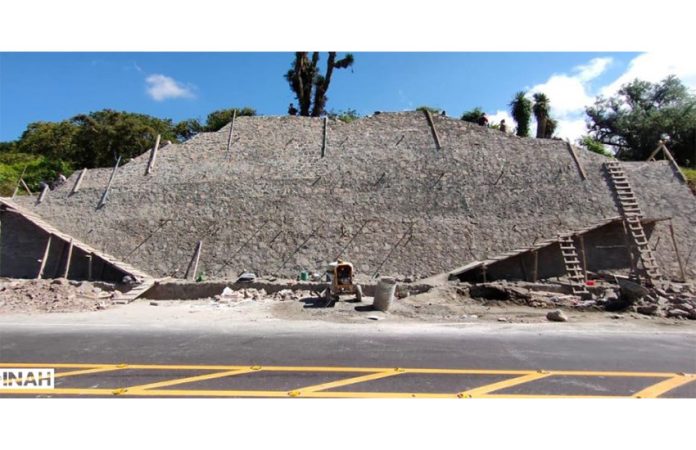
Researchers collected 155 samples of ceramic, shell and lithic materials before re-burying the pyramid. (CINAH Hidalgo)
The National Institute of Anthropology and History (INAH) has announced it will stop exploration and excavation work at a newly discovered pyramid in the state of Hidalgo, due to lack of budget.
The discovery happened in June this year, in the municipality of San Agustín Metzquititlán, during expansion works at the Pachuca-Huejutla highway. Following the discovery, experts from the INAH visited the site for inspection.
The archeological site is made up of five sectors and includes at least 10 archaeological mounds. According to archeologists, it dates to the Epiclassic (650-950 A.D.) and Late Postclassic (1350-1519 A.D.) periods. During their initial investigation, they unearthed obsidian fragments and rock paintings depicting faces, arrows, and everyday objects, which appear to belong to an ancient citadel.
Researchers also collected 155 samples of ceramics, shells and lithic materials from floors made of lime, coal, earth and charred wood. All samples will be subject to laboratory studies in the coming month.
The dimensions of the pyramid are between 300 and 400 meters, according to the newspaper El País.
According to the director of Tourism of San Agustín Metzquititlán, Héctor Labra Chávez, the base of the pyramid is located where the road passes and excavation work is necessary to learn more about the structure. He stressed that there are no vestiges of pre-Columbian civilizations in this area and noted the need to conduct more in-depth research in the area to learn about the culture that settled there.
🤩🇲🇽 ~ ¡Lo que escondía la carretera Pachuca-Huejutla!
Trabajadores del municipio de San Agustín Mezquititlán que realizaban trabajos en el tramo Cerro Colorado, descubrieron diversos monumentos piramidales fuera del derecho de vía de la carretera, como vasijas, pinturas… pic.twitter.com/0N5AQNxso9
El País and other outlets reported that, according to INAH sources, excavation on the site will not continue due to budgetary limitations. Labra, the local tourism director, said the municipal government offered to provide the financial resources to continue excavating the site, if INAH provided personnel.
However, after taking samples, INAH announced that the pyramid would be covered with geotextile fabric and re-buried to ensure its preservation. The institute also announced plans to build a 43-meter wall to protect the site.
Claudia Sheinbaum’s government budget for next year has made significant cuts to nearly all cultural areas. In 2024, INAH received a budget of just 8 million pesos (US $395,000). Next year, this amount will be reduced to 4.5 million pesos (US $222,000), representing a substantial decrease of 45%.
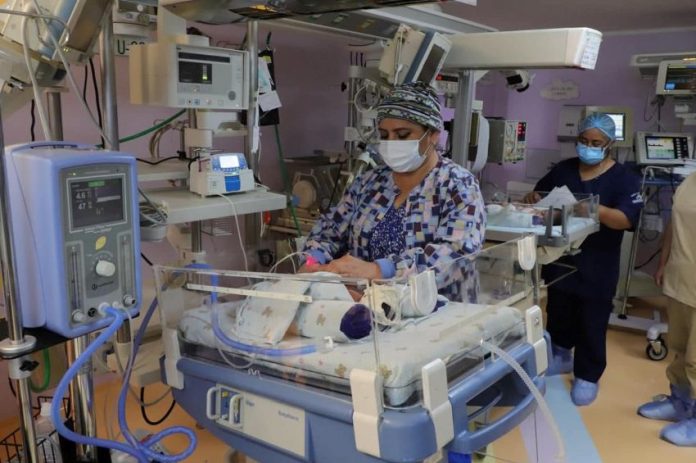
On Thursday, the Health Ministry affirmed that the dead were among 20 stricken patients, of whom 15 were infected by Klebsiella oxytoca, a life-threatening and potentially antibiotic-resistant bacteria.
These bacteria are naturally found in the intestinal tract, mouth, and nose, according to the website Healthline. They’re considered healthy gut bacteria when found inside your intestines, but outside the gut, they can cause serious infections.
The tragic situation caught President Claudia Sheinbaum unawares.
The Health Ministry had issued an epidemiological alert on Tuesday, but when Sheinbaum was asked about the outbreak during her daily press conference on Thursday morning, the president said she had heard that there was just one case and the situation was under control.
A digitally colorized scanning electron microscopic (SEM) image shows a blue-colored human white blood cell interacting with two pink-colored, antibiotic-resistant Klebsiella bacteria, which are known to cause severe hospital-acquired infections. (David Dorward/NIAID)
Lab studies identified the K. oxytoca bacteria later Thursday after which the Health Ministry traced the infections to contaminated IV bags of total parenteral nutrition (TPN).
The U.S. National Institutes defines TPN as “the intravenous administration of nutrition outside of the gastrointestinal tract.” A special formula given through a vein provides most of the nutrients the body needs.
TPN is often prescribed when a baby is unable to get enough nutrition through feeding tubes or by mouth.
The investigation is ongoing and conflicting reports have started to emerge.
On Friday, the México state Health Ministry (ISEM) reported that additional studies indicate only eight of the victims tested positive for K. oxytoca, according to the news site López-Dóriga Digital. The federal Health Ministry has not confirmed the report.
The ISEM said it has ordered all state hospitals on full alert, and that the outbreak is under control. Authorities will remain vigilant, it said, and monitoring activities have been redoubled. Extra training will also be offered to 3,000 nurses and health care workers in the state.
Sheinbaum said the government would provide support for the families of the victims.
The Health Ministry reported that three of the hospitals where the infections occurred are public hospitals, while the fourth is a private institution.
El País also reported that a pediatric infectious disease specialist at a hospital in the state of Hidalgo said she has seen 30 cases involving K. oxytoca since March, including three fatalities.
Mexican Formula 1 driver Sergio "Checo" Pérez is under pressure after a poor season with Red Bull Racing. (Sergio Pérez/Facebook)
Mexican Formula 1 driver Sergio “Checo” Pérez has had a miserable 18 months: no first-place finishes in 41 races; last place in his “home” Grand Prix in Mexico City in October; and not a single top-three finish since April — a span of 18 straight races heading into this weekend’s season finale, the Abu Dhabi Grand Prix — all as his teammate, Max Verstappen, won his fourth straight World Championship title.
It’s the kind of season that could lead one’s team to drop him.
Pérez has endured a disappointing season with Red Bull Racing. (Sergio Perez/X)
The thing is, Pérez’s team for the past four years, Red Bull Racing, signed him to a two-year contract extension back in June.
During the mid-season break, speculation began over who would be Red Bull’s second driver alongside Verstappen in 2025. With Pérez’s contract expiring at the end of this season, Red Bull team management signed him to the extension in an attempt to provide the Mexican driver with a feeling of stability. Since then, however, Pérez’s season has gone into a tailspin, taking just nine points in the last seven races (compared to 126 earned by Verstappen). In the last race, the Qatar Grand Prix on Dec. 1, Pérez spun out and failed to finish for the third time this season.
His slide, which also includes poor qualifying times, has dropped Red Bull out of contention for a third straight No. 1 finish in the Constructors’ World Championship standings.
Liam Lawson (left) is a leading contender to take over the Red Bull seat if Pérez is released by the team. (Red Bull)
Week after week, speculation has grown among fans and media over what Red Bull will do for the 2025 season.
One option is to make Pérez, 34, a driver on Red Bull’s junior team, Visa Cashapp Racing Bulls, and promote 24-year-old Japanese driver Yuki Tsunoda, or 22-year-old New Zealand rookie Liam Lawson, to the senior outfit in a direct swap. Another option is to simply cut Pérez and eat his contract. Red Bull also has several development prospects in lower formulae, including Isack Hadjar, who is currently second in F2.
Media speculation has been so rampant lately that Pérez’s father, Mexican politician Antonio Pérez Garibay, vowed this week via an Instagram post to publicly confront the “lying journalists” who say Red Bull will replace Pérez for the 2025 season.
Pérez Garibay, a Morena party member who represented Jalisco in Mexico’s lower house of Congress, the Chamber of Deputies, for three years until Aug. 31, posted that, come Monday, he’ll be “publishing the list of lying journalists and lying media.”
That would apparently include veteran pundit David Croft of Sky Sports, who recently wrote: “Our sources indicate that Red Bull don’t want to continue necessarily with Sergio Pérez for next season. And [management is] trying to say you can either go nicely, step down, or we will … make that decision for you.”
According to Motorsport Week, Red Bull “has admitted the decision to renew” Pérez’s contract in June “failed to deliver the desired impact.”
Red Bull boss Christian Horner, who has been a staunch defender of the embattled Mexican, was quick to defend Pérez’s position. “Now, obviously, Checo is our driver. He remains our driver and [is] contracted to the team. … Obviously, this season hasn’t gone to anyone’s plan, particularly with Checo’s performance since Monaco. It’s been very, very tough for him … Once we get this race [Abu Dhabi] out of the way, we’ll sit down and discuss the future.”
Added Horner: “There’s huge respect for Checo within the team. And nobody likes to see him struggling like the way he has.”
Red Bull team boss Christian Horner has publicly backed Pérez on several occasions. (Red Bull)
Signing Pérez shortly after he had “four podiums in the first five races,” Horner continued, was done “to settle his mind and extend that run of form for the rest of the season … which obviously didn’t work … that’s just life sometimes.”
It is believed that Pérez brings a considerable sponsorship package with him to Red Bull.
Red Bull is notorious for its ruthless treatment of underperforming drivers, with Pierre Gasly, Nyck De Vries and Daniil Kvyat all removed from the team midway through their contracts in recent years. Motorsports journalists have speculated that Pérez’s contract includes a major payoff if he is cut.
Pérez, who is currently eighth in the 2024 driver standings despite his woes, gave his thoughts on the matter Thursday in the United Arab Emirates: “Nothing has changed since before in terms of what I have said for the whole year. I have a contract for next year, and I will be driving for Red Bull next year.”
Pressed on the matter, Pérez said: “I’ve already said it. Nothing more to add. I have a contract for next year, so nothing more to add … The important thing now is to focus on this weekend.
“It has been very difficult,” he added. “We have had a great car, but a very difficult car to get 100% out of. No matter how good it is, if you can’t get 100% of your performance, you will hardly be able to have good results. That has happened this season.”
President Sheinbaum's approval ratings remain high as she wraps up her first 100 days in office. (Claudia Sheinbaum/X)
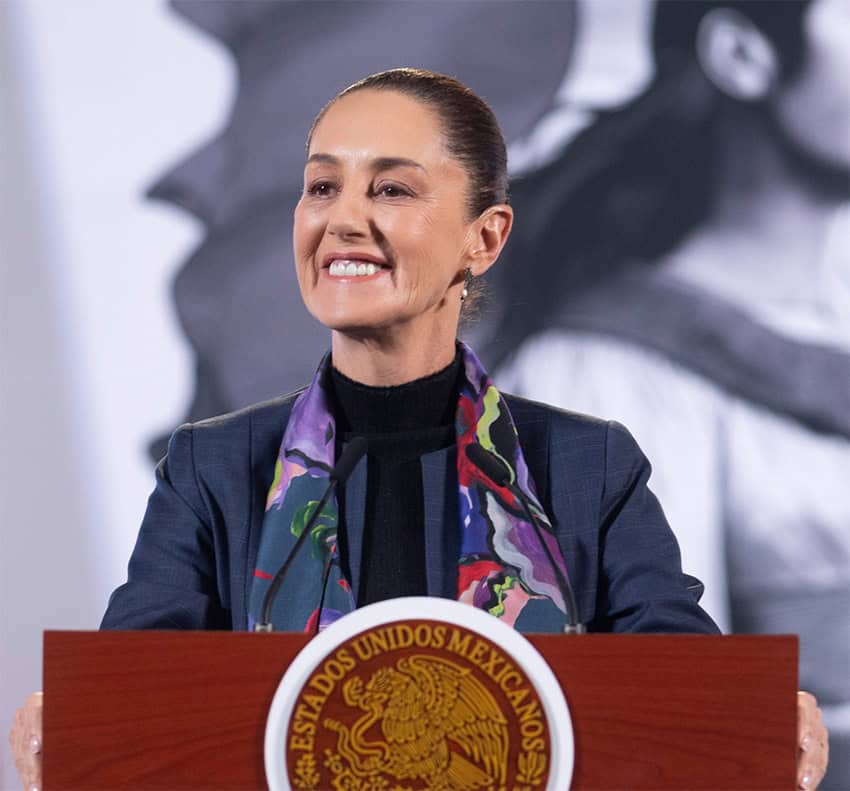
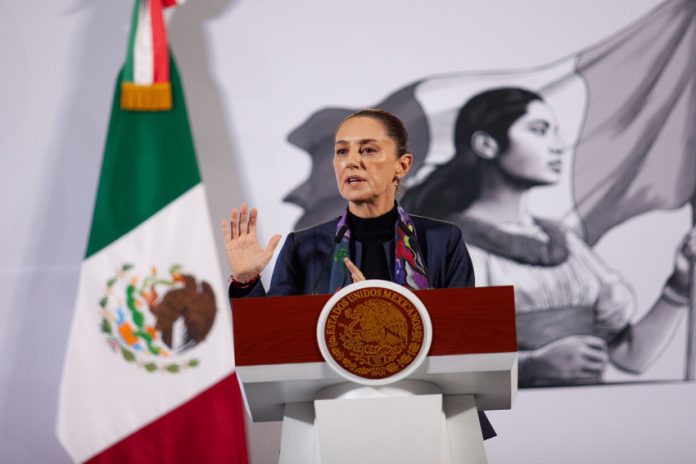
Before traveling to Chiapas to officially open a new highway between Tuxtla Gutiérrez and San Cristóbal de las Casas, President Claudia Sheinbaum held her final morning press conference of the week at the National Palace in the historic center of Mexico City.
Sheinbaum once again highlighted the government’s efforts to reduce violence in Sinaloa, and also responded to Donald Trump’s latest remarks about his telephone conversation with the Mexican president last week.
Presence of security minister in Sinaloa is the ‘best support’ feds can give to struggling businesses
A reporter asked the president whether the government would provide support to businesses in Sinaloa that have sustained heavy financial losses due to ongoing violence in the northern state.
“The best support we can provide is that which we’re providing now,” Sheinbaum responded.
“He’s in Sinaloa to strengthen the security strategy. That is the best support we can provide,” Sheinbaum said.
En seguimiento a la investigación del aseguramiento de más de una tonelada de pastillas de fentanilo y con acciones operativas para disminuir índices delictivos en Sinaloa, personal del Gabinete de Seguridad detuvo a Adrián “N” “El Gallero” integrante de un grupo delictivo que… https://t.co/UjbndCN6HQpic.twitter.com/btkklkGeda
“He’s coordinating the [security] tasks of all the federal and state forces … and it will yield results. … In fact it is already producing results in terms of arrests,” she said.
Among the other women on the list are Taylor Swift, Kamala Harris, Ursula von der Leyen and Arundhati Roy.
Sheinbaum said she wouldn’t let the Financial Times article go to her head or consider it a personal endorsement.
“What there is is a recognition of what’s happening in Mexico,” she said.
President Sheinbaum is one of the 25 most influential women of the year, according to the Financial Times. (FT)
“I said, ‘let the transformation continue’ and ‘it’s time for women.’ That is noticed and felt in our country and that is the recognition … [of the Financial Times],” Sheinbaum said.
“… So I think, in effect, that it is a recognition of the people of Mexico,” she said.
In a short profile of Sheinbaum in the “leaders” section of its “25 most influential women” list, the Financial Times noted that not only is Sheinbaum the country’s first female president, “but also the first former climate scientist to hold the post.”
FT also said that the president is “renowned for her steely character” and described her as “a life-long feminist” who is “determined to present a strong front against bullying tactics.”
“Stand by for fireworks, and a big test of whether a woman cannot just lead Mexico, but do so in the face of Trump’s own version of MAGA machismo,” the Times said.
Sheinbaum disputes Trump’s latest account of their telephone call
“I said, ‘I’m not. I’m just putting a lot of tariffs on because you’re allowing criminals to pour into our country, and we can’t allow that anymore,'” said the former and future U.S. president.
Sheinbaum attributed Trump’s Thursday evening comments to his unique communication style. (Gage Skidmore/CC BY-SA 2.0)
Asked whether she did in fact make the “why are you doing this to me?” remark, Sheinbaum simply responded that Trump has his own unique “way of communicating.”
“It was like when we had the call and he did a [social media] post where he says we’re going to close the border and that was never spoken about,” she said.
Sheinbaum responded to that claim last week by saying that “Mexico’s position is not to close borders but to build bridges between governments and between peoples.”
She also said: “Everyone has their own way of communicating, but I can assure you … that we never suggested that we were going to close the border, we would be incapable [of doing so].”
On Friday morning, the president said she wouldn’t be lured into a public “debate” over what was and wasn’t said during her call with Trump, but assured reporters that she and other officials in her government will always “represent Mexico in a dignified way.”
By Mexico News Daily chief staff writer Peter Davies (peter.davies@mexiconewsdaily.com)
President Sheinbaum had a choice response for ex-president Salinas de Gortari's financial woes. (Enrique Ordoñez/Cuartoscuro, Presidencia)
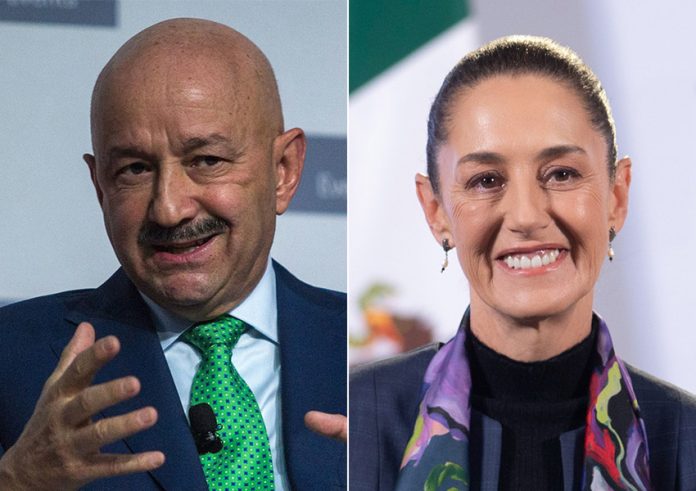
With the year-end holidays approaching, it is only fitting that former Mexican President Carlos Salinas de Gortari is being treated like a Christmas piñata by President Claudia Sheinbaum.
During her Wednesday morning press conference, Sheinbaum was asked about a video in which Salinas declared, “My name is Carlos Salinas and I am unemployed.” Then, responding to a question, Salinas adds, “I’m not a pensioner because someone took away our pensions.”
«Me llamo Carlos Salinas de Gortari y soy desempleado… Sí porque “pensionado” ya no, ahora que “alguien” nos quitó las pensiones.» dijo @CarlosGortari_ refiriéndose a que @lopezobrador_ les quitó las remuneraciones al terminar su sexenio. 💰
Salinas was referring to the pension granted to ex-presidents, which was rescinded by Sheinbaum’s predecessor and mentor, former President Andrés Manuel López Obrador.
When asked about this by a reporter, Sheinbaum admitted she had not seen the video before, but invited Salinas to “apply for a pension via the Welfare [Ministry].”
During Thursday’s press conference, Salinas’s name was brought up again and Sheinbaum was ready with more put-downs, first insinuating that Salinas did not even qualify as an ex-president.
“I don’t call him president,” Sheinbaum said, referring to the controversial 1988 election “Despite the differences I have with Fox, Fox won the presidency, but Salinas de Gortari arrived via electoral fraud.”
A reporter’s questions gave Sheinbaum a chance to bash an old rival of her mentor on Thursday. (Presidencia)
Sheinbaum piled on further. “He’s so unemployed, yes, so unemployed. But nobody’s ever seen him fly commercial,” she said of the ex-president, who lives in Spain.
In 2004 while López Obrador was mayor of Mexico City, leaked videos showed members of Salinas’inner circle taking bribes to finance the midterm elections. His chief-of-staff, finance minister and a borough president were implicated, and López Obrador accused Salinas of being behind the scheme.
(An added bit of irony: The borough president arrested as a result of the 2004 video scandal was none other than Carlos Imaz, who was married to Sheinbaum at the time.)
So the fact that Salinas is again serving as a punching bag is no big surprise.
However, the video that sparked this latest round of insults is over a year old.
El Universal columnist Salvador García Soto said it was taken from an interview of Salinas conducted by the media group Nexos as part of its series on the North American Free Trade Agreement (NAFTA). The interview was conducted in the context of the 30th anniversary of NAFTA, which Salinas negotiated with former U.S. President George H.W. Bush and Canada’s Brian Mulroney.
Finally, the framing of the video as an abject former president whining about the elimination of his pension is ironic on two levels.
Citing anonymous sources, García Soto reported that Salinas voluntarily canceled his pension in 2001. To be clear, of this there appears to be no prior reporting on the topic; the only former president to publicly decline the pension was Ernesto Zedillo (1994-2000).
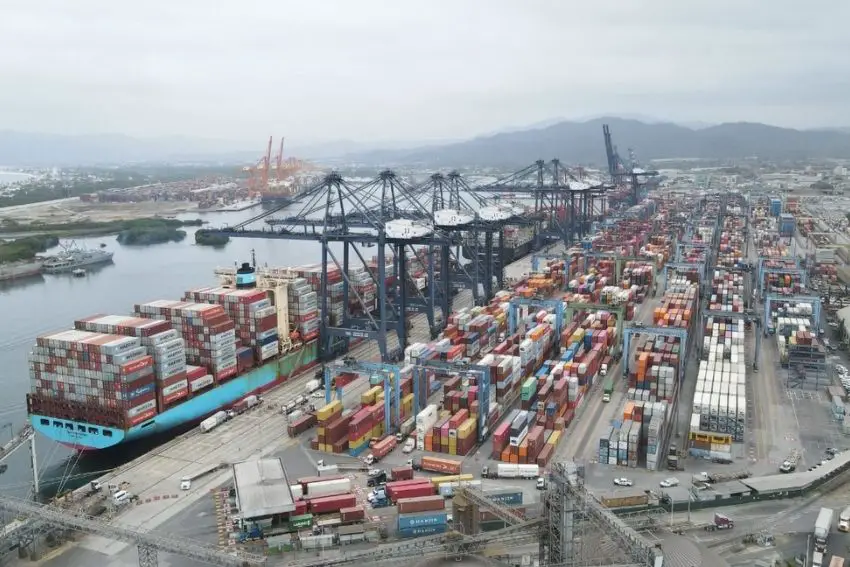
The modernization will prepare the port of Progreso to receive cargo carried by the Maya Train. (Asipona Progreso)
The federal government announced Thursday that it will invest almost 33 billion pesos (US $1.6 billion) to modernize and expand six ports, four on Mexico’s Pacific coast and two on the Gulf of Mexico.
The ports set to benefit from the investment are:
Ensenada, Baja California.
Manzanillo, Colima.
Lázaro Cárdenas, Michoacán.
Acapulco, Guerrero.
Veracruz, Veracruz.
Progreso, Yucatán.
At her morning press conference on Thursday, President Claudia Sheinbaum described the investment as “very significant.”
She noted that the outlay is in addition to investment in the ports in Salina Cruz, Oaxaca, and Coatzacoalcos, Veracruz. Those two ports — the former on the Pacific side of the Isthmus of Tehuantepec, the latter on the Gulf of Mexico side — are being modernized and expanded as part of the Interoceanic Corridor of the Isthmus of Tehuantepec (CIIT) project.
The Mexican Navy’s general director of port promotion and administration Marco Antonio Martínez Plancarte provided the details about the investment in the six “strategic” ports of Ensenada, Manzanillo, Lázaro Cárdenas and Acapulco on Mexico’s Pacific coast and Veracruz and Progreso on the Gulf coast.
Sheinbaum noted that the ports of Coatzacoalcos and Salina Cruz are also undergoing upgrades as part of the Interoceanic Corridor. (Presidencia)
The Pacific ports are Mexico’s gateway to Asia while the Gulf of Mexico ports provide access to Europe and the Gulf and East coasts of the United States.
Ensenada
A total of 5.74 billion pesos (US $283.7 million) is set to be invested in the port in Ensenada, located about 100 kilometers south of Tijuana on the Pacific side of the Baja California peninsula.
Martínez noted that the Ensenada port is made up of two different precincts — one called Ensenada and the other called El Sauzal.
In the Ensenada precinct, the dock area will be expanded, the port will be deepened and a maritime traffic control center will be built. The increased depth will allow the port to accommodate larger ships.
The port of Ensenada will be deepened to allow larger ships to enter. (Asipona Ensenada)
In the El Sauzal precinct, the wharves and breakwater will be expanded and fishing boat docks will be relocated.
Martínez said that the projects will commence in 2025 and conclude in 2028. After their completion, the Ensenada port precinct will only receive cruise ships while the El Sauzal precinct will receive container ships as well as fishing vessels in a separate section, the Navy official said.
Manzanillo
Martínez said that the government will invest 13.59 billion pesos (US $671.2 million) in projects in the Nuevo Manzanillo and Manzanillo San Pedrito precincts of the Manzanillo port.
Among the proposed projects for the Nuevo Manzanillo port precinct are the construction of two fuel terminals, four container terminals and a “specialized dock” for large fishing vessels. A customs precinct with the capacity to attend to 10 million shipping containers annually will also be established.
Mexico’s largest port, Manzanillo, is the third-busiest port in Latin America and a principal commercial route to Asia. (Asipona)
In the Manzanillo San Pedrito precinct, new docks for container ships and fishing vessels will be built and a new storage area for empty shipping containers will be established.
The projects in Manzanillo are set to begin in 2025 and conclude in 2029.
Lázaro Cárdenas
A total of 6.14 billion pesos (US $303.4 million) has been set aside to modernize the port in Lázaro Cárdenas, on Mexico’s Pacific coast.
A range of infrastructure projects will aim to more than double the number of 20-foot-long shipping containers the port can handle on an annual basis.
The port’s current capacity is 4 million containers annually but projects including the expansion of docks and the construction of new access roads is slated to increase capacity to 8.2 million containers per year.
Acapulco
The port in Acapulco, battered by Hurricane Otis in October 2023, is set to receive a 386-million-peso (US $19 million) makeover.
Martínez said that “major maintenance” work will be carried out on the port’s “multiple purpose dock” as well as in the Jardín del Puerto (Port Garden) and a section of the port where new eateries and an entertainment precinct are slated to be installed.
Veracruz
Martínez said that 1.8 billion pesos (US $88.9 million) will be allocated to the construction of a new breakwater at the port in Veracruz.
The new eastern breakwater will allow the establishment of new terminals in the port and thus attract new investment, the official said.
In the port of Veracruz, a new breakwater will create more space for terminals. (Asipona Veracruz)
Martínez said that a total of 7.22 billion pesos (US $356.7 million) will be invested in the port in Progreso, located just north of Mérida and due south of New Orleans, Louisiana.
The federal government will contribute 5.2 billion pesos, the state government will provide 1.5 billion pesos and the private sector will chip in with 525 million pesos.
Martínez said that the money will go to the construction of “an 80-hectare platform” that will be able to accommodate a shipyard as well as a range of terminals including ones for liquefied gas and petroleum.
The Maya Train railroad is expected to be extended to Progreso, which would allow freight trains to take goods to the port for onward shipment by sea.
Port upgrades are part of a broader infrastructure plan
As it seeks to capitalize on Mexico’s nearshoring opportunity and increase domestic production capacity in order to reduce reliance on imports from China, the federal government is planning to establish specialized industrial corridors, or “well-being hubs,” spanning all 32 federal entities.
Each corridor will focus on attracting investment from companies in specific sectors of the economy.
For example, the priority sectors for the Bajío corridor are automotive, data centers, aeronautical and tourism, while the trans-isthmus corridor — part of the CIIT — will focus on renewable energy, specialized manufacturing, agro-industry and logistics.
The renovated maritime ports will facilitate export of products manufactured in Mexico’s developing industrial corridors. (Galo Cañas/Cuartoscuro)
The upgraded ports on Mexico’s Pacific and Gulf coasts could facilitate the export of products manufactured in the different industrial corridors.
Sheinbaum — whose administration is investing in a range of other infrastructure projects including rail and water ones — said last week that the government’s Advisory Council for Regional Economic Development and Relocation, which includes private sector representatives, will focus on the development of the government’s “well-being hubs.”
On Thursday, the president met with members of the Mexican Business Council (CMN), which is affiliated with the government’s advisory council.
Sheinbaum told reporters that she spoke to business leaders about Plan México, a government initiative whose aims include increasing investment in Mexico and the development of the industrial corridors.
The president said that she explained to the CMN members, which includes CEOs of large companies, how they could contribute to the realization of the plan.
“There was a commitment to work together, … complement each other and invest,” she said.
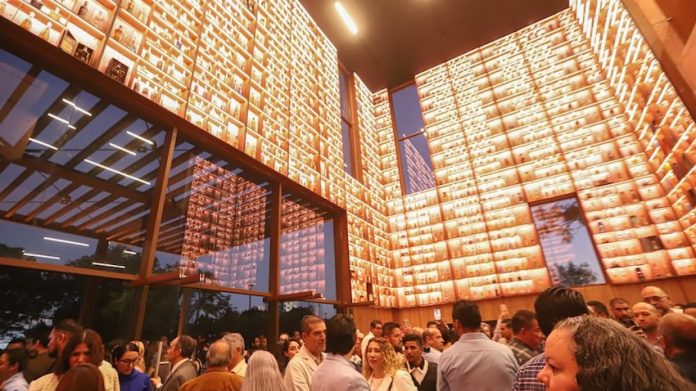
Tequila Lab is a new interactive museum in Guadalajara, Jalisco. (Tequila Lab)
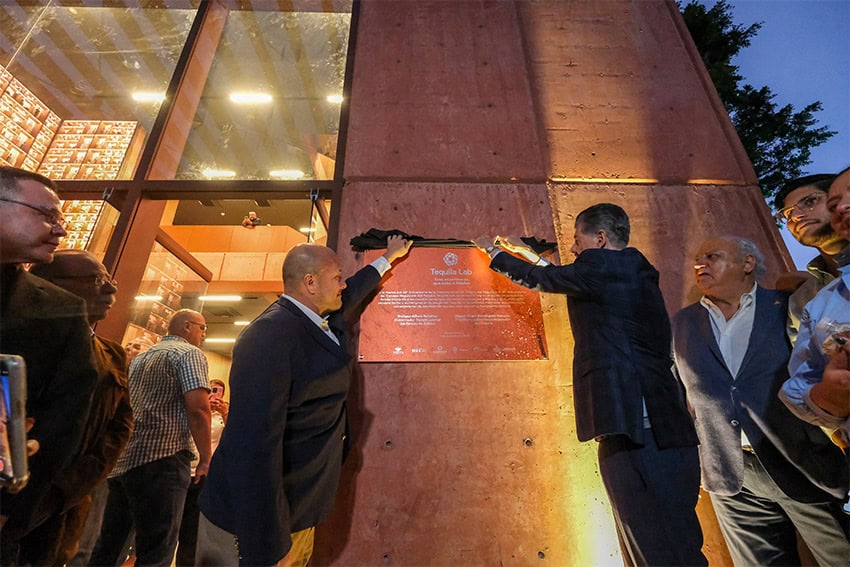
A new interactive museum has been inaugurated in Jalisco’s capital. Named Tequila Lab, the museum is Guadalajara’s first cultural center dedicated to Mexico’s most famous distilled beverage.
The opening ceremony was led by Jalisco Governor Enrique Alfaro, who said the museum is part of collaborative efforts to expand the offering of experiences related to tequila. It required a joint investment of 227 million pesos (US $11.2 million) by the Jalisco state government and the Tequila Regulatory Council (CRT).
Inauguramos #TequilaLab, una experiencia que sabe a México y un espacio inmersivo que hicimos en conjunto con el @CRTequila, para honrar el legado del tequila y vivir el orgullo de ser jaliscienses. Mira lo que puedes encontrar: pic.twitter.com/T3z1zSJifT
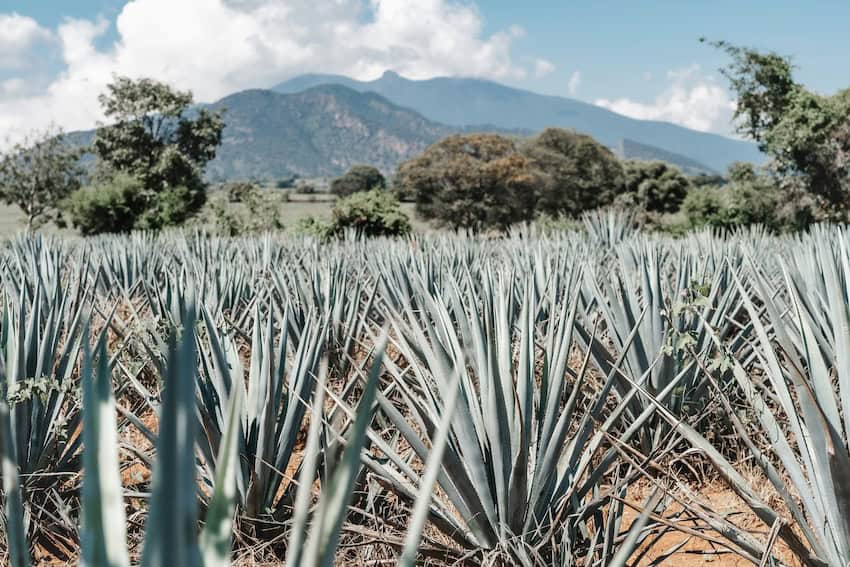
The western state of Jalisco is the birthplace of tequila, a distilled beverage made exclusively with the blue agave, Agave tequilana, which is native to western Mexico. Only spirits produced using the blue agave in 181 municipalities of Jalisco, Guanajuato, Michoacán, Nayarit and Tamaulipas can be labeled as tequila.
“Tequila Lab … will serve as a space for agave growers, tequileros and all the sectors that make up the tequila agroindustry, which supports over 100,000 families,” the president of the CRT, Miguel Ángel Domínguez, said. “Furthermore, it will serve as another location in Jalisco promoting tourism.”
The museum offers immersive experiences with cutting-edge technology like holograms and audiovisual projections that showcase the tequila-making process from agave cultivation to harvesting and distillation. With 2,500 tequila bottles on display, Tequila Lab also taps into the cultural and economic influence of the spirit across the country.
Public officials and members of the tequila industry inaugurated the new cultural space on Wednesday night. (Enrique Alfaro/X)
Part museum, part business hub, the building also features coworking areas and a patio for exhibition purposes.
CRT Director Ramón González Figueroa told the newspaper El Economista that the museum will serve as a platform for micro, small and medium-sized companies in the industry to exhibit their products and train staff.
“All of this will boost tequila to conquer new markets,” he said.
González told El Economista that CRT executives visited several museums abroad to draw inspiration for the project. Some of the destinations they visited included Bordeaux, Champagne and Cognac in France, La Rioja and Ribera del Duero in Spain, and other cities in Italy and the United States.
“All regulatory councils have a place like this,” González stressed. “We were lacking one to provide service to the 204 distilleries that are currently active with 2,900 brands.”
The agave industry supports over 100,000 Mexican families today, according to the Tequila Regulatory Council (CRT). (Dylan Freedom/Unsplash)
Head of the National Chamber of the Tequila Industry (CNIT), Roberto Ciprés, said that the Tequila Lab “is a national and international cultural reference point that gives dignity and pride to one of the most important denominations of origin in the world.”
This year marked the 50th anniversary of the Tequila Denomination of Origin, and the 30th anniversary of the CRT.
In 2023, official figures from the CRT reported that distilleries produced 598.7 million liters of tequila and exported 399.2 million liters.
Do you want to live in the heart of the city, but avoid the expats of Roma and the noise of the historic center? There just might be a neighborhood for you. (Roland DRz/Pexels)
Around 40,000 residents call Santa María la Ribera home. With an average age of 36 and a mean individual income of 6,840 pesos, the colonia is categorized as lower-middle-class. In recent years, its attractive prices and historic, Art Nouveau mansions have encouraged an influx of investors and upper-middle-class residents. Santa María la Ribera boasts an abundance of local shops, markets and restaurants, as well as staples like family-owned hardware stores, laundromats, and cantinas. It’s currently undergoing a revival after a period of neglect, and visitors will notice architectural restoration taking place alongside the construction of modern apartment buildings.
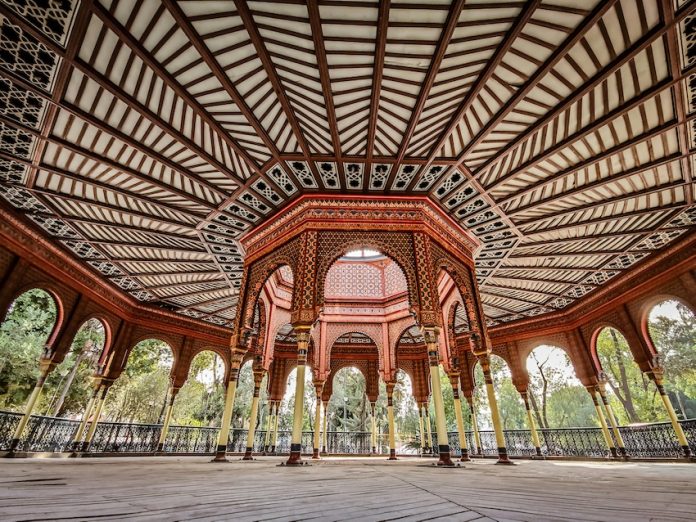
During El Porfiriato, the Kiosko Morisco, designed by Mexican architect José Ramón Ibarrola for the 1884 World Cotton Centennial, was relocated from Alameda Park to its current location. (Isaac Garcia/Pexels)
A brief history of Santa María la Ribera
Long before the Spanish arrived, the region of what in Santa María la Ribera was characterized by its proximity to Lake Texcoco, which served as a vital water source. In the 16th century, the area began to develop as a rural zone. Haciendas were built and agriculture was developed. With the era of Porfirio Díaz, came French-style mansions, making it one of the city’s most affluent suburbs. It was during this period that the Kiosko Morisco, designed by Mexican architect José Ramón Ibarrola for the 1884 World Cotton Centennial, was relocated from Alameda Park to its current location.
A guide to Santa María la Ribera today
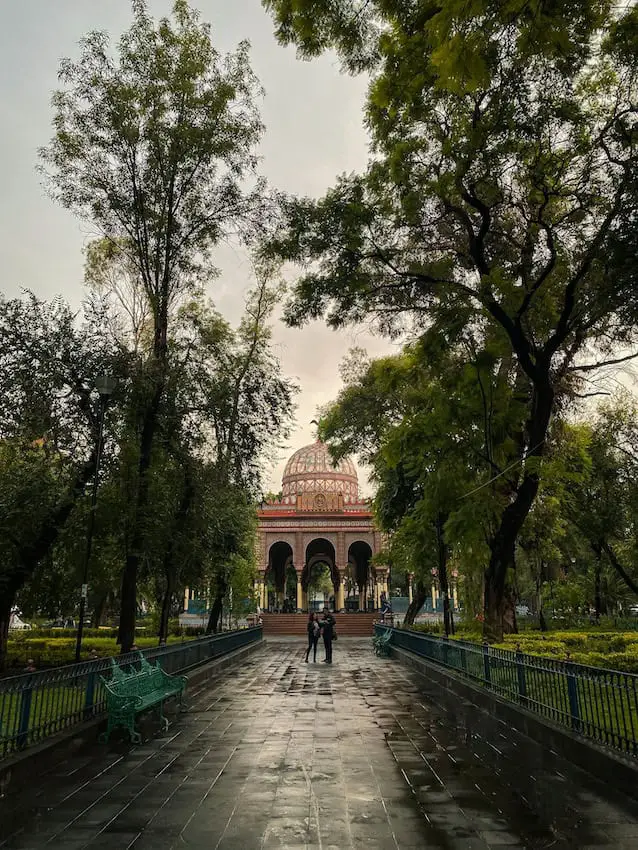
Santa María la Ribera is a vibrant, local neighborhood with threads of gentrification showing via almond-milk-cappuccino cafes and upscale pizza joints. What’s cool is that these places coexist next to mom-and-pop taquerías or a moody cantina from the ‘40s. Its centerpiece is the Kiosko Morisco, an intricately decorated pavilion that stands proud in the neighborhood’s park. The park itself is a treat, with dance classes, artisan markets, and music performances taking place at any given moment.
Surrounding the center is a testament to what Santa María la Ribera truly is — a mix of everything. You’ll see restaurants that range from Russian to Italian to Oaxacan, museums and theaters and contemporary art galleries. Maybe it’s the bustling nature of its residents, the barrage of undetectable sounds, or the smell of tamales wafting from street corners, that makes you really feel like you’re in Mexico.
Santa María la Ribera is great if you love: surprises. It’s slightly gritty in a way that makes it feel authentic, blending the ultra-modern with historic, the decrepit with the restored, street carts with fine dining, and the young professional with the cane-wielding abuelito who hasn’t left the ‘hood since the ‘80s.
The park itself is a treat, with dance classes, artisan markets, and music performances taking place at any given moment. (Diana Reyes/Pexels)
What to do in Santa María la Ribera
Kiosco Morisco
This requires little explanation. You simply couldn’t miss it, even if you wanted to. It stands central to Alameda de Santa María, a beautiful public park with lush greenery, walking paths, and various recreational activities.
Galería Naranjo 141
A beautiful contemporary art gallery that gives young artists a space to exhibit their work. The setting is especially lovely, expertly designed to play with light and shadows.
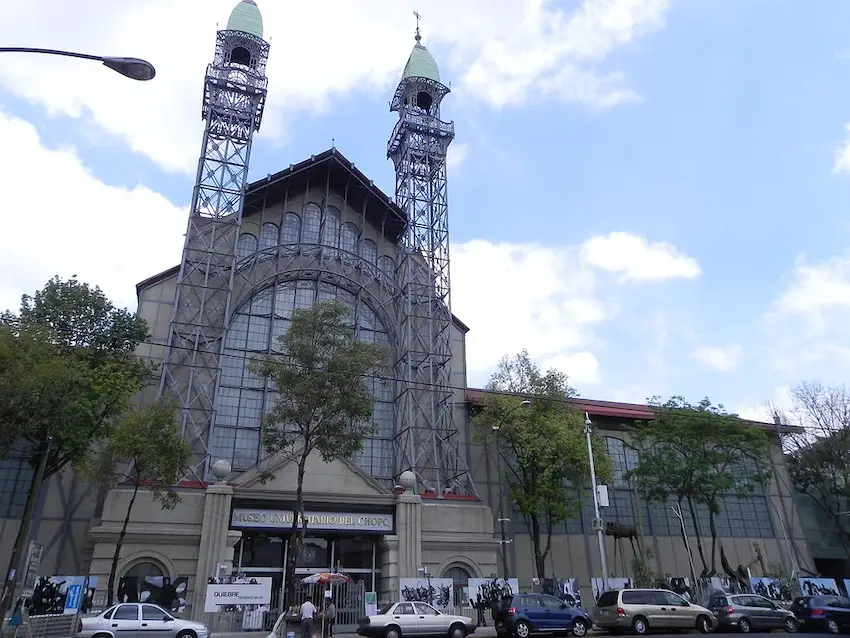
Museo Universitario del Chopo
Known for its striking Art Nouveau architecture in a German style, this art museum hosts innovative exhibitions and cultural events.
Museo del Instituto de Geología
You’ll likely be drawn to the gorgeous facade and grand staircase anyway, so you might as well enter. The geology museum showcases a vast collection of fossils, minerals, and meteorites, making it a must-visit for geology enthusiasts.
This incredibly unique church features bombastic Byzantine architecture with numerous cupolas and ornate windows. Like the rest of the colonia, it contrasts greatly with its neighbors in a charming way.
Mercado La Dalia
A visit to Santa María la Ribera isn’t complete without a pop into its bustling local market brimming with fresh produce, sizzling tamales, and various artisanal goods.
Tianguis Cultural del Chopo
The famous Saturday flea market is situated just outside Santa María la Ribera in neighboring Buenavista, and is known for its alternative culture, selling everything from vinyl to vintage clothes.
El Museo Universitario del Chopo offers striking Art Nouveau architecture in a German style, as well as a great museum. (Pablo Fossas/Wikimedia Commons)
Casa Chopo
Even if you don’t plan to spend a night here, would you, perhaps, pretend you’re interested? This way, you can get reception to take you on a tour of the enchanting Casa Chopo, a renovated Porfiriato home-turned-boutique hotel.
Casa de los Mascarones
Easily recognizable by the dozens of masks that make up the facade, the Count of Valle de Orizaba’s mansion was erected in 1776. He died before construction finished and the house remained empty and, obviously, haunted. Rumors of apparitions and strange noises persist to this day.
What to eat in Santa María la Ribera
Coyota
A favorite among locals, Coyota’s casual, friendly atmosphere and colorful decor strongly reflect Mexican culture. It’s irresistibly situated on a small park so you can watch a pickup soccer match while indulging in fresh fish tacos and a sharp mezcal.
Seeing that this cheerful spot is connected to the ontemporary art gallery Acapulco 62, it’s no wonder they boast a fresh menu of seaside-inspired dishes and cocktails.
Jametaro
Santa Maria la Ribera’s international culinary scene is hotter than you might have realized. Jametero, a cozy Japanese eatery, attracts ramen lovers who appreciate its distinct blend of traditional Japanese flavors with local ingredients.
Restaurante Xuva
Elegant, relaxed, innovative, sustainable. These four words sum up the stand-out dining experience you’re sure to have at Xuva, whose focus on Oaxacan coastal flavors draws foodies of all kinds.
María Ciento38
The restaurant is so lovely that one almost doesn’t care about the food. Luckily, that’s good too. Dine in the gorgeous garden or inside the artsy-rustic house, chowing down on pizza, pasta, and other Italian favorites.
Salón Puebla exudes a nostalgic charm reminiscent of a classic Mexican cantina, complete with vintage decor and friendly patrons. As you may have guessed, their mole poblano comes highly recommended, as does the paella.
Kolobok
Forbes and Entrepreneur have sung their praises for Mexico City’s most famous Russian restaurant. From the authentically Russky food to the furnishings, there’s a more-than-good chance you’ll completely forget you’re in Mexico.
Camino a Comala
Snug and tranquil, this cute little cafe is the perfect place to pause over a freshly brewed drip coffee and a sweet treat.
One hidden gem
The tiny, hidden street called Callejón Chopo-Pino will temporarily transport you to Notting Hill, if only for a few minutes. Meander down the picturesque alley lined with colorful British-style townhouses, vivacious gardens, and eclectic architecture.
Bethany Platanella is a travel planner and lifestyle writer based in Mexico City. She lives for the dopamine hit that comes directly after booking a plane ticket, exploring local markets, practicing yoga and munching on fresh tortillas. Sign up to receive her Sunday Love Letters to your inbox, peruse her blog, or follow her on Instagram.
Hubertus Hohenlohe-Langenburg might be Mexico's most outrageous showman. There's just one catch... He's actually a German prince! (Poblanerías)
Prince Alfonso of Hohenlohe-Langenburg was a descendant of a German royal family who traces their history back to 1153. The family came out of the Second World War badly, losing their considerable possessions in Bohemia to the new communist government. However, they were hardly destitute and were now settled comfortably in Madrid. In 1947 Alfonso was driving along the Spanish coast when he came across the tiny fishing village of Marbella. At the time he was a twenty-three-year-old playboy with money, contacts, and the looks of a film star — more the bad boy looks of Clark Gable than the clean-cut hero type, but film star looks nonetheless. He also had that extra touch of the exotic, perhaps inherited from his mother, who was half-Mexican
Whether he saw a business opportunity, or the village touched his heart, is uncertain but Alfonso started buying land and in 1954 opened the Marbella Club (something like Los Cabos’ Palmilla hotel). In 1955, with Marbella established, Alfonso produced another surprise. At the age of thirty-one, he got married. His bride, Ira von Fürstenberg, was only 15 but the pope himself gave his blessing and 400 guests and TV crews from around the world descended on Venice for the 16-day wedding party. Although Italian, Ira could also trace her heritage back to German aristocracy and her family had a lot more money, her uncle Gianni Agnelli being the chairman of Italian car giant FIAT.
Alfonso and Ira Hohenlohe-Langenburg at their wedding. (Histoires Royales)
Princess von Fürstenberg was a mother at 16 to Christoph “Kiko” Humberto and seemed happy in her role as the biggest and brightest star in the now glittering world of Marbella. By the time her second son Hubertus was born the family was living in Mexico, where Prince Alfonso was involved in opening Puebla’s legendary Volkswagen factory. It is unlikely that the task of ‘opening the factory’ saw him standing on the shop floor with plans in his hands — more likely he and his glamorous wife staged a series of parties and meetings to ease through all the necessary paperwork and permits.
Unfortunately, it was then that Ira met Francisco “Baby” Pignatari, with whom she had a brief and intense affair, leaving Alfonso and moving to Brazil. There was a struggle over the children which made headlines around the world with Prince Alfonso snatching the boys and fleeing to Europe and his wife putting out a million-dollar reward for their return.
If Alfonso was heartbroken at losing his young wife, he hid it well. Once they could come out of hiding he threw himself into promoting Marbella. He dated film stars Kim Novak and Ava Gardner, and married a third, Jocelyn Lane. While Kiko gravitated toward his mother and a life in Hawaii, Hubertus was brought up in Marbella where he would join his father for dinner with Sophia Loren and Brigitte Bardot. One night he sat at the edge of the pool with David Bowie as the superstar wrote a song.
Life was easy for Hubertus and this might have caused problems. His father, perhaps seeing the danger of such a lifestyle, sent him to a monastery school in Austria. Whether the harsh routine did Hubertus good or not, it did allow him access to some of the best ski slopes in the world. He became ill and had to take a rest from alcohol. He discovered he didn’t need it — and a man who would go on to throw some of the most extravagant parties in the world never touched alcohol again.
Handsome, charismatic and talented, Hubertus has enjoyed careers in sports, arts and music. (Metzger Live)
Just as he was about to graduate from university with a degree in business administration Hubertus rebelled, dropping out of University and setting up a photography studio in Vienna. Perhaps sensing this would not be enough of a challenge he considered other options. He was a very good skier, but not good enough to get a place on the Austrian team. However, he had been born in Mexico and had a Mexican grandfather — could he compete for Mexico?
He flew to Mexico City, where his family name and his contacts helped him gain access to influential members of the Mexican Olympic committee. A Mexican ski federation was formed and in 1984 Hubertus von Hohenlohe paraded in the opening ceremony of the Winter Olympics in Sarajevo. He was the first Mexican representative since the bobsleigh team of 1928.
Hubertus competed in the three Alpine races at the 1984 Games with his highest finish, 26th, coming in the slalom. Critics point to how far he was behind the leaders. Supporters instead pointed to the fact that he had finished in the middle of an international field and had completed two runs on a steep, tight course made even more tricky by the icy conditions where half the field crashed out of the competition.
Having ticked off the Olympics von Hohenlohe might have hung up his skis but he was doing something he loved and was having fun. For the next eighteen years, he represented Mexico in the ski world championships and as he attended the 1988, 1992, and 1994 Olympics other targets. By now, the titles of “most Olympic games competed in” and, “oldest Olympian” had come into reach.
Mexican Ski Championships with Hubertus Hohenlohe & Padre azul Tequila
Life off the slopes was not standing still either and the skier-prince-photographer was approached by the Austrian singer Falco to work his next album. Having edged through the door into the world of music Hubertus did what he did best and charmed people. He is credited as a co-producer for a song by the Swiss band Jello, recorded in collaboration with Shirley Bassey. Musician was now added to his extensive resumé, and he formed several bands, most notably Royal Disaster.
He was still skiing and represented Mexico for the sixth time at the 2014 games in Sochi. This time though, he gained fame not for his skiing but for his mariachi-inspired ski suit. Reporters across the games wanted to interview the Mexican mariachi prince. The razmataz hid his most impressive achievement — at fifty-five he was still competing in one of the Olympics’ most demanding sports.
It was through skiing that the Prince found his wife Simona Gandolfi, a cousin of the great Italian skier Alberto Tomba. It was a true romance but — as with much in Hubertus’ life — it did not follow a conventional course. Simona wanted children, he did not, so she left him and had two children with another partner. Hubertus was her real passion, and she returned to him. In an interview with the luxury magazine Hochedel, Hubertus admitted there was something of an overlap in the relationships, and the younger child could possibly be his.
It is hard to assess the totality of Hubertus von Hohenlohe’s achievements. He is a good skier who, had he not been a prince in a mariachi suit, would not have attracted any attention. His singing is not as good as his skiing, but his photography is perhaps better. He is not as famous at being famous as his mother, but never wanted to be either. If he has done anything well, it is perhaps finding a path through life. Adapting a line from a bad movie, “the thing he is most successful at is life itself.” He also, of course, throws excellent parties.
Bob Pateman is a Mexico-based historian, librarian and a life term hasher. He is editor of On On Magazine, the international history magazine of hashing.
In response to the ruling, President Sheinbaum said that the Mexican Congress will soon enact a ban on planting GM corn in Mexico. (Andrea Murcia Monsivais/Cuartoscuro)
With the inauguration of the 47th president of the United States less than seven weeks away, Mexico is preparing – or, some might say, bracing – for the return of Donald Trump.
Whether or not Trump goes through with his promise to conduct mass deportations of migrants to Mexico, Sheinbaum said she and governors in Mexico’s northern states will have a plan in place. (Ron Sachs/Consolidated News via Shutterstock)
The latter promise – and especially the possibility of it becoming reality – was a key focus of President Claudia Sheinbaum’s morning press conference on Thursday.
Among other remarks at her Thursday mañanera, Sheinbaum recalled the period of her life when she lived as an immigrant in the United States.
Feds and border states to plan for possible US mass deportations
Sheinbaum noted that all state governors will attend a security meeting with federal officials in Acapulco next week.
She indicated that on the sidelines of that meeting, the governors of Mexico’s six northern border states – Baja California, Sonora, Chihuahua, Coahuila, Nuevo León and Tamaulipas – will gather with federal officials to discuss Donald Trump’s stated plan to carry out a mass deportation operation.
Sheinbaum said that the federal government will come to an agreement with the northern border states over “how to receive our compatriots in case of a mass deportation” of Mexican immigrants currently living in the United States.
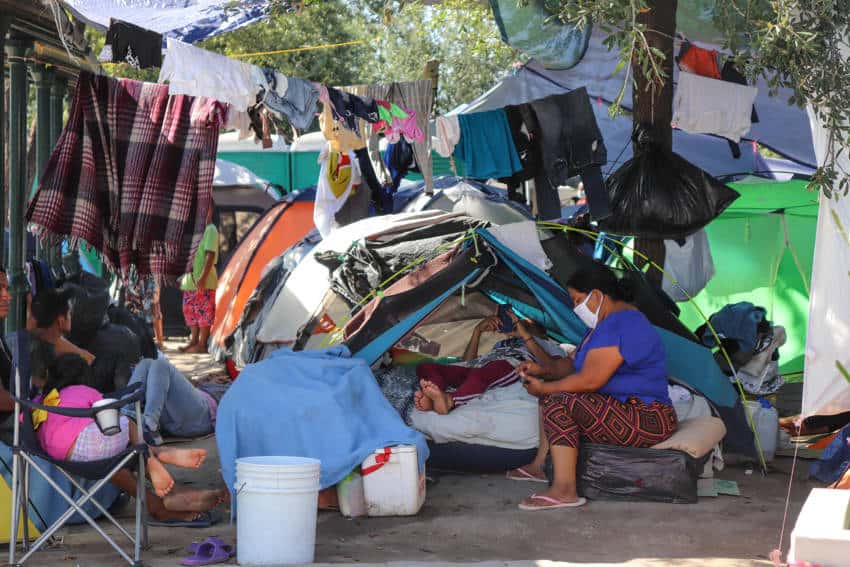
The U.S. policy of deporting migrants to Mexico — whether Mexican or not — has led to shanty towns in border cities like Reynosa, Tamaulipas, where deported migrant families live in tents and other makeshift living spaces.(MSF)
“We hope that it doesn’t happen, but if it does happen we’ll be prepared to welcome them,” she said.
Mexico’s former foreign affairs minister and current Environment Minister Alicia Bárcena said in February that there were 5.3 million undocumented Mexicans living in the United States.
Trump confirmed last month that he plans to use the U.S. military to carry out his proposed mass deportation plan.
Mexico hopes for agreement with Trump to avoid receiving non-Mexicans
Sheinbaum told reporters that Mexico currently has an agreement with the Biden administration under which the United States sends deportees “of many nationalities” on direct flights to their countries of origin.
She said that Mexico has a “caring” attitude toward “everyone,” but stressed that its “main” job is to receive Mexicans who are deported from the United States.
Sheinbaum said that her government hopes to reach an agreement with the Trump administration so that most non-Mexican deportees continue to be sent to their countries of origin.
Reuters reported Thursday that “Mexico has played a key role in implementing U.S. immigration policy in recent years, accepting migrants from countries to which the U.S. struggles to deport people, such as Cuba, Haiti, Nicaragua, and Venezuela.”
‘I never stopped participating in the transformation of my country’
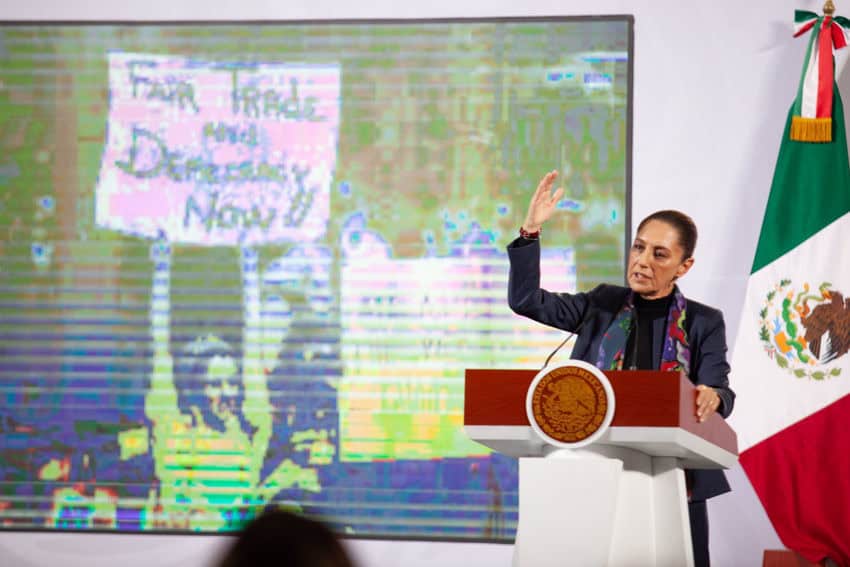
During Thursday’s press conference, President Sheinbaum showed a 1991 newspaper photo of herself protesting then Mexican President Salinas de Gortari’s appearance at Stanford University. At the time, she was pursuing a doctorate at UC Berkeley. (Andrea Murcia Monsivais/Cuartoscuro)
Near the end of her press conference, the president noted that she lived in northern California for four years in the early 1990s while completing a doctorate at UC Berkeley.
“I had the opportunity to live four years outside of Mexico. … I always dedicated myself to academia, but I never stopped participating in the transformation of my country,” said Sheinbaum, who says her government is now building the “second story” of the so-called “fourth transformation” initiated by former president Andrés Manuel López Obrador.
She told reporters that she participated in protests in the United States that were aimed at pressuring the Mexican government to give Mexicans abroad the right to vote in Mexican elections.
“We thought that the agreement had to be fair and include good salaries for Mexicans,” she said of the North American Free Trade Agreement.
The president displayed on a screen the front page of the Oct. 1, 1991 edition of The Stanford Daily newspaper, which included a photograph of her protesting against then Mexican president Carlos Salinas de Gortari at Stanford University.
Sheinbaum, 29 at the time, was holding up a sign that read: “Fair trade and democracy now!!”
By Mexico News Daily chief staff writer Peter Davies (peter.davies@mexiconewsdaily.com)