Home Blog Page 44

The AIFA train’s inauguration and a possible papal visit: Friday’s mañanera recapped

0
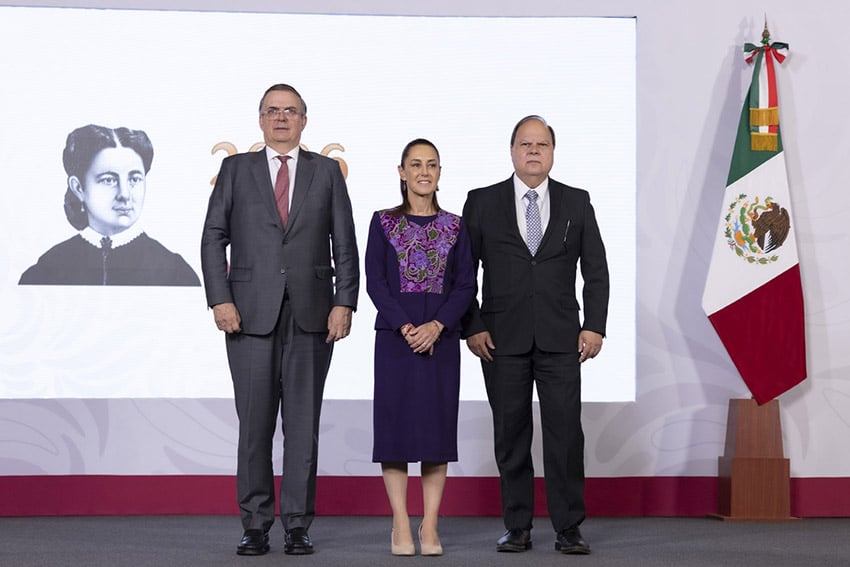
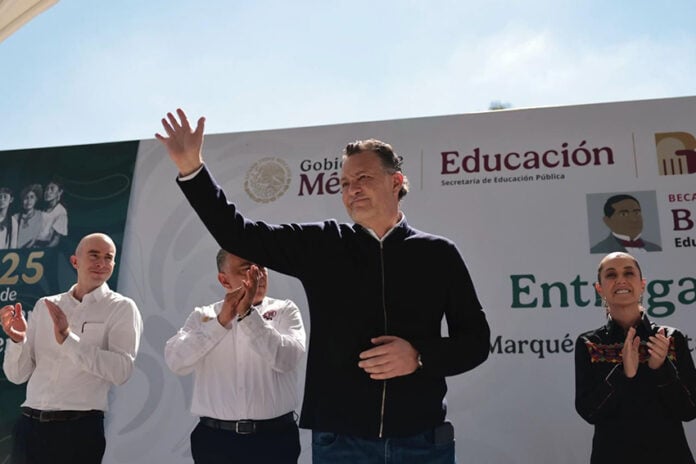
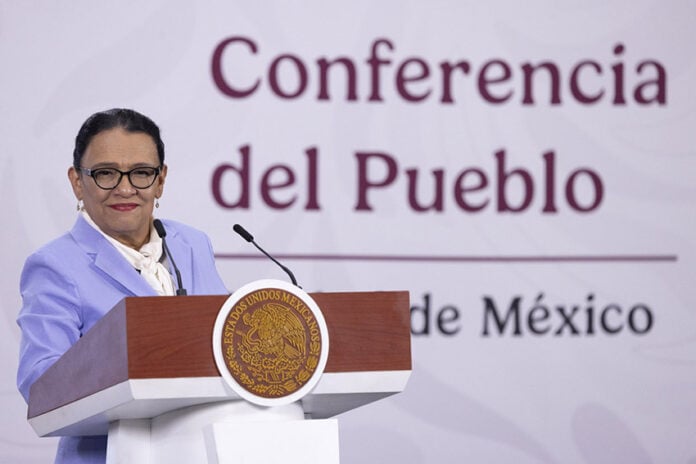
With President Sheinbaum en route to a meeting with fellow progressive leaders in Barcelona, Interior Minister Rosa Icela Rodríguez led Friday's press conference in her place. (Carlos Ramos Mamahua / Presidencia)
  • 🎙️ Today’s mañanera was led by Interior Minister Rosa Icela Rodríguez, standing in for President Sheinbaum.

  • 🚆 CDMX–AIFA train line: The long-awaited suburban rail link to Felipe Ángeles International Airport is tentatively set to open the weekend of April 25–26, pending final confirmation from President Sheinbaum.

  • 🇲🇽 200,000+ repatriations since Jan. 20: Rodríguez reported 203,685 returns to Mexico in Trump’s second presidential term, with over 80% arriving by land. Returnees have been supported by the México te abraza program. Deportations to Mexico in 2025 were below the annual figures recorded under Biden.

  • ✝️ Papal visit still unconfirmed: Asked about a visit from Pope Leo XIV, Rodríguez said the government has received information from the Vatican but nothing official. Mexico has the world’s second-largest Catholic population after Brazil.


Why today’s mañanera matters

Interior Minister Rosa Icela Rodríguez stepped in for President Sheinbaum, who was traveling to Spain to attend a meeting in Barcelona this Saturday.

Today’s mañanera was significant as Rodríguez gave an updated timeframe for the opening of the train line to the Felipe Ángeles International Airport (AIFA) and provided the latest data on repatriations to Mexico from the United States.

The Friday morning press conference also served as a reminder that women are at the apex of political power in Mexico. The federal interior minister is usually considered to be the second most powerful person in the Mexican government. Rodríguez is the third woman to serve in the role, after Olga Sánchez Cordero and Luisa María Alcalde, both of whom held the position during the 2018-2024 presidency of Andrés Manuel López Obrador.

Opening of train line to AIFA ‘tentatively’ set for next weekend 

Rodríguez told reporters that the opening of the long-awaited train line between the Buenavista station in central Mexico City and (AIFA) in México state is “tentatively” set for the weekend of April 25 and 26.

She said that Andrés Lajous, head of the Railway Transport Regulatory Agency, has said that the railroad will open next weekend. However, Rodríguez stressed that the date is pending confirmation from Sheinbaum.

She said that the train line — an extension of the Mexico City suburban railroad — is ready to open “shortly.”

Sheinbaum said in February that the railroad would begin operations “before Holy Week,” but that target was missed.

AIFA is located about 50 kilometers north of central Mexico City in the México state municipality of Zumpango. The federal government hopes that the opening of the train line  will lead to an increase in passenger numbers at the airport. The trip from Buenavista to AIFA will take around 40 minutes.

The inauguration of the train that will connect Mexico City to Felipe Ángeles International Airport (AIFA) is tentatively set for next weekend, Rodríguez said. (Presidencia via Cuartoscuro)

More than 200,000 repatriations since Trump returned to office

Rodríguez reported that there have been 203,685 “repatriations” to Mexico since Jan. 20, 2025, the day U.S. President Donald Trump began his second term.

Over 80% of those repatriations — 164,444 — were completed by land, with deportees and voluntary returnees crossing the Mexico-U.S. border. The remainder of the repatriations — 39,241 — were completed by air.

Rodríguez noted that the federal government has assisted returnees with the México te abraza (Mexico embraces you) program, which was unveiled the same day that Trump returned to the White House.

The program — which offers financial assistance, temporary accommodation and transport to returnees, and ensures that they can access services in Mexico — “came out of the mind and heart of the President Claudia Sheinbaum,” she said.

The program was developed after Trump pledged to carry out “the largest deportation operation in American history.”

However, deportations to Mexico in 2025 were in fact lower than the numbers recorded in each of the years of the Biden administration.

Will the pope visit Mexico this year?

Almost a year after she attended the inaugural mass of Pope Leo XIV and invited the pontiff to come to Mexico, Rodríguez was asked whether the government had received any information from the Vatican about the “probable date” of a papal visit.

“We have had information, but it’s not official,” the interior minister said.
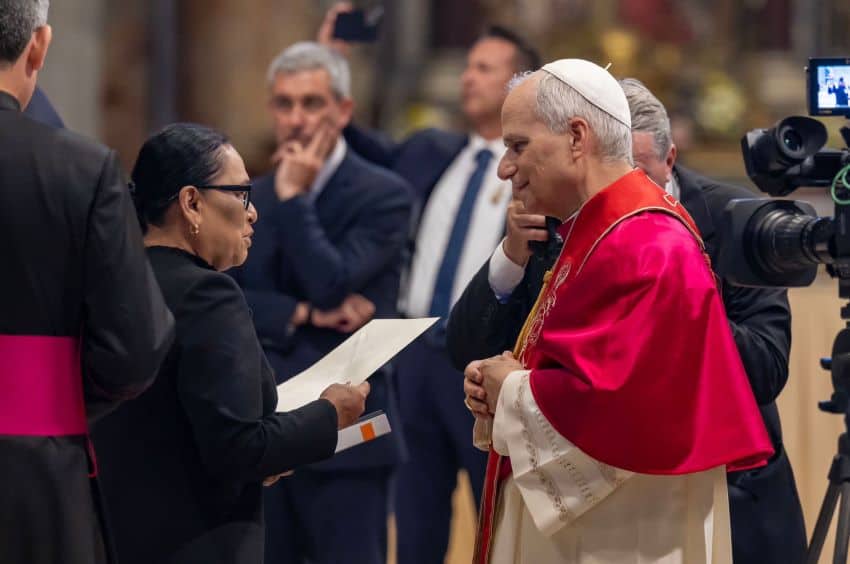
Mexico's Interior Minister Rosa Icela Rodríguez meeting Pope Leo XIV
Mexico’s Interior Minister Rosa Icela Rodríguez met with Pope Leo XIV in May 2025, following his inaugural mass in St. Peter’s Basilica. (Rosa Icela Rodríguez/X)

Rodríguez said that the government was hopeful that Pope Leo would come to Mexico, but stressed that it will be up to the Vatican to announce any visit.

Mexico has the world’s second-largest population of Catholics after Brazil.

Pope Leo, born Robert Francis Prevost in Chicago, became pontiff last May after the death of Pope Francis in April 2025.

By Mexico News Daily chief staff writer Peter Davies (peter.davies@mexiconewsdaily.com)

El Jalapeño: Company whose entire purpose is logistics reports ‘logistical issues’

0
Be warned: This aircraft is not performing logistics. (Magnicharters)

All stories in El Jalapeño are satire and not real news. Check out the original article here.

MEXICO CITY — Magnicharters, a commercial airline — an industry defined entirely by the coordinated movement of people and aircraft between predetermined locations at agreed-upon times — announced late Saturday afternoon that it would be suspending all flights for two weeks due to what it described as “logistical issues,” a phrase chosen, analysts noted, for its remarkable ability to explain nothing while technically saying something.

The company, which exists solely to perform logistics, did not elaborate. This is consistent with its general reputation for customer service.

magnicharters aircraft
You had one job… (Magnicharters)

Magnicharters, for the uninitiated, occupies a specific and humbling tier of Mexican aviation: the kind of airline where the seat pocket contains one laminated card and the lamination is coming off. The kind where the fare is so low that passengers board with the quiet, private understanding that they have made a financial decision rather than a travel one. The kind of airline where “on time” is treated as a secondary consideration to “now arriving at your destination.”

Passengers, in other words, knew what they were getting into. They just assumed they’d be getting into a plane.

The announcement, posted to social media at approximately six minutes past six on a Saturday evening — a time selected possibly because it is the least convenient possible moment to receive information — immediately left thousands of passengers stranded at airports including Cancún, Mérida, and Huatulco, in what the company’s CEO Gabriel Bojórquez called “an inconvenience” and what stranded tourists in beachside resort towns called several other things.

Bojórquez stopped short of acknowledging that an airline failing to operate flights is, in the most literal possible sense, an airline failing to do the one thing it does.

The Mexican government coordinated emergency rebooking options through Aeroméxico, Viva Aerobús, and Volaris, each of which, notably, managed to continue performing logistics throughout the crisis.

As of press time, Magnicharters had promised updates in the coming days. The coming days have begun.

Check out our Jalapeño archive here.

Got an idea for a Jalapeño article? Email us with your suggestions!

How AI wants to change agriculture in Mexico

3
Technological solutions for farming in Mexico
Artificial intelligence and technological solutions are poised to have an enormous effect on agriculture in Mexico. (Wikifarmer)

Mexico is one of the world’s great agricultural nations — a leading global exporter of avocados, tomatoes, citrus, coffee and berries, supplying produce for tables across North America, Europe and Asia. Its farmers are experienced, its land is productive, and its geographic position is uniquely advantageous for trade. What has historically held the sector back is not the quality of its produce but the inefficiency of the systems surrounding it.

Farmers currently receive between 10% and 20% of the final sale price of their goods, with the remainder absorbed by intermediaries. Cross-border transactions still commonly rely on phone calls and informal networks, taking weeks when they could take days and less than 1% of agricultural trade occurs online. The opportunity to modernize is enormous, so one AI company is looking to help Mexico’s farmers seize it.

A powerhouse ready for its next chapter

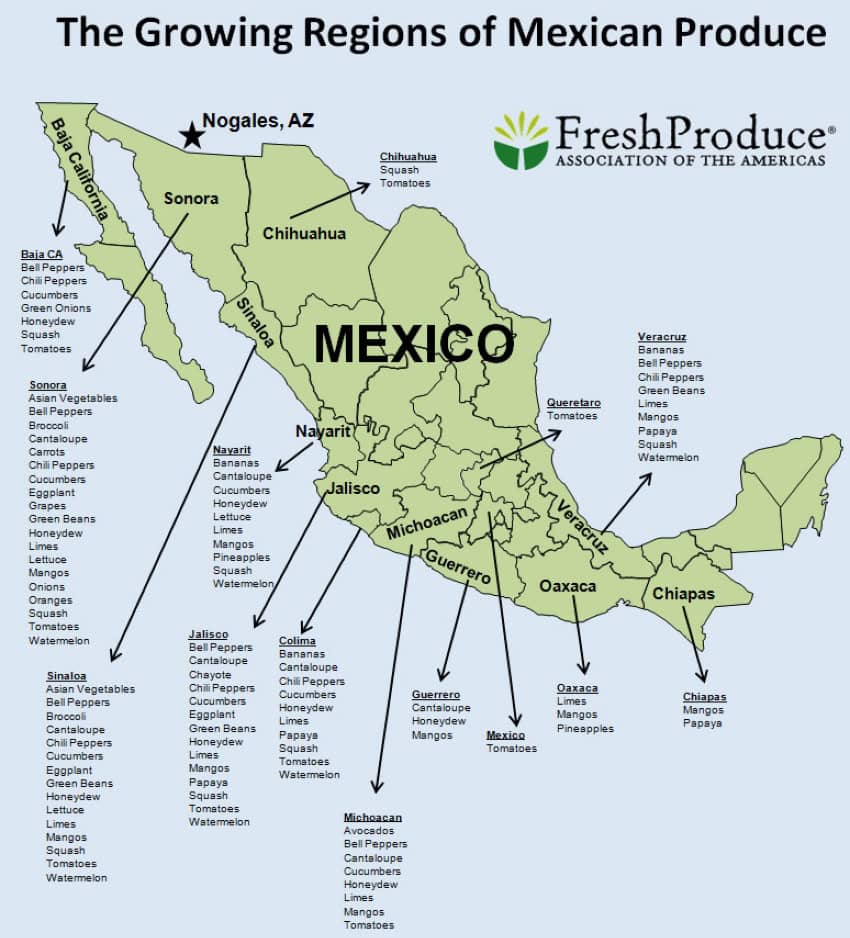
Growing map of Mexico
Mexico is an agricultural powerhouse, but it could benefit greatly from the increased quality and efficiency brought by AI. (UC Davis)

Mexico’s agricultural sector — already one of the world’s most productive — is drawing fresh attention from international technology investors betting that artificial intelligence can unlock its next era of growth. Wikifarmer, a Greek agricultural technology platform, has raised US $7.7 million to expand its AI-powered trading system into Latin America, with Mexican farmers designated as its primary target market. 

The platform, which the United Nations Food and Agriculture Organization has recognized as the “Wikipedia of Farming,” connects producers directly with buyers using artificial intelligence to forecast commodity prices, match suppliers with buyers, and manage transactions that include logistics, payments and credit assessment. The company says it has already reached more than 40,000 users in Mexico at the end of 2025, as they look to navigate a challenging landscape of tariffs, fluctuating demand and climate change.

Mexico’s northern states already benefit from advanced irrigated systems, while the biodiverse south offers considerable untapped agricultural potential, but Wikifarmer hope that their new platform will help realize these gains.

AI delivering real results

Artificial intelligence is already proving its value in agricultural markets around the world, and the evidence of what it can do for smallholders and commercial producers alike is compelling.

The income impact alone can be transformative. AI-driven optimization in supply chains and market access has already delivered 30 to 50% higher farmer incomes in India, along with reductions in price volatility and improved profitability. Research suggests that export-oriented farmers earn 20% to 50% higher incomes compared to those reliant on local markets — and AI-powered platforms are increasingly making those export markets accessible to producers who previously had no route in.

On the farm itself, the gains are equally striking. Precision farming enabled by AI can cut water usage by up to 25%, reduce agrochemical use and deliver crop yield increases of 20 to 30% in early adopter regions. AI provides farmers with real-time crop insights, helping them identify which areas need irrigation, fertilization or pesticide treatment — decisions that previously required expensive specialists or years of trial and error. For Mexican producers already expert in their crops, these tools amplify the knowledge they already have rather than replacing it.

Water scarcity Mexico
Precision farming enabled by artificial intelligence could help cut water usage by up to 25%. (Government of Mexico)

Climate resilience is another area where AI is proving its worth. Precise weather predictive capabilities can empower farmers’ climate management by providing accurate forecasts, helping them adopt effective strategies against drought, excessive rainfall and extreme weather events. These are risks that Mexican farmers, particularly in the south, know well.

Deployment of new capital for Mexican markets

The platform’s AI tools analyze commodity trends, seasonal cycles and supply data to generate price forecasts, matching buyers with verified suppliers based on certifications and quality data. The system also handles credit assessments — a significant advantage in Mexico, where producers have historically struggled to access financing. AI agricultural service networks can increase farmer incomes further by assisting with pricing and marketing strategies, compounding the gains that come from reaching international buyers directly.

“AI is transforming agriculture faster than most expect,” said Ilias Sousis, co-founder and CEO of Wikifarmer. “We are moving the industry from analog to digital, making trade faster, smarter, and more transparent.”

The new funding will go toward expanding AI capabilities, growing producer networks across Latin America and Africa and launching FarmClick — a joint digitization initiative with Greece’s Piraeus Bank, covering seeds, fertilizers, equipment and financial services, with similar banking partnerships planned for new markets. Mexican farmers will have access to this funding, which Wikifarmer hopes will be able to transform the lives of thousands of low-income agricultural workers across the country.

For Mexican farmers, the trajectory is clear: a sector that already feeds much of the world is gaining the digital infrastructure to ensure its producers are rewarded accordingly. Agricultural intelligence is empowering farmers to use their deep expertise to make smarter decisions that increase crop yields, improve sustainability and drive profitability. In Mexico, that expertise runs deep.

Irena Vélez is a journalist at Wikifarmer, based in Seville, Spain. She holds a Bachelor’s degree in Journalism (Honors) from Carleton University in Ottawa, Canada, and reports on a range of topics, including agriculture, sustainability, and agribusiness.

To learn more about the agriculture sector, Wikifarmer empowers farmers, agribusiness professionals, and industry observers through four key pillars: the Wikifarmer Marketplace, connecting producers with buyers around the world; the Wikifarmer Library, a free, open-access knowledge hub with thousands of expert-authored articles; the Wikifarmer Academy, offering online courses with certifications to enhance agricultural skills; and Wikifarmer Price Insights, providing real-time market intelligence on key commodities. 

False friends: Spanish and English words that look similar, but have different meanings

7
Two friends embracing
You will make real friends living in Mexico, but beware "false" ones while learning Spanish. (RDNE Stock project/Pexels)

For English speakers, Spanish can feel deceptively familiar. So many words are similar that it’s tempting to trust them. The danger isn’t in the words you don’t know, but in the ones that you think you do.

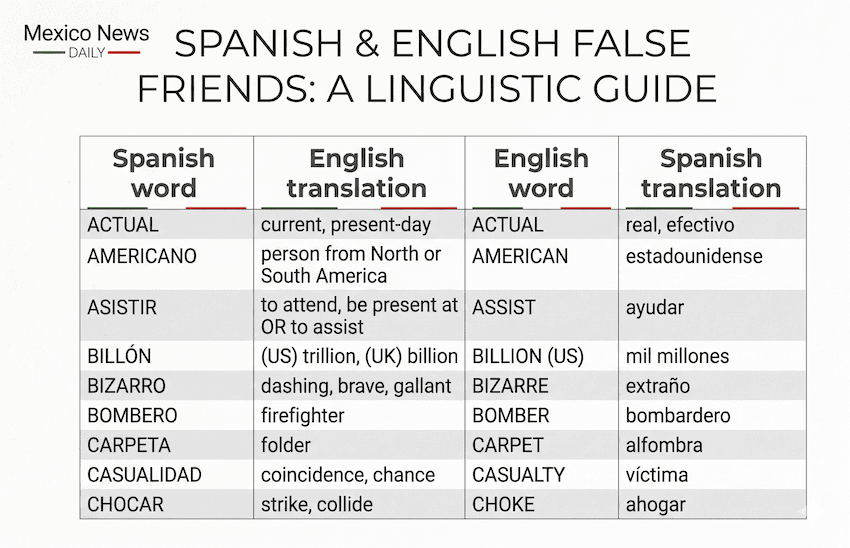
In linguistics, words that look and behave similarly across languages are called cognates; they share both form and meaning. On the other hand, false cognates, also known as false friends, look similar but behave differently. These are words that have drifted apart in meaning through a process known as semantic shift, the way languages evolve in response to their own geographical and historical contexts.

Shared origins, different journeys

Women speaking Spanish
Learning Spanish is important if you’re living in Mexico, but it’s not always as easy as “¿Hablas español?”  (LinkedIn Sales Solutions/Unsplash)

False friends offer a fascinating window into linguistic history. For those of us inclined to nerd out, they read like an archaeological dig through etymology, revealing how common roots evolved in different directions.

Spanish grew directly out of Latin, while English began as a Germanic language and later absorbed large amounts of Latin-based vocabulary through French, religion, law and science. The result is a shared pool of familiar-looking words, some of which shifted gently in meaning, while others wandered off entirely.

False friends can get you in trouble because the listener may still understand you, just not in the way you intended. The resemblance gives you confidence, until it sabotages your intentions. Let’s look at a few of these traitors in action.

A toast to accidental motherhood

Imagine you’re at a social gathering and spill your drink. Wanting to recover gracefully, you smile and announce, “Estoy embarazada.” Heads turn. Someone places a hand on your shoulder in far more solidarity than seems necessary. An awkward way to learn that embarazada doesn’t mean embarrassed, it means pregnant.

Drama by pretense

Pretender is frequently misused by learners because it looks so familiar. In Spanish, pretender means to intend or to plan to do something. It has nothing to do with acting fake or putting on a show; that sense of pretending would be fingir. However, you could certainly say, “No pretendas fingir que me amas,” which means “don’t intend to pretend that you love me,” if you’re ready to raise the drama to telenovela levels.

Authority lost in translation

You’re in the middle of a heated debate and jump in with a confident “Actualmente,” fully expecting it to carry the force of a sharp actually. What you’ve actually said, though, is currently. Your firm intervention suddenly sounds less like a fact-check and more like a calendar update.

Better than trusting your memory

You might ask someone to “recordar” a meeting, thinking you’re requesting a recording you can replay later. In Spanish, recordar doesn’t mean to record audio or video; it means to remember. If you want the meeting captured and saved, you’ll need grabar.

Don’t commit when you want to compromise

You might think you’re being polite by saying you are open to a compromiso, imagining you can all reach a fair agreement. In Spanish, however, compromiso means a commitment, and very often, an appointment. So instead of signaling flexibility, you just announced that you have somewhere else to be. Not exactly the spirit of a good conversation.

Thanks for tolerating

You might warmly tell someone that you soportar their decision. In Spanish, however, soportar doesn’t mean to support or encourage. It means to tolerate or put up with, often with effort. So, instead of sounding loyal and uplifting, you may have just implied that you’re bravely enduring their choice.

You don’t need an epiphany to carry out a task

Realizar is another word that often tricks English speakers. It looks like the English word realize, so it’s tempting to use it when you’ve had an insight. But in Spanish, realizar means to carry out or perform a task. For sudden clarity, you’ll want darse cuenta. Realizar is about execution, not enlightenment.

Not level-headed, just tender-hearted

Sensible is another word that feels like a safe compliment, until it isn’t. In English, calling someone sensible suggests they’re practical, level-headed and calm. In Spanish, sensible means sensitive, emotionally fragile. So, if you describe a colleague as “muy sensible,” you are not praising their sound judgment but rather implying that you’ve had to keep them company more than once while they cried.

Not that kind of introduction

And then there’s a false friend that deserves a big warning label. If you’re one of the many who says, “Voy a introducir a mis amigos,” this is your cue to pause. Introducir is not used for introducing people; that would be presentar. Introducir means to insert. The problem is that it sounds fine until the mental image lands.

The bilingual brain

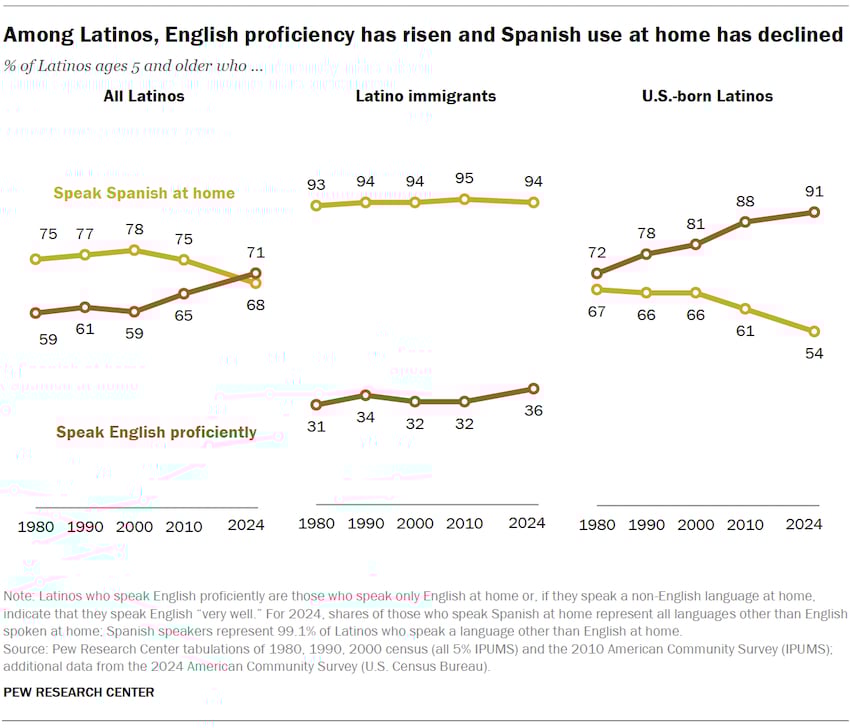
With more Hispanic Americans than ever switching to English as a primary language, perhaps it’s time to remember the benefits of bilingualism. (Pew Research)

Juggling two languages means constantly choosing one while suppressing the other, a mental training that strengthens attention and task-switching. The benefits show up throughout life: bilingual babies adapt more quickly to their environment, and bilingual seniors often experience slower cognitive decline. In other words, learning another language gives your brain a healthy workout.

The payoff isn’t only neurological. Knowing different languages expands your reality. When a familiar word reveals a different meaning, it challenges your assumptions. You begin to sense that language is not just a tool for describing the world, but a lens through which the world is interpreted. As that lens widens, so does your perspective. What once felt universal becomes circumstantial, and you become more flexible. Occasional stumbles aren’t a failure, but evidence that you’re growing toward a more compassionate understanding of your place in the world.

Sandra is a Mexican writer and translator based in San Miguel de Allende who specializes in mental health and humanitarian aid. She believes in the power of language to foster compassion and understanding across cultures. She can be reached at: sandragancz@gmail.com.

Flex is making a billion-dollar bet on AI manufacturing in Mexico

0
Flex logo on building
The billion-dollar investment is coming from a company that has been manufacturing in Mexico for four decades and accumulated a workforce of 40,000. (Flex)

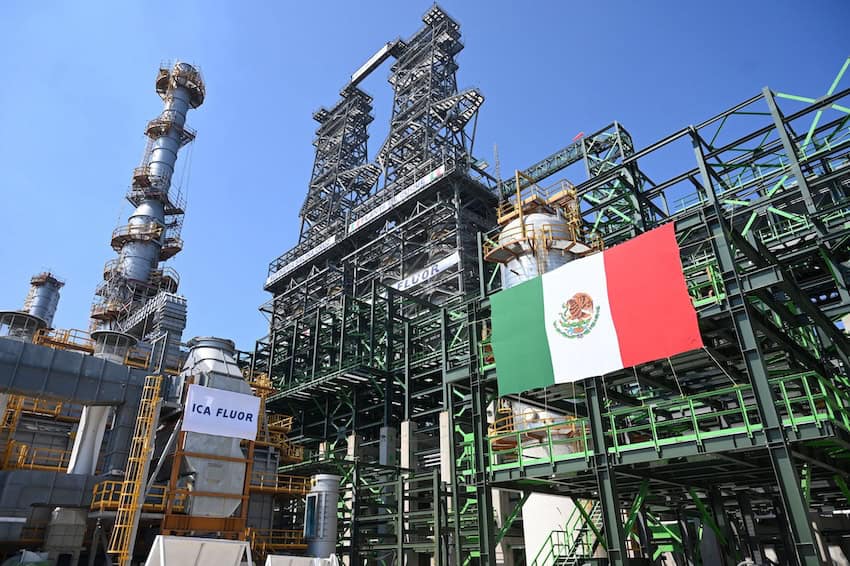
Flex, a diversified manufacturing partner with a growing focus on AI infrastructure, cloud computing and power solutions, has announced a US $1 billion investment in Mexico.

The investment — to be spread out over the next two years — seeks to boost the Austin, Texas-based company’s advanced manufacturing capacity in Mexico and will focus on creating equipment for data centers and artificial intelligence.

Guillermo del Río Ochoa of Flex stands with President Sheinbaum and Economy Minister Ebrard at a press conference
Economy Minister Marcelo Ebrard and Flex’s senior director of business development and governmental relations Guillermo del Río (right) elaborated on the new investment during President Claudia Sheinbaum’s Thursday morning press conference. (Gabriel Monroy / Presidencia)

With eight plants and 40,000 employees already in Mexico, Flex provides design, engineering, manufacturing and supply chain services, while operating as a key hub for advanced manufacturing.

Economy Minister Marcelo Ebrard and Flex’s senior director of business development and governmental relations Guillermo del Río elaborated on the new investment during President Claudia Sheinbaum’s Thursday morning press conference.

Ebrard said the investment is linked to the development of infrastructure for data centers and artificial intelligence, while Del Río confirmed that Flex already manufactures all the equipment needed to operate data centers at its plant in Guadalajara.

“The goal is to manufacture, assemble and test this equipment — this high-tech manufacturing — in Mexico,” Ebrard said, adding that only six countries in the world are capable of doing this.

The new funds — Flex’s largest investment in Mexico since it began operating here 40 years ago — will create 5,000 new jobs and will also serve to grow the company’s supply chain in Mexico, Del Río said.

“The metals we use … are already made in Mexico, the plastics are made here, too,” Del Río said, “[but] we’re still very dependent on external sources for electronics.”

Del Río said the investment is a response to the growth in telecommunications and the demand for technological infrastructure, explaining that production, which requires high energy consumption for equipment testing, will be concentrated in Guadalajara.

“To give you a sense of scale, we’re going to consume seven times the energy consumed by the port of Manzanillo,” he said. “That’s the energy required for testing this highly complex equipment.”

Flex — which also designs sophisticated products in Mexico such as hospital beds that can detect osteoporosis with a high degree of accuracy simply from the patient lying in the bed — has invested US $2.3 billion in Mexico over the past 10 years.

With reports from Reforma, El Universal and Quadratín México

US border wall construction damages sacred Cuchumá Hill on Mexico–US border

4
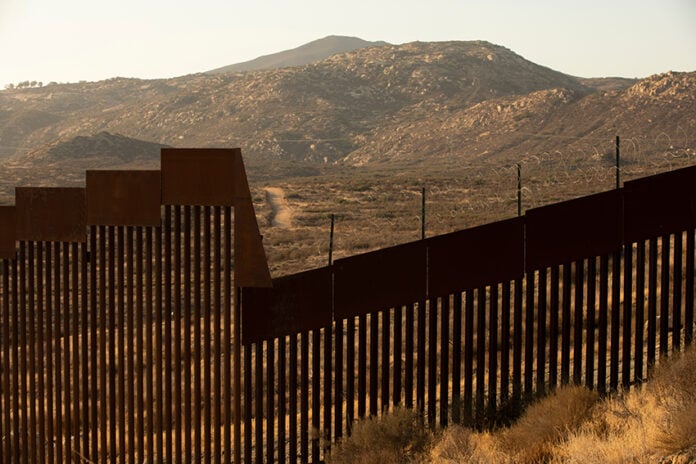
A previously built section of wall along the Mexico-U.S. border near Tecate, Baja California.
A previously built section of wall along the Mexico-U.S. border near Tecate, Baja California. (Shutterstock)

To facilitate the construction of a section of wall on the border between the United States and Mexico, the U.S. government has been using explosives on a sacred hill, angering the Kumeyaay Indigenous people.

The explosions on the rock-covered Cuchumá Hill (also known as Tecate Peak) began in early April and have continued during the past week, according to residents of Tecate, a municipality in Baja California that borders California.

Explosiones en el Cerro del Cuchumá: montaña sagrada amenazada por el Muro Fronterizo.

Authorities in Mexico and Kumeyaay people say that the blasts are causing major damage to the hill, which straddles the U.S.-Mexico border just west of the Baja California city of Tecate. A 35-meter-high carved monolith that is considered sacred was reportedly damaged by one detonation.

“They’re destroying it,” Indigenous rights advocate Norma Meza Calles said of the hill, which is considered intangible cultural heritage in Mexico and has been on the United States’ National Register of Historic Places since 1992.

“It’s very sad because that mountain is very important to us,” Meza told the news agency EFE.

“We’re taught to respect the mountain because for us there are no churches, so we used to go there to sing and concentrate. … For you, it’s just a mountain; for us, it’s our church,” she said.

Another Tecate resident, Juan Saldaña, described Cuchumá Hill as the “faithful guardian of Tecate.” The Kumeyaay people have carried out rituals and ceremonies there for as long as anyone can remember, practices that are now under threat from the border wall construction. Tecate residents reportedly received no prior warning that the U.S. government would use explosives on the hill.

Claudia Cota, a Kumeyaay woman and a councilor with the Tecate municipal government, told KSDY Channel 50 that the detonations by U.S. authorities “have altered the natural environment of the hill.”

“We know that there are a lot of small animals that live there. There is flora, there is subterranean water that circulates and maintains the aquifers,” she said.

Explosives are reportedly being used to help clear the way for a new section of border wall between Tecate and San Diego County. The Trump administration overrode laws that protect the environment, archaeological sites, water, flora and fauna to forge ahead with construction of the wall in the area, the newspaper El Universal reported.

Tecate Mayor Román Cota Muñoz told EFE that he has chosen not to not to “interfere” with the work U.S. authorities are doing as it is taking place within U.S. territory. However, he noted that “the hill’s location means any modification on one side has visible effects on the entire environment,” according to EFE.

For their part, state authorities in Baja California have arranged a meeting with the U.S. consul in Tijuana to speak about the situation. The meeting — at which Kumeyaay representatives from both sides of the border and Mexico’s consul in San Diego will also be present — is scheduled for this Friday.

Alma Delia Abrego Ceballos, Baja California’s culture minister, said that Cuchumá Hill represents “resistance and spirituality” for the Kumeyaay people. Isaul Adams Cuero, a Kumeyaay man, told El Universal that the hill is considered sacred because it was formerly a place where “wise” members of the Indigenous group passed on life lessons to their students.

Gilberto Herrera Solórzano, a deputy who represents Tijuana in federal Congress, has called on the federal Culture Ministry to investigate and disclose the damage that has occurred on the hill. He has also urged the Ministry of Foreign Affairs to push for the suspension of the use of explosives in the area.

President Claudia Sheinbaum said last week that the ministries of Culture and Foreign Relations were already looking at the issue.

The US has also blasted a border site near El Paso 

On March 16, the El Paso Sector of the U.S. Border Patrol posted a video to social media showing a series of detonations on Mount Cristo Rey, located just west of El Paso in Sunland Park, New Mexico.

“Conducting another controlled blast to clear the way for vital infrastructure and strengthen homeland security,” the El Paso Sector said in the post. “El Paso’s Mt. Cristo Rey area is known for unexpected crossings — we’re on the ground to keep everyone safe. Border security is national security.”

Mount Cristo Rey straddles the U.S.-Mexico border near the Mexican city of Ciudad Juárez.

The Puente News Collaborative reported that last June, “then-Homeland Security Secretary Kristi Noem waived more than two dozen laws … to expedite construction of the wall across the mountain.”

There are significant concerns about the impact the construction of a border wall will have on Mount Cristo Rey, which is home to a statue of Christ and dinosaur footprints — which are reportedly not threatened — and frequented by animals such as coyotes and lizards.

In public comments to U.S. Customs and Border Protection “more than 80 people expressed concern for Mount Cristo Rey’s prized environment,” Puente News Collaborative reported.

“The agency’s summary statement, in response, explained that a biological survey yielded no federally listed threatened or endangered species,” the news outlet said.

The CBP also said it has “determined there is minimal impact to vegetation and behavioral patterns of wildlife since the project area is flanked by existing barriers and an active patrol road.”

Puente News Collaborative summed up the situation this way: “Blast by blast, border wall construction is coming for Mount Cristo Rey.”

The same thing could be said for Cuchumá Hill.

With reports from La Jornada, EFE, El Universal and El País

Setback for Mexico: Canadian court reopens US $270 million NAFTA case against Pemex

1
An oil drilling platform in the Gulf of Mexico
A private oil services company's lease of five platforms to Pemex led to a legal dispute that was quashed by an arbitration panel on technical grounds. But a new court ruling has opened up the case again, putting Mexico at risk for a US $270 million penalty. (Shutterstock)

Mexico could be on the hook for US $270 million after a Canadian court overturned a 2024 arbitration award that had seemed to terminate the case in Mexico’s favor.

The court ordered that proceedings be reopened in a lawsuit filed by Mexican oilfield services provider Oro Negro against Mexico’s state-run oil company Pemex, claiming violation of the rules of NAFTA, the trilateral trade agreement that preceded the current USMCA.

PEMEX INSTALLATION
Although it does not imply a conviction against Mexico, the new procedural twist prolongs a high-profile litigation that keeps the relationship between private investors and Mexico’s state-run energy sector under scrutiny. (Presidencia/Cuartoscuro)

The new court decision reverses the previous status of the case, which had been closed in August 2024 after an arbitration tribunal favored Mexico by declaring itself incompetent to hear the case based on the claimants’ Mexican nationality and their close connection to it. 

According to reports from Global Arbitration Review, the Canadian court found that “the [arbitration] tribunal wrongly declined jurisdiction and Chilean arbitrator Andrés Jana failed to disclose a potential conflict from his counsel work.”

Additionally, the Canadian court ordered Mexico to cover US $100,000 in legal costs within 30 days.

As a result of this week’s ruling, international investors linked to Oro Negro revived their legal offensive against Mexico and the case returns to the substantive analysis stage presumably leading to an eventual ruling on its merits, rather than on jurisdictional issues. 

Although it does not imply a conviction against Mexico, this new procedural twist prolongs a high-profile litigation that keeps the relationship between private investors and Mexico’s state-run energy sector under scrutiny, particularly in disputes related to contracts with Pemex. 

Should the final ruling be unfavorable to Mexico, its treasury could face a potential payment of US $270 million.

The dispute dates back to the 2013-2017 contractual relationship between Oro Negro and Pemex when Oro Negro leased five oil platforms.

The plaintiffs initiated their lawsuit in 2017, alleging that Pemex manipulated agreed-upon tariffs in 2015, induced Oro Negro to accept reduced lease rates and prematurely terminated existing contracts. The accusations included breach of contract and preferential treatment of competitors.

The conflict triggered the bankruptcy of Oro Negro and gave rise to one of the most significant energy disputes under NAFTA (the North American Free Trade Agreement).

Pemex bribery mechanism revealed at meeting with Israeli investigators

The case eventually became a NAFTA investor versus state dispute under Chapter 11 as investors claimed Mexico breached NAFTA obligations regarding fair and equitable treatment and expropriation.

In 2019, the Wall Street Journal reported that the Israeli private investigation company Black Cube secretly recorded senior officials at Pemex describing widespread bribery and corruption at the state-run oil company in 2017.

The investigators were hired by Oro Negro and the oilfield services company submitted the recordings as evidence while claiming that Pemex intentionally drove it into bankruptcy because it refused to pay bribes.

Mexico maintained the recordings lacked probative value and were obtained illegally.

With reports from El Universal, Milenio and Aristegui Noticias

Which Mexican states have the most popular governors?

2
Querétaro Gov. Mauricio Kuri
With an approval rating just over 60%, Mauricio Kuri of Querétaro was Mexico's most popular governor in March. (Presidencia via Cuartoscuro)

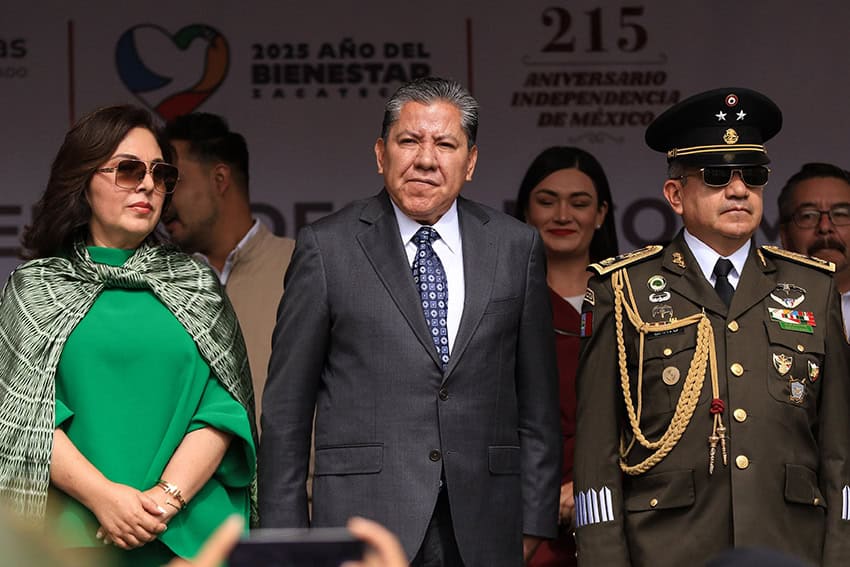
Mexico’s most popular state governor is Mauricio Kuri of Querétaro, while the least popular is David Monreal of Zacatecas.

They are among the findings of the latest popularity poll of governors of Mexico conducted by Mitofsky for the newspaper El Economista.

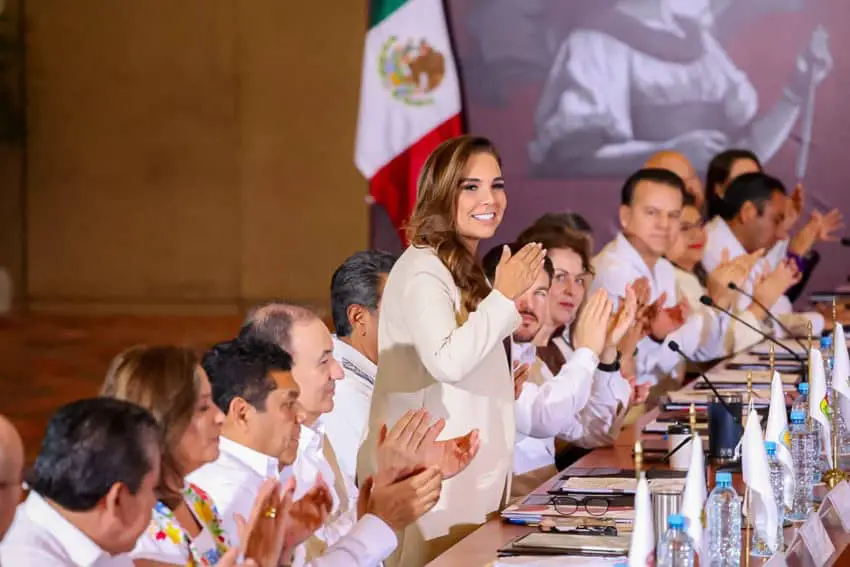
Quintana Roo Governor Mara Lezama standing in a row of seated Mexican government officials.
Quintana Roo Gov. Mara Lezama, who oversees the tourist meccas of Cancún and the Riviera Maya, was Mexico’s second-most popular governor in March. (Mara Lezama/X)

Mitofsky, a Mexico City-based polling company, surveyed 59,548 people across Mexico in March, asking them whether they approved or disapproved of the performance of the governor of the state in which they live.

The poll found that three governors had approval ratings of 60% or higher, two of whom represent the conservative National Action Party (PAN). Those governors are:

  • (1) Mauricio Kuri of Querétaro (PAN): Approval rating of 60.7% in March, up 3 points compared to February.
  • (2) Mara Lezama of Quintana Roo (Morena): 60.4% (+1.4 points).
  • (3) Tere Jiménez of Aguascalientes (PAN): 60% (+2.8 points).

Mitofsky’s February poll also found that Kuri, Lezama and Jimémez were Mexico’s three most popular governors. However, in March, Kuri — who has been in office since October 2021 — supplanted Lezama in the top position. It is the first time a Mitofsky poll has detected that the PAN politician is the country’s most popular governor. Querétaro has lower levels of violent crime than many other states and currently has one of the country’s lowest unemployment rates (1.4% in February).

The three least popular governors all had approval ratings in the 30s last month. They are:

  • (30) Javier May of Tabasco (Morena): 8%
  • (31) Rocío Nahle of Veracruz (Morena): 4%
  • (32) David Monreal of Zacatecas (Morena): 1%

Just over half of respondents approve of their governor 

On average, the approval rating of a state leader in Mexico in March was 50.6%. That percentage — up 0.7 points from February — was the highest average since last September.

Nineteen leaders had approval ratings above the average in March, while 13 had approval ratings below the average.

Twenty-three leaders improved their approval ratings compared to February, while nine went backwards.

Among those whose approval rating improved, Hidalgo Governor Julio Menchaca recorded the largest gain, improving his standing by 4.2 points in the space of a month. He jumped three positions in the rankings to become Mexico’s fourth most popular governor.

Morelos Governor Margarita González recorded the biggest approval rating decline, sliding 2.8 points to 48.1%. She fell one position in the rankings to 21st.

Gov. David Monreal of Zacatecas at a military event
Zacatecas Gov. David Monreal remains Mexico’s least popular governor, followed by Rocío Nahle of Veracruz. (Adolfo Vladimir / Cuartoscuro.com)

David Monreal remains Mexico’s most unpopular governor, even though homicides declined by a larger percentage in Zacatecas last year than in any other state. Mitofsky attributed the decline in Veracruz Governor Rocío Nahle’s approval rating in March to the recent oil spill off the state’s coast. Nahle, a former federal energy minister, slid three spots in the rankings and is now Mexico’s second most unpopular governor.

All of the governors whose approval rating fell in March represent Morena, the party founded by former president Andrés Manuel López Obrador. Morena is currently in office in 23 of Mexico’s 32 federal entities, and at a federal level.

With reports from El Economista

Meet Yuji, the abandoned baby monkey stealing hearts at the Guadalajara Zoo

1
baby monkey at Guadalajara Zoo
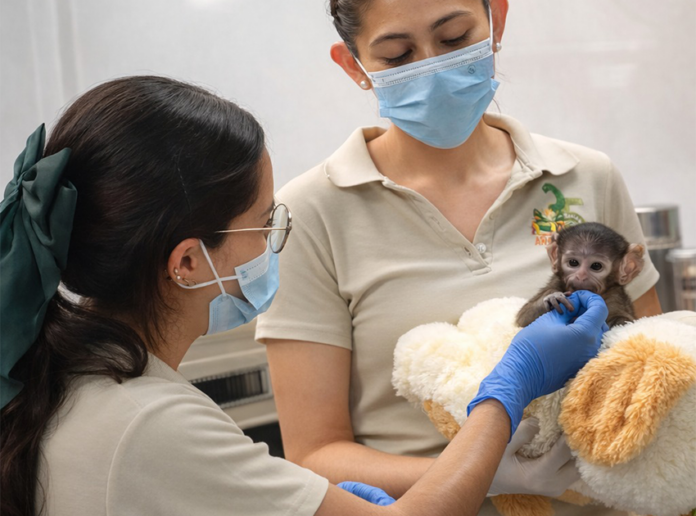
Zoo personnel saved the abandoned infant monkey's life by providing it with a controlled temperature, liquid nutrients and a substitute mother in the form of a stuffed animal toy. (Guadalajara Zoo)

Rejected by his mother and now clinging to a stuffed dog for comfort, a tiny Mexican monkey at the Guadalajara Zoo has become Mexico’s latest internet star.

The story of frail, lovable Yuji — who weighed just 443 grams, slightly less than a pound, at birth on March 3 — lands in the middle of a global wave of sympathy for rejected zoo babies.

In Japan, Punch, a baby macaque whose mother rejected him shortly after birth, went viral this year after he was photographed clinging to a stuffed orangutan — an image recreated by a Mexico City baker in the form of a concha.

Now in Washington, D.C., there is a frenzy over Linh Mai, a 10-week-old bottle-fed Asian elephant calf at the National Zoo whose own mother refused to care for her.

Meanwhile, Yuji, a six weeks old patas monkey (Erythrocebus patas), is being hand-raised at the Guadalajara Zoo’s Integral Center of Animal Medicine and Wellbeing (CIMBA) after his mother, Kamaria, a first-time parent, failed to hold or nurse him properly in the hours after birth.

Weighing just 15.6 ounces at delivery, he was moved almost immediately into an incubator kept near 35 degrees Celsius to stabilize his temperature. A team of more than a dozen veterinarians and biologists are giving him 24/7 care, including four bottles a day of fortified formula. Yuju now weighs about 673 grams (23.7 ounces).

“His mother was a first-time mother and did not have the experience needed to care for him,” said Iván Reynoso, veterinarian and manager of the zoo’s primates department. “Therefore, we decided to provide assisted rearing by doctors, veterinarians and caretakers from the primates area here at CIMBA.”

Like Punch, Yuji now rarely lets go of his plush toy, a stuffed dog that functions as a surrogate mom.

“They cling, and at that age, all the security they have comes from their mother,” Reynoso said. “So, in the absence of his mother, what we do is substitute her with a stuffed toy … This is completely natural behavior for him.”

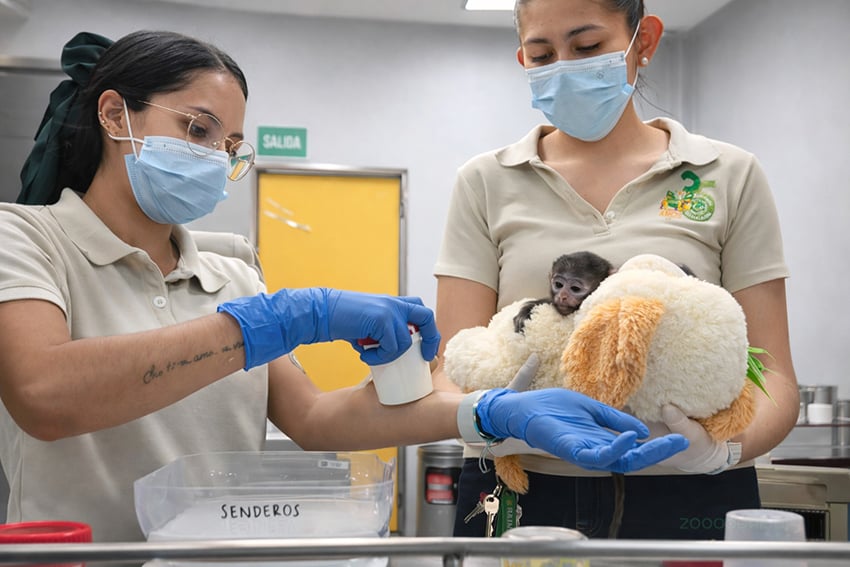
Staff rotate the stuffed dog with a bear and a monkey to keep the toys clean, but Yuji’s routine is the same: he naps and drinks from a bottle while clinging to the plush toy inside a crate with a small hammock and ropes to encourage climbing.

He has not yet had physical contact with other patas monkeys and no date has been set for his move into the exhibit with 12 adults and three other infants. The transition will depend on weaning him off milk and getting him onto fruits and vegetables.

A zookeeper prepares formula as Yuji looks on from the comfort of a stuffed dog plushie. (Guadalajara Zoo)

As he approaches six months, officials will slowly take away the plush toys in preparation for his move into the main habitat.

Social media users have dubbed him “Mexican Punch” and “Punch tapatío.”

As for his given name, veterinarian Sandra Arely Franco said she chose “Yuji” because it’s a character from the Japanese manga-anime series “Jujutsu Kaisen” known for having “unbreakable strength.”

As with Punch and the baby elephant in Washington, Yuji’s story has stirred debate.

Some animal-rights advocates argue that no incubator or plush toy can replace a natural habitat and social group, and that animals have the right to live and die where they belong.

Guadalajara Zoo officials counter that intervention was a matter of survival. They even tried to get other patas mothers to “adopt” him.

“If he was not fed and comforted, it could have had negative consequences for his life,” Reynoso said.

With reports from Associated Press, TV Azteca Laguna, Dexerto and Reuters

Mexico in Numbers: Mexico’s biggest and smallest states

0
A highway sign says "Termina Chihuahua, El estado grande"
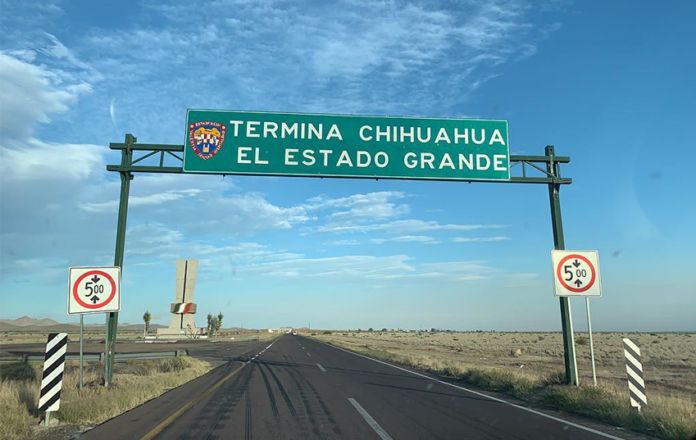
At 247,455 square kilometers, Chihuahua — Mexico's largest state by area — is bigger than the entire United Kingdom. (Asociación de Estudiantes de Chihuahua)

You likely know that Mexico has 32 federal entities — 31 states and the national capital, Mexico City, which has state-like status.

But do you know how many municipalities Mexico has?

At the end of 2024, the number was 2,478, including Mexico City’s 16 alcaldías (mayoral districts or boroughs), according to national statistics agency INEGI.

So which state has the most municipalities and which has the least? Read on to become a Mexico municipality master!

In this “Mexico in Numbers” article we also take a look at the size of Mexico’s states by area and compare some of them to different countries around the world. Did you know that Chihuahua is slightly bigger than the entire United Kingdom?

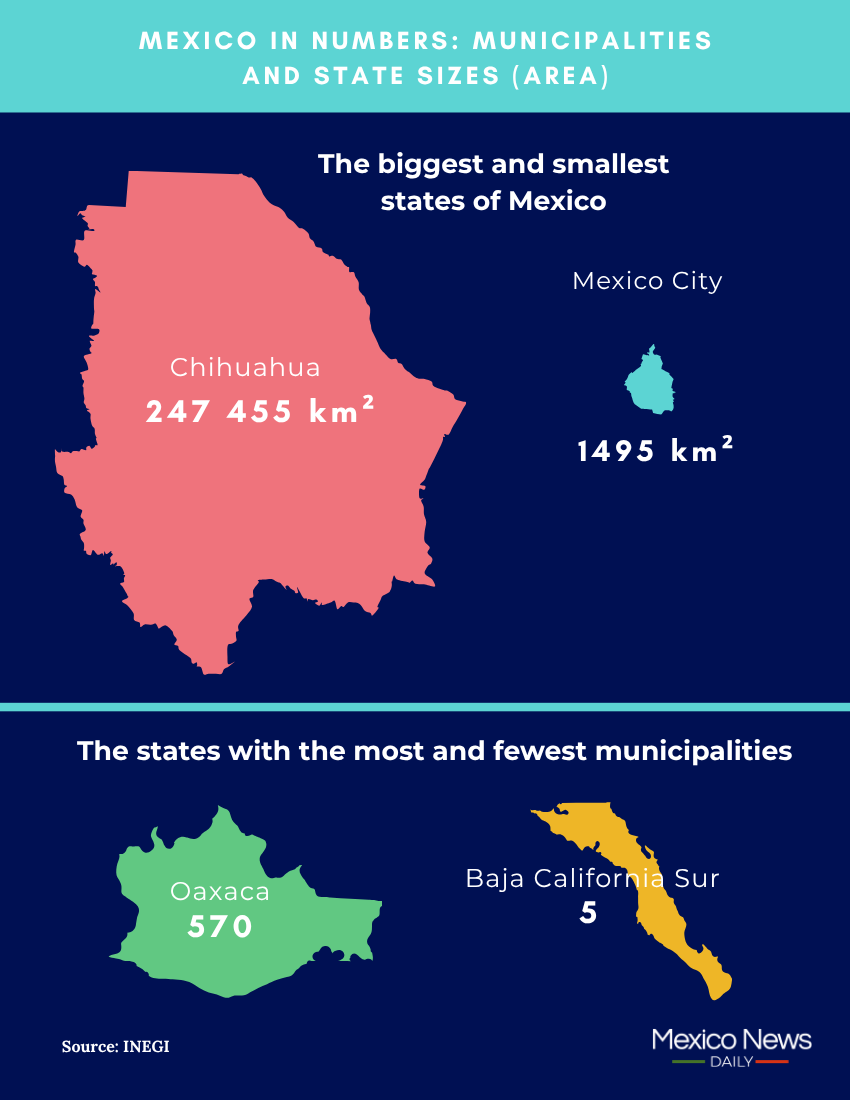
Oaxaca has 570 municipalities, Baja Sur has just 5 

As you can see in the map below, the southern state of Oaxaca easily has the most municipalities among Mexico’s 32 federal entities. Why so many? In a nutshell, the provision of Indigenous autonomy at a hyper-local level — more than 400 of the 570 municipalities are self-governing Indigenous communities where leaders govern in accordance with a traditional system known as usos y costumbres.

Among the other quirks of the distribution of municipalities in Mexico is that the country’s largest state by area, Chihuahua, only has seven more municipalities than the nation’s smallest state, Tlaxcala. Needless to say, municipalities in Chihuahua are generally much larger than those in Tlaxcala. In fact, Chihuahua’s largest municipality, Ahumada, is more than four times larger than the entire state of Tlaxcala.

The number of municipalities in Mexico is subject to change. Among those that have been created this century are San Quintín in Baja California and Puerto Morelos in Quintana Roo. México state is currently analyzing a proposal to create four additional municipalities.

Chihuahua is more than 60 times larger than Tlaxcala 

As you can see in the graphic below, Chihuahua is Mexico’s largest state by area, covering 247,455 square kilometers. Chihuahua is thus slightly bigger than the West African nation of Guinea (245,857 km²). The state’s area also exceeds the combined area of the four countries that make up the United Kingdom (244,376 km²).

Chihuahua is around 61 times larger than Tlaxcala — Mexico’s smallest state — and some 165 times bigger than Mexico City. The northern state covers around 12.5% of Mexico’s total territory of around 1.97 million square kilometers.

A graphic shows the outlines Mexico's largest and smallest states and municipalities

Here is a list of five other Mexican states and the countries that most closely match them in size.

  • Sonora, Mexico’s second largest state, is slightly smaller than Cambodia (181,035 km²) and slightly bigger than Uruguay (176,215 km²).
  • Oaxaca, Mexico’s fifth largest state, is slightly bigger than Hungary (93,025 km²).
  • Nuevo León, Mexico’s 15th largest state, is slightly smaller than Latvia (64,594 km²).
  • Hidalgo, Mexico’s 26th largest state, is slightly larger than Slovenia (20,273 km²) and slightly smaller than El Salvador (21,041 km²).
  • Mexico City, Mexico’s smallest federal entity, is almost three-quarters the size of the Indian Ocean island nation of Mauritius (2,096 km²).

Click here to see a social media post with more comparisons between Mexican states and countries that closely match them in size.

Mexico News Daily