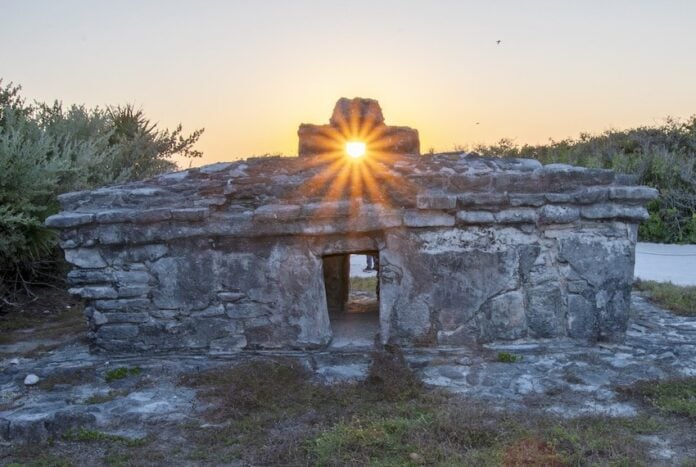
El Caracol — a domed building dating back roughly 600 to 800 years — once served as a navigational marker for Maya travelers along the Caribbean coast. (qroo.gob.mx)
A rare Mayan solar phenomenon will draw residents and visitors to a coastal eco-park in Cozumel on Thursday evening, when the sun aligns perfectly with the upper window of the ancient structure known as El Caracol.
The event will begin at 6 p.m. at Punta Sur Eco Beach Park, a large ecological reserve at the southern tip of Cozumel, Quintana Roo, about a half-hour’s drive from the island’s cruise ship terminals at San Miguel.
The alignment, visible only under clear skies, highlights the astronomical precision achieved by the Maya centuries ago.
“This type of alignment in pre-Hispanic structures has been significant for the consolidation of archaeoastronomical studies,” said Jesús Benavides Andrade, director of the Punta Sur park.
The experience, he added, offers “a unique experience of connection with the ancestral legacy of the island.”
El Caracol — a domed building dating back roughly 600 to 800 years — once served as a navigational marker for Maya travelers along the Caribbean coast. The structure’s uncommon cupola distinguishes it from other Mesoamerican buildings, researchers note.
The phenomenon occurs twice a year, typically in February and October, when the sunset or sunrise corresponds precisely with the tower’s upper opening.
Punta Sur Eco Beach Park is a protected park noted for its biodiversity, sustainability efforts, wildlife viewing areas, Mayan ruins (El Caracol) and Celarain Lighthouse.
Its beaches, lagoons, mangroves and low forests cover about 1,000 hectares — about three times the size of Manhattan’s Central Park.
This week’s alignment will mark the latest opportunity to observe one of the Maya civilization’s most striking examples of solar engineering, said Juanita Alonso Marrufo, director of the Cozumel Parks and Museums Foundation (FPMC).
The event, she said, strengthens the sense of identity and pride in the historical and cultural heritage of Cozumel, adding that it’s in line with the New Agreement for the Well-being and Development of Quintana Roo promoted by Governor Mara Lezama Espinosa.
Weather permitting, that “historical and cultural heritage” will quite literally shine through at sunset on Thursday, April 16.
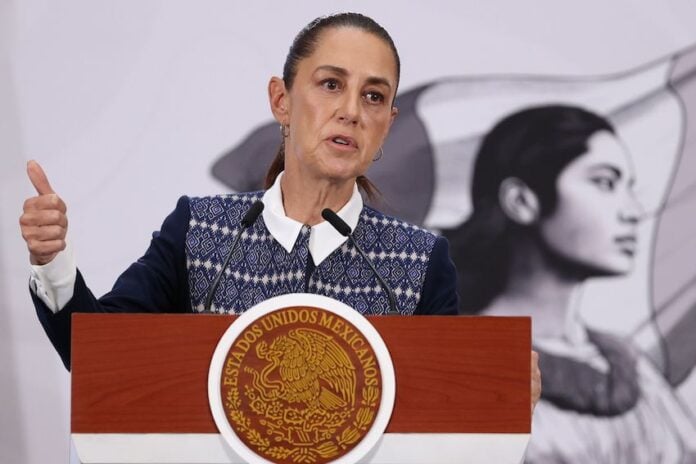
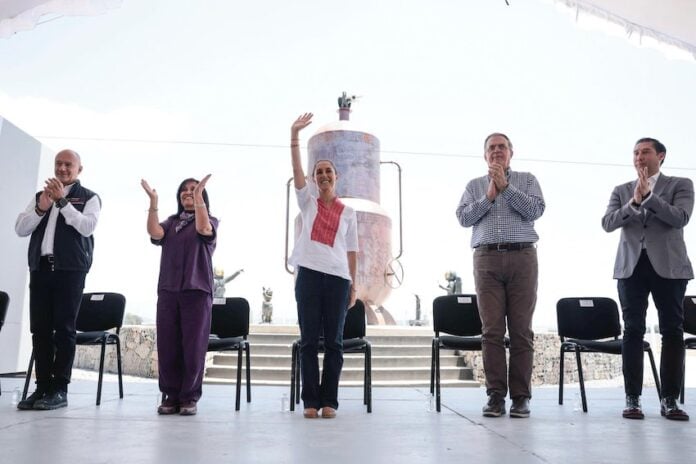
"We'll stand up for Mexicans at every level," Sheinbaum said on Tuesday. "There are a lot of Mexicans whose only crime is not having [immigration] papers." (Galo Cañas/Cuartoscuro)
Sheinbaum’s mañanera in 60 seconds
📉 Homicides down 31% in March: Mexico averaged 51.4 homicides per day last month — a 31% annual drop and the least violent March in 11 years. Guanajuato, Chihuahua and Baja California were the deadliest states; Nayarit recorded zero murders. Sheinbaum credited her security strategy for the decline in murders.
🇺🇸 15th Mexican dies in ICE custody: Alejandro Cabrera Clemente, 49, died at a Louisiana detention center on Saturday — the 15th Mexican to die in ICE custody since Trump took office. Mexico’s Foreign Ministry called the repeated deaths “unacceptable” and demanded immediate action.
🏛️ Mexico escalates response to ICE deaths: Sheinbaum said consular staff will now visit ICE detention centers daily rather than weekly, and that her government is helping families file criminal complaints in the U.S. and referring cases of allegedly negligent practices to the Inter-American Commission on Human Rights.
Why today’s mañanera matters
Murders in Mexico and deaths of Mexicans in ICE custody were key focuses of President Sheinbaum’s Tuesday morning mañanera. The latest national homicide data — compiled from statistics supplied by Mexico’s 32 Attorney General’s Offices — was presented, making today’s mañanera particularly noteworthy, and Sheinbaum responded to the death of yet another Mexican at an ICE detention center.
A core responsibility of any government is to guarantee the safety of the people under its jurisdiction, and in that respect the Sheinbaum administration says it is making significant progress, although officials acknowledge there is still plenty of work to be done.
At face value, the decline in murders appears to be good news. However, as Mexico News Daily reported in January, there are doubts over the accuracy of the government’s homicide numbers.
Homicides declined 31% annually in March
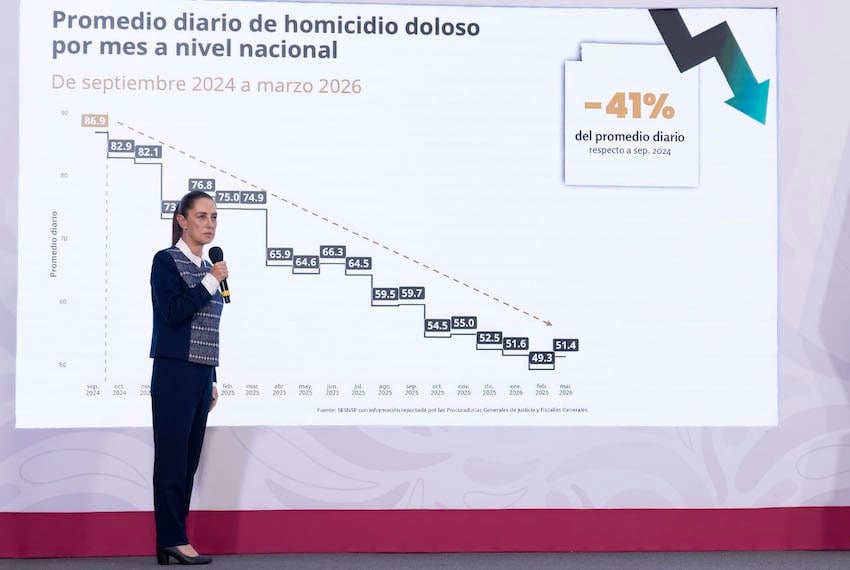
National Public Security System chief Marcela Figueroa presented preliminary data that showed there was an average of 51.4 homicides per day across Mexico in March, a decrease of 31.4% compared to the same month last year. She said that last month was the least violent March of the past 11 years.
Figueroa also highlighted that the average daily homicide rate last month was 41% lower than that in September 2024, the final month of Andrés Manuel López Obrador’s presidency. She noted that there were 35 fewer homicides per day on average in March than in September 2024.
Figueroa also presented data that showed there was an average of 50.8 homicides per day in the first three months of 2026, an annual decline of 32.8%. It was the least violent first quarter of any year since 2016.
Sheinbaum attributed the decline in homicides to her government’s security strategy.
President Sheinbaum stands before a chart showing that the average daily homicide rate last month was 41% lower than that in September 2024, the final month of Andrés Manuel López Obrador’s presidency. (Juan Carlos Ramos Mamahua/Presidencia)
“We’re working and we have to work more, but the security strategy is yielding results,” she said.
Guanajuato led Mexico for murders in March
Figueroa reported that Guanajuato recorded 147 homicides in March, representing 9.2% of all homicides committed across the country last month.
The next six most violent states in terms of total homicides in March were:
Chihuahua: 132 homicides (8.3% of the national total)
Baja California: 128 homicides (8%)
Morelos: 102 homicides (6.4%)
Guererro: 101 homicides (6.3%)
México state: 95 homicides (6%)
Oaxaca: 94 homicides (5.9%)
Just over half of the 1,593 homicides counted last month were committed in the seven states with the highest number of murders.
Nine states recorded fewer than 10 murders last month. They were Campeche (8); Baja California Sur (5); Zacatecas (5); Aguascalientes (4); Coahuila (4); Durango (3); San Luis Potosí (3); Yucatán (3); and Nayarit (0).
Another Mexican national dies in ICE custody
A reporter noted that another Mexican died in the custody of U.S. Immigration and Customs Enforcement (ICE). Alejandro Cabrera Clemente, who passed away at the Winn Correctional Center in Louisiana on Saturday, is the 15th Mexican to die in ICE custody since U.S. President Donald Trump returned to office in early 2025 and commenced an immigration crackdown. ICE said in a statement that the 49-year-old “was found unresponsive” and resuscitation efforts failed.
Sheinbaum noted that the Ministry of Foreign Affairs (SRE) issued a statement regarding the death on Monday.
The statement said that “communication is ongoing with the [U.S.] authorities involved to determine the cause of death and surrounding circumstances, in order to fully clarify the facts.”
⛓️🙅♀️ #MañaneraDelPueblo| Claudia Sheinbaum Pardo ordena a personal diplomático mexicano acudir diario a centros de detención de migrantes en EUA, tras fallecimiento de 15 connacionales en operativos:
“Le he señalado a Trump que no estoy de acuerdo en las detenciones que hace ICE” pic.twitter.com/i3wH6Kg0Pp
The SRE also said that “together with the family and the Ministry’s legal advisors, the next actions in the case will be carefully assessed.”
“The Ministry reiterates its deep concern and its demand for immediate action. The repeated occurrence of deaths in custody is unacceptable and reveals serious deficiencies in ICE detention centers,” the SRE added.
Sheinbaum said she has instructed staff in Mexican consulates in the U.S. to visit ICE detention centers on a daily basis to check on the welfare of detained Mexicans.
“They were visiting them once a week, but now I asked them to visit every day,” she said.
Sheinbaum said that her government has assisted families of Mexicans who have died in ICE custody to file criminal complaints in the United States.
She said that her government is also referring cases involving allegedly negligent “practices” in ICE detention centers to international bodies, including the Inter-American Commission on Human Rights.
“We’ll stand up for Mexicans at every level,” Sheinbaum said.
“… There are a lot of Mexicans whose only crime is not having [immigration] papers,” she added.
By Mexico News Daily chief staff writer Peter Davies (peter.davies@mexiconewsdaily.com)
A vaquita swims in front of fishing ships in the Gulf of California. Fishing of a specific kind is implicated in the vaquita’s extinction-threatening decline. (Paula Olson, NOAA/Wikimedia Commons)
“The spectacular Sea of Cortez is among the biologically richest 1% of all marine ecosystems. It is also home to one-third of all marine mammal species, as well as one of the world’s few known endemic porpoises, increasingly threatened with extinction.”
Those sentences were written on behalf of Conservation International in a 1991 issue of Baja Explorer, with the endangered porpoise in question being the vaquita, the world’s smallest cetacean — a family that includes whales, dolphins and porpoises. In the 35 years since that warning, vaquita numbers have declined by over 99%, dropping from between 600 and 700 individuals to around 10 or fewer. The threat of extinction is looming, despite glimmers of hope.
At high risk for extinction
This illustration is an accurate reflection of the number of vaquitas thought to be left on Earth: 10 or fewer. (Instagram)
If you know anything at all about the vaquita species, it’s almost certainly in the context of this sad fact, which is reflective of a larger reality — 158 fish, 146 amphibian, 80 bird, 69 mammal and 24 reptile species are conservatively estimated to have gone extinct since 1900.
In the case of the vaquita, its high profile status as the most endangered marine mammal in the world — the unenviable distinction it has held since 2007 — has brought attention and attempted aid, from the abortive attempt at a captive breeding program using U.S. Navy dolphins to the dangerous duty done by Sea Shepherd boats in defending the last stronghold of the vaquita in the northern waters of the Gulf of California, the vaquita’s only habitat.
But no one over the last half century has been able to stave off the precipitous decline — not when the vaquita was listed as vulnerable in 1978, or when the species’ status was upgraded to endangered in 1990, or critically endangered in 1996.
Declining since discovery
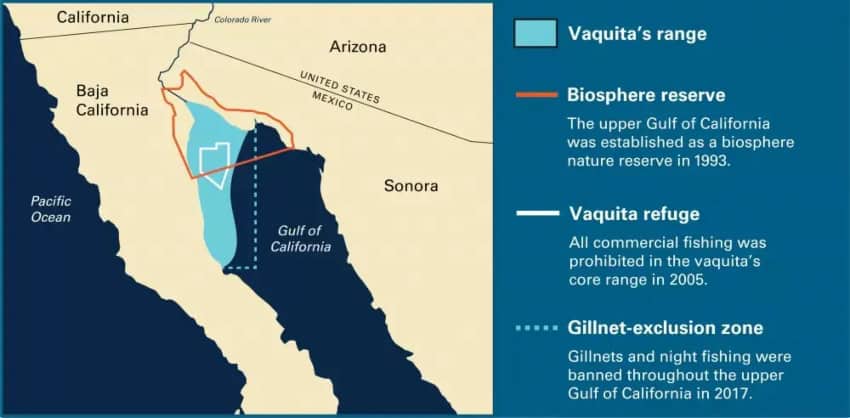
The vaquita’s first step towards possible extinction was taken about three million years ago, when members of its ancestral species were thought to have crossed the equator and become “trapped” in the upper reaches of the Gulf of California. The evolutionary offspring, vaquitas — small porpoises that are only about five feet long and 100 to 120 pounds (females are slightly larger than males) — don’t migrate. So ever since, they’ve been prey to the vicissitudes of nature in the 4,000 km² aquatic habitat they call home; an area that has shrunken in recent years to the 1,800 km² vaquita refuge, with most activity seen in the 225 km² area known as the “zero tolerance zone.”
Sometimes called “pandas of the sea” due to the black masks around their eyes, vaquitas weren’t officially discovered until 1950. That was the year a Scripps Institution of Oceanography student named Kenneth S. Norris found the first documented vaquita skull near Punta San Felipe. Norris and William M. McFarland published the first scientific paper on the newly dubbed Phocoena sinus in 1958. However, the first systematic survey of vaquitas in the wild wasn’t undertaken until 1979.
By then, vaquitas were already in steep decline due to gillnetting by fishermen in San Felipe. Not because they were valued as a catch, but because totoaba they hunted very much were.
Gillnetting and the shared decline of the totoaba
After becoming “trapped” in the Gulf of California about three million years ago, the vaquitas’ range, like their numbers, has been slowly shrinking. (Marine Mammal Commission)
San Felipe has been a fishing town since its founding in 1916, and even when tourism began in the 1950s, fishing remained part of the allure, both as an activity and as a source for area restaurants. Along with Ensenada, San Felipe is considered one of the first purveyors of the modern fish taco.
Even more acclaimed for its shrimp, San Felipe is also traditionally known for its delicious food fish, totoaba, which, like the vaquita, is considered endemic to the Gulf of California. By the 1940s, local fishermen were primarily using gillnets to catch it, a method so efficient that by the 1970s, the totoaba was listed as endangered and declared off-limits for fishing by Mexican authorities.
But by that point, it wasn’t just totoaba numbers that had plummeted; vaquita numbers had also crashed. Prone to entanglement in gillnets of any kind, the vaquita became bycatch, and, since even at its most robust, the vaquita population was only a few thousand, existential peril followed, with numbers continuing to fall even after totoaba fishing was made illegal.
‘Cocaine of the seas’
Not just because other fish were also being caught via gillnet by San Felipe fishermen, but because a thriving black market trade in totoaba soon developed, with the exorbitant prices being paid for its swim bladder in China leading to totoaba being dubbed the “cocaine of the seas.”
Fish maw, or swim bladder, is a traditional speciality in Chinese cuisine prized for its health benefits, and when the large local species traditionally used became overfished in the early 2000s, totoaba became the new favorite source, with its bladders selling for between US $20,000 and $80,000 a kilo.
Inevitably, given the illicit nature of the trade and the amounts of money at stake, Mexican cartels soon became involved and there were incidents of violence. The most well-publicized of these happened in December 2020, when San Felipe panga fishermen attacked the Sea Shepherd ship Farley Mowat, with one panga ramming the ship, and others throwing rocks, lead weights and Molotov cocktails. A local fisherman was killed during the collision.
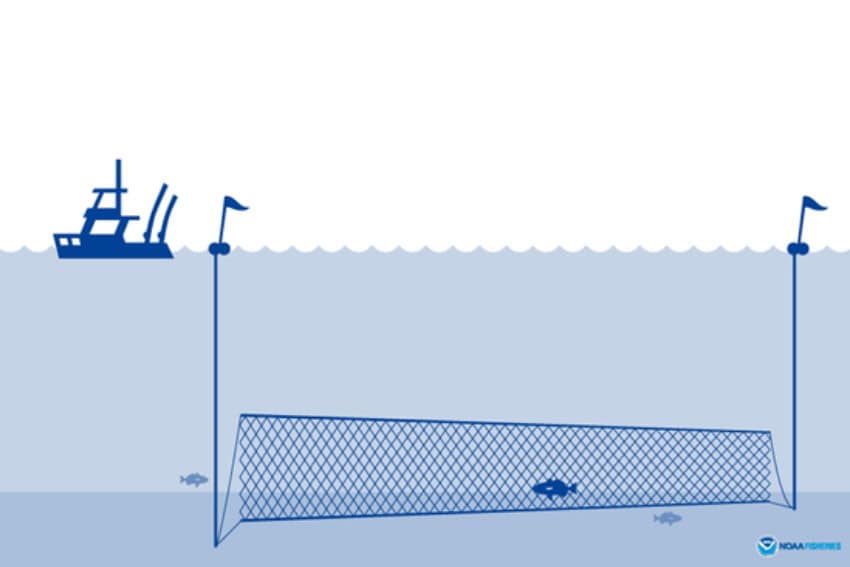
Illustration of how gillnetting works. This is the fishing method that has been driving the vaquita to extinction. (NOAA Fisheries)
Why attack the Sea Shepherd organization, whose mission is to protect and conserve wildlife? Because it was removing gillnets in the vaquita refuge, gillnets which were meant to catch totoaba for the illegal trade in its bladders.
Attempts to protect the vaquita
Thanks to aquaculture and fish farm-raised totoaba regularly being released into the Gulf of California, the species is recovering and will survive. The vaquita, on the other hand, may not survive, despite the best efforts of several conservation organizations and the laws passed to protect it.
In 1993, for example, Mexico announced the creation of the Upper Gulf Biosphere Reserve, and in 2005, it designated the vaquita refuge, with specific fishing restrictions attached to both. President Enrique Peña Nieto visited San Felipe in 2015 to declare a two-year emergency ban on gillnetting, and in 2017, that ban was made permanent throughout the vaquita’s habitat. A “zero tolerance area” was subsequently designated for the vaquita.
In 2017, there was also an attempt, with the instigation of VaquitaCPR and the blessing of the Mexican government, to use U.S. Navy dolphins to herd some remaining vaquita into sea pens, where they could be cared for and potentially bred to enhance their numbers. This plan ended in tragedy when a female vaquita died due to the stress of the rescue effort.
What happens next
Photo of a Vaquita mother and calf, taken by Sea Shepherd, which has done much in the effort to conserve them. (Sea Shepherd Organization)
Of course, making laws and enforcing them are two different things, and as noted regarding the illegal totoaba trade, gillnetting has never been severely curtailed except in the “zero tolerance area” when patrolled by Sea Shepherd ships, with support from the Mexican Navy.
Now the government is considering rollbacks that would shrink the gillnet ban in the vaquita’s habitat by 85%, which some are characterizing as a death knell for the vaquita. But since gillnet bans have been laxly enforced even when they’ve been in effect, the death knell has already been sounding.
Ten or fewer vaquitas are remaining in the wild, at least according to the most recent estimates. But extinction is not guaranteed. A study published in Science in 2022 noted that the species has the genetic resilience for recovery, and new calves were born as recently as last year. But it all depends on whether local fishermen embrace other fishing methods, which some have done, whether the gillnet ban remains in force and, even more importantly, whether it is strictly enforced. The latter possibility is yet to be realized, but there’s still at least a fleeting hope.
Chris Sands is a writer and editor for Mexico News Daily, and the former Cabo San Lucas local expert for the USA Today travel website 10 Best and writer of Fodor’s Los Cabos travel guidebook. He has also contributed to numerous other websites and publications, including The San Diego Union-Tribune, Marriott Bonvoy Traveler, Forbes Travel Guide, Porthole Cruise and Travel, and Cabo Living.
What happens when you mix Yucatán travels with a love of chocolate? Delicious adventures await. (Gobierno de Mexico)
I’m in the jungle, and a beautiful young woman approaches me and bows. Her name is Asti, and she tells me to sit on a soft cushion and gives me a gentle footbath with lemongrass and clove oil. Next Asti invites me to lie face down on a table, draped in chocolate-colored sheets. She begins covering me, systematically, limb by limb, with a mixture of chocolate and honey, followed by a sugar scrub — soft, silky, scratchy and wonderful.
I turn over and Asti continues to slather my body. Soon, I am covered neck to toes in a gooey mess. A purifying steam bath melts the chocolate away and detoxifies at the same time. My skin feels transformed: firm yet buttery to the touch.
Beginning your choco-adventures at Banyan Tree Mayakoba in the Yucatán Peninsula is never a bad idea. (Banyan Tree Mayakoba)
Then the massage begins. Again, I lie face down, and Asti asks permission to use some Balinese techniques. What follows is completely new. Asti climbs up on the table and, using her body weight, applies pressure to my back, arms and legs. The pressure is deep, and the work she does on my spine and lower back is revelatory.
After my bespoke spa treatment is over, I am enveloped in the scent of chocolate, and I feel 10 years younger. Welcome to choco-heaven.
Rainbow of flavors
My husband, Peter, and I have come to Banyan Tree Mayakoba, a luxury resort in Quintana Roo, Mexico, to begin a choco-vacation in Mexico and Belize. We are on a quest to learn as much as we can about the cacao bean, its history and traditions, as well as culinary and medicinal uses. Who knew chocolate could be so healthy?
Chocolate workshops in Xcaret will teach you more than you thought possible about the process of making chocolate. (Blog Xcaret)
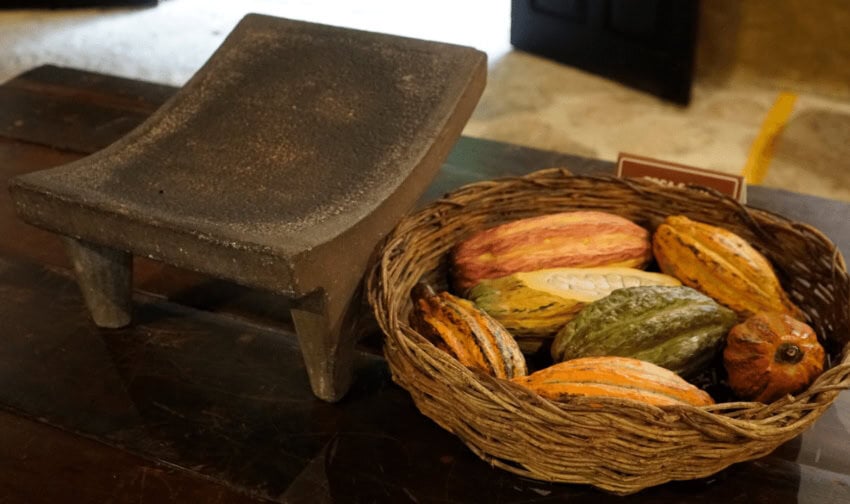
The following day, we attend a chocolate workshop at Xcaret Park, where we meet Pablo, a friendly young man, whom Leo, our guide, calls an “old soul.” On our hands and knees, we crush the cacao beans into a paste, using metates. It’s surprisingly hard to do, but Pablo helps me and then adds sugar, dried vanilla, pepper and Chile.
The result is a yummy, mud-like concoction that will harden into a tablet to be melted in hot milk for authentic Maya hot chocolate. Pablo says the people of Chiapas, where he’s from, use cacao beans in many healing remedies. I wish I had time to find out more.
In nearby Cozumel, Peter and I snorkel in turquoise water and see a huge lobster, speckled rays, elegant coral, and fluorescent fish in colorful hues. In town at the KaoKao Chocolate Factory, we witness the chocolate-making process — from tree to bar — and taste luscious samples of KaoKao’s chocolate.
A rainforest paradise
Our second destination is an eco-resort in the jungles of Belize. We drive south in our rental car, crossing the border with ease, to The Lodge at Chaa Creek, located just east of the Guatemalan border.
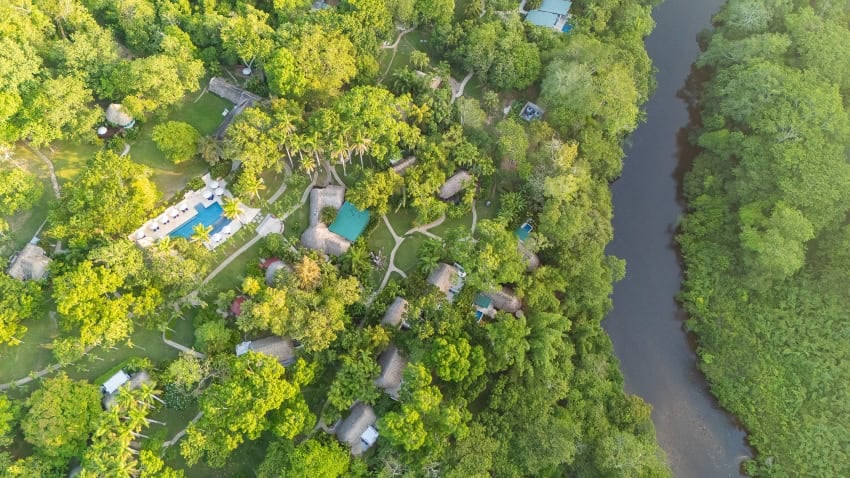
This destination resort nestles in a tropical rainforest with lush vegetation, exotic birds (we see a toucan moments after we arrive), monkeys and iguanas, luxurious villas (ours is in the treetops overlooking the river), outdoor activities, tours, incredible cuisine, an infinity pool and friendly staff. When you add chocolate to the mix, you’ll never want to leave.
The owners, Mick and Lucy Fleming, are a lovely couple who have spent their lives carving this unique eco-resort out of the jungle. From its early days as Chaa Creek Cottages, which opened in 1981, it’s grown into a full-featured resort and welcomes guests from around the world. We spend three days here and love every minute.
Horseback riding and spa bliss
Carved from the jungle, Chaa Creek is a chocolate lover’s paradise. (Chaa Creek)
One of my favorite activities is our horseback ride — two hours of muddy fun. After some trotting and cantering, we stop for a rest in an ancient, overgrown Maya square. As we walk around, the site feels peaceful and holy — even the horses seem calmer. There are so many secrets under this ground.
What better way to relax after an exhilarating horseback ride than at the Spa at Chaa Creek? The staff customizes a special package for me featuring five choco-licious spa treatments: a scrub, therapeutic massage, soothing facial, pedicure and body wrap. My favorite is the choco-massage, which I enjoy on the spa’s veranda with views of the jungle and the sounds of nature lulling me into a dreamy euphoria.
One evening, Peter and I experience a romantic dinner in the poolside tiki hut lit with glowing candles — just the two of us. We begin with choco-martinis: cool, refreshing and delicious. Everything on the menu except the soup features chocolate. A salad of chicken, pineapple and cacao nibs is next. For my entrée, I try lobster with mole sauce — it’s divine. Peter loves his beef tenderloin cooked in cocoa butter. The fairytale setting, completed with a brief tropical rain shower, makes our dinner that much more magical. And I’m still not tired of eating chocolate!
A chocolate trance
Our last destination is Mérida, the capital of Yucatán. We stop about an hour south of the city at a new attraction beside the ancient ruins of Uxmal. Choco-Story is an interactive museum that explores cacao. We join a small group and watch a Maya ceremony honoring Chaac, the rain god. Priests gather around an altar, beat on drums, blow conch shells, chant in ancient Mayan languages and parade by in a somber ceremony.
Afterwards, we view exhibits in tiki huts about ancient rituals performed on Maya temples, many of which involve human sacrifices. One exhibit describes how people would go into a trance after eating chocolate and volunteer to be sacrificed. A chocolate trance sounds nice, but not the other part.
After roaming around Uxmal, we head north to Mérida, where we stay at Rosas & Xocolate, a romantic boutique hotel created from two restored colonial mansions. High ceilings, authentic architectural touches, a cozy restaurant with outdoor seating, even a rooftop bar — combine to create a unique fusion of historic and modern, traditional and contemporary.
Relaxation is synonymous with Rosas & Xocolate in Mérida. (Rosas & Xocolate)
In the morning, after a deliciously spicy Mexican breakfast, Peter and I borrow the hotel’s bikes for a ride down the Paseo de Montejo, lined with elegant mansions and upscale businesses. Traffic on Montejo is heavy, so Peter and I turn down a side street and cycle through a peaceful neighborhood instead.
‘A storm of chocolate rain’
After our bike ride, it’s time for my Rosas & Xocolate Experience at the hotel’s cozy spa. When I arrive, the receptionist offers tea and a dish of nuts and dried fruit covered in gooey chocolate. Sweet! Next, I’m taken to a darkened room, where dozens of candles glow and exotic scents fill the air. My journey to chocolate heaven begins.
After a sensual cacao and oil scrub, I am toweled off. Then the fun begins. Two therapists start covering me in chocolate goo, and they don’t just smear me with chocolate. They sling it all over my naked body: a storm of chocolate rain. I feel like a Jasper Johns painting.
Next, I’m wrapped up in a chocolate cocoon while my therapist gives me the most amazing head massage. After being unwrapped, I shower and then a different therapist appears to give me a full-body massage. I am in a chocolate trance. All told, the Rosas & Xocolate Experience is one of the best spa treatments I’ve ever had. I only wish I could remember it better.
All good things must end, however, so after relishing one last flavorful breakfast at Rosas & Xocolate, we stopped by the Grand Museum of the Maya World in Mérida. The state-of-the-art attraction tells the story of the Maya culture, and we only have time for a taste. This choco-vacation has left me with a hunger to know more — about Maya culture and the tantalizing cacao bean.
Peggy Sijswerda is a freelance writer who divides her time between San Miguel de Allende and the Netherlands. She writes about travel, food, culture and wellness, and is the author of “Still Life with Sierra,” a travel memoir. Find her on Substack at @peggysijswerda.
Founded in Monterrey nearly 30 years ago, Magnicharters serves tourists to Mexican beach resorts, offering all-inclusive packages. The problem that grounded its planes and stranded its passengers remains unclear. (Magnicharters)
Magnicharters, the commercial airline focused on tourist flights to beach destinations in Mexico, unexpectedly suspended all operations for two weeks over the weekend, leaving hundreds of passengers stranded as the extended Holy Week vacation period came to an end.
In a notice issued to its passengers on April 11, the airline cited “logistical issues” and indicated that all flights scheduled for the next two weeks would be canceled. Passengers in Cancún, Huatulco and Mérida were particularly affected as many were already at the airport when they were informed of the cancellations.
Pasajeros que iban a viajar en Magnicharters señalan que no hay personal que los atienda en los slots de la aerolínea, que anunció ayer suspensión de operaciones por “problemas logísticos”.
“Due to logistical issues, flights scheduled for the next two weeks will not be able to operate. We want to inform our customers that we are addressing this situation with due diligence to resolve it,” the airline stated.
Users stranded at various airports reported closed counters, staff unable to provide clear information, and passengers having to buy last-minute tickets on other airlines, paying up to 7,000 pesos (US $400) per person.
Following the mass cancellation of flights, local authorities, in collaboration with the federal government, activated an emergency operation in Cancún to assist affected passengers and facilitate their return to their destinations.
“We are working to rebook passengers on other flights, subject to availability,” Quintana Roo Governor Mara Lezama said in a statement Sunday night.
Low-cost airlines Viva and Volaris, as well as Mexico’s flagship airline Aeroméxico, said they will serve affected passengers. Authorities have said that those affected should head to these airlines’ counters to receive assistance.
Founded in Monterrey, Nuevo León, nearly 30 years ago, Magnicharters is a niche airline and one of the smallest in Mexico. Still, it serves more than 200,000 passengers annually and is known for offering all-inclusive packages — including hotels, transfers and checked-in luggage — aimed at the family vacation market in Mexico.
Ángel Domínguez, head of the Pilots’ Association, told the newspaper La Jornada that airlines in Mexico can suddenly stop flying without consequence.
“In the last 30 years, the industry has seen between 20 and 25 airlines go bankrupt,” Domínguez said. “In the last four years alone, two have gone bankrupt or suspended operations: Interjet and Aeromar.”
In Mexico, he said, victims of these sudden stoppages have little recourse.
“Unfortunately, Mexico has not yet developed a public policy that protects not only passengers, but also those who invest their money in this industry and the professionals in the sector,” he added.
Although Magnicharters has said that they “deeply regret this situation,” the company has not shared any details regarding refunds or flight rescheduling. Nor has it answered the question of why it stopped flying, other than to cite “logistical issues,” which is essentially restating the question.
President Sheinbaum and local authorities celebrate the inauguration of the first Well-Being Hub (Polo de Bienestar) in the state of Tlaxcala on Sunday. (Gabriel Monroy/Presidencia)
President Sheinbaum celebrated on Sunday the launch of the First Economic Development Hub for Well-Being (Podecobi) in Huamantla, in the central state of Tlaxcala, with a US $540 million investment.
The investment-attracting project falls within the administration’s flagship Plan México initiative and will be developed across 53 hectares of land. It is expected to create over 5,000 direct and indirect jobs. Funding will come from public and private sources.
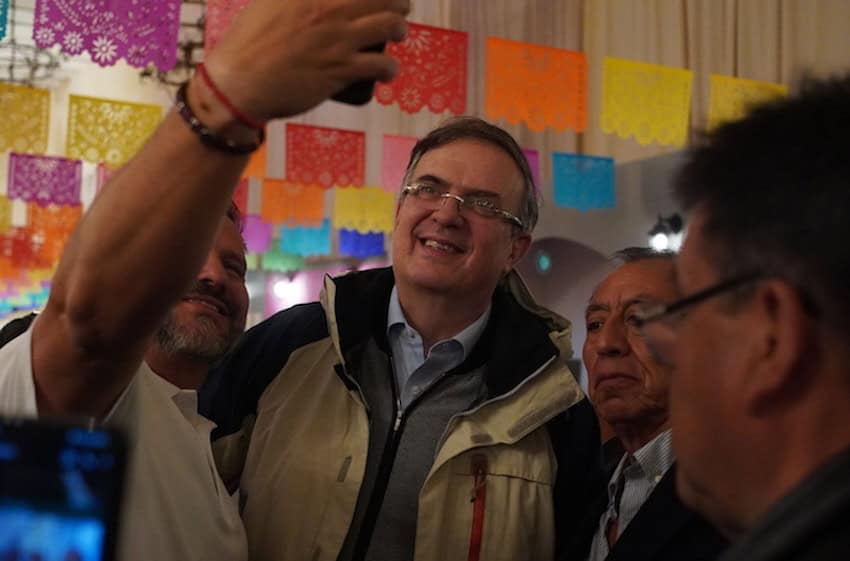
Economy Minister Marcelo Ebrard shares a selfie moment with residents of Huamantla in the state of Tlaxcala during a visit last August to discuss the location of the first Well-Being Hub in that city, which became a reality on Sunday. (Alain Hernández/Cuartoscuro)
“Mexico imports many products, and many of those products could be produced in Mexico,” Sheinbaum said. “That’s why we have the ‘Made in Mexico’ brand. The goal is to generate more national and foreign investment in Mexico that will allow us to achieve greater development.”
Last June, Sheinbaum signed agreements with 14 governors to establish the first 15 Podecobis across the country, eight of which will be situated in Mexico’s south-southeast region. This inaugural hub in Tlaxcala is not far from Mexico City.
Tlaxcala Governor Lorena Cuéllar Cisneros stressed that business confidence continues to grow in her state, which she credits largely to government support.
Upon the launch of the first Podecobi, Sheinbaum emphasized the importance of shared prosperity, echoing the Morena catchphrase “for the good of all, the poor come first.”
“What we want is for… public resources to be invested in the people,” said Sheinbaum.
Sheinbaum plans for the Podecobis to be sited in urban areas that already have basic services, such as housing for workers, schools, water and transportation, making them more attractive to investors for further development, benefiting more people.
The government will provide the Podecobis with economic incentives and waive certain taxes during the initial years of operation to help accelerate investment.
At least seven companies have already committed to establishing operations in the first Podecobi, according to Alejandro Espinosa de los Monteros, the general manager of the Xicohténcatl Industrial City Trust (Fidecix) in Tlaxcala. He added that the infrastructure needed for companies to begin operations immediately has already been developed.
Jaime Adolfo Juan Martínez, the director of Neuse México, believes that the arrival of international companies in Tlaxcala will help strengthen the local economy, promote specialized training and facilitate knowledge transfer, thereby enhancing the state’s competitiveness.
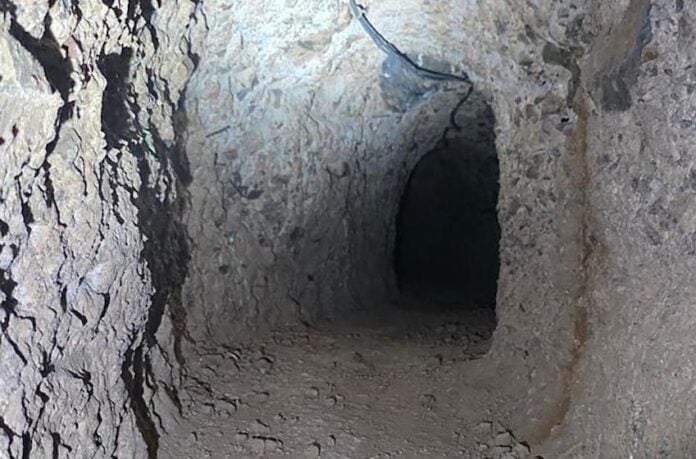
The 79-meter-long border tunnel was unfinished without any apparent exit, but it was assumed to be meant for transporting illicit goods, including human beings, from Mexico to the United States. (Gabinete de Seguridad de México)
Authorities credited recently increased federal security operations in Sonora and neighboring states, as well as smoothly coordinated intelligence collection, for their ability to discover and seal off a tunnel in Nogales leading into Arizona.
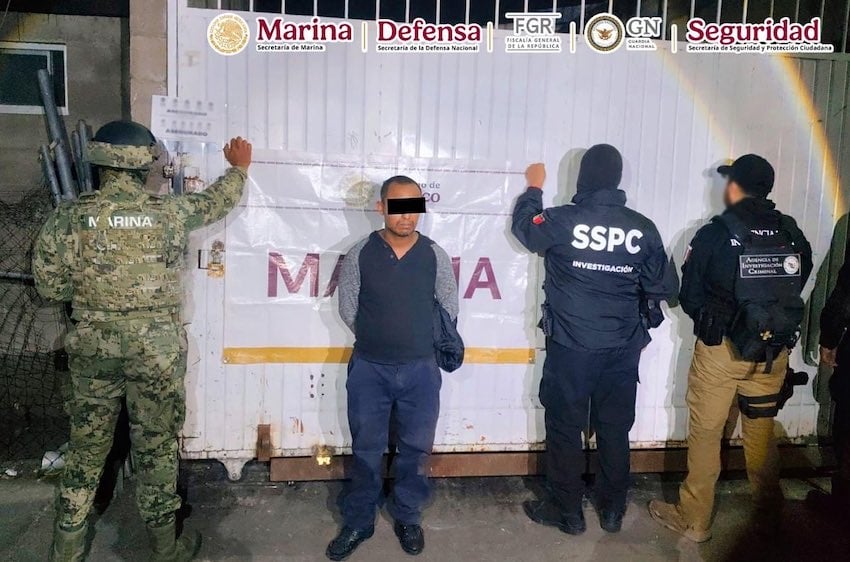
One individual was arrested during last week’s operation, according to a joint statement from the Navy, Security and Defense Ministries that attributed their success to inter-agency cooperation with assistance from the Federal Attorney General’s Office (FGR) and the Sonora Security Ministry.
The discovery of the narcotunnel and detention of a suspect were the latest examples of multi-level security cooperation, with federal and state agencies working together both to gather information and carry out the operation. (Gabinete de Seguridad de México)
As a result of investigations conducted in the office and in the field, a property in the Centro neighborhood of Nogales was linked to a criminal group. After fixed and mobile surveillance provided solid evidence of the suspicion, a search warrant was granted by the local presiding judge.
Upon entering the property, agents located a rudimentary excavation 4.5 meters deep and 79 meters long, leading toward the U.S. border though with no apparent exit. The property was sealed and remains under police custody.
Along with the detained suspect, 21 live rounds of ammunition were seized.
The suspect — identified as Luis Fernando Garduño — was turned over to the FGR and faces charges of illegal surveillance, smuggling and human trafficking. He is said to be a member of the “Los Salazar” criminal group, which is known to engage in illegal operations in the region.
The online newspaper Infobae reported that the tunnel was allegedly intended for the illegal crossing of migrants into the United States, though it had not yet been completed.
In a social media post, U.S. Ambassador to Mexico Ronald Johnson praised the Mexican government for its commitment to keeping border communities safe.
“This action by the Mexican authorities demonstrates that our countries offer no respite to criminal networks,” he said.
This is the second border tunnel discovered in the past 15 months.
The underpass — attributed to the crime gang known as “La Línea” — was approximately 40 meters long, featured ventilation and lighting and was connected to El Paso drainage systems. It was sealed shut with concrete on the U.S. side.
Foreign visitors generated US $6.75 billion in foreign exchange earnings during the two-month period, a 2.2% uptick from the same stretch in 2025. (Elizabeth Ruiz/Cuartoscuro)
Of that total, 8.17 million were classified as international tourists — overnight visitors rather than day-trippers or cruise passengers — representing a 6.5% year-over-year rise, according to INEGI’s International Traveler Survey (EVI).
February alone brought in 8.01 million international visitors, up 8.5% from February 2025. International tourists in February reached 3.88 million, a 4.2% annual increase.
Foreign visitors generated US $6.75 billion in foreign exchange earnings during the two-month period, a 2.2% uptick from the same stretch in 2025. February alone brought in $3.27 billion.
“The fact that more and more people are choosing to visit Mexico reflects confidence in the tourism experience our country offers,” Tourism Minister Josefina Rodríguez Zamora said in a press release, describing Mexico’s offering as diverse, high-quality and continuously improving.
The strong numbers arrive as Mexico gears up for what could be a landmark summer.
Rodríguez is projecting an additional 5.5 million tourists above average due to the tournament, along with nearly US $3.2 billion in extra revenue. Destinations beyond the host cities, like Los Cabos, are actively marketing themselves as “second stop” getaways for World Cup visitors seeking a luxury beach escape after the final whistle.
Sectur said it will continue efforts to diversify source markets and strengthen regional tourism development, describing tourism as a driver of shared prosperity across the country.
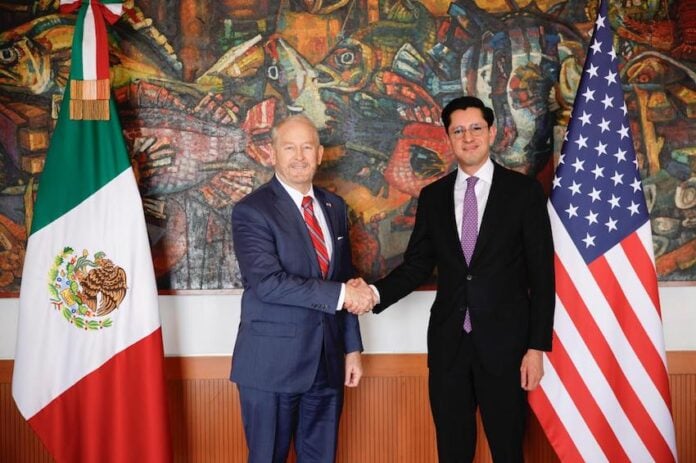
Mexico's Ministry of Foreign Affairs said on social media on Saturday that Minister Velasco and Ambassador Johnson met to discuss "the various issues on the shared agenda." (SRE)
Foreign Affairs Minister Roberto Velasco is prioritizing the bilateral relationship with the United States in his first days in the job. In addition to speaking by phone to U.S. Secretary of State Marco Rubio, Velasco met with U.S. Ambassador to Mexico Ron Johnson in Mexico City last week.
The Ministry of Foreign Affairs (SRE) said on social media on Saturday that Velasco and Johnson met at SRE headquarters to discuss “the various issues on the shared agenda.”
“Within this framework, they reiterated their mutual commitment to continue strengthening cooperation and collaboration based on the principles that guide the bilateral relationship in order to bring well-being and prosperity to both sides of the border,” the SRE said.
Responding to the SRE post via his own X account, Johnson said that he and Velasco discussed “the shared priorities of our countries and the importance of continuing to work together to strengthen our historic cooperation and ensure it continues to deliver results for both our nations.”
Met with Secretary @r_velascoa to discuss the shared priorities of our countries and the importance of continuing to work together to strengthen our historic cooperation and ensure it continues to deliver results for both our nations. I also congratulated him and wished him… https://t.co/163K68TneN
Velasco’s nomination as foreign minister was approved by the Senate last Wednesday. Sheinbaum nominated him for the role after Juan Ramón de la Fuente decided to resign for health reasons earlier this month. Velasco is well-versed in the various aspects of the Mexico-U.S. relationship, having served as deputy foreign affairs minister for North America prior to succeeding de la Fuente.
His early focus on Mexico’s relationship with the United States is not surprising given that the two countries are each other’s largest trade partner and share a range of challenges, including in the areas of security, biosecurity and migration. A mandated review of the USMCA — the North American free trade agreement that also includes Canada — is taking place this year against a backdrop of increased U.S. protectionism against all countries around the world, including the United States’ southern and northern neighbors.
Velasco: ‘We must translate diplomacy into prosperity for the people of Mexico’
In an address on Thursday directed to SRE officials and Mexican diplomats abroad, Velasco said that “foreign policy is, in essence, the external expression of a national project” — i.e., the “fourth transformation” political project led by Sheinbaum and the Morena party.
“Our task is not limited to representation; we must transform,” the foreign minister said, according to an SRE statement.
“We must translate diplomacy into prosperity for the people of Mexico, into effective protection for those far from home, and into tangible opportunities for our country’s development,” Velasco said.
The 38-year-old foreign minister is an Ibero-American University-trained lawyer and earned a master’s degree in public policy from the University of Chicago in 2017. According to media reports, Velasco is Mexico’s first openly gay cabinet minister.
Members of several search groups on Sunday organized pick-up soccer matches at the Glorieta of the Disappeared on the iconic Paseo de la Reforma avenue in Mexico City. (Daniel Augusto/Cuartoscuro)
Groups searching for missing persons in Mexico say they will take advantage of the presence of international press during the World Cup to expose the problem of disappearances in the country.
As a first step to build awareness of the situation, members of several search groups on Sunday organized pick-up soccer matches at the Glorieta of the Disappeared on the iconic Paseo de la Reforma avenue in Mexico City.
At a press conference, Jorge Verástegui, who has been searching for his brother and nephew since 2009, described the groups’ “Let’s make it happen. Until we find them” initiative as an effort to break the information blackout they allege the government’s discourse is creating.
“The government intends to use [the World Cup] as a showcase of normality,” he said. “We, the families of the missing, will take to the streets to remind them that Mexico ought not to be a sports venue while it remains a clandestine grave.”
The groups said they will stage a demonstration on June 11 in the vicinity of Mexico City’s Banorte Stadium — site of the inaugural World Cup match. In the meantime, they will stage informal soccer games on Sundays in the streets of Mexico City, Guadalajara and Monterrey, Mexico’s three World Cup host cities.
A spokesman denounced “institutional abandonment” and “the systematic attempts by each administration to downplay the figures and manage the suffering. We will no longer accept these charades.”
“We, the families of the missing, will take to the streets to remind them that Mexico ought not to be a sports venue while it remains a clandestine grave,” said Jorge Verástegui, who has been searching for his brother and nephew since 2009. (Daniel Augusto/Cuartoscuro)
Liliana Meza, founder of the Luz de Esperanza search collective in Jalisco, said the families searching for their missing loved ones “find it very difficult to hear the president … say these forced disappearances don’t exist … [acting like] her goal is to lower the numbers, not by finding people, but by fudging all the state and federal data.”
Héctor Flores, whose son disappeared in 2021, said he was eager for the crisis to be brought before the U.N. General Assembly, told the newspaper El Financiero that he believes this “would show the world the reality that the Mexican government has refused to see.”
“In Mexico, people disappear every day … torture, murder and crimes against humanity occur every day,” he said.