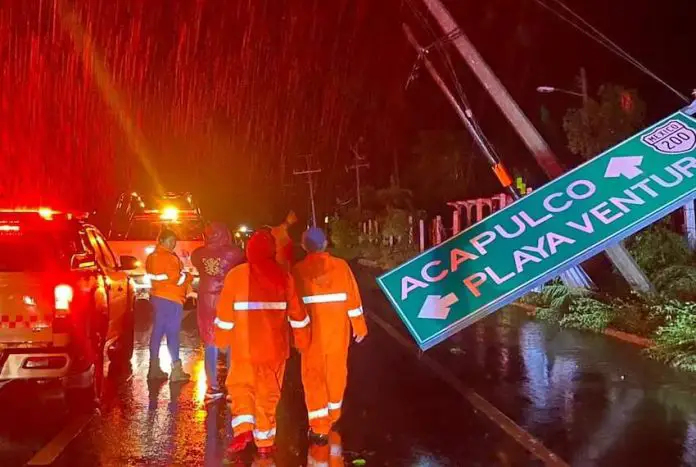
Two people were killed in the municipality of Tlacoachistlahuaca when a mudslide swept away their home on Monday night. (@Moreliactiva/X)
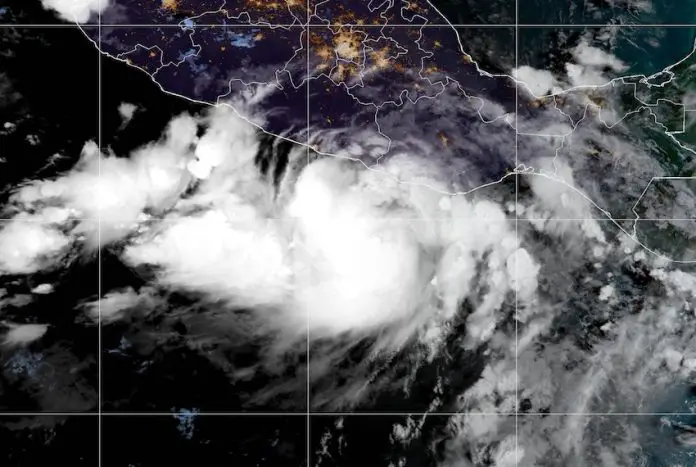
Hurricane John made landfall as a Category 3 storm in Punta Maldonado, Guerrero — located on the border with the state of Oaxaca — on Monday night, ripping tin roofs off houses, bringing down trees and triggering mudslides before weakening to a tropical storm early on Tuesday.
Guerrero Governor Evelyn Salgado confirmed that two people were killed in the municipality of Tlacoachistlahuaca when a mudslide swept away their home on Monday night. She urged the public to take precautions since heavy rains are expected to continue.
#Entérate || Ante el pronóstico de lluvias intensas en varios municipios del estado, derivado de la evolución del Huracán “John”, personal operativo de esta secretaría realiza acciones de perifoneo en zonas de alto riesgo, para brindar información preventiva a la población. pic.twitter.com/gpv3BfBga2
— Secretaría de Gestión Integral de Riesgos y PC-Gro (@PC_Guerrero) September 23, 2024
According to an advisory published on Tuesday at 9 a.m. CST, the U.S. National Hurricane Center (NHC) warned life-threatening flash flooding is possible across portions of southern and southwestern Mexico during the next few days as Tropical Storm John moves slowly to the northwest, noting “little motion is expected during the next few days.”
AccuWeather meteorologists warned that the storm “can continue to bring life-threatening conditions and possible extreme damage around Acapulco due to torrential rain.”
While Acapulco — devastated by Category 5 Hurricane Otis last October — dodged John’s worst wind impacts, the storm will unload significant rainfall on the area. Acapulco may still face wind gusts of 40-60 mph before John loses more intensity.
The NHC forecast indicates Tropical Storm John could produce 150 to 300 milliliters of rain with isolated totals around 380 mm across the coastal areas of Chiapas to the south. Along the Oaxaca and Guerrero coasts, the NHC forecasts between 250 and 500 mm of rain with isolated totals near 750 mm through Thursday.
The governors of those three states have activated civil protection protocols while urging the public to stay alert for official advisories. According to the newspaper El Financiero, Guerrero has set up 300 shelters to attend to the 59,000 residents who live in coastal areas of the state.
President Andrés Manuel López Obrador posted an alert on his X account on Monday night, telling the public to “seek higher ground, protect yourselves and do not forget that life is the most important thing; material things can be replaced. We are here.”
The U.S. NHC will issue its next public advisory on Tropical Storm John at 3 p.m. CST.
Change is difficult, especially as we age. Such is the common belief: The older we get, the more encased we become in our stiff, inflexible containers of self. As a popular book title in the 1990s put it, wherever you go, there you are. You can’t escape yourself.
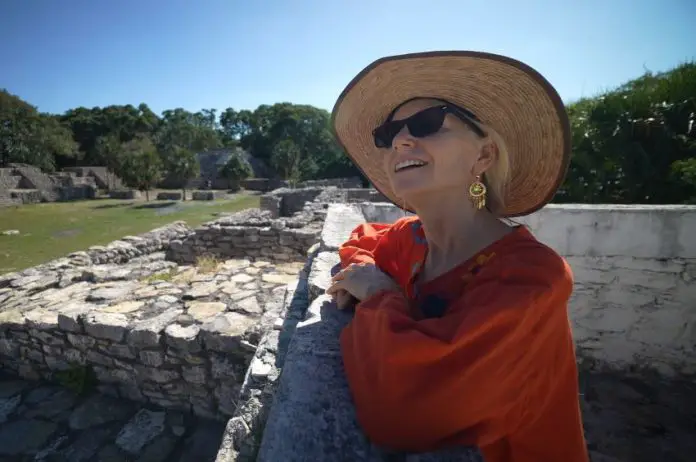
Or can you? After we move abroad, many of us change much more than our addresses and zip codes. Often we change our habits, routines, friends, priorities, values and even our sense of self. After living part-time in Mexico for 20 years, I’ve been struck by how much lighter I am, both physically and psychologically. Some of that may be due to aging and no longer having to earn a living, but I know in my heart that some of it is Mexico itself.
(Instituto Allende)
And I’m not alone. I asked a number of foreigners, mostly residents of Guanajuato, where my husband and I own a home, to share their thoughts. It turns out that moving to Mexico brought about positive changes in their lives that they had never been able to achieve before.
Many were ready for a major reset and ripe for change. In my husband’s and my case, we had wanted an international base for years. Others were at a transition point: a divorce, the end of a career, children grown, even the death of the family dog. And some were exhausted by U.S. partisan politics.
Social life
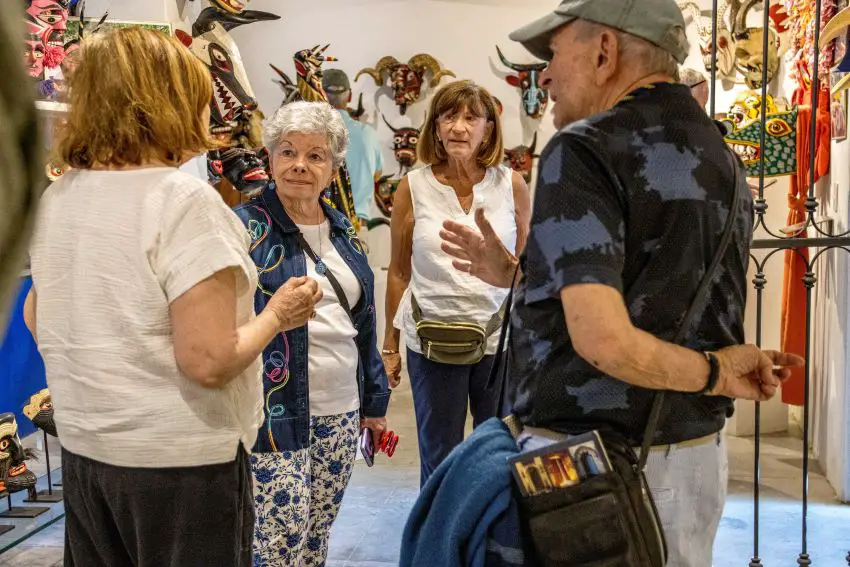
One of the main areas people described was friendships and social life. Martine, a Quebecker who moved to Vancouver when she was 20, told me that she had “made more friends in Mexico in the last 12 years — mostly in the first couple of years — than I have all my life in Canada.”
Deb, an Oregonian, agrees. ”I’m much more social than I was in Portland,” she says. “And with that has come a sense of warmth towards people — even those I pass on the street! In Mexico, people are outside in public spaces so much of the time.”
(Fabrica La Aurora)
Exercise, eating change and weight loss
Many people reported becoming healthier since moving to Mexico. “Guanajuato comes with a free gym membership,” says Tom, a Texan who’s lived in the city for 24 years. “It’s easier to get to most places walking, so it isn’t discipline or exercise, it’s just more efficient.”
Others have lost weight. “Because we can’t hop in our car and drive to Popeye’s chicken,” says Billy, who used to live in Oakland, “my eating habits are much healthier. Combined with all the walking and stairs, he has lost 23 pounds since moving to Mexico 9 months ago. “And I still enjoy the same number of margaritas!” he adds.
A few adapted their eating rhythms. Cathy, from Colorado, now eats on a Mexican schedule: late breakfast and a mid-afternoon lunch. She also eats more fresh fruits and vegetables.
Others got rid of their cars, and don’t miss the cost of insurance, gas and maintenance.
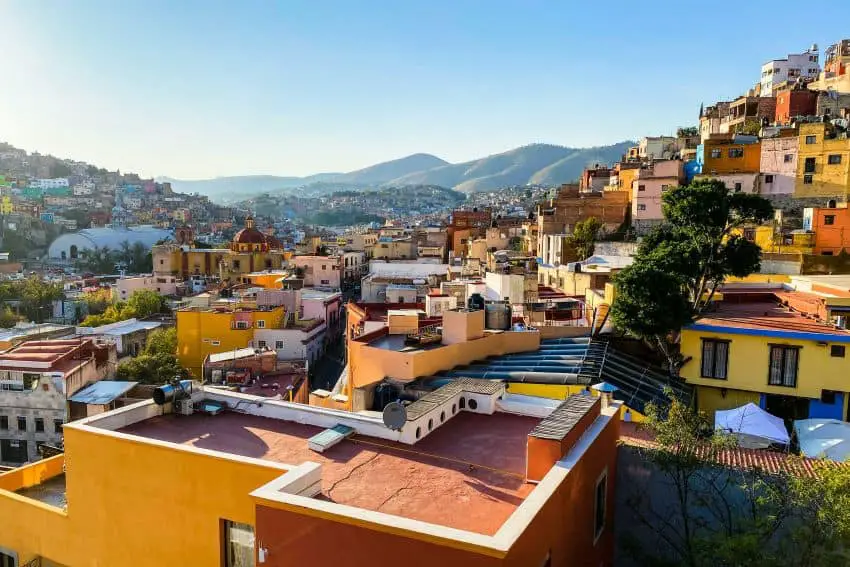
Who wouldn’t lose weight in a city surrounded by mountains, with ups and downs? (Jorge Gardner/Unsplash)
Adapting to a different, more relaxed culture
“Life here reminds us of our childhoods, with friendly neighborhoods, local stores, strong community and family values,” say Kevin and Jan, a Denver couple who both grew up in Westchester County, New York. “It’s comforting to feel a part of things in our ‘hood.” They chose their neighborhood to immerse themselves in local culture and avoid the expat bubble trap. “The vibrant colors and sounds, the abuelas and kids in our neighborhood, cheer us up with their stories and laughter. It’s a society that is more grounded in gritty reality — combined with lots of personal affection.”
Cathy appreciates the less complicated lifestyle. “I rent, I don’t have a car and my needs are minimal. I no longer want more stuff, and it’s been easy to make new friends,” she says.
Evelin and Doug, a couple who moved from Pasadena, love the different values found in Mexico. “Mexicans focus more on living a happy life than financial gain,” says Evelin. “This is so refreshing, and it’s why we chose to live here.”
Jack,who with his wife Jacquie, divides his life between Guanajuato and Bend, Oregon, believes that getting angry when things don’t go his way doesn’t work. “I just go with the flow, be patient and polite. It will all work out.”
Cathy agrees. “I love living in this culture. I find Mexican people friendly, helpful and they don’t seem to take themselves too seriously. It’s nice to be able to strike up conversations with people sitting on a park bench.”
Learning Spanish
(Instituto Allende)
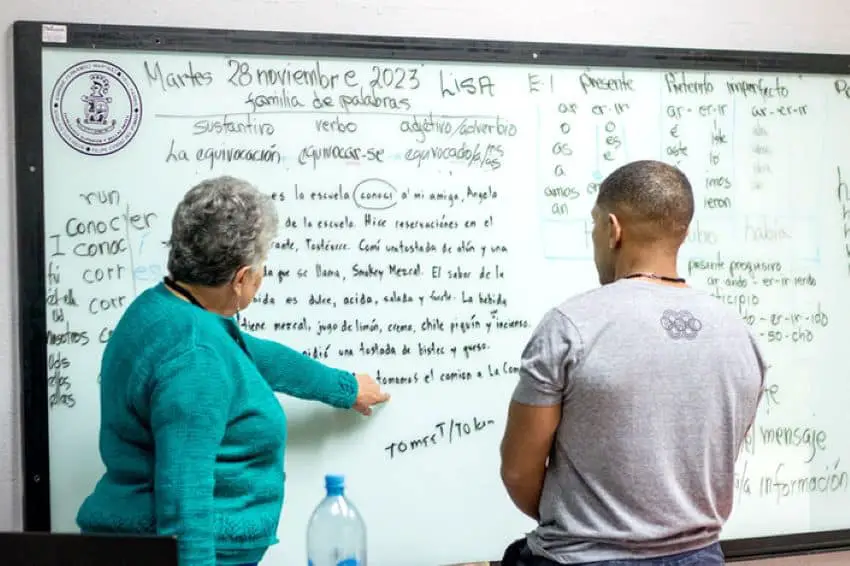
Liz, a woman from Austin, Texas, who lives in San Miguel, is comfortable speaking Spanish after taking a six-month, four-hour-a-day immersion course. “It was one of the hardest things I’ve ever done,” she says. “But I feel it’s really helping my brain, and hopefully keeping Alzheimer’s at bay.”
“When we lived in the Bay Area,” says Billy “many people spoke Spanish, but I didn’t. Just lazy, I guess. But here, speaking Spanish is a must, and I am learning more each day.”
Deep changes
The most profound transformations have happened to people who truly immerse themselves in the culture. Tom married a Mexican woman and became part of her family. “Changing cultures involved giving up some of my desire to be recognized for personal accomplishments,” he says. “My sense of who I am is more malleable than I used to believe. Everything is more interesting not knowing things for sure, including who I am. Life is more mysterious and exciting.”
Mexico seems to change a person. We speak a different language, eat differently, move differently, even dream differently. Surrounded by new colors, textures, rhythms and sounds, many of us outgrow our old selves. Whatever once defined us shifts, our boundaries soften, and, like other species, we shed our skins.
Louisa Rogers and her husband Barry Evans divide their lives between Guanajuato and Eureka, on California’s North Coast. Louisa writes articles and essays about expat life, Mexico, travel, physical and psychological health, retirement and spirituality. Her recent articles are on her website, https://authory.com/LouisaRogers.
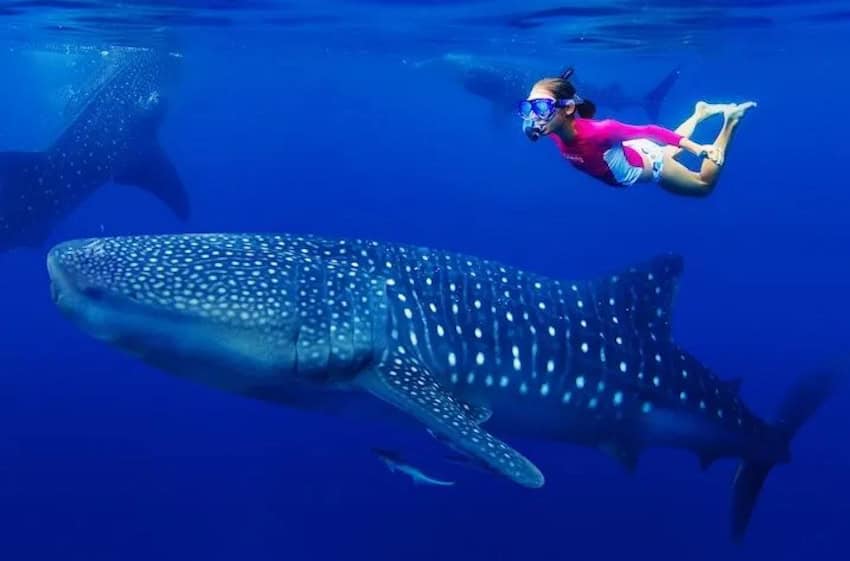
If I’m honest, it’s why I live in the Riviera Maya. The crystal clear Caribbean waters are stunning. So I was delighted when we found these gentle giants off the northern tip of Isla Mujeres. A mere 25 minutes after leaving Cancún, my lifelong dream came true. I found myself staring down at one as it went silently glide past.
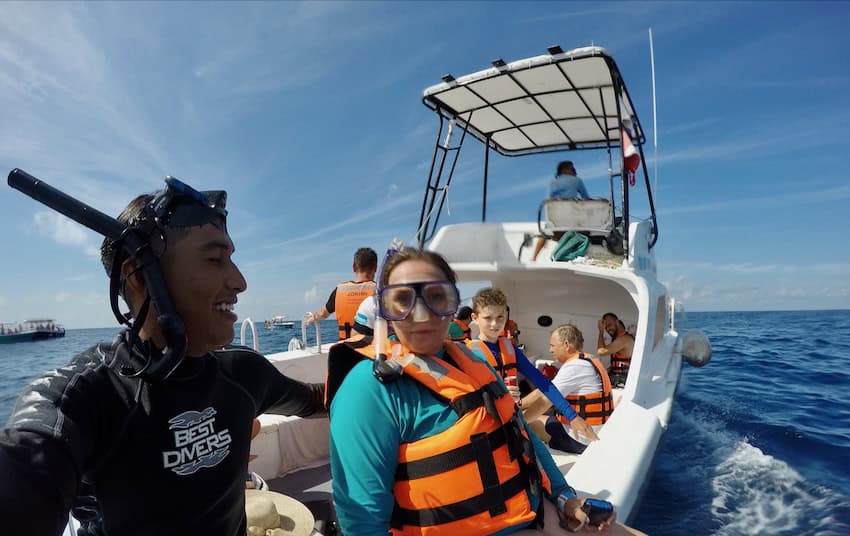
The whale shark grounds are easily reachable in small boats, and you can jump right in with them!
The size was astounding.
So, how big are whale sharks?
Bigger than I thought. The first one was the length of our boat. The second one was a little smaller but still breathtakingly impressive.
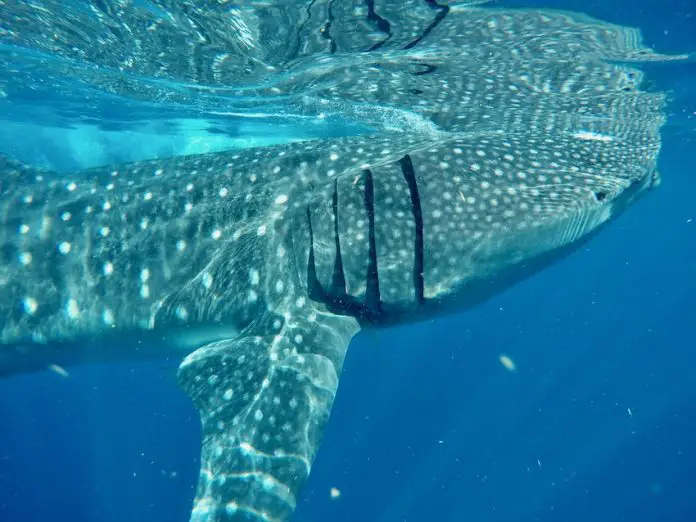
Staring down through the crystal clear water was beautiful satiny dark skin mottled with white spots. The enormous gaping mouth sucked in everything in its path. My friend next to me sucked in her breath seeing this. But it’s okay, it’s not dangerous, being filter feeders, that’s how they feed.
And did that huge mouth deter me from wanting to jump in? No, not at all. I knew I wasn’t on the menu.
Okay, bear with me while I geek out on fun facts so you know how harmless they are!
All about whale sharks: Do they have teeth? What do whale sharks eat?
Fun whale shark fact time: Whale sharks are harmless. Even though they have 3,000 teeth. Teeny tiny teeth. In fact, they are so tiny they’re not visible, so they do not bite or chew. Whale sharks are filter feeders. That means they filter small animals from the water. Zooplankton and phytoplankton, as well as krill, jellyfish, and tiny crab larvae are favorites. Occasionally, small fish get sucked in too.
A majestic whale shark swimming past the boat.
This is why they are so close to the surface. The warm top layer of water is where the plankton live. With their huge mouths open, this feeding behavior is called ram-filtration. It channels the plankton-filled water into their mouths, where it’s strained. The shark’s gills have a fine mesh called gill rakers, which catch the plankton.
That’s why they’re so great to swim with. They’re close to the surface, so you don’t have to dive. They aren’t predatory, so you’re safe. And best of all, they cruise at a steady speed. It’s quite a fast speed, though, so grab your fins!
Swimming with the whale sharks
I’ll say this, whale sharks swim deceptively fast. I consider myself a good swimmer. I live in Cozumel in the Mexican Caribbean and swim all the time, usually 2-3 km at a time. Plus, I’m ex-Navy and have had to maintain my swimming fitness year-round for years.
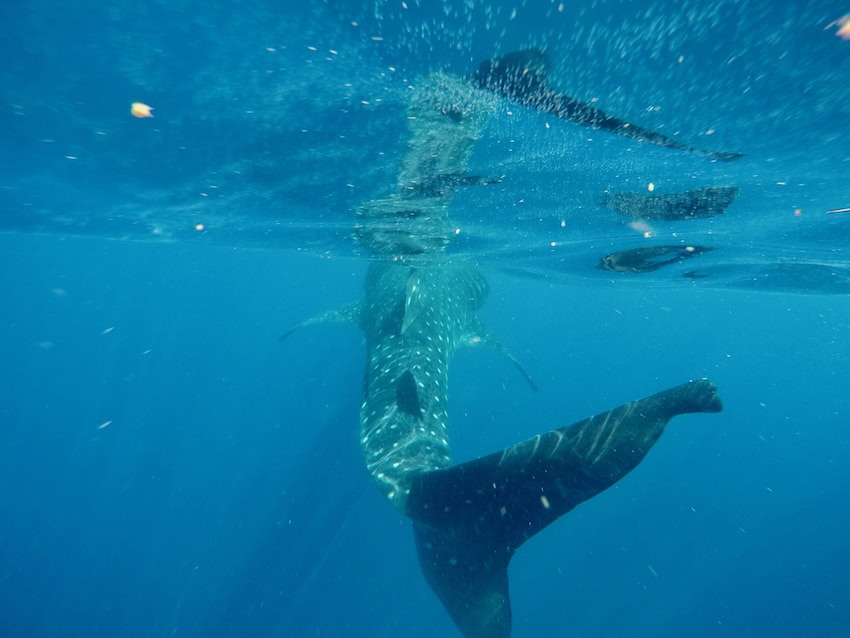
I don’t say this to brag. I say this to give you a point of reference. These gentle giants cruise a lot faster than I thought. They seem to glide along effortlessly. But that massive tail sure does give maximum propulsion for little effort.
My friend, who was with me, missed it the first couple of times. By the time she jumped in and started swimming, it was gone. Nothing but tail when she looked up.
Thankfully, I learned from that. I swung my legs over the side of the boat and jumped in as the shark approached. The trick is to start swimming strongly before you hit the surface. Otherwise, it just cruises by while you pop to the surface.
Still, it was a heart-pumping exercise. I had to jump in and swim like an Olympian. I couldn’t keep up that pace for long. But this enabled me to get some beautiful pictures and videos as they glided by. And left me feeling very small as that big tail slowly disappeared in the distance.
How big is a whale shark?
Even small whale sharks are much larger than we are. (Friend of the Sea)
More fun whale shark facts. Whale sharks are the largest fish in existence. Yes, that’s right. A mature 12-meter-long whale shark can weigh eleven tons. And their mouth can be over a meter wide. Let me tell you, up close, it’s breathtaking!
So, when you see more than one close to you, it’s thrilling. Usually, whale sharks are solitary creatures cruising the seas alone. But each year, they gather in this area between Isla Mujeres and Holbox Island to feast in the plankton-rich water.
When is the best time to swim with whale sharks?
From June to September each year is best. The plankton-rich currents from South America reach the Gulf of Mexico. Meeting the warm Caribbean Sea makes a very rich feeding ground for whale sharks.
Is it worth swimming with whale sharks?
As I said at the start, this was on my bucket list. Swimming alongside the largest fish on earth…for me, was priceless. It’s a once-in-a-lifetime kind of adventure you will tell your grandkids about.
Having said that, many of the people on our trip couldn’t keep up. While thrilled at seeing the sharks, they were a little disappointed.
So, my advice is this. Get back in the water before you go. Not like you’re training for an Ironman. No, just to feel comfortable in the water. That way, you will keep up and create a lifelong memory.
Mexico Correspondent for International Living, Bel is an experienced writer, author, photographer and videographer with 500+ articles published both in print and across digital platforms. Living in the Mexican Caribbean for over 7 years now she’s in love with Mexico and has no plans to go anywhere anytime soon.
Luisa María Alcalde at her swearing-in as Morena's new party leader, accompanied by Andrés Manuel López Beltrán, Morena's incoming secretary of organization, and Carolina Rangel Gracida, the party's new general secretary. (Luisa María Alcalde/Instagram)
The ruling Morena (National Regeneration Movement) party announced its new leadership following internal elections held on Sunday in Mexico City. Luisa María Alcalde, currently serving as interior minister, was elected unanimously as the new leader of the party founded by President Andrés Manuel López Obrador in 2011. The president’s son, Andrés Manuel López Beltrán, was chosen to be the party’s secretary of organization.
“The people chose continuity and the time of women, [they] chose Claudia Sheinbaum and in Morena, we cannot let them down,” said 37-year-old Alcalde in her speech to the party assembly. “I will not let you down because I know the events, the struggles, the risks, the sorrows and the joys of this national regeneration movement since its founding.”
Sheinbaum warned Morena against becoming a “state party” before she gave up her party membership ahead of her Oct. 1 inauguration as president of Mexico. (Morena Sí/Facebook)
Alcalde, who will assume office for a three-year term on Oct. 1 — the same day as President-elect Claudia Sheinbaum — takes the helm of a powerful party that not only won the presidency in the June 2 elections, but also governs 24 of Mexico’s 32 states and has majorities in both houses of Congress.
Morena has already taken advantage of its legislative power to approve AMLO’s controversial judicial reform bill earlier this month. On Thursday, the lower house, where the ruling party and its allies have a supermajority, also approved another constitutional reform which would put the National Guard under military control. The bill is expected to be discussed in the Senate this week.
At his morning press conference on Monday, AMLO congratulated the party delegates on their selection and described Alcalde as an “extraordinary” and “honest” woman. Prior to her appointment as the country’s youngest-ever interior minister in June 2023, Alcalde had served as labor minister and previously as a federal deputy in Congress.
López Beltrán, the second of AMLO’s four sons, has been active in the party for years and is also a businessman. “We all know that he [AMLO] will continue to be present in this party, with his example and his legacy. Our job … will be to uphold that legacy,” he said in a speech on Sunday, while also affirming that his 70-year-old father will be retiring from political life.
🇲🇽MEXICO— Long-suspected to be a major player behind the scenes & with his closest friends winning lucrative Govt. contracts in the past few years, the son of Mexico’s President was appointed today a top position in his father’s party in what is the birth of a political dynasty. https://t.co/NBhb8uBwhy
Some critics have accused Morena of hypocrisy by awarding a position to López Beltrán since one of its party tenets is to eradicate nepotism. Reforma newspaper correspondent José Díaz Briseño described the Morena election as “the birth of a political dynasty” in a post to X.
Sheinbaum dismissed the allegations of nepotism at a press conference on Monday and said that López Beltrán is a “great organizer” who had the right to put himself forward for the position now that AMLO is on the cusp of retirement.
In Sheinbaum’s speech to the assembly on Sunday, she outlined a 10-point vision for the future of the movement and warned against becoming a “state party,” as she stepped down from Morena to be “president for all Mexicans.”
“… The government of the Republic fulfills its duties for the transformation of the country and the party fulfills its own,” she said.
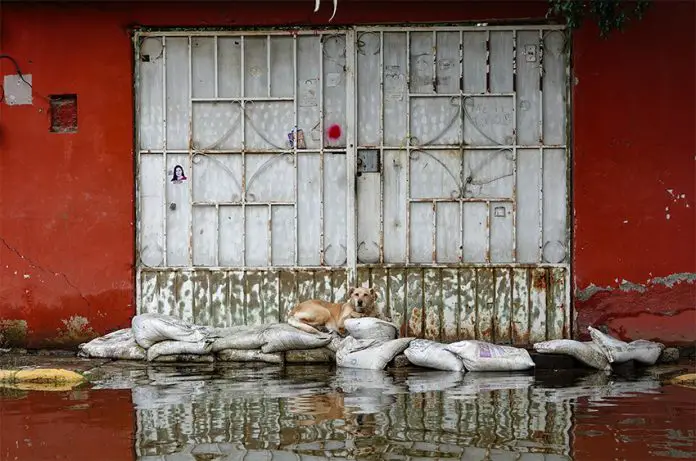
As repeated sewage flooding has upended lives in Chalco, state authorities have rescued and sheltered more than 100 lost pets. (Rogelio Morales Ponce/Cuartoscuro)
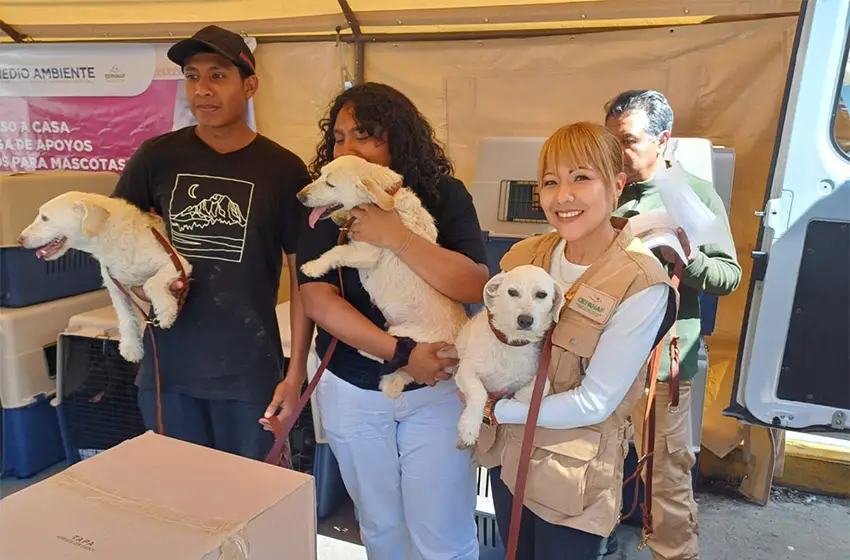
On Sunday, 32 pets rescued and sheltered by local authorities returned to their owners following the flooding in the municipality of Chalco, México state.
“My dog is already 8 years old and has been with me for a long time,” María Alejandra, who lost her pet during the flooding, told the newspaper El Financiero. “I am truly grateful that they [the shelter] gave it back to me. I have no words.”
On Sunday, 32 or the more than 100 animals rescued by Cepanaf were reunited with their owners. (Gobierno Edomex)
Over the course of the Chalco flooding disaster, the State Commission of Natural Parks and Fauna (Cepanaf) rescued 135 pets with and without owners. The commission provided the animals with food and veterinary care for two weeks with the support of animal welfare groups.
All rescued animals received deworming, rabies vaccine and other first-line vaccines. Moreover, authorities provided rations of kibble, wet food and additional dewormer.
“This is the first time that a government carries out something like this, supporting dogs and cats, with or without owners, that were vulnerable due to the floods,” Cepanaf chief Alma Diana Tapia Maya told El Financiero. “It is a dream come true that these little ones were able to return safe and sound to their home. It is a very enriching experience,” she said.
The state government reported that the remaining 66 rescued animals without owners will be given for adoption through Caravans for Animal Welfare, a program developed by Cepanaf.
Why did Chalco flood?
In August, thousands of residents in Chalco lived in dire conditions for over four weeks due to severe sewage flooding triggered by unusual torrential rains. The ongoing disaster led to widespread health concerns, forced evacuations and increasing demands for government intervention.
According to local authorities, the colossal flooding was caused by a huge garbage plug 50 meters wide by 2.4 meters deep in the Solidaridad Storm Drain.
However, Greenpeace México disagrees.
“What we are seeing in Chalco is the result of water and city management that is far from sustainable,” Greenpeace México said in a statement following the floods. “We have been calling [the government] for sustainable management of cities and water for years, and for corporations to be required by law to take responsibility for the plastic pollution they generate,” the statement said. “What have the state and federal governments done?”
On Friday, the neighborhoods of Jacalones and Culturas de México were once again affected when foul-smelling water gushed out of the drainage system and entered homes. The newspaper La Jornada reported that residents are once again struggling to evacuate it.
“This is our reality now,” Ricardo Carreño Marroquín, a resident in Chalco, told La Jornada. “It drizzles briefly, and the water quickly goes up. It is very frustrating to live like this. We are very tired, and the situation is very difficult. We are physically and emotionally exhausted” he stressed.
The ministry developed the new website section in recognition of private sector interest in investing in Mexico. (Shutterstock)
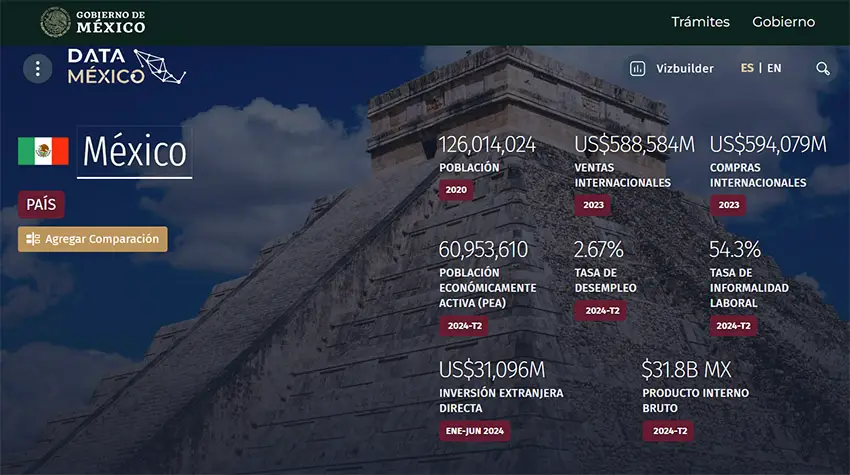
Mexico’s Economy Ministry (SE) this week launched a new section in its DataMéxico platform designed to highlight private investment trends, allowing private sector interests to consult disaggregated lists of public investment announcements.
Users of the platform can find data arranged in a variety of categories, including country of origin of the companies announcing investments, the Mexican state in which the investment is to be made and the economic sector within which the investment is being made.
The data is also broken down by date so that potential investors can conduct detailed analysis of the timing and context of the proposed investments. The new section can be found at economia.gob.mx/datamexico/.
In a social media post, the SE said the new Public Announcements of Foreign Investment section “aims to recognize the private sector’s interest in investing” in Mexico, citing the nearshoring phenomenon and the growing need for companies to increase efficiency in their production chains.
In an attached press bulletin, the SE said it remains committed to providing educational tools that the public can rely on, supplying timely information in a transparent manner as the government strives to consolidate international best practices in Mexico.
On the same day they unveiled the new tool, the SE announced that since January 2023 the private sector has issued 575 investment announcements featuring a sum total of US $170.6 billion.
On the website, visitors can view data relating to economic activity at the national, regional or local level. (DataMéxico)
According to the newspaper La Jornada, Economy Minister Rachel Buenrostro said these announcements reflect investor confidence in Mexico’s economy and its capacity to augment industry at both the local and global levels.
Mexico’s manufacturing sector has attracted the most planned investment (US $86.3 billion), followed by the energy sector (US $24.9 billion) and the transportation sector (US $22.5 billion). These three sectors comprise 78% of the total prospective investments since January 2023.
The data show that U.S. companies lead the way in investing in Mexico, with proposed investments exceeding US $68.5 billion.
In addition, investment announcements from companies in China (US $16.8 billion), Germany (US $12.2 billion), Argentina (US $10.7 billion), Denmark (US $10.2 billion) and France (US $8 billion) represent for Mexico a desirable diversification in the origin of these investments.
Of equal importance is the distribution of the target location of these investments. Although the industrialized northern and central regions of Mexico are the primary destinations for these funds, companies in the west and south are expecting to receive new investments to the tune of US $39 billion.
While projecting that these proposed investments could generate more than 331,000 new jobs, the SE said the above illustrates the confidence in the economic development of previously overlooked regions of Mexico and the talent of its workforce.
These figures bode well for the country’s future as Claudia Sheinbaum prepares to take office on Oct. 1 as Mexico’s next president. Vidal Llerenas, tapped to be Sheinbaum’s deputy economy minister for industry and commerce, said last week that foreign direct investment could increase by US $3-4 billion each year during Sheinbaum’s six-year term.
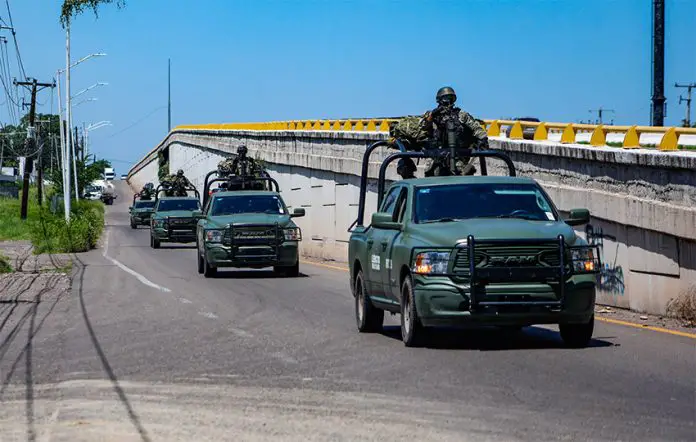
Two batallions made up of 600 soldiers arrived in Sinaloa on Saturday. (José Betanzos/Cuartoscuro)
The federal government has deployed 600 additional soldiers to the battle-scarred state of Sinaloa where hostility within the Sinaloa Cartel has sparked armed confrontations.
Shootouts and commando attacks have occurred primarily in Culiacán, the state capital, and surrounding towns.
The news magazine Proceso reported that four people were murdered overnight on Friday. Proceso also reported that a firefight between suspected cartel gunmen and the military on Saturday claimed three more lives. Meanwhile, El Sol de Sinaloa reported the discovery of five additional bodies outside an aquatic park in southern Culiacán later on Saturday.
That same afternoon, Sinaloa Governor Rubén Rocha announced the arrival of two battalions of soldiers.
In a social media post, Rocha said “a total of 600 members of the army have arrived in the state capital to join the active security operation … reinforcing the coordinated strategy between the three levels of government to combat insecurity in the state.”
“An operation was immediately implemented in coordination with security forces [who] managed to evacuate six adults and a minor from the building where the attackers had taken refuge, while they subdued three of the civilian attackers and arrested another.”
The governor declared the situation under control, but urged the public to avoid the neighborhood of Desarrollo Urbano Tres Rios while authorities conducted an investigation.
On Sunday, the Sinaloa Attorney General’s Office acknowledged reports of three murders and three disappearances, according to the news site Aristegui Noticias.
State struggles to keep students in school
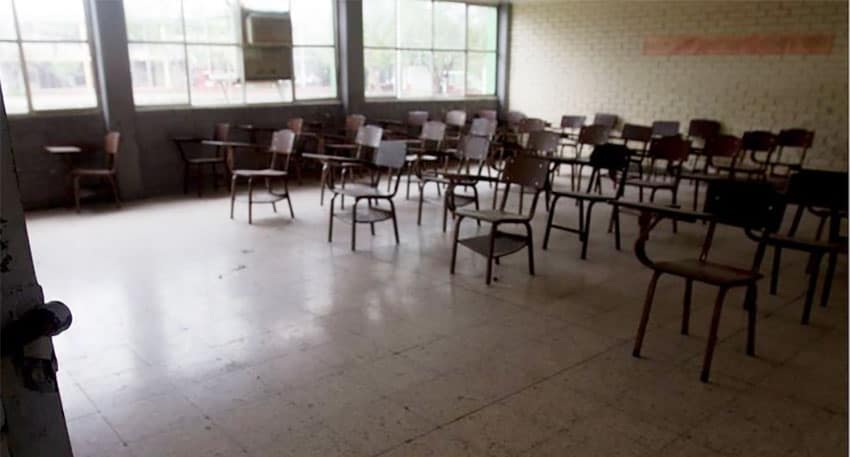
When the violence began back on Sept. 9, the 1,846 elementary schools in the cities of Culiacán, Concordia, Elota and Cosalá opted to suspend classes.
A week or so later, the state Education Ministry insisted that the schools reopen their doors, according to El Sol de Sinaloa. On Sept. 17, after touring high schools in Culiacán, Education Minister Catalina Esparza Navarrete lamented the low attendance.
“The schools seem deserted,” she said.
Though schools in Culiacán and many other areas of Sinaloa reopened last week, few parents allowed their children to attend. (File photo)
Esparza said the state would offer training to 1,500 teachers, instructing them how to react when violence threatens their schools. The National Guard has also been deployed to protect more than 1,600 schools in the municipalities of Culiacán, Cósala, Elota and San Ignacio.
One school principal told El Sol de Sinaloa that the 370 Guardsmen and 125 vehicles would not be enough to guarantee student safety at their school.
El Sol de Sinaloa cited three cases, including two shootouts, that occurred in the vicinity of schools between Sept. 9-13. The third incident was the placement of a human head on the grounds of an elementary school.
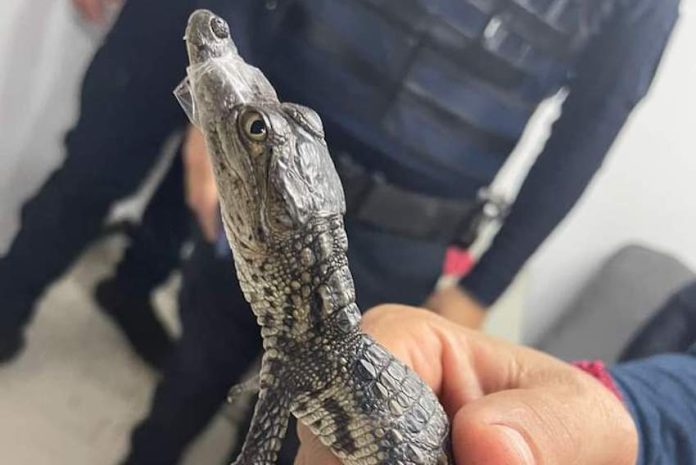
A Morelet's crocodile was found on the Mexico City Metro in September.
(@DiariodeMorelos/X)
Here are a couple things to remember while waiting for a train in a Mexico City metro station: Don’t step past the yellow line that marks the edge of the platform. And watch out for crocodiles.
Wait … what?
Over the weekend, baby crocodiles were spotted in two separate Mexico City metro stations.
On Saturday night, police responded to reports of a baby crocodile inside a train at the Río de los Remedios station in the eastern outskirts of Mexico City. The creature was found “commuting” inside a container partially filled with water.
After on-site officials confirmed it was a crocodile, they collected the reptile and notified animal rescue personnel.
The baby crocodile was taken to the Animal Vigilance Brigade (BVA) headquarters in the southern borough of Xochimilco where it was examined by a veterinarian.
The following day, passengers in the busy Balderas metro station in downtown Mexico City were surprised to see a little crocodile walking in the drainage canal along the edge of the railway platform.
Passengers notified authorities, who then trapped the reptile and handed it over to BVA agents.
This is not the first time exotic reptiles have been discovered outside their natural habitat in Mexico.
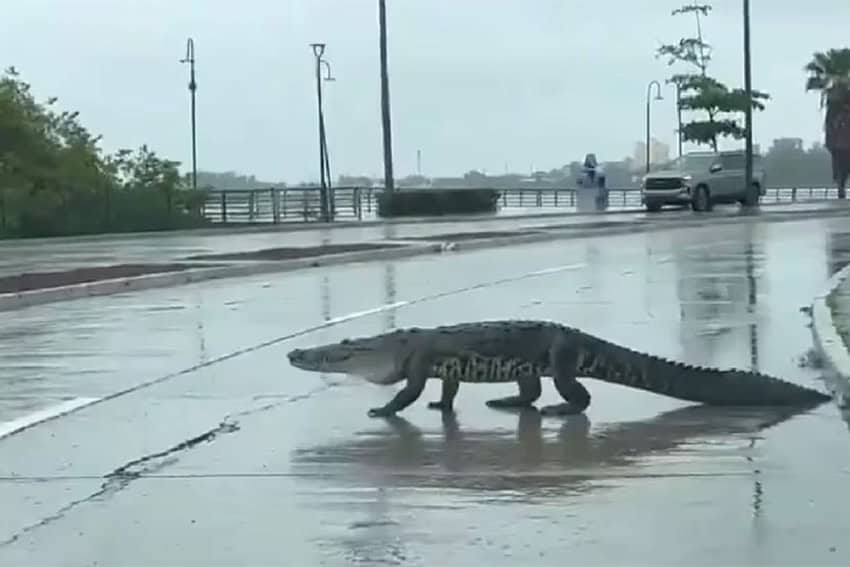
In June, an escapee from a nature park stopped traffic on a busy road in downtown Tampico, Tamaulipas. (Screen capture)
In 2020, two men attempted to carry several small crocodiles on the metro but were arrested. In 2022, a snake was found in the Boulevard Puerto Aéreo metro station in eastern Mexico City.
The authorities are unsure how the baby crocodiles made their way into metro facilities, though the immediate speculation was that they were abandoned by wildlife traffickers.
The BVA disclosed that both reptiles found this weekend are Morelet’s crocodiles, which can grow to 4.5 meters in length.
Though the Morelet’s crocodile is not an endangered species, it has long been threatened by habitat destruction and illegal hunting, particularly because high-quality leather can be made from its hide.
The NHC has said that Hurricane John will cause “large and destructive waves,” as well as potentially “catastrophic, life-threatening flash flooding and mudslides” to the coasts of Chiapas, Oaxaca and southeast Guerrero. (NOAA)
Hurricane John, currently located 160 km southwest of Puerto Escondido, Oaxaca, is forecast to rapidly strengthen into a major hurricane, bringing extraordinary rain to the coast of Oaxaca on Monday night through Tuesday morning.
The United States’ National Hurricane Center (NHC) expects John to produce 25 to 50 cm of rain along the Oaxaca coast and southeast Guerrero, with maximum sustained winds of 140 km/h. The NHC urged that “preparations to protect life and property should be rushed to completion,” as the storm is forecast to make landfall near Puerto Escondido in the next 24 hours.
Tropical Storm #John has strengthened into a Hurricane 🌀⚠️
Continued intensification is expected until landfall over the Mexican state of Oaxaca late Tuesday, possibly as a Major Hurricane. pic.twitter.com/oVE3PZGBje
A hurricane warning is in effect for the area between Punta Maldonado, Guerrero, to Bahías de Huatulco, Oaxaca. A tropical storm warning is in effect east of Bahías de Huatulco to Salina Cruz, as well as west of Punta Maldonado extending to Acapulco.
Oaxaca civil protection authorities have advised at-risk municipalities to install temporary shelters for residents. Civilians are encouraged to stay alert to official information here.
The rain and wind forecast by state in Mexico’s southwest is as follows:
Oaxaca: Extraordinary rainfall (+250 mm) with wind gusts of 100 to 120 km/h and waves of three to five meters high in coastal areas.
Chiapas and Guerrero: Torrential rainfall (150 to 250 mm) with gusts of 40 to 60 km/h and waves of one to three meters high, with waterspouts possible.
12:00 PM CST Key Messages on #Hurricane#John: John rapidly strengthens to a hurricane. John is forecast to rapidly intensify into a major hurricane before making landfall in southern #Mexico. Preparations to protect life and property should be rushed to completion. pic.twitter.com/ETpaepxLbo
The NHC has said that Hurricane John will cause “large and destructive waves,” as well as potentially “catastrophic, life-threatening flash flooding and mudslides” to the coasts of Chiapas, Oaxaca and southeast Guerrero.
The national weather agency has cautioned residents of these areas that strong winds may lead to falling trees and billboards.
Monday weather forecast for the rest of Mexico:
Intense rainfall: Campeche, Quintana Roo, Tabasco and Yucatán.
Very heavy rainfall: Chihuahua, Durango, Michoacan, Morelos and Puebla.
Heavy rainfall: Mexico City, Colima, México state, Jalisco, Nayarit, Nuevo Leon, San Luis Potosi, Sinaloa, Tamaulipas and Tlaxcala.
Showers: Aguascalientes, Coahuila, Guanajuato, Hidalgo, Querétaro and Zacatecas.
High winds from Hurricane John may reach some areas of México state through the end of the week.
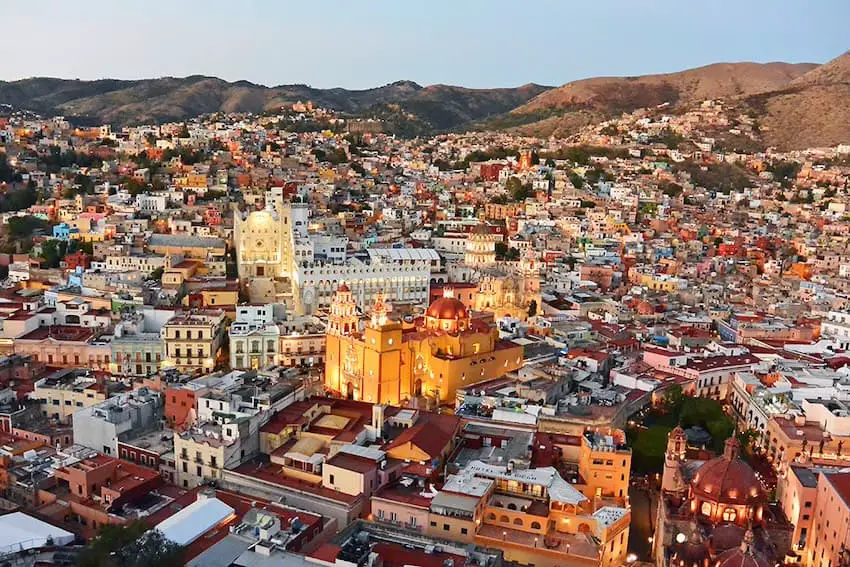
A lot has been said about San Miguel de Allende and Guanajuato City - and for good reason. But how do these gems stand up to the MND Where to Live in Mexico test? (The Longest Weekend)
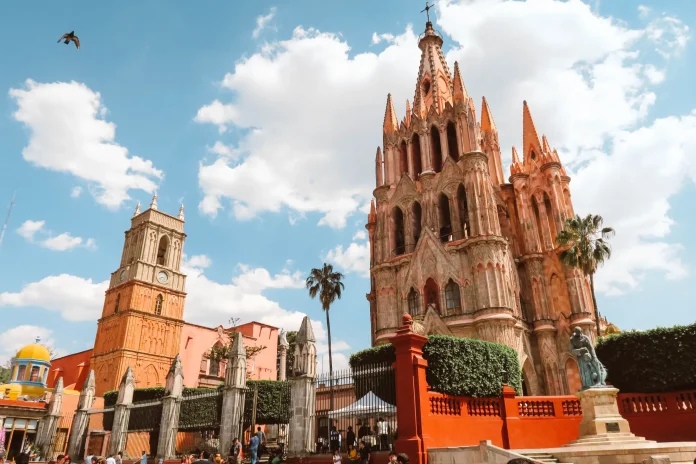
Last week’s essay drew inspiration from a bygone era when the Pacific’s Mexican Riviera dominated the tourism landscape. This week we turn to the Mexican heartland, and a state that’s captured the attention of global travelers competing for selfies and a heady dose of “real Mexico.” Guanajuato has two UNESCO World Heritage cities and a third “route” (the Camino Real) that’s also on this coveted list. San Miguel de Allende has even earned a “Best City in the World” ranking a remarkable five times, 2014, 2017, 2018, 2021 and 2024! That’s an astonishing feat, especially since some Mexican and even foreign residents accept these accolades with a “Really?” blush of incredulity. But even without these international recognitions, the State has earned its 21st-century overseas living cred based on some simple, undeniable attributes: location, authenticity and sophistication.
Guanajuato was one of the first areas of Mexico colonized by the Spanish. In the mid-16th century, the state’s rich silver deposits lured the Spanish crown to develop settlements that grew into centers of wealth and influence. In fact, for some two and a half centuries, nearly one-third of the world’s silver came from the mines of one city — Guanajuato. This fertile region was also Mexico’s “breadbasket” — its farms, orchards and ranches feeding the emerging New World cities. The mining wealth enabled the economic and social emergence of Europe in the 17th and 18th centuries, helping fuel the Renaissance.
Guanajuato state is one of the oldest colonized regions of Mexico, and the mineral wealth found there made its cities some of the richest in New Spain. (Barefoot Caribou)
It has an average altitude of 2,015 meters (6,611 ft) above sea level. Guanajuato has a pleasant, high desert, spring-like climate, with temperatures from 11 to 26 degrees Celcius (52 to 80 Fahrenheit). Winter evenings can be cold, while the summer rainy season lasts from June to September — though with the uncertainty wrought by Mexico’s changing climate, this is becoming less certain with every passing year. It’s greener in the south, where vineyards are common. Before the Spanish arrived, this area was covered in dense forest, but mining needed wood fuel and sheep grazing pastures. Today, the central area is home to most of the state’s agriculture and industry since the terrain allows for highways and large farms, which produce grains, vegetables and fruit. This farmland is considered some of Mexico’s most productive.
Guanajuato State is perhaps Mexico’s grandest colonial-era showcase. It is located in the center of Mexico, in a region referred to since colonial days as El Bajio, meaning the lowlands. Guanajuato is bounded on the north by the State of San Luis Potosí, on the east by the State of Querétaro, on the south by the State of Michoacán, and on the west by the State of Jalisco. It has an area of 30,491 square kilometers (about 11,800 square miles; the size of Massachusetts). It derives great advantage from these surrounding states, especially Queretaro, which offers great access to medical care, air travel and shopping. In 2020 the state had an estimated population of 6.1 people and no one’s quite sure how many more foreign transplants.
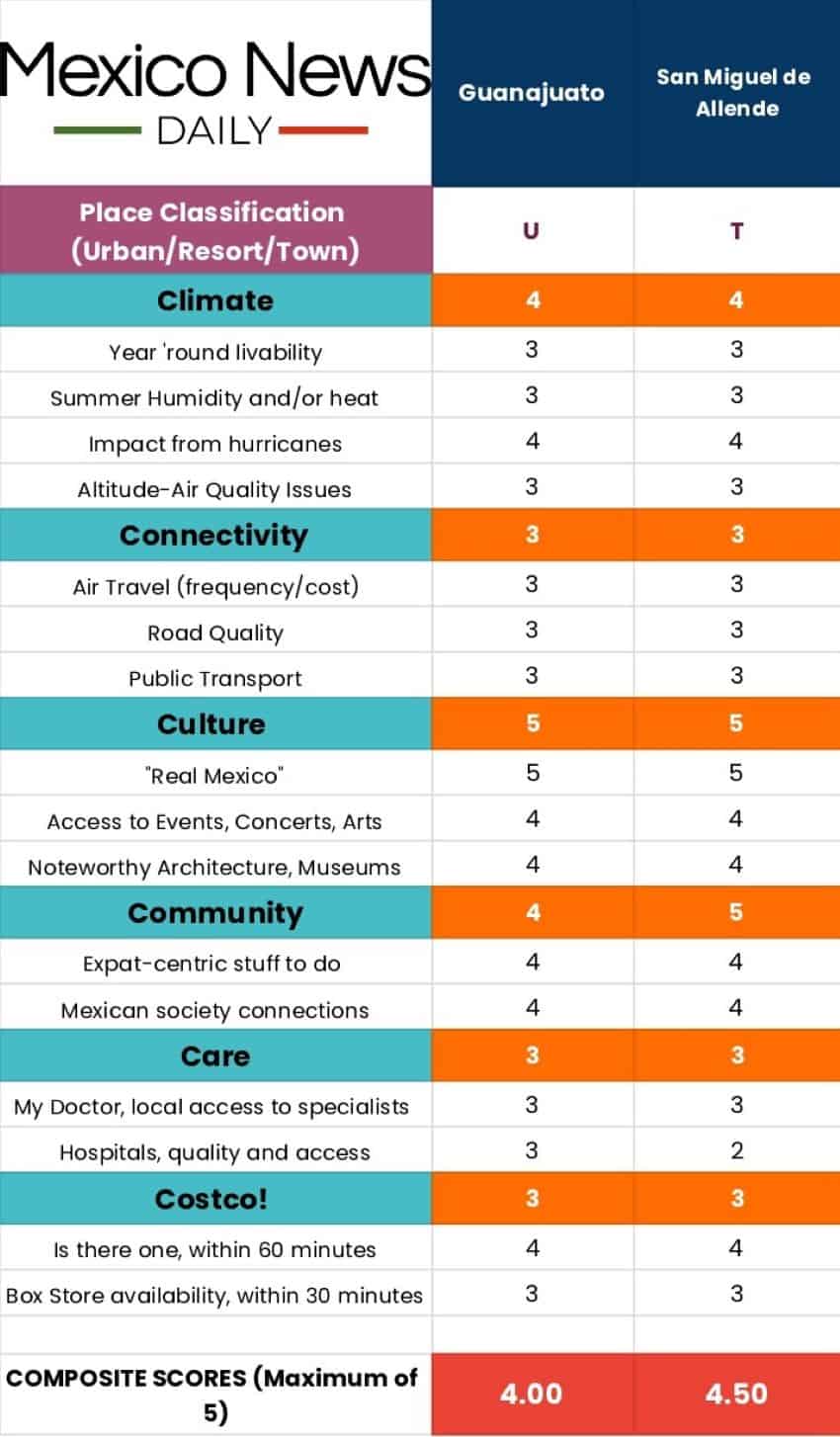
Two cities (Guanajuato and San Miguel de Allende, each around 180,000 residents) earn high marks in our series’ ratings (see below). Some will lament how these places have been “loved to death” or how rising prices and weekend “invaders” have fundamentally altered each icon’s livability. The state is not all “pina coladas and getting caught in the rain”, as a persistent criminal element in the state’s southern region has put once visited places (Irapuato, Celaya) off-limits (what a shame).
Most foreign tourists and expat residents concentrate their Guanajuato visits to the state’s most famous colonial cities: Guanajuato and San Miguel de Allende. In addition, visitors will want to consider visits to León and Dolores Hidalgo, the “cradle” of Mexican independence. Prominente Pueblos Magicos include Jalpa de Canoves, Mineral de Pozos, Salvatierra, Comonfort and Yuriria. Far fewer foreigners live in these places, so you might actually get the chance to practice your Spanish.
San Miguel de Allende might steal all the plaudits, but Guanajuato is every bit as much of a colonial gem. (Feather and the Wind)
Visitor infrastructure in Guanajuato State is a step above other Mexican interior states. There’s a rich assortment of historical attractions, exquisite architecture, excellent shopping, vibrant festivals, thermal water spas, and the chance to participate in small town Mexican life. Several super-highways cross the State; there’s Guanajuato’s international airport outside of León; and intercity bus service is frequent and inexpensive. Guanajuato State is also host to some of Mexico’s most renowned festivals, including the International Festival Cervantino in October, staged in Guanajuato, and the Fiesta de Los Locos in San Miguel de Allende held in June.
The State’s gastronomic heritage is one of Mexico’s best, including wine. You’ll want to try the tuna de xoconostlesalad, menudo quitar, the enchiladas mineras, the sopes, and pozole. Tohelp disseminate traditional cuisine and new dining trends,the state hosts culinary events throughout the year indifferent municipalities, including gastronomic weeks,festivals, encounters with national and international chefs,and vineyard tours.
San Miguel de Allende
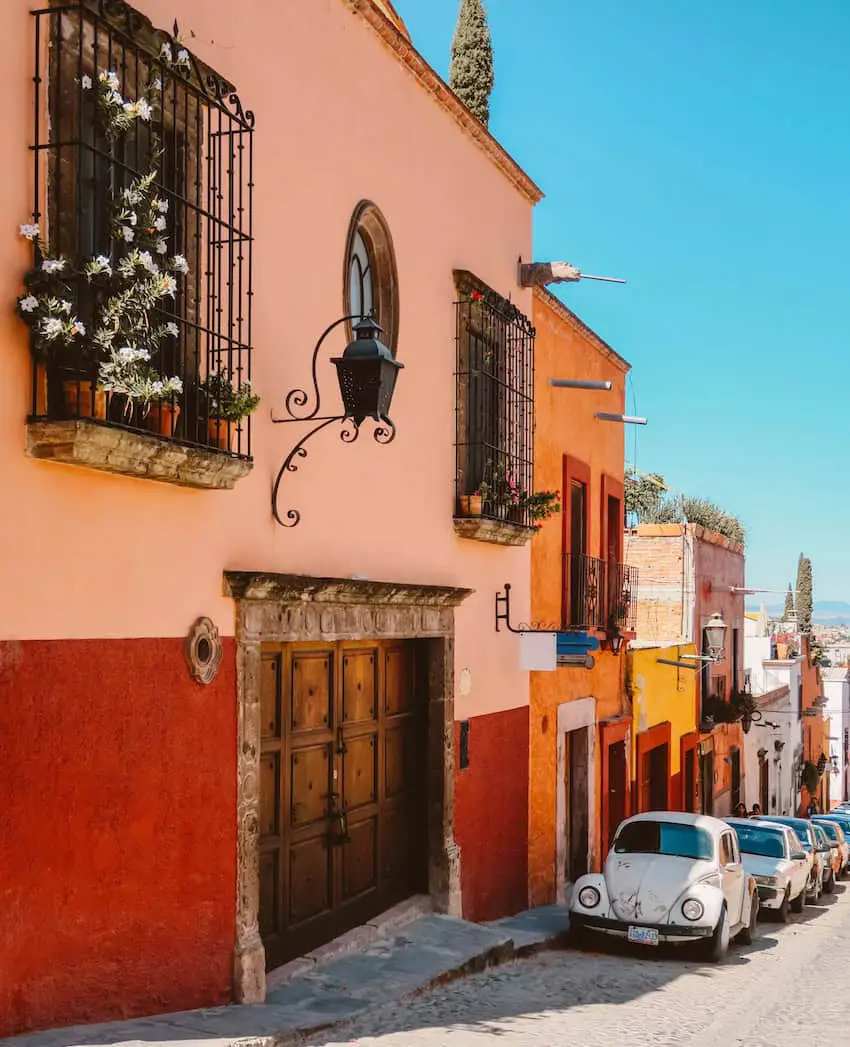
San Miguel de Allende is now so synonymous with Mexico living that there isn’t much new to say. Those who love luxury will be drawn to the colonial haven, though others decry a lack of authenticity. (The Longest Weekend)
How would most places deal with being named the “Best city in the world”? San Miguel seems to have risen above the pressure, repeatedly winning the “honor.” Of course, you might want a place to live that’s a little less “discovered”, as one blogger puts it. To some detractors, and there are many vocal critics of what San Miguel has become, it’s all a charming façade: too expensive, too many awards, too many Texas license plates, too little foreigner integration with Mexican neighbors. But that’s not the whole story. As someone living in Mexico’s “other” expat hangout (Lake Chapala) I embrace San Miguel for its architectural authenticity and shopping-gallery-lodging-dining sophistication, all things my area lacks.
I meet in Ajijic with San Miguel “refugees” who have been priced out, or driven away from what they thought would be small town living — especially on weekends, when SMA can become saturated with CDMX experience seekers. My repeated visits, which began back in the 1980’s, still deliver a very pleasing mix of multiculturalism, local business friendliness, the remarkable Biblioteca Publica, interesting folks with global perspectives, and, yes, “real Mexico” engagements.
SMA’s municipal governments have for years kept the wheels on by balancing gentrification with authenticity. If you have mobility issues, the town is sloped and parking can be a nightmare, though sidewalks and streets are immaculate in the city center, some closed to automobiles. Lodging in San Miguel offers Mexico’s most esteemed inland collection of luxury brands (Belmond, Rosewood, Live Aqua and Small Luxury Hotels among others), some exquisite and historic small inns — even a property named the world’s best hotel by Travel + Leisure in 2021, and plenty of 3-4 star choices. Rental costs have skyrocketed. If you’re hoping you’ll find a “fixer-upper”, well you’re quite late to the party. What the city lacks for living — an airport, box stores, high quality medical care — all found 45 minutes away in Queretaro, so what’s the problem?
But who better to recount the realities, truths and myths of San Miguel living than Mexico News Daily owner Travis Bembenek, who has this to say: “Rarely if anywhere in the world have I seen such a beautiful mix of people from all walks of life enjoying living as much as I do in San Miguel de Allende. The mix of locals, Mexicans from other parts of the country, and expats from around the world all coexisting happily is a sight to see.”
Guanajuato City
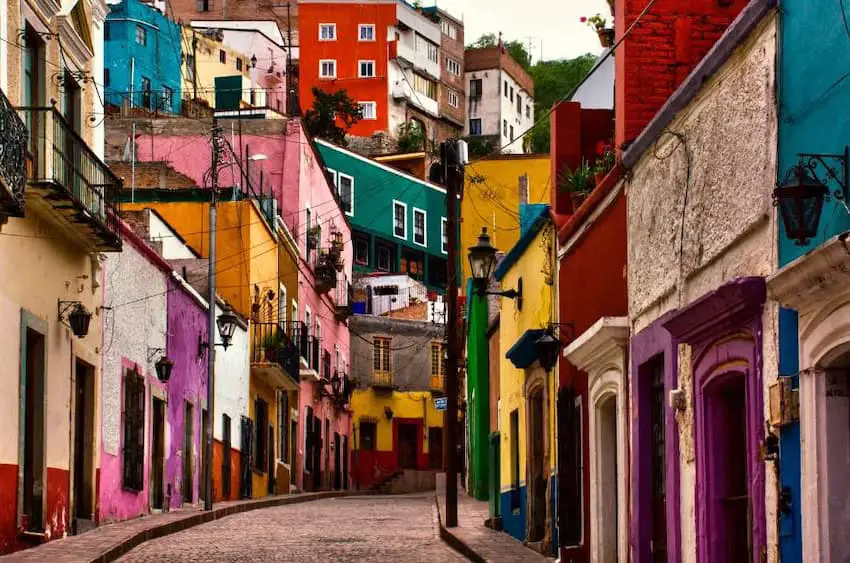
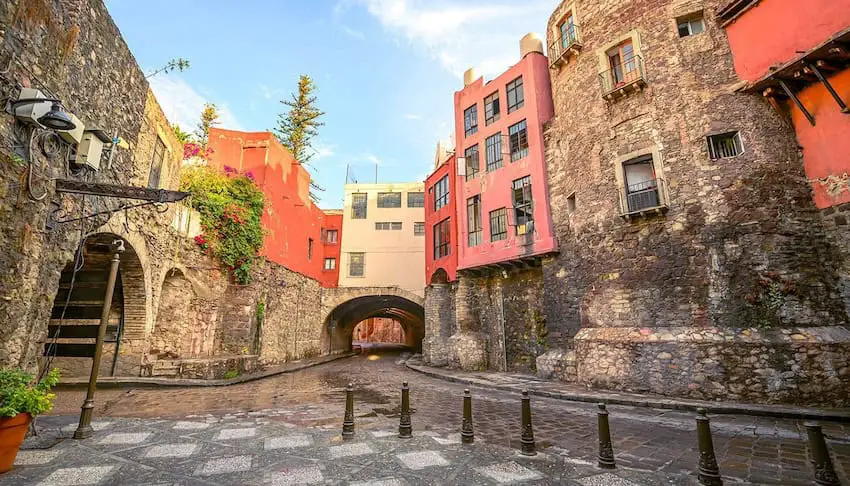
Guanajuato’s old flood control network now hosts the city streets, lending a charm more reminiscent of Seville than Mexico. (Visit Mexico)
This might be your Mexico living highlight for Guanajuato State, especially if San Miguel is just too, well, San Miguel. Climbing the sides of a narrow, mountainous ravine, Guanajuato founded in 1557, is one of Mexico’s most beguiling and beautiful cities. The best way to explore this city is literally to lose yourself in it. Around every corner is a new surprise. The city’s impossible topography gave Guanajuato one of the world’s most unusual, subterranean street systems. In what was once a riverbed and later the city’s flood control canals, cars now swoop through stone-arched tunnels that meander under the city.
The city’s centuries-old veneer conceals the fact that Guanajuato is a pretty hip town, imbued with musicians, artists, and Mexico’s most renowned cultural celebrations. particularly the Cervantino, held in October. Harmonies of all strains, from classical to mariachi, echo throughout the city. Strolling estudiantinas — local singers dressed as 19th century Spanish troubadours — serenade listeners on nighttime callejoneadas. Several acclaimed painters come from Guanajuato, including the great muralists Diego Rivera, José Chavez Morado, and painter Manuel Leal. The city’s downtown university campus draws foreign and Mexican students, giving the city a youthful flair.
And living here? Owning a car is not really an option, city center noise travels up into the hillsides where you’ll likely be living, and there’s nothing approaching the same levels as San Miguel de Allende for living the high life. Medical care is compromised, comparatively speaking and the demographic skews younger. But it’s affordable, eye-pleasing, and has a sort of magical ambiance that’s never boring.
Author Greg Custer lives in Mexico. He’s worked for over 40 years in international tourism, educating travel advisors around the world about Mexico and other Latin American destinations. He helps folks explore Mexico for living at www.mexicoforliving.com.