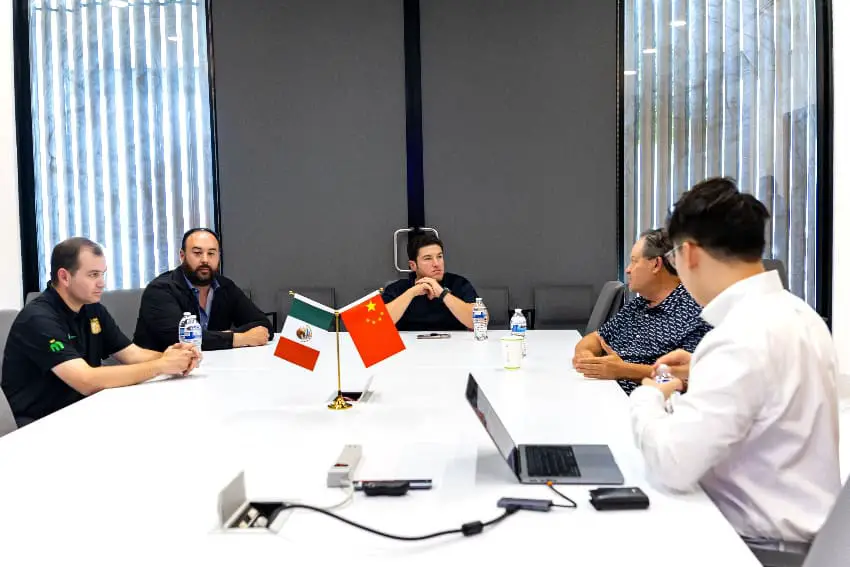
Hofusan Industrial Park in Nuevo León is home to 40 companies today and has already invested US $1 billion in its facilities to date. (Government of Nuevo León)
The Chinese and Mexican-owned Hofusan Industrial Park has plans to invest US $1 billion to expand its facilities north of Monterrey, Nuevo León, according to a statement by Governor Samuel García.
“The company has informed me that they have already invested over US $1 billion, and they plan to continue expanding with an additional US $1 billion,” García posted on his X account on Saturday, along with a video taken at the company’s facilities.
García (center) met with executives from Hofusan Industrial Park to discuss their expansion plans. (Government of Nuevo León)
Furthermore, García said Hofusan Industrial Park has plans to develop an area of hotels, housing and shopping malls.
“New roads, new outposts and the remodeling of the Colombia-Laredo customs office has attracted large companies from around the world to invest in Nuevo León,” García said.
César Santos, the president of the board of Hofusan Industrial Park, added that they are “very grateful” to García’s government for having improved the access road to the park, which went from being “a rural road to a four-lane highway.”
Developed by the Chinese companies Holley Group and Futong Group along with the Mexican Santos family in 2017, Hofusan Industrial Park occupies an area of 8.47 square kilometers located 20 km north of Monterrey — about 200 km from Laredo, Texas.
The industrial park has been one of the key players in the arrival of Chinese manufacturers to the northern state of Nuevo León. (Hofusan Industrial Park NL/X)
The industrial park currently houses 40 businesses and is projected to eventually include 100 industrial buildings.
Some of the park’s largest companies include Hong Kong-based furniture manufacturer Manwah and Chinese home appliance manufacturer Hisense. The park also houses manufacturers in the auto parts and automotive industry.
Nuevo León was the third biggest recipient nationwide of the announced FDI during the first six months of 2024, accounting for 9% of the total. Some recent big announcements include U.S. software giant Oracle’s plans to bring a hyperscale cloud region to Nuevo León, and Chinese Boda International Holding Group’s plan to invest US $850 million to build smart homes as part of a community development program.
A study by the Mexican Institute for Competitiveness (IMCO) and the Friedrich Naumann Foundation for Freedom (FNF) found that Nuevo León is among the best-prepared states in Mexico to accommodate nearshoring investments, along with Aguascalientes and Coahuila.
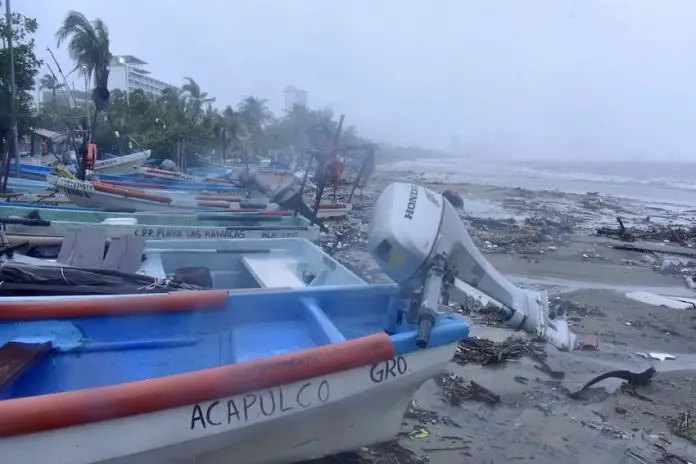
Areas including southern Guerrero and coastal Oaxaca as well as the Isthmus of Tehuantepec could see considerably more rain today and throughout the week.
(Carlos Alberto Carbajal/Cuartoscuro)
As residents of Mexico’s Pacific coast area reel from the effects of Tropical Storm John, today’s weather forecast suggests there is little relief in sight.
In its Monday morning weather bulletin, Mexico’s national weather agency (SMN) reported that intense rains are forecast to continue in Guerrero, Chiapas and Oaxaca.
These three storm-battered states could see an additional 75-150 millimeters of rain on Monday. Guerrero is especially vulnerable to flooding and landslides after John dumped rain on its coastal mountain region for the better part of last week, leaving at least 23 dead across the state.
Farther north along the Pacific coast, Colima, Jalisco and Michoacán are projected to see 50-75 mm of rainfall.
According to the weather agency Meteored, unstable tropical systems featuring tropical waves, monsoon troughs and tropical cyclones threaten to bring torrential rains across Mexico this week.
As a result, areas including southern Guerrero and coastal Oaxaca, as well as the Isthmus of Tehuantepec extending to the Gulf, could see considerably more rain today and throughout the week. The SMN alerted the public to be on the lookout for mudslides and flash flooding, especially where the ground has already been saturated with rain.
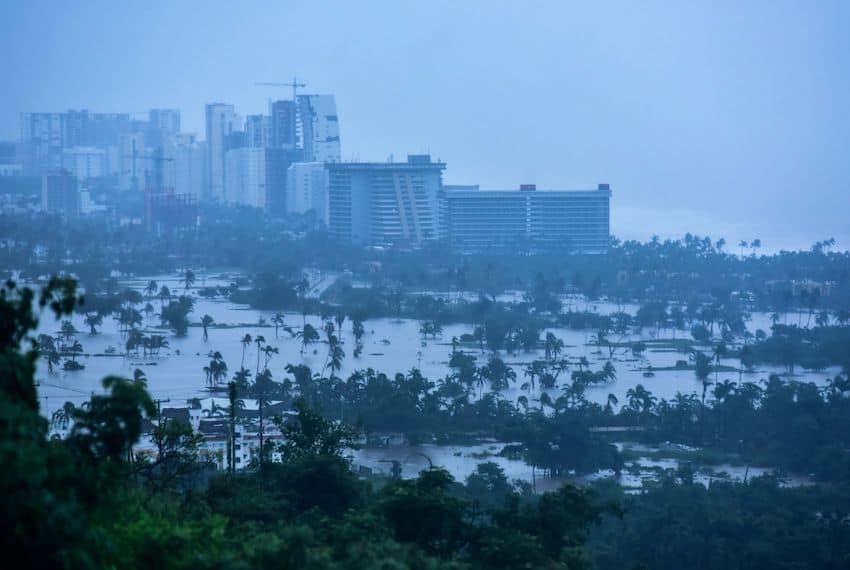
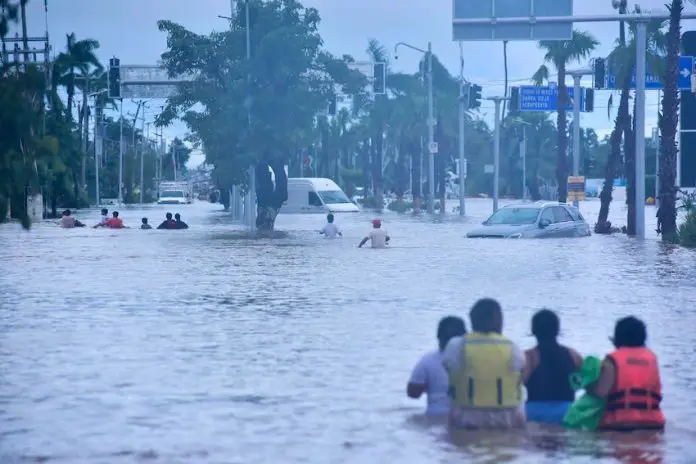
The “Diamante” resort zone of Acapulco, Guerrero, was under water on Monday. (Carlos Alberto Carbajal/Cuartoscuro)
The first, off the coast of the states of Oaxaca and Guerrero, has a 20% chance of becoming a tropical cyclone in 48 hours but a 70% chance of becoming a storm in the next seven days. The SMN said this system is located roughly 200 kilometers south-southwest from Punta Maldonado, Guerrero, the spot where Hurricane John came ashore exactly one week ago.
The second system is located about 160 kilometers offshore from Pijijiapan, Chiapas, and has just a 20% chance of becoming a cyclone in the next week. The fourth cold front of the season is forecast to arrive by the weekend, contributing to the inclement conditions in Mexico’s storm-affected regions.
Across the country on the Gulf coast, Tabasco and Veracruz will see 75-150 mm of rain, while Campeche, Quintana Roo, Puebla and Yucatán are projected to get 50-75 mm of precipitation.
The Central American Gyre (CAG) is the main contributor to the weather conditions in Mexico’s southeast and along the eastern Gulf of Mexico. An early and late-season source of tropical development, the CAG can bring dangerous levels of rainfall in a very short period.
Meteored says the CAG will primarily affect the weather across the Yucatán Peninsula and up into the Gulf of Tehuantepec this week.
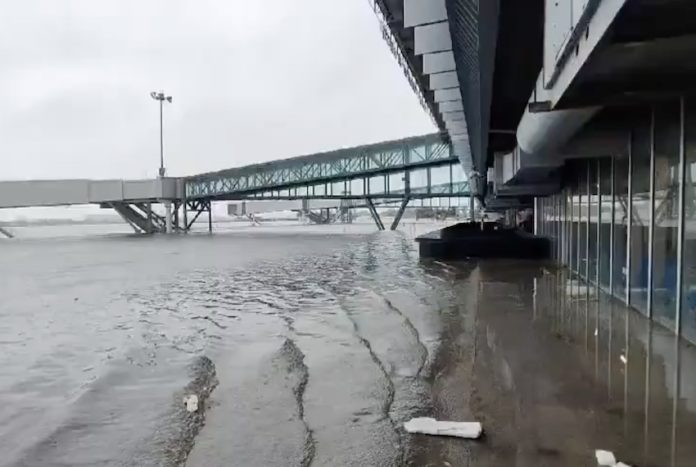
Members of the National Guard are carrying out cleaning and water pumping tasks, along with airport employees, but authorities say the closure will continue until further notice.(@Garcimonero/X)
The Pacific coast resort city of Acapulco, which was devastated by the impact of Hurricane Otis last October, was drenched last week by Hurricane and Tropical Storm John, disrupting all commercial flights.
Runways at Acapulco International Airport are flooded, restricting operations to only rescue flights. According to a statement on the airport’s X account, members of the National Guard are carrying out cleaning and water pumping tasks, along with airport employees, but authorities say the closure will continue until further notice.
⚠️ ¡Atención! El Aeropuerto Internacional de Acapulco ha suspendido sus operaciones ya que se encuentra inundado tras la tormenta tropical John; las autoridades informaron que reanudarán los vuelos cuando mejoren las condiciones.
The newspaper El Universal reported that an Aeroméxico airplane was stranded at the airport and that the parking lot at Terminal 2 — inaugurated six years ago by former President Enrique Peña Nieto — also remains flooded.
Juan Ramos, the head of monitoring at the Acapulco Civil Protection Communications Center, told the newspaper El País that in just four days, from Sept. 23 to 27, Acapulco was soaked by an entire year’s worth of rain.
“It was a lot of water,” Ramos stressed. “It was an extraordinary phenomenon that has surpassed all the statistics.”
Officials have reported that the number of dead in Guerrero has risen to 23, while 5,000 people have been displaced in the coastal city due to severe flooding and landslides.
Claudia Sheinbaum, who will be sworn in as Mexico’s new president on Tuesday, said her first trip as president would be to Guerrero, where she will “assess the damage” and ensure residents get “all necessary assistance.”
Meanwhile, another low-pressure system is developing off the coast, and more heavy rains are in the forecast for the area.
“It is essential that we remain alert and prepared. We will continue to report,” Guerrero Governor Evelyn Salgado wrote on her X account on Monday.
Which roads are closed in Guerrero?
John also wreaked havoc on highways in Guerrero, including several sections of the Chilpancingo-Acapulco highway, the Iguala-Chilpancingo highway and the Acapulco-Zihuatanejo highway. Authorities are working to repair damage caused by fallen trees, landslides and road collapses.
The Zona Diamante district, where numerous resorts and luxury condominiums are located, is one of the worst affected areas of Acapulco after the passage of Hurricane John. (Carlos Alberto Carbajal/Cuartoscuro)
Hurricane John, which made landfall in Mexico twice last week, claimed 29 lives in three Pacific coast states, including more than 20 in Guerrero, according to news reports.
The EFE news agency and other media outlets reported that the death toll from John rose to 29 on Sunday after authorities confirmed four additional hurricane-related fatalities in Guerrero.
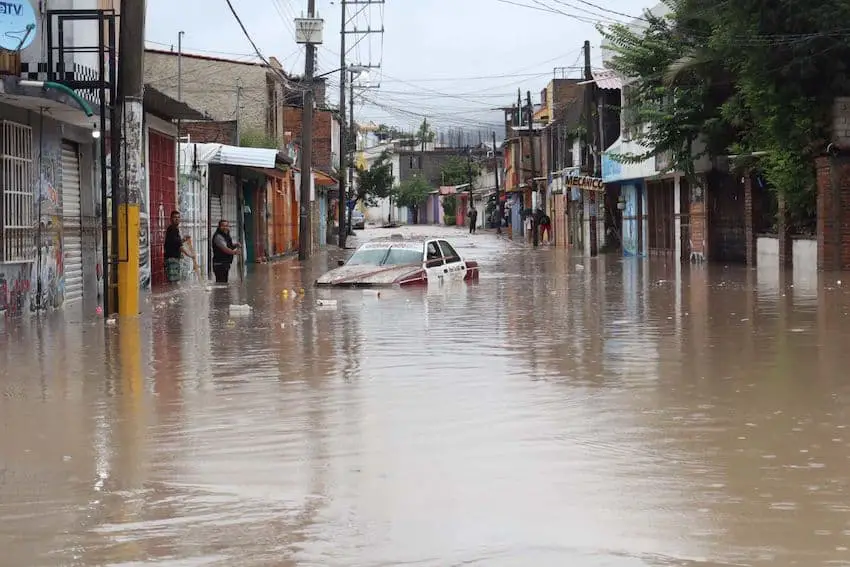
Guerrero’s capital of Chilpancingo, located about two hours north of Acapulco, also saw major flooding that caused dozens of homes to collapse. (Dassaev Téllez Adame/Cuartoscuro)
After weakening and drifting offshore, John regained strength in the Pacific Ocean before making landfall for a second time last Friday as a tropical storm on the coast of the neighboring state of Michoacán.
According to reports, 23 of the 29 fatalities linked to Hurricane John occurred in Guerrero. Five deaths reportedly occurred in Oaxaca — where at least 80 landslides were reported — and one fatality was reported in Michoacán.
Some of the victims were killed in mudslides while others were swept away by raging floodwaters. The storm also caused significant damage to homes, commercial establishments and other structures, including bridges.
Authorities have begun cleanup efforts but there is still a lot of mud in the affected areas. (Carlos Alberto Carbajal/Cuartoscuro)
Powerful winds and the accompanying storm surge, as well as sinkholes caused by torrential rain, caused some buildings to collapse, including at least 13 restaurants in Acapulco, according to EFE.
The BBC reported that some places affected by John, described as a “zombie storm” because it returned to hurricane strength after initially dissipating, have “had almost a year’s worth of rainfall over a matter of days.”
Citing the latest report of Civil Protection authorities, López Obrador said that floodwaters were receding but noted that there is “a lot of mud in the streets.”
Authorities have begun cleanup efforts, electricity services have been reestablished and evacuations have been completed, the president said.
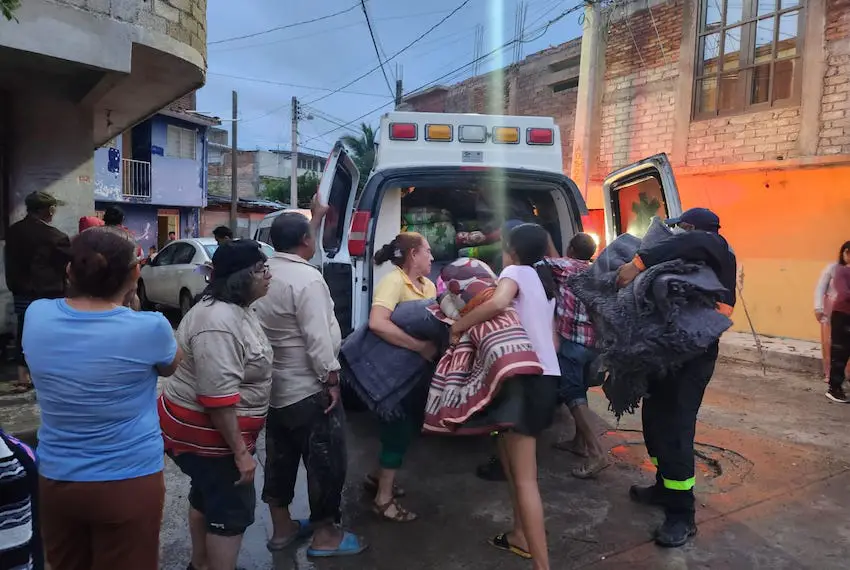
Residents of Chilpancingo received blankets and other essential items from local civil protection authorities. (@PC_Guerrero/X)
“There are 1,000 people in shelters; they are guaranteed three hot meals a day and health services, and are given groceries and water,” he wrote.
“There is no looting,” López Obrador said, highlighting that the security situation in Acapulco has not significantly deteriorated, as occurred after Hurricane Otis.
“Unfortunately, the number of deceased people, according to the state Attorney General’s Office, is 15,” López Obrador said, apparently referring to hurricane-related fatalities in Acapulco.
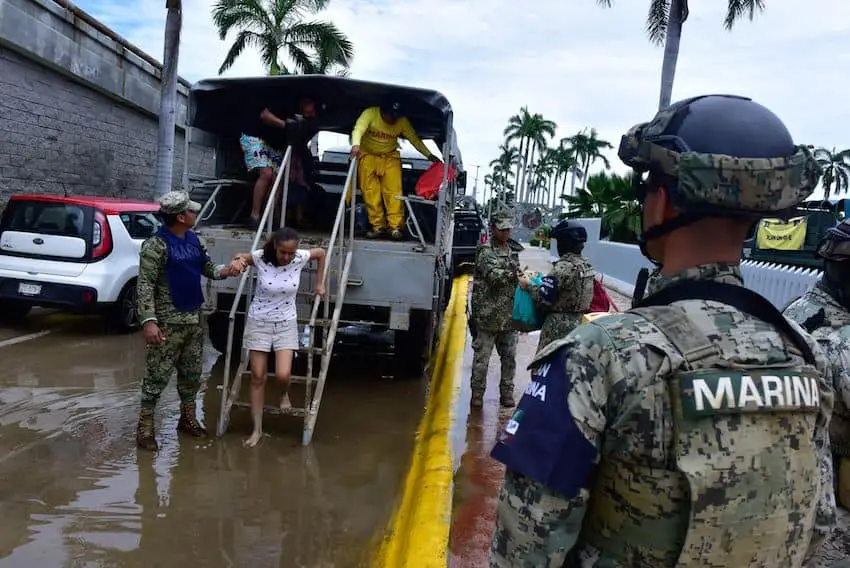
He also said that “the first phase” of “humanitarian rescue” efforts carried out by the army, navy and National Guard were almost complete. López Obrador added that a “house by house” census would be carried out to assess damage and provide “direct support” to victims.
Boats are the only mode of transport — or evacuation — for some acapulqueños
With some neighborhoods in Acapulco completely under water, many acapulqueños, as residents of the city are known, have had to rely on boats to get to and leave their homes.
The Zona Diamante district, where numerous resorts and luxury condominiums are located, is one of the worst affected areas.
Among those who have had to use the services of lancheros (boatmen) are hundreds of residents of the Vicente Guerrero 2000 residential complex, located near an overflowing lagoon in Acapulco.
“What we want the most is for the rain to stop,” Cyndi Viridiana Gómez told the newspaper El Universal while on her way home — by boat — from a shopping center.
“When it stops raining, the water will go down and we’ll be able to clean up and see what [still] works and what we’ll have to throw out,” she said, referring to furniture and domestic appliances.
El día de hoy, con #FuerzaOperativaGuerrero en marcha, hemos desplegado 33 motos acuáticas, 3 lanchas y un catamarán, logrando rescatar a cerca de mil 123 personas en Acapulco.
Tenemos un gran compromiso con ustedes, no vamos a parar hasta llegar y apoyar a las familias… pic.twitter.com/drmzuvddoe
Armando Vázquez, another resident of the Vicente Guerrero 2000 complex, told El Universal that his home was flooded with “almost two meters” of water.
“We left by boat,” said Vázquez, who acknowledged it would take some time for the floodwaters to recede.
Some acapulqueños were forced to climb onto the roofs of their homes to take refuge from rising waters. Over 5,000 people had to be evacuated, authorities said.
One Acapulco resident, Bárbara Encinas, told the AFP news agency that the situation was “critical” and that she and other locals were “desperate.”
“We still haven’t recovered from Hurricane Otis,” she said. “Now, we’re in a situation that appears to be worse.”
Marta Soteldo, another Acapulco resident, told AFP that she became “sick with nerves” when strong winds whipped up dust and lifted sheet roofs off homes early last week.
“Children became hysterical,” she added.
Some 25,000 military and National Guard personnel were deployed to coastal Guerrero to assist affected residents and contribute to cleanup efforts.
“We’re rescuing those who were trapped by flooding in neighborhoods in Acapulco,” López Obrador said late last week.
AMLO, who will cede the presidential sash to Claudia Sheinbaum on Tuesday, said that the amount of rain that fell during four consecutive days in southern Pacific coast states “hadn’t been seen in a long time.”
Sheinbaum to visit Acapulco on Wednesday
A day after she is sworn in as Mexico’s first female president, Claudia Sheinbaum intends to travel to Acapulco to assess the situation in the storm-ravaged city.
The president-elect said in a social media post that she had spoken to Guerrero Governor Evelyn Salgado and agreed to visit Acapulco on Wednesday afternoon with members of her cabinet.
In addition to assessing the situation on the ground, Sheinbaum said that federal authorities would look at plans “to continue with all the help necessary for Guerrero” to recover from Hurricane John.
“In the same way, we will continue the support that the government of President López Obrador is providing to Oaxaca and Michoacán,” she said.
“We are humanist governments,” Sheinbaum said, referring to the current federal administration, and that which she will lead for six years starting on Tuesday.
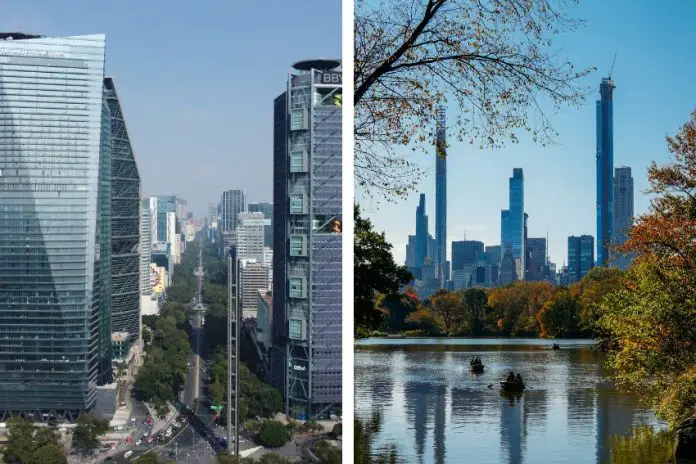
The beating urban hearts of two very very different areas, Mexico City and New York City are worlds apart, despite their similarities. (Anton Lukin/Paul Huisman/Unsplash)
After nearly two years spent living in Mexico City, I’ve recently returned to my native New York City for work. And, after my love affair with CDMX, the transition has been a difficult one. Despite NYC being my home for 12 years. I’m seeing it with new eyes and, sometimes, the culture shock feels like a rude awakening. I’ve been roughly thrown back into the crowded hustle of New York life, where the frenetic energy is akin to furiously paddling to stay afloat in freezing waters inundated with swimmers — all wearing fixed smiles that barely conceal their harried eyes. The sense of ambition permeating the concrete jungle of New York is palpable, driven by a survival instinct that jarringly kicks in, screeching “Achieve! Accomplish! Now! Hurry! Run! WIN! This busyness is at the heart of the argument between the CDMX vs NYC question — how do you want to live your life?
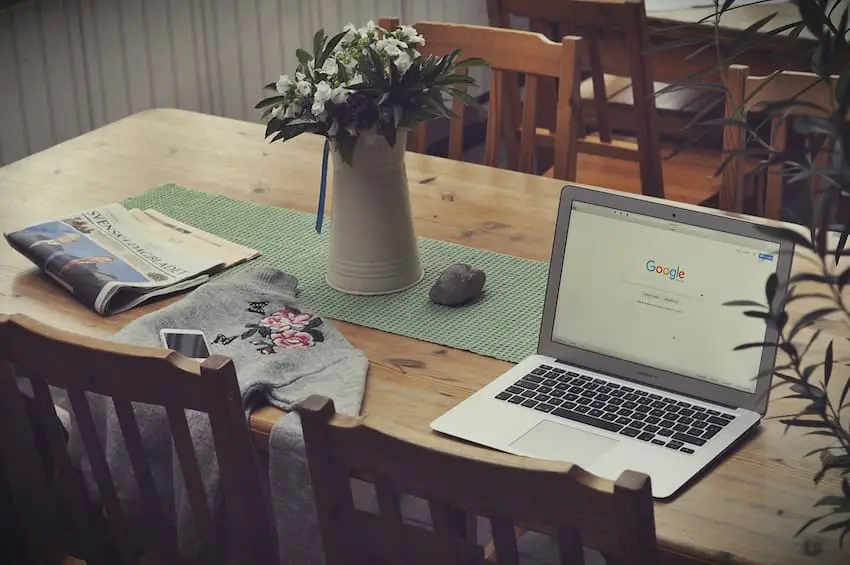
A brief Google search yields hundreds of results unpacking the difference between Mexico City and New York City, most focusing on “functional” factors: things like weather differences, city size, population statistics, transportation systems, and walkability. And truly, many of these logistical components are useful to know. Yet aside from the surface level differences between the two cities, there is something much more profound characterizing each core of the two metropoles. What is it that really defines the soul of each city?
Hustle vs. Flow
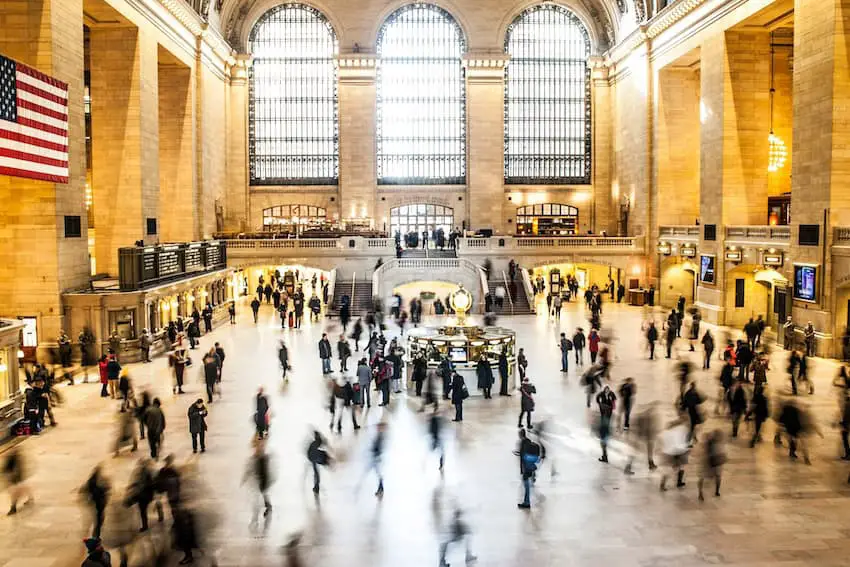
Both are megacities, but the flow of the crowds in NYC and CDMX couldn’t be more different. (Nicolai Berntsen/Unsplash)
Life in Mexico City unfolds at a more deliberate pace. Mornings stretch slowly, work often happens at outdoor café tables dappled by gentle sunshine, and activities are punctuated by walks through streets filled with lush foliage and a sense of community. Mexico certainly has its own challenges, but I’ve found it to be a place where time seems to flow rather than race, and where life is lived rather than conquered. This difference in urban rhythm goes beyond mere surface happenings; it reflects a difference in cultural values and approach to life.
Urban Migration
Digital nomads love Mexico City for a reason – but their comparatively high salaries have brought problems to residents of the capital. (Agnieszka Boeske/Unsplash)
With the recent surge of digital nomads, Mexico City has become a central place on the map for young professionals seeking non-traditional lifestyles. Remote work opportunities have given individuals (myself included) the ability to leave the crowded, stressful environments of cities like New York, and work from anywhere in the world.
For many expatriates, particularly those from high-pressure, over-achieving urban centers, Mexico City has become a sanctuary, providing a sense of refuge and unprecedented calm. A friend once characterized it succinctly: New York taught me how to hustle. Mexico City taught me how to live.
However, this influx of remote workers hasn’t been without controversy. While many Mexicans warmly welcome outsiders, there’s a growing undercurrent of resentment among some locals. They view digital nomads, with their comparatively high salaries, as catalysts for gentrification and rising costs of living. The tension highlights the complexities of globalization and cultural preservation in today’s world.
Lingering versus loitering
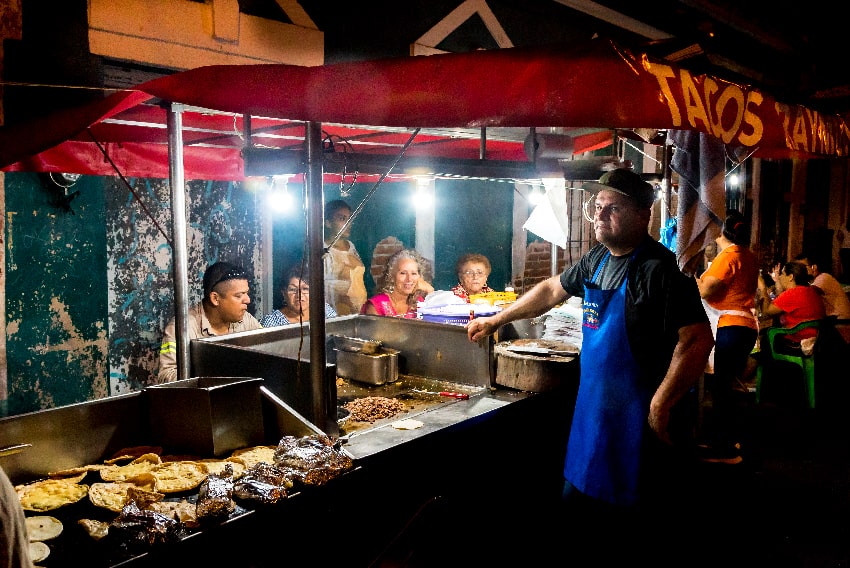
Taco stands are a social hub for Mexicans of all classes, uniting people in a way that feels impossible in New York. (Janet Glaser)
A friend from my writing group in Mexico City once brought up the distinction between the concepts of “lingering versus loitering.” It’s interesting food for thought. In New York, efficiency reigns. Public spaces often seem designed to discourage unproductive loitering, pushing people onward into the cycle of perpetual motion. Mexico City, however, embraces the art of lingering. Streets become impromptu social centers, neighbors exchange greetings, and conversations bloom in unexpected corners. Taco stands on the streets are hubs of prolonged banter, meal-sharing and conversation. While New Yorkers wear their busyness and efficiency as a badge of honor, chilangos (Mexico City locals) are renowned for their warmth. It’s a city where “Cómo estás?” is more than a passing greeting – it’s an invitation to connect and catch up.
Nature and cracked sidewalks
The interplay of nature and urban spaces marks another significant difference between the two cities. In many parts of Mexico City, nature is deeply integrated into the city. The streets of Condesa, for instance, are a lush blend of jungle-like foliage and urban boulevard replete with cafes and shops. Trees are omnipresent, and plants decorate balconies and building facades, creating a sense of living in nature with a “city experience”. In New York, by contrast, it’s not uncommon to walk for blocks encountering nothing more than a sickly bush, allocated a tiny square of the sidewalk, struggling to survive in the harsh environment.
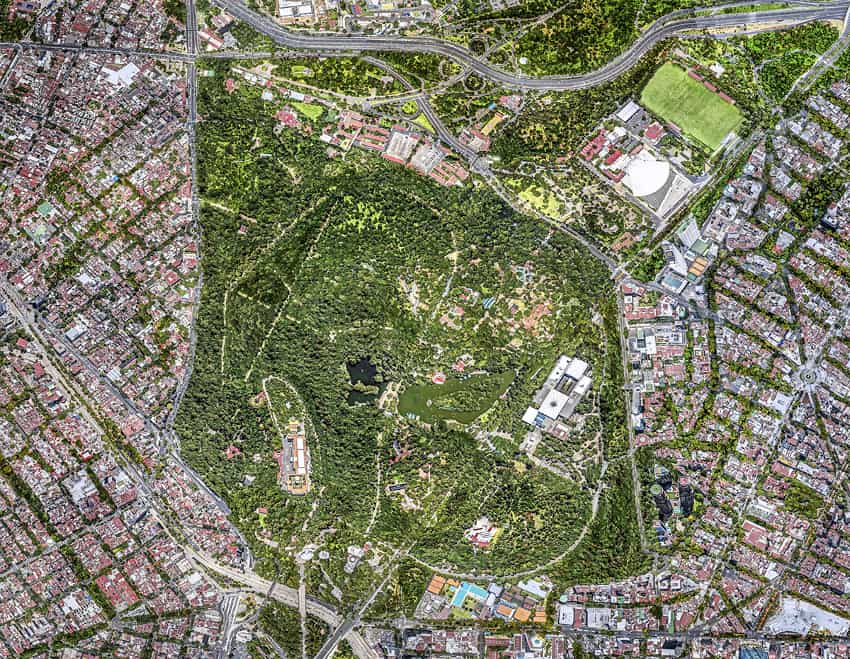
Meanwhile, Central Park might be the jewel of Manhattan, but Mexico City’s Chapultepec Park — twice the size — blows it away. Central Park is a weekend spot for most, while opportunities to walk through lush parks or greenery on one’s daily route in Mexico City abound. In New York, nature feels like a rare afterthought. In many parts of Mexico City, it’s part of everyday life.
An aerial view of the giant Bosque de Chapultepec in Mexico City. (Santiago Arau/Gob MX)
Once in Roma Norte, I recall sitting at a cafe table next to a couple from New York. The two were complaining about the annoyance of walking on Mexico City’s cracked, sometimes uneven sidewalks. I mulled over their conversation for longer than I probably should have. To me, these imperfect sidewalks, largely a result of the city’s seismic activity, represented something beautiful. The cracks allowed the tree roots and shoots to creep through among the urban setting. They served as a metaphor for the lack of perfection-focused commerciality that characterizes many US cities. They reflected the balance between urban development, and the respect for nature that characterizes Mexico’s indigenous heritage and deep-rooted connection to the natural world.
Must love dogs: Mexico edition
An unexpected but delightful aspect of life in Mexico City is its vibrant dog culture. It’s a pup-lover’s paradise. Canine companions are nearly everywhere, seamlessly integrated into the city’s daily life. You’ll find them lounging on sidewalks while their owners enjoy a meal at a café, happily walking off-leash through the streets, playing in dog parks, and even hanging out inside restaurants. This canine-friendly atmosphere is facilitated by the city’s abundance of natural elements, its overall dog-loving community, and the numerous small parks with dedicated canine areas scattered throughout the city
Being surrounded by these furry friends wherever you go, not only adds an extra layer of warmth to the city; it allows for greater interaction as smiles are exchanged in passing at silly canine antics, and passersby stop to pet the furry buddies and briefly converse with their owners.
From tacos to bagels
Apologies to both the NYC and CDMX communities. (Härkis)
The culinary scene of New York and Mexico City offers another interesting point of comparison. New York, true to its reputation as a global melting pot, offers a plethora of diverse ethnic cuisines. Mexico City, while not matching this level of global variety, offers something perhaps more valuable — an incredible depth of flavor in its local cuisine and produce.
Fruits and vegetables in Mexico City seem to taste more like themselves than anywhere. This quality of ingredients often differs from that of New York, where — perhaps as an analogy for the city itself — things often “look” great but can lack depth of flavor.
New York’s efficiency and drive have fueled incredible achievements and innovations, while Mexico City’s more relaxed approach fosters a different kind of creativity and human connection.
In the end, perhaps it’s not about which city is better, but about one’s ability to cultivate the hustle when needed, but also to remember the art of lingering, of savoring, of truly living – no matter where you make your home. For now, I’m counting down the days until I can return to my little nest in Condesa.
Monica Belot is a writer, researcher, strategist and adjunct professor at Parsons School of Design in New York City, where she teaches in the Strategic Design & Management Program. Splitting her time between NYC and Mexico City, where she resides with her naughty silver labrador puppy Atlas, Monica writes about topics spanning everything from the human experience to travel and design research. Follow her varied scribbles on Medium at https://medium.com/@monicabelot.
Puerto Vallarta comes to life when the sun goes down. Check out these top class night spots to dance, drink and dine the night away. (Discovery Vallarta)
When the sun goes down, the beaches of Puerto Vallarta make way for moonlit streets and pulsing energy. This energetic Pacific coast city transforms into a playground for night owls, offering everything from cold Coronas and classy cocktails to sweaty dance floors and divey dens. Speaking as a laid-back lounge lover and a dancer-til-dawn in this city over the past 11 years, it’s undeniable that Puerto Vallarta has some of the best nightlife in Mexico. Here are some of the city’s best nighttime haunts.
Colibri: A mixology masterpiece
Mixology is elevated into a high art form at Colibri. (Colibri)
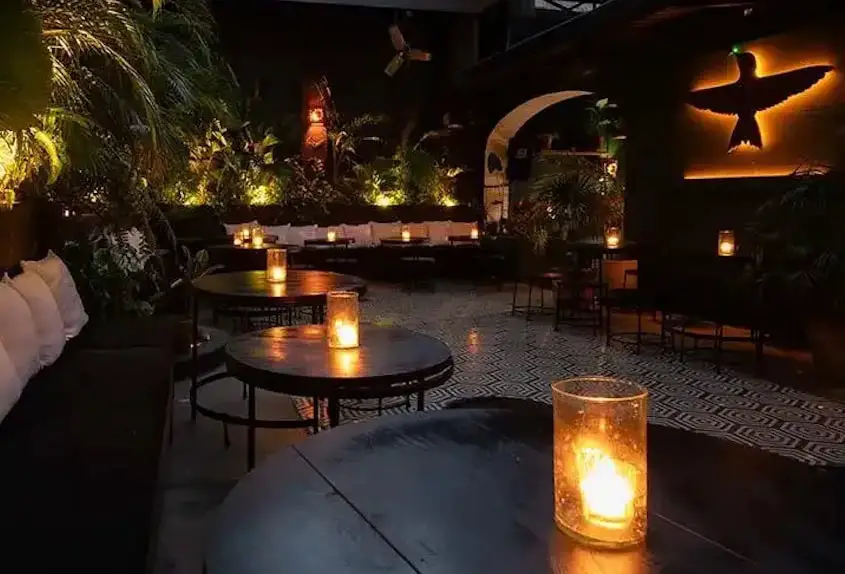
Colibri is a sexy, dimly lit cocktail bar in the heart of Centro, just steps from the Malecón. Designed like a tropical speakeasy, the green glow of neon lights washes over the foliage-filled courtyard. But this isn’t your typical rum and Coke kind of place: here, bartenders are artists, crafting cocktails that are as photogenic as they are potent and delicious. Try the Papu’s Sazón, a mezcal-based cocktail served with green tomatillo jam, pineapple juice and a spicy homemade jalapeño liqueur.
Mr. Flamingo: Open-air street party
If you’ve got a good buzz going, the next stop has to be Mr. Flamingo. On a buzzy corner in the Zona Romántica, Mr. Flamingo is one of Puerto Vallarta’s most popular and lively gay bars. With its open-air design, neon pink flamingos and an incredibly bubbly and inclusive ground, this is the place in town to grab a margarita and dance to an infectious playlist of pop, retro and Latin hits. The crowd often spills into the street, creating a block-party vibe that is impossible to avoid. Don’t be surprised if you end up staying longer than planned.
El Tasting Room: For low-key wine lovers
El Tasting Room: A big night on the town, but make it classy. (El Tasting Room/Instagram)
If the idea of downing tequila shots at Mr. Flamingo doesn’t appeal to you, no worries— Puerto Vallarta has something for every kind of night owl. Enter El Tasting Room, an intimate wine bar that offers a world-class selection of wines in an upscale yet approachable environment. Whether you’re a wine aficionado or someone who just wants to enjoy a good glass of cabernet, the staff will help guide you to a great pour. Plus, they serve tapas, which is great if you need a little refuel.
Bar La Playa: Effortlessly cool
Sometimes all you need is a hole-in-the-wall bar with great drinks and good vibes. That’s exactly what you’ll find at Bar La Playa. This unassuming bar, also in Zona Romántica, has garnered a local cult following for its strong drinks and welcoming atmosphere. It’s the kind of place where you can pull up a stool, chat with strangers and see where the evening takes you.
The Top Sky Bar: Rooftop vibes
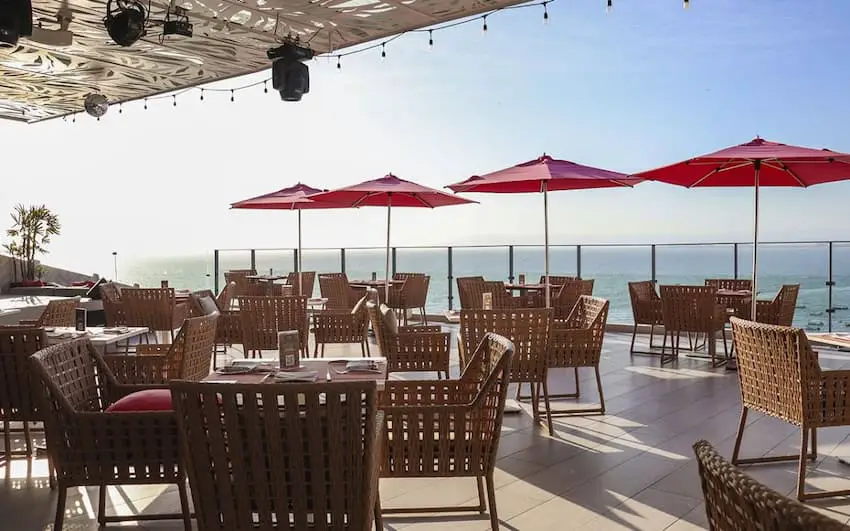
Dinner with a view can be yours at The Top. (The Top Sky Bar)
You can quite literally elevate the night at The Top Sky Bar. Perched high above the city, this chic rooftop bar has sweeping views over the Bay of Banderas and the lights of Zona Romántica and beyond. The ambiance is equal parts trendy and romantic, making it a prime spot for either a date night or a group hangout. Order a mojito and soak in the ocean breeze. It’s a great spot for sunset, too.
La Santa: Late-night salsa
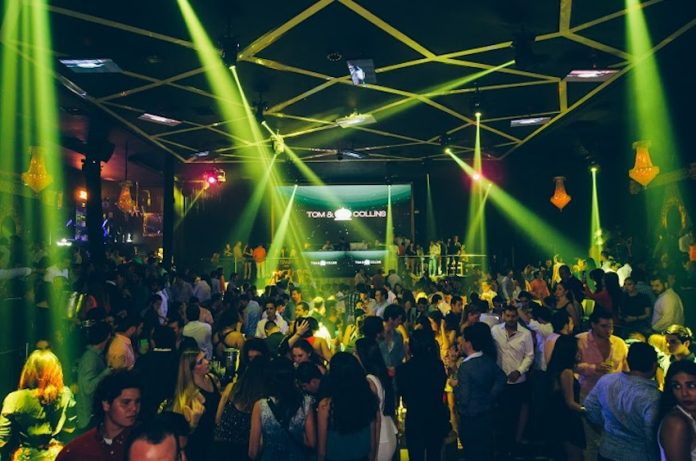
Let’s be honest. No Puerto Vallarta nightlife guide would be complete without a nightclub. If you’re looking for a glamorous late-night spot where you can dance until your feet hurt, head to La Santa in the Zona Hotelera. This exclusive club attracts a fashionable crowd ready to party in style. With state-of-the-art lighting, booming music and high-end cocktails, La Santa is definitely on a whole new level. VIP tables line the dance floor, so if you’re feeling fancy, this is the spot to splurge.
La Bodeguita del Medio: Classic salsa
Don’t worry: you don’t need to dig deep into your pockets to enjoy a good night of salsa in Puerto Vallarta. Trade the club beats for something more classic at La Bodeguita del Medio. This iconic Cuban bar on the Malecón brings Havana’s vibrant energy to Vallarta, complete with live salsa music, dancing and, of course, mojitos. You’ll feel like you’ve been transported to Cuba as the dance floor starts to heat up. Even if you don’t know how to salsa, this is still an incredibly fun atmosphere for drinks and people-watching.
If rooftop lounging is a little too fancy for you, fear not. Vallarta’s nightlife goes in every direction. Get the best in rock’n’roll energy at Roxy Rock House. A tribute to classic rock, the bar features live bands and a playlist that skews heavily toward rock classics. The grungy, unpretentious vibe makes it a great place to grab a beer and jam out to playlists that feature bands like The Rolling Stones and Metallica.
El Soñador: A local gem
Tucked away in the Zona Romántica, this bi-level bar is all about ambiance, great drinks and a social atmosphere. The relaxed, dimly lit El Soñador has pool tables on the first floor and an open-air rooftop area with neon signs and sexy graffiti. The bartenders are always smiling, and you’ll find a great mix of locals, expats and tourists.
Mandala: A Malecón maybe
I can’t write about Puerto Vallarta’s nightlife without mentioning at least one of the legendary late-night dance clubs on the Malecón. There are three that most tourists gravitate to: La Vaquita, Zoo Bar and Mandala. All three have the same high-octane energy, extravagant design, bottle service and high prices. They’re fun for a night if you’re 25 and it’s your first time in Puerto Vallarta. But other than that, I’d say walk you can probably skip these.
Meagan Drillinger is a New York native who has spent the past 15 years traveling around and writing about Mexico. While she’s on the road for assignments most of the time, Puerto Vallarta is her home base. Follow her travels on Instagram at @drillinjourneys or through her blog at drillinjourneys.com.
Few cities anywhere in the world can pretend to boast even a fraction of the history and importance of Mexico City. The capital is a riot of color, life and chaos - and it is uniquely perfect for Mexico living.
This series has explored over two dozen locations for viable, sustained overseas living across a broad diversity of physical and cultural spaces. Saving for last the “Gran Manzana” of Latin America — Mexico City — was not by accident. As this series’ creator, I needed some reflection, writing about Mexico’s other potential living spots as prep to reflect on this week’s essay. Even with this buffer, should I write about a place that’s embraced and showered with praise for all its “culture” and “diversity”? Or should I fall into the “Gringo Go Home” narrative that foreigners (especially Americans) should just pack up and go back to their original Starbucks?
There’s also my hesitation to tell you about living in one of the most complex neighborhood landscapes in this hemisphere, when this publication has some fine local correspondents living daily lives in this pulsating mass of humanity.
The Mexica and Spanish past stand shoulder-to-shoulder with modern day Mexico across swathes of the city. (Laurentiu Morariu/Unsplash)
As one of my favorite travel writers, Brit, Kate Simon puts it, “At one moment it’s a garbage heap, the next it’s the garden of Eden.” This sentiment certainly applied a generation ago, when Mexico City was presented to the world as a doomsday landscape of unregulated sprawl. It still is, but the 16 boroughs and over 1,800 neighborhoods are unquestionably better managed than before.
Before deciding to live here, you’ll need to honestly ask yourself the following questions:
Can you live and recreate at over 7,000 feet, some months with inversion layer smog? Can you embrace public transportation mobility and casually rub shoulders — and other body parts — with total strangers? Will you accept the flood of urban, external stimuli with a very low likelihood of finding fluent English speakers? Will your curiosity be enough motivation to get out of whatever comfortable colonia you settle into, and relish pockets of human expression across 3,000 square kilometers of sprawl? That is, of course, before the risk of a serious earthquake — the most recent serious event was in 2017 and evacuation alarms remain a common occurrence.
If you live in Mexico and hope to ever claim you “know” your adopted nation, you really must spend some time here. Sadly, most foreigners and nearly all of my lakeside expat friends and acquaintances have not made the effort. I suspect this applies to my coast-hugging fellow countrymen and women who are living a “real” Mexico existence without feeling the need to get acquainted with the city that’s the economic, cultural, political, and “everything Mexico” touchstone. And it takes more than an escorted four-days seeing the old buildings, ruins and mercados or double-decker red bus “highlights” tour to imprint how CDMX is likely the most captivating urban space you’re likely to ever experience. That’s before we even begin to talk about the food.
Ultra-modern Mexico sits side-by-side with traditional neighborhoods in a way not often seen elsewhere in the country. (Anton Lukin/Unsplash)
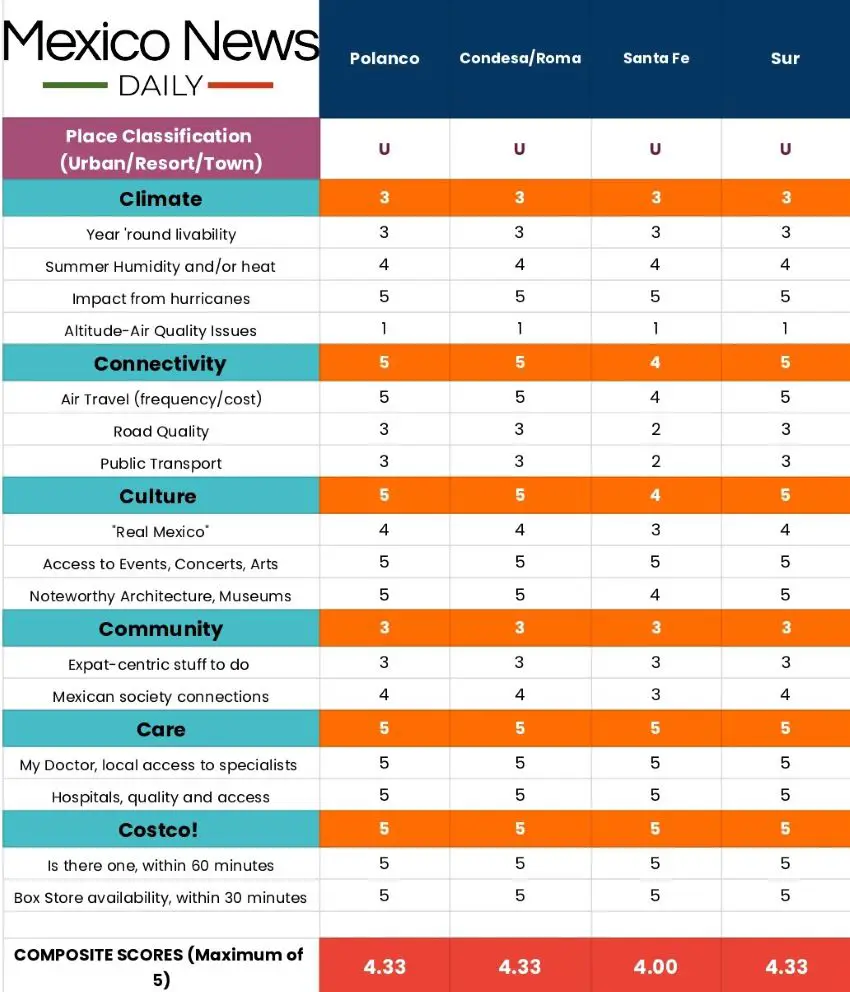
Anyone who claims they don’t like this place has either made only a drive-by attempt, glancing from a distance or not been exposed to places and micro spaces that defy and compensate for the city’s glaring urban challenges, whether they be traffic, political protests, seasonally poor air quality, tarp settlements or citizen indifference to what’s crumbling around them. In each of the four areas targeted in our ratings there are utterly fascinating, often hidden, treasures of ingenuity and artistic exuberance.
Tell me you can walk the Centro Histórico and the Diego Rivera National Palace murals and not be in utter awe, or have a white linen late afternoon lunch at the San Angel Inn with a shrug, or wander the Museo de Arte Popular past Miguel Covarrubias’s monumental map of Mexico mural with indifference, or see the sunken stone baths used by Mexica royalty in Chapultepec Park and not surrender to the grandeur of this seven thousand foot high, volcano encircled, former lakebed that’s been witness to more history, triumph and tragedy than anywhere else on the continent.
The city’s districts are unlike anything most North Americans can even imagine. Mexico City housed three million residents as recently as the 1950’s, (22 million today in the metro area, almost one-fifth of all Mexicans), across a gigantic, flat valley floor, dotted with 16th century satellite “pueblos,” with dusty dirt roads connecting to the capital’s government buildings, colonial-era elite residences and a grid-like central city core. As the city spread, small towns were gobbled up and often obliterated. Yet some spaces survived, and as a result, the Mexico City of today feels more like a jamboree of competing small towns than a coherent city.
Condesa, Polanco and La Roma
Parque España, the beating heart of the upmarket districts of Condesa and Roma. (Naya Homes)
As the Spanish settled in Mexico, San Ángel was the spot that many of their wealthiest chose to build their home. Today, it’s a leafy and extremely exclusive southern suburb. (MX City)
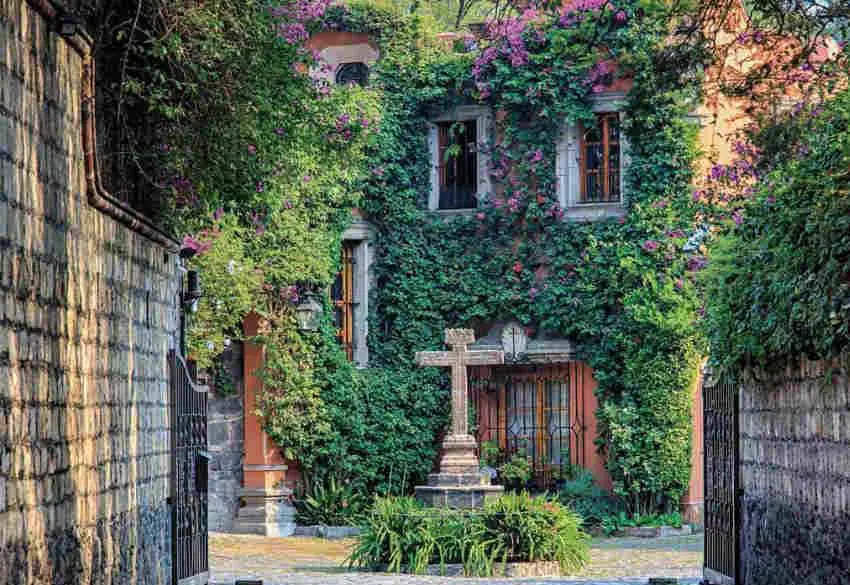
The city’s southern area is where colonia life takes its deepest breath. It’s greener, at a slightly lower elevation, more residential, and further away from the city’s clogged center and industrial north. Places like San Ángel, Coyoacan, and Chimalistac are delightful, but hardly undiscovered.
San Ángel is a picturesque village that has somehow maintained the atmosphere of a remote mountain retreat. In colonial days it was an enclave for the city’s aristocrats. Its meandering cobblestone streets, thick-walled opulent mansion estates, small plazas and parks make San Ángel a pleasant respite from the city’s clamor. The lovely Plaza San Jacinto is a square that invites relaxation and contemplation, especially mid-week, sans the weekenders visiting for the famous Bazar del Sabado, Mexico City’s most beloved weekend “artsy” hang-out.
Coyoacán
The obvious colonial jewel in the crown, Coyoacán offers an enormous dose of Mexican culture to anyone who makes the journey south. (Travel Mexico Solo)
Coyoacán lies about a mile east of San Angel and is also a throwback to Mexico City’s colonial days. Following the conquest, it nearly replaced Tenochtitlan as the site for the new capital. Coyoacán is larger and has a more bohemian, young intellectual beat. And of course, there is magnificent UNAM, a UNESCO World Heritage Site that’s a wonder to behold of early urban planning, striking architecture, murals, the Olympic and Azteca stadiums and green spaces.
Santa Fé
(Marquitored/Reddit)
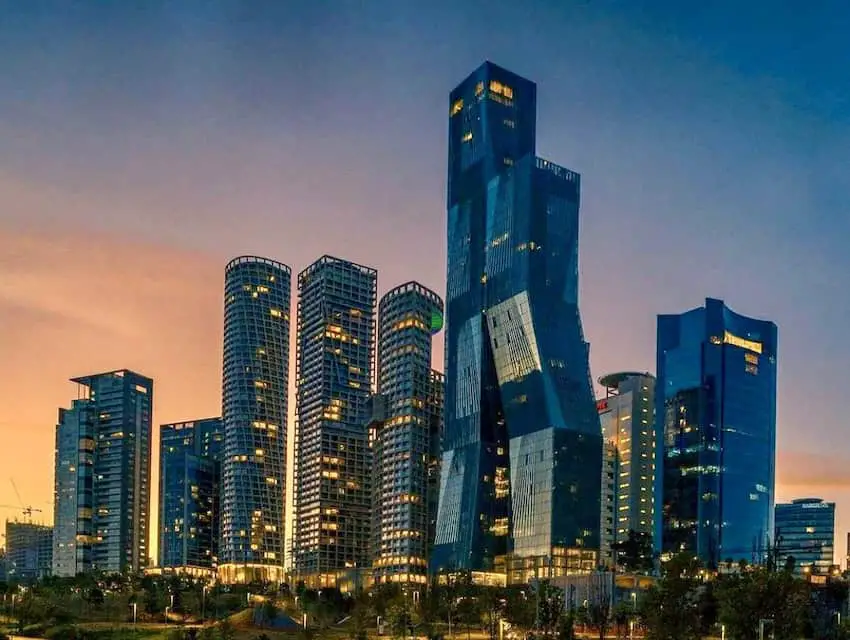
Modern Santa Fé, built on top of what was once a municipal dump, is the business hub of the 21st Century capital. Living here feels more like Singapore or Hong Kong than Mexico at times, with towering, modern blocks, replete with every amenity you could ask for, perfectly sculpted parks, and recently, modern transport connections to the city center. Despite this, it is still somewhat removed from the heart of the “real” Mexico City, and is devoid of much of the culture that makes the capital such a truly magical place. Traffic can be an absolute nightmare — a salient warning when you consider it can be up to 3 hours from the airport at peak rush hour.
All of this wonder and diversity comes with a disclaimer from our resident “colonia-ista,” Bethany Platanella: “If you plan to visit as many alcadías as possible, please do your due diligence before going! Areas like Iztapalapa, Xochimilco, Tlalpan, and parts of Cuauhtémoc are not safe and should be avoided, especially at night. We recommend taking a guided tour where possible.”
Finally, as if all this weren’t enough, Mexico City is an excellent base from which to explore the surrounding states of Hidalgo, Puebla, Mexico, Morelos and others. Within two hours by bus or car, urban inconveniences melt away as rural Central Mexico unfolds in a mosaic of colonial towns, little-visited ancient ruins, Spanish-inspired cities, alpine forests and lush semi-tropical valleys. So, for the urban-inclined, Mexico City can be the perfect place to “dig in,” while “getting out” offers a lifetime of “real Mexico” escapes.
Author Greg Custer lives in Mexico. He’s worked for over 40 years in international tourism, educating travel advisors around the world about Mexico and other Latin American destinations. He helps folks explore Mexico for living at www.mexicoforliving.com.
September is the month Mexico celebrates its independence, but this year it was also a month of political polarization. MND CEO Travis Bembenek shares why he still thinks there are reasons for optimism in Mexico. (Cuartoscuro)
There is no denying that September was a polarizing month in Mexico.
It was the long-anticipated (or dreaded, depending on your political affiliation) month in which the Morena party and its allies gained majority control in Congress. As President-elect Claudia Sheinbaum does not take power until Oct. 1, September has also been AMLO’s last month in power, and he used it to push through some of his constitutional reforms in a Morena-controlled legislature.
First up, the judicial reform was quickly passed. Next was a proposal to move the National Guard under military control. Both of these proposals received heavy criticism from the opposition as well as from many international observers and experts. I have had dozens of conversations with people on both of these issues, and it’s easy to understand why there has been so much polarization and high emotion.
At the risk of an oversimplified explanation, those against the judicial reform argued that the proposal to elect all federal judges nationwide would reduce the quality and integrity of the judicial branch. A weakened judicial system, they reasoned, affects the integrity of the rule of law. This, in turn, discourages investor confidence, which ultimately affects the amount of investment and hurts the economy and the country. Strong arguments were made that this would potentially kill the golden goose of the nearshoring opportunity.
Those in favor of the judicial reform reasoned that the current system was already far from perfect, with serious flaws and high levels of corruption. They argued that the direct election of judges would, in fact, give more “power to the people” and reduce the level of corruption.
On the issue of the National Guard, those against the move to put them under military control argue that the military has already gained far too much power under AMLO. The past six years have seen the military building airports, passenger railways, and hotels, as well as beginning to operate the commercial airline Mexicana.
They also argue that the military has been ineffective against the cartels and that putting the National Guard under their control could lead to an increased militarization of what is supposed to be a civilian force.
Those in favor of the move have argued that the National Guard under military control will professionalize the force and prevent the notorious corruption that afflicted the federal police.
Over the past month, the anxiety from the opposition has reached a fever pitch, with fears ranging from “missing the nearshoring opportunity” to “jeopardizing the USMCA agreement” to a “significant devaluation of the peso” to “a judicial system taken over by the cartels.”
If any of these come true, the consequences could be terribly damaging to the country. But in reality, only time will tell if the worst fears are realized. It is with that backdrop in mind that I think we need to step back and reflect on two important points.
First, we are in “crazy talk” time on both sides of the border. In Mexico, September is the month in which AMLO can do what he wants with the Morena mandate, as Sheinbaum awaits, perhaps hoping he doesn’t do anything too polarizing (which clearly didn’t happen).
In the United States, one presidential candidate is talking about “the end of America” if he doesn’t win, while the other candidate talks about “the end of democracy” if she doesn’t win.
Viewed from a Mexican point of view, neither one of these scenarios is reassuring when you hear your big brother to the north talking in such stark terms. But we need to remember that we are in the heat of the election season, the rhetoric is off the charts, and it will likely calm down in a few months.
The temperature is very high on both sides of the border. U.S. political and business leaders have been expressing significant concerns about whether Mexico is still a “business-friendly” country, given AMLO’s recent moves.
That’s a fair point, but imagine being a Mexican political or business leader looking north at a second failed assassination attempt of a presidential candidate in two months, threats of up to 200% tariffs against your products (in clear violation of the USMCA agreement), renewed talk of a border wall and a “round-up and return of illegal immigrants like the world has never seen before.”
I think it’s fair to say that both sides have some reasonable concerns.
As troubling as the above two points might be, it’s important to remember that the U.S.-Mexico relationship is actually stronger than ever by many metrics. Record amounts of U.S. foreign direct investment into Mexico. Record amounts of Mexican exports to the U.S. Record numbers of tourists coming to Mexico by airplane, cruise ship, and car. Record numbers of expats moving to Mexico. Increased cross-border train lines being built. A significant increase in new flights between the two countries. And on, and on, and on…
It’s also important to remember that, as complicated as the U.S.-Mexico relationship might be at this time, the risks and concerns pale in comparison to other parts of the world. Mexico isn’t building up its military and provoking its neighbors. Mexico isn’t conducting cyber-attacks on the U.S., Mexico isn’t using government subsidies to help its industries dump products into the U.S. and disrupt local suppliers.
Claudia Sheinbaum, in an attempt to quell some fears, is soon meeting with a group of business leaders to address concerns and share her vision for the next six years. After her win in June, I wrote my “wish list” of things I think she needs to do to increase investor and international confidence in her administration.
All things considered, and when viewed with a global geopolitical perspective, there is much reason for optimism for both the U.S. and Mexico.
Despite the current rough patch, I am confident that both countries will continue to grow ever closer and reliant on each other. And that, I would argue, is a very good thing for the citizens of both nations and the world.
Travis Bembenek is the CEO of Mexico News Daily and has been living, working or playing in Mexico for over 27 years.
The difficult economic realities of migration often drive many Mexicans abroad - but it also presents challenges for those going the other way, too. (Omar Lopez/Unsplash)
To begin to discuss the realities of emigration from Mexico, I often begin by looking closer to home. I have a good friend, a fellow U.S. citizen, who I’ll call Hannah.
She met her spouse of more than 10 years — we’ll call him Mario — in the United States. Because Mario was undocumented, their ability to keep their family together in the U.S. was uncertain. They decided to all move to Mario’s native Mexico.
Cross-border romance can be a challenge when money enters the picture. (Vince Fleming/Unsplash)
For Hannah, adjusting was a challenge. She faced learning both Spanish and a brand new culture, all while continuing her work as an accountant. Her husband, a skilled builder, built their house on family land and took charge of the children and running the household. The adjustment period was long, but Hannah found ways to make her life in Mexico a happy one.
Unfortunately, there were certain problems that simply did not have solutions in Mexico. Because of this, Hannah made the difficult decision to move back to the U.S.
She and her children now meet Mario just over the border every few weeks or so, for a couple of days. They are currently trying to secure the proper paperwork for him to move to the U.S. and be with his family. But the odds aren’t great.
Opportunities in the U.S.
Most immigrants to the U.S. will tell you about how their lives became better. They were safer. They were able to do honest work. They earned enough money to support family at home and construct enough of a nest egg for a business or a home there in the future.
Many Mexicans head abroad in search of better wages in order to support family back in Mexico. (Freepik)
Indeed, millions of Mexican households get by, in a very literal sense, on remittances. The president of Mexico said recently that money sent from abroad “has become the main source of income for our country.” Although remittances actually represent around four percent of the country’s GDP, for many families, the idea that they are the main source of income is 100% true. As many of us know, how well you can live off of hard work depends on many things that are out of our control.
Even many immigrants to Mexico now do a modern version of the same thing. If you’re employed online by a U.S. company and living in Mexico, then you’re essentially sending remittances to yourself and your family. Comparable jobs in Mexico simply do not cover enough expenses. This is especially true if you’re a foreigner without local family ties and support.
Sometimes, of course, immigrants put down roots. Sometimes they even fall in love, get married, have kids. There’s a tendency to reduce immigrants in the U.S. to their immigration status alone. Are they there lawfully or unlawfully? Lawful means they “did things right.” “Unlawful” means, in the eyes of many, that they are criminals.
My gripes about capital being permitted and encouraged to move abroad when it helps capitalists economically while laborers are prevented from doing so and classified as criminals for trying will have to be a separate article.
Remittances to Mexico come largely from the U.S. and are the country’s second largest source of income from abroad. (Depositphotos.com)
In any case, they are, of course, humans who do very normal human things. We grow and develop and make connections wherever we are.
Unfortunately, increasingly tougher immigration rules mean that their lives could be, and sometimes are, quickly uprooted. And when this happens, families face a choice: split up, or leave the country all together.
Going back to where they came from
There is a sizable population spread throughout Mexico and Latin America of spouses and children who’ve “returned” with their deported family members. Most of these spouses are women, and many of them come with minimal knowledge of the culture and language. Children must often be sent to school without a good grasp of Spanish.
At least when they first arrive, things tend to get a lot worse. The U.S. jobs and wages that supported the family are gone. Suddenly, the whole family faces the reduced opportunities that the deported person was trying to escape from in the first place.
That isn’t to say that these moves are carried out with no planning. Sometimes, the plan is an over-the border-dynamic: the American spouse lives on one side of the bridge, the Mexican spouse on the other. In other cases, an American might be able to cross daily in order to work, depending on their jobs, skill sets and transportation options.
If you’ve found yourself in Mexico long term, working remotely in the United States, perhapas you’re also receiving remittances, of a sort. (Vardan Papikyan/Unsplash)
When the only choice is to go deeper into Mexico, American workers will often try to secure online work. This tends to work fairly well, at least in the economic sphere. As many of us are discovering, though, U.S. companies are becoming increasingly strict about their workers residing physically in the United States. And a lost U.S. job that supports a Mexican family can mean financial ruin.
So this is why they left
Poverty in the absence of U.S. salaries is of course one of the reasons that a move back can be tough. Starting over anywhere is expensive, especially when it must be planned hastily. Heartbreaking stories about lacking even basic things like refrigerators, beds and Christmas presents for kids abound.
Many women become sharply aware of other dynamics once in Mexico, too. Especially for those “coming back” to smaller and more humble communities, expectations and stereotypes can be very strong. Unfortunately for us, some Mexicans still have an American-Girls-Gone-Wild notion of American women. And ladies they suppose spend all their time in wet t-shirt contests are not presumed to be good wives and mothers.
Even when they do speak the language and learn more about the culture, outsider status is pervasive. When you’re one of a small group in any given place, you become the official representative of that group. And as any minority-group member will tell you, that’s an exhausting job. Especially when you don’t have anyone from your own group around for support.
So what will become of Hannah and Mario? For now, they’re crossing their fingers that the thousands of dollars spent on legal fees will pay off.
Until then, the family will be together only in fits and spurts, visiting when they can. Their longing and love will stretch across the invisible line that divides Mexico from the U.S. until they’re reunited — if they ever are.
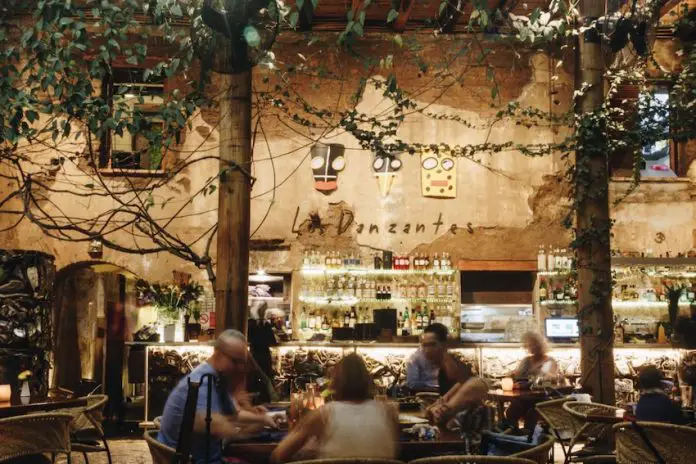
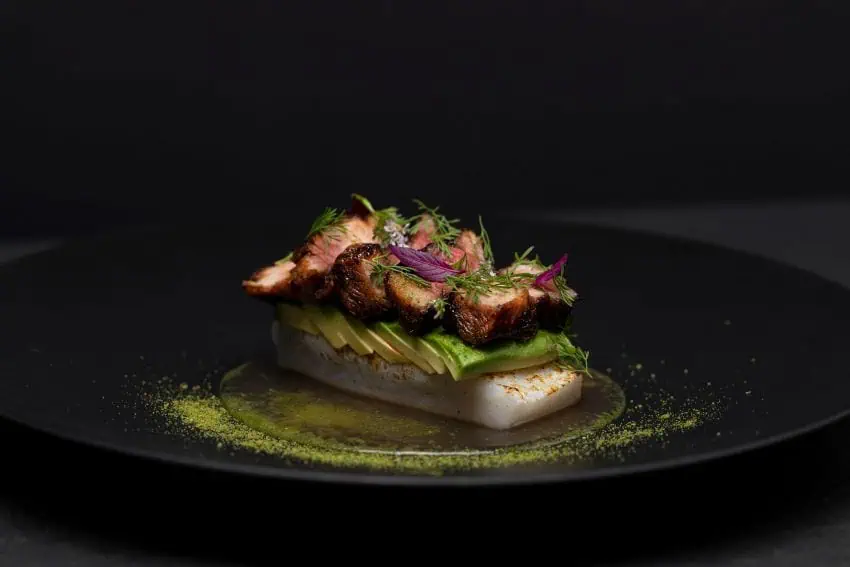
Four months on from being awarded Michelin stars, how are Mexico's top restaurants faring in the limelight? (Los Danzantes)
If there’s one thing Michelin Guide stars promise, it’s prestige. Even for eateries already respected in their given communities, this coveted endorsement guarantees something more — namely, that in the public perception, they will now be recognized as being among the best restaurants in the world.
This enhanced standing is well-established and has been a fact of life for restaurants since the eponymous French tire company first started including them in its travel guides in 1920. The star system to denote high quality began in 1926, with a second and third star added to recognize the best of the best by 1931. Additional awards have followed, including the Bib Gourmand, to denote quality and value, and the Green Star, to reward high-quality restaurants with sustainable practices, as the Michelin Guide has evolved beyond France through the years to rate restaurants in more than three dozen countries around the globe.
The first Michelin guidebook, published in 1900. was designed to help French motorists find the best places to stop during their travels. (Michelin)
Since May, that number has included Mexico. A few months ago, the Michelin Guide announced that 157 restaurants had been recognized for quality from several Mexican states, with 16 receiving the coveted one-star ranking and two more earning an elite two-star classification. Given Mexico’s internationally recognized cuisine, more should probably have been honored.
“Without a doubt,” said Enrique Olvera, chef at Mexico City’s Pujol, which received two stars. “I hope that subsequent editions will include more states: the diversity of cuisines and ingredients in Mexico is something that fortunately happens throughout the country. There isn’t a single state that doesn’t have extraordinary cuisines.”
However, Mexico’s Michelin Guide recognized chefs and restaurateurs are certainly benefiting from the honor, including in ways they may not have envisioned when the stars were first announced.
The unexpected benefits of a Michelin star
One benefit for those who work at Michelin Guide-recognized restaurants is an enormous sense of pride and accomplishment. “We received the recognition with great pride and joy,” affirmed Elena Reygadas, chef-owner at the one-star Rosetta in Mexico City. “It was a tangible appreciation of the hard work and dedication of the people who put many hours and effort into this project. After more than a decade of commitment, it is a good encouragement for the team to continue moving forward.”
Rodrigo Rivera-Rio, chef at KOLI, compared winning a Michelin star to being in a dream. (KOLI/Facwbook)
The chef at another one-star restaurant, KOLI Cocina de Origen in Monterrey, likened the award to a dream and the culmination of a long journey. “We are a tasting menu project focused on the traditions and stories of our state,” explained Rodrigo Rivera-Rio. “Like any restaurant we’ve had our ups and downs. But we’ve always stayed motivated and been true to our traditions… [the Michelin Guide star] was always what we all dreamed of. Many collaborators have been working at KOLI for years and some of us have been since the opening. But we kept giving it our all, when we found out they were coming we got super excited. In the end, everything was a dream. The day they gave us the star was an explosion of emotions… just total excitement.”
Michelin stars boost reservations and sales
The pride and well-earned sense of achievement felt by those who work at Michelin Guide-starred restaurants are real. But it bears noting that there are also even more tangible benefits. The prestige that comes with the awards invariably leads to increased interest, more reservations and more revenue. Often, this means more money for the staff, too.
The monetary value of a Michelin star has long been recognized. As the late, great Joël Robuchon — the most decorated chef in Michelin Guide history, whose restaurants earned 31 stars — once told Food & Wine: “With one Michelin star, you get about 20 percent more business. Two stars, you do about 40 percent more business and with three stars, you’ll do about 100 percent more business. So from a business point… you can see the influence of the Michelin Guide.”
Of course, those numbers aren’t exact and can vary from country to country and from region to region. Rivera-Rio, for example, estimated that sales are up about 40 percent for KOLI since the Michelin Guide announcement in May, allowing the restaurant to give better pay to its staff and hire more workers. Victor Ramírez, Communication and Marketing head at Los Danzantes Oaxaca, which was awarded a Michelin star and a Green Star for sustainability, did not quote an exact figure, but said that “reservations at our restaurant increased significantly, and people visited us with even greater expectations.”
A reminder to residents that lets restaurants get more creative
With prestige comes the chance to experiment and push boundaires. (SUD 777/Facebook)
For Edgar Núñez, chef of the acclaimed Sud 777 in Mexico City, the biggest benefit of receiving a Michelin Guide star hasn’t been a boost to his reputation or his restaurant’s sales, but rather that it has helped to remind the city’s residents of the culinary pleasures available to them. “I think the star has returned Mexican diners to us… and that is very good, because I am interested in local people.”
Chefs also mentioned the quality of their restaurant’s food, and how the Michelin Guide stars had helped them to raise it to a new level. For Reygadas, this was reflected by enhanced creativity, as she feels she now has a “wonderful opportunity to show a broader range of approaches within the Rosetta kitchen.” Meanwhile, for Rodrigo Rivera-Rio and KOLI Cocina de Origen, the star has meant the opportunity to buy better ingredients. And because sales are better, he worries less about whether they’ll use them all.
Victor Ramírez also brought up suppliers, and how Los Danzantes Oaxaca has been able to spotlight those who contribute to its quality and sustainable ethos.“They are the main ambassadors of Los Danzantes, Oaxaca and Mexico,” he noted, mentioning those who tend the restaurant’s garden and the many small producers from whom the restaurant sources ingredients.
Michelin Guide stars bring more attention
More than the enhanced prestige, the increased sales or the opportunity to make better food, what the Michelin Guide awards have done is bring more attention to Mexico’s best restaurants. For that, the chefs are appreciative.
“We are very grateful and feel honored,” said Enrique Olvera. “It is a recognition of the daily work and effort of the entire Pujol team over 24 years, including everyone who works and has worked with us.”
“The truth is,” Rivera-Rio noted, the Michelin Guide star “has been something wonderful, almost miraculous. We know this is a blessing and don’t want to go backward. So we’re working very hard to maintain this star. We are all happy and very motivated with an eye to the future and to continue doing what we like the most.”
Chris Sands is the Cabo San Lucas local expert for the USA Today travel website 10 Best, writer of Fodor’s Los Cabos travel guidebook, and a contributor to numerous websites and publications, including Tasting Table, Marriott Bonvoy Traveler, Forbes Travel Guide, Porthole Cruise, Cabo Living and Mexico News Daily. His specialty is travel-related content and lifestyle features focused on food, wine and golf.