Home Blog Page 58

Finance Ministry forecasts economic rebound of up to 2.8% this year after a sluggish 2025

1
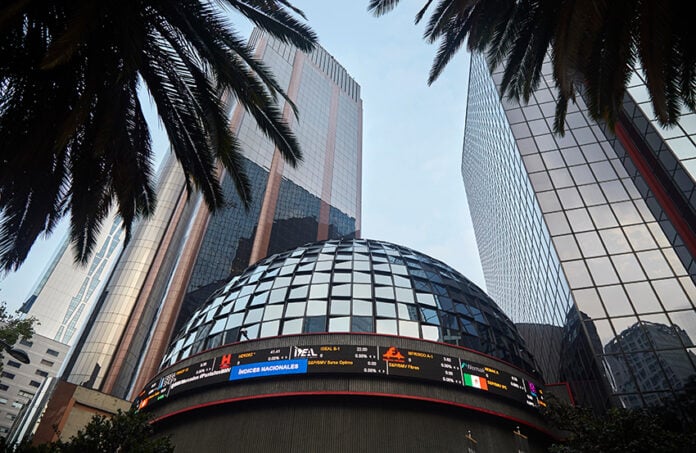
The shiny dome of the Mexican Stock Exchange (BMV) on Paseo de la Reforma in Mexico City.
The Mexican Finance Ministry projects economic growth of up to 2.8% this year, with similar expectations for 2027. Pictured: The headquarters of the Mexican Stock Exchange (BMV) on Paseo de la Reforma in Mexico City. (Shutterstock)

The federal Finance Ministry (SHCP) is forecasting that the Mexican economy will grow in the range of 1.8%-2.8% this year and 1.9%-2.9% in 2027.

The forecasts are included in the ministry’s “General Economic Policy Preliminary Guidelines for 2027” document, which was submitted to both houses of Congress on Wednesday and which will inform the 2027 budget. The forecasts for this year and next would represent significantly faster growth than the 0.8% expansion recorded in 2025.

The SHCP’s growth outlook for this year is unchanged from the forecast included in the 2026 budget proposal the ministry submitted to Congress last September. The SHCP hadn’t previously published a growth forecast range for 2027.

The midpoints of the ministry’s growth forecasts are 2.3% in 2026 and 2.4% in 2027.

Both midpoints are significantly more optimistic than the consensus forecasts yielded from the Bank of Mexico’s March survey of 41 private sector economic analysis and consulting groups. Those consensus forecasts are 1.49% growth in 2026 and 1.82% growth in 2027.

SHCP: ‘Investment will be one of the main drivers of growth’

In the executive summary of its “General Economic Policy Preliminary Guidelines for 2027” document, the SHCP said that in 2026 and 2027, the Mexican economy “will return to a path of greater dynamism, supported by its solid macroeconomic fundamentals.”

“Mexico has a sustainable public debt, a resilient financial system, historically high levels of foreign direct investment, and a strategic position within North American value chains,” the ministry said.

“Investment will be one of the main drivers of growth. Private investment will rebound as companies adapt to the new regulatory environment and the USMCA review process moves forward. In turn, public and public-private investment will help expand productive capacity, improve connectivity, and reduce bottlenecks in strategic sectors through Plan México and the Infrastructure Investment Plan for Development with Well-being,” the SCHP said.

The ministry also said that household consumption will be “a pillar of economic growth.”

“The sustained rise in real wages, job creation associated with investment, and the continuation of welfare programs will continue to strengthen families’ purchasing power,” the SHCP said.

The ministry also said that Mexico’s export industries “will continue benefiting” the Mexican economy within a context in which Mexico has a “more favorable” tariff environment than its competitors — i.e. when goods are shipped to the United States, the world’s largest economy.

The SCHP said that “productive integration” with the United States and Canada “will continue deepening,” and asserted that “high-tech sectors will continue to gain prominence.”

Mexico’s soaring tech exports have taken the lead over the automotive sector

It also said that the Mexican economy will get a boost this year from the FIFA men’s World Cup, which Mexico will co-host with the United States and Canada in June and July. Millions of tourists are expected to visit Mexico during the tournament.

While its overall tone was optimistic, the SHCP did acknowledge that “sources of volatility associated with geopolitical conflicts, disruptions to strategic global trade routes, and changes in U.S. trade policy persist.”

Nevertheless, the ministry said that Mexico has economic “strengths that allow it to face up to the external environment with a greater capacity to respond.”

The SHCP’s other forecasts 

The Finance Ministry made a range of other forecasts in the document it submitted to Congress on Wednesday. Among those forecasts are the following:

  • Mexico’s annual headline inflation rate will be 3.7% at the end of 2026 and 3% at the end of 2027. (The headline rate was 4.63% in the first half of March.)
  • The US dollar-Mexican peso exchange rate will be 18.4 at the end of 2026 and 18.6 at the end of 2027. (The peso closed at 17.83 to the dollar on Wednesday, according to the Bank of Mexico.)
  • The Bank of Mexico’s benchmark interest rate will be 6.3% at the end of 2026 and 5.5% at the end of 2027. (The central bank’s key rate is currently set at 6.75%.)
  • Public debt will be 54.7% of GDP at the end of 2026 and 55% at the end of 2027.

With reports from La Jornada, El Financiero and El Sol de México
Mexico seeks solutions to Vulcan Materials mine dispute as US lawmakers threaten sanctions

1
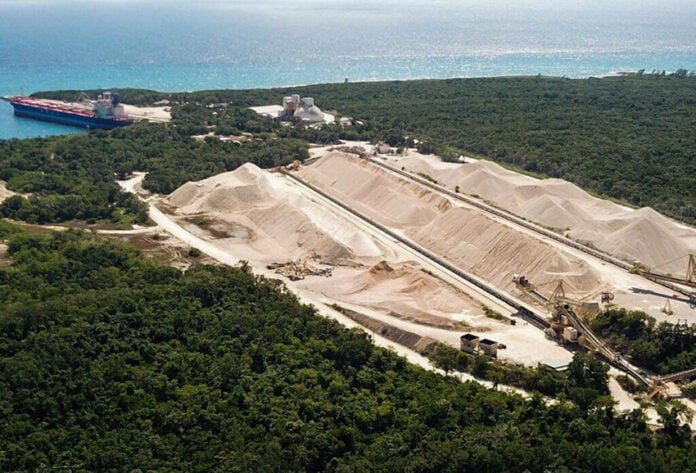
An aerial shot of the Sac-Tun mine, formerly called Calica Mine, owned by Vulcan Materials near Playa del Carmen
Former President López Obrador declared the site of the Sac-Tun limestone quarry, located just outside Playa del Carmen, a natural protected area in 2023. The declaration followed a years-long dispute between mine owner Vulcan Materials and the Mexican government. (Cuartoscuro)

Mexico could offer new sites of operation to U.S. mining company Vulcan Materials in a bid to settle a long-running dispute, President Claudia Sheinbaum said this week as Mexico faces a fresh wave of pressure from the United States over what the company calls the “expropriation” of its land in Mexico.

The U.S. House of Representatives this week approved legislation to protect U.S. business assets abroad. The bill — now pending a Senate vote — was proposed by Texas Congressman August Pfluger, who has acknowledged that the initiative was inspired by the Vulcan Materials case in Mexico.

Dubbed the Act to Protect American Companies Abroad, the bill could lead to sanctions for the Mexican government after it closed the company’s port and limestone quarry in Quintana Roo in 2023, and declared the land a Protected Natural Area (ANP) two years later.

President Sheinbaum recently said that her administration is seeking new land where Vulcan Materials can continue its operations.

The Environment Ministry confirmed Sheinbaum’s claim and clarified that Vulcan Materials’ assets in Mexico, including its maritime terminal, “remain the property of the company.”

“The Mexican government maintains an open and good-faith dialogue with the company to find solutions that provide legal certainty and guarantee environmental protection,” the Ministry said.

It said the mining restrictions are due to the declaration of the “Felipe Carrillo Puerto” Protected Natural Area, in accordance with the Mexican legal framework.

The Alabama-based company has a different position. In 2024, Vulcan Materials said that the Mexican government’s decree constituted a de facto expropriation of its properties on Mexico’s Caribbean coast and that the measure violated the United States-Mexico-Canada Agreement (USMCA).

The Mexican government has also argued that the company’s operations caused an “ecological disaster” in the area it was authorized to mine.

At her Tuesday morning press conference, Sheinbaum said her proposal to find new sites for Vulcan Materials would allow the company to continue operating in Mexico, ending a years-long conflict.

“Mining could no longer take place in the Protected Natural Area. There are some mines located elsewhere that the Environment Ministry would have to analyze to determine if their operation is feasible, or if there is some other mechanism to avoid the controversy and reach an agreement,” she said.

With reports from El País and AP

MND Local: San Miguel de Allende news roundup

7
wine grapes growing in Guanajuato
A viticulture lab has been expanded at the Technological University of San Miguel de Allende, reinforcing Guanajuato's reputation as one of Mexico's top wine-growing states. (Tim Gouw)

Business developments and disputes are in the news for San Miguel de Allende and the state of Guanajuato lately, along with a startling number of fires, ongoing hotel construction and a lab to support viticulture (wine grape cultivation) at a local university.

US senators want a probe into companies exporting from Mexico

Two U.S. senators have asked Commerce Secretary Howard Lutnick to investigate the importation of heavy construction and agricultural equipment from U.S.-owned production facilities in Mexico, including one in Querétaro.

Case New Holland tractor
Case New Holland has been making tractors in Querétaro since 1964, but two U.S. senators want manufacturing to return to the U.S. (CNH)

A March 26 letter signed by U.S. Senators Tammy Baldwin (D-Wisc.) and Bernie Moreno (R-Ohio), requested a government investigation under Section 232 of the Trade Expansion Act of 1952. President Trump has used that law to restrict imports or impose tariffs, citing national security concerns.

“Comprehensive trade remedies are needed to hold companies accountable for offshoring jobs and compel the industry to move these manufacturing jobs back to the United States,” the letter stated. The companies are Caterpillar, which has more than 29 facilities and more than 14,000 employees in Mexico; John Deere, which has plants in three Coahuila cities and in Monterrey, Nuevo León (with a new one coming this year in Nuevo León); and Case New Holland (CNH), which has a production facility in Querétaro originally established by Ford in 1964.

It remains to be seen how this request might be handled, given the current renegotiation of the USMCA Act, the U.S. Supreme Court’s recent action overturning the Trump tariffs and Trump’s request that those three companies and others in the sector lower agricultural equipment prices to U.S. farmers.

Nearly 900 fires have been reported to date around San Miguel

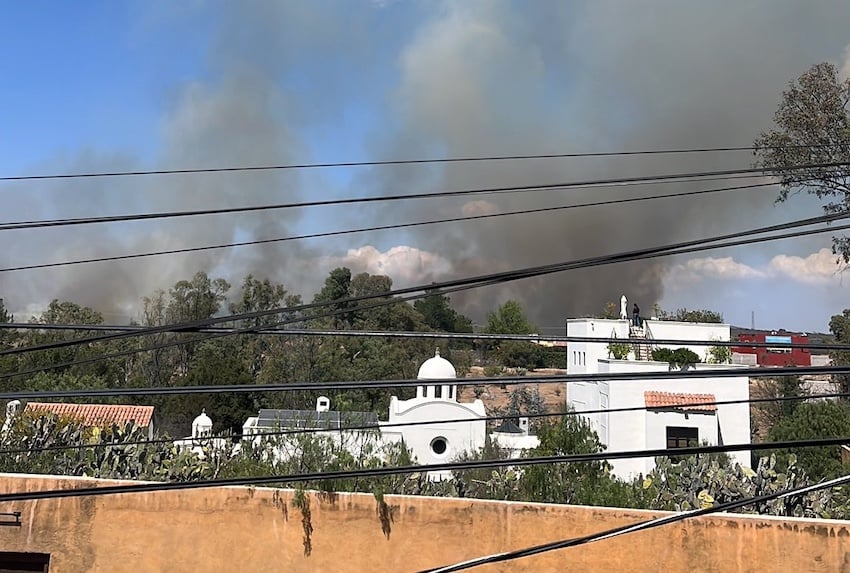
The El Charco fire as seen from a nearby residence. (Barbara Pardue)

More than 500 hectares (1,235 acres) have been burned in 883 fires reported in and around San Miguel so far this year. This number includes a fire on March 4 at the El Charco del Ingenio Botanical Garden on the eastern edge of the city. Four hectares of El Charco’s total of 67 hectares (about 165 acres) also burned about a year ago.

Other reported fires included more than 90 hectares burned in the Los Picachos mountains south of San Miguel and some outbreaks near, and sometimes including, residential areas.

Since dryer weather has arrived, Civil Protection officials have warned that additional fires can be expected in grassy areas and vacant lots around the city.

Big cranes loom over a hotel construction site

Waldorf Astoria San Miguel de Allende
This is what the Waldorf Astoria in San Miguel de Allende is expected to look like when it’s finished. Construction is ongoing. (Waldorf Astoria San Miguel)

Two huge cranes were recently spotted inside the Waldorf Astoria construction site on El Cardo in Centro. Work has been ongoing at what was previously a large parking lot since shortly after the announcement of the hotel project in December 2022.

Completion of the 120-room and 24-residence hotel has been pushed back one year to 2027 from the original schedule. The project, owned by Peakair Group, is being developed by Mexico City-based Skyplus Developments Corp. and will be managed by Hilton.

Viticulture lab built at local technological university

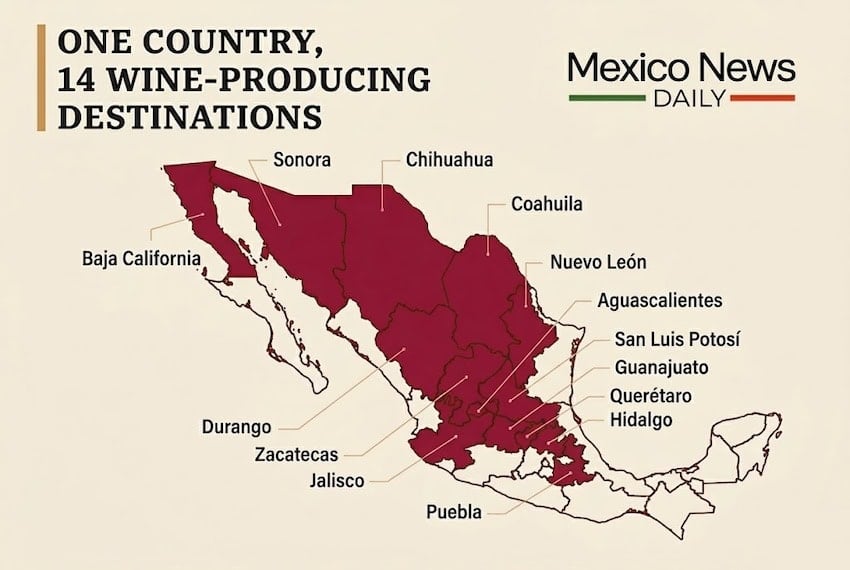
A map of Mexico's wine producing regions
Mexico has a number of wine-producing regions, of which Guanajuato is one of the most important. (Sectur/Mexico News Daily)

The state of Guanajuato Ministry of Public Works has invested more than 12 million pesos (about US $667,000) in a viticulture program laboratory at the Technological University of San Miguel de Allende, east of the city. The work includes a raw material reception and preparation area, an area for fermentation and wine processing, and a wine cellar.

Guanajuato is attracting attention for producing good wines and has won many awards for them in recent years. It is one of 14 major wine-producing areas in Mexico and one of the four most important ones, along with Baja California, Coahuila and Querétaro.

The Technological University of San Miguel de Allende opened in 2007 and is an academic unit of the Technological University of Northern Guanajuato in Dolores Hidalgo. It is a non-profit public institution and offers both two-year technical degree programs and four-year bachelor’s degree programs.

Cathy Siegner is an independent journalist based in San Miguel and Montana. She has journalism degrees from the University of Oregon and Northwestern University.

The origins of Centro Cultural Tijuana, and how it continues to shape the city’s art and culture

4
Centro Cultural Tijuana (CECUT
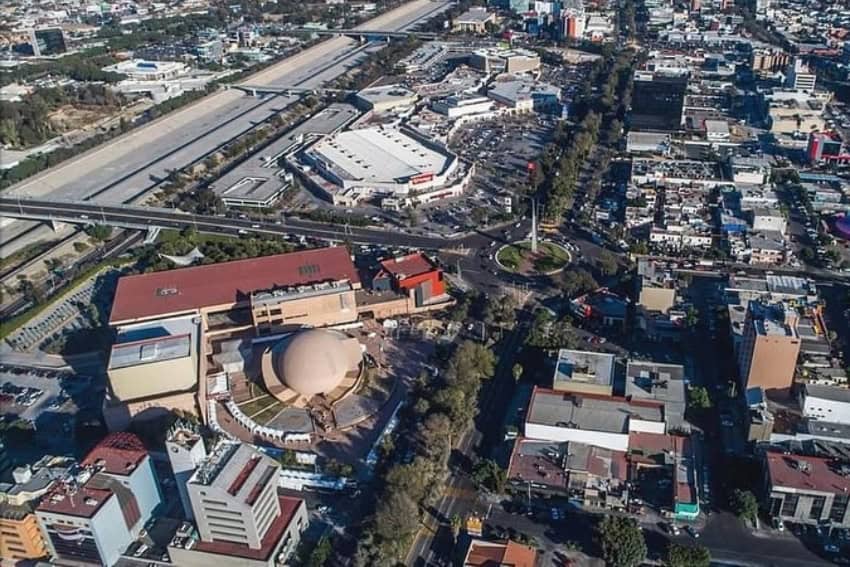
CECUT and its distinctive architectural achievement, La Bola, which houses an IMAX theater, have been cultural landmarks in Tijuana for over 40 years. (Instagram)

Most people think of Tijuana as a place you pass through, a blur of traffic signs and waiting. President José López Portillo, who led Mexico between 1976 and 1982, set out to challenge that notion by commissioning a bold arts and culture center just five minutes from the border. Inaugurated in 1982, Centro Cultural Tijuana (CECUT) quickly became one of Baja California’s most important cultural institutions.

Spearheaded by a visionary first lady

The creation of CECUT was led by Carmen Romano, the wife of President López Portillo. As Mexico’s first lady from 1976 to 1982, Romano played an active role in the country’s cultural life and firmly believed that access to the arts should extend far beyond the capital.

CECUT Tijuana
President José López Portillo and his wife Carmen Romano were instrumental in the creation of CECUT, which opened in Tijuana in 1982. (Instagram)

Designed by architects who helped shape modern Mexico

The project was entrusted to architect Pedro Ramírez Vázquez, one of the most influential architects in modern Mexico. Known for integrating pre-Hispanic motifs with modernist principles, he created many of the nation’s most emblematic civil landmarks. Through the National Border Program, for example, he had already designed the Museo de Arte in Ciudad Juárez.

However, his most celebrated work is the Museo Nacional de Antropología in Mexico City, inaugurated in 1964. With its monumental courtyard and iconic concrete umbrella, the building transformed how history and identity were presented, placing Indigenous cultures at the core. Ramírez Vázquez also designed the Estadio Azteca and multiple venues for the 1968 Mexico City Olympic Games. His way of showcasing Mexico to the world even reached the Vatican when he designed the Chapel of Our Lady of Guadalupe inside St. Peter’s Basilica.

Manuel Rosen Morrison, an innovator already recognized for designing the beautiful Japanese Embassy in Mexico, was also a designer on the project. He approached CECUT with a bold idea: the building itself should announce that it housed an IMAX theater. By adding color directly into the concrete mix, he gave the structure its warm tone and sculptural presence. The choice was both forward-thinking and practical. Without paint or coatings, the dome ages naturally and requires less maintenance, allowing time itself to become part of its character.

The iconic dome

CECUT unfolds across 3.5 hectares (nearly 9 acres) in one of Tijuana’s most modern districts, functioning less like a single museum and more like a cultural ecosystem. At its center is La Bola, the complex’s most visually striking feature.

The massive sphere was built to house one of the country’s most advanced movie theaters at the time. It originally operated as an Omnimax theater, using a curved screen to create a fully immersive experience, and was later rebranded as IMAX Dome. The first film shown there was created especially for the space and celebrated Mexico’s landscapes and cultures.

An unexpected look at the surrounding seas

Another main attraction is the Tijuana Aquarium, the only facility of its kind in Baja California. Opened in 2012, the 300-square-meter space offers a close-up look at marine life from the Pacific Ocean and the Gulf of California. Around 500 animals live here, including native regional fish, species from other parts of the world, Australian corals, jellyfish, turtles and freshwater creatures. Designed as an educational space, the aquarium aims to connect visitors with the sea and ocean that border the peninsula.

The history that blurs the borderline

Museo de las Californias in Tijuana
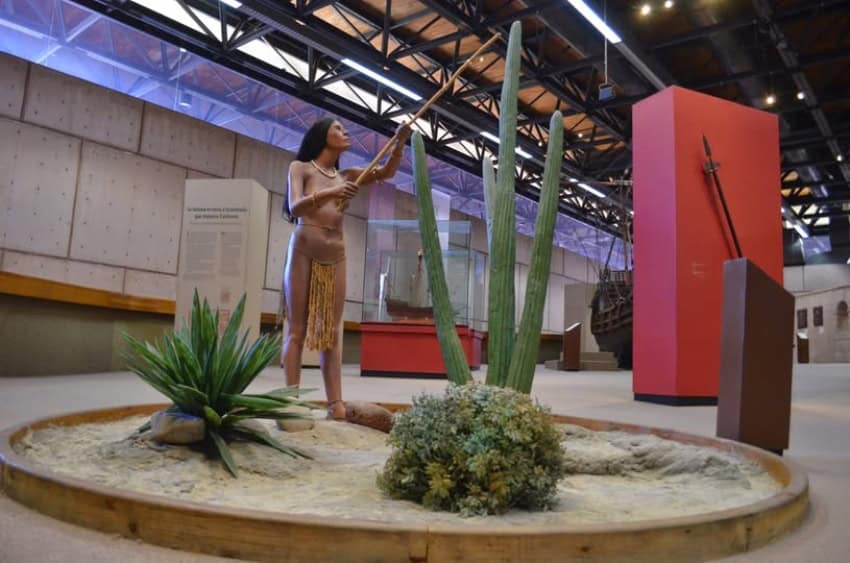
The Museo de las Californias at CECUT welcomes visitors to explore the region’s fascinating history. (CECUT)

The Museo de las Californias guides visitors through the region’s complex history. The journey begins before California had a name and moves steadily toward the present day. Along the way, Indigenous cultures, Spanish colonization, missionary routes, migration, shifting borders, revolutions and environmental change are woven into a continuous narrative, showing how Baja California and the U.S. West evolved together.

El Cubo is Tijuana’s venue for contemporary art

The sense of evolution continues at El Cubo, a space devoted to contemporary art. It hosts exhibitions that meet international standards, from large-scale installations to photography, sculpture and painting. El Cubo’s more than 1,500 square meters are spread across several exhibition halls, a mezzanine and outdoor terraces, giving curators room to experiment and visitors space to linger. It has hosted exhibits featuring Mexican and international artists, with themes that range from cutting-edge visual trends to deeply local stories shaped by border life and migration.

Where Tijuana’s cultural energy takes the stage

The Sala de Espectáculos is a modern performance hall with a thousand seats. It hosts a wide range of events throughout the year, from theater and contemporary dance to concerts, film presentations and multimedia productions. Its design allows for professional staging and acoustics. On busy nights, the energy spills outside to the adjacent esplanade, where festivals and open-air events turn the surrounding plazas into an extension of the stage.

CECUT also serves as a gathering point for creative communities through events like FotoFilm Tijuana, an annual photography and film festival that brings together local and international creators. Screenings, workshops, and panel discussions turn the center into a meeting place for visual storytellers and curious audiences alike.

A powerful presence at the border

Just steps from one of the busiest border crossings in the world, CECUT invites visitors to pause and see Tijuana not as a place you pass through, but as a city with a strong cultural pulse. It has a way of reshaping first impressions and reminding you that some of the most meaningful stories live right at the edge.

Sandra is a Mexican writer and translator based in San Miguel de Allende who specializes in mental health and humanitarian aid. She believes in the power of language to foster compassion and understanding across cultures. She can be reached at: sandragancz@gmail.com.

Mexico’s soaring tech exports have taken the lead over the automotive sector

8
tech equipment
Mexico has been emphasizing higher-cost, more-profitable electronic products as demand for them has increased in the United States. (Unsplash)

Helped along by the U.S. decision to decrease tech imports from China, Mexico is exporting record quantities of computer equipment and other electronics to such an extent that tech has overtaken automotive as Mexico’s leading export sector.

According to an analysis by Banco Base, national exports grew 7.64% in 2025, but shipments under heading #8471, which covers computer equipment, grew nearly 145% — a surge so outsized it knocked new automobiles off the top spot for the first time.

big computer stuff
The strength of Mexico’s export figures for electronics has a lot to do with computer equipment not being subject to any rules-of-origin restrictions, meaning that many products fall within the criteria of the USMCA free trade agreement. (Unsplash)

Leading the tech export boom are Chihuahua and Jalisco.

Chihuahua alone accounted for 46% of all computer equipment exports, while Jalisco contributed 23% — together representing nearly seven out of every ten dollars in Mexican tech exports. Both states saw their technology and electronics shipments drive overall export figures to record highs, with Chihuahua reaching an export value of almost $110 billion in 2025 (from 75 billion in 2024) and Jalisco climbing to nearly $53 billion (from $32 billion).

Jalisco had never before achieved the status of the leading non-border state in terms of exports.

The strength of Mexico’s export figures for electronics has a lot to do with computer equipment not being subject to any rules-of-origin restrictions, meaning that many products fall within the criteria of the USMCA free trade agreement. 

As a result, the average U.S. tariff on Mexican electronics stood at just 0.45% throughout 2025, compared to the average tariff of 10.53% on the import of similar products from China. 

Computer processors were the single most exported product, at $80.5 billion, with just 0.71% of their value subject to a 25% tariff, according to the deputy director of economic studies at Banamex, Rodolfo Ostolaza. 

“Decades of investment in North American supply chains have created products that easily comply with the USMCA rules of origin,” explained Ostolaza in an interview with Forbes.

Mexico has been emphasizing higher-cost, more-profitable electronic products as demand for them has increased in the United States. Modernization is also solidifying through automation, robotics and artificial intelligence. 

Move over cars; the computer is king  

The increase in U.S. demand for computer equipment is driven by the growth in the country’s data center sector, with investment growing by 30% between 2024 and 2025 to reach $102.2 billion. Meanwhile, U.S. investment in information processing equipment and computers increased by nearly 22% last year. 

In addition to Chihuahua and Jalisco, Baja California (13% of total tech exports), Tamaulipas (7%) and Nuevo León (5%) also made important inroads in the sector in 2025. 

The equipment is mainly destined for six U.S. states, which accounted for 96.92% of related exports in 2025: Texas (67%), Georgia (10%), North Carolina (6%), California (5%), Arizona (4.11%) and Virginia (4%).

Employment in Mexico’s computer equipment manufacturing sector reached 331,411 workers in 2025, representing over 7% of total manufacturing employment. 

While Mexico’s tech manufacturing sector has the potential to continue growing, it is currently operating at production capacity, meaning there is no room to increase output without investing in new facilities, according to the director of Banco Base Gabriela Siller.

With reports from Forbes México and El Informador 

Opinion: What might a regional utopia look like? Part 2

1
Pedro Casas explains why Mexico, the U.S. and Canada need a deliberate strategy that puts small and medium-sized enterprises (SMEs) at the center.
Pedro Casas explains why Mexico, the U.S. and Canada need a deliberate strategy that puts small and medium-sized enterprises (SMEs) at the center. (Courtesy of the author)

The global contest for industrial dominance isn’t between companies or even countries anymore. It’s between continental production systems.

Over the past two decades, China has built the most expansive manufacturing ecosystem in modern history. Twenty years ago, the United States accounted for more than twice China’s share of global manufacturing output. Today, China claims about 30 percent—roughly twice the U.S. figure.

Scale tells much of the story. China has constructed nearly two billion square meters of industrial warehouse space, the logistical spine of its manufacturing juggernaut. Mexico’s entire industrial real estate market, by comparison, is about 100 million square meters. If Mexico built capacity equivalent to just five percent of the warehouse space in China’s major manufacturing cities, its industrial footprint would double.

For the past three decades, all Foreign Direct Investment (FDI) into China had to be anchored in hiring local providers and local workers, partnering with a Chinese company to produce and an obligation to technological transfer, among many other things. All of these have a profound involvement of the Chinese government.

This isn’t to say North America should mimic China. But it should learn from it. To compete with Asia’s integrated bloc, the region needs a deliberate strategy that puts small and medium-sized enterprises (SMEs) at the center, as the engine of widespread prosperity.

When we think about who gets the most benefits from the USMCA, most people point first to Mexico, then to Canada and sometimes hesitate about the United States. Yet we must double-click on those figures to be even more precise. A huge winner of the USMCA — not widely discussed enough — are American SMEs. Not the big Wall Street public companies, but actually the farmer from Iowa and Nebraska, the manufacturer from Ohio and Michigan, the family-owned machine shop in Texas and California. Let me explain why.

Mexico and Canada are the top destinations for U.S. SME export value, outpacing every other market. In recent years, SMEs have shipped roughly $90-110 billion to Mexico annually (40–45% of total U.S. exports there) and $80-100 billion to Canada (35–40% of the total). Proximity slashes costs, USMCA rules reward regional content and supply chains are so intertwined that smaller firms can plug right in-shipping parts to Monterrey or produce to Toronto without the headaches of trans-Pacific hauls. Against European or Asian competitors, these near-shore partners give American SMEs a decisive edge: lower barriers, faster turnaround and just-in-time reliability that far-flung rivals can’t match. Those exports keep heartland fields productive, Rust Belt factories humming and small-town paychecks steady — sustaining middle-class jobs where big multinationals often overlook.

Yet this SME success is uneven. FDI in Mexico clusters in the north and Bajío, leaving the south-southeast — a region rich in agriculture and untapped potential — largely sidelined. In the U.S., Rust Belt revival often focuses on headline-grabbing OEMs, ignoring the supplier networks that could revitalize smaller communities. To build a true regional utopia, we need policies that integrate SMEs everywhere, ensuring no part of North America is left behind.

The USMCA recognized this reality: Chapter 25, dedicated specifically to SMEs, was designed to help smaller firms access the opportunities created by regional trade. Yet, the next phase of North American integration should go further.

SMEs should not merely benefit indirectly from integration. They should become a central pillar of the region’s industrial strategy. I see several practical steps that could move North America toward a stronger SME-driven production platform.

First, we must ensure the development of supplier ecosystems. Industrial clusters, business and trade organizations should actively incorporate small firms into their supply chains and communities. Along with this should come trainings, know-how and technological transfers. Incentives for foreign investment could prioritize projects that develop local supplier networks, particularly in sectors such as automotive, electronics, agribusiness and advanced manufacturing. We must lose the fear of asking for conditions for foreign investors, not just set the dollar sign as the sole KPI (cough cough, this message is for you, my dear friends at the EDOs and Mexican Secretarios de Desarrollo Económico).

Second, talent mobility and workforce development. SMEs often face labor shortages and skills gaps. Regional certification systems and targeted mobility programs could enable technicians, engineers and specialized workers to temporarily cross borders to where they are most needed. This in hand can create regional spillovers in knowledge and ways (I will cover this topic in more depth in an article about talent mobility).

Third, digital integration of supply chains. China did it already. Digitalizing SMEs’ supply portfolios in a standardized way is the gateway to accessing big buyers. Small firms often struggle to navigate complex rules of origin, certification requirements and customs procedures. A unified North American digital trade platform, including single-window customs systems and shared supplier databases, could lower entry barriers and connect SMEs directly to regional manufacturing networks.

Fourth is access to capital investment. Development banks — national and regional — should increase capital risk investments to facilitate their access to SMEs and enhance their growth capacity. Without this, none of it will work.

Fifth is trusted-trader interoperability. Programs such as the U.S. CTPAT and Mexico’s OEA initiative already allow certified companies to move goods across borders with fewer inspections. Making these programs fully interoperable for SMEs would reduce border friction and allow smaller firms to participate more easily in cross-border supply chains.

Sixth, secure logistics corridors. Increased security in Mexico is essential for SMEs’ participation in regional supply chains. While big companies have equally big budgets to mitigate security risks, SMEs don’t have that margin. Security instability is an SME’s death penalty. (I will also dive deeper into these two topics when I write about the border).

‘We want there to be zero robberies on Mexico’s highways’: Tuesday’s mañanera recapped

We could increase the percentage of rules of origin for USMCA tariff-free access to North America. Nonetheless, if we don’t enhance the avenues for SME creation, empowerment and capacity building, we’ll undoubtedly be shooting ourselves in the foot (again?).

This isn’t zero-sum. When Mexican manufacturers grow, they buy U.S. machinery. When U.S. agricultural exports rise, Mexican logistics and processors expand too. China didn’t dominate because of a few giants; it built a dense web of suppliers, parks, and clusters.

I have no doubt that strengthening the millions of SMEs across the U.S. and Mexico will prove to be the most decisive step in turning integration into lasting prosperity.

Pedro Casas Alatriste is the Executive Vice President and CEO of the American Chamber of Commerce of Mexico (AmCham). Previously, he has been the Director of Research and Public Policy at the US-Mexico Foundation in Washington, D.C. and the Coordinator of International Affairs at the Business Coordinating Council (CCE). He has also served as a consultant to the Inter-American Development Bank.

Fish fraud on the rise: Over one-third of seafood sold in Mexico isn’t what it claims to be

14
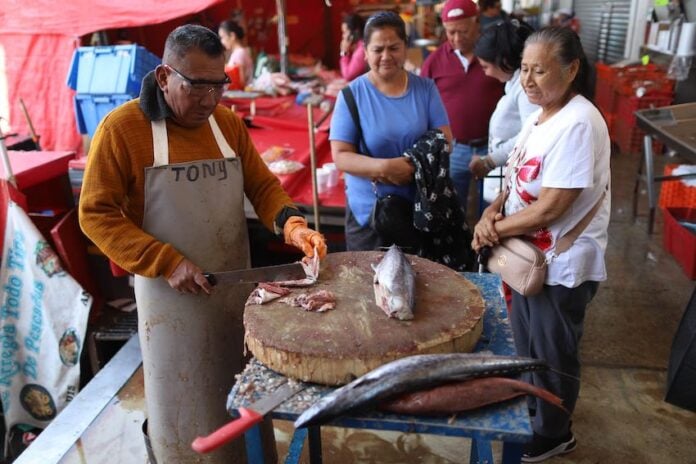
CIUDAD DE MÉXICO, 26FEBRERO2026.- Con el inicio de los Viernes de Cuaresma, los precios de pescados y mariscos incrementaron en los puestos del Mercado la Nueva Viga. En la imagen, un vendedor corta un pescado en filetes para su venta.
The study noted that vendors and restaurants are overcharging for things like red snapper, grouper (mero) and marlin, replacing them with cheaper species such as tilapia or catfish (bagre). (Graciela López/Cuartoscuro)

According to a new study, seafood lovers in Mexico face some of the world’s highest rates of retail fraud, with more than one-third of fish sold in markets and restaurants turning out to be a different species than advertised.

A new report by the globally respected ocean conservation group Oceana found that 38% of 1,262 fish and seafood samples collected in restaurants and markets in the 10 largest Mexican cities were mislabeled or sold fraudulently — nearly double the roughly 20% global average cited by the Food and Agriculture Organization of the United Nations (FAO).

That means in about four out of every 10 purchases at these locations in Mexico, consumers get a different species than the one on the menu or label, often of lower value.

Written in Spanish, the 15-page report is titled “Gato X Liebre: engaño vigente, solución pendiente,” which translates roughly to “Bait and Switch: fraud persists, solution pending.” “Gato por liebre” (Cat for hare) is from a Spanish idiom meaning to cheat someone by passing off something inferior as something better.

The study notes that in Culiacán, capital of the Pacific Coast state of Sinaloa, substitution reaches an astounding 53%. 

Mazatlán, another key Pacific port, has a 36% rate, while Los Cabos in Baja California Sur tops 60%, according to the report.

Some of the most replaced species include sailfish (pez vela in Spanish) at 100% substitution, marlin (marlín) at 91%, sea bass (lobina) 89% and red snapper (huachinango) 54%, Oceana’s analysis found.

Turistas se entretienen viendo a un pescador con un pez vela recién capturado
Does sailfish (pez vela) even exist in Mexico? Oceana’s finding that 100% of “sailfish” sold is actually something else might make you wonder. (Cuartoscuro)

That means that in this particular study, everything purchased as sailfish turned out to be a different species — which is a bit of a flip, because in some coastal towns such as Zihuatanejo, Guerrero, diners say sailfish is routinely served as a cheaper stand‑in for dishes like mahi mahi (dorado) or swordfish (pez espada).

The study noted that vendors and restaurants are overcharging for things like red snapper, grouper (mero) and marlin, replacing them with cheaper species such as tilapia or catfish (bagre).

In some cases, red snapper was replaced with up to 16 different species, while marlin was swapped for shark species listed as at risk.

Oceana warns that the practice hits consumer wallets, undercuts law‑abiding fishing communities and threatens marine biodiversity. 

“There are no measures that give us complete information about the journey of fish products from boat to plate,” pointed out Esteban García‑Peña, coordinator of Research and Public Policy at Oceana.

The group argues that a national seafood traceability standard — tracking each product from catch to final sale — is needed to curb fraud, protect coastal economies and keep endangered species off dinner plates.

With reports from López Dóriga Digital, El Debate and El Heraldo de San Luis Potosí

Was someone really trying to tan on the National Palace?

0
someone tanning from Mexico's National Palace
There's actually no law prohibiting a visitor from sunbathing on a National Palace window, according to the president. Rather, she said, it's a matter of respect. (Screenshot of video taken from Mexico City's Zócalo)

In an episode that could have been seen in MND’s much-loved El Jalapeño satirical column, President Claudia Sheinbaum confirmed that the viral image of a woman working on her tan from one of the windows of Mexico City’s National Palace wasn’t an AI-generated image but, rather, quite real.

The video surfaced a week ago and soon went viral. Although it was recorded from a mobile device at a long distance, it is possible to see that the individual is a young woman with her dress lifted modestly to bare her lower legs, presumably for tanning purposes.

Because the National Palace is the official residence and office of Mexico’s president, the video prompted debate about the inappropriate use of a historical and official building. 

Days later, the Infodemia MX organization, which belongs to the Mexican State Public Broadcasting System (SPR), said that it submitted the video through a verification process and concluded that it was a deepfake. 

However, Sheinbaum revealed during her Monday morning press conference that the content of the video is, in fact, real.

“At first, the relevant department requested information from the area where this window is located and they reported that no one had ever gone out to sunbathe there,” she said. “Later, they checked and it turns out that there was indeed a person who had sat in the window that day.” 

The president chuckled as she delivered the news, but was serious about the issue of respect.

“We must have great respect for what the National Palace represents as a historical landmark,” she said. “While it is not explicitly forbidden to sunbathe on a window at the National Palace, we must respect the meaning of this heritage.”

The woman has been sanctioned and informed that such actions were unacceptable, but Sheinbaum gave no details about what the sanctions consisted of, nor the identity of the woman.

This story has been the subject of countless memes online, including one with the headline “Government considers including the ‘tanning balcony’ in official tour,” by the satirical newspaper el Deforma.

With reports from Infobae

Attention travelers: Truckers and farmers announce mega-blockade on April 6

1
a highway blockade in Mexico
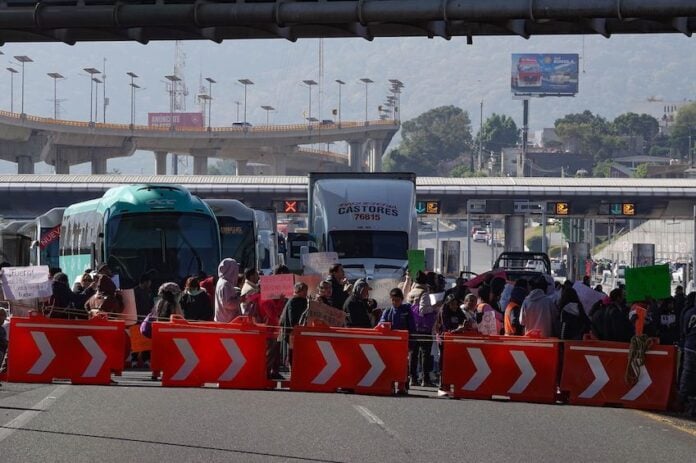
The highway blockades are expected to commence on Monday morning, with most to be set up by 7 a.m. (Rogelio Morales/Cuartoscuro)

Truckers and farmers are set to protest on highways across Mexico next Monday, April 6, in a collective effort to create another so-called megabloqueo, or mega-blockade.

The National Truckers Association (ANTAC) and the National Front for the Rescue of the Countryside (FNRCM) have confirmed that a nationwide protest against insecurity on highways and other problems will take place on Easter Monday.

ANTAC leader David Estévez Gamboa said in a video message that April 6 was deliberately chosen as the protest date so as not to affect people using the nation’s highways during the Holy Week holiday period.

“We want people to be able to go on vacation, we’re not irresponsible. But after, on April 6, we have the need to protest,” he said, calling the planned action a “national strike.”

Despite those remarks, it appears inevitable that some vacationers (and many other motorists) will be affected by highway blockades next Monday. School holidays will not end until Friday of next week.

The protest planned for Monday will take place some four months after truckers and farmers blocked highways for days on end to call on the federal government to combat insecurity and extortion and provide more support for producers of crops such as corn and beans.

Cars wait on a highway blocked by tractors bearing protest signs
In November, farmers organized a major blockade in protest of a reform to the National Water Law that created backups in more than half of Mexico’s 32 states. (Adolfo Vladimir/Cuartoscuro)

Estévez asserted that authorities are not interested in resolving the problem of insecurity on Mexico’s highways, a view the federal government rejects. According to the protest organizers, security problems on highways include robberies, abductions, homicides and acts of extortion perpetrated by members of security forces. Eraclio Rodríguez, an FNRCM delegate in Chihuahua, told the Reforma newspaper that the federal Agriculture Ministry hasn’t fulfilled commitments it made to farmers in December.

To express their opposition to the prevailing situation, Estévez called on protesters to “paralyze absolutely everything” next Monday — i.e., bring the country, or at least its highways, to a standstill.

In addition to urging the government to address security problems on highways, truckers and farmers are set to make a range of other demands next Monday. Those demands include:

  • The permanent presence of the National Guard on stretches of highway known for crime.
  • A reduction in the price of diesel and the elimination of the IEPS tax on that fuel.
  • The urgent repair of potholes on highways.
  • The provision of subsidies to offset the increase in the price of agricultural inputs.
  • Action against dumping of agricultural products in the Mexican market.
  • Access to development bank loans for sole proprietor truckers.
  • Access to medical treatment at IMSS Bienestar facilities, including for work-related chronic illnesses.
  • Access to housing schemes designed specifically for transport workers.

Estévez said that the trucking and agricultural sectors are a “key part” of the Mexican economy, and asserted that to date there has been “no clear solution” to the problems they face.

Which highways will be affected? 

ANTAC and FNRCM have not yet confirmed which highways they intend to block next Monday. However, various media outlets reported that total or partial blockades are expected on numerous highways, including:

  • The Mexico City-Querétaro highway.
  • The Mexico City-Cuernavaca highway.
  • The Mexico City-Pachuca highway.
  • The Mexico City-Puebla highway.
  • The Culiacán-Mazatlán highway.
  • The Morelia-Pátzcuaro highway.
  • The Salamanca-Celaya highway.
  • Federal Highway 45.
  • Federal Highway 49.
  • Federal Highway 15D.

The highway blockades are expected to commence on Monday morning, with most to be set up by 7 a.m.

According to the newspaper Milenio, takeovers of customs offices and blockades at border crossings to the United States are also expected. Such actions were part of last November’s mega-blockade.

Interior Ministry claims there is ‘no motive’ for the planned protest 

The federal Interior Ministry (Segob) released a statement on Tuesday in response to the announcement that truckers and farmers will protest next Monday.

The ministry said that “mechanisms” have already been established to “guarantee conditions for dialogue” between truckers, farmers and the government, and to ensure the “solution to their problems.”

Segob asserted that a range of concerns, including those related to highway security, have been addressed in a “timely manner.”

The ministry said that agricultural sector demands, including ones “focused on conflicts that affect transport [of goods] and productive activity,” have also been addressed and “relevant agreements” between the sector and authorities have been reached.

In that context, “there is no motive for the protest” planned for Monday, Segob asserted.

“The Mexican government reiterates its ongoing commitment to open, respectful, and institutional dialogue with all organizations in the agricultural and transportation sectors,” the ministry said.

Referring to the transport sector, Segob said that “specific working sessions have been held, leading to agreements aimed at improving safety, regulation, and operational efficiency on highways.”

Regarding specific “actions” implemented, the Interior Ministry highlighted “the strengthening of security operations in coordination with federal authorities” and “the supervision of inspection checkpoints,” among others.

With reports from Milenio, Debate, N+, Excélsior and Reforma 

Mexico’s foreign affairs minister steps down

0
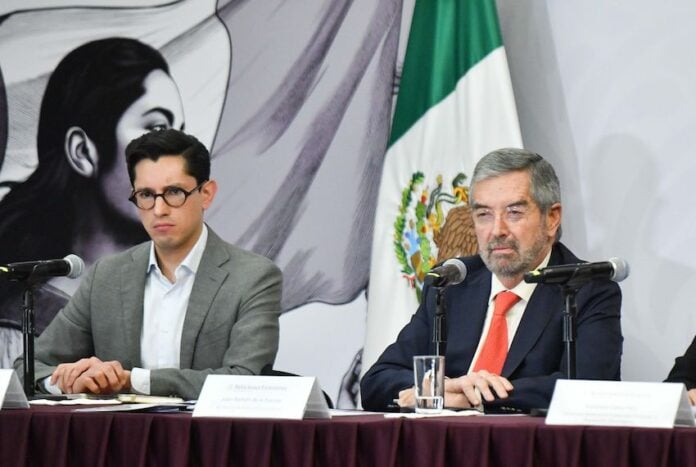
De la Fuente (R) said in his resignation message that Sheinbaum had appointed Roberto Velasco (L) as his successor. Velasco is the current deputy foreign minister for North America.
De la Fuente (R) said in his resignation message that Sheinbaum had appointed Roberto Velasco (L) as his successor. Velasco is the current deputy foreign minister for North America. (Mario Jasso/Cuartoscuro)

Juan Ramón de la Fuente has stepped down as Mexico’s foreign affairs minister for health reasons and is set to be replaced by Deputy Foreign Minister Roberto Velasco.

President Claudia Sheinbaum announced de la Fuente’s decision to resign on social media.

According to the newspaper Reforma, the outgoing foreign minister advised colleagues of his resignation in a written message, telling them that he asked Sheinbaum to allow him to leave his position in order to attend to a spinal problem for which he has already undergone surgery on two occasions.

He told colleagues that he may need to have another operation in order to remain “active” and “productive.”

De la Fuente, a 74-year-old psychiatrist and former rector of the National Autonomous University, said in his message that Sheinbaum has appointed Velasco, deputy foreign minister for North America, as his successor.

“I know his leadership, I know his loyalty. He will be a foreign minister who provides great support to the president from this ministry,” he wrote of Velasco, who has headed up the Foreign Affairs Ministry’s North America department since 2020.

De la Fuente, who served as Mexico’s health minister in the 1990s and as the country’s permanent representative to the United Nations between 2018 and 2023, became foreign affairs minister at the start of Sheinbaum’s presidency on Oct. 1, 2024.

He has been particularly active in defending the rights of Mexicans who live abroad, especially in the United States. De la Fuente has also been involved in negotiations with the Trump administration on issues such as security and trade.

Velasco, 38, stood in as head of the Foreign Affairs Ministry late last year while de la Fuente was on medical leave.

Sheinbaum: ‘I told him, don’t go, Juan Ramón’

Accompanied by de la Fuente and Velasco, Sheinbaum announced the foreign minister’s decision to step down in a video message on Wednesday afternoon.

“I already told him, ‘Don’t go, Juan Ramón,’ but he has this health problem and he has decided that he needs this space for rehabilitation,” she said.

The president said that de la Fuente “will continue helping us on different issues” and will return to the government in an unspecified position when he has completed his rehabilitation.

Sheinbaum said that Velasco is an international relations “expert,” with “a lot of knowledge” about Mexico’s foreign policy. She wrote on social media that she had decided to propose his appointment as foreign minister to the Senate.

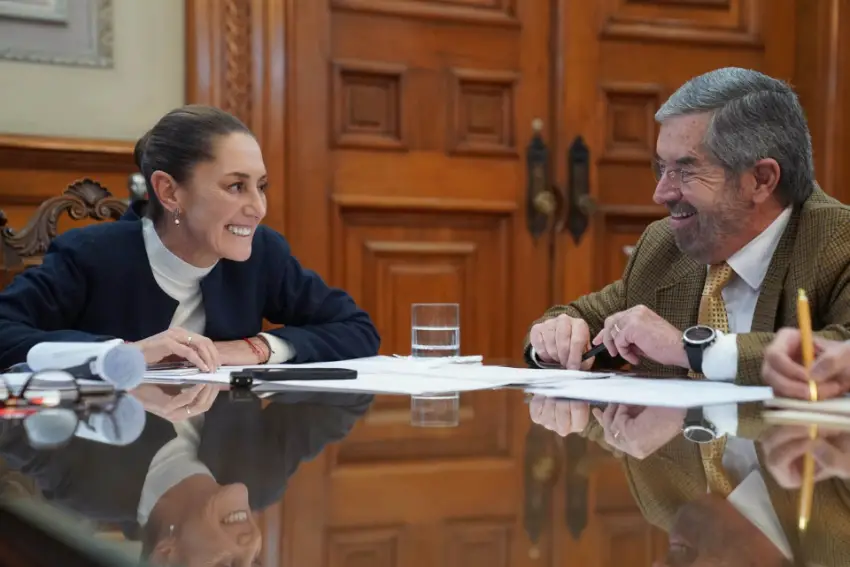
Mexico's president Claudia Sheinbaum in the national palace on a call with Donald Trump looking at Mexico's Foreign Affairs Minister Juan Ramón de la Fuente who sits aside from her at the same table.
President Sheinbaum and departing Foreign Affairs Minister Juan Ramón de la Fuente on a call with U.S. President Donald Trump following his election in 2024. (Cuartoscuro)

For his part, De la Fuente thanked the president for allowing him to be part of her “political project” — i.e., the “fourth transformation” movement founded by former president Andrés Manuel López Obrador and now led by Sheinbaum. He said that defending Mexico and assisting and supporting Mexicans abroad, regardless of their migratory status, had been “a great privilege.”

De la Fuente also said that Velasco has been a “great colleague” and declared he was certain that his tenure as foreign minister would be “very successful.”

Velasco thanked Sheinbaum for her confidence in him and said it was an “enormous honor” to be nominated as foreign minister. He said he would take on the position with “a lot of love for the people” and “a lot of commitment to our country.”

“Of course if the Senate ratifies me [as foreign minister], we’re going to continue with this work of defending the sovereignty of Mexico and protecting Mexicans across the whole world,” Velasco said.

With reports from Reforma, El Universal and Milenio