Japan's National Tourism Organization (JNTO) wants to encourage tourists to visit regions less explored than the traditional hotspots. (X)
Mexican tourism to Japan is increasing, with a record 200,400 Mexicans visiting the Asian destination in 2025, marking a 32% rise over 2024 and a higher rate than pre-pandemic levels.
Growth has been driven by improved air connectivity, a favorable exchange rate, investment in marketing initiatives and a growing interest in Japanese culture.
The 200,400 Mexican visitors to Japan last year was a higher number than even before the pandemic. (X)
The Japan National Tourism Organization (JNTO) office in Mexico emphasized the sustained effort it has taken to drive up tourism between Mexico and Japan, working with airlines, travel agencies, specialized media and strategic partners.
JNTO director Masumi Yamada said that the growth in tourist numbers reflects a greater interest in Japan among Mexicans.
Cultural experiences, from traditional festivals to regional cuisine, topped the list of features drawing Mexicans to Japan. Meanwhile, sustained growth in family and multigenerational travel also came high on the list.
Yamada said that the JNTO intends to expand destination awareness as well as encourage tourists to visit Japanese regions less explored than the traditional hotspots.
The expansion of direct air routes between Mexico and Japan, operated by airlines such as Aeroméxico and Japan’s All Nippon Airways (ANA), have supported the increase in travel between the two countries by enhancing access.
In June, ANA’s general manager in Mexico, Koichi Tochinai, expressed interest in expanding operations between Mexico and Japan.
ANA has run a daily nonstop flight between Mexico City International Airport (AICM) and Narita Airport in Tokyo since 2017, and, in recent months, increased visitor numbers have led the airline to consider adding more flights to the route.
“Although there are no specific plans (to increase frequencies) at this time, we are very interested in doing so,” stated Tochinai. “Mexico is a promising and important market for ANA, and we want to contribute to the growth of both passenger and cargo traffic to and from Japan, as well as to Asia.”
Tochinai emphasized the growing interest of Japanese businesses in the Mexican market, particularly in the manufacturing industry.
The airline views AICM as the likely hub for ANA, due to its large flight network. While other Mexican airports, such as Cancún and Tulum, are growing in popularity for Japanese visitors, seasonal fluctuations make them less reliable a choice for establishing a Mexican ANA hub, according to Tochinai.
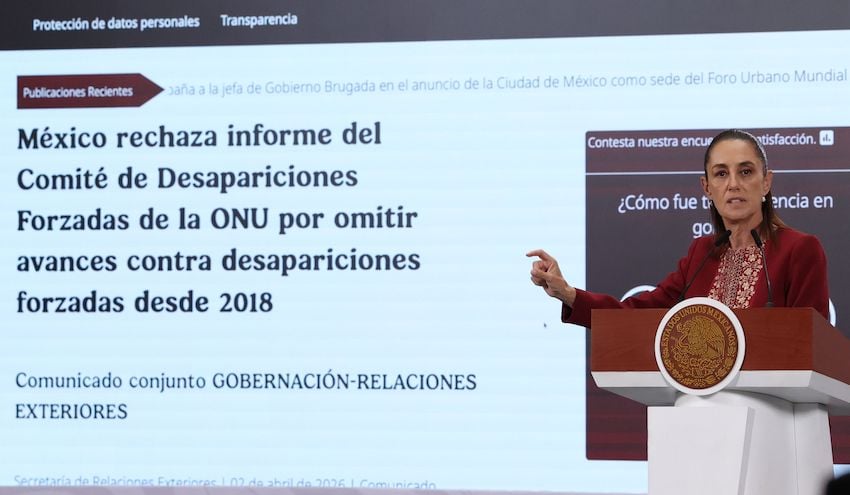
President Sheinbaum showed a post on Instagram at her morning presser that CBC News says was artificially generated. (Moisés Pablo/Cuartoscuro)
At her Monday morning press conference, President Claudia Sheinbaum spoke about the arrest last week of Ryan Wedding, an alleged drug boss accused of overseeing a vast cocaine pipeline and numerous murders.
She doubled down on her government’s assertion that Wedding, a Canadian citizen, was not captured in a planned operation with the United States, but rather turned himself in at the U.S. Embassy in Mexico City.
However, the main evidence she presented to support that version of events was fabricated, according to CBC News, a division of the Canadian Broadcasting Corporation.
Later on Monday, Wedding — who is now in U.S. custody — pleaded not guilty to two criminal indictments, from separate federal grand juries in California in 2024 and 2025, CBC News reported.
Contradicting Sheinbaum, the suspect’s lawyer, Anthony Colombo, told reporters on Monday that his client “didn’t surrender.”
“He was apprehended. He was arrested. And so any spin that the government of Mexico is putting on this that he surrendered is inaccurate. And I think that if there’s anyone in a position to know how his apprehension and arrest went down it’s his counsel,” he said.
“So those reports of what happened, that he surrendered, are completely inaccurate,” Colombo said.
“… Look, the Trump administration with the apprehension of [Nicolás] Maduro has made clear that we’re in a bold new era with regard to international relations. So one can understand why that statement might have been put out, because if the U.S. government is unilaterally going into a sovereign country and apprehending someone, you can understand the concern that that sovereign entity might have. But he was apprehended,” the lawyer said.
Wedding’s next court appearance will be on Mar. 24, CBC News reported.
Sheinbaum: Ryan Wedding turned himself in at the US Embassy
Mexican authorities said on Friday that Wedding, a 44-year-old former Olympic snowboarder, turned himself in at the U.S. Embassy in Mexico City last Thursday, but U.S. authorities and some media reports contradicted that information.
In an article headlined “Inside the Dramatic Arrest of an Olympic Snowboarder Turned America’s Most Wanted,” Vanity Fair wrote that “the FBI worked with Mexican law enforcement officials who, on Thursday, in the middle of the night, apprehended Wedding.”
“After an intense negotiation, Wedding was later taken into U.S. custody by the FBI Hostage Rescue Team [HRT], the same team that captured Nicolás Maduro of Venezuela just weeks before,” the report stated.
Vanity Fair quoted FBI Director Kash Patel as saying that, “This was a complex, high-stakes operation with zero margin for error. I was on the ground with our team in Mexico and witnessed extraordinary teamwork, precision and trust between our agents and partners in Mexico.”
On Monday morning, Sheinbaum gave a very different account of Wedding’s arrest.
🚨La presidenta Claudia Sheinbaum aclaró que Ryan Wedding se presentó voluntariamente ante la Embajada de EEUU el jueves pasado.
Señaló que la prueba es la publicación hecha por el propio Wedding y subrayó que no hubo operativos conjuntos en México. pic.twitter.com/snvlnKc2jE
“This person of Canadian origin presented himself to the Embassy, turned himself in at the Embassy,” she said, adding that Wedding reasoned that doing so was a better option than remaining a fugitive.
The suspect, who Patel described as a “modern-day Pablo Escobar” and a “modern-day El Chapo,” was on the FBI’s “Ten Most Wanted Fugitives” list before he was taken into custody. Patel shared Vanity Fair’s article on social media and wrote above it that “our FBI HRT teams executed with precision, discipline, and total professionalism alongside our Mexican partners to bring Ryan James Wedding back to face justice.”
For her part, U.S. Attorney General Pamela Bondi wrote on social media on Friday morning that at her “direction, Department of Justice agents @FBI have apprehended yet another member of the FBI’s Top Ten Most Wanted List: Ryan Wedding, the onetime Olympian snowboarder-turned alleged violent cocaine kingpin.”
“Wedding was flown to the United States where he will face justice. This is a direct result of President Trump’s law-and-order leadership. Under @POTUS, criminals have no safe harbor. Director Patel has worked tirelessly to bring fugitives to justice. We are grateful to our incredible Ambassador Ron Johnson and the Mexican authorities for assisting us in this case,” she wrote.
Sheinbaum acknowledged that Patel was in Mexico when the arrest occurred, but told reporters that he was here for security meetings rather than the execution of an operation to capture Wedding.
She noted that Patel spoke about the arrest of the suspect in a “bilateral operation,” before stressing that Security Minister Omar García Harfuch “immediately denied” that it was the case.
“And then the United States ambassador himself denies it,” added Sheinbaum, referring to a statement issued by Ron Johnson that refers to “the surrender of Ryan Wedding.”
“This person turned himself in at the Embassy,” she stressed.
Sheinbaum subsequently said that the “best evidence” in support of Wedding having turned himself in at the U.S. Embassy came from the suspect himself.
She was referring to a post on Instagram by the account “bossryanw” that includes a photo that purports to show Wedding standing outside the U.S. Embassy in Mexico City prior to turning himself in.
However, CBC News reported on Monday that it had determined that “the image was generated using artificial intelligence.”
The Canadian news organization also reported that the fake image “was posted to an Instagram account that falsely purported to belong to Wedding’s ‘representative.'”
CBC News reported last week that a review of the account found “multiple red flags suggesting an imposter has been posting images created using AI.”
The latest (and now sole) post to the account — most of which Sheinbaum interpreted into Spanish at her mañanera — reads: “To the media and my followers: After seeking guarantees for a fair process, I have decided to voluntarily turn myself in to the authorities. I thank my wife, @myriamcastt, for being my driving force, and @johnbilonog, who will be in charge of my legacy. Thank you for your messages this week; they gave me great comfort in taking this step. I am fully confident that the truth will come to light and set me free.”
Beneath that message in bold font was the following: “This message is being posted by a representative – the context of the photo is that Mr. Wedding walked to the United States Embassy in Mexico City on his own two feet.”
Sheinbaum said that the circumstances of Wedding’s arrest must be made “very clear” because “some” media commentators “love to go around saying the opposite.”
But “there are no joint operations in Mexico,” emphasized the president, a staunch defender of Mexican sovereignty.
“In other words, the U.S. agents [in Mexico], from the FBI or any other agency, know very clearly their limitations, which are established by the [Mexican] Constitution and by the National Security Law,” she said.
“What exists is coordination regarding information from both sides, but there are no joint operations in Mexico. We wouldn’t allow that, we do not agree with it. I have stated this personally to President Trump on several occasions,” Sheinbaum said.
Wedding’s arrest came a week after The New York Times reported that the United States was “intensifying pressure” on Mexico “to allow U.S. military forces to conduct joint operations to dismantle fentanyl labs inside the country.”
Since the return of Donald Trump to the White House just over a year ago, Mexico has been under increased pressure from the United States to do more to combat drug cartels and the narcotics they traffic to the U.S.
That pressure has only intensified in recent weeks, following the United States’ military operation in Venezuela and Trump’s assertion that the U.S. would imminently start “hitting” cartels on land.
By Mexico News Daily chief staff writer Peter Davies (peter.davies@mexiconewsdaily.com)
The most recent National Survey of Urban Public Security (ENSU) shows that 63.8% of respondents across 91 Mexican cities (including the 16 boroughs of Mexico City) consider their place of residence unsafe. (Margarito Pérez Retana/Cuartoscuro)
Almost 90% of people who live in Uruapan — the city in Michoacán where the mayor was assassinated last November — believe that the city is an unsafe place to live.
That was among the findings of the latest National Survey of Urban Public Security (ENSU), carried out by the national statistics agency INEGI in the final quarter of 2025.
Published on Friday, the survey results show that 63.8% of respondents across 91 Mexican cities (including the 16 boroughs of Mexico City) consider their place of residence unsafe.
The percentage rose 0.8 points compared to the third quarter ENSU and 2.1 points compared to a year earlier, reflecting an increase in people’s perceptions of insecurity during Claudia Sheinbaum’s presidency, even though official statistics show declines in the incidence of many crimes, including homicide.
Almost seven in 10 women who responded to the survey (69.4%) said that their city is unsafe, while nearly six in ten men (57.1%) said the same.
INEGI conducted the ENSU at 27,130 homes between late November and mid-December.
Which cities have the highest percentages of residents with personal security concerns?
INEGI reported that 88.7% of ENSU respondents in Uruapan said that the city is an unsafe place to live. The percentage rose 6.1 points compared to the previous survey, but declined 3.8% points compared to a year earlier.
The latest ENSU was conducted just weeks after Mayor Carlos Manzo was gunned down in Uruapan’s central square during a Day of the Dead festival on Nov. 1.
After Uruapan, the cities with the next highest percentages of residents with personal security concerns in the final quarter of 2025 were:
Culiacán, the capital of Sinaloa. Almost nine in ten surveyed residents (88.1%) consider the city unsafe. In recent times, Culiacán has been plagued by violence related to Sinaloa Cartel infighting.
Ciudad Obregón, the second largest city in Sonora, is considered unsafe by 88% of surveyed residents.
Ecatepec, a densely-populated México state municipality that adjoins Mexico City, is also considered unsafe by 88% of surveyed residents.
Irapuato, the second largest city in Guanajuato, is considered unsafe by 87.3% of surveyed residents.
Rounding out the top 10 cities where the highest percentage of residents feel unsafe were Chilpancingo, Guerrero (86.4%); Chimalhuacán, México state (85.7%); Puebla city (84.5%); Tlalnepantla, México state (83.8%); and Villahermosa, Tabasco (83.8%).
Which cities have the lowest percentages of residents with personal security concerns?
The cities with the lowest percentages of residents with personal security concerns in the final quarter of 2024 were:
San Pedro Garza García, a municipality in the metropolitan area of Nuevo León capital Monterrey. Just 8.7% of surveyed residents said that San Pedro is an unsafe place to live.
Benito Juárez, a Mexico City borough that includes neighborhoods such as Del Valle, Narvarte and Nápoles. Only 14.8% of surveyed respondents consider Benito Juárez an unsafe place to live.
Piedras Negras, a border city in Coahuila opposite Eagle Pass, Texas. Around one in six surveyed respondents (17.3%) consider the city unsafe.
Los Mochis, a city in Sinaloa, is considered unsafe by 25.6% of surveyed residents.
San Nicolás de los Garza, a Nuevo León municipality in the Monterrey metro area, is considered unsafe by 27.5% of surveyed residents.
Perception of insecurity down significantly in 7 cities, up significantly in 7
Compared to the third quarter of 2025, there were statistically significant changes in perceptions of insecurity in 14 Mexican cities, INEGI said.
In seven of those cities, the percentage of residents with security concerns declined significantly, while the percentage increased significantly in seven.
The cities where there were significant decreases were:
Miguel Hidalgo, Mexico City: 51.1% in Q3 to 35.7% in Q4 (↓15.4 points)
Torreón, Coahuila: 43.4% in Q3 to 29.5% in Q4 (↓13.9 points)
La Laguna, Coahuila: 48.4% in Q3 to 36.9% in Q4 (↓11.9 points)
Nayarit, Jalisco: 49.7% in Q3 to 37.9% in Q4 (↓11.8 points)
Tonalá, Jalisco: 65.4% in Q3 to 56.5% in Q4 (↓8.9 points)
Tlalpan, Mexico City: 64.4% in Q3 to 55.7% in Q4 (↓8.7 points)
Gustavo A. Madero, Mexico City: 73.2% in Q3 to 65.3% in Q4 (↓7.9 points)
The cities where there were significant increases were:
Mazatlán, Sinaloa: 52.8% in Q3 to 80.4% in Q4 (↑27.6 points)
Hermosillo, Sonora: 47.5% in Q3 to 61% in Q4 (↑13.5 points)
Milpa Alta, Mexico City: 52.3% in Q3 to 65.4% in Q4 (↑13.1 points)
Pachuca, Hidalgo: 46.9% in Q3 to 59.9% in Q4 (↑13 points)
Tampico, Tamaulipas: 22.8% in Q3 to 34.8% in Q4 (↑12 points)
La Magdalena Contreras, Mexico City: 55.9% in Q3 to 65.2% in Q4 (↑9.3 points)
Azcapotzalco, Mexico City: 59.6% in Q3 to 68.5% in Q4 (↑8.9 points)
The places where Mexicans most commonly feel unsafe
Just over 72% of ENSU respondents reported feeling unsafe while using ATMs on the street, while almost 65% expressed security concerns about walking on the streets they regularly use and traveling on public transport.
More than 50% of respondents said they felt unsafe on highways and at the bank.
The percentages were higher among women than among men in all those places — and several others, including the home and the workplace.
Crime and anti-social behavior
Among the respondents who reported having seen or heard criminal activity or anti-social behavior near their homes in the fourth quarter of 2025, almost six in 10 said they had observed people drinking in the street.
Of those surveyed, 36.7% reported having heard frequent gunshots. (Cuartoscuro)
More than 48% of respondents reported having witnessed a robbery or mugging, and around four in 10 told INEGI they had seen people buying or using drugs.
Just under 39% of those surveyed said they had witnessed homes or businesses being vandalized, and 36.7% reported having heard frequent gunshots.
Just under one-quarter of respondents said they had witnessed some kind of gang activity near their home.
Opinions on Mexico’s security forces
The Mexican Navy is the country’s most effective security force, according to the results of the latest ENSU. Exactly 83% of respondents said they believe the Navy is very or somewhat effective in preventing and combating crime.
Just under 81% of those polled said the same about the Air Force, while the figures for the Army and the National Guard were 79.7% and 70%, respectively.
Almost 52% of respondents said that state police forces are very or somewhat effective in preventing and combating crime, while 46% said the same about municipal police.
Citizens’ security expectations
Around one-third of survey respondents (33.7%) said they expected the security situation in their city to remain “just as bad” during the next 12 months, while 25.6% predicted a deterioration.
Almost a quarter of respondents (23.2%) said they expected security to improve in their place of residence during the next 12 months, while 16.4% anticipated that the situation would remain “just as good” as it currently is.
President Sheinbaum said on Monday that she wrote a letter to the prime minister of Korea asking him to bring the K-pop group to Mexico more often. (Ticketmaster/Cuartoscuro)
Ticket sales for three BTS concerts scheduled for Mexico City in May devolved into chaos late last week, triggering government sanctions and even a presidential plea for more shows by the globally loved K-pop group.
A 24-year-old BTS fan tried last week to earn money for a concert ticket by selling candy in front of the Palacio de Bellas Artes. She may have found, as so many others did, that having the money for a ticket did not necessarily mean being able to buy one. (Andrea Murcia/Cuartoscuro)
Virtual queues swelled to more than 1.1 million users from over 1,300 cities worldwide, according to data shared by Ticketmaster and promoter OCESA.
Fans reported system crashes, orders getting stuck on the payment page and various error messages during the ARMY presale, along with complaints that tickets marked as available could not be selected.
Others denounced alleged dynamic pricing and said seats jumped from about 8,500 pesos (about US $490) with fees to more than 12,000 pesos (about US $692) during purchase attempts.
ARMY, the group’s fan club, is an acronym for “Adorable Representative MC for Youth,” with MC meaning emcee.
Outrage grew as images circulated of regular people (or perhaps apparent resellers) lining up at physical box offices despite rules that sales were supposed to be restricted to registered fan club members.
A presale for ARMY members was held Thursday and Friday of last week, with the general sale on Saturday.
Mexico’s Federal Consumer Protection Agency (Profeco) said it had received roughly 5,000 emails and multiple hotline complaints about irregularities and price changes in the BTS sale.
Profeco’s head, Iván Escalante, announced proceedings against Ticketmaster “due to a lack of clarity in the information provided to consumers” and promised sanctions for resale platforms such as StubHub and Viagogo “for engaging in abusive and unfair practices.”
At her Monday morning press conference, Mexican President Claudia Sheinbaum said around 1 million young Mexicans wanted to attend the shows, but “there are only 150,000 tickets.”
After OCESA warned that the global schedule left little room for extra dates, Sheinbaum said, “I wrote a letter to the prime minister [Kim Min-seok] of Korea, asking him to bring the group to Mexico more often. I haven’t received a reply yet, but hopefully it will be positive, or at least that he’ll allow screens,” so those who can’t attend the concerts can watch them.
BTS, a seven-member K-pop boy band formed in 2013, is the best-selling act in South Korean history and one of the few non-English-language artists to sell out London’s Wembley Stadium.
Their 79-date Arirang world tour, starting in South Korea this spring, marks their full-group return after completing their nation’s mandatory military service.
With the participation of 1,500 exhibitors from all 32 states, Mexico's tourism minister said FITUR 2026 marked a turning point in the international projection of Mexican tourism. (@SECTUR_mx/X)
On Sunday, Mexico concluded its participation as partner country at the 46th edition of the International Tourism Fair (FITUR) 2026, held in Madrid, Spain, marking an unprecedented program that highlighted the diversity and competitiveness of Mexico’s tourism industry in one of the most influential platforms in the global tourism sector.
According to Tourism Minister Josefina Rodríguez Zamora, the Mexican delegation broke attendance and visibility records with more than 155,000 professional visitors in the first three days of FITUR. Its stand space, which spread across 1,800 square meters, was also the most visited in the Americas region.
With the participation of 1,500 exhibitors from all 32 states in Mexico, Rodríguez said FITUR 2026 marked a turning point in the international projection of Mexican tourism, positioning the country as a global power and a benchmark in the industry.
“Mexico shone at FITUR Madrid,” Rodríguez wrote on her official X account. “We demonstrated the strength of a united nation, proud of its roots and its people. Today, Spain and the whole world know why Mexico Está de Moda [Why Mexico Is Trending].”
This edition also served as a platform for Mexico to showcase its culture throughout the city, with strategic advertisements on FlixBus buses and Madrid Metro stations, art installations and exhibitions of Mexican handicrafts.
Rodríguez also held meetings with officials from other countries to strengthen community-led tourism and international cooperation. She also met with representatives from companies and leaders of international initiatives across multiple industries to explore opportunities for collaboration, investment and promotion in Mexico.
Desde FITUR 2026, compartimos una historia que nace desde lo humano 🎬✨
📍En el Recinto Ferial IFEMA, Madrid, presentamos el estreno oficial del cortometraje “El Buen Morir”, una producción de CONCANACO SERVYTUR en colaboración con Studio, que invita a reflexionar sobre… pic.twitter.com/MEqGCnhGgc
As part of these efforts to strengthen Mexico’s reputation before an international audience, the Mexico pavilion presented the short film “El Buen Morir” (A Good Way to Die), which explores death, identity and culture through the Mexican worldview: a view of death not as a taboo or absolute end, but as transformation and permanence in memory and legacy.
Other notable activations included the “Travel Safe To the 2026 World Cup” program organized by the Confederation of National Chambers of Commerce, Services and Tourism (CONCANACO SERVYTUR) with the purpose of protecting girls, boys and adolescents from human trafficking during the sporting event.
According to CONCANACO SERVYTUR, more than 300 meetings were held during FITUR with business leaders, international organizations and strategic partners, strengthening ties that will enable the coordination of international investment and cooperation in Mexico’s 32 states.
Divers from the Selvame MX collective found among the some 15,000 columns supporting the Maya Train examples of rusty structures that crumble to the touch, releasing contaminants into the underground aquifer. (Pepe Urbina/Selvame MX/Cuartoscuro.com)
Environmental activists are warning that structural damage to columns that support the tracks of the Maya Train endangers the operation of the railway and presents a risk of environmental damage that was foreseen but not addressed.
The environmental collective Selvame MX, comprising activists, divers and specialists dedicated to protecting the Yucatán Peninsula’s biodiversity, with particular focus on the Maya Forest and its aquifer, had elicited assurances from a construction company that it would repair the damaged columns.
Lo que especialistas advirtieron en 2024 hoy es una realidad alarmante
Imágenes exclusivas obtenidas por @SelvameMX el pasado 15 de enero de 2026, revelan que las camisas de acero de los pilotes que sostienen el Tramo 5 del #TrenMaya se están desintegrando.
The activists published a video of the damage on social media and included a message that said: “We did a dive to check if they had repaired the damage as promised, but we found that [a previously discovered damaged] column …from which tons of concrete spilled, is still there.”
Other fractured pilings with visible signs of deterioration were documented underwater. Selvame MX says the metal cladding of the columns has detached, exposing the structures and allowing the dispersal of contaminants.
The columns in question pierce the aquifer system of the Maya jungle in the state of Quintana Roo and have been the source of considerable criticism from the outset of the Maya Train project.
Last year, the Environment Ministry confirmed that construction of the Maya Train had indeed caused environmental damage, particularly to Section 5, where at least eight caverns and cenotes were significantly compromised to accommodate the train.
Selvame MX claims that surrounding the damaged column are others that reflect the poor construction and low-quality materials used. The organization maintains that the documented situation represents only a fraction of the problem, since they are only able to supervise the areas to which they have access.
They allege that the contamination of the aquifer by the corrosion of these metal cylinders meant to contain the concrete was foreseen and accepted by the promoters of the Maya Train project.
“These cylinders are corroding away,” they explained. “They serve no support function; they were destined to disappear.”
As a result, Selvame MX insists, the concrete poured inside the cylinders will eventually be exposed to water and will degrade, without any possibility of repair, due to the inaccessibility of the columns.
The reliability of the statistics the state-based Attorney General's Offices provide to the Executive Secretariat of the National Public Security System is considered by many to be questionable. (Moisés Pablo/Cuartoscuro)
At face value, it certainly appears to be good news, even though homicide numbers in Mexico remain high, with more than 23,000 victims reported last year.
Sheinbaum has attributed the decline in homicides during her presidency to the federal government’s security strategy. (Victoria Valtierra/Cuartoscuro)
Standing next to a bar graph, Sheinbaum frequently lauds the sustained reduction in murders as a testament to the effectiveness of her government’s security strategy; on Jan. 8, she highlighted that the murder rate in 2025 was the lowest since 2016.
However, there is a growing skepticism about the accuracy of the government’s numbers.
On one hand, there are concerns that authorities in Mexico’s 32 federal entities are not accurately reporting homicides because they are incorrectly classifying some murders as less serious crimes.
On the other hand, there are claims that the decline in homicides during Claudia Sheinbaum’s presidency is related to an increase in disappearances.
The federal government’s homicide statistics come from the states. Are they reliable?
The homicide data the federal government presents on a monthly basis is derived from reports it receives from the Attorney General’s Offices in Mexico’s 31 states and Mexico City.
The reliability of the statistics the state-based Attorney General’s Offices provide to the Executive Secretariat of the National Public Security System is considered by many to be questionable.
“They operate under budgetary, political and media pressures. When a homicide is difficult to prove or requires lengthy investigation, there is an incentive to reclassify it as injury, accidental death or a lesser crime,” he wrote.
“… An unresolved homicide looks bad in the statistics. A [fatal] injury unrelated to homicide looks better,” Guerrero wrote.
He said that “in states such as Jalisco, where multiple cartels operate, and Chihuahua, where violence is structural, these practices of reclassification are systematically documented by independent organizations.”
“The official statistics show declines [in homicides] while defense lawyers, forensic doctors and journalists document that violent deaths continue,” Guerrero wrote.
In a report published last November under the title “La Transformación de los Asesinatos en Propaganda” (The Transformation of Murders into Propaganda), the non-governmental organization Causa en Común also wrote about the “possible/probable reclassification” of homicides as other crimes.
“Adjacent to the category of intentional homicide, there are two other categories whose behavior has been peculiar in recent years: culpable homicide (accidents) and ‘other crimes against life and integrity,'” states the report.
“… In the past six years, the number of victims recorded in the category of intentional homicide has supposedly declined 11%. In contrast, the number of victims of culpable homicide and ‘other crimes against life and integrity’ has increased 11% and 103%, respectively,” the NGO said.
A June 2025 report by Ibero University similarly flags the “reclassification of crimes” as a possible “common strategy to reduce the visibility of high-impact crimes.”
The report also states that “the apparent reduction in homicide numbers doesn’t necessarily imply a real decrease in violence, but [could indicate] a sophisticated concealment of [intentional homicide] victims through [their classification in] other categories such as disappearances, atypical culpable homicides, unidentified deceased persons or bodies hidden in clandestine graves.”
In an interview with the EFE news agency last November, Armando Vargas, the coordinator of the security program at the think tank México Evaluá, said that to speak of a significant decline in homicides “is politically very profitable.”
However, he too noted that other “forms of violence” have increased, “amplifying suspicions” that criminal data is being manipulated.
“The expert,” EFE reported, highlighted that “some entities record more deaths from accidents (homicidio culposo) than from homicidio doloso [intentional homicide], without there being public reports of mass accidents that justify this anomaly.”
The manipulation of crime statistics by authorities in Mexico’s states is not a new phenomenon. The practice, aimed at making it appear that there are fewer homicides than there really are, allegedly dates back decades.
However, data showing a significant reduction in murders during the Sheinbaum administration — something that didn’t occur during the terms of recent past governments — has brought the issue into sharp focus.
Do disappearances conceal the seriousness of Mexico’s security situation?
In Sheinbaum’s first 12 months in office — Oct. 1, 2024 to Sept. 30, 2025 — 14,765 of the people reported as missing in the period remained unaccounted for when the president completed the first year of her term. That figure represents an increase of 16% compared to the final year of Andrés Manuel López Obrador’s presidency, and an increase of 54% compared to the annual average during AMLO’s six-year term.
Is this increase in disappearances related to the decrease in homicides? According to many observers, the answer is yes.
Reuters reported on Jan. 8 that government critics claim that the increase in “forced disappearances” is “masking the violence in the country.”
In an opinion article published by The New York Times in December, Ioan Grillo, a Mexico-based journalist with extensive experience reporting on organized crime, wrote that “opposition figures” assert that the reduction in homicides is “just because cartels are now disappearing more people, rather than leaving corpses to be counted.”
For its part, the news website Animal Político reported a few weeks ago that from the point of view of search collectives, “disappearance has become a criminal strategy: erase the body, dilute the crime [disappearance rather than homicide] and indefinitely extend punishment for the families.”
In its report, Causa en Común wrote that “another factor of uncertainty about the accuracy of the intentional homicide records is the increase in the number of disappeared persons” during the Sheinbaum administration.
“… Of course, an indeterminate number of people recorded as missing were murdered. Maybe for that reason, the missing person numbers don’t usually appear in the morning press conferences,” the NGO wrote.
It added: “The increase in disappearances has been of such magnitude that in some entities there has been a crossover in the records, with more reports of disappeared persons than victims of intentional homicide.”
Vargas, the México Evalúa security expert, asserted that “the federal government isn’t interested in the issue of disappearances,” even though Sheinbaum has said that attending to the missing persons problem is a “priority” for her administration.
“The disappeared are once again missing from official discourse,” he said.
Vargas said that disappearing people allows organized crime groups to “create terror” and “hide lethal violence” because “without a body there’s no crime.”
Do authorities, including the federal government, need to do a better job at locating missing persons — dead or alive — and solving such cases? According to victims’ relatives, and many others, the answer is definitely yes.
But the status quo — a significant decrease in homicides (per the government’s data) and an increase in disappearances — is a situation “in which everyone wins,” Vargas told EFE.
“With the bodies disappeared,” he said, “it is possible to maintain [that there is] a reduction in violence” — at least as measured in homicide statistics.
Vargas also said that Sheinbaum uses the data showing a reduction in homicides during her administration to “show off” to “the opposition,” her “political rivals within Morena,” Mexico’s ruling party, and Donald Trump.
“It’s a very perverse scenario, but politically profitable,” Vargas said.
Less flattering data
If the number of homicide victims in the first year of Sheinbaum’s presidency is added to the number of disappearances in that period, the total is 40,265.
That figure represents a decline of just 5% compared to the average annual combined total of homicides and disappearances during López Obrador’s six-year term. It represents a significant increase compared to the average number of homicides and disappearances annually in the sexenios (six-year terms) of Enrique Peña Nieto (2012-18) and Felipe Calderón (2006-12).
Of course, a 5% reduction in the incidence of these two serious crimes doesn’t sound anywhere near as good as a 30% annual decrease in homicides, as the government has recently been touting. And clearly it is not in the interests of the current federal government to dwell on — or even raise — data that shows that the combined incidence of homicides and disappearances under Sheinbaum is higher than during the sexenios of Calderón and Peña Nieto.
However, it should be remembered that whether a person is murdered or missing, the reality for the victim’s family is essentially the same — their loved one is gone.
In a perhaps flawed defense of her government, Sheinbaum said late last year that “disappearances in Mexico are linked to organized crime in the vast majority of cases,” rather than “the state, as was the case in the ’70s and even part of the ’80s.”
Still, the Sheinbaum administration — like any government — has a responsibility to provide security conditions that make it less likely that abductions will occur, no matter who is attempting to commit them.
A proposed remedy
In an article published by Animal Político on the final day of 2025, journalist Manu Ureste described a disconnect between the government’s data on homicides and the reality of the security situation Mexico faces.
“While the institutional discourse focuses on the drop in homicides, the country ended the year with nearly 14,000 people still missing [among those who disappeared in 2025], cartels operating with wartime tactics, cities trapped in internal conflicts, and local economies subdued by large-scale extortion from organized crime,” he wrote.
In a report published late last year, Causa en Común wrote that “the underestimation and distortion of crime with political purposes are of such magnitude that official reports cease to be a useful tool to design security strategies.”
The NGO also said that “the manipulation of the most sensitive information for Mexico indicates an irresponsibility that must be corrected, out of political honesty, and to acknowledge and face up to the most serious of our problems.”
So, what can be done?
In his recent column for Expansión, Guerrero Baena, the security consultant, wrote that the Executive Secretariat of the National Public Security System (SESNSP) “acts as an intermediary between state data and public opinion.”
“Theoretically, it should filter out inconsistencies. In practice, it validates what it receives. It has no investigative powers, does not break down methodologies, and does not question classifications. It is a passive receiver that becomes an active certifier,” he wrote.
In that context, Guerrero Baena proposed “four structural reforms” that he asserted could “restore credibility” to “the statistical measurement of violence.”
The carrying out of independent audits of State Attorney General’s Offices’ crime data. Such audits would review “100% of cases” in which violent deaths are not classified as intentional homicides. When “patterns of systematic reclassification” of violent deaths are detected, the information should be referred to federal authorities. Audit results must be published on a quarterly basis.
Reform the SESNSP to give it “independent verification” powers. Create a “statistical validation unit” with direct access to information from the Civil Registry and the Mexican Social Security Institute as well as forensic records, and investigations in prosecutors’ offices. “This unit should publish reports on methodological discrepancies found, requiring public corrections when the figures do not correspond to demographic realities.”
Create a “national observatory of anomalous mortality” that cross-checks Civil Registry data on deaths with information from prosecutors, medical examiners and forensic medicine institutes. “This observatory would report monthly on deaths recorded as violent,” but which don’t have “corresponding investigation files, allowing for the identification of true blind spots in the system.”
Conduct “methodologically rigorous” victimization surveys every three months in order to gauge the “lived experience” of Mexicans with regard to violence. The results of the surveys “would be published alongside” data on reported crimes, “allowing for comparison and mutual validation.” (Statistics agency INEGI already conducts a National Survey of Urban Public Security on a quarterly basis, which measures people’s perceptions of insecurity in the cities in which they live.)
In his column, Guerrero wrote that his proposals “are just the beginning of a necessary transformation.”
“The urgent task is to restore credibility. Without reliable statistics, without figures that society recognizes as reflecting reality, it is impossible to have a genuine public security policy,” he wrote.
“Mexicans deserve to know what is really happening in their cities. They do not deserve figures that reassure them with lies.”
By Mexico News Daily chief staff writer Peter Davies (peter.davies@mexiconewsdaily.com)
More than 100 gunshots were heard during the attack, causing widespread panic among those lingering at the field after an amateur soccer match. (X)
Eleven people were killed and at least 12 others were injured when gunmen arrived at a soccer pitch and opened fire in the state of Guanajuato on Sunday.
Six people were still receiving medical attention for injuries, Guanajuato’s state attorney general’s office said in a statement on Sunday evening.
Guanajuato, the sixth most populous state in Mexico, registered the highest number of murders in the country last year, with 2,539 homicides recorded. (X)
The massacre occurred in the community of Loma de Flores, in the municipality of Salamanca, just 12 kilometers (7.5 miles) east of the city of Irapuato.
According to local residents, more than 100 gunshots were heard during the attack, causing widespread panic among those who were lingering at the field after an amateur soccer match between two local teams had ended.
Salamanca Mayor César Prieto condemned the attack and said it was part of an ongoing “crime wave” in the city and appealed to President Claudia Sheinbaum for help to control the violence.
“The Municipal Government of Salamanca expresses its most sincere solidarity with the families and people affected by these events, and reaffirms its commitment to support them and work permanently for the safety and peace of our community,” the mayor said in a press release.
In a social media post, Guanajuato Governor Libia Denisse García Ledo described the events as “unacceptable,” and declared that state authorities “will act firmly to protect the families, restore peace to the community, and bring the perpetrators to justice.”
The Guanajuato state prosecutor’s office said it was investigating the attack while also coordinating with federal authorities to reinforce security in the area. The motive for the attack remains unclear.
Asked at her Monday morning press conference for information about the attack, President Sheinbaum deferred to the state attorney general’s office, though she said her government is coordinating with the local authorities.
The incident received broad international coverage as Mexico is due to host 13 soccer matches during the FIFA World Cup this summer.
Salamanca lies 12 km east of Irapuato, 21 km east of Celaya and 88 km southeast of San Miguel de Allende. (Google Maps)
Guanajuato, the sixth most populous state in Mexico with just over 6 million residents, registered the highest number of murders in the country last year, with 2,539 homicides recorded, representing 10.9% of the national total.
At least three U.S. Northrop Grumman MQ-4C Triton drones have conducted a dozen flights over the Bay of Campeche, roughly following the route taken by tankers carrying Mexican fuel to Cuba, according to Reuters. (Cuartoscuro)
The importance of imports from Mexico is even more significant now because Cuba is no longer receiving oil from Venezuela due to a U.S. blockade of oil tankers in the South American nation in December and the capture of President Nicolás Maduro earlier this month.
However, there is a possibility that Mexico could stop sending oil to the blackout-plagued, communist-run Caribbean island out of a desire not to upset the U.S., according to a report by Reuters.
Citing three “senior Mexican government sources,” the news agency reported on Friday that the Sheinbaum administration is “reviewing whether to keep sending oil to Cuba amid growing fears … that Mexico could face reprisals from the United States over the policy.”
Reuters wrote that Mexico’s “pivotal role in sending oil to Cuba” has put the country “in Washington’s crosshairs,” noting that U.S. President Donald Trump “has stressed Cuba is ‘ready to fall'” and declared in a Jan. 11 social media post that “THERE WILL BE NO MORE OIL OR MONEY GOING TO CUBA – ZERO!”
Separately, Politico reported on Friday that “the Trump administration is weighing new tactics to drive regime change in Cuba, including imposing a total blockade on oil imports to the Caribbean country.”
The news outlet said its reporting was based on information from “three people familiar with the plan.”
Politico wrote that “no decision has been made on whether to approve” a blockade on oil imports to Cuba — which would presumably take Mexico’s decision out of its own hands — but added that “it could be among the suite of possible actions presented to President Donald Trump to force the end of Cuba’s communist government.”
President Claudia Sheinbaum has said publicly that Mexico will continue to send oil to Cuba, declaring last Wednesday that Mexico “will always be there” to support the island nation both with petroleum and humanitarian aid.
However, Reuters reported that the Mexican government sources said that the policy of sending oil to Cuba is “under internal review as anxiety grows within Sheinbaum’s cabinet that the shipments could antagonize Trump.”
Mexico is certainly in a tricky position. Mexican governments have long supported Cuba, and both Sheinbaum and her predecessor, Andrés Manuel López Obrador, expressed their opposition to the long-standing U.S. embargo against the Caribbean nation. Now, however, the Sheinbaum administration is especially wary about angering the United States as the USMCA free trade pact is up for review this year and Trump has threatened to launch unilateral strikes on cartels in Mexican territory, something that remains a possibility despite Sheinbaum’s repeated public assertions that such a move won’t happen.
“There is a growing fear that the United States could take unilateral action on our territory,” said one of Reuters’ Mexican government sources.
#Petróleo 🇲🇽🇨🇺 Sheinbaum aceptó que México sigue enviando crudo a Cuba por razones humanitarias, bajo una lógica de apoyo regional y contratos establecidos. #Periodistaspic.twitter.com/1bAtAxeATd
Reuters reported that it “remains unclear what ultimate decision the Mexican government might take” with regard to sending oil to Cuba “with sources saying a complete halt, a reduction and a continuation in full are all still on the table.”
Citing its three sources, the news agency also wrote that within the Mexican government “there is a belief that Washington’s strategy of cutting off Cuba’s oil could push the country into an unprecedented humanitarian disaster, triggering mass migration to Mexico.”
“For this reason, they added, some in the government are pushing to maintain some fuel supplies to the island,” Reuters reported.
The news agency said that it was told by Sheinbaum’s office that Mexico “‘has always been in solidarity with the people of Cuba.'” The president’s office also told Reuters that “shipping oil to Cuba and a separate agreement to pay for the services of Cuban doctors ‘are sovereign decisions.'”
Reuters: Trump questioned Sheinbaum about oil shipments to Cuba in recent call
Citing two of its sources, Reuters reported that “Trump questioned Sheinbaum about crude and fuel shipments to Cuba and the presence of thousands of Cuban doctors in Mexico” during the leaders’ Jan. 12 call.
Again citing its Mexican government sources, Reuters reported that “Sheinbaum responded that the shipments are ‘humanitarian aid,'” — even though Mexico is paid for at least some of the oil it sends to Cuba — “and that the doctors deal ‘is in full compliance’ with Mexican law.”
The sources added that “Trump did not directly urge Mexico to halt the oil deliveries,” Reuters reported.
The call between Sheinbaum and Trump came four days after the U.S. president said that the United States was “going to start now hitting land, with regard to the cartels,” a remark that increased expectations that a U.S. military strike on a cartel target in Mexico would occur.
After her conversation with Trump, Sheinbaum said that U.S. military action in Mexico could be ruled out.
Mexico’s president said that in the call, Trump “understood” her position on military interventionism. (@Claudiashein/X)
Still, Reuters reported that its three sources said that Mexican officials are “increasingly concerned about a growing presence of U.S. Navy drones over the Gulf of Mexico since December.”
“Local media have reported, using flight-tracking data, that at least three U.S. Northrop Grumman MQ-4C Triton drones have conducted a dozen flights over the Bay of Campeche, roughly following the route taken by tankers carrying Mexican fuel to Cuba,” the news agency wrote.
“These same reconnaissance aircraft were spotted off the Venezuelan coast in December, days before the U.S. attack on the South American country.”
Krauze: Mexico can’t support the ‘Cuban dictatorship’ and expect ‘goodwill’ from US
In an opinion article published in The Washington Post last Thursday under the headline “Sheinbaum’s Cuba policy is testing Washington’s patience,” journalist and columnist León Krauze noted that he was recently told by Republican Party congressman Carlos A. Giménez that “the Mexican government’s invocation of humanism” to justify its oil shipments to Cuba ‘is an excuse President Sheinbaum is using to help Cuba sustain its regime because they match ideologically.'”
Krauze also cited Giménez as saying that Mexico is “propping up a dictatorship that denies its people their human rights.”
“Indeed,” the journalist wrote in WaPo, “funneling oil into Cuba does not seem to benefit the Cuban people.”
“Cuba continues to endure chronic food shortages, blackouts and appalling poverty, and political repression has intensified. Mexico’s oil is only helping to entrench the brutal regime,” Krauze wrote.
Later in his column, he asserted that “for better or worse, Sheinbaum will soon be forced to choose.”
“Amid Venezuela’s collapse, Cuba’s economic free-fall and broader geopolitical tensions — especially in the Western Hemisphere — Mexico cannot openly sustain the Cuban dictatorship while simultaneously expecting goodwill or flexibility from Washington,” Krauze wrote.
He also wrote that “the Sheinbaum administration may be downplaying the extent of the support it is providing to Cuba.”
“According to reporting by the anti-corruption watchdog Mexicanos Contra la Corrupción, Pemex last year shipped roughly $3 billion worth of oil to Cuba, while officially reporting only about $400 million to the United States,” Krauze wrote.
Editor’s note: At the time of publishing, the article was erroneously edited to say “Mexico has paid for at least some of the oil it sends to Cuba.” The text has been updated to indicate that Mexico “is paid for” at least some of the oil it sends to Cuba.
The capital's biggest and best art festival returns to town in February. Here's what to expect. (Zona Maco)
Every February, Mexico City transforms into one of Latin America’s most vibrant art destinations as galleries, museums, and cultural spaces across the city open their doors for Art Week. The 2026 edition is scheduled for Feb. 4-8, anchored by Zona Maco, the region’s largest contemporary art fair at Centro Citibanamex. What began as a modest gathering has blossomed into a week-long celebration that draws collectors, curators, and art enthusiasts from around the world.
Art Week stretches well beyond Zona Maco’s official dates, with events before and after the fair. Satellite fairs like Feria Material and Salón ACME have grown alongside the main event. At the same time, exhibitions, talks, and parties animate the neighborhoods of Condesa, Roma, Polanco, and Juárez.
The Zona Maco exhibition is the highlight of Mexico Art Week. The fair brings together artists and galleries from all over the world. (Zona Maco)
From Monterrey to Mexico City
Founder Zélika García took three years to gather 25 galleries and hold the first edition — originally called “Muestra” — in 2002 in Monterrey. After its success, she brought the fair to Mexico City in 2003, where it was renamed “Maco” (México Arte Contemporáneo) and later became “Zona Maco.” The 2024 edition marked the fair’s 20th anniversary, drawing a record-breaking 81,000 visitors, with similar attendance in 2025 when 200 galleries from 29 countries participated. The fair has a direct economic impact on the city during the event, with hotels, restaurants, and local businesses all benefiting from the influx of international visitors.
A distinctive Latin American voice
The two largest fairs in Latin America, Zona Maco in Mexico City and SP-Arte in São Paulo, are both still independent and, notably, both founded by women. This independence has allowed Zona Maco to maintain its distinctive regional character.
The fair is tightly curated with just 125 galleries compared to the much larger Art Basel Miami Beach’s 286 galleries. Yet while Art Basel Miami Beach 2024 attracted more than 75,000 visitors, Zona Maco’s 81,000+ attendance in the last two years demonstrates its growing appeal for art lovers.
Unlike Basel, over half of the galleries at Zona Maco are from Mexico and Latin America, and offer a cultivated roster of museum-caliber artists and an engagement with traditional materials, modern politics, and Latinx-centric themes. “People come to this fair to see different art from Latin America,” says Luis Maluf of the São Paulo gallery. “There are new collectors from around the world, and we have more space than at other fairs to show our Latin American artists.”
Zona Maco 2026 Schedule:
Wednesday, February 4:
Exclusive collector and museum preview; 10 a.m.-12 p.m.