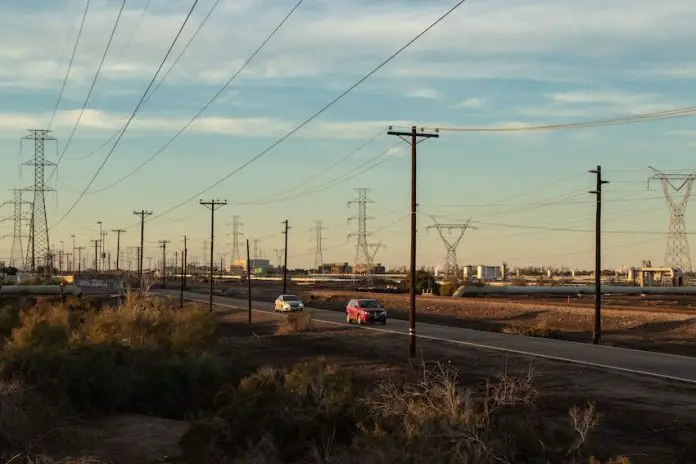
The energy generated at the new plants will also be shared with the rest of the country. (Cuartoscuro)
Mexico’s Federal Electricity Commission (CFE) announced Thursday that it will build five new power plants in the state of Baja California with an investment of US $1.3 billion. All five plants will be built in the city of Mexicali, located near the border with the United States.
The CFE project will connect the northwestern state to the national power grid, and will install power line connections that share the electricity generated in Baja with the rest of the country.
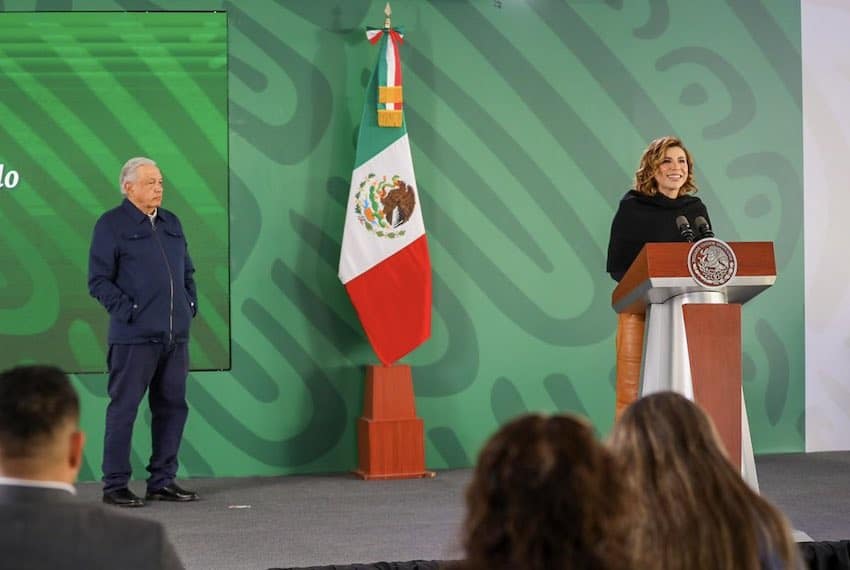
The president visited Baja California on Thursday to announce the project alongside Governor Marina del Pilar and CFE Director Manuel Bartlett. (@MarinadelPilar/X)
President Andrés Manuel López Obrador and CFE Director Manuel Bartlett were in Baja California on Thursday to announce the project alongside Governor Marina del Pilar.
“Mexicali will become a very important center of electricity distribution,” said Bartlett of the project.
Bartlett said three of the five power plants will be combined-cycle operations, another will be an aero-derivative gas turbine and the fifth will be an internal combustion plant.
A combined-cycle power plant uses both a gas and a steam turbine together to produce from the same fuel up to 50% more electricity than a single-cycle plant. The waste heat from the gas turbine is routed to the nearby steam turbine, which generates extra power.
“Each time our president visits Baja California he brings good news … Today’s news is about connecting our state to the national power grid …an unprecedented investment to address our state’s energy demands.”
Baja California’s energy structure is different from the rest of Mexico, as it runs off of an independent electric power grid, separate from the country’s main grid system. Despite significant solar and wind potential, the state continues to rely heavily on the importation of natural gas from the United States.
The construction project will also include a high-tension line that will connect the Mexicali plants with Hermosillo Solar Park, a ground-mounted 21.56MW solar photovoltaic power project that is spread over an area of 50 hectares in the adjoining state of Sonora. This solar park is said to be among the largest solar PV power plants in Latin America.
In January, the president claimed that since his term began in December 2018, his administration has invested nearly US $9.2 billion to build and renovate 35 power stations. These projects now generate 54% of the country’s electricity.
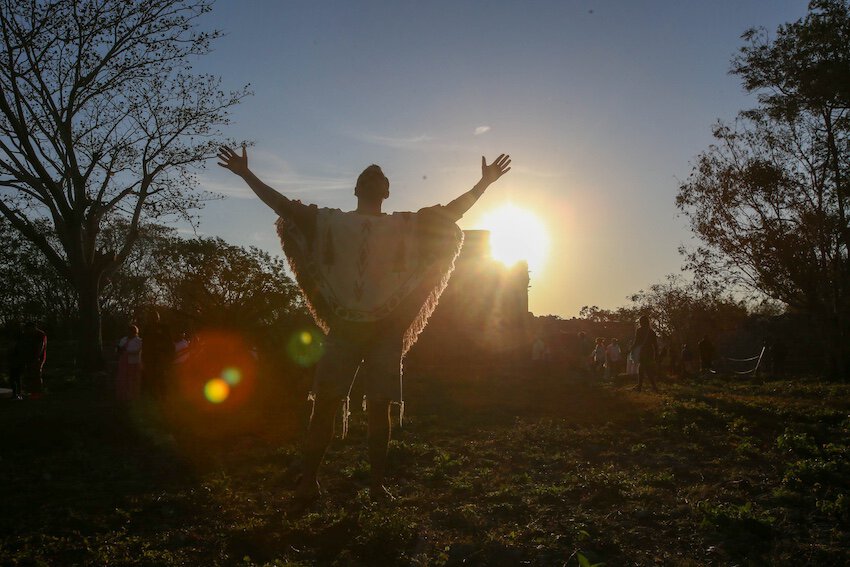
Mexico's ancient ruins - many of them built to mark the equinox - are the perfect place to experience some magic. (Martín Zetina/Cuartoscuro)
In school, we learn that the spring and fall equinoxes mark equal night and daylight hours as well as the official change of seasons. In northern climes, it is a signal that the cold is ending. In Mexico, it is eagerly anticipated more as a sign of the impending rainy season, the defining phenomenon of agriculture here.
Modern technology marks this year’s spring equinox for March 19 at exactly 9:06 p.m. Mexico City time. However, in Mexico’s Mesoamerican archeological sites, the more important celestial event is the sun’s position on March 20 or 21.
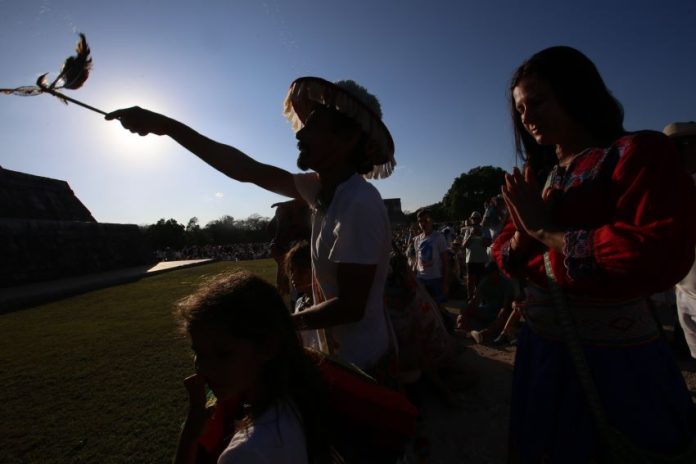
The equinox was observed by many of Mexico’s indigenous cultures, as it marks the arrival of the first rains. (Martín Zetina/Cuartoscuro)
Past and present come together as thousands of people flock to see the sun interact with monumental structures and continue honoring each site’s ancient spiritual significance.
Chichén Itzá
The most famous archaeological site for watching the equinox is Chichén Itzá in Yucatán state, in no small part because of the particular light and shadow show created by El Castillo, the pyramid that stands in the center of the site. The pyramid, built between the 8th and 12th centuries A.D., is itself a gigantic calendar.
Its four sides each have 91 steps, meaning that if we count its crowning platform as a step, the pyramid has 365 steps: one for each day of the year on the Maya Haab’ solar calendar. Each side has 18 terraces, reflecting the number of “uinal,” or 20-day months of the Haab’ — like the ancient Egyptians, the ancient Maya believed that the five leftover days at the end of the year were unlucky, calling them the Wayeb’, or “nameless days.” Each of El Castillo’s facades contains 52 carved panels — the same number of years in the Maya calendar round.
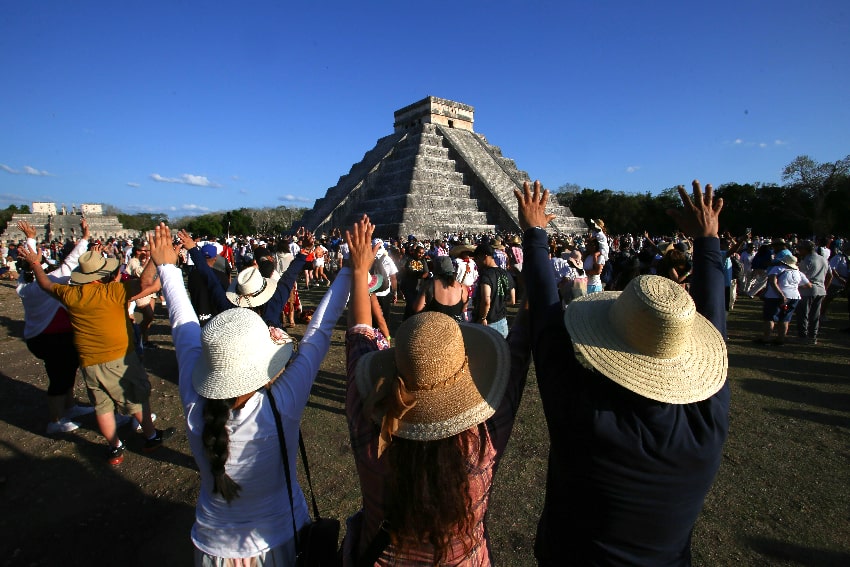
Visitors gather at the Temple of Kukulcán in Chichén Itzá to witness the phenomenon of the spring equinox in 2023. (Martín Zetina/Cuarotscuro.com)
This year at exactly 3:24 p.m. on March 21, a series of triangular shadows will appear on the pyramid’s northwest stairs, and descend towards the serpent head at the base of the structure, creating the shape of a giant snake crawling down the pyramid. This event, called the Descent of Kulkulcan — the Plumed Serpent, a deity found across Mesoamerican cultures — was understood as the arrival of Kukulcan in his role as a fertility god, letting the ancient Itzás know that it was time to prepare the earth for the coming rains.
The public nature of this light show means that many people can gather in the plaza to witness it. In 2023, it drew over 20,000 visitors, a figure anticipated to rise significantly with the inauguration of the Maya Train.
Teotihuacán
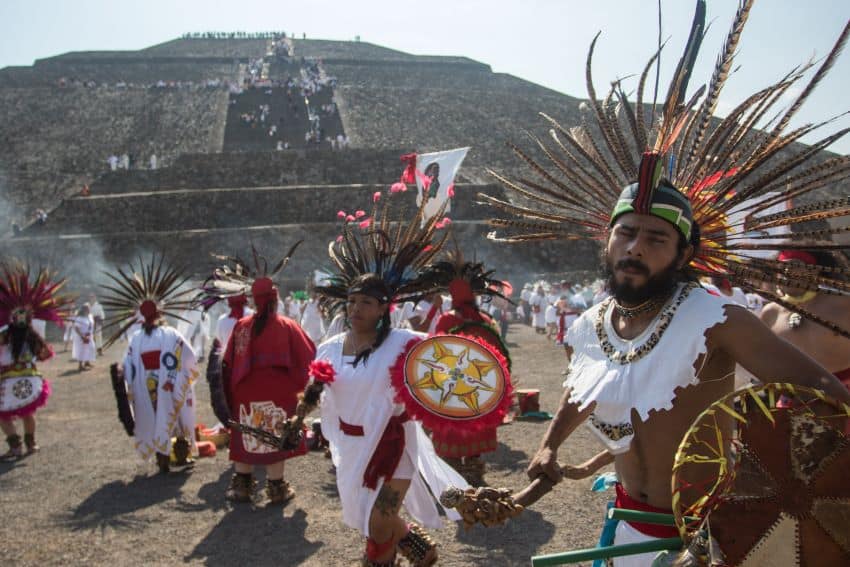
One of the most visited places during the change of season is the Archaeological Zone of Teotihuacan, in Mexico state. (Isaac Esquivel/Cuartoscuro)
In second place is Teotihuacán, both because of its international fame and proximity to Mexico City. As early as the 1960s, observers noted that the light of the spring sun hitting certain buildings created effects that could not be accidental. This was not only confirmed in detail at the site’s Palace of Quetzalpapálotl — or Palace of the Butterflies, for the many butterfly-shaped reliefs that adorn it — but at most Mesoamerican archeological sites since.
Built between A.D. 400 and 600, the palace is a complex structure in which light from the rising equinox sun hits the building’s crenels and casts a stepped shadow that strikes certain red and mica-incrusted figures on the interior west wall as it moves. However, due to the nature of the building, seeing this show live is nearly impossible. For most visitors on this day, the important thing is to be here at dawn to “absorb the energy” marked by the turning of the season, often performing ceremonies dressed in white. In the past, these ceremonies included climbing the pyramids, but that has been prohibited in the past decade or so. This does not discourage thousands of people from being at the site very early in the morning.
Going to either of these sites for the event is a once-in-a-lifetime experience, but be aware that they are very crowded. Going as part of a tour is recommended, not only for the information a guide can provide about what to see, but to make sure practical concerns, like transportation and lunch are taken care of.
Alternative sites
Growing knowledge about Mesoamerican sites means that there are more than two options to be awed by how much Mexico’s ancient cultures understood the workings of heaven and earth.
Recently, magazines like Mexico Desconocido have begun to promote other sites including Monte Albán in Oaxaca and Palenque in Chiapas. Both have noted solar observatories and have long been major cultural attractions.
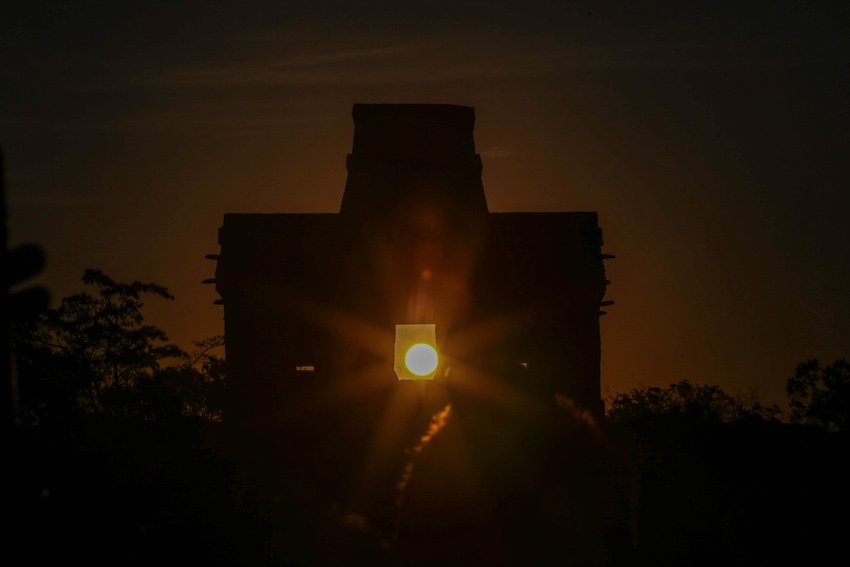
Dzibichaaltún, a Maya archeological site 10 km from Mérida, is another great place to observe the equinox. (Martín Zetina/Cuartoscuro)
In the Mexico City area alone, there are quite a few options other than Teotihuacan. In the city proper, the Templo Mayor in the Zócalo, Cuicuilco, Cerro de la Estrella and the Mixcoac archaeological site, all accessible via public transport, welcome visitors for the event Day trips from the capital include Cholula in Puebla, Tula in Hidalgo and Tenango del Valle in México state.
Other noted archeological sites with equinox activities include El Tajín in Veracruz, Guachimontones in Jalisco, Yagul in Oaxaca, Cañada de la Virgin in Guanajuato, La Quemada in Zacatecas and Tulum in Quintana Roo. These locations are likely to be less crowded but no less awe-inspiring, as each has its own story and local traditions that can come onto full display with dances, special guided tours and ceremonies.
It is important to note that not all of Mexico’s archeological sites open for the equinox. Some smaller ones specifically close due to lack of resources available to handle crowds. This year, the National Institute of Archeology and History (INAH) has expressed particular concern about several sites in Hidalgo state, including Tula, which suffered vandalism in past years. While these might seem to be punitive restrictions, the presence alone of a large number of people at the same time can cause damage to archaeological sites.
But growing interest does present an opportunity for smaller sites. Las Labradas in Sinaloa has begun scheduling special events to draw crowds to the site and educate the public of this northwestern state’s role in the Mesoamerican world with dances, rituals, food, presentations and much more.
Such offerings are growing and if properly managed, are not necessarily a bad thing. The equinox offers the opportunity to see Mesoamerican sites as something more than just static buildings. It can even remind us that the world is not really all that different than it was 1000 years ago.
Leigh Thelmadatter arrived in Mexico over 20 years ago and fell in love with the land and the culture in particular its handcrafts and art. She is the author of Mexican Cartonería: Paper, Paste and Fiesta (Schiffer 2019). Her culture column appears regularly on Mexico News Daily.
In many Mexico City neighborhoods, residents have become accustomed to lining up at delivery points where municipal tankers bring them potable water. (Rogelio Morales/Cuartoscuro)
As if drought and high temperatures weren’t bad enough, Mexico City’s water crisis is being further exacerbated by thieves tapping pipelines, a practice that sees criminals make off with tens of thousands of liters of water that they sell illegally each day.
In January, Mexico City Mayor Martí Batres announced that water distribution would be reduced in 13 of the city’s 16 boroughs, citing the need to conserve supplies.
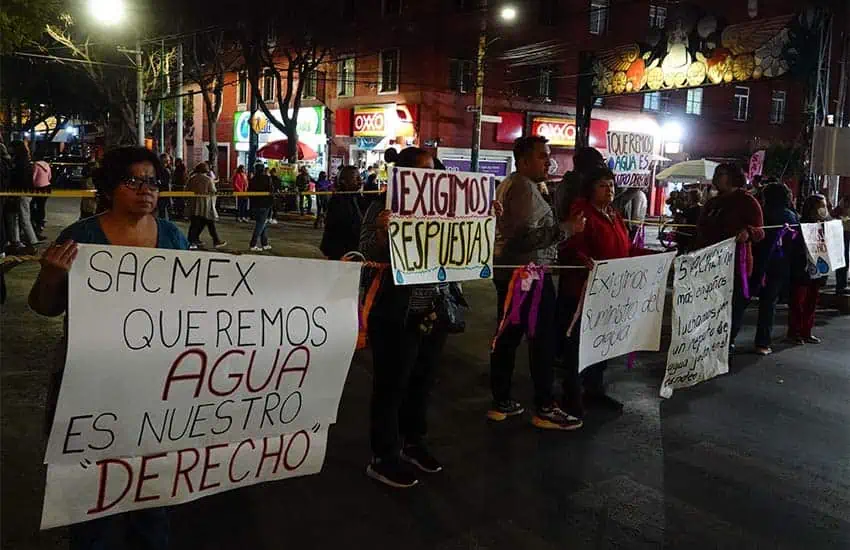
Fed-up residents in the Coyoacan borough taking to the streets in January to demand that the city provide reliable supplies of potable water. There are such demonstrations occurring monthly in the capital. (Rogelio Morales/Cuartoscuro)
Fed up with the faulty water system and angered that they have to get up at dawn to receive the day’s ration of water from delivery trucks, residents in southern Mexico City decided to show their displeasure last week.
On the morning of March 7, about 300 people from the village of San Lorenzo Huipulco in the borough of Tlalpan blocked the avenue leading north into central Mexico City, snarling commuter traffic.
“There are five wells in Huipulco,” Lucy, a protester, told the news outlet Expansión. “It doesn’t make sense that there are five wells underneath us that we as residents don’t have access to but that the water trucks are doing a booming business with.”
While Lucy and her neighbors have to carry water from a truck to their homes, dozens of water tanker trucks, known in Spanish as pipas are illegally siphoning water and selling it or delivering it to other boroughs.
Local officials are not ignorant of the situation. In January, Batres told reporters that putting an end to the practice of stealing water was “a top priority of the Mexico City government.”
It’s easy to see why he’d feel the need to say that: since 2018, the Mexico City water agency (Sacmex), which oversees water distribution in the capital in conjunction with borough governments, has received nearly 1,400 reports of illegal tapping operations. Only 153, however, were confirmed and closed down by officials.
Mexico City Mayor Martí Batres, seen here in January in an unrelated event, has promised that water theft has become the city government’s “top priority.”
The Mexico City Congress is considering legislating stiffer penalties for water theft. A proposed bill would increase fines for domestic theft — installing a connection from city pipes to one’s home — from 10,857 pesos (US $650) to up to 37,000 pesos (US $2,216). Fines for commercial theft — stealing water to sell it clandestinely for profit — would rise from 108,570 pesos (US $6,502) to 290,624 pesos (US $17,405).
Legal authorities are also taking action: an illegal tap on a water pipe in Tlalpan that was siphoning water from an aquifer was shut down by local police and federal Interior Secretary (Segob) agents in January.
Stealing water to sell illegally — known as huachicoleo, a word that more commonly refers to fuel theft — has become more profitable as the capital’s delivery system has become increasingly unreliable. Old, leaky pipes lose up to 40% of their water and the supply is being further depleted by drought, high temperatures and poor management that has caused the extraction rate of the city’s aquifer — which supplies 65% of the city’s water — to surge to 2.5 times the natural recharge rate.
A recent National Autonomous University of Mexico (UNAM) study suggested that an investment of 97 billion pesos (US $5.8 billion) is required for much-needed maintenance on the aging Cutzamala aqueduct system, which supplies about 28% of Mexico City’s water. Another report by a public policy think tank confirmed this month that “severe, extreme and exceptional droughts” were affecting more than 1,600 municipalities around the nation and the densely populated Valley of México is no exception.
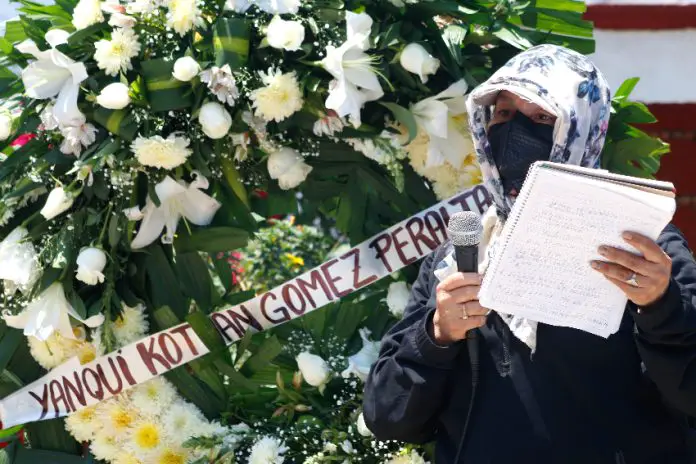
The mother of the 23-year-old student who was killed last Thursday spoke about her son at a memorial event in Chilpancingo, describing him as her "right hand." (Cuartsocuro)
Two of three state police officers allegedly involved in the murder of a student in Chilpancingo, Guerrero, last Thursday are now in custody.
The Guerrero Public Security Ministry (SSP) said Wednesday night that two other officers “involved in the events” had been handed over to the Federal Attorney General’s Office (FGR), which is investigating the death of Gómez, who was a student at the school attended by 43 young men who were abducted and presumably murdered in 2014.
The officers handed themselves into authorities, according to Filiberto Velázquez, a priest and director of a human rights center in Chilpancingo. The SSP said that a search for the third suspect is ongoing.
President Andrés Manuel López Obrador said Monday that Gómez and another student with him at the time of his death “did not shoot” at police — as the SSP said in a statement last week — and therefore “there was an abuse of authority” on the part of officers.
Meanwhile, Guerrero Governor Evelyn Salgado announced Thursday that state Interior Minister Ludwig Marcial Reynoso and Security Minister Rolando Solano Rivera had resigned.
The president told reporters on Monday that there had been an “abuse of authority” in the shooting of Gómez. (Cuartoscuro)
Gómez’s mother and Ayotzinapa students had called for the dismissal of the two men for allegedly fabricating the SSP’s version of events that Gómez and the other student were armed and had drugs in the vehicle in which they were traveling when police shot at them.
Pressure on the two ministers, and the governor, only grew after the police officer vanished on Monday. They have also faced criticism for a recent spike in violence in Guerrero.
Salgado said Thursday that she would ask state Attorney General Sandra Luz Valdovinos to resign.
Valdovinos has been accused of “irresponsibility as a public servant for not calling on the state police officers who abused their power to give evidence,” the El Universal newspaper reported.
A police patrol vehicle was set on fire by protesters in Chilpancingo after the death of the student. (Cuartoscuro)
Gómez’s death occurred a day after Ayotzinapa students used a pickup truck to break open wooden doors at the National Palace while protesting the abduction and presumed murder of the 43 students in 2014.
López Obrador has pledged since the beginning of his government that the case would be resolved before he leaves office, but it appears probable that will not be the case as he now has just 6 1/2 months left in his six-year term.
Almost a decade after the students disappeared no one has been convicted of the crime and the case remains shrouded in mystery, although a government report published last September outlines three “possible reasons” for the abduction of the young men.
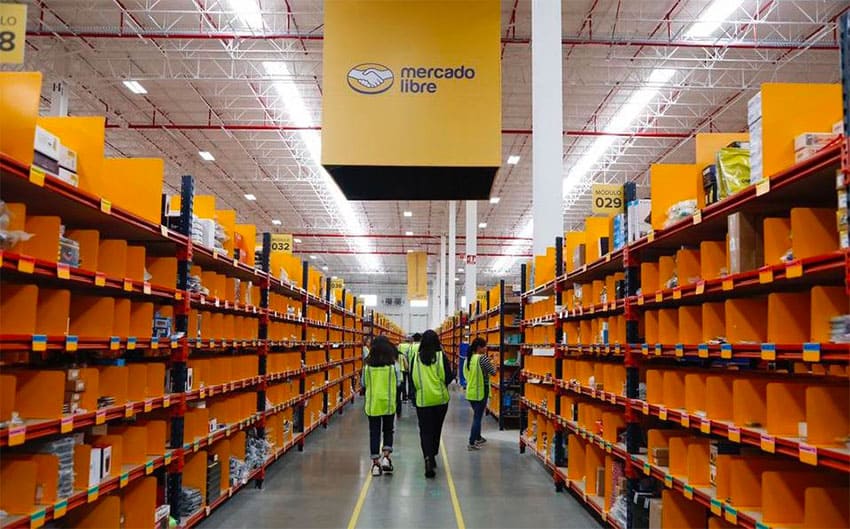
Mercado Libre was founded in Argentina in 1999 and today, Mexico is its second-biggest market. (Mercado Libre México)
Mercado Libre, Latin America’s e-commerce and financial services behemoth, announced plans to invest US $2.45 billion in Mexico this year, its largest-ever expenditure in the country.
David Geisen, director general of Mercado Libre México, said the funds would serve to boost the company’s technical and logistical capabilities while also demonstrating its commitment to Mexico, Mercado Libre’s second-biggest market.
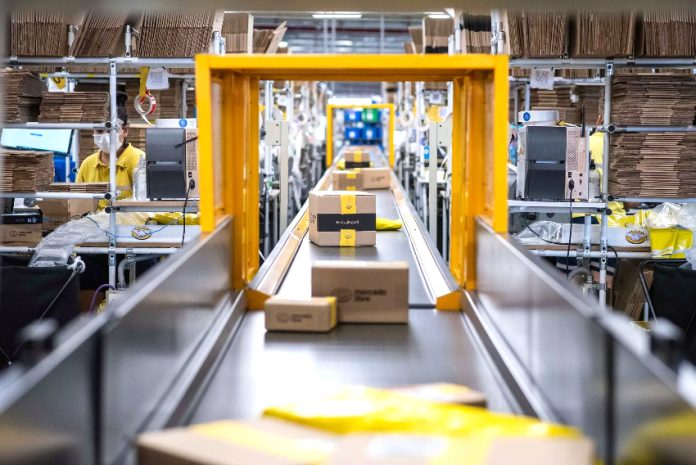
A Mercado Libre distribution center in Tepotzotlán, México state. (Mercado Libre México)
The company, founded in Argentina in 1999, will upgrade its logistics network, develop priority categories, invest in marketing and strengthen its Mercado Pago financial services product application.
“This continues the upward trajectory of our investments in Mexico dating to 2017 when, for the first time, we invested more than US $100 million,” Geisen told reporters at a press conference.
Last year, Mercado Libre invested US $1.6 billion in Mexico, where it has 90 distribution centers as well as a fleet of 900 electric vehicles.
Thursday’s announcement comes on the heels of a banner year for e-commerce in Mexico. Growth in Mexico’s e-commerce sector in 2023 was the highest in the world, according to the Mexican Association of Online Sales (AMVO). E-commerce profits in Mexico soared to 658 billion pesos (US $39.4 billion) last year, up 24.6% over 2022.
The company also saw the number of users soar in 2023, spurred by a rapidly expanding consumer base in Mexico. Mercado Libre reported 144 million active users across all of its platforms last year, a 50% increase over 2022. Total sales last year grew to 1.4 billion units, up 32% over 2022, and the company reported profits of US $1.2 billion in 2023, up 156% over the previous year.
Although Mercado Libre and its rival Amazon are confronting regulators in Mexico who accuse the companies of monopolistic practices, the threat of legal action has not negatively impacted stock listings. Mercado Libre’s stock price closed at US $1,550 on Wednesday and financial analysts project share prices will reach US $1,900 this year.
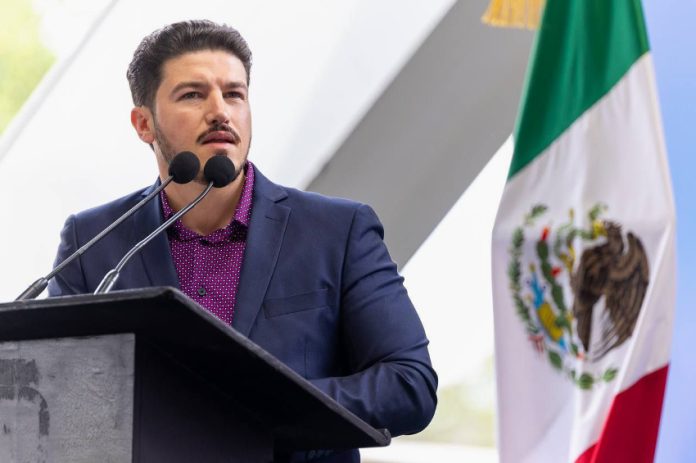
A report in El Norte newspaper revealed payments made by a company affiliated with a government supplier to a law firm owned by the governor. García says the payments were for services rendered in 2017, before he took office as governor. (Samuel García/X)
Nuevo León Governor Samuel García Sepúlveda denied any wrongdoing and declared that his government is “incorruptible” after a Monterrey-based newspaper reported that a law firm owned by the politician and his father received payments of over 200 million pesos from a company affiliated with a favored government supplier.
“I’m very relaxed because I don’t have anything to hide and because I have proof and arguments to refute every false accusation,” García, a representative of the Citizens Movement (MC) party and one of Mexico’s best known political leaders, said in a statement on Wednesday.
“… I hope that next time [the] El Norte [newspaper] asks me for information before drawing up a front page in bad faith, based on false and manipulated information.”
What does the El Norte report say?
El Norte, a sister paper of the Mexico City-based broadsheet Reforma, reported Wednesday that it had obtained a copy of a document from the federal tax administration SAT that showed that a law firm established in 2014 by García and his father Samuel García Mascorro received 202.9 million pesos (US $12.1 million) from a “sister company” of “one of the most favored suppliers” of the current Nuevo León government.
The report, which was also published by Reforma, said that the SAT document shows that between October 2021 — the month García took office — and November 2023 the company Suministro MYR billed the Nuevo León government 964.7 million pesos (US $57.8 million) for its provision of meals to prisons, police training facilities, cafeterias of government department and government events.
El Norte reported that MYR paid its “sister company” Proveedor de Productos Mexicanos Jace — with which it has partners in common — 237.2 million pesos in the same period for “supposed corporate administration services.”
The governor was questioned about the payments during a press conference on Wednesday. (Screen capture)
Jace, meanwhile, paid 202.9 million pesos in professional service fees to García’s law firm, Firma Jurídica y Fiscal Abogados, according to the report. El Norte noted that the exact natures of the services wasn’t specified. The newspaper called the payments by Jace to the governor’s law firm a “triangulation” of resources.
El Norte said that the SAT document indicates that Jace’s payments to the law firm began on Oct. 15, 2021 — 11 days after García was sworn in as governor of Nuevo León. The company made a total of 29 payments to the law firm in 2021, 2022 and 2023, according to the newspaper.
El Norte said that MYR also provided food services to the Nuevo León government when Jaime Rodríguez, García’s predecessor, was governor. The company has been involved in a range of other businesses and didn’t make the provision of meals its main activity until 2022, El Norte said.
The only government supplier that has received more money from García’s administration is Mota-Engil México, which is building new metro lines in Monterrey, the newspaper said.
The contractor building new metro lines in Monterrey has been the biggest recipient of payments from the state government during García’s term. (Samuel García/X)
Based on information to which it had access, El Norte said that Jace became a client of the governor’s law firm in 2021. “There are no previous records of operations or transactions between the company and the [law] firm,” it reported.
García’s response in detail
The governor and erstwhile 2024 presidential hopeful rejected the basis of El Norte’s report at a press conference on Wednesday morning. He subsequently released a statement based on his remarks.
“My government is incorruptible and I am as well,” the statement began.
In the first of three numbered points, García said that MYR has been a Nuevo León government supplier since January 2016 when the government led by Rodríguez was in office.
Contradicting El Norte’s claim, he said that Jace has been a client of his law firm since October 2017, four years before he became governor. “I wasn’t even a senator at that time,” García added.
At his press conference, the governor said that his law firm signed an agreement with Jace to provide it with legal services associated with an audit. That audit, El Norte reported, resulted in the company receiving a 196-million-peso tax credit.
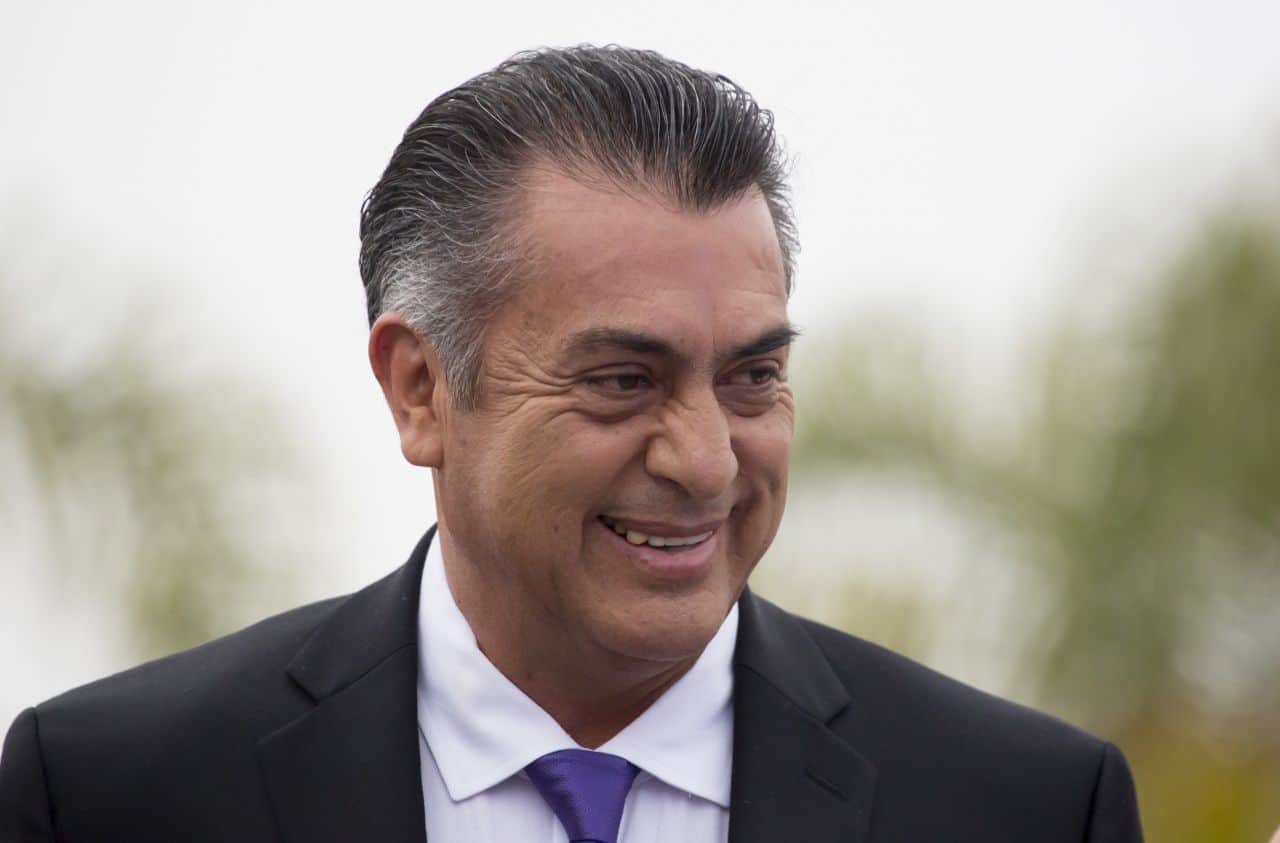
One of the companies in question has been supplying the government since the administration of García’s predecessor, Jaime “El Bronco” Rodríguez. (Cuartoscuro)
García said that the payments the law firm received from Jace were for services rendered starting in 2017, but didn’t explain why the company only settled its bill after he took office as governor in October 2021.
El Norte and Reforma reiterated on Thursday that “available information from SAT indicates that between 2017 and September 2021 there was no invoicing between Jace and Firma Jurídica y Fiscal Abogados.”
García said in his statement that the tax credit granted to Jace was “nullified” by a court in September 2022 and that another court upheld that ruling in January 2024.
“The origin of this article is a montage,” he said, asserting that it was based on information leaked by the Nuevo León Attorney General’s Office [FNL], which he derided as being “managed by the old politics,” i.e. parties that previously held power in the northern state, namely the Institutional Revolutionary Party (PRI) and the National Action Party (PAN).
Since January, the FNL “has been investigating my family’s companies as a means to pressure, extort and defame us during this electoral process,” said the governor.
García’s term as governor doesn’t end until 2027, but his wife Mariana Rodríguez will represent MC at the June 2 mayoral election in Monterrey, and voters will elect new Nuevo León lawmakers on the same date.
García’s wife Mariana Rodríguez is running for mayor of Monterrey. (Cuartoscuro)
The governor predicted that “more attacks like this” will occur “for a simple reason: … [we’re in] electoral times and that’s the way the old politics operates.”
Another reason for future attacks, he said, will be that “the government has thousands of suppliers and the [law] firm that my father founded has a lot of clients because for years it has been one of the best in Nuevo León.”
In addition to saying he had “nothing to hide” and “proof and arguments to refute every false accusation,” García asserted that he “built” his personal wealth “working hard and a lot before entering politics.”
The El Financiero newspaper reported that García declared annual income of 4.23 million pesos (US $253,750) in 2022, of which 1.13 million pesos came from his salary as governor. The newspaper said that he is a partner of at least 11 companies, including the law firm he established with his father.
Xóchitl Gálvez, presidential candidate for an opposition alliance made up of the PRI, the PAN and the Democratic Revolution Party, was one of several politicians who called for García to be investigated in light of the information disclosed by El Norte.
India's Hinduja Tech helps auto industry clients lower costs by moving engineering and R&D functions closer to where they’re already doing their manufacturing. (Hinduja Tech)
In many ways, the automotive industry is the poster child for Mexico’s evolution as a manufacturing powerhouse. What was once a “Saturday Night Live” skit that I wrote about hereis now a significant contributor to national GDP and a major source of jobs. The industry employs hundreds of thousands of people throughout the country and continues to take in significant foreign investment as the nearshoring boom gains momentum.
We at Mexico News Daily frequently write about the automotive industry, given its outsized importance, and are following two emerging trends that could accelerate not only the quantity but also the quality of jobs throughout the country.
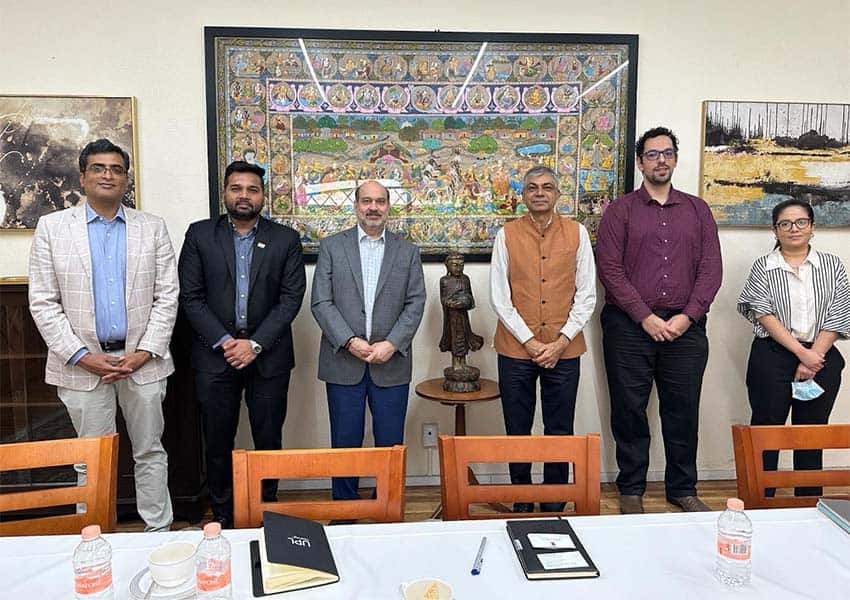
Hinduja Tech has been in Mexico for five years with a staff made up of both Indians and Mexicans. It says it plans to keep expanding staff and revenue in Mexico by 25% per year for the foreseeable future. Here company representatives are seen with India’s Ambassador to Mexico, Pankaj Sharma (fourth from the left). (Hinduja Tech)
The first trend is that of electric vehicle (EV) manufacturing, led by companies like Tesla, Volkswagen, Audi, BMW, as well as by several Chinese companies.
The second is the relocalization of not only these foreign companies’ manufacturing processes to Mexico but also increasingly large parts of their engineering and R&D departments. This trend means more well-paid professional engineering jobs being created in Mexico.
Enter Hinduja Tech, an India-based company focused on integrated product engineering and digital solutions for the vehicle industry. Hinduja Tech helps its business clients move engineering and R&D functions closer to where they’re already doing their manufacturing, to lower costs and improve product development speed.
Hinduja is currently on a hiring spree, seeking 100 mechanical and electrical engineers throughout Mexico to help its customers localize engineering capabilities.
I recently spoke with Vijay Malik, the company’s president of marketing and international sales to discuss Hinduja’s journey to Mexico.
After taking five years to hire its first 100 engineers in Mexico, Hinduja Tech is now looking to double that number this year alone. The company is confident it can grow both its personnel and revenue in Mexico by at least 25% per year going forward, Malik says, and he sees huge potential for growth given the acceleration of EV manufacturing moving to Mexico.
Vijay Malik, president of marketing and international sales, says his company believes that 70% of its engineering work can be done in Mexico and the other 30% remotely with experts from India. (Hinduja Tech)
Having witnessed the power of localization and outsourcing of its customers’ engineering in India, the company now sees Mexico as “the new India” to follow that trend.
Hinduja Tech’s model aims to have approximately 70% of engineering work done in Mexico and the other 30% done remotely with specialized experts from India.
Imagine a Hinduja Tech Mexican engineer working in a Japanese, American, or European automobile plant in Mexico, collaborating with colleagues in India — a fascinating mix of globalization and regionalization.
Mexico has already demonstrated that it has the skilled labor force to make auto parts and assemble vehicles in huge quantities.
This new opportunity is to “move up the food chain” by providing higher-level, value-added services — in this case, engineering work — to capture more high-skill jobs in Mexico.
These are higher-paid, less labor-intensive jobs — ones that require a college degree and pay middle- and upper-middle-class salaries. These are exactly the jobs that Mexico needs to develop to improve standards of living.
The country is already making strides: while just a few years ago, few women graduated from Mexico’s university-level mechanical and electrical engineering programs, Hindjua Tech’s Mexico-based engineering team is currently made up of over 10% women; and the company expects that percentage to grow. Its human resources team is made up entirely of women, and the Mexico leadership team is 100% local talent.
We at MND are closely following how companies from around the world are investing in Mexico — increasingly in the tech and engineering sectors — and Hinduja Tech is an interesting example of a company doing just that.
Travis Bembenek is the CEO of Mexico News Daily and has been living, working or playing in Mexico for over 27 years.
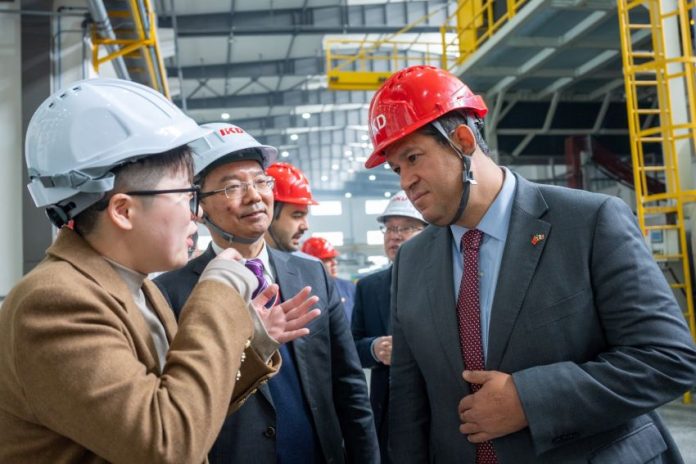
Governor Sinhué meets with representatives of Chinese auto parts manufacturer IKD. (Diego Sinhue Rodríguez Vallejo/X)
As Mexico continues to grow as a hotspot for nearshoring by manufacturers, some Mexican politicians have gone on tour to attract investment to their states. This week, Guanajuato Governor Diego Sinhue Rodríguez visited Asia and announced some significant investments planned for the Bajío state.
NTT Data
“We’ve started our business trip in Japan with some great news for Guanajuato,” Governor Rodríguez shared on the X social media platform. “The global technology leader NTT Data has chosen León, Guanajuato, to expand its operations.”
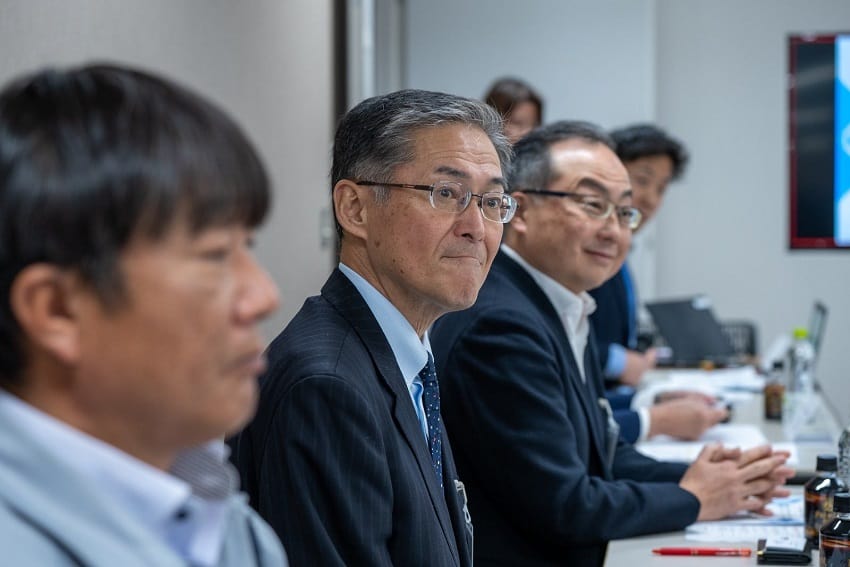
Governor Rodríguez at a meeting at NTT headquarters in Japan. (Diego Sinhue Rodríguez Vallejo/X)
NTT Data is a multinational technology consulting and services company based in Tokyo, Japan, with operations in over 50 countries. The company already operates in León.
While neither the government nor the company shared details about the amount of the investment, it will reportedly focus on creating specialized tools for the telecommunications, banking and insurance sectors in the state, creating some 500 jobs for engineers specialized in technological development.
Nippon Steel Trading
Governor Rodríguez alsoconfirmed on his X account that Nippon Steel Trading will invest US $71 million in a factory in Apaseo el Grande, Guanajuato that is already under construction.
According to a company statement, “the factory will become a crucial supply base for meeting the increasing demand for electric vehicles in North America.” It will specialize in processing and selling electrical steel sheets.
The new plant aims to achieve an annual production of 120,000 tons of steel and is expected to create 200 direct jobs. It will start operations in April 2025.
Nippon Steel Corporation is Japan’s largest steel manufacturer and one of the world’s leading steel producers, with operations in 15 countries. In December, it announced an agreement to buy American-owned US Steel for US $14.9 billion. On Wednesday, however, Reuters reported that U.S. President Joe Biden will express concerns about the planned buyout, which is projected to be finalized in the second or third quarter of this year.
Nippon Steel executives at a March 7 meeting with Governor Rodríguez. (Diego Sinhue Rodríguez Vallejo/X)
IKD
The Chinese automotive aluminum parts casting supplier IKD will invest US $178.2 million in Guanajuato, creating some 1,000 jobs, according to Rodríguez.
IKD produces and sells high-precision aluminum alloy castings for automobiles, including for electric vehicles (EVs). Neither the company nor the Guanajuato government has provided any additional information regarding how the investment will be utilized.
However, according to the news site Cluster Industrial, the investment will likely be allocated to the construction of a new plant, based on reports that a 30,000-square-meter space is currently being built next to the existing IKD México plant in Irapuato.
Yusei Holdings
Yusei Holdings, a Japanese company that specializes in plastic injection for the automotive industry, is another that announced an investment in Guanajuato. The company says it will build a US $84 million plant —though the location is not yet confirmed — and Rodríguez said it will create 500 jobs in the state.
The company started operations in Querétaro in 2019, and some of its main clients include Toyota, Volkswagen, Ford, Nissan, Honda, Mercedes Benz, Buick, Audi, BMW, Tesla and Volvo.
Globally, Yusei Holdings also manufactures and trades molds and plastic components, offering assembly and processing services.
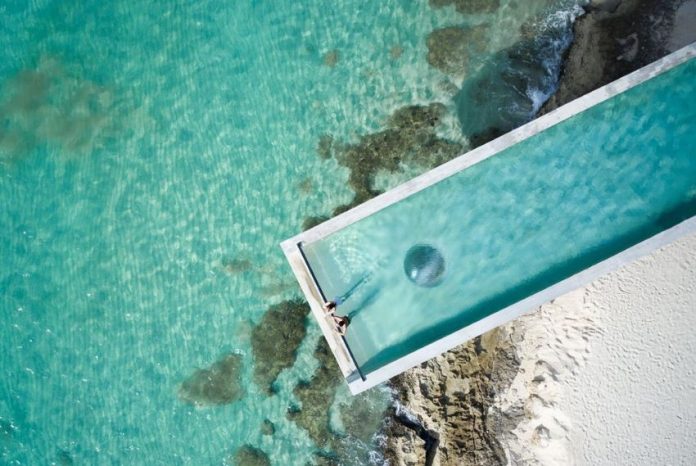
Where are Mexico's best swimming pools, and what do they look like? We've compiled a handy guide to the most Instagrammable swims in the country. (Casa de la Playa)
There is no combination better than Mexico and swimming pools, as the diverse landscapes and pleasant weather allow you to enjoy incredible views from the comfort of the water. The country’s extensive beaches, spanning 11,122 kilometers, make relaxing in the pool an integral part of Mexico’s tourist offerings.
Recently, the variety of accommodation choices in the country has increased as platforms like Airbnb have expanded tourist options beyond traditional hotel accommodation — and many of these homes also come with their own (incredible) private pools.
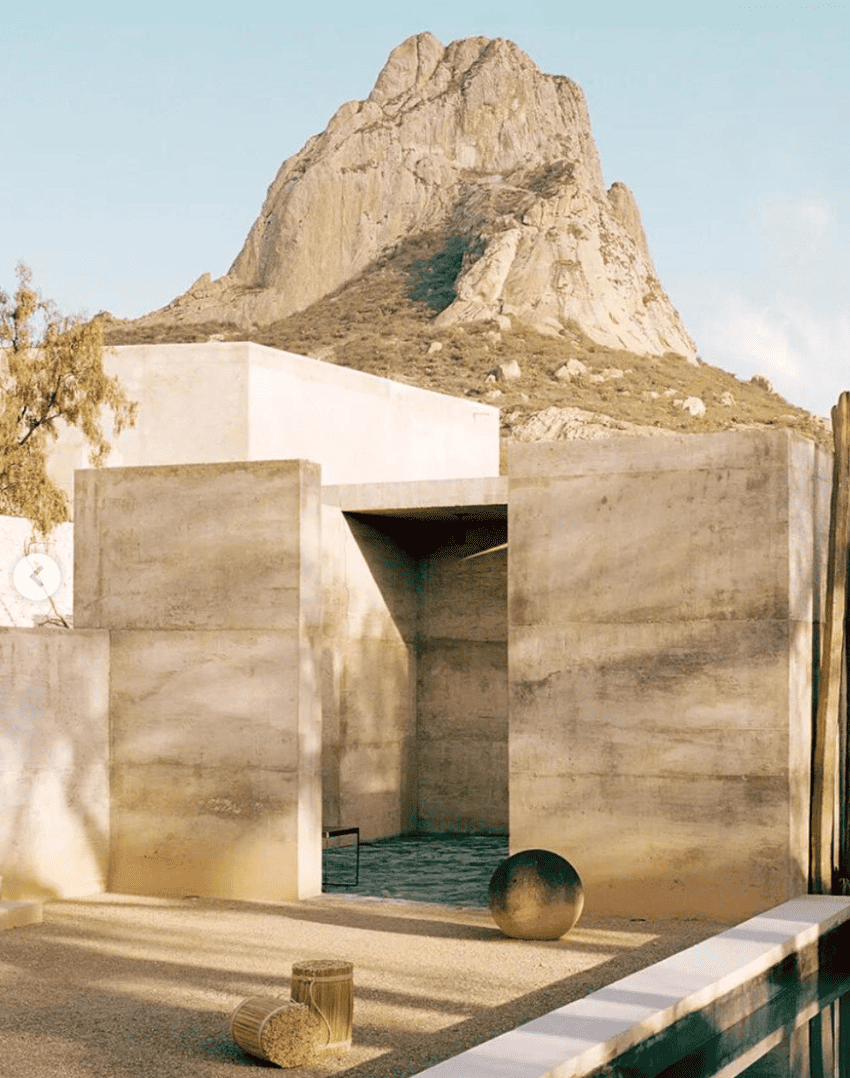
View of the famous Peña de Bernal from the pool of the Casa Bernal. (@tomdepeyret/Casita MX)
Today, we present a curated collection of unique and stunning swimming spots throughout this country. From the desert mountains of Baja California Sur to the breathtaking Caribbean coast, prepare to discover some of the finest pools Mexico has to offer.
Querétaro
This amazing pool is a work of art. The visual harmony between the walls, the reflective surface that mirrors the water and the cactus, creates a surreal and dreamy ambiance. The space is situated within the brutalist architecture of Casa Bernal, located in the town of Peña de Bernal, Querétaro, known for the captivating view of the unique rock formation that defines that area.
The private home was built for Mexican architect Emmanuel Picault and his studio, Chic by Accident, a project that also serves as a gallery of antiques and contemporary design. The mix of talents within this project is reflected in the uniqueness of the pool; from every angle and every point you stand, you experience a different visual composition.
Puerto Escondido
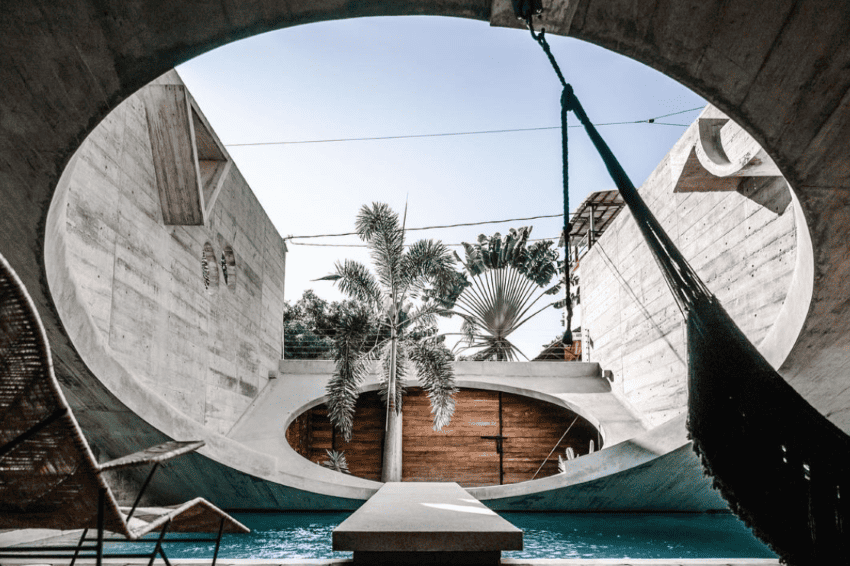
Futurism and dreaminess abounds at Casa Hezbo. (Casa Hezbo/Instagram)
Previously on Mexico News Daily, the exquisite Casa TO was featured in our compilation of the best brutalist buildings in the country. Located in Puerto Escondido, Oaxaca, this house is a creation of the renowned architect Ludwig Godefroy. Twin projects Casa VO and Casa Hezbo make it onto this list thanks to their remarkable pools, which evoke a futuristic experience akin to another world. The visual effects achieved by this architect are truly special.
Perhaps the most memorable of the dreamy spaces created by Godefroy in Puerto Escondido, the water serves as the center of the composition, resembling a tunnel of reality and a painting that foretells the future. Godefroy, a Mexican architect renowned for his brutalist style integrated with nature, established his studio, Ludwig Godefroy Architecture, in 2011.
Playa del Carmen
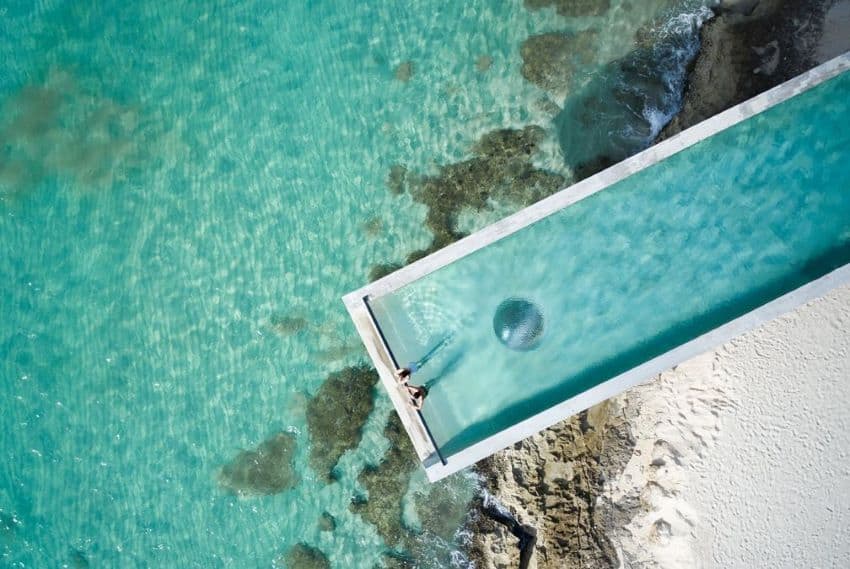
One of Mexico’s most photographed pools, Casa de la Playa offers a swim unlike any other. (Casa de la Playa)
La Casa de la Playa showcases a charming style that culminates in one of the most photographed pools in Mexico. The cantilevered pool is a favorite Instagram spot for a reason – it evokes a floating bridge which seamlessly blends with the Caribbean waters. Moreover, each of the 63 hotel suites at La Casa de la Playa include a balcony-style floating pool, further enhancing the appeal of the property. A transparent pool suspended between two buildings elevates the swimming experience to an entirely new level of amazement.
Created by architect David Quintana, La Casa de la Playa is highly exclusive and adults only. One of its notable characteristics is the visual impact of each of its views, which are all an awesome experience in their own right.
Baja California Sur
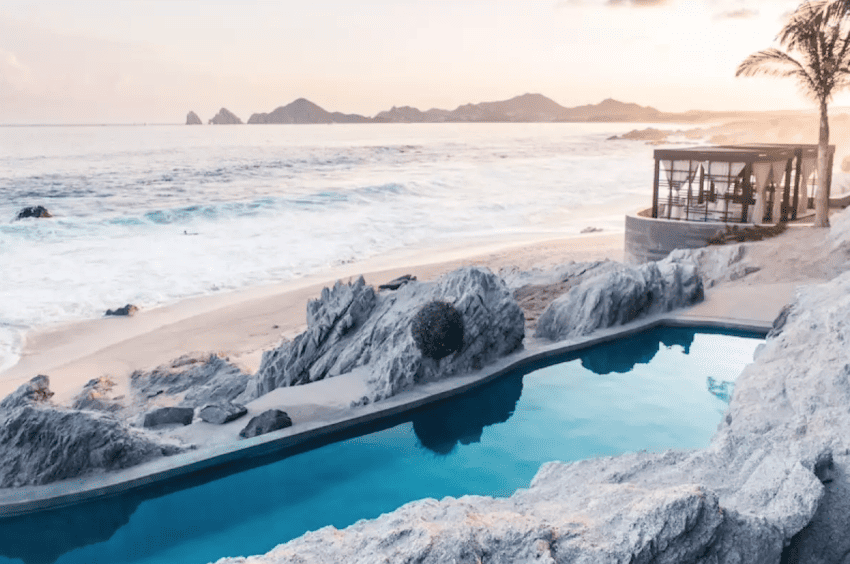
Swim among rocks and salt water in Los Cabos. (The Cape, A Thompson Hotel)
In Todos Santos, a quiet location named “Paradero” harmoniously blends the extraordinary beauty of the desert mountains. The serene pool water creates an infinite effect that sparkles within the unpredictable landscape. Moving on to Baja California Sur, we would also like to highlight the stunning pool in Los Cabos, fed with salt water and nestled among natural rocks at The Cape, A Thompson Hotel.
Paradero Todos Santos was designed by architects Yashar Yektajo and Rubén Valdez. As they explain on their website, this remarkable building was inspired by the desert: “In this project, we aimed to emphasize the dynamic natural movement of the desert, exploring and highlighting the topography shaped by its winds and elements that contribute to its sensory appeal,” the team explained to Arch Daily.
The design of The Cape was a collaborative effort involving Mexican architect Javier Sánchez of JSa Arquitectura, Marisabel Gómez Vázquez of the interior design firm Arquitectura de Interiores, ceramicist Jose Noé Suro.
Oaxaca
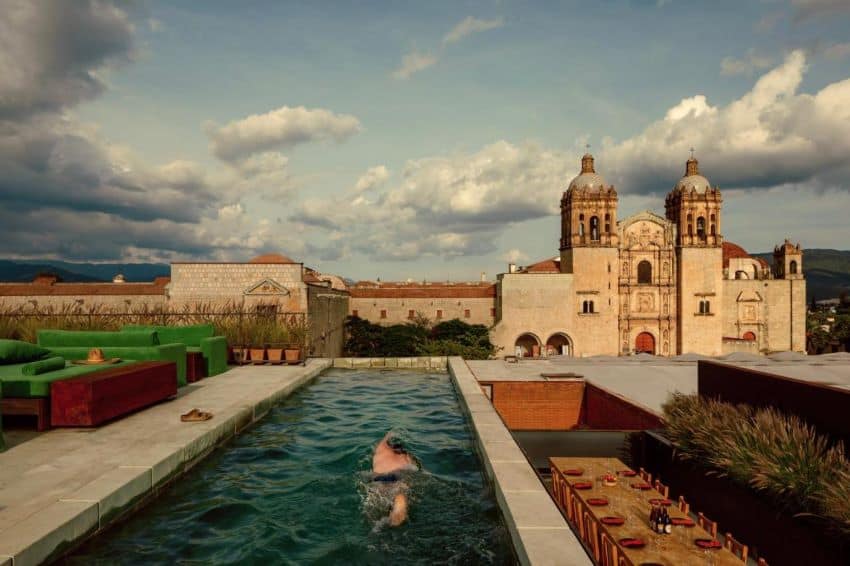
The heart of Oaxaca’s historic center and the comfort of a pool, does life get any better? (Otro Oaxaca)
Offering one of the most iconic and breathtaking views in Oaxaca City, Otro Oaxaca is a design hotel with a rooftop pool that is truly inspiring. From this vantage point, you can admire the towers of the Templo de Santo Domingo de Guzmán, a UNESCO World Heritage Site, as well as the entirety of the historic center of Oaxaca.
The design of this pool (and building) was overseen by João Boto Caeiro of ROOTSTUDIO, while the interior design was handled by Carlos Couturier of Grupo Habita. The building drew inspiration from Mitla, an ancient Zapotec archaeological site situated 40 kilometers from the city of Oaxaca. The ground floor of the building has a spa featuring a 7-meter diameter pool with a brick dome that creates the effect of natural light streaming into the center, reminiscent of the cenotes found across the southern region of Mexico.
CDMX
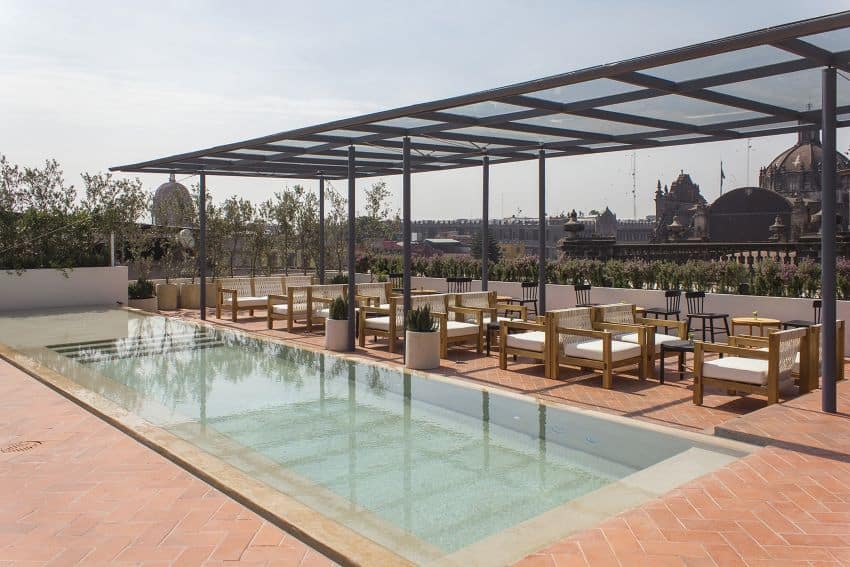
With the Metropolitan Cathedral and Zócalo in full view, this city center pool offers relaxation like no other. (Círculo Mexicano)
Situated on the rooftop of the design hotel Círculo Mexicano, this pool offers a panoramic view of downtown Mexico City. From the water, you can gaze upon the iconic towers of the Catedral Metropolitana, the oldest Baroque building in Latin America, as well as other iconic buildings like the Torre Latinoamericana. Additionally, this location holds significance as the birthplace and childhood home of Manuel Álvarez Bravo, the famed Mexican photographer, adding an extra layer of magic to the experience.
The building was designed by Ambrosi | Etchegaray, and the interior was a collaboration between La Metropolitana and Carlos Couturier. According to their website, “The idea was to reimagine a 19th-century residential building, envisioning the ground floor as a modern marketplace.”
San Miguel de Allende
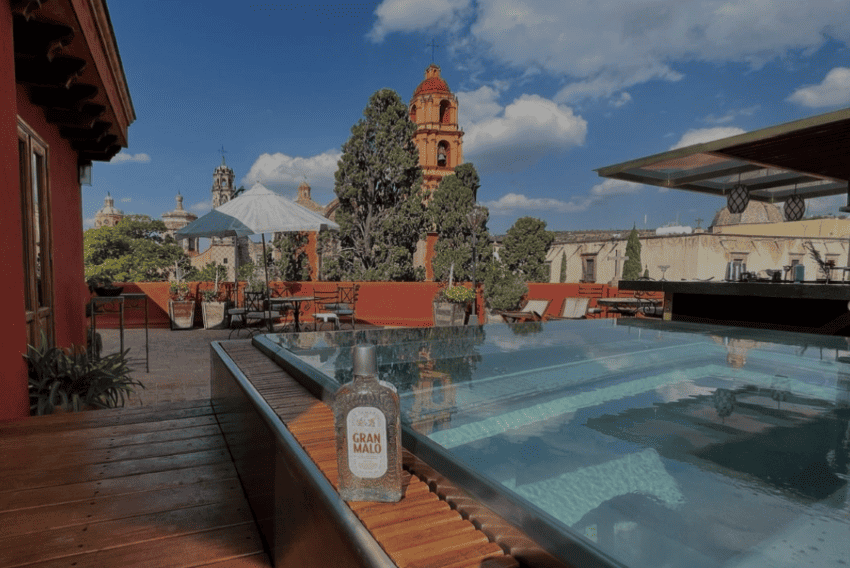
Its transparent pool is another spectacle in the interior of this building. (Casa Oratorio/Instagram)
The Hotel Oratorio provides a delightful view of the towers in San Miguel de Allende, complemented by the serenity of its pool. It is truly a pleasure to behold the iconic sights, including the towers of the Parroquia de San Miguel Arcángel and other classic buildings in San Miguel de Allende. Additionally, this pool offers a unique feature as it is transparent and serves as a visible ceiling inside the building; while at the same time, the swimmer can see down intothe hotel.
On the rooftop, you will also find comfortable loungers, where you can relax and enjoy the view while savoring a drink from their bar and food service.
Punta Mita, Nayarit
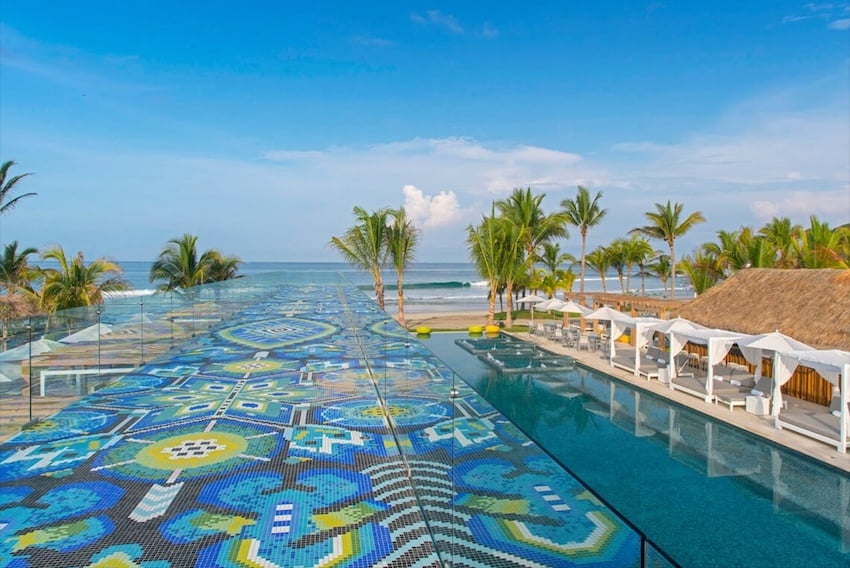
The W Punta de Mita pool is designed to incorporate traditional Wixárika art. (All Inclusive Outlet)
Undoubtedly, the tiles of this pool make it truly unique, as the pattern they create pays homage to traditional Wixárika design. The Huichol tribe, also known as the Wixárika, are a prominent indigenous group, renowned for their art, which is inspired by visions induced by peyote. This remarkable pool is located at Hotel W Punta de Mita, just a short drive from Puerto Vallarta. What sets it apart is that the pool extends inside the hotel, seamlessly crossing through the bar and other significant areas of the property.
Another special feature of this pool is that it is supported by columns, creating the illusion of a floating pool and a sense of infinity when you are at the pool’s edge. The project was developed by ASET / AOMA in collaboration with the Oakland-based design firm Mister Important Design and the award-winning design studio Starwood.
Have we missed your vote for Mexico’s best pool? Have you been lucky enough to swim in any of these amazing spots? Let us know in the comments.
Ana Paula de la Torre is a Mexican journalist and collaborator for various outlets including Milenio, Animal Político, Vice, Newsweek en Español, Televisa and Mexico News Daily.
Saúl "Canelo" Álvarez weighs in, in May 2023. (Cuartoscuro)
Mexican super middleweight Saúl “Canelo” Álvarez will be returning to the boxing ring on Cinco de Mayo weekend to defend his undisputed world title against countryman Jaime Munguía — the first time Álvarez will have fought a Mexican boxer in nearly seven years.
Organizers of the May 4 bout at the T-Mobile Arena in Las Vegas announced the fight on Tuesday.
The match was made official this week. (Saúl Canelo Álvarez/X)
Álvarez, who fought exclusively in Mexico from his 2005 debut until his first bout in the U.S. five years later, has come under fire in recent years for saying he didn’t want to fight Mexicans.
The Guadalajara native’s last Mexican opponent was Julio César Chávez Jr. in 2017, and only three of his 34 fights since 2011 have been against Mexican-born boxers. He even told the TV Azteca network in February that his May 4 opponent would be “an American.”
The bout was only decided upon after a long period of drama and negotiation over who that opponent would be — with more twists and turns than a telenovela.
Álvarez has a 60-2-2 record with 39 knockouts following his latest fight in September, when he made easy work of Jermell Charlo. The 168-pounder currently possesses all four super middleweight championship belts: from the World Boxing Council (WBC), the World Boxing Association (WBA), the International Boxing Federation (IBF) and the World Boxing Organization (WBO).
Canelo and Charlo in their September face-off. (Canelo Álvarez/Instagram)
The scheduled fight falls two months before Álvarez’s 34th birthday, with retirement seemingly looming.
Munguía is a 27-year-old from Tijuana with a career record of 43-0, including 34 wins by knockout. Having improved under Hall of Fame trainer Freddie Roach, he is coming off a career-best win — a ninth-round technical knockout (TKO) in January of now-retired British boxer John Ryder.
Munguía is rated No. 4 by ESPN at 168 pounds; Álvarez is No. 1 at that weight and is also ESPN’s No. 4 pound-for-pound boxer.
Álvarez also plans to fight on Mexico’s Independence Day weekend in September, ESPN reported.
Many boxing fans were hoping the May 4 opponent would be David Benavídez, the WBC’s mandatory super middleweight challenger. The Phoenix native has a Mexican father and is nicknamed “El Bandera Roja” (the Red Flag) and “The Mexican Monster.”
But Benavídez (28-0, 24 by KO) is six years younger and four inches taller than Álvarez, with a 10-centimeter longer reach and just as powerfully built. Citing these factors, some have accused Álvarez of ducking Benavídez.
However, Álvarez denied such claims, telling TalkSport’s Michael Benson, “Look at my history, I’ve done everything in boxing. I’ve done it all.”
Amazon Prime and DAZN have secured pay-per-view rights for the upcoming bout, which will be shown for free in Mexico.