Home Blog Page 8

MND Local: Scorpion stings surge across Puerto Vallarta

3
A black scorpion sitting on a rock
Check your shoes before you put them on, especially if you live in Puerto Vallarta. (Wolfgang Hasselmann/Unsplash)

The last thing anyone wants is to be stung by a scorpion, which can result in symptoms that range from mild pain to severe, life-threatening reactions. But according to Mexican officials, scorpion stings have increasingly been reported in Puerto Vallarta in recent months.

Scorpion stings on the rise

Health authorities across the Bay of Banderas region are warning residents to take extra precautions after a sharp spike in scorpion sting incidents during the hotter weeks of spring. Officials say more than 2,000 cases have already been reported this season, with rising nighttime temperatures and dry conditions pushing scorpions into homes, storage areas, gardens and shaded urban spaces.

A hand holding a large scorpion
If something this big stings you, it’s going to leave a mark and maybe even require medical attention. (Sippakorn Yamkasikon/Unsplash)

Medical workers say the majority of incidents involve people being stung inside residences, often after scorpions hide in shoes, towels, bedding or clothing. While most stings are treatable, young children and elderly residents remain the most vulnerable to severe reactions. Clinics and hospitals throughout the region have reportedly increased supplies of antivenom and emergency treatments as temperatures continue climbing toward summer highs.

Public health departments are encouraging residents to shake out clothing and footwear before use, seal cracks in walls and floors and reduce piles of debris or wood around homes where scorpions may shelter. Pest control services have also seen a seasonal increase in demand.

The situation is especially concerning in rapidly growing neighborhoods on the outskirts of Puerto Vallarta, where construction and land clearing can disturb natural habitats and drive wildlife closer to populated areas.

Officials expect sting reports to remain elevated through the rainy season, when humidity and heat typically increase insect and arachnid activity throughout the coastal region.

Environmental closures aim to protect rare turtle habitat

turtle nestlings making their way to the sea
The endangered turtle population in Puerto Vallarta is facing increasing pressure due to urban expansion. (Campamento Mayto/Instagram)

Federal environmental authorities have ordered temporary closures and restrictions to protect the habitat of the endangered tortuga casquito, a freshwater turtle species found only in limited areas of Jalisco and Nayarit. The action comes after inspectors discovered land clearing, vegetation removal and unauthorized activity affecting approximately 5.37 hectares of sensitive habitat used for nesting and reproduction.

According to environmental officials, the affected zones included areas of low jungle vegetation and wetlands across Bahia de Banderas that are critical to the survival of the species, scientifically known as Kinosternon vogti. Inspectors also identified illegal dumping, construction-related debris and brickmaking operations operating within protected sections of the habitat.

Profepa, Mexico’s federal environmental enforcement agency, ordered temporary shutdowns of the activities while investigations continue. Community environmental groups working in the area have welcomed the move, saying the turtle population faces growing pressure from urban expansion, industrial activity and habitat fragmentation throughout the bay region.

The tortuga casquito is considered highly vulnerable because of its extremely limited geographic range. Conservation organizations say preserving wetlands and seasonal freshwater systems is essential to preventing further population decline. Environmental volunteers have additionally helped authorities remove dozens of illegal traps discovered within turtle nesting areas.

The closures also highlight broader tensions developing throughout Bahía de Banderas, where tourism growth and luxury development projects increasingly intersect with environmentally sensitive land. Conservation advocates argue that stronger enforcement will be needed as construction continues expanding along both the Jalisco and Nayarit coasts.

Puerto Vallarta updates Risk Atlas ahead of rainy season
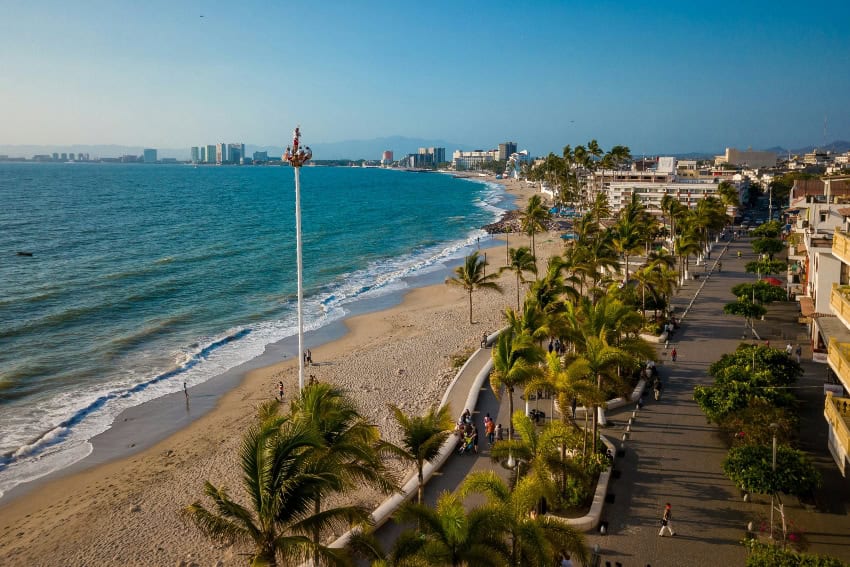
Puerto Vallarta
Puerto Vallarta officials are bracing for potential flooding and landslides during the rainy season. (Unsplash/Miguel Naranjo)

Puerto Vallarta officials are preparing for the arrival of the rainy season with continued updates to the city’s official Risk Atlas, a planning tool used to identify flood-prone zones, landslide risks, infrastructure vulnerabilities and emergency response priorities. Civil Protection authorities say the document is being constantly revised to reflect the region’s rapid urban growth and changing environmental conditions.

The updated atlas is expected to help emergency services coordinate responses more efficiently during storms and tropical weather events that commonly affect the Pacific coast between June and October. Officials say newer data is being incorporated to better track drainage limitations, hillside development, vulnerable roadways and densely populated neighborhoods that may face flooding or evacuation risks.

Meteorologists are also monitoring the first potential heavy rain systems of the season, with forecasters warning that early tropical activity could arrive within the coming weeks. While no major storm threats have yet been confirmed for the bay, authorities are encouraging residents to begin seasonal preparations early, including clearing drains, checking emergency supplies and reviewing evacuation routes in flood-prone areas.

Local officials say the Risk Atlas has become increasingly important as Puerto Vallarta continues expanding into hillsides and previously undeveloped zones. Urban growth, combined with aging infrastructure in some districts, has increased concern about drainage capacity during periods of intense rainfall.

Emergency planners believe updated mapping and risk analysis will improve coordination between municipal departments and help reduce disruptions during what could become another active rainy season for the region.

Growth pressures raise concerns over water access and infrastructure

Men working on a construction site
Rapid development is transforming communities in the Bay of Banderas region, including Puerto Vallarta. (Ryan Donner)

Puerto Vallarta and neighboring communities in Bahía de Banderas continue facing growing pressure on public infrastructure as rapid development transforms the region.

Residents and neighborhood groups are increasingly voicing concern over water shortages and declining service reliability, particularly in areas experiencing heavy residential expansion and new tourism-related construction.

Much of the frustration centers around the perception that water resources are being prioritized for large condominium towers, hotel projects and luxury developments while long-established residential neighborhoods experience reduced water pressure or intermittent service interruptions.

Some residents say shortages have become more noticeable during peak tourism periods and in rapidly growing suburban districts.

Urban expansion throughout the bay has accelerated in recent years as more domestic and international residents relocate to the region. The population boom has fueled economic growth but also intensified strain on roads, drainage systems, utilities and water distribution infrastructure that many argue has not kept pace with development.

Charlotte Smith is a writer and journalist based in Mexico. Her work focuses on travel, politics, and community. You can follow along with her travel stories at www.salsaandserendipity.com.

What to cook in June: Watermelon salad, salsa and avocado ice cream

2
a watermelon smile
Watermelon smiles everyone: summer is here! (Bel Woodhouse)

Is there anything better on a hot summer’s day than a nice cold slice of watermelon? It’s my birthday month, and I love the abundance of fresh summer fruits in June — like Mother Nature is offering up a birthday bounty just for me. 

All the melons are at peak freshness this month. Watermelon, cantaloupe and honeydew, all of which people either love or hate. I think they get a bad rap — all melons are aces in my book. 

Fresh watermelon slices
What’s better on a hot summer day than a fresh watermelon slice? Nothing we can think of! (Prathyush Thomas/Wikimedia Commons)

You’ll also find stone fruits starting to make an appearance. Plums and peaches are appearing at lower prices, which is awesome. A big summer salad with grilled peach is a favorite for me. 

And good news: it’s peak season for my favorite fruit: avocados. So I’ve got a lovely, refreshing way for you to enjoy them that you’ll love, trust me. 

Let’s take a look at some refreshing ways to enjoy these sumptuous summer treats.

Watermelon Salad

Cold straight from the fridge or as a big glass of agua fresca de sandía, watermelon is the perfect way to cool off in summer. And with only three ingredients, who doesn’t love a cheeky watermelon margarita

But have you tried watermelon in a salad? It’s amazing. 

We’re talking sweet watermelon with salty cotija cheese, refreshing mint, tied together with a nice zesty lime dressing. It might sound unusual, but for most, it’s love at first bite. Plus, let’s not forget all watermelon’s health benefits: improved hydration, muscle recovery and heart health. It’s also an excellent source of vitamins A and C and lycopene, which can reduce the risk of heart disease. 

This summer salad is the perfect way to beat the heat of June. 

Watermelon salad ingredients:

  • 8 cups cubed watermelon
  • 1 jalapeño, finely chopped
  • ½ cup of either cojita or feta cheese, crumbled
  • ½ cup red onion, finely chopped
  • 3 tablespoons (tbsp) fresh mint, finely sliced

Dressing:

  • 2 tbsp olive oil
  • 2 limes zested and juiced
  • ¼ teaspoon salt, more if desired

Directions:

  1. Add watermelon, cheese, jalapeño, red onion and mint to a large bowl.
  2. Whisk olive oil, lime juice and zest and salt together. 
  3. Pour the dressing over the salad and gently stir to combine. Serve immediately. 

Avocado ice cream

Avocado ice cream
Avocados are not only delicious but good for you … even in ice cream form. (California Avocados)

Easy to make in 10 minutes, I dare you not to fall in love with avocado ice cream.  If there was ever going to be a healthy-ish ice cream, it’s made from a superfood, right? Creamy and delicious, avocado ice cream is competing for favorite summer treat against mango sorbet in my house. Best of all, no ice cream maker needed! You probably have all the things you need already in the kitchen.

We all know avocados are healthy, full of vitamins and those glorious healthy heart-smart fats, so I don’t feel guilty making them into ice cream. Not one bit. Plus, it’s a win-win; they’re cheaper at peak season, so I can indulge.

Avocado ice cream ingredients:

  • 2 large whole avocados 
  • 1 cup heavy cream
  • 1 cup condensed milk
  • 1 lime, zest and juice

Directions:

  1. An hour before making the ice cream, place a glass bowl in the freezer (this helps the cream get fluffy). Then line a rectangular loaf pan with plastic wrap. 
  2. Slightly smash the scooped-out avocado in a bowl and add the lime juice and zest. Stir to combine. Beat with an electric mixer for a couple of minutes until it has a smooth, even consistency. 
  3. Take the glass bowl from the freezer and pour in the heavy cream. Starting slowly, then increasing the speed, whip until the cream has formed peaks after about four minutes.
  4. With a spatula, gently fold in the avocado mixture until incorporated. Be careful not to lose too much of the cream’s fluffiness. 
  5. Pour the mixture into the loaf tin, cover with plastic wrap and freeze for at least four hours. 
  6. Take it out five minutes before serving so it’s soft enough to scoop and enjoy!

Taquería-style salsa

freshly made salsa
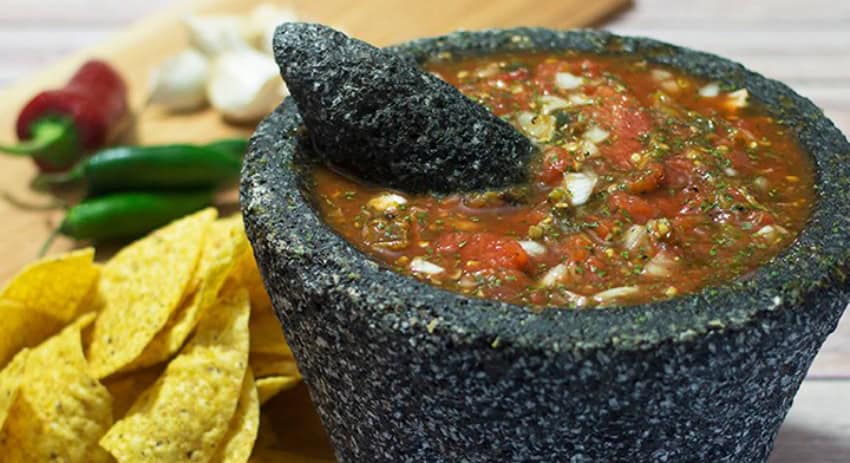
Fresh salsas are the perfect complement to any Mexican dish. (Gobierno de México)

Okay, this salsa should come with a warning: It’s addictive. It’s so good, you’ll want to put it on everything, not just your tacos pastor. Best of all, you can roast, fry or boil the ingredients to suit your taste. I like them roasted. 

I love that this recipe has tomato and tomatillos. But then again, I’m a sucker for tomatillo anything. Thankfully, they’re also available year-round. Oh, and this salsa can be spicy. Adjust the heat to your liking by not adding as many chiles arbol. 

Ingredients:

  • 1 large tomato
  • 4 medium tomatillos (or 6 small ones)
  • ⅓ medium white onion
  • 2 cloves of garlic, unpeeled
  • 13-15 dry chile de árbol, dry
  • Salt to taste

Directions:

  1. Heat a heavy skillet over medium heat. Once hot, add the tomatillos, tomato, garlic and onion to roast. 
  2. Cook, turning occasionally, for about eight minutes until everything shows signs of blistering and softening. The garlic will cook faster than everything else, in just a few minutes, so remove it and set it aside. 
  3. Remove everything from the skillet and place it in a blender. Now add the chile de árbol to the skillet and continuously stir to slightly roast them. They can burn fast, so keep an eye on them. 
  4. Add them to the blender with the garlic and blend until smooth. Add a little water if too thick.
  5. Place in a bowl and enjoy!

Mexico Correspondent for International Living, Bel is an experienced writer, author, photographer and videographer with 500+ articles published both in print and across digital platforms. Living in the Mexican Caribbean for over seven years now, she’s in love with Mexico and has no plans to go anywhere anytime soon.


Opinion: Why President Sheinbaum’s ‘Don’t watch TV Azteca’ comment is such a big deal

19
TV Azteca building
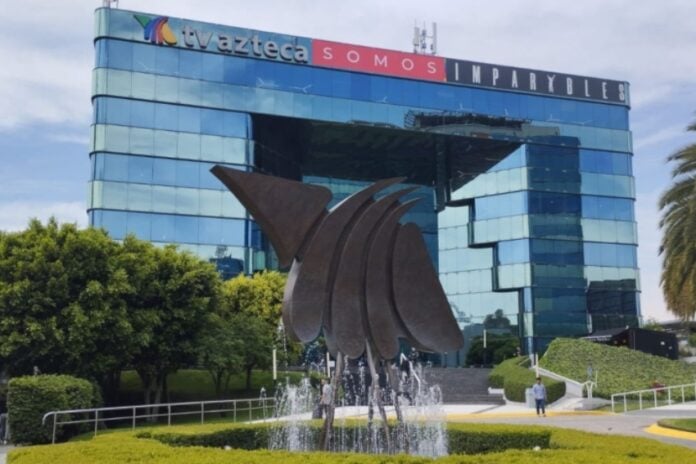
President Sheinbaum's comments about TV Azteca received an immediate response from the network. (TV Azteca)

On Monday, May 25, 2026, President Claudia Sheinbaum did something no Mexican president had done quite so bluntly in modern memory. She addressed the country directly: “Don’t watch TV Azteca.”

To any foreigner, this might sound like an ordinary spat between a politician and a hostile network — the sort of thing a U.S. president might fire off about a cable channel before breakfast. But in Mexico, the comment detonated. Within hours, TV Azteca published an open letter accusing the president of “an evident attempt at censorship and a direct assault on freedom of expression and the press.” The Inter American Press Association (IAPA) and the Alianza de Medios MX warned of a threat to press freedom. Ricardo Salinas Pliego, the network’s owner, fired back on X — and then, with characteristic showmanship, posted that TV Azteca was enjoying “one of the best ratings in its history.”

Claudia Sheinbaum speaking at a podium
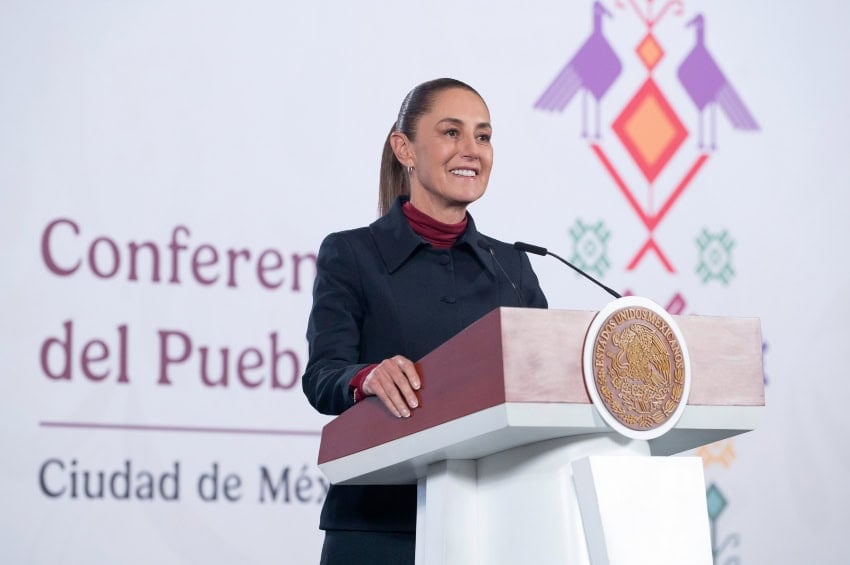
President Sheinbaum’s comments about the network were seen by some media watchdogs as an attack on freedom of the press. (Gobierno de México)

Why the firestorm? Because in Mexico, the relationship between the presidency and television is not a sideshow to politics. For decades, it was politics. To understand why “don’t watch TV Azteca” is treated as something graver than a presidential comment, you have to understand where TV Azteca came from, what it has become and what its owner really wants.

A network born in the shadow of a scandal

TV Azteca did not begin as a private company. In 1993, the government of President Carlos Salinas de Gortari auctioned off the state media package known as Imevisión, which included national Channels 7 and 13. The winning bid, by a group controlled by Ricardo Salinas Pliego, came to roughly US $645 million. It was a landmark moment: for the first time, Mexican commercial television would not be a Televisa monopoly.

But there was something deeply irregular about how the deal was financed. To help cover the purchase, Salinas Pliego received a loan of US $29.7 million from Raúl Salinas de Gortari, the brother of the sitting president, who was selling the asset. The money was reportedly channeled through a Panama-registered company called Silverstar, with Salinas Pliego as its nominal owner, in transfers made shortly before he won the auction.

A questionable loan

This is not an innuendo from his enemies. Salinas Pliego admitted it himself at a 1996 press conference, offering a now-infamous justification: he said he used Raúl Salinas’s money for the media package, but that it was a loan, and that in 1993 “everyone admired President Carlos Salinas de Gortari, and it was a social distinction to be a friend of his brother.” The matter later spilled into open litigation. In 2003, Raúl Salinas sued Salinas Pliego in civil court to collect the debt. Salinas Pliego has said he eventually repaid it.

Whatever one concludes about the legalities — and Salinas Pliego has never been convicted of any wrongdoing in the transaction — the optics are damning. The man buying a state broadcaster borrowed millions from the president’s brother, routed through an offshore shell. The most important television privatization was controversial right from the start. That original sin is precisely why Sheinbaum, defending herself this week, reached back to “the sale of Imevisión in 1993” to frame the network’s history.

From challenger to duopoly partner

Whatever its murky origins, the new company succeeded commercially. Rebranded as Televisión Azteca, it quickly challenged Televisa and turned what had been a television monopoly into a duopoly. Between them, the two conglomerates came to hold over 90% of Mexico’s commercial television concessions — an extraordinary concentration of the airwaves in two private hands.

Ricardo Salinas Pliego
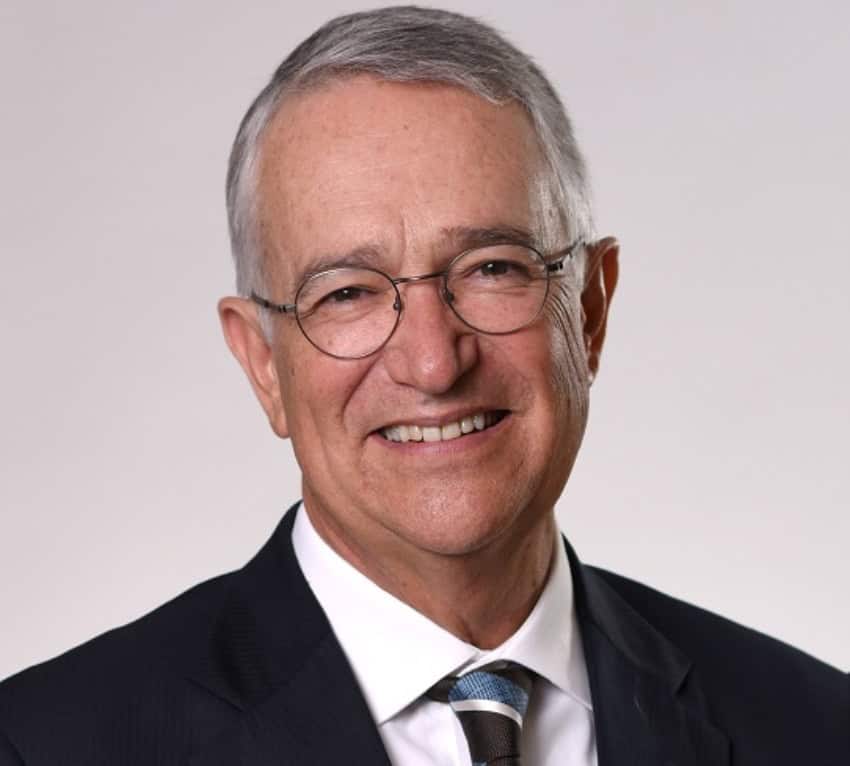
When Ricardo Salinas Pliego bought TV Azteca, he acquired a powerful platform of his own, particularly if he decides to run for president in 2030. (JGTorresH/Wikimedia Commons)

Today, TV Azteca is the second-largest broadcaster in the country, behind Televisa. And it is widely understood to be the advertising engine for the rest of Salinas Pliego’s empire, which includes the Elektra retail chain, Banco Azteca, TotalPlay and Italika motorbikes — businesses that target Mexico’s lower-middle and working classes. The network gives Salinas Pliego something money alone cannot buy: a megaphone and leverage over governments and rivals.

It’s worth noting that during Andrés Manuel López Obrador’s presidency, Salinas Pliego was an ally. He sat on a business advisory council — alongside Televisa and Grupo Imagen, the country’s third-largest network — that spoke into the ear of President López Obrador. The rupture came later, and over money.

The tax war — and the birth of a movement

You cannot separate this week’s clash from the fiscal battle underneath it. For roughly 18 years, Grupo Salinas waged legal war against the SAT, Mexico’s tax authority, over enormous tax assessments. The SAT estimated the conglomerate’s combined liabilities at around 74 billion pesos (close to US $4 billion). In November 2025, the Supreme Court ruled that Salinas Pliego’s companies owed the treasury some 51 billion pesos.

Then came the settlement. In January 2026, the SAT announced that Grupo Salinas would pay 32.13 billion pesos — about 37% less than originally claimed — to liquidate the bulk of its debts, on a payment schedule stretching into 2027. TV Azteca’s portion, roughly 10 billion pesos, was paid in full up front; Elektra is paying its share in monthly installments. Sheinbaum has repeatedly noted that Salinas Pliego “has paid every month.” Soon after, in February 2026, TV Azteca filed for concurso mercantil — a voluntary insolvency reorganization — citing the financial strain of the tax payment, the pandemic and roughly US $600 million owed to creditors in the United States.

Is Salinas Pliego running for president in 2030?

It was against this backdrop that the politics turned overt. In a late-August 2025 interview, Salinas Pliego declined to rule out a presidential run in 2030. On Sept. 12, 2025, at TV Azteca’s own facilities, he launched the Movimiento Anticrimen y Anticorrupción (MAAC) — the Anti-Crime and Anti-Corruption Movement — surrounded by his own network’s commentators, including journalist Sergio Sarmiento and star anchors Javier Alatorre and Leonardo Curzio. Three days later, on Sept. 15, he posted a viral “counter-grito” video, telling Mexicans it was time to say “enough” and to throw out the country’s left. His slogan — “Life, property and liberty” — and the movement’s MAGA-like framing made the ambition hard to miss. Polls circulated a few days later showing a majority of respondents would view him favorably as a candidate.

Whether MAAC is a genuine political project, a shield against his legal troubles or a vehicle for an actual 2030 candidacy is exactly what Mexican analysts are debating. But the through-line is unambiguous: the owner of Mexico’s second-largest broadcaster is openly building a political movement aimed at removing the governing party from power.

Salinas has TV Azteca, but the president has the mañanera

Here is how the spark actually caught. During the Q&A that follows the president’s daily morning press conference — the mañanera — a reporter asked Sheinbaum about a collective called “Mexicanos al Grito de Paz,” which has been running a campaign against her government by hanging banners that depict Mexican officials and brand them “narco-politicians.” What stood out, the reporter noted, was that the people amplifying those messages in the media appeared to be close to Salinas Pliego.

The president paused for a few seconds and answered: “Don’t watch TV Azteca.” There was a long silence, then laughter. She acknowledged that Salinas Pliego would surely lash out at her on X at that very moment, and then added that she had proposed to Luisa María Alcalde that they hand out a new award — “the Mythomaniac of the Week. Ta-daaaah.” (She really said ta-da.) The rest of her answer argued that the public is well aware of the lies, which is why Morena’s approval remains so high.

In response, virtually all of TV Azteca’s entire programming lineup — down to “Ventaneando,” the longest-running entertainment show in Mexican television history, on the air since 1996 — devoted airtime to telling the president they would fight to defend freedom of speech.

‘It’s not censorship, it’s an opinion’

The next morning, May 26, Sheinbaum refused to back down — but she reframed. “When I said yesterday, ‘don’t watch TV Azteca,’ that’s an opinion; it’s not censorship,” she said. “I’m not using the power of the State to censor a television station.” She pointed out that the entire TV Azteca lineup had spent the previous day attacking her, which she offered as proof that free expression is alive and well.

Salinas Pliego, meanwhile, declared that on the very day the president asked Mexicans not to watch TV Azteca, the network broke audience records.

Both sides, in other words, claim the mantle of democracy. The president says she is exercising free speech and the right to reply against a network that traffics in falsehoods. The network says the head of state, who controls the apparatus of the entire government, cannot pretend her words are just one citizen’s “opinion.”

The question I want to leave open

Sheinbaum at podium on May 25, 2026
Sheinbaum’s daily mañanera is an enormous platform for her to tell citizens what networks are legitimate. (Moisés Pablo/Cuartoscuro)

Here is where I’ll be transparent: what follows is my opinion, and I’m hoping to start a conversation with you in the comments.

First, the case for press freedom is real and should not be waved away. There is a meaningful difference between a private citizen saying, “I don’t like TV Azteca,” and a president using the most powerful platform in the country to tell us as citizens not to watch a specific network. Even if no concession is revoked, no advertiser is leaned on and no journalist is fired, her statement matters. That is why the press-freedom organizations reacted the way they did, and they are right to be vigilant. A government that decides which outlets are legitimate is walking toward a door no democracy should want opened.

But we also have to be honest about what TV Azteca is in this moment. This is not a neutral newsroom being bullied for asking tough questions. Its owner has launched a political movement, flirted openly with a 2030 presidential run and is locked in a multibillion-peso fight with the same government his network attacks nightly. When the line between “critical journalism” and “the media arm of an opposition political project” dissolves, citizens are entitled — obligated, even — to ask who benefits from what they’re being shown. Healthy skepticism toward a press that flatters you is essential; so is skepticism toward a press that attacks on behalf of its owner’s interests. The discerning citizen owes neither blind loyalty nor blind hostility to the network or to the president.

And now the question I really want to put on the table.

Does the president deserve this scrutiny?

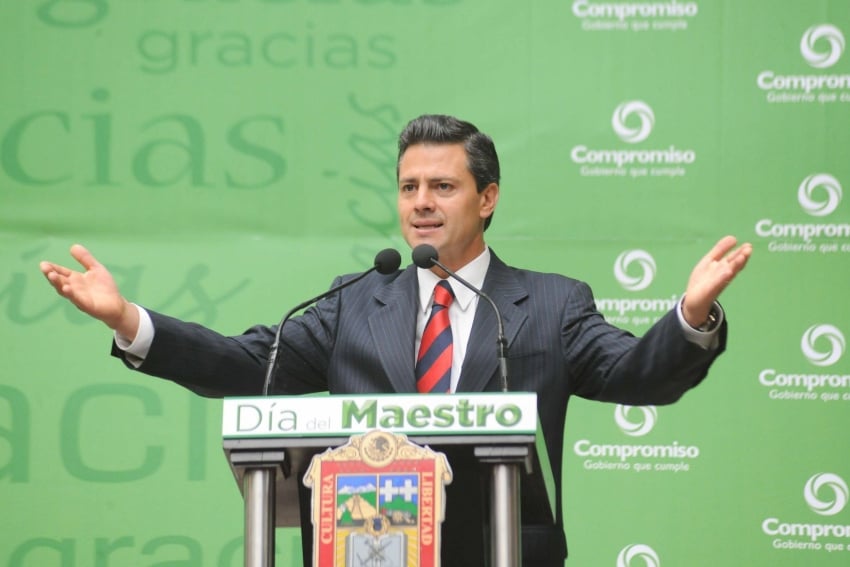
We criticized President Enrique Peña Nieto for being a leader who seemed to cut a ribbon somewhere almost every day — so “mediático,” so addicted to the photo op, that critics asked whether he cared more about putting on a show than sitting at a desk and governing. 

López Obrador and Sheinbaum have flipped the model entirely. The daily mañanera is not a ribbon-cutting; it is a marathon, hours long, in which they present their work, but also field questions, set the day’s narrative and — as we saw this week — name their enemies. It is arguably the most sustained, deliberate daily media operation any Mexican president has ever run.

Enrique Peña Nieto
Mexicans love their country but not always their politicians. Enrique Peña Nieto, for example, was often criticized while president for his frequent “ribbon-cutting” photo ops. (Cuartoscuro)

A new kind of politics

So here is what I keep turning over: if a president chooses to live in the media every single day, doesn’t that invite exactly this kind of scrutiny and conflict? When you make the morning broadcast the center of national power, you also make every word a presidential act, with a president’s full weight behind it. “It’s just my opinion” becomes a harder thing to claim from behind the seal of the republic. The medium of governing has changed radically since Peña Nieto — but if the presence is greater than ever, shouldn’t the public scrutiny be greater too?

I don’t think the answer is obvious, and I don’t think it cuts cleanly for either Sheinbaum or Salinas Pliego. Tell me where you land. Is “don’t watch TV Azteca” an abuse of the pulpit, a fair shot at a politically compromised network, or simply the inevitable cost of a presidency that has chosen to be on television every morning of its term?

Join the debate in the comments below.

Maria Meléndez writes for Mexico News Daily in Mexico City.

Slim slams Moody’s and S&P’s Mexico downgrades as ‘irrational,’ pledges US $5B in new investments

6
Carlos Slim
Carlos Slim's annual press conference generally makes news, and this week's version was no exception. Mexico's richest man came to the defense of his nation's economic reputation by criticizing recent downgradings by major credit rating agencies as "irrational," and then, as though to prove his sincerity, pledged to invest US $5 billion in Mexico over the rest of this year. (Galo Cañas/Cuartoscuro)

Carlos Slim Helú, Mexico’s wealthiest man and the owner of Grupo Carso, announced plans to invest US $5 billion in Mexico this year, while criticizing two major international ratings agencies for downgrading the country’s financial outlook. 

During his annual press conference, Slim called out the ratings agency Moody’s for determining Mexico’s rating by looking at an isolated metric of how public debt and the deficit are growing, rather than examining how those resources are being used and invested. 

sli, slim and Ayub
Carlos Slim Helú was accompanied at his annual press conference on Tuesday by Arturo Elías Ayub, his director of strategic alliances for América Móvil, and his son Marco Antonio Slim Domit, chairman of the board for Grupo Inbursa, Telmex, América Móvil and Grupo Sanborns. (Galo Cañas/Cuartoscuro)

“That rating is irrational,” said Slim. 

Moody’s cut Mexico’s credit score to Baa3 on Thursday, its lowest level of investment grade and just one notch above junk status. Two weeks prior, Standard & Poor’s changed Mexico’s outlook from stable to negative.

The ratings agencies expect debt as a proportion of gross domestic product to reach around 60% by the end of the year in Mexico, but Slim pointed out that that percentage is much lower than in some other economies, such as the United States and Brazil, whose debt will be around 130% and 80% of GDP, respectively.

Slim stressed that Mexico maintains conditions that make it attractive for investment, and that the productive structure has changed, supported by the strengthening of female participation in the workforce.

The billionaire also emphasized that the U.S. continues to rely heavily on Mexico. 

“The U.S. government has been tough on everyone …, but at the same time, it has a great need for Mexico,” said Slim. 

That dependence reflects the current situation in the U.S., as key industries, such as automaking and technology, have become less competitive there, according to Slim. 

Slim believes that Mexico has several conditions in place to return to strong growth, which he says will exceed the 1.5% seen in recent years. 

“We have an investment plan, and we’ve already made it more aggressive,” he said. “There’s a lot to be done, and I believe the investments will start to materialize next year.”  

Slim also praised President Sheinbaum for driving greater investment in Mexico. 

The creation of the National Council in December, which forms part of the government’s overarching development strategy Plan México, brings together the country’s wealthiest businesspeople.

“It is very important that the president has prioritized investment, because without investment there are no jobs, no maintenance of infrastructure, and so on,” Slim said. 

He added that the meetings the council has held with cabinet ministers have allowed them to discuss aspects such as simplifying procedures and facilitating investment agreements at both the state and municipal levels.

With reports from Debate, La Jornada and Sin Embargo

HRW report accuses US and Mexico of abandoning thousands of Cuban deportees

3
migrants outside at dark
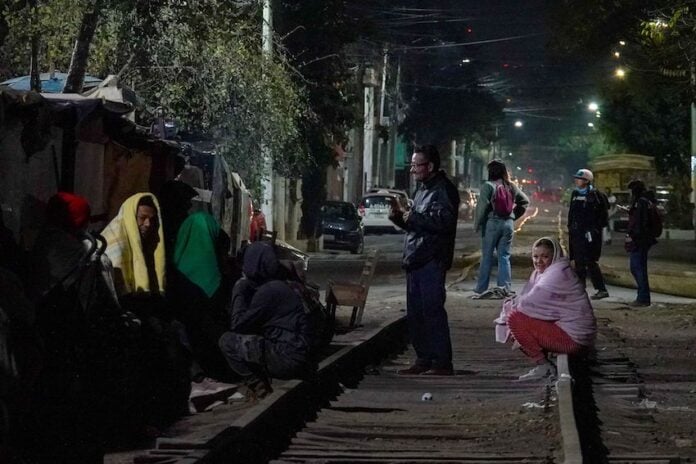
HRW said that between Jan. 20, 2025, and March 9, 2026, the U.S. has sent 4,353 Cubans to Mexico "under an undisclosed agreement between the two governments." (Rogelio Morales/Cuartoscuro)

“They’re casting us aside to die. There’s no help; we can’t work because we don’t have papers. They don’t give us anything, nothing. … How are we supposed to eat, to pay rent?”

Those are the words of 58-year-old Harold A. (not his real name), one of thousands of Cuban nationals who have been deported to Mexico by the U.S. government since U.S. President Donald Trump began his second term in January 2025.

Human Rights Watch (HRW), a New York-based watchdog organization, recently spoke to Harold and 52 other third-country nationals who were deported from the United States to Mexico before being transported to the southern cities of Tapachula, Chiapas, and Villahermosa, Tabasco.

Those conversations inform “‘Casting Us Aside to Die:’ Cuban and Other Third-Country Nationals Deported from the US to Mexico,” a 66-page report published on Wednesday that HRW says “documents U.S. government abuses against Cubans and other third-country nationals deported to Mexico between January 2025 and March 2026.”

The report is also an indictment of the Mexican government, which HRW says has provided little if any support to deportees from the United States despite agreeing to receive them.

‘Trapped in a legal limbo’

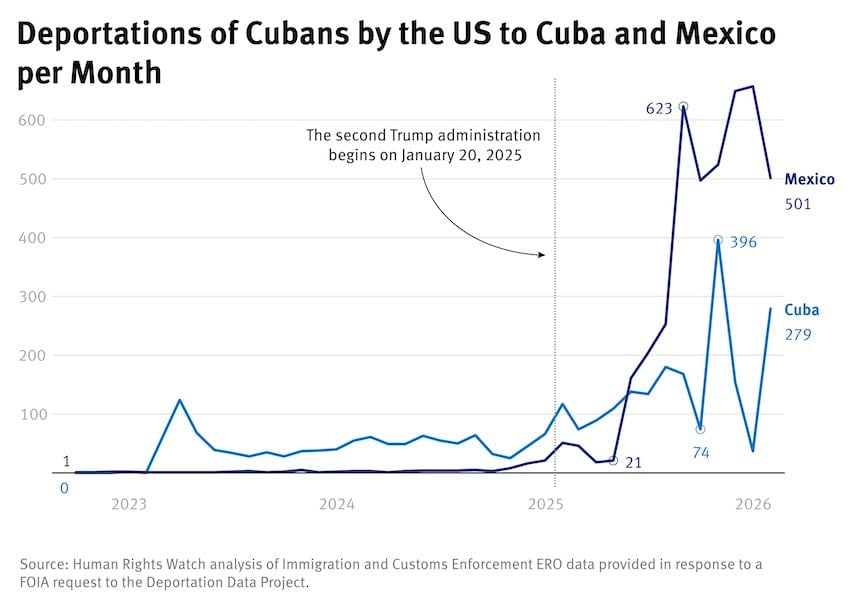
In a press release summary of its report, HRW said that it found that, between Jan. 20, 2025, and March 9, 2026, U.S. authorities deported more than 18,000 people to third countries — i.e., nations that are not the deportees’ countries of origin.

(HRW)

HRW said that the U.S. sent nearly 13,000 of that number — around 70% of the total — to Mexico “under an undisclosed agreement between the two governments.”

“Cubans accounted for the largest group, with 4,353 deported to Mexico over the same period,” the organization said.

HRW asserted that the Trump administration has denied due process to thousands of Cubans it has deported to Mexico, among whom are many “older adults.”

It also said that the U.S. government has left many of those people “stranded without access to basic services.”

“… With no other recourse to obtain permanent residency in Mexico, many Cuban deportees, whose home government refuses to take them back, are trapped in a legal limbo,” HRW said.

“Since arriving in Mexico, they have received little if any government support, and many are without access to shelter, food, or health care.”

Alcira Silva Hava, a fellow in the refugee and migrant rights division at HRW and author of the report, said that “the Trump administration is using Mexico as a dumping ground for people it cannot deport to their countries of origin, including many Cubans who have been in the United States for decades.”

“The Mexican government is not offering them any way to obtain durable legal status outside of the asylum system, leaving many in limbo with no shelter, no medication, and at the mercy of criminal organizations,” she added.

‘None of the people interviewed were given the opportunity to challenge their deportation to Mexico’

In February and March, HRW interviewed 53 third-country nationals deported to Mexico by the Trump administration, including 41 Cuban men. The other 12 people HRW spoke to are from Haiti, Honduras, Nicaragua, Venezuela, El Salvador and Jamaica. In its report, HRW uses pseudonyms for all of its interviewees to protect their identities.

HRW said that “none of the people interviewed were given the opportunity to challenge their deportation to Mexico, violating their due process rights under both U.S. and international law.”

“U.S. authorities deported them without documentation, money, or personal belongings. Although Mexican authorities have agreed to receive Cuban nationals, they have left them in unsafe conditions, without access to shelter or health care,” the organization said.

“With no clear path to legal status, many have little prospect of improving their circumstances. Some have been forced to live on the streets, including in parks or outside hospitals.”

HRW said that “the deported individuals were sent to southern Mexico, where cities like Tapachula and Villahermosa have high levels of violence and paltry capacity to provide protection, housing, jobs and access to public services.”

“Most of those interviewed struggled to find non-exploitative work or health care. Older people faced the most severe consequences. Some were cut off from the medications they had taken for years,” the organization said.

HRW said that 55% of the 4,353 Cubans deported to Mexico between January 2025 and March 2026 “had a prior U.S. criminal conviction,” while 16% “had a pending charge but no conviction,” and 26% “had no criminal record at all.”

“Only 16 percent had a violent or potentially violent offense as their most serious conviction. The mass targeting of long-term Cuban permanent residents and their deportation to Mexico was not a U.S. practice prior to President Donald Trump’s second term,” HRW said.

Accounts of life in Mexico as a third-country deportee 

Many of the deportees HRW spoke to in Mexico were transported by bus from the northern border to Tapachula and Villahermosa.

“You don’t know what it’s like to come all the way here [Tapachula] by bus from the United States,” said Harold, the 58-year-old Cuban national.

“It’s inhumane, I didn’t even know how to sit so [my body] wouldn’t hurt. My feet, my ankles, they were like this [gestures to indicate swollen]. [We had] nothing but bread and water,” he told HRW. 

Javier, a 62-year-old deportee, told HRW that he had been living in a “little cave of sorts” near a gas station in Villahermosa.

“I’m sleeping on the street. Like a dog,” he said. 

Fermín, another Cuban deportee, has been homeless since he arrived in Tapachula in February.

For the most part, I don’t sleep. I haven’t slept in three days,” he told HRW. “I can’t find water, I don’t know where to get food. Nothing.”

Ruben, a Cuban deportee in Villahermosa, was homeless for 20 days before finding an apartment to share with other Cubans. “He expressed frustration at the absence of any governmental programs to house and support deportees,” HRW said in its report.

“Villahermosa does not have the infrastructure,” Ruben said.

“People are living on the streets. How am I supposed to integrate into society, if I don’t have [a place] to eat and sleep! Why bring so many people here, if they [the Mexican government] have nowhere to put them?” 

HRW said that “Cubans’ lack of legal documentation affects every aspect of their lives in Mexico.”

“It significantly limits access to banking systems, particularly when individuals have had their phones taken away, cutting them off from mobile banking apps. In Mexico, a Unique Population Registry Code (Clave Única de Registro de Población, or CURP), a form of personal ID, is required to open a bank account. Without it, many deported individuals are unable to receive or manage funds independently,” the organization said. 

HRW said that for deportees “who wish to make asylum claims, the process is arduous.”

“The Mexican Refugee Assistance Agency’s under-resourced bureaucracy is slow and saddled with procedural requirements that make it very difficult for people to access asylum or similar protection,” it said.

HRW also said that deportees’ lack of legal documentation “makes it difficult for Cubans and other third-country nationals to access health care in Mexico, which was especially harmful for those interviewed with chronic health conditions.”

“… Many interviewees said they were deported with a limited supply of the medications they use to manage their chronic health conditions and were concerned about how they would obtain more once it ran out,” HRW said.

Miguel Ángel, a diabetic Cuban deportee, told HRW: “I ran out of insulin… because it is very expensive, too expensive. … I had nothing to treat my diabetes for two days and by the third day my vision was failing me. When my blood sugar spikes, it takes a toll on my eyesight.… Of course, I’m worried. If I go blind here, who is going to take care of me? I don’t have family here. I don’t have anyone.”

Regarding deportees’ transportation to southern Mexican cities, including Tapachula, Villahermosa, Palenque, Chiapas, and Tenosique, Tabasco, HRW said it was told by one Mexican government official that “these transfers to the south are intended to make it harder for people to return north toward the U.S. border.”

HRW’s recommendations to the Mexican government 

In its report, HRW makes numerous recommendations to the Mexican government.

The organization advises the government to:

  • Ensure that transfers of third-country nationals from the United States only occur pursuant to a public, transparent agreement that stipulates strict adherence to due process and respect for international law.
  • Comply with the requirement under the 2011 Migration Law and restart the issuing of the Humanitarian Reasons Visitor Card to people seeking asylum and to others who qualify under the law.
  • Ensure that people deported from the United States have access to free, quality, and rights-respecting medical, psychosocial and mental health care and support services.
  • Establish an effective pathway to permanent resident status for third-country nationals who were removed to Mexico pursuant to agreements with the United States.
  • Ensure immediate access to the asylum system for deportees.
  • Suspend or adapt reporting and check-in requirements that are impossible or unduly burdensome for people who are homeless, lack transportation, have disabilities, are older or have serious health conditions.
  • Allow asylum seekers to relocate within Mexico when necessary for safety, health, family unity, shelter or access to services, including when remaining in the state where they filed their claim exposes them to organized crime, homelessness or other serious risks.
  • Ensure access to emergency shelter, food, healthcare and essential medication for deported people, with particular attention to older people, people with disabilities, people with chronic illnesses, pregnant people, children and others at heightened risk.
  • Adopt specific protection protocols for older people and people with serious medical conditions, including screening upon arrival, referrals to public health services, continuity of care and access to necessary medication.
  • Increase funding and staffing for the Mexican Refugee Assistance Commission and relevant protection institutions, particularly in cities receiving large numbers of deported or transferred people, to reduce delays and ensure timely, fair and accessible asylum procedures.

Among a number of recommendations to the U.S. government, HRW says that it should “stop the removal of Cubans and other third-country nationals to Mexico in the absence of a formal, transparent agreement with the Mexican government that people transferred will have access to a full and fair process for determining a claim for asylum or equivalent protection, as well as a pathway to effective and durable legal status for persons who might not qualify as refugees but whose home country refuses to repatriate them.”

HRW advises the government of Cuba to “respect the rights of all Cubans to their nationality and to return to their country, as established under international human rights law.”

Mexico News Daily 

A suspected new geyser is disrupting life in a small Michoacán community

0
Geyser siteThe
Water burst forth some 15 meters from this backyard of a Michoacán farmer's house before subsiding, as geysers tend to do temporarily. Whether the phenomenon was a true geyser will be determined by scientific observation. (Facebook)

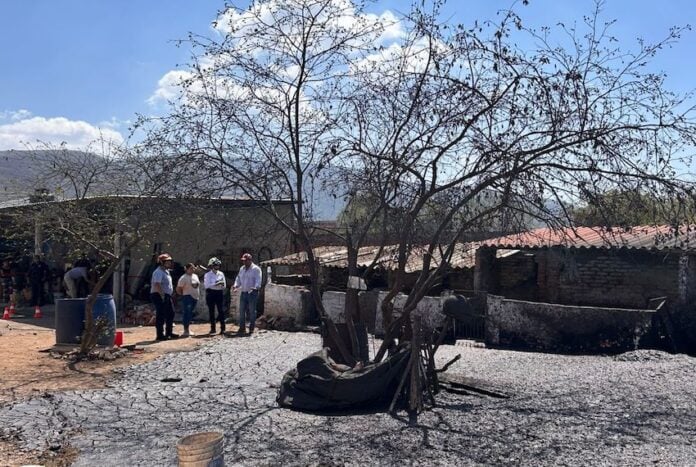
A suspected geyser that burst from the pig pens and backyard of a small Mexican farm this week has prompted evacuations, a school closure and a multi-agency scientific response, according to state and federal officials.

The hydrothermal eruption began overnight Monday in the rural community of El Salitre, about 135 kilometers west of Morelia, the capital of the west-central state of Michoacán.

Water, mud and gases began spewing from “the middle of pig pens on a small family farm,” according to authorities.

As of late Wednesday morning, the geyser-like phenomenon was still active, though in a reduced, bubbling-mud state with constant gas emissions rather than a jet, according to Mi Morelia.

Earlier, authorities had reported an initial spout of about 15 meters, which subsided to eight meters.

An unknown number of pigs “died as the result of the eruption,” according to N+, the news division of TelevisaUnivision.

The National Coordination of Civil Protection (CNPC) reported Wednesday that 13 people had been evacuated, and that a security perimeter will remain in place as the phenomenon continues.

Authorities also confirmed the suspension of classes at a nearby preschool.

Additionally, the family living at the site was evacuated, nearby gas tanks were removed, and the farm’s pigs were moved from their roofed areas and corrales de cerdos (pig pens) as a precaution.

The Federal Electricity Commission (CFE) showed up to carry out thermal measurements and assess risk.

Also on scene are geologists from the National Autonomous University of Mexico (UNAM) and specialists from the National Center for Disaster Prevention (Cenapred) to conduct field studies to determine if it’s a true geyser or surface hydrothermal activity.

“The observed phenomenon presents characteristics similar to those of a geyser, due to the eruptive expulsion of water and steam,” said Amuravi Ramírez, Michoacán’s Civil Protection coordinator. “However, to scientifically confirm whether it is formally one, it will be necessary to carry out specialized studies and continuous monitoring.” 

Authorities urged the public to avoid the area while monitoring continues.

With reports from Mi Morelia, El Financiero and La Jornada

How Loreto stood up to the cruise industry and reversed a presidential decree

10
A coordinated civic response to a presidential decree put the small BCS town of Loreto at the center of Mexico's growing pushback against cruise ship tourism.
A coordinated civic response to a presidential decree put the small BCS town of Loreto at the center of Mexico's growing pushback against cruise ship tourism. (Regi Domingo/Baja Adventures)

When a presidential decree opened the UNESCO-designated Loreto Bay National Park to large-scale maritime traffic, residents of the coastal Baja California Sur town were prepared to fight. 

The town of Loreto, with a population of around 20,000, has built its identity around low-impact tourism — and a long-running grassroots movement to stop mega cruise ships from entering its protected waters. That changed on April 10, when President Claudia Sheinbaum, with the support of the Mexican Cruise Association, signed a decree reclassifying Loreto as a deep-sea cabotage port, thereby opening it to more and larger vessels.

In the first four months of 2026, Loreto received more than 7,600 cruise ship passengers, up from 1,510 throughout 2025. In addition to the increased pressure on infrastructure, the noise from cruise ships creates a hostile environment for the bay’s native species, such as the endangered blue whale. 

Together with fishermen’s cooperatives, tour operators, professional associations and conservation groups — including Conexiones Climáticas, Conserva Loreto and the Unión de Loreto — residents staged major protests, transforming what began as shock and confusion into one of the most rapid environmental campaigns Mexico has seen in years. In just six weeks, Sheinbaum reversed course with a new decree, this one removing the large-scale designation while emphasizing the area’s extraordinary biodiversity and “ecological relevance.”

It also establishes a formal working group — half government representatives, half community and civil society members — to update the park’s management plan and set new rules governing navigation in the bay.

But while residents and environmental advocates are celebrating what many see as a growing wave of environmental pushback in Mexico — including recent setbacks for the massive Saguaro LNG project in the Gulf of California and the “Perfect Day” theme park in Mahahual, Quintana Roo  — they also caution that the fight is far from over. 

MND Local: A cause to rally behind in Loreto and luxe life in Los Cabos

“The revocation of the decree would only bring us back to the same situation we had before,” wildlife expedition leader and regenerative tourism advocate Regi Domingo said. “For 20 years, cruise ships have still been anchoring irregularly inside the national park. The real challenge now is making sure the management plan finally protects the bay the way the community has been asking for years.” 

Moving gently through the sea

For more than a decade, Loreto’s whale guides have been developing what they call “passive whale watching” — a method designed to minimize stress on the animals while allowing visitors intimate encounters with the world’s largest mammals. It’s a method that has been adopted by the Blue Whale Group of Loreto, and the cooperative’s members have shared and improved techniques over the years.

When guides spot the blow of a blue whale in the distance, instructor and naturalist María Nájera explained, they slowly approach to within about 100 meters, then cut the engine and observe the whale’s behavior before moving any closer. Over time, she said, guides began noticing that the whales appeared calmer and more open to the visitors.

“We started to realize the whales were much more relaxed,” Nájera said. “They were feeding more easily at the surface.” 

The approach became central to Loreto’s identity as a destination for small-scale ecotourism. Local operators trained one another in the technique, bringing new captains and guides into the practice as whale tourism grew. Many tours limited outings to small groups of six or eight passengers at a time. They were often rewarded with encounters, sometimes surprisingly close.

Whale watching in Loreto, Baja California Sur
Whale watching instructor María Nájera described seeing whales become erratic and abandon feeding areas after the arrival of large vessels. (Regi Domingo/Baja Adventures)

That philosophy stood in sharp contrast to the cruise industry that residents say had already been operating in Loreto for years through legal gray areas, anchoring offshore and ferrying thousands of passengers into the small town in smaller boats.

“When the cruise ship arrives, everything changes,” Nájera said. She described seeing whales become erratic and abandon feeding areas after the arrival of large vessels. In previous years, she said, areas where guides might regularly observe 10 or 12 whales could suddenly fall nearly silent after cruise ship visits.

Pushing back against the tide

Local cooperatives also questioned the economic benefits the ships brought to the town.

Noé Gaona, president of the Union of Cooperatives of Loreto, said most cruise passengers spent little money locally because food and entertainment were already included onboard. Local guides and fishermen, he said, often felt displaced rather than included in the business model, with contracts concentrated among a small number of operators.

“We felt we were being pushed aside,” Gaona said.

Gaona recalled learning about the decree during one of the cooperative union’s organizing meetings. At first, he said, many residents feared speaking publicly against the project, worried there could be repercussions for permits or future work.

But when organizers called a public meeting in a local park to explain the decree and gather signatures, more than 300 people showed up — far more than expected.

“We realized people really wanted to speak,” Gaona said.

Soon afterward, they organized a noisy caravan through town, with residents decorating vehicles with signs and honking in protest. Then, when what organizers believed would be the season’s final cruise ship arrived, hundreds gathered peacefully near the marina carrying banners and signs, while many local tourism operators refused to work that day.

Families came with children. Some residents tried to confront cruise passengers more aggressively, Gaona said, but organizers intervened to keep the demonstration calm.

“We wanted people to understand what was happening without turning it into an attack,” he said.

Gaona said what stayed with him most was not the confrontation itself, but the unity that emerged across the town.

“It was a genuine movement — a movement that no one expected,” he said. “And it was something that surprised me: seeing the unity that emerged amidst everything triggered by this decree. It filled me with pride to hear the mothers, the children, the students and the older people — those who understood the problem and wanted to help. I am proud to say that we proved ourselves to be an intelligent people, but a peaceful one as well.”

Could Loreto set a precedent for the Baja California peninsula? 

Environmental advocates say Loreto’s victory may ultimately carry significance far beyond the Baja California Sur town.

Roberto Cerda, a Gulf of California conservation advocate who has worked on marine protection issues across Mexico’s Pacific coast, said Loreto is only one front in a growing regional struggle.

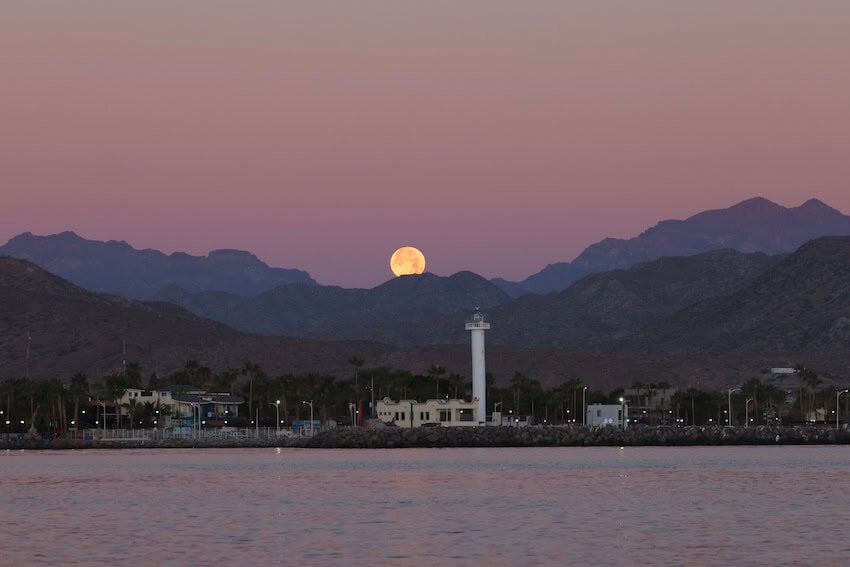
Full moon behind Loreto
Loreto is home to approximately 20,000 people, a good portion of whom are dedicated to protecting their environment. (Regi Domingo/Baja Adventures)

“What we are seeing is not an isolated conflict in Loreto,” Cerda said. “Across the Gulf of California, there are simultaneous efforts tied to LNG infrastructure, shipping routes, industrial tourism and even deep-sea mining proposals. What worries many of us is what feels like a systematic effort to weaken the legal protections that already exist for some of the most biologically important marine regions in Mexico.”

Just across the Gulf in Topolobampo, Sinaloa, for example, construction of a controversial ammonia plant inside a designated Ramsar wetlands reserve continues despite strong backlash from the local community. 

For now, however, many residents are allowing themselves a moment of cautious relief.

The repeal decree opens a new phase centered on updating the management plan for Loreto Bay National Park — a process activists hope will permanently strengthen restrictions on large-scale maritime traffic and industrial activity inside the protected area. In order to succeed, Domingo says the working group must bring together science, local knowledge and authorities to address current and emerging pressures, particularly deep-sea navigation, “and ensure the program is fully implemented, not just written, with real monitoring, inspections and enforcement.”

But as Cerda and Domingo point out, Loreto is just one part of a highly intricate and interdependent web of life. 

“We need to be able to protect the entire Gulf of California as an ecosystem that is all connected,” Domingo said. “It is a corridor for highly migratory species and also for resident species that depend entirely on these ecosystems. Now the decree has been revoked for Loreto, but the work continues. We cannot feel fully happy and ensure these species, ecosystem and community are protected if the other places they pass through are still under pressure.”

Tracy L. Barnett is a Guadalajara-based freelance writer and the founder of The Esperanza Project.

With more internet access, Mexico seeks to boost tourism from China

0
Rodríguez and Jane Jie Sun,
In Shanghai, Tourism Minister Josefina Rodríguez met with Jane Jie Sun, CEO of CTRIP, one of Asia’s most important travel platforms, to discuss strategies for boosting Chinese tourism in Mexico. (Sectur)

In Shanghai to attend the ITB China 2026 tourism fair, one of the most significant business-to-business events in the global travel industry, Tourism Minister Josefina Rodríguez Zamora is seeking to take advantage of some encouraging developments to bring more Chinese tourists to Mexico.

After an eight-year hiatus, the Chinese platforms WeChat, Weibo and Red Note (or ZiaoHongShu) are open again to Mexico. That reconnection provides what may be the most important element for tourism promotion — communication.

Josefine Rodriguez
Tourism Minister Josefina Rodríguez leads the ribbon-cutting ceremony for Mexico’s pavilion at the prestigious ITB China tourism fair, which runs through Thursday. (Sectur)

“We want to speak directly to the Chinese traveler, listen to their interests, share our stories, and build a lasting relationship through content designed specifically for this market,” Rodríguez said.  

The tourism minister said that Mexico’s strategy will stress direct and permanent communication with Chinese travelers through content designed for their interests, consumption habits and forms of digital interaction.

China is one of the world’s largest sources of tourists, and one of the countries that spends the most on international tourism. According to Rodríguez, China sends out some 155 million international tourists per year and projections suggest the figure could reach 200 million by 2028.

Rodríguez’s plan is to capitalize on China’s potential in the industry and take advantage of direct flights from Shenzhen and Beijing to Mexico City. 

Rodríguez is joined in China by Michoacán State Tourism Minister Roberto Monroy García. Both are highlighting Mexico’s natural, cultural and culinary diversity.

Rodríguez held a meeting with Jane Jie Sun, the CEO of CTRIP, one of Asia’s most important travel platforms and a global leader in digital tourism services, with a strategic presence in international markets and millions of active users.

The two women discussed opportunities for collaboration to strengthen the promotion of Mexico in the Chinese market, expand the visibility of Mexican destinations, and generate alliances that contribute to increasing the flow of visitors to the country.

“Today, we want to tell China that Mexico awaits them with open arms,” Rodríguez said. “We want more Chinese travelers to discover the energy of our cities, the richness of our culture and the warmth of our people.” 

Mexico News Daily

El Jalapeño: American foodies devastated as Mexico City taco stand loses Michelin star

2
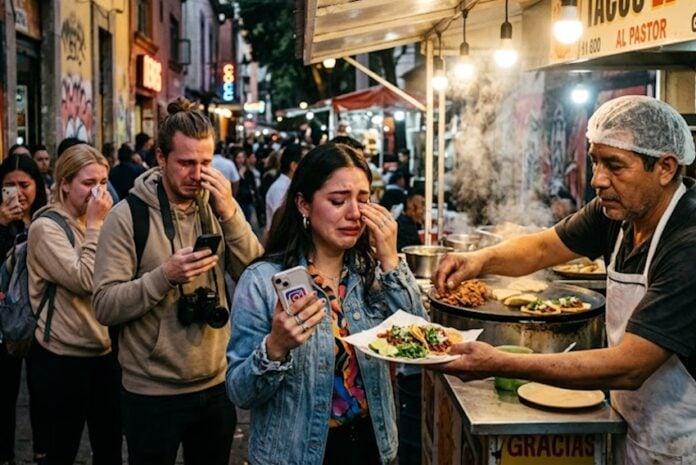
Is there even a point coming to Mexico City at all now? (This image generated using AI tools)

All stories in El Jalapeño are satire and not real news. Check out the original article here.

MEXICO CITY — North American food influencers are in mourning this week after Mexico City’s famed El Califa de León lost its Michelin star, abruptly stripping thousands of U.S. travelers of the only interesting thing they had to say about their trip to Mexico.

For many visitors, the tiny stand’s star had become a core identity marker, proudly cited in captions like “found this hidden gem that 4 million people already posted about” and “real Mexico, not touristy,” written while standing in a line of other tourists. “I built my entire ‘Mexico City in 36 hours’ itinerary around saying I ate at the world’s first Michelin-starred taco stand,” said one distraught visitor from Brooklyn. “Now what am I supposed to do, just… enjoy the city without a European award system validating my choices?”

Two tortillas with meat on top, presented on a green plate and with a lime wedge
Are tourists expected to eat this?! (Michelin)

Travel content creators have reacted swiftly, updating their guides to clarify that while El Califa de León is “no longer star-worthy,” it remains “acceptable for B-roll” if filmed in slow motion and desaturated. Several have rebranded their YouTube thumbnails from “I Ate At The CHEAPEST Michelin Restaurant!!!” to “I Survived A Former Michelin Taco Stand (Gone Wrong?).”

Local diners, who had eaten at the stand for years before inspectors and selfie lights arrived, appeared less concerned. “The tacos were good before the star, they’re good after the star,” said one resident. “The only difference now is I can maybe get to work on time without waiting behind a guy filming his first bite from six angles.”

Despite the downgrade, many tourists insist they will still visit — but admit the experience will never be the same. “I just don’t know how to explain to my followers that I waited 90 minutes for a taco that’s merely excellent,” said one influencer, staring at her plate. “If it doesn’t come with a star, a narrative arc and a brand partnership, did I even eat it?”

Check out our Jalapeño archive here.

Got an idea for a Jalapeño article? Email us with your suggestions!

New Morena-backed bill seeks to nullify elections in cases of foreign interference

4
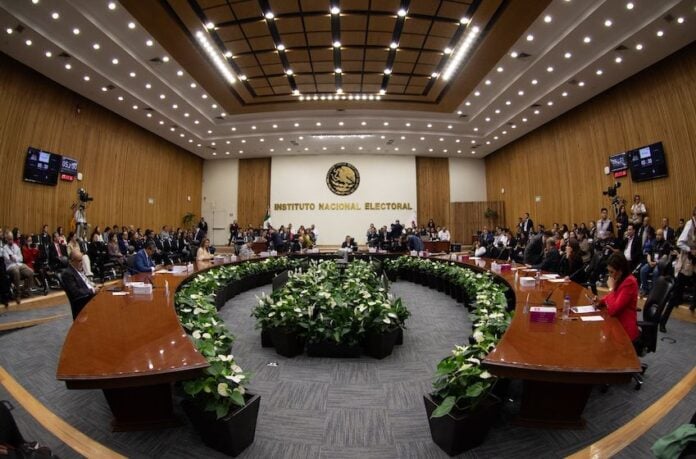
National Electoral Institute
The Morena party has initiated broad changes to how elections are conducted in Mexico, most notably, the submission of judges to popular vote starting in 2025. (Andrea Murcia/Cuartoscuro)

A committee of Mexico’s lower house of Congress approved on Tuesday a bill that seeks to allow elections to be annulled in cases of foreign interference.

The constitutional bill was put forward by Deputy Ricardo Monreal, the Morena party’s leader in the lower house, and has consequently been dubbed the Ley Monreal (Monreal Law).

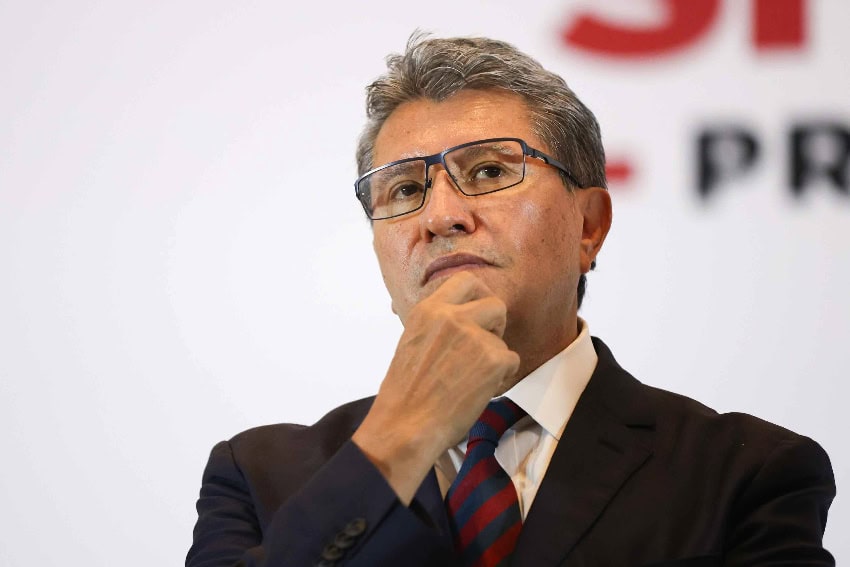
Ricardo Monreal
The bill was put forward by Deputy Ricardo Monreal, the Morena party’s leader in the lower house. (Cuartoscuro)

Put to a vote in the Constitutional Points Committee of the Chamber of Deputies, the bill was supported by 28 lawmakers affiliated with Morena and its two allies, the Labor Party and the Green Party (PVEM). Nine opposition lawmakers opposed the bill.

The bill will now be debated and possibly modified in the Chamber of Deputies before facing a full vote. Morena and its allies have a two-thirds majority in the 500-seat lower house, allowing them to pass constitutional bills without the support of any opposition deputies.

How would Ley Monreal shield Mexico’s elections?

Monreal’s bill seeks to modify Article 41 of the Mexican Constitution so that elections can be annulled in cases of proven foreign interference. It also seeks to make changes to the General Law for the System of the Challenge Process on Electoral Matters and other electoral laws.

Opposition lawmakers assert that Monreal’s proposal lacks clarity.

“We’re very concerned about the ambiguity of the term ‘intervention’ by foreign individuals, organizations or governments,” said Nadia Navarro Acevedo, a deputy with the Institutional Revolutionary Party (PRI).

National Action Party (PAN) Deputy Noemí Luna said that “no one is in favor of foreign interference” in elections in Mexico, but added that “we are against legal ambiguity.”

Luna suggested that Morena could use foreign interference as a pretext for annulling the results of elections it loses.

The newspaper El Financiero reported that “the operational reach of the proposal still has gray areas.”

“In order to declare the nullity of an election under this new figure, it will be mandatory to legally prove the interference of other countries,” the newspaper wrote, adding that Monreal hasn’t specified how the process would work in practice.

On his personal website, Monreal wrote that the Federal Electoral Tribunal would be the sole authority responsible for validating whether foreign interference occurred and, in the case that it did, determining whether such interference had a decisive impact on an election result.

“Neither the government, nor any prosecutor’s office, nor any other authority would rule on this serious situation,” he wrote.

Monreal also provided examples of a range of ways in which foreign individuals, organizations and governments can interfere in elections, including through the “illicit financing” of candidates and the “systematic dissemination of disinformation.”

He and his Morena colleagues argue that the constitution needs to be modified to protect Mexico’s electoral processes from interference by and/or from foreign countries, including the United States.

Opposition Senator Téllez tells Fox News that Mexicans want US help against the cartels

Ricardo Astudillo, a PVEM deputy, said that Mexico mustn’t allow its destiny to be decided from abroad. Defending his proposal, Monreal pointed to alleged interference by the United States in previous elections in the region, such as the 2025 election in Honduras.

If Monreal’s bill is approved by Congress, proven foreign interference would become another justification for the annulment of elections. As things stand, elections can be annulled if candidates are found to have received and/or used in their campaigns ill-gotten money or public resources to which they are not entitled. In addition, elections can be annulled if candidates or parties exceed spending limits or illegally purchase or acquire television and radio advertising.

Proposal to postpone judicial elections advances 

On Tuesday night, the Chamber of Deputies approved en lo general (in a general sense) a separate constitutional reform proposal that seeks to postpone Mexico’s next judicial elections from 2027 to 2028 and make other changes to the judicial reform that took effect in 2024.

President Claudia Sheinbaum submitted that constitutional bill to Congress last week. It effectively recognizes that there were a range of deficiencies in the 2025 judicial elections and seeks to address them. Just 13% of eligible voters participated in Mexico’s first-ever judicial elections, where complicated ballots with large numbers of candidates led many citizens to use cheat sheets.

In addition to seeking to postpone the next judicial elections — which could take place on the same day as a presidential recall vote in 2028 — Sheinbaum’s judicial reform bill aims to reduce the number of candidates seeking judgeships and simplify ballots, among other objectives.

Debate on the individual articles of the reform proposal was scheduled to take place in the Chamber of Deputies on Wednesday ahead of a second vote on the bill.

With reports from El Financiero, La Jornada and Reforma