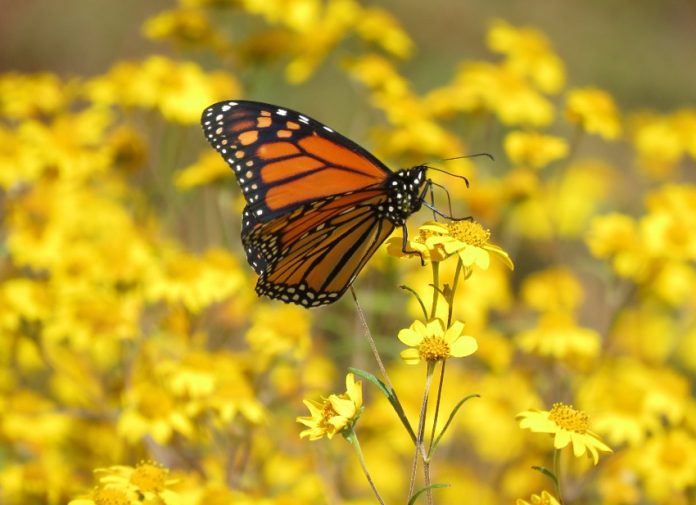
Monarch butterfly are considered a "poster species," and efforts to conserve them also benefit less glamorous pollinators as well. (CorreoRealMX/X)
Monarch butterflies have started to arrive in Mexico as part of their annual migration from Canada and the U.S., reported the organization Protection of Mexican Fauna (Profauna), based on observations made in the northern states of Mexico.
Each year, the monarchs embark on a 4,000 km journey to migrate from their breeding grounds in the U.S. and Canada, to overwinter in the warmer forests of the Monarch Butterfly Biosphere Reserve in central Mexico.
These sanctuaries are critical for monarch butterfly hibernation since 87% of the total population of butterflies converge here each season. There are four reserves open to tourism in the states of México and Michoacán.
Profauna encouraged the population living in the northern states of Coahuila, Nuevo León and Tamaulipas, to report their sightings, and citizens began reporting times, weather conditions and GPS locations of observed butterflies.
The monarch butterfly is a species with “special protection” under Mexican law. Due to the destruction of its habitat and to climate change, the migratory species was also added to the endangered species list of the International Union Conservation of Nature (IUCN) this year owing to a decrease in its population over the last decade.
However, in the 2020-2021 hibernation season, the WWF Mexico reported that the butterflies’ presence in and around the biosphere,grew from 2.10 hectares to 7.02 hectares – a “fragile” but positive improvement that represents an increase of 35% compared to the previous season.
“The growth in the monarch population is good news and indicates that we must continue working to maintain and strengthen conservation measures in Mexico, the United States, and Canada,” said Jorge Rickards, Director General of WWF Mexico, in a statement.
The butterflies are estimated to begin arriving at the biosphere no later than Nov. 1, coinciding withDay of the Dead celebrations. However, Rocío Treviño, the program’s coordinator, anticipated that the highest migration peak will not be recorded until the third seasonal cold front.
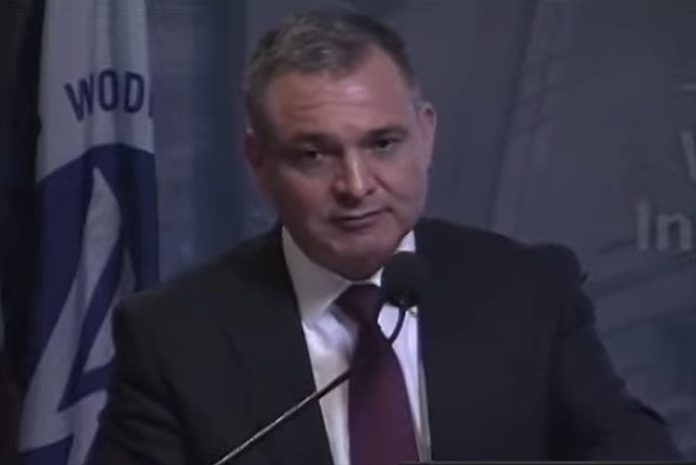
Genaro García Luna shortly before his arrest. YouTube screenshot
Prosecutors in the United States have gathered more evidence against Genaro García Luna, a former federal security minister who was arrested in Texas in 2019 on charges he colluded with the Sinaloa Cartel.
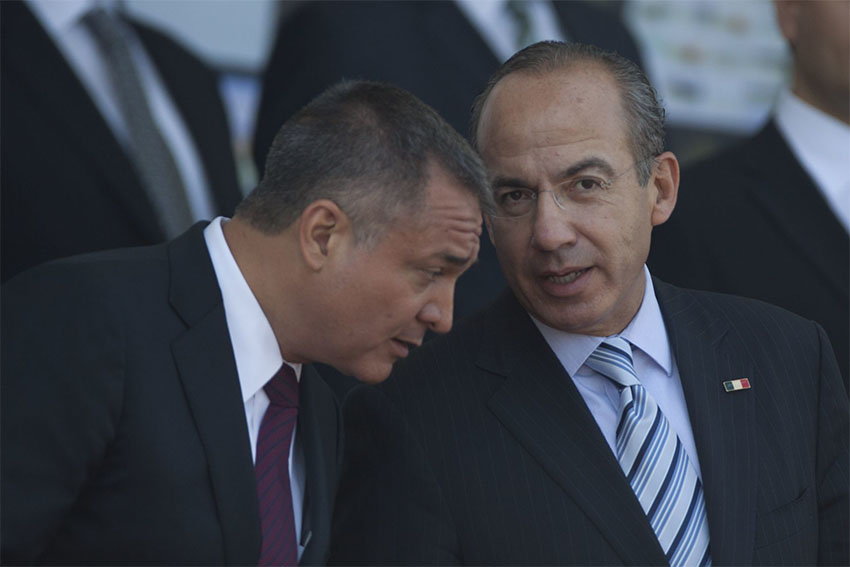
García Luna — security minister in the 2006-12 government led by former president Felipe Calderón and director of the now-defunct Federal Investigation Agency before that — used shell companies to ship drugs to the United States, U.S. Department of Justice (DOJ) prosecutors allege. They also allege that the ex-security official was involved in the trafficking of drugs that were seized in New York just after he was detained in Dallas in December 2019.
The allegations are detailed in a letter sent to García Luna’s lawyer and in a submission to a United States federal court in Brooklyn, New York, where the accused is scheduled to go on trial in January.
The newspaper Milenio obtained a copy of the DOJ letter sent to lawyer César de Castro in which prosecutors said they have “records related to the shipment of narcotics into the United States through shell companies.”
Garcá Luna speaks with then-president Felipe Calderón. Archive / Cuartoscuro.com
The prosecutors said they have other evidence against García Luna including pay stubs from his time as a government official and “records related to a co-conspirator and the seizure of narcotics in Queens, New York, on December 18, 2019.”
The prosecutors also said that six cell phones have been seized from co-conspirators of the former security minister and that a Drug Enforcement Administration digital forensic investigator will present related testimony in court.
All told, the DOJ has submitted over 1 million pages of documents detailing evidence against García Luna to the Brooklyn court as well as thousands of photos and financial records and hundreds of video tapes.
The ex-security minister and two former high-ranking officials who worked under him are accused by U.S. authorities of allowing the Sinaloa Cartel to operate with impunity in Mexico in exchange for multimillion-dollar bribes.
Negotiations between prosecutors and the defense with a view to García Luna pleading guilty to trafficking and cartel collusion charges and cooperating with prosecutors in exchange for a more lenient sentence are ongoing.
President López Obrador has claimed that the charges faced by the former security minister prove that Mexico was a “narco-state” during the presidency of Calderón, who narrowly defeated AMLO at the 2006 election. Calderón categorically rejected the claim and has asserted he had no knowledge that his security minister was involved in criminal dealings with the Sinaloa Cartel, which was formerly led by convicted drug lord Joaquín “El Chapo” Guzmán.
Pérez's car flashes past the camera at an exhibition show run in Jalisco on Tuesday. Fernando Carranza García / Cuartoscuro.com
Formula 1 racing roars into Mexico City this weekend and more than 110,000 people are expected to pack the racetrack on Sunday for the Mexican Grand Prix — with most of them rooting for Mexican Sergio “Checo” Pérez as he tries to make history.
After finishing third last year at the Hermanos Rodríguez Autodrome, and becoming the first Mexican driver to get onto the podium there, the 32-year-old native of Guadalajara is hoping to take it to the next level this week and finish first on his home soil.
With the crown in this year’s F1 championship series already secured by Pérez’s Red Bull teammate Max Verstappen, Pérez just might have a clear path to crossing the finish line first, but he doesn’t want anything handed to him.
“I don’t need to be given anything,” Pérez told ESPN this week. “I have achieved everything without any gift for so many years, [so] it is not necessary. In the end, I don’t think about it. I think about my work, about being perfect this weekend and looking for that victory.”
Checo Pérez celebrates with the Red Bull team after winning the Monaco Grand Prix in May. Getty Images / Red Bull Content Pool
However, there is a motive for Verstappen allowing Pérez to take the checkered flag: It could give Red Bull a one-two finish in the season standings. Pérez is currently in third place behind Monte Carlo-based driver Charles Leclerc, and a win in Mexico City could put him one spot behind Verstappen.
“I give everything on behalf of the whole team,” Pérez said.
The race covering 305.4 kilometers (189.7 miles) on Sunday will be the centerpiece of a busy weekend that will include practice sessions at 1 p.m. and 4 p.m. Friday and 12 p.m. Saturday that are free and open to the public. Qualifying is scheduled for 3 to 4 p.m. Saturday, with Sunday’s racing activity scheduled to begin at 12 p.m. with a drivers’ parade, followed by a show on the main straight, vehicle inspections, an opening ceremony and then green flag dropping to start the race at 3 p.m.
Last year’s Mexican Grand Prix was won by Verstappen, a Belgian-born Dutch driver, followed by Brit Lewis Hamilton and Pérez. Verstappen, who has now won two straight F1 season titles, started in the third position last year; Pérez was in the fourth position.
This year’s Sunday race will consist of 71 laps around the 4.3-kilometer track at the Hermanos Rodríguez Autodrome, which has hosted the F1 Mexican Grand Prix since 2015. The facility is named for Ricardo Rodríguez and his brother, Pedro, Mexican race car drivers in the 1960s who died in separate crashes eight years apart.
For the entire weekend, more than 300,000 people are expected to pass through the turnstiles, and that’s a conservative estimate, considering last year’s total attendance was 371,000. With upwards of 1 million people predicted to attend Saturday’s Day of the Dead parade in central Mexico City, it’s going to be a busy weekend in the capital.
The autodrome is located in the Iztacalco neighborhood in Mexico City, east of downtown, next to Alfredo Harp Helú Stadium where the Mexico City Diablos play.
One other side story in this year’s race concerns 37-year-old British driver Lewis Hamilton, an all-time great whose streak of 15 seasons with at least one victory is in peril. After Sunday’s race, there will be only two more races in the 2022 season: in São Paulo on Nov. 13 and the following week in Abu Dhabi.
Checo Pérez, right, with his Red Bull teammate Max Verstappen. Formula 1
In an interview with the newspaper El Heraldo de México, Pérez was asked about being “the most famous person in Mexico right now” and what he likes (and doesn’t like) about that.
“I think that the dedication that Mexicans have is unmatched. There is no rider in the world who has more fans than me at the moment, without a doubt,” he replied. “Perhaps what I don’t like is that when I’m eating [at a restaurant], or when I’m having a moment with my children, they don’t respect that moment. Not all of them, but there are those who can’t respect the fact that I’m eating. But I also understand them. Many times they don’t know that I come from taking more than 300 photos a day.”
Pérez has made 232 starts in Formula 1 in his career, and he has four wins and 24 top-three finishes. His most recent win was in this year’s Singapore Grand Prix on Oct. 2, and he’s been on the podium four times this season.
In this year’s world championship standings, Canadians Lance Stroll (13th) and Nicholas Latifi (20th) are doing well, but no U.S. drivers are in the top 22.
Formula 1 is the highest class of international racing, and the cars, often described as “sexy,” are open-wheel single-seaters.
The race on Sunday will be broadcast around the world on various networks, including ESPN in the United States, TSN in Canada and over the air in Mexico on Channel 5.
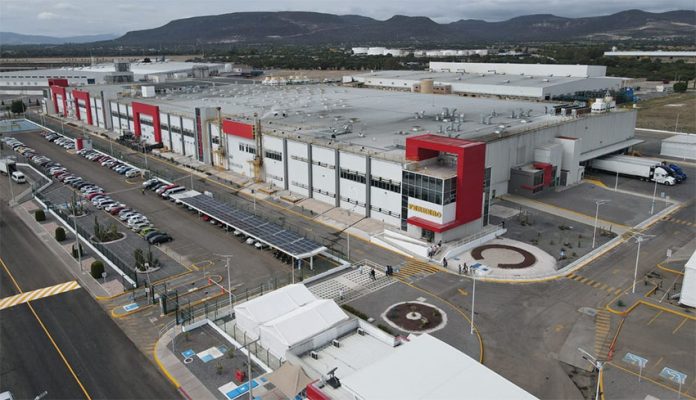
The candy manufacturer and distributor Grupo Ferrero announced that they planned to invest US $50 million to expand their industrial operations in Guanajuato, on the Bajío states. Gobierno de Guanajuato
Construction and development of new industrial space in the region known as el Bajío — which includes Aguascalientes, Guanajuato, Querétaro, and San Luis Potosí — is booming, pushed in large part by nearshoring in the car manufacturing industry. As of the end of September, 455,000 square meters of industrial space was reportedly under construction, an increase of 36% compared to the same period of 2021.
Rodrigo Folgueras, regional head of the real estate consulting firm CBRE in the Bajío region, said that the expansion of logistics companies which settled in the region during the COVID-19 pandemic is expected to continue as industrial construction recovers. Folgueras expects to see strong growth from Querétaro-based companies in particular, he said. He also noted that much of the growth in the Bajío region has been driven by the expansion of companies already in the area.
Folgueras said that the demand from automotive and light manufacturing industries will continue thanks to the region’s advantages in location, labor force, and infrastructure. He added that “nearshoring,” which is currently happening at the Mexico-U.S. border, will also occur in the Bajío region.
“It is foreseen that nearshoring, which has attracted investments in the Mexico-U.S. border industrial markets, will also happen in the Bajío, particularly from companies within the automotive sector, which constitute an important cluster in the region,” said Folgueras.
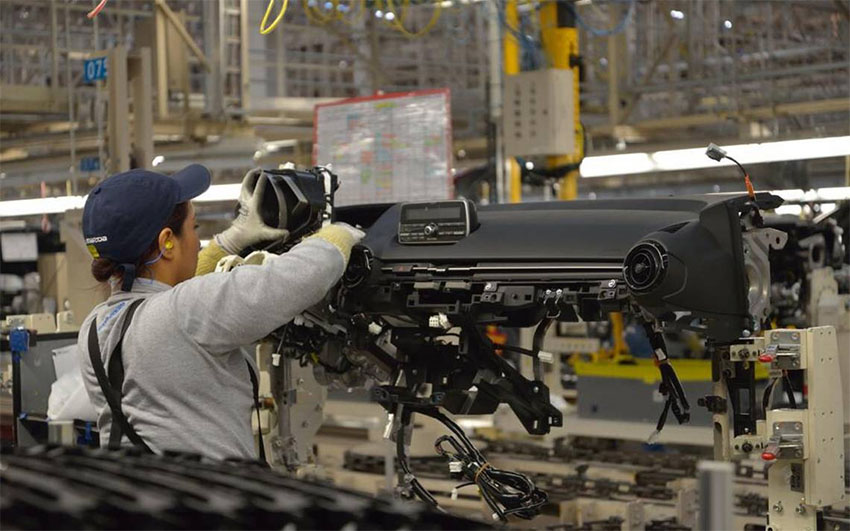
A woman assembles a car dashboard at a manufacturing plant in Guanajuato. Gobierno de Guanajuato
Aby Lijtszain, CEO of Traxión, a transports and logistics Mexican company, said during a press conference that nearshoring in Mexico is directly related to merchandise transportation between Mexico and the U.S., and that it constitutes 25% of Traxión’s revenue.
According to Forbes México Magazine, companies in developed countries are betting on nearshoring to increase efficiency and reduce costs. Companies looking to transfer their operations closer to their main destination markets in response to continued supply chain disruptions — such as the Russia-Ukraine war and COVID-19 policies in China — are turning to Mexico.
Héctor Guerrera Herrera, Deputy Minister of Trade and Industry in the Economy Ministry celebrated the recognition Mexico has obtained from companies already established in Mexico owing to nearshoring in comments at the 2022 Annual Meeting of Industrialists. “Relocation of companies has mainly happened in the north and the Bajío area,” he said.
According to CBRE, the Bajío is one of the top areas in the country in terms of land availability for building industrial warehouses — almost as much as northeastern industrial powerhouses like Monterrey, Nuevo León, and Saltillo, Coahuila.
Folgueras also said that Guanajuato and Querétaro are the most sought-after states for industrial space, a trend driven mainly by manufacturing companies over the last three quarters.
At the end of the third quarter, both amounted to 80% of the net absorption , or net change in the supply of commercial space available. That 80% represents 200,000 square meters that are mainly occupied by companies in the automotive, aerospace, warehousing, transportation, and food and beverage industries.
During the fourth trimester of 2021, the industrial corridor with the largest construction area was León, Guanajuato, with more than 55,000 square meters to be delivered by the end of 2022.
According to the Economy Ministry, the Bajío region, which includes 19% of all industrial space in the country, totaled US $2.7 billion of foreign direct investment (FDI) in the first semester of the year, surpassing by 9% the amount collected in the same period of 2021.
While the influx of foreign direct investment has increased, the gross investment amount is close to that of 2019 when the region received $2.1 billion, but still lower than 2018 when the gross amount reached $4.7 billion.
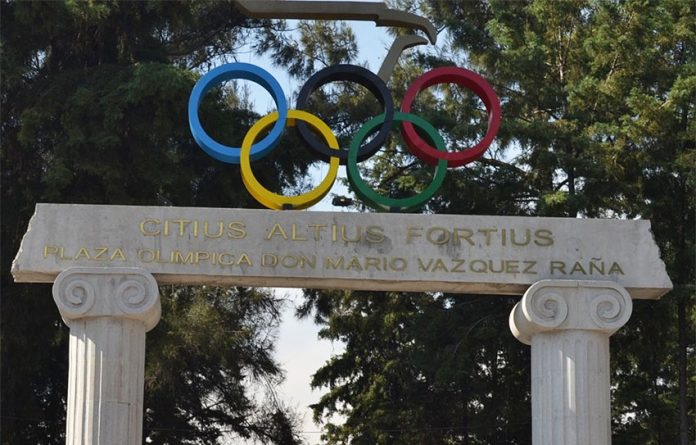
Mario Vázquez Raña Olympic Plaza at the national Olympic sports center in Mexico City.
Mexico is officially vying to host the Summer Olympic Games for a second time in 2036.
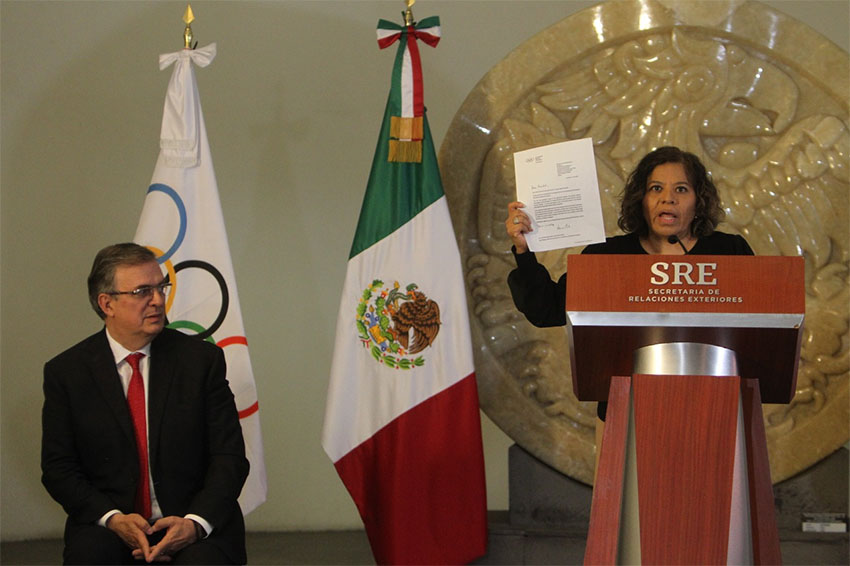
Foreign Affairs Minister Marcelo Ebrard and Mexican Olympic Committee president María José Alcalá Izguerra announced Wednesday that Mexico was bidding to host the Games in the former year but would set its sights on 2040 if unsuccessful.
“Our goal is to bring the Olympic Games to Mexico in 2036, or if not [that year] 2040 because that’s the way the system works,” Ebrard told a press conference.
“You nominate for one year and … you can compete again [to host the following Olympics] if you’re not chosen by the International Olympic Committee. Of course we know that there are other cities [that will compete to host the Games], it’s a competition,” he said.
The foreign minister didn’t nominate a potential host city, but Mexico City – which in 1968 became the first Latin American city to host the Olympics – would appear to be the most likely candidate.
Ebrard asserted that Mexico is a strong contender to host the quadrennial sporting event, the next edition of which will be held in Paris in 2024. “We see ourselves as a winning, successful, ambitious country that is respectful of international norms,” he said.
“… Mexico is a sporting power and a vigorous country with a strong democracy, solid institutions and an economy that is today one of the best in the world,” said Ebrard, who could be in a position to oversee Mexico’s preparations to host the Olympics if he achieves his goal of securing the ruling Morena party’s nomination and winning the 2024 presidential election.
He also noted that in 2026 Mexico will become the only country to have hosted three FIFA World Cups.
Foreign Affairs Minister Marcelo Ebrard and Mexican Olympic Committee president María José Alcalá Izguerra announced Mexico’s goal to once again host the Olympics at a Wednesday press conference. Secretaría de Relaciones Exteriores
Alcalá said that Mexico has been considered a viable candidate to host a future Olympics since July, when International Olympic Committee president Thomas Bach sent a letter expressing his support for a bid.
Ana Gabriela Guevara, an Olympic medalist and current director of the National Commission for Physical Culture and Sport, asserted before Wednesday’s press conference that it was economically unfeasible for Mexico to host the Games.
But Ebrard said that the way in which Olympics are financed has changed and that the federal government would cover just 10% of the total cost. He also said that Mexico already has infrastructure that could host events at an Olympic Games next decade.
The foreign minister said that Mexico will undertake the studies requested by the International Olympic Committee (IOC) while taking into account “the changes that have taken place in the Olympic Games financing.”
“… Cities shouldn’t adapt to the Olympic Games, the Olympic Games have to adjust to the [host] cities,” he said. “We would have 15 years, enough time to organize [the event]. If Mexico proposes something, it is to achieve it.”
Other countries where officials have expressed some interest in hosting the 2036 Games include the United Kingdom, South Korea, Egypt and Germany. The IOC is expected to decide on the host city sometime in the second half of this decade.
An Olympic Games here would be just the third in Latin America after Mexico City 1968 and Rio 2016. Mexico City’s hosting of the international event 54 years ago was marred by the Tlatelolco massacre in which hundreds of protesting students were killed by the army just 10 days before the opening ceremony.
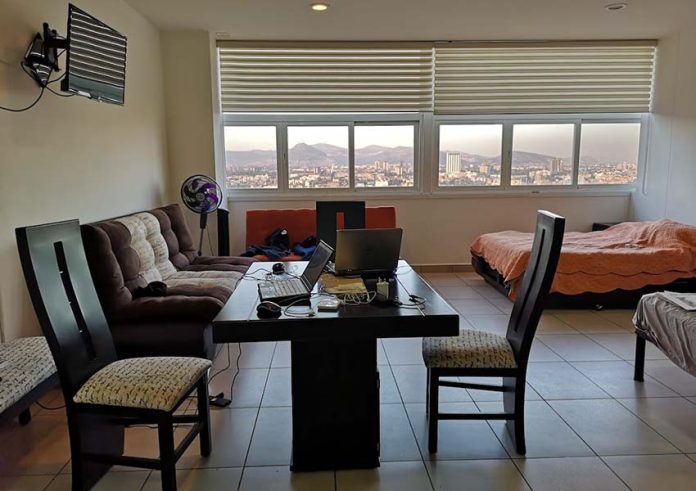
Airbnb and the city government hope to lure foreign digital nomads with affordable but well-appointed accommodations and the promise of a cultural adventure. Laurentiu Morariu/Unsplash
The Mexico City government has entered into a partnership with the accommodation booking platform Airbnb and the United Nations Educational, Scientific and Cultural Organization (UNESCO) to promote the capital to digital nomads.
Airbnb said in a statement that the partnership will also “showcase cultural and creative stays and experiences on Airbnb that enhance Mexico City’s reputation as the capital of creative tourism.”
Airbnb said that its partnership with the Mexico City government and UNESCO will support the capital’s “ambition to become a global hub for remote workers and the capital of creative tourism.”
Sheinbaum, seen with Airbnb and UNESCO representatives, said the partnership is good for Mexico City. Claudia Sheinbaum/Twitter
“Guests come to Airbnb to look for unique and special experiences hosts provide, and these partnerships will help ensure there is an abundance of uniquely Mexican experiences on offer,” it added.
The company also said that “Mexican entrepreneurs will participate in UNESCO-led trainings to develop authentic cultural experiences that represent Mexico City’s unique, cultural and creative traditions.”
At an event in the capital, Airbnb cofounder Nathan Blecharczyk said that his company was proud to partner with the city government and UNESCO to “cultivate the next generation of cultural entrepreneurs…”
“With the rise of remote working around the world, destinations must consider how to ensure that the benefits of remote work are felt by the wider community. The best approach is one that not only attracts remote workers but also integrates them into communities so that all residents can benefit from this rising trend,” he said.
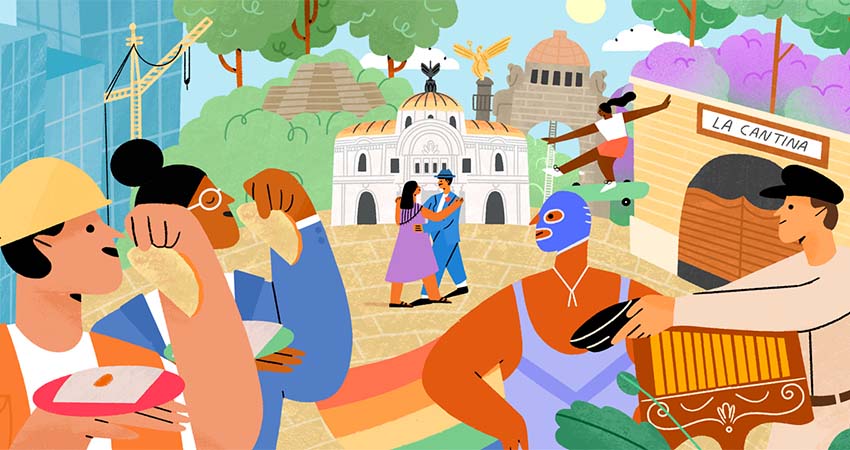
The front-cover image of Mexico presented to digital nomads in Airbnb’s new PDF guide to visiting Mexico City. Airbnb/CDMX government
Some Mexicans have expressed concerns about the influx of digital nomads to certain parts of the capital during the pandemic, asserting that their presence has pushed up rents and driven locals out of desirable neighborhoods such as Roma and Condesa.
But Mexico City Mayor Claudia Sheinbaum said that the alliance with Airbnb won’t result in higher rents. She did say, however, that her government is reviewing the impact remote workers have had on rents in Roma, Condesa and other central neighborhoods popular with digital nomads.
“We asked the planning institute to do a review. We have no [knowledge] that … [higher rents] are associated with Airbnb,” Sheinbaum said.
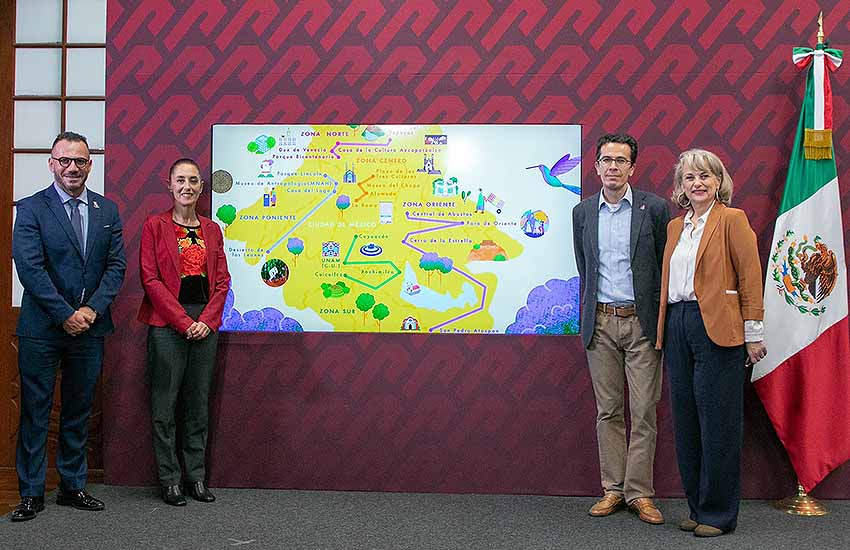
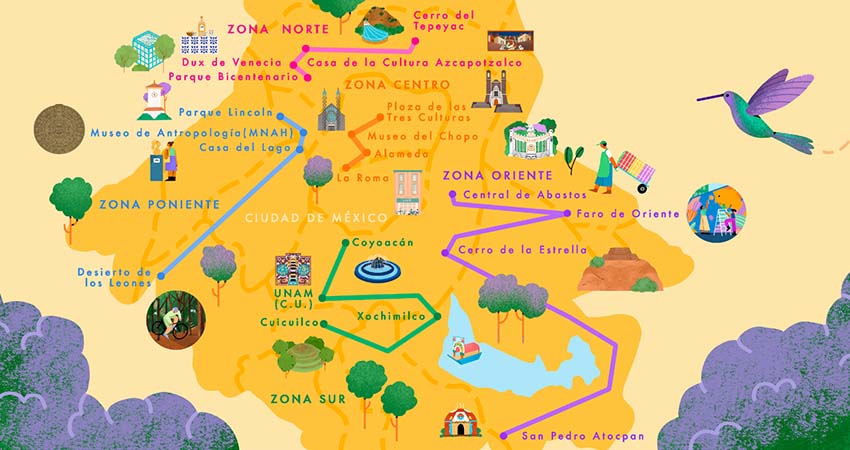
Ángel Terral, Airbnb’s Mexico director, said that parts of the capital beyond the “traditional tourism corridor” will be promoted via the alliance with the city government and UNESCO. Places such as the Central de Abastos – the capital’s massive wholesale market in the sprawling Itzapalapa borough – and the Desierto de los Leones National Park on the city’s southwestern outskirts are featured in a PDF guide that can be downloaded from Airbnb’s new Mexico City website.
The guide highlights landmarks, historical sites and neighborhoods of cultural note in the capital. Airbnb/CDMX government
Mexico City Tourism Minister Nathalie Desplas said that the partnership will help the capital tap further into a lucrative market.
There are approximately 30 million digital nomads around the world, 15.5 million of whom are U.S. citizens, she said. If just 5% of the latter number spend time in Mexico City each year, they will inject some US $1.4 billion into the local economy, Desplas said.
“If they come with their partner or family, we found that [revenue] could be $3.7 billion a year; that’s the impact … digital nomads [can have],” the tourism minister said.
She added that Mexico City meets all the needs of such visitors as it is safe, has an air and land transport hub and good internet connections. Desplas also noted that the capital’s coworking and co-living spaces make it an attractive destination.
“The majority of the [digital] nomads are young, and they want spaces where they can work,” she said.
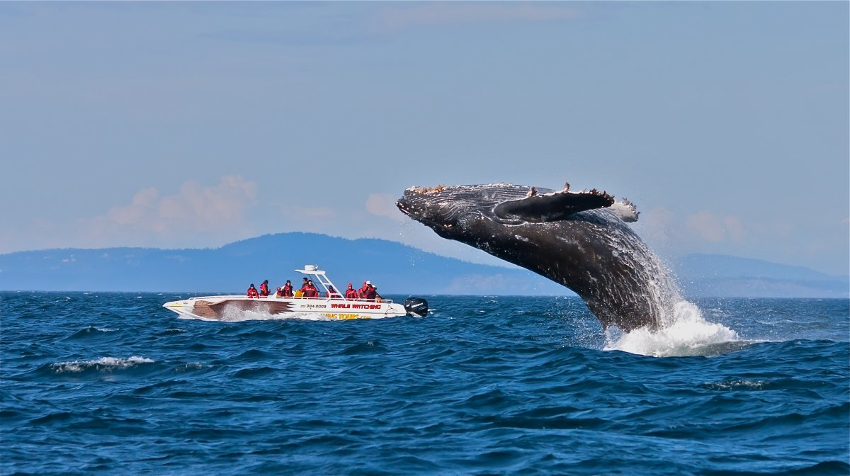
Whale-watching dates for the upcoming season were published in the government’s official gazette on Oct. 19, as well as rules that apply to observation spots and restricted zones in eight states on the western coast of Mexico: Baja California, Baja California Sur, Nayarit, Jalisco, Sinaloa, Sonora, Oaxaca, and Guerrero.
The whale-watching season will go from mid-December to April in most states, though in Baja California the whales can be observed all the way to mid-May and in Guerrero the season ends as early as March.
Every year, as the northern ice pushes southward, whales migrate from the cold Bering and Chukchi seas near Alaska to Mexico’s warm Pacific coastal waters to breed, attracting a great number of tourists to watch the migration.
According to the International Whaling Commission, Mexico is now the most popular whale-watching destination outside the United States.
Whale watchers in Mexico @Mexico Twitter
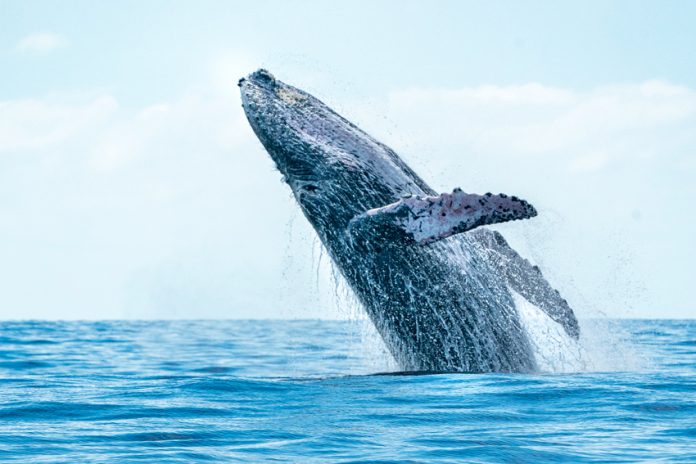
Whale-watchers can spot grey, blue, and humpback whales on their journey along most of Mexico’s Pacific coastline. To protect the natural habitat of the whales, the Ministry of the Environment and Natural Resources (Semarnat), in accordance with current Mexican environmental laws, has restricted access to certain areas.
In the Baja Peninsula, whale-watching is banned in a 2-kilometer zone around the Arch of Cabo San Lucas as well as offshore from Punta Ballenas in order to prevent excessive conglomeration of boats.
For the same reason, the Bahía de Acapulco and the Bahía de Puerto Marqués – both in the municipality of Acapulco de Juárez – have also been designated as off-limits.
To prevent disturbing whales with newborn calves, an area from Punta Mita to the mouth of the Ameca River has been made a restricted zone.
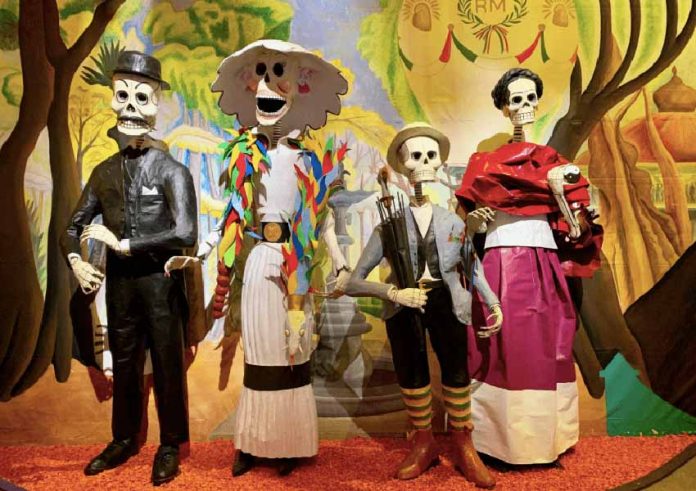
A papier mache calaca version of Diego Rivera’s mural, "Dream of a Sunday afternoon in Alameda Park," part of the annual mega altar set up annual by the Dolores Olmedo Museum in Mexico City.
In the opening scenes of the James Bond film Spectre (2015), giant skeleton puppets parade down Mexico City streets, and Bond himself wears a skull mask with very regal clothing.
The parade was fictitious at the time, but its focus on depictions of skeletons (calacas) and skulls (calaveras) had basis in reality. Skeletons that imitate those of us of flesh and blood have been a part of Day of the Dead for some time.
One other positive nod for Bond: the puppets and masks were made of papier mache, a Mexico City tradition, and the skeletons were created by a local folk art cooperative, La Última Hora.
Calacas are not only central to Day of the Dead, they have become central to Mexican identity both inside and outside the country. Skeletons and other depictions of death date back to way before the arrival of the Spanish.
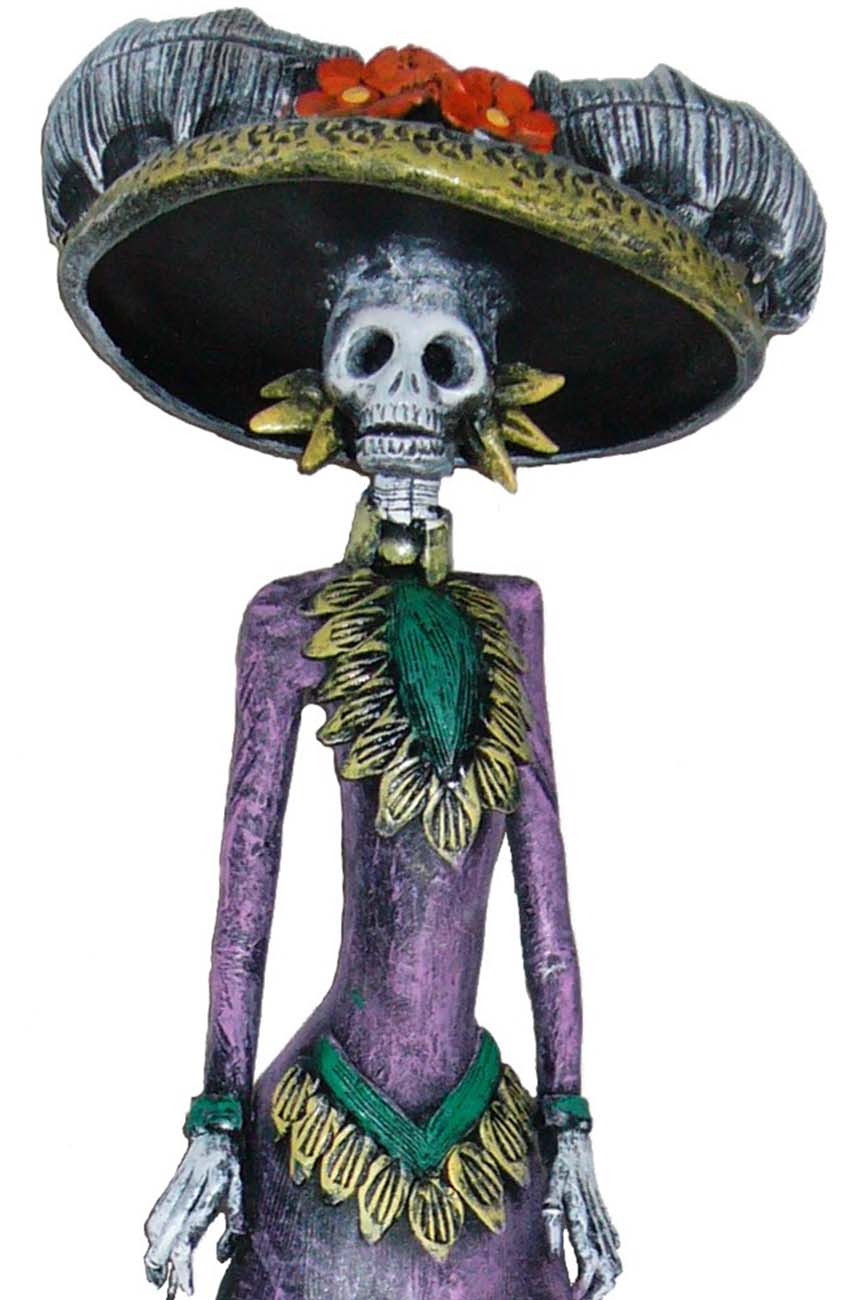
The famed skeleton figure La Catrina, inextricably associated with Day of the Dead, is just one example of a calaca.
Missionaries tried to stamp out Mesoamerican beliefs about death, or at least co-opt them into Catholicism, but they were never completely successful. Instead, imagery and meanings keep evolving along with Mexican society.
Calacas today tend to represent one or more of three things: the fleeting nature of life; an acknowledgement of the reality of death by the living; or a reinforcement of Mexican identity, especially as it relates to the past.
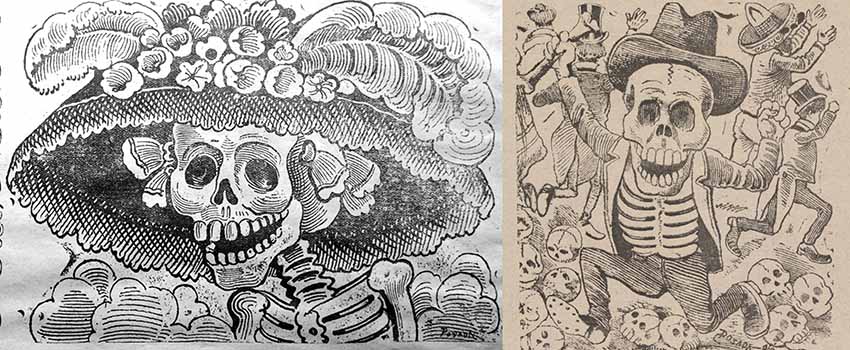
These modern interpretations have their origin with the work of political cartoonist José Guadalupe Posada (1852–1913). He created a myriad of clothed and active calacas reflecting the social and political reality of pre-Revolution Mexico. The most famous of these is La Catrina.
That was not his name for her. The original drawing was a skull wearing an ornate floral hat popular with late 19th-century upper-class women. They, and other European-style trappings, were also popular among mestizo and indigenous merchants who sold the fine ladies chickpeas and other “distinguishing” foodstuffs. Posada named his calaca figure La Garbancera (Chickpea Seller), and it was his criticism of women who denied their own heritage for financial gain.
It is more accurate to say that the La Catrina we know today is the creation of both Posada and Diego Rivera. Posada died in obscurity, but post-Revolution cultural authorities saw in his work an antecedent for the values they looked to promote. The name La Catrina first appears in a 1930 book about Posada, which Rivera was involved with. But the artist’s main contribution came through the 1948 mural Dream of a Sunday afternoon in Alameda Park.
Here, La Catrina not only has a body, a dress and a feather boa, she is surrounded by many past and contemporary Mexican notables, including Rivera himself as a child holding the calaca’s hand. The symbolism here is clear: death comes for everyone, no matter the social status.
Nowadays, La Catrina is so iconic, she is not really considered to be a calaca. She is classed separately, accompanied only by a “mate,” El Catrín, a dandy skeleton in clothes from the same time period.
So what about all the other calacas? Most have a more modern appearance, show doing both traditional and modern activities. Not so much has been written about them, but full disclosure, I did dive into the subject for my book “Mexican cartonería: Paper, paste and fiesta.”
La Garbancera, left, is the original version of La Catrina by José Guadalupe Posada. On the right is one of Posada’s other calacas making fun of Mexico’s regional strongmen, known as caudillos.
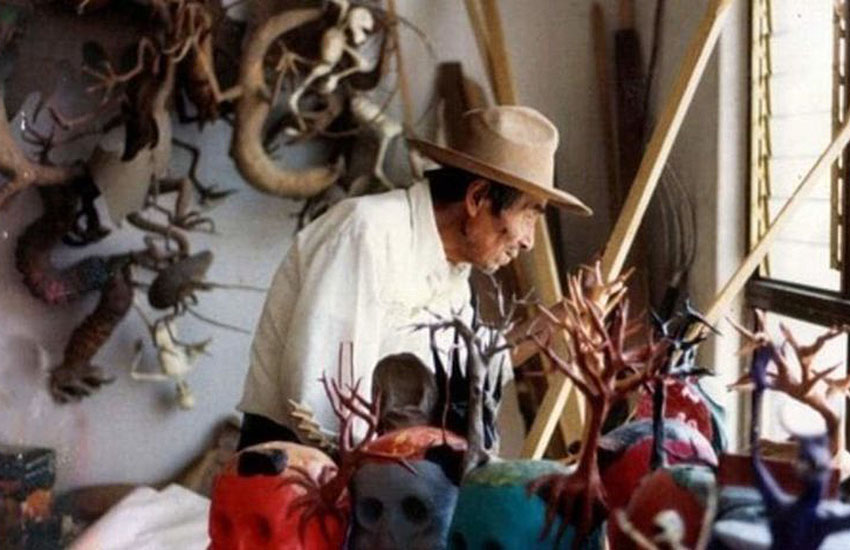
For the status they enjoy today, if not their outright creation, modern calacas should absolutely be credited to Mexico City papier mache artisan and maestro, Pedro Linares (1906–1992), best known for his colorful monsters called alebrijes, but he has not received the credit he deserves for his calacas.
Papier mache artisans traditionally make festival paraphernalia. Piñatas are the best-known, but in central Mexico, they make much more than that.
The most traditional work for Day of the Dead is a skeleton assembled from a paper skull and bones, joined together with cords so that the figure can dangle in the air.
Skeletal figures appear in the opening scenes of the classic movie Macario (1960), but some are static and have sombreros and musical instruments. There is nothing in the credits, but both experts and the Linares family agree that the work is clearly by maestro Pedro.
Linares, who had contact with the artists and intellectuals of his day and was aware of the work of Posada and other iconic artists despite his very humble origins, took calacas from mere decoration to folk art, thanks to his artistic talent. As his fame grew from the 1950s on, he received increasingly-important commissions for calacas, and not just for Day of the Dead.
In 1968, he made 70 life-sized figures for the Mexico City Olympics, followed by La Muerte Tembloroso (The Tremoring Death), his depiction of the aftermath of the 1985 earthquake. His Atomic Apocalypse: Will Death Die? was made for England’s Museum of Mankind.
His work is why artisans today can make calacas year round but are busiest in the months before Day of the Dead.
Calacas and calaveras are made from just any material imaginable, from edibles (like sugar) to resin. They are still most frequently found on public and monumental altars for Day of the Dead.
The late great Pedro Linares was better known for creating Mexico’s alebrijes, but he also created masterful calacas.
One important subset of calacas are those which depict personages from Mexico’s past. Since the skeletons do not have faces, the person is identified through the calaca‘s clothing, pose and accessories.
These are very common on school and other government-sponsored altars, but perhaps the finest example is in Train of History, a project sponsored by the Mexico’s Museum of Popular Art for the country’s 2010 bicentennial. The work consists of boxcars, each with a scene from Mexico’s history. These include a depiction of Miguel Hidalgo’s patriotic Cry of Dolores speech, made from many different materials by artisans from different parts of Mexico. It was not created for Day of the Dead, but it is often exhibited at this time of the year.
Leigh Thelmadatter arrived in Mexico 18 years ago and fell in love with the land and the culture in particular its handcrafts and art. She is the author of Mexican Cartonería: Paper, Paste and Fiesta (Schiffer 2019). Her culture column appears regularly on Mexico News Daily.
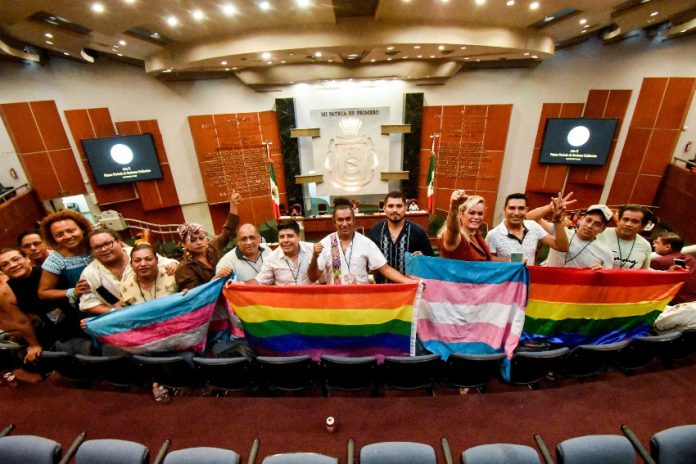
Guerrero is the seventh state to legalize same-sex marriage this year FOTO: DASSAEV TÉLLEZ ADAME/CUARTOSCURO.COM
Guerrero has become the 31st federal entity to legalize gay marriage, leaving just one state without laws permitting matrimony between same-sex couples.
Thirty-eight of 46 lawmakers in the unicameral state Congress voted in favor of legalization, six opposed the legislation and two abstained. Tuesday’s vote came less than a week after the Tabasco Congress legalized same-sex marriage.
Tamaulipas is now the only state that doesn’t allow couples of the same sex to marry, but lawmakers in the northern border state are expected to legalize the practice soon.
Guerrero’s legalization bill – which changes the legal definition of marriage to a union between two people rather than a man and a woman – was presented by lawmakers with Morena, the party founded by President López Obrador.
Yoloczin Domínguez Serna, Morena’s parliamentary leader, said that legalization of gay marriage reaffirms the Congress’ opposition to all kinds of discrimination.
Ricardo Locia, an anthropologist and gay rights activist, said that the approval of gay marriage in Guerrero is akin to payment of a “historic debt” to members of the LGBT community who have been victims of crime including murder due to their sexuality.
Guerrero is the seventh state to legalize same-sex marriage this year after Durango, Jalisco, Yucatán, Veracruz, México state and Tabasco. Several other states, including Guanajuato, Querétaro and Zacatecas, approved marriage equality in 2021.
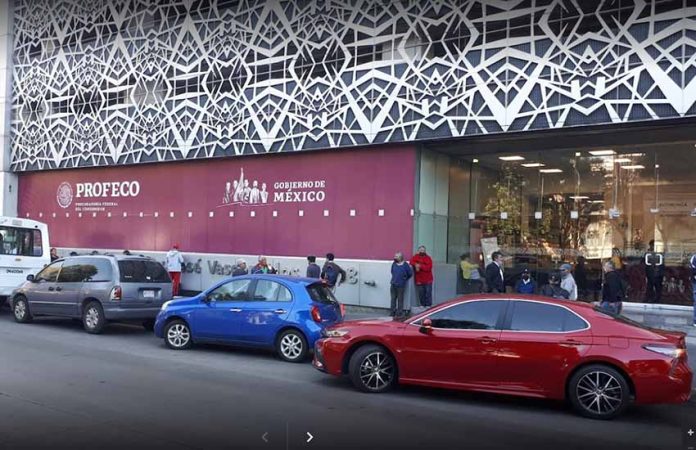
The nation's consumer protection agency Profeco filed the suit against the cable internet company on behalf of more than 4 million subscribers.
The federal consumer protection agency Profeco has filed a class-action lawsuit against the Mexican telecommunications company Megacable due to increasing consumer complaints about the company’s recurrent service failures.
The legal action demands that Megacable deliver its contractually obligated services on behalf of more than 4 million subscribers, under the premise that failure to do so violates the user’s human right to access to communication and information technologies.
Under Mexico’s Consumer’s Federal Protection Law, Profeco may sue whenever the constitutional rights of a group of consumers are harmed; Mexicans’ right to access communications and information technology is protected by the nation’s constitution.
In a statement, Profeco said that among users’ main complaints were the frequent loss of connectivity for long periods and undue charges despite Megacable’s service outages.
According to the agency, Megacable is the telecommunications and cable television operator that had accumulated the most complaints per million subscribers in recent months – an increase that was noticed across different states in Profeco’s Consumer Defense Offices. The Federal Institute of Telecommunications also reported that Megacable ranks second among Mexico’s companies with the most complaints reported as of June this year.
Internet service failures were the main complaint, followed by disagreements about charges, pending balances and outage reimbursements.
Earlier this year, the federal agency targeted AT&T México with a class-action lawsuit. In May, the agency sued the company over a subsidized equipment charge. Profeco objected to an annual 225-peso (US $11) charge to AT&T México customers acquiring devices by paying in monthly installments.
Profeco and AT&T México later reached an agreement in which AT&Tagreed to pay back the charges to 844,000 users. Those who had stopped using the company were entitled to compensation of up to 3,000 pesos (US $150), while existing users were to receive a bonus 3-gigabyte data bundle.