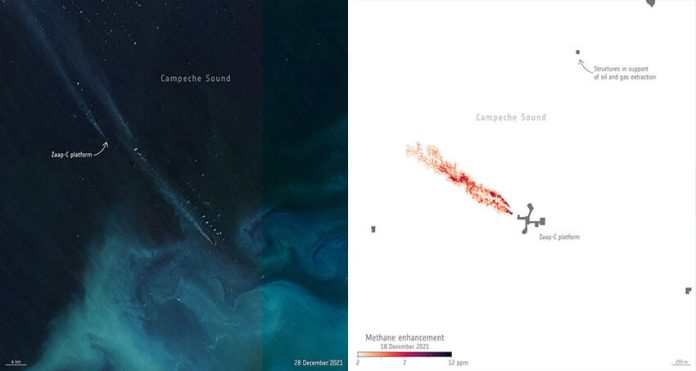
A team of European scientists published a paper earlier this year that details the “ultra-emission event.”
Announcing the results of the study in June, the European Space Agency (ESA) noted that the scientists used satellite data to detect methane plumes from Pemex’s Zaap-C platform.
“This is the first time that individual methane plumes from offshore platforms are mapped from space,” the ESA said. “… The team found that the platform released high volumes of methane during a 17-day ultra-emission event which amounted to approximately 40,000 tonnes of methane released into the atmosphere in December 2021.”
Methane, the main constituent of natural gas, is much more harmful to the environment than carbon dioxide and is considered a major contributor to global warming.
In a statement published Wednesday, Pemex said that a government-commissioned study carried out by the company Solal-Genermasa confirmed that “there were no large emissions of methane” at the Zaap-C platform.
The state oil company said that last December’s emissions had a 22% concentration of methane, while the remainder was made up of nitrogen and other gases “that don’t affect the environment.”
“The images captured by the satellites referred to in the Environmental Science & Technology Letters article were considered, incorrectly and unprofessionally, to be entirely methane gas emissions,” Pemex said.
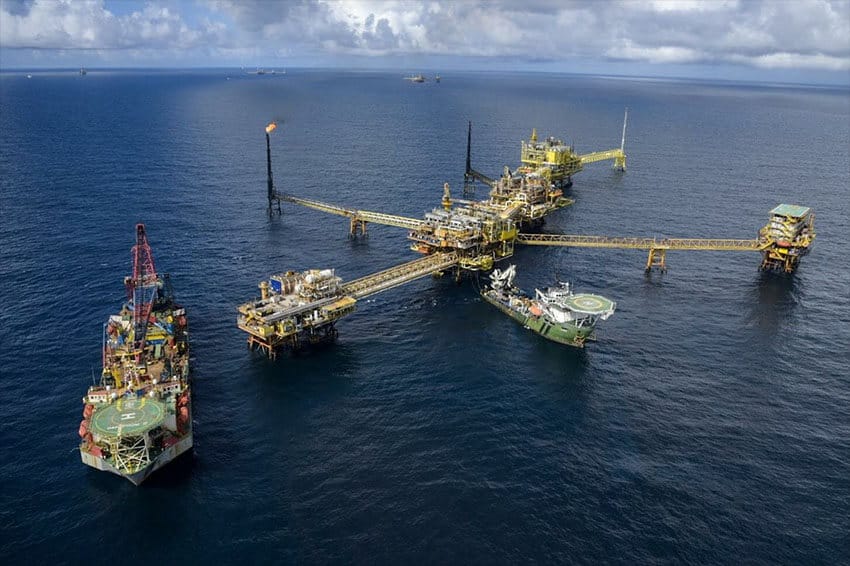
Burning methane is a common way to avoid emitting the gas into the atmosphere, as can be seen in the upper left side of this image of a Pemex processing center off the coast of Campeche. Pemex
The state-owned firm said that the authors failed to “take the care” of asking Pemex for “feedback with regard to the composition of the gas” and the quantity of methane emitted into the atmosphere.
“The company Solal-Genermasa determined … that the emission of methane was 2,224 tonnes, which corresponds to 5% of what was published in the aforementioned article,” Pemex said.
“Finally, it’s important to point out that these emissions were an extraordinary event due to the meteorological conditions,” it added, explaining that there was strong rain and gusts of wind that caused a burner to shut down during the period in question.
Concerns about Pemex’s methane emissions were also raised last year. Daniel Zavala, a senior scientist at the United States-based non-profit Environmental Defense Fund, said in July 2021 that methane was leaking from Mexican gas and oil operations at “alarming and worrying” levels.
A study to which he contributed found that Mexico’s methane leak rate was more than double that of the United States, the world’s largest oil producer.
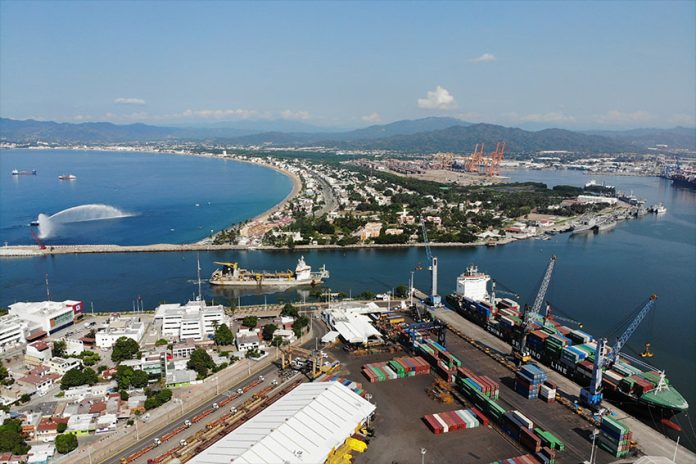
An aerial view of Manzanillo, Colima, an important port of international trade. Fernando Macías Romo / Shutterstock.com
Mexico was the United States’ second largest trade partner in the first seven months of the year with two-way trade worth almost US $450 billion, U.S. government data shows.
United States Census Bureau data published this week shows that two-way trade increased 19.8% between January and July to $449.8 billion. Almost 60% of that amount – $261.9 billion – came from Mexican exports to the United States, while imports from the U.S. were worth $187.9 billion.
The value of Mexico’s exports to the United States increased 20% compared to the first seven months of 2021, while imports from the U.S. rose 19.5%.
Most of Mexico’s export income comes from manufactured goods, including vehicles, machinery, computers and televisions. However, it also sends a range of other products to the United States and other countries further afield, among which are crude oil, fruit and vegetables, chemicals, beer and alcoholic beverages such as tequila, mezcal and wine.
Among the products that Mexico imports are gasoline and other refined fuels – a situation President López Obrador is trying to bring to an end – food (including corn) and consumer goods such as cell phones.
Canada edged out Mexico as the United States’ No. 1 trade partner in the first seven months of the year, with Canadian-American trade totaling $466.7 billion. China ranked as the United States’ third largest trade partner, with Sino-U.S. trade worth $402.3 billion between January and July.
The trade between Mexico and its northern neighbor left the former with a surplus of almost $74 billion so far this year. However, taking into account all trade partners, overall Mexico is running a trade deficit for 2022.
Data from national statistics agency INEGI shows that the value of Mexican exports to all countries around the world in the first seven months of the year was $327.3 billion. Imports in the same period totaled $346.2 billion, leaving Mexico with a trade deficit of $18.9 billion.
Trade surpluses have only been achieved in two months this year – February and March – while there were deficits in January and the four months between April and July. Mexico recorded a trade deficit of $10.9 billion in 2021.
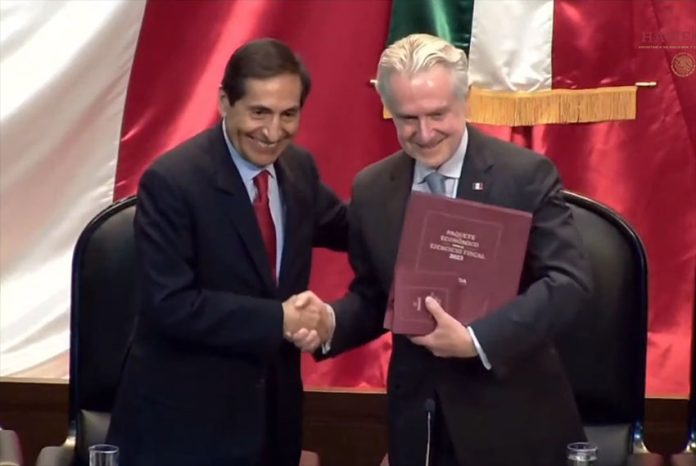
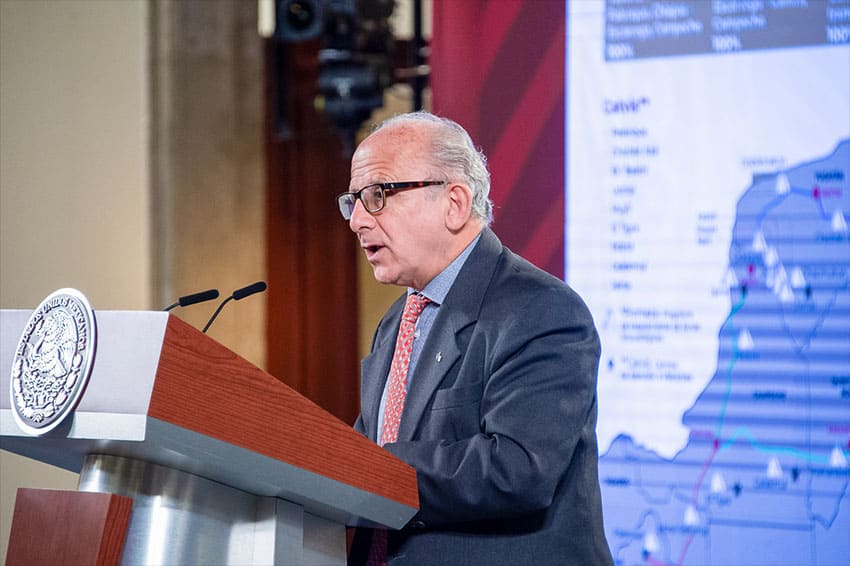
Finance Minister Rogelio Ramírez de la O officially handed over the budget proposal to Congress on Thursday. Screenshot / Secretaría de la Hacienda
Infrastructure projects, seniors’ pensions, health care and social programs are among the big-ticket items in the federal government’s proposed 8.3-trillion-peso (US $417 billion) 2023 budget.
Delivered to Congress on Thursday, the economic package outlines proposed spending whose total is 11.6% higher in real terms than that approved for 2022.
The Ministry of Finance (SHCP), which prepared the budget, said that the package is “aligned with the 2019-24 National Development Plan,” whose purpose is to “achieve an environment of security and general well-being for the Mexican population.”
The proposed expenditure, which must be approved by Congress to be implemented, “confirms the Mexican government’s commitment to maintain healthy public finances despite the complex international situation,” the SHCP said in a statement.
The Tourism Ministry is slated to get 145.6 billion pesos, an increase of 111% compared to the resources it was allocated for 2022.
However, 98% of that amount is earmarked for construction of the Maya Train railroad, one of the government’s priority infrastructure projects. The total cost of the project, which is not yet 50% complete, is now slated to be 230 billion pesos (US $11.5 billion).
The Environment Ministry is also in line to get a substantial funding boost: it received 42.8 billion pesos in 2022 but is set to get 75.6 billion pesos next year, a 77% increase.
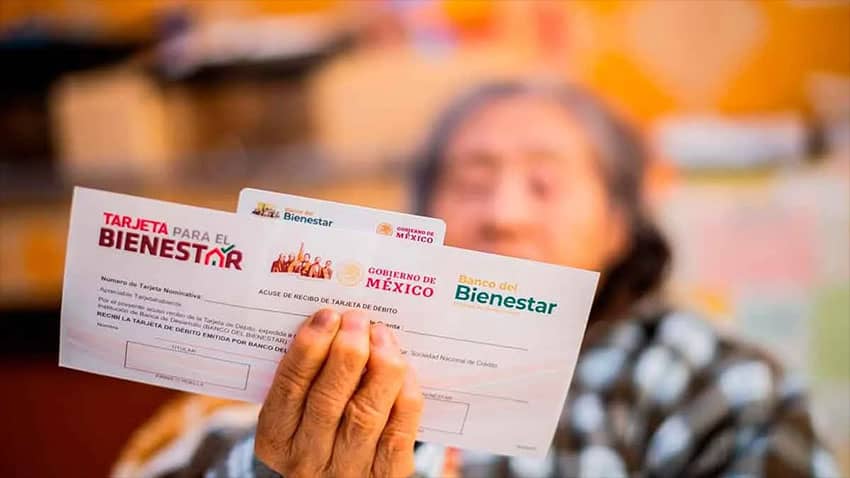
The Welfare Ministry, responsible for paying pensions to seniors and government benefits to citizens in general, is slated to get a more modest 30% increase in funding, but its proposed budget – just over 400 billion pesos – is the largest of any ministry. Over 80% of that amount will go to paying pensions to millions of Mexican seniors.
An elderly woman displays her pension card and Welfare Ministry paperwork for the camera. Twitter @bienestarmx
The SHCP also outlined significant spending on health care. The Mexican Social Security Institute, a major health care provider, is slated to receive over 1.1 trillion pesos – an increase of almost 10% compared to this year – while the Ministry of Health is in line to get 209.6 billion pesos.
Among the other ministries with large proposed budgets for 2023 are Public Education (402 billion pesos) and National Defense (111 billion pesos). The former is responsible for implementing a new curriculum model in the nation’s schools, while the latter is engaged in a range of non-traditional tasks including public security, management of customs and infrastructure construction.
The government has proposed cutting the Federal Electricity Commission’s budget by 6.9% to just under 440 billion pesos, while the state oil company Pemex is slated to get 678.4 billion pesos, a slight increase compared to this year. President López Obrador is determined to “rescue” both state-owned companies from what he describes as years of neglect.
He is also determined to deliver a range of infrastructure projects – including the Maya Train, the Dos Bocas refinery on the Tabasco coast and a new railroad to link the Pacific and Gulf of Mexico coasts across the Isthmus of Tehuantepec – and improve the living conditions of the nation’s most disadvantaged people.
Almost 830 billion pesos are slated to go to the construction of strategic projects next year, while 1.75 trillion pesos is earmarked for social programs, including the pension scheme, the Youths Building the Future apprenticeship scheme and the Sowing Life reforestation and employment program. Some 1.2 trillion pesos is set to go to state and municipal governments, a 14% increase compared to the 2022 budget.
The government’s budget document also includes a range of economic forecasts, including projected income of 7.1 trillion pesos in 2023.
The SHCP forecast GDP growth of 2.4% in 2022 and predicted that the annual inflation rate will be 7.7% at the end of the year, which would be 1% lower that the level reached in August.
The ministry also predicted an exchange rate of 20.6 pesos to the U.S. dollar at the close of 2022 and a central bank benchmark interest rate of 9.5%, one point above the current level. In addition, it predicted an average 2022 price of US $93.60 per barrel of Mexican crude and a production level of 1.83 million barrels per day.
State-owned oil company Pemex is set to receive more than 650 billion pesos, a small increase over the funds it received in 2022. Facebook / Pemex
For 2023, the SHCP forecast growth in the range of 1.2% to 3% and predicted that inflation would come down to within the central bank’s target range of 3% give or take a percentage point by the end of the year. It predicted that a greenback will buy 20.6 pesos at the end of next year and that the key interest rate will be 8.5%. A lower Mexican crude price of US $68.70 is anticipated but output is slated to ramp up to 1.87 million barrels per day.
The SHCP also predicted public debt of 49.4% of GDP at the end of 2023. It highlighted that debt as a percentage of GDP “has only grown four points” since the government took office despite the economic downturn precipitated by the coronavirus pandemic, described as “the worst crisis of the last 80 years.”
It emphasized the role the government’s “prudent fiscal policy” played in keeping debt levels down.
In an address to lawmakers on Thursday, Finance Minister Rogelio Ramírez de la O asserted that the 2023 economic package is “balanced, responsible and realistic” and will drive the country’s economic recovery from the pandemic-induced downturn.
The budget ensures that government will continue to function, but directs the majority of resources to projects that will benefit the well-being of the Mexican people, he said.
The organization is helping poor children in Oaxaca not only get an education but also a childhood they might not otherwise have because their families need them to work.
Anyone who has visited the state of Oaxaca can attest that it is a magical place. Mexican and not Mexican at the same time, it distinguishes itself from the rest of the country by preserving many of its socio-political structures from the past. However, there is a downside.
Much of that preservation exists because of historical, geographical and socioeconomic isolation.
Like the rest of Mexico, Oaxaca is mandated to provide free, public and secular education to all the state’s children. But as one of the country’s poorest states, making that a reality requires more than just laws and regulations.
“Free” education comes with costs to families, including school uniforms, books and other supplies. Plus there is the hidden cost of lost income from children who could be earning a few pesos the family often needs to make ends meet. Almost 70% of the state’s population lives under the poverty line, and about 30% in extreme poverty. Before the COVID-19 pandemic, the dropout rate by seventh grade was already at 15%, one of the highest in the country.
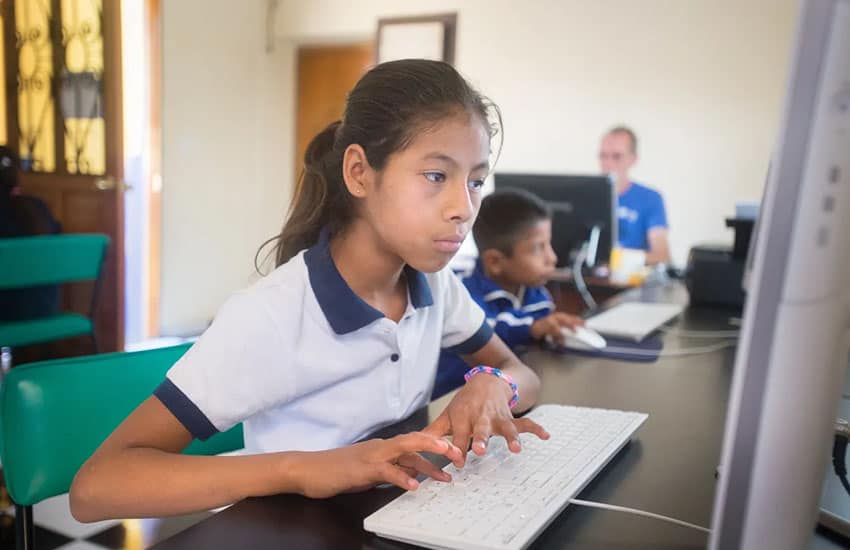
During the pandemic, OSG provided computers and internet access, a luxury most of the children they support don’t have.
Oaxacan children, on average, complete only 6.4 years of schooling, compared to the national average of eight years and 10.5 years for Mexico City. The situation is worse in the rural and indigenous communities, but it is also a serious problem in the city of Oaxaca, in part because it receives migrants from other parts of the state.
In the 1980s, Missouri expats Jodi and Harold Bauman noticed the visible effects of this lack of schooling and other opportunities through the large number of school-aged children working and hanging out on the streets day and night. These included kids from the city’s migrant Triqui community, whose original homeland is west of the city of Oaxaca.
The Baumans first worked with a Triqui family, helping them get their children enrolled in school and supporting their education. By 1996, when they officially foundedOaxaca Streetchildren Grassroots (OSG), the Baumans were supporting about 70 children.
OSG calls itself a “need-based, comprehensive program for children and young adults that gets them off the street and provides the opportunity to attend school…” They do this by subsidizing costs to families, along with providing nutritious meals, tutoring, a computer lab, a library and even some medical and dental services.
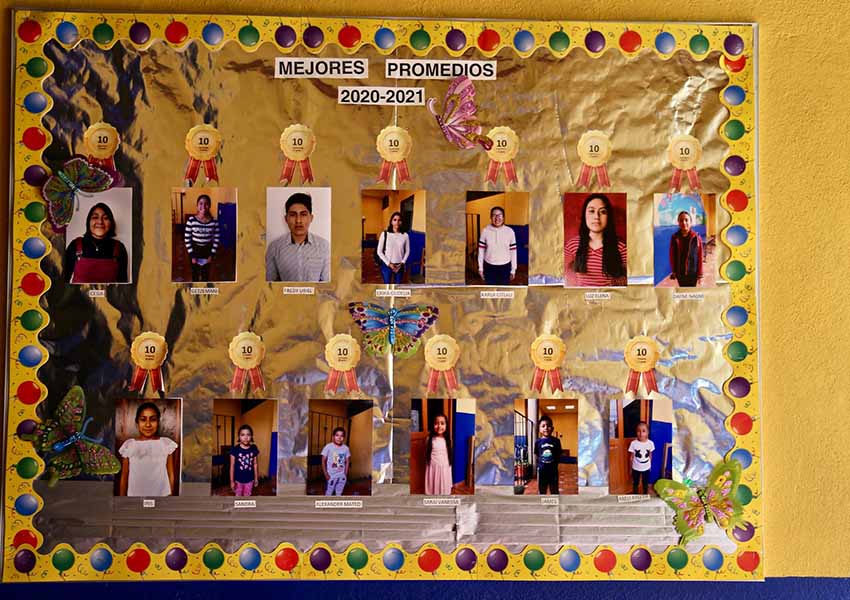
Students are encouraged to stay in school with not only logistical support and money but by having their achievements, like high grade point averages, celebrated.
The organization is registered both in Mexico and the United States, but until now, its main installation has been the Centro de Esperanza Infantil (Center for Child Hope) in Oaxaca city. Over the past 26 years, the charity has matured enough to have paid staff, but most of the work is done by volunteers — many of them expats and students on exchange programs.
Kendall Chase Hitch volunteered with the organization as an exchange student. He worked with a teen girl to get her through high school, then worked on the board.
“It’s a really nice place.” she says, “They do a lot of work with, and they help a lot of, different families, a lot of different kids. It has a rich history. A lot of foreigners have kind of come to know a different side of Oaxaca from that experience of working with the kids there and getting to know their families and making a difference in their lives.”
She adds that it is a good way to get to know “…the real Oaxaca.”
During the pandemic, OSG provided families with care packages of food.
The organization has also gone from supporting mostly Triqui children who had never been to school to supporting multiple programs centered in an old colonial building at Calle Crespo 308 that the charity bought in 2000. Early programs looked to get children to complete at least the sixth grade, but today, qualifying students can receive support for higher levels of education, even postgraduate studies.
At the moment, they have 651 students enrolled for support from elementary to high school. As of August 2022, 139 have graduated from college with degrees that will support their communities in fields such as accounting, English teaching, law, medicine/dentistry, nursing, primary education and more.
The various programs have filled the original center to capacity, but in 2021, the organization received a grant to open a second site in the nearby town of Xoxocotlán. Opening September 10th, the new center will offer even more services than the first and will serve up to 200 children.
But the success and growth of the program do not mean that it has not faced its share of challenges.
Promotional poster.
During the pandemic, the main center had to close temporarily, but the families they serve still needed support. They adapted by delivering food packages and setting up sites to give their children access to the Internet — a necessity for the distance education that the Mexican school system provided during the height of the pandemic.
The challenge right now, board member Marla Jensen says, is rising inflation.
I went looking for any negatives I could find about this organization. The only one I could find was a capstone thesis project by Jonathan Power at the School of International Training that warns that program participants can develop a “…false consciousness about assimilation into middle-class Mexican society.” This may be the case, but much of that has to do with the state of Mexican society, rather than whether or not indigenous and/or very poor children should or should not get as much education as possible.
On the plus side, there is nothing but praise for the Oaxacan Streetchildren from organizations such asGuidestar,Charity Navigator andGreat Nonprofits. They have also received support from foreign organizations such asGrassrooots Volunteering (its parent organization), Grace Lutheran Church, the Rotary Club andSocial Work Sin Fronteras, which does cross-cultural immersion in Oaxaca and is organized by the University of California at Berkeley’s School of Social Welfare.
Leigh Thelmadatter arrived in Mexico 18 years ago and fell in love with the land and the culture in particular its handcrafts and art. She is the author of Mexican Cartonería: Paper, Paste and Fiesta (Schiffer 2019). Her culture column appears regularly on Mexico News Daily.
In 1975, Queen Elizabeth II and Prince Philip got a hero's welcome in Mexico City. (Archive)
“Dressed in a peacock blue and gray print dress and matching hat, the queen was greeted by local dignitaries and members of the British community,” read a United Press International account of Queen Elizabeth II’s visit to Puerto Vallarta in 1983.
The monarch, who died today at age 96 at Balmoral Castle in Scotland, counted two journeys to Mexico among the many international state visits she made during her 70-year reign, the longest ever by a British monarch.
On that visit in the eighties, she stuck to the Pacific Coast as she visited Acapulco in the state of Guerrero, Lázaro Cárdenas in Michoacán, Puerto Vallarta in Jalisco and La Paz in Baja California Sur from February 17–25.
Her first visit was in 1975, when she saw Mexico City, Guanajuato, Oaxaca, Yucatán and Veracruz in just a few days, from February 24 through March 1. That first whirlwind journey across Mexico was more than two decades after she had been crowned on June 2, 1953.
Queen Elizabeth II visit to Mexico 1975
Footage chronicling Queen Elizabeth’s debut visit to Mexico in 1975.
When she finally did visit Mexico, accompanied by her husband, Prince Philip, the Duke of Edinburgh, Mexico’s president was Luis Echeverría Álvarez. Although relations between Mexico and the United Kingdom dated back to the early 19th century, this marked the first official visit of a British monarch to Mexican lands.
The royal couple arrived on the 412-foot Royal Yacht Britannia to Cozumel, where they barely set foot on soil: immediately after leaving the yacht, they boarded a plane to Mexico City. There, the royals were received by Echeverría and his wife, María Zuno Arce. The visit coincided with Día de la Bandera (or Flag Day), so children filled the capital’s zócalo with rhythmic boards, gymnastics demonstrations, choirs and colorful pom-poms to welcome the royals.
That celebration ended with the president and his wife accompanying the monarchs on a tour of the city aboard an open car, with the streets full of cheering observers. Afterward, the royal couple stayed a couple of days at the Camino Real hotel, taking time to visit Echeverría at his private residence in San Jerónimo, south of the city.
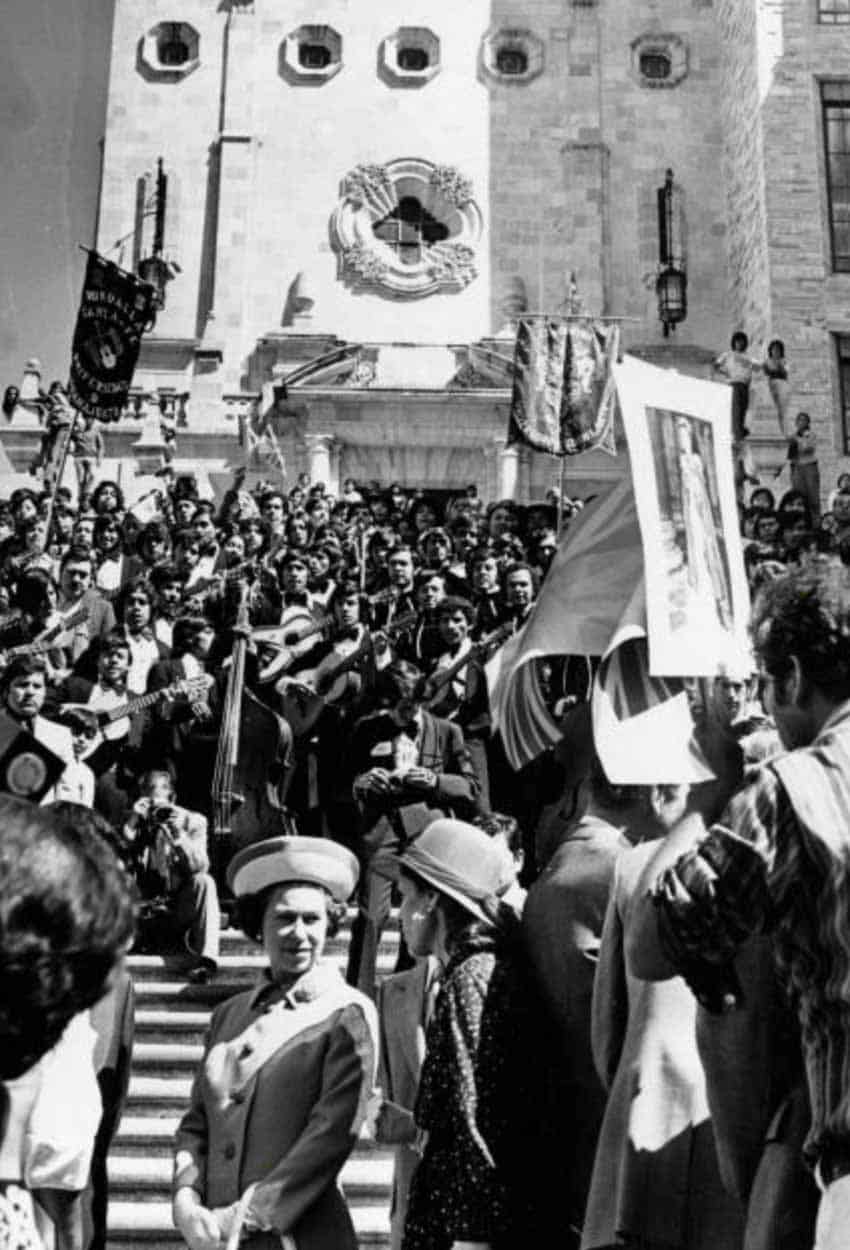
The next leg of the trip included a train ride to Guanajuato city, where the royals toured the Pípila independence monument, the Juárez Theater, the University of Guanajuato, the Alhóndiga de Granaditas (a museum in a former grain storehouse that was an important site in Mexico’s fight for independence) and the local market, where they ate tlacoyos — a snack made of thick corn dough and filled with fava bean paste and other goodies.
On her first visit in 1975, Elizabeth was serenaded in Guanajuato city.
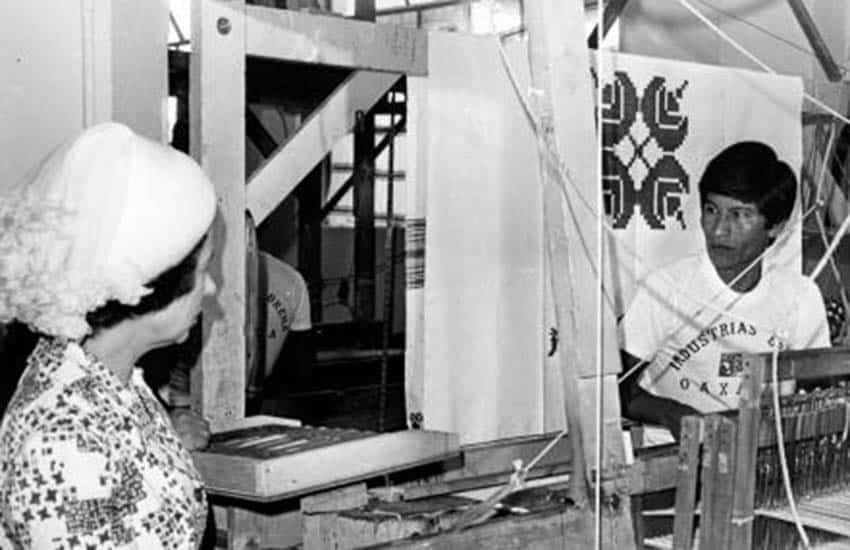
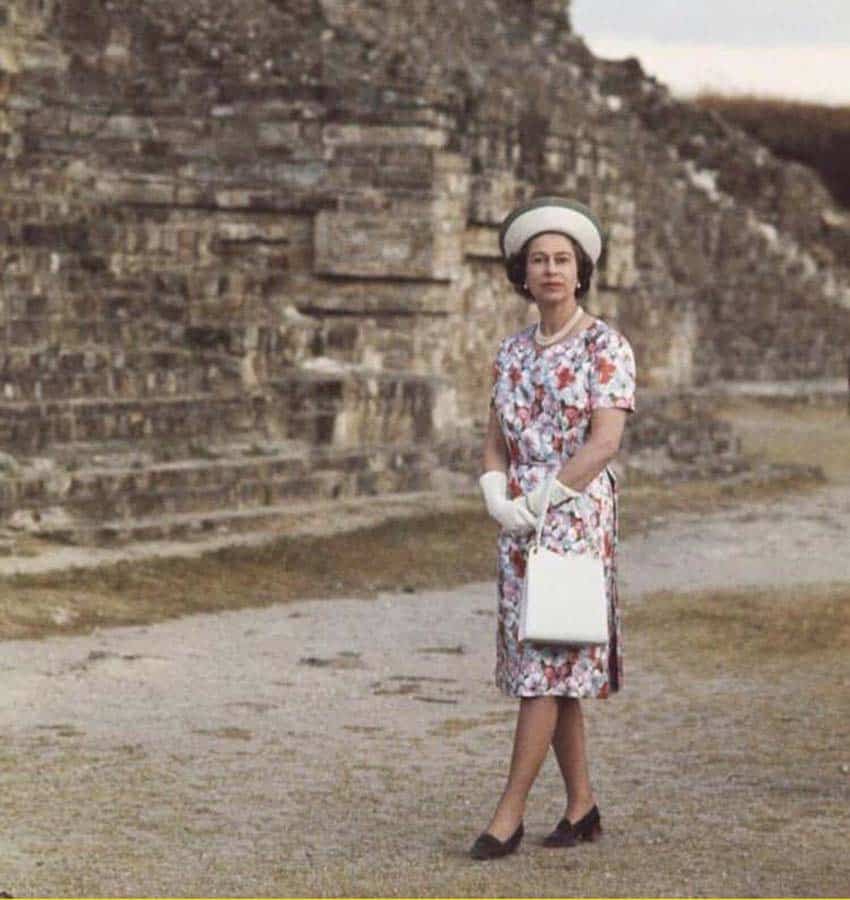
In Oaxaca city, the monarchs visited loom halls and the handicrafts market and bought various items — paying with pounds sterling. They also visited the archaeological site of Monte Albán. At night, the celebration of Oaxaca’s traditional La Guelaguetza.
Their next stop was Mérida, where a rain of confetti greeted the queen, along with a song whose lyrics said, “Queen of queens, when you pass by, all the flowers give off their fragrance,” performed by the Orquesta Típica Yucalpetén. At one point, a strong wind nearly blew her hat off and lifted her skirt.
“Jovial, simple, smiling, much more beautiful than her photographs” was how the Diario de Yucatán newspaper described the 48-year-old queen.
The monarch visiting a textile workshop in Oaxaca.
The next day, near Yucatán’s north coast in Tizimín, she inaugurated the La Reina Zoo (The Queen’s Zoo). There, 2,000 children sang part of the English hymn “Land of Hope and Glory,” nearly moving the queen to tears. “It is the best gift I have received from Yucatán,” she reportedly told the governor.
During her stay of 23 hours and 50 minutes in Yucatán, she wore four dresses, white gloves, a hat, diamond and emerald earrings, pendants, a three-strand pearl necklace and white shoes, and of course accessorized with her handbag. Upon departing for Veracruz, she wore a yellow and orange dress — and there reportedly was 10 liters of ice cream in the royals’ luggage.
When the royal couple returned in 1983, they arrived on a Royal Air Force aircraft to Acapulco, where they were greeted by President Miguel de la Madrid.
They toured the coast and then visited the municipality of Lázaro Cárdenas, where they met with Governor Cuauhtémoc Cárdenas and Secretary of Foreign Affairs Bernardo Sepulveda. The royal party traveled up the coast on the Britannia, upon which Sepulveda and his British counterpart, Francis Pym, held three days of talks, reportedly discussing the Falkland Islands, oil prices and various conflicts in Central America.
Looking fashionable in 1983 in Yucatán.
During her tour of Puerto Vallarta, the 56-year-old queen was taken to a senior home amid lush vegetation outside the city, where she was serenaded by a chorale group of 22 elderly women in long, red gowns said to be the color of the bougainvillea flower.
After sailing to La Paz, the royal couple visited Laguna Ojo de Liebre, Our Lady of Peace cathedral, and the islands Jacques Cousteau and Espírito Santo.
And that was it. The queen’s trip continued on to the United States and Canada, but she never returned to Mexico.
President López Obrador responded to announcements of the queen’s death with a tweet on Thursday.
“I send my condolences to the people of the United Kingdom on the passing of Queen Elizabeth II, British monarch and ruler of 14 independent states. In the same way, I extend them to her family, friends and members of the Royal Household.”
With reports from Infobae, Diario de Yucatan and UPI
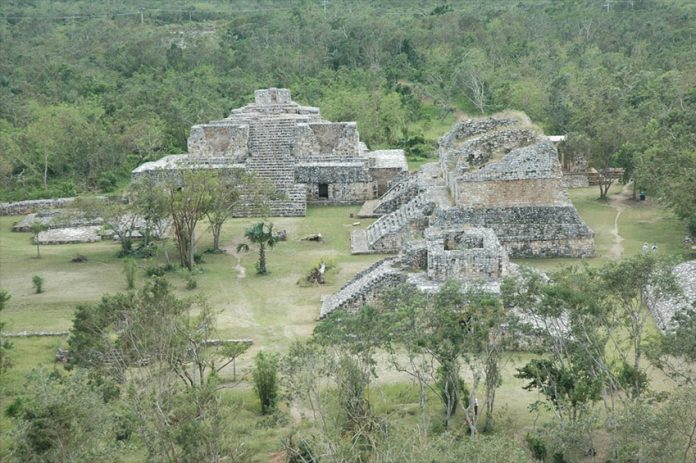
Southern Mexico was home to myriad ancient Mayan towns and cities, like the city of Ek' Balam in Yucatán, shown here. INAH
The federal government has announced the discovery of an “impressive” archaeological site along the route of the Maya Train railroad in Quintana Roo.
Diego Prieto, director of the National Institute of Anthropology and History (INAH), said that the site has more than 300 buildings, some of which are over 8 meters high.
“Engineering adjustments are being made to the southern part of section 5 [of the railroad] in order to protect an impressive archaeological site that we’ve recognized as Paamul II,” he told President López Obrador’s regular news conference on Thursday morning.
“This site … will be protected as [part of] an … ecological and archaeological corridor,” Prieto said.
INAH chief Diego Prieto reports on archaeological finds along the Maya Train route at a Thursday morning news conference. Presidencia de la República
The southern part of section 5 of the railroad (Tramo 5 Sur) will link Solidaridad, the municipality where Playa del Carmen is located, to Tulum.
The government decided to move the route inland earlier this year after the Playa del Carmen business community complained about the construction of the railroad through that city. Environmentalists have protested the modified route as its construction requires the clearing of significant sections of virgin forest.
Prieto said that INAH’s archeological review of the land along Tramo 5 Sur is only 11% complete. Divers are also working to “recover very valuable material” and “assist the safety of the work in this section” where there are subterranean rivers and cenotes (natural sinkholes), he said.
“[The divers] are working in caverns, in flooded caves, in cenotes and they’re providing very valuable information … that speaks of very ancient times. There is Pleistocene [ice age] fauna in these caverns,” Prieto said.
The INAH chief also said that more than 25,000 “immovable assets” have been found along the different sections of the Maya Train railroad, which will run through Tabasco, Campeche, Yucatán, Quintana Roo and Yucatán and is slated to begin operations in 2023.
Among them are pre-Hispanic structures and “ancient roads,” he said, explaining that the discoveries are evidence of Mayan settlements “throughout this region of our country.”
Among the other significant discoveries made by INAH personnel are 431 complete ceramic pots and 423 bones “corresponding to [pre-Hispanic] human burials.”
Prieto said that the valuable relics will be displayed in museums, including a new one that will be established in the historic center of Mérida, Yucatán, especially for “Maya Train discoveries.”
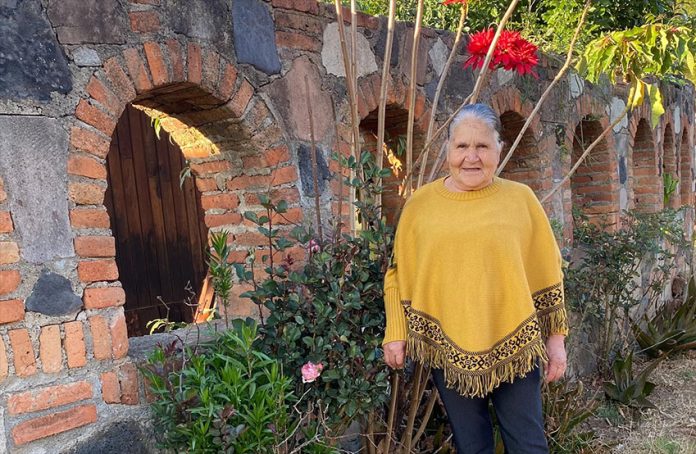
Doña Ángela, Michoacán abuelita and star of a highly successful YouTube cooking channel. Facebook / De Mi Rancho a Tu Cocina
Doña Ángela, a 71-year-old grandmother living in rural Michoacán has surpassed the viewership of culinary icons Gordon Ramsay and Martha Stewart on YouTube.
Her channel “De Mi Rancho a Tu Cocina” (“From my ranch to your kitchen”) has over 4 million subscribers, far less than Ramsay’s more than 19 million and yet her videos get more views than both Ramsay and Stewart (who has a little over 800,000 subscribers). According to the website Latinometrics, Doña Ángela’s last 25 videos had close to 300,000 views, surpassing the almost 250,000 of Ramsey and less than 100,000 of Stewart. That makes “De Mi Rancho a Tu Cocina” the fourth most popular cooking channel currently on YouTube.
Within two months of the publication of her first video in 2019, Ángela Gardias had over 100,000 subscribers. Doña Ángela lives in the town of Pablo Cuin in the Ario de Rosales municipality of Michoacán and she has become a viral hit by presenting homestyle Mexican recipes from her state’s regional cuisine and beyond. Her first video of how to make enchiladas verdes has had over 11 million views since it was published in 2019.
Without a big production team, a fancy demonstration kitchen, and bevy of assistants behind the scenes, Doña Ángela’s kids film her on their cellphones as she cooks in front of her a large flat comal stove in a rural, wood-paneled kitchen.
Agua De Bugambilias De Mi Rancho A Tu Cocina
Doña Ángela’s channel shares both longer, more complex recipes and short videos like this recipe for agua de bugambilia (iced bougainvillea tea).
In her recipes Doña Ángela highlights traditional processes in Mexican cooking like the nixtamalization of corn and shows off local ingredients that she herself raises and grows. She speaks with a distinctive regional accent and is watched by Mexicans around the world hankering for a nostalgic taste of home.
Doña Ángela was named one of Mexico’s 100 most powerful women of 2020 in Forbes magazine alongside famous figures such as Claudia Sheinbaum, Mexico City’s first female mayor and expected Presidential candidate in 2024. She has been hailed as a exemplar of not only traditional cooks, but also rural Mexico and its incredibly diverse and rich culture.
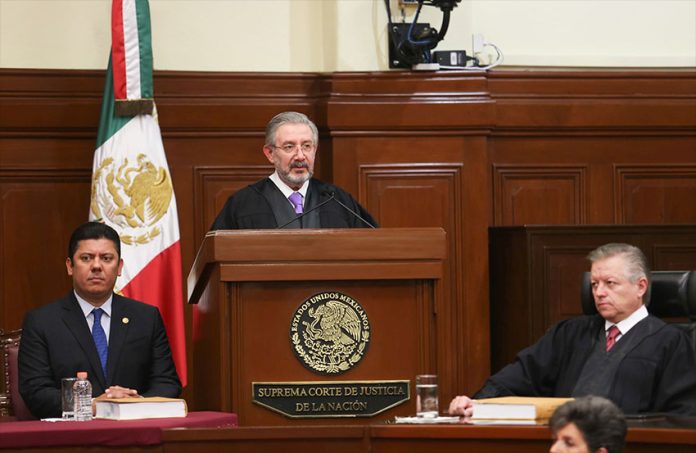
Justice Luis María Aguilar Morales speaks at the Supreme Court in 2016. Presidencia de la República
A Supreme Court (SCJN) justice who advocated the abrogation of a constitutional provision that applies mandatory pre-trial detention for suspects accused of certain crimes has withdrawn his proposal.
Justice Luis María Aguilar withdrew his proposal Thursday before it was put to a vote. A majority of the 11 justices expressed opposition to modifying the constitution, meaning that the proposal was doomed to fail had a vote been held.
Aguilar said he would reformulate his proposal in order to present to his SCJN colleagues “a new methodology that allows us to do away with the damaging effects” of mandatory preventive prison, which currently applies to suspects in crimes including homicide, rape, kidnapping, human trafficking, illicit enrichment, fuel theft, burglary and firearm offenses.
He rejected suggestions that his proposal sought to declare an article of the constitution unconstitutional.
“I categorically reject affirming or even insinuating that I propose removing pages from the constitution,” Aguilar said.
Other justices characterized his proposal in that way, and asserted that only the federal Congress has the authority to modify the constitution. The federal government – which argues that mandatory pre-trial detention is fundamental to ensure that suspects don’t evade justice and continue committing offenses – also contended that the SCJN doesn’t have the power to invalidate sections of the constitution.
Although Aguilar withdrew his proposal, he continued to argue for the elimination of mandatory preventive detention, saying that use of the measure violates human rights as it doesn’t respect the presumption of innocence principle.
It “punishes the most vulnerable people,” he added, citing data that shows that 65% of people in preventive custody have low levels of education and over 50% are younger than 35.
“This statistical data allows us to see a cruel reality: over half the people detained in preventive custody are young people with incomplete studies,” Aguilar said.
“Almost half the people in preventive prison earn [just] 5,000 pesos [US$250] a month, almost 20% … are indigenous people and Afro-Mexicans and many of them don’t even speak Spanish.”
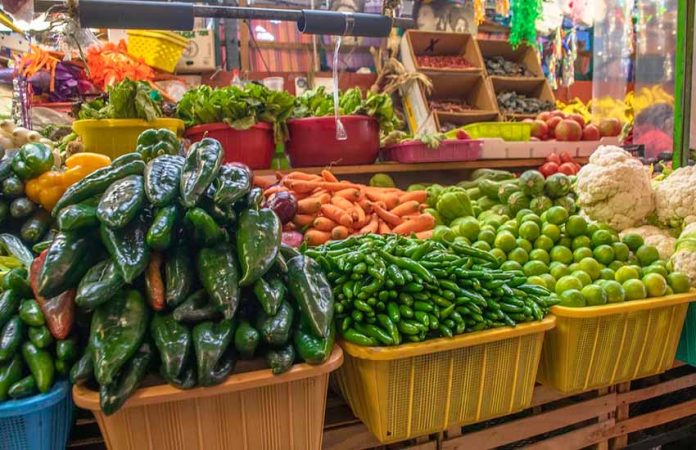
Food prices increased greatly from last August. Fruits and vegetables on average rose 15%. Miranda Garside/Unsplash
Fueled by soaring food prices, annual inflation reached 8.7% in August, the highest level in more than two decades.
The national statistics agency INEGI said Thursday that consumer prices increased 0.7% in August compared to July, lifting the annual inflation rate to its highest level since December 2000, when the rate was 8.96%.
Core inflation, which strips out some volatile food and energy prices, was 8.05% in August, INEGI said.
Food and nonalcoholic beverages were 14.2% more expensive in August compared to the same month a year earlier, while energy costs, including gasoline and electricity, were up 8.1%. Within the former category, prices for fruits and vegetables and for meat rose at an even faster rate, with annual inflation rates of 15.2% and 14.7%, respectively.
President López Obrador said he would be strengthening his existing anti-inflation plan in response. Presidencia
Onions are particularly problematic: their price soared 54% between July and August and almost 101% in annual terms.
Among the other individual food items whose cost rose sharply in the 12 months to August were potatoes (+74%), oranges (+44%), watermelon (+39%), eggs (+33%), white bread (+29%), limes (+24%) and fish (+15).
Prices for non-food goods were 7.9% higher in August compared to a year earlier, while services in general were 5.2% more expensive. Housing was 3.1% more expensive, clothing and footwear rose 5.6%, alcohol and tobacco prices were 8.9% higher and restaurant and hotel bills were up 10.9%.
President López Obrador said Wednesday that his greatest concern with regard to inflation was the increase in the cost of tortillas, a staple across the country. INEGI data showed that prices for corn tortillas rose 2.4% between July and August, with the average cost of a kilo just above 21 pesos in tortillerías, or tortilla shops.
He said he raised the inflation issue during a meeting Tuesday with the heads of the influential Business Coordinating Council and Mexican Business Council.
“We’re going to strengthen the anti-inflationary plan because [higher prices] affect people, and it’s what concerns me most and occupies my time,” López Obrador said.
The president – who said in late July that he expects inflation to begin to ease in October or November – personally pledged to speak to the owners of Maseca and Minsa, corn flour suppliers that together form a duopoly.
López Obrador also said he would approach two major corn flour makers, Maseca and Minsa, to keep down prices for the major Mexican staple. Screen capture
The high inflation rate recorded in August raises expectations for another hefty interest rate rise when the board of the central bank meets later this month. The Bank of México (Banxico) lifted its benchmark rate by 0.75% after each of the board’s two most recent meetings, the largest increases since the introduction of a new monetary policy regime in 2008.
Its key rate is currently 8.5%, the highest level since the new regime was implemented. Banxico, whose board will meet to discuss monetary policy on September 29, noted last month that inflationary pressures associated with both the pandemic and the military conflict in Ukraine were continuing to affect headline and core inflation.
It said it would continue to monitor inflationary pressures as it seeks to set a benchmark rate that will allow inflation to come down to its 3% target “within the time frame in which monetary policy operates.”
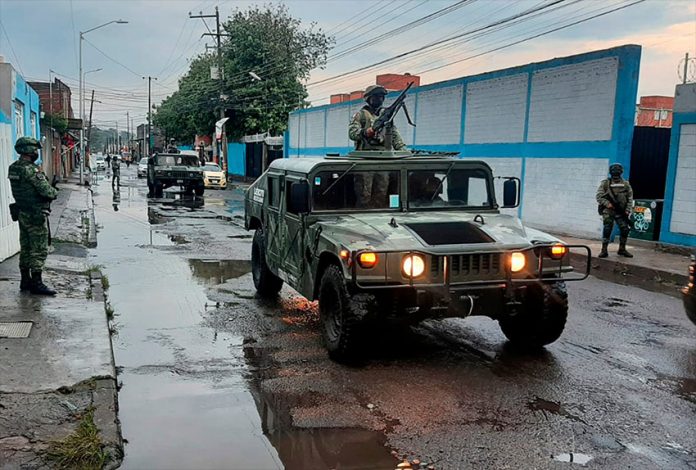
An army regiment patrols the streets in Puebla after heavy rains "to guarantee the safety of residents," Sedena said on social media. Twitter @SEDENAmx
Two controversial public security initiatives were endorsed by congressional committees on Wednesday and will now be considered by all lower or upper house lawmakers.
A bill that would authorize the use of the military for public security tasks until 2028 was approved by the Chamber of Deputies’ constitutional points committee, while a proposal to put the National Guard (GN) under the control of the army was approved during a joint meeting of the Senate’s justice and legislative studies committees.
The former, put forward by an Institutional Revolutionary Party (PRI) deputy, will be considered in the lower house next week, while the latter is being debated in the Senate on Thursday.
As things stand, the military is authorized to carry out public security tasks until March 2024. However, PRI Deputy Yolanda de la Torre believes that a four-year extension of the authorization is needed because the National Guard and state and municipal police haven’t shown they have the capacity to combat Mexico’s significant public security problems.
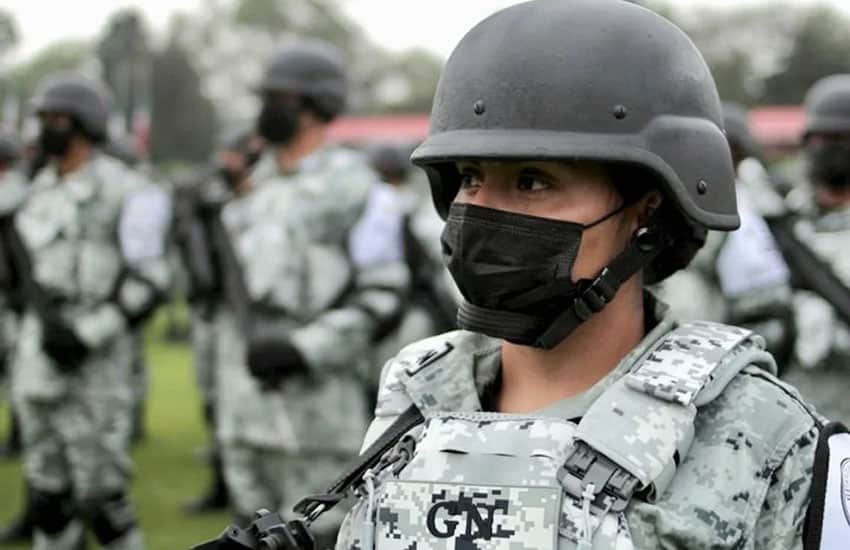
Some politicians said the National Guard was not ready to stand alone without domestic military support.GN/Twitter
Her bill states that a “solid and effective” police force “is not built overnight” and therefore, while the National Guard “develops its structure, capacities and territorial establishment,” the president of the day can use the armed forces for public security tasks in an “extraordinary, regulated, controlled, subordinated and complementary way.”
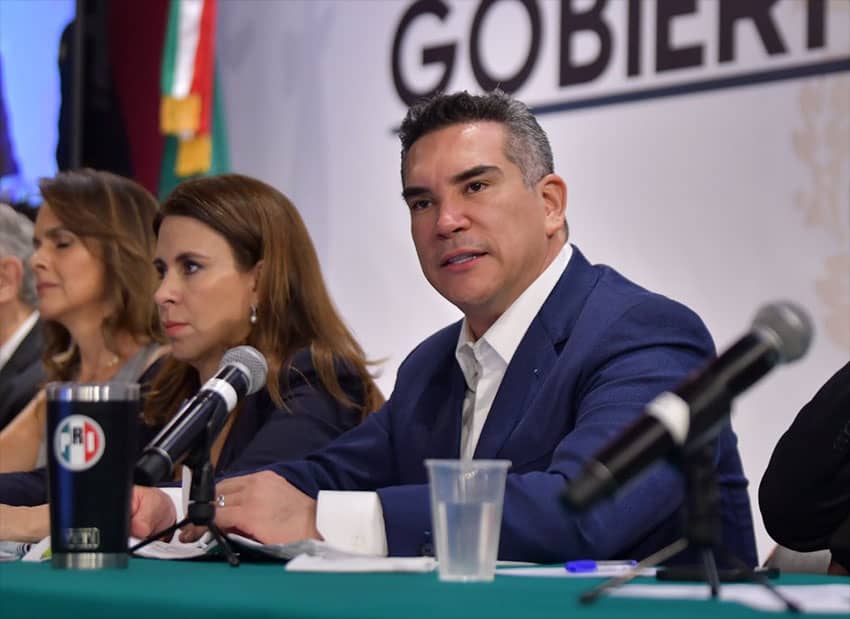
PRI national president Alejandro Moreno said that the party’s deputies can vote as they see fit, but indicated that they are united behind the constitutional bill, which will likely also be supported by the ruling Morena party and its allies.
The proposal threatens the electoral and legislative alliance between the PRI, the National Action Party and the Democratic Revolution Party because the latter two are opposed to increased militarization of the country.
Earlier this week, PAN national leader Marko Cortés called on PRI lawmakers to withdraw de la Torre’s bill, or vote against it, while PRD chief Jésus Zambrano described the proposal as “not only concerning but also offensive.”
PRI president Alejandro Moreno indicated that his party stands behind the reforms. Twitter @alitomorenoc
They both said that the Va por México coalition – which fielded common candidates in gubernatorial elections earlier this year – was at risk of breaking up.
Morena’s support for the second proposal – which seeks to put the GN under military control rather than civilian – ensured that it was approved by the two Senate committees. The proposed reform, which, if approved, would modify no less than four different laws, has been rejected by opposition parties, which warned of the risk of the militarization of public life.
It requires support from two-thirds of lawmakers to pass Congress – a supermajority Morena and its allies don’t have, but President López Obrador said last month that he also intended to issue a decree to put the National Guard under the control of the army. The decree, he asserted, would be binding even if the reform doesn’t pass Congress.
During Wednesday’s joint committee meeting, Morena Senator María Merced González asserted that most Mexicans want the GN to be under military control and that lawmakers have an obligation to legislate accordingly.
“The people rule. The majority of people believe the National Guard should have military control,” she said, apparently citing recent polls.
González said that Morena’s objective is to “protect society and give people an effective remedy against violence,” which neither the GN – under civilian command – nor the military has been able to significantly combat since López Obrador took office in late 2018.
In expressing his opposition to the plan to put the GN under military control, PAN Senator Damián Zepeda said that the militarization of public security – a policy implemented by former president Felipe Calderón when he deployed the army to combat cartels shortly after he took office in 2006 – has failed.
Calderón – who held office for the PAN between 2006 and 2012 – “failed in public security policy,” he said, adding that former president Enrique Peña Nieto, who perpetuated the militarized model during his 2012-18 government, “failed in public security policy” too.
López Obrador – who has also depended on the army to carry out public security tasks despite a campaign pledge to return soldiers to their barracks – has done no better, Zepeda charged.