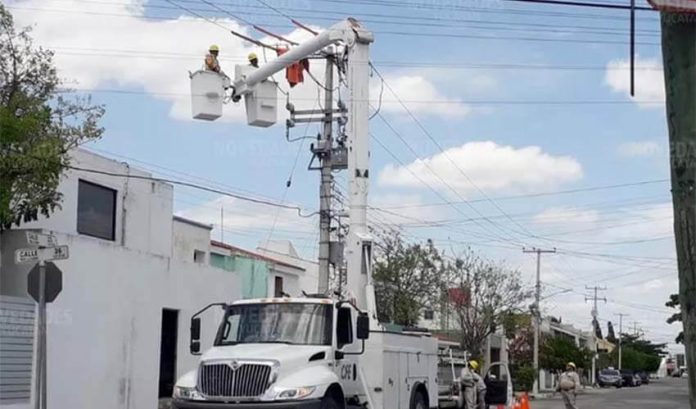
The power outage occurred early Wednesday morning, just as citizens were heading out to school and work. File photo
With temperatures in the 30s across the region Wednesday, many Yucatán Peninsula residents had a tough morning after the power went out at approximately 8:32 a.m.
The outage affected 1.3 million residents living in the three states that comprise the peninsula: Yucatán, Quintana Roo and Campeche.
As people were on their way to work and school, complaints started rolling in on social media with posts about the loss of cell phone and internet service as well as electricity for homes and air conditioning.
The Federal Electricity Commission (CFE) said in response that early this morning six high-tension electricity lines went down because of an accident during routine maintenance that sent one injured worker to the local hospital. He was reported in stable condition.
According to CFE’s calculations, 62% of the region’s households were affected by the outage, including 700,000 residents of Yucatán’s capital city Mérida. Mérida Mayor Renán Barrera Concha reported to the newspaper Milenio that around 30% of the city’s power had been restored by mid-morning.
“We have been working in constant coordination with CFE to monitor the reestablishment of power,” Barrera said. “We believe that in a few more hours, we will be much closer to normal power levels again.”
CFE representative Laura Estrada Loría warned residents this morning that the process would take time. “Workers are currently trying to identify the causes [for the outage] for the quick re-establishment of service. Service will come back online gradually and CFE will work to uncover the causes of the outage in order to inform the public.”
However, according to the CFE, by 11:45 a.m. 100% of the region’s electricity service was back online.
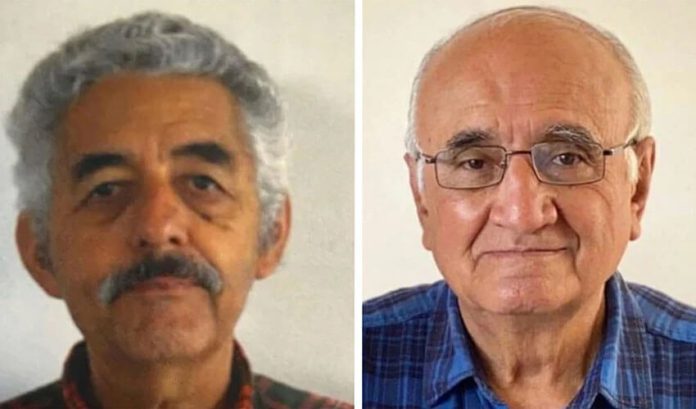
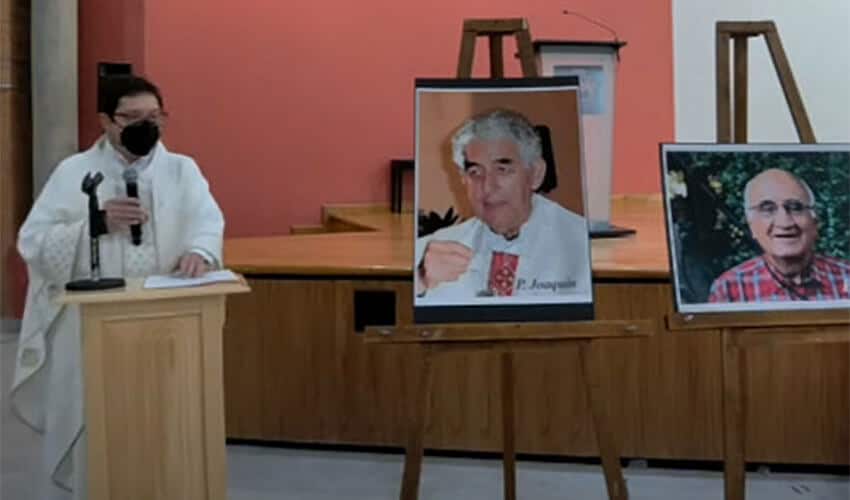
Jesuit priests Joaquín Mora, left, and Javier Campos were killed in Chihuahua last month. Social media
Two elderly Jesuit priests were killed in a church in southwestern Chihuahua Monday, a crime that the state governor said “shook us to the very core.”
Joaquín César Mora Salazar, 80, and Javier Campos Morales, 79, were shot dead in a church in Cerocahui, a town in the Sierra Tarahumara municipality of Urique, part of a region where opium poppies and marijuana are grown. The life of a third priest at the church was inexplicably spared.
The victims were killed apparently after a man attempting to escape a drug gang took shelter in the church. The gang caught up with the man and killed him and Mora and Campos, both of whom were ordained in the early 1970s and had served communities in the Tarahumara region for decades.
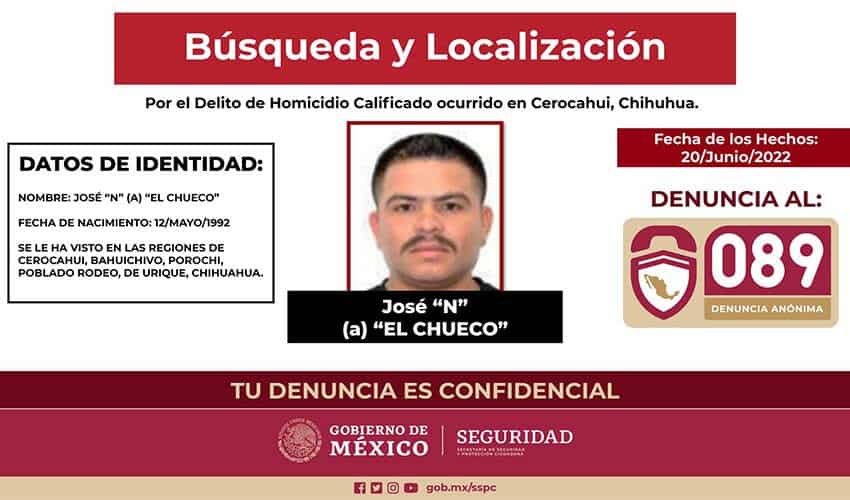
José Noriel Portillo Gil, a presumed member of Los Salazar gang – an affiliate of the Sinaloa Cartel – has been identified as the person responsible for the murders. Portillo, known as “El Chueco,” is also accused of the 2018 murder of United States citizen Patrick Braxton-Andrew.
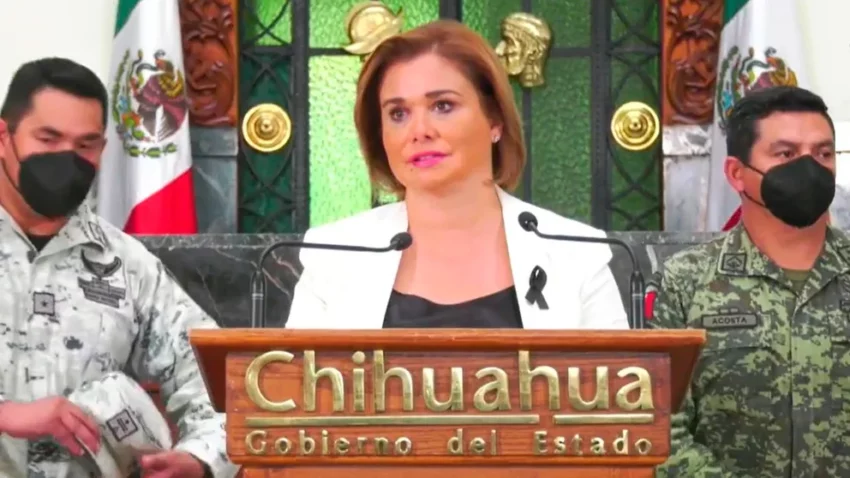
Chihuahua Governor Maru Campos said the killings “shook us to the core” and promised that security forces were on the way to make the region safer.
Javier Ávila, another Jesuit priest who has worked in the Tarahumara region since the ’70s, said that one of the slain priests knew Portillo and approached him to try to calm him down after his colleague was killed. “He killed him too,” Ávila said in a radio interview.
The priest said he had heard that the aggressor was drunk and drugged when he committed the crime. The third priest in the church apparently asked Portillo to leave the bodies of Mora and Campos, but he ignored the request and loaded them into a pickup truck with the help of other presumed members of Los Salazar.
The Mexico branch of the Society of Jesus acknowledged that the bodies of the two priests were removed from the church by armed men. “We demand justice and the recovery of the bodies of our brothers,” Jesuitas México (JM) said in a statement.
Federal authorities said the killer was José Portillo — an alleged member of the Los Salazar gang known as “El Chueco.” Portillo has an outstanding warrant for the 2018 killing of U.S. citizen Patrick Braxton-Andrew.
“… Events like this are not isolated. The Tarahumara Sierra, like many other regions of the country, faces conditions of violence. … The lives of men and women are arbitrarily taken away every day like our brothers were murdered today,” JM said.
Chihuahua Governor Maru Campos said Tuesday that the investigation into the murders was advancing and pledged to hold those responsible to account. The murders of the priests caused “deep anger, indignation and pain” and “shook us to the very core,” she said
Security forces have been deployed to the region to protect citizens from violence, the National Action Party governor told a press conference.
“We’re not going to allow acts like this,” Campos declared. “To the Jesuits and all Chihuahua residents I say: you have the state government and the federal government [to protect you]. You have the force of the state that will protect you against those who disrupt our peace and take away the most precious thing we have, which is life.”
Father Óscar Lomelín called the two slain men martyrs at a Mass on Tuesday in Monterrey, Nuevo León. The victims were both natives of the city.
Both slain priests grew up in Monterrey, Nuevo León, where a Mass was held in their honor Tuesday. “We ask for the violence and impunity in our country, the indifference of authorities and even our own indifference, to stop,” said Óscar Lomelín, the priest who offered the Mass. He described the two priests as martyrs who died while carrying out their religious duties.
President López Obrador on Tuesday pledged that a thorough investigation into the murders will be carried out and noted that the region where they occurred has “a significant organized crime presence.”
Seven priests, including the two most recent victims, have been murdered since López Obrador took office in December 2018, according to Mexico’s Roman Catholic Multimedia Center. At least two dozen were killed during the 2012–18 term of the government led by former president Enrique Peña Nieto.
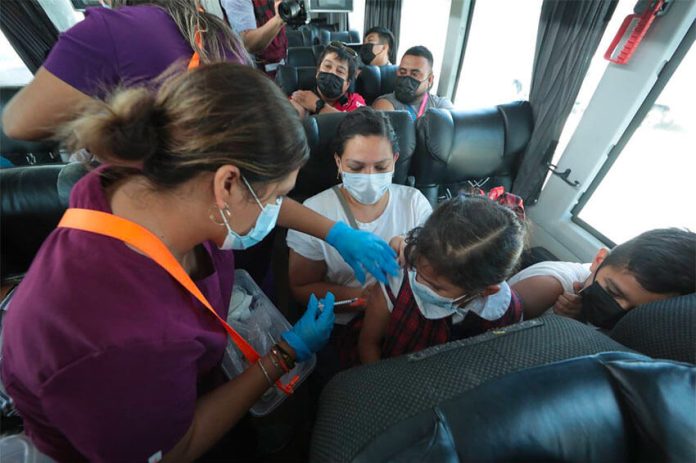
COVID vaccine is administered to children aboard a bus in Laredo, Texas.
Mexico hasn’t approved COVID-19 vaccines for children younger than five but that isn’t stopping young kids from Tamaulipas getting shots this week.
The mayor of Nuevo Laredo struck an agreement with health authorities in Texas that allows babies and children aged between six months and four years to get vaccinated on the other side of the border. The vaccination of children under five began in the United States this week.
A group of young Nuevo Laredo kids with health conditions that make them vulnerable to serious COVID-19 illness crossed into Laredo, Texas, on Monday to get shots administered by Webb County medical personnel.
“We’re the first municipality in Mexico to administer COVID-19 vaccines to babies of six months [and children up] to four years old,” tweeted Mayor Carmen Lilia Canturosas Villarreal, who has secured a batch of 1,800 vaccines for young children.
“The health of Nuevo Laredo residents is a priority for this government, which with willpower and effort is achieving the transformation of Nuevo Laredo,” added the Morena party mayor in a post that included photos of young children getting vaccinated while still on the bus on which they crossed the border.
Other Nuevo Laredo children will have the opportunity to get a shot in Laredo during a weeklong campaign that commences Thursday. Canturosas published photos to Twitter Wednesday showing long lines of parents waiting to complete the vaccination registration process for their young sons and daughters.
Nuevo Laredo was also the first municipality in Mexico to offer vaccination to children aged five to 11 and adolescents aged 12 to 17 thanks to its cooperation with Laredo health authorities. The federal government only announced that it would offer shots to the former cohort last week.
Mexico is currently experiencing a fifth wave of the pandemic, with new case numbers increasing significantly in recent weeks. The federal Health Ministry reported 13,752 new cases Tuesday, lifting the country’s accumulated tally to 5.89 million. The estimated active case count is currently 69,575, while the official COVID-19 death toll rose by 41 Tuesday to 325,458.
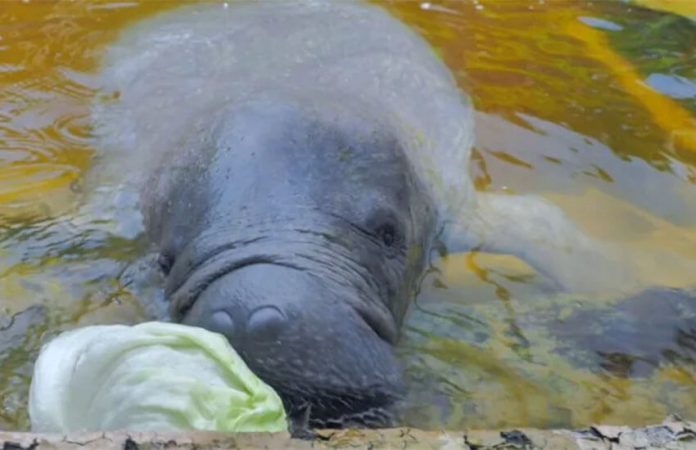
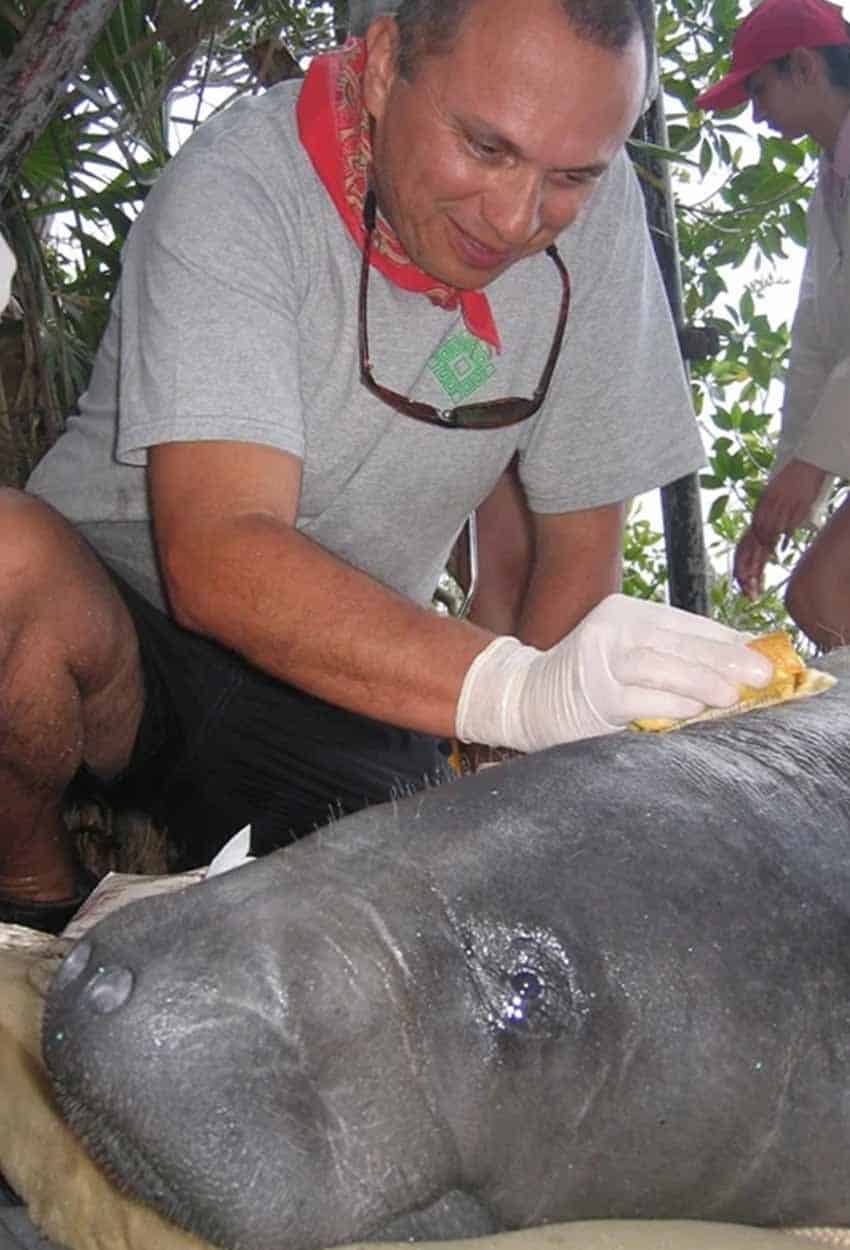
Daniel the manatee eating lettuce in 2020. Manatees eat sea vegetables in the wild. AMHMAR
I once heard that if you spend too much time studying or living with an animal, you end up resembling that animal and that animal ends up resembling you.
This is the story of Benjamín and Daniel. One of the many stories that happen under the rocking cadence of the waves in our Caribbean Sea, a story that can be told and understood only as time passes, because only then can change be recognized in its entirety.
This story takes place in Chetumal, which in the Mayan language means, “the place where the rains come down.” This is the trustworthy account of a Mexican scientist who, since 1990, has been transforming into a manatee, slowly but surely, before everyone’s eyes.
It is also the story of a baby manatee born as an orphan in 2003 and who for two decades has stubbornly tried to become one of us — flick by flick of his tail and smile by smile on his face.
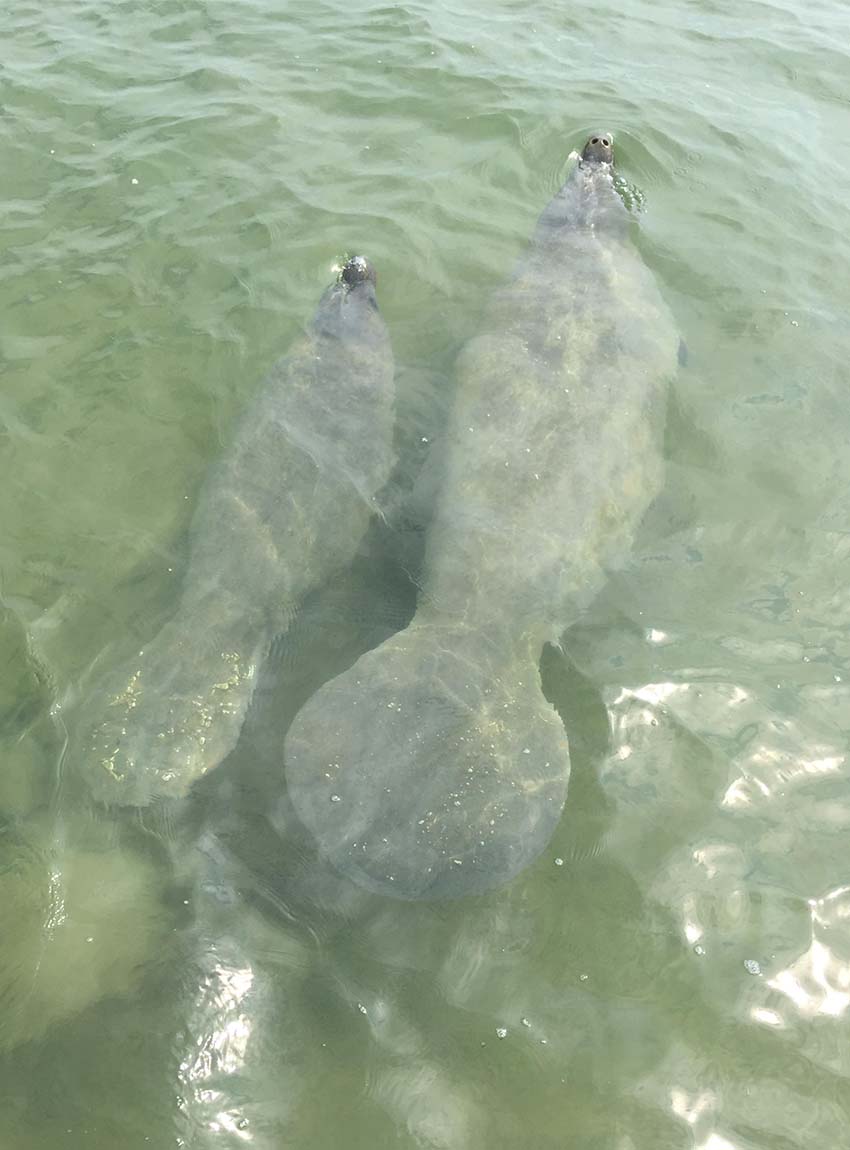
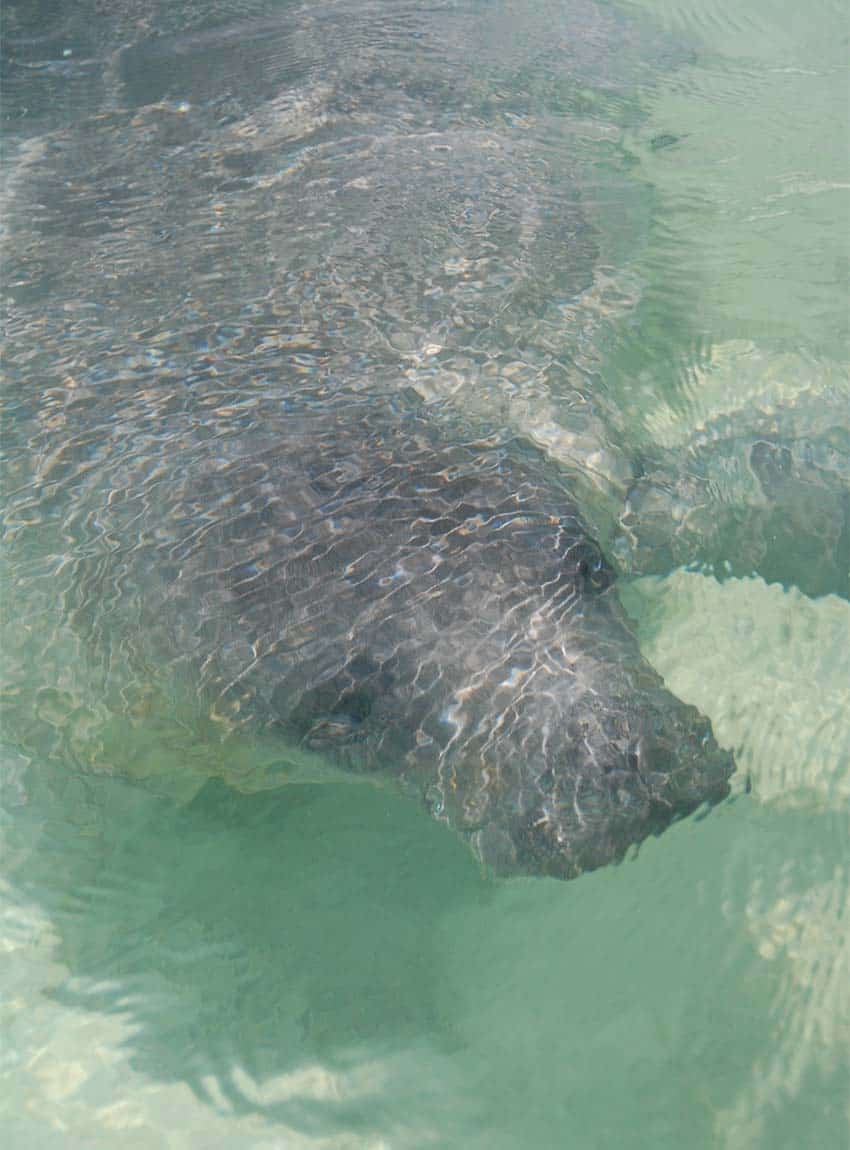
An Antillean manatee mother and calf. Omar Vidal
But let’s start from the beginning.
Manatees originated 6.5 million years ago (way before humans walked on the planet) from an ancestral lineage that lived in Colombia’s Magdalena River. From South American rivers, these mermaids migrated to the ocean, taking advantage of marine currents to navigate the Atlantic and some eventually reach Africa.
Today, three species of manatees survive, but all are threatened with extinction. They swim in the fresh and marine waters of America and Africa.
One of the three living species is the American manatee, inhabiting the coasts of Florida, Mexico, Central America, the Caribbean islands and south to Brazil. Another one is the manatee of the Amazon and Orinoco rivers in South America. The third is the African manatee.
They are all herbivores, mild-mannered migratory mammals that roam in warm waters. Sailors have confused them with mermaids for millennia — although some less poetic people call them sea cows. Truth be told, they are more closely related to elephants.
And, as we had done with those serene pachyderms, for many years, we relentlessly hunted manatees to devour their skin, fat, meat, teeth and their souls.
I met Dr. Benjamín Morales many years ago, when he studied sea lions and I studied great whales in the Gulf of California. He did so under the tutelage of a Chilean marine mammalogist who left Chile in 1973 after the coup d’état that killed President Salvador Allende. He eventually made Mexico his home until returning to Chile 10 years ago.
I was under the guidance of an American ichthyologist who in 1977 moved from California to Baja California, promising to never go back if Governor Ronald Reagan ever became the U.S. president; in 1981, Reagan was elected president, and that ichthyologist settled here.
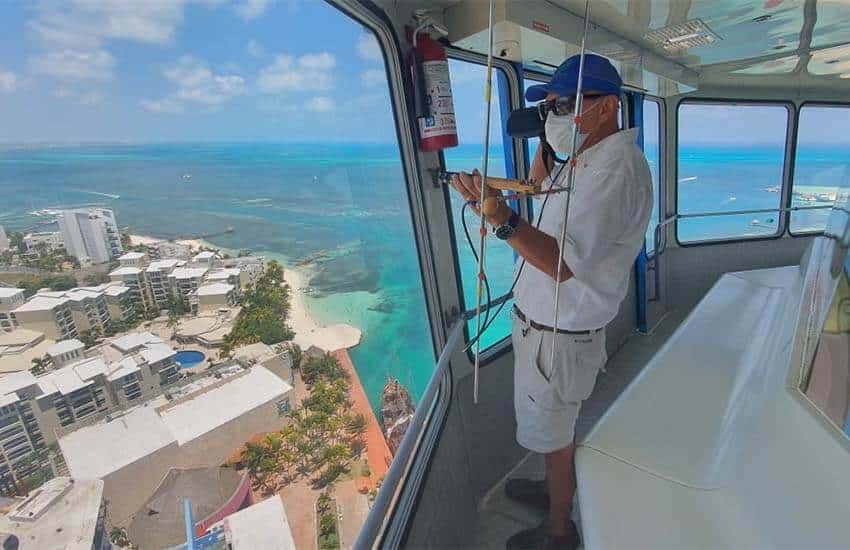
Dr. Morales has spent his career researching manatees, tracking several of them in the Chetumal area for years.
Those two men, now octogenarians, were pioneers of modern scientific research on Mexico’s marine mammals, and they nurtured scores of students. They now live 10,000 kilometers apart: one in Guaymas in the Gulf of California, the other in Punta Arenas in the Magallanes Region of Chilean Antarctica.
When I saw Daniel for the first time, I was moved by his manatee smile: a smile that exposes his massive molars — a warm-hearted, easygoing love-filled merman. His is a smile that invites you to pat, cuddle and smile back.
Daniel, as most manatees, loves to be pampered. With his two bulky prehensile upper lip lobes, he incessantly throws kisses to the left and to the right, while displaying his massive teeth and the most captivating smile in the entire animal kingdom.
He has a big heart, a small brain, eyes the size of human ones, huge nostrils and a pair of tiny auditory holes that give him extraordinary acoustic capability. Since Daniel doesn’t have vocal cords, he is almost mute; he can produce only a few sounds through pharyngeal vibrations.
Mute Daniel reminds me of Quasimodo, that unforgettable character in Victor Hugo’s 1831 novel, The Hunchback of Notre Dame: massive, brave, astute, with a heart of gold and longing for the impossible.
With each day that passes, Benjamín and Daniel look more like each other. The two met on September 14, 2003, in Laguna Guerrero, near Chetumal. Daniel was stranded on the beach alone — newly born and already an orphan. He still had the umbilical cord that had connected him to his mum for 12 months; she died of unknown causes.
Not thinking twice, Benjamín the man, adopted Daniel the manatee.
I have asked myself if Dr. Morales thought precisely about what he was going to do with a baby manatee; I doubt it. The calf’s irresistible smile certainly captivated him, suddenly and forever.
Daniel’s mother died of unknown causes. He was found stranded in Laguna Guerrero, near Chetumal, with an umbilical cord still wrapped around him. Guias turisticos Xcalak
As it happened, Daniel was taken to a pond in El Colegio de la Frontera Sur in Chetumal, a scientific institution where Dr. Morales worked. The baby manatee was nursed for many days and nights with a baby’s bottle by his new dad and the young enthusiasts of Chetumal who also surrendered their hearts to the most enchanting smile in the animal kingdom.
For 13 years, Daniel lived in semi-captivity in a place that national and international NGOs and foundations built especially for him, when he was the star of the moment. He was the only guest and had frequent visitors.
Then, in May 2016, Daniel was freed, and I can only imagine Benjamín’s broken heart when he opened Daniel’s pond doors to allow him to go to see the world in the company of his kin.
But despite Dr. Morales’ efforts to make him independent, Daniel the manatee did not want to leave. Sometimes he leaves for a few days, weeks or even months, but he always comes back. And every time he returns, I imagine the bittersweet mix of happiness and sorrow that overwhelms Benjamin. It is like when a father encourages his adult son to leave home but deep inside his heart yearns for him never to leave.
Daniel spends his life eating, resting, thinking, exploring and letting himself be cherished. Like Benjamín does. The two never stop smiling, even at the most critical moments, such as when — abandoned and forgotten by all — starving Daniel languished because the big donor NGOs, foundations and authorities no longer wanted to pay for his food.
Everyone turned their backs on Daniel — but not the manatee man who with his only salary bought lettuce, jicamas and carrots every day to appease the ravenous appetite of his beloved adopted son.
Because, you should know, dear reader, manatees eat between 10% and 15% of their body weight each day, and they feed on almost any kind of aquatic vegetation. This is why Daniel and his kin are natural agents controlling the excessive growth of vegetation along navigation and irrigation channels. And, in doing that, they protect our health and economies.
If only for that, we must respect and take care of them.
Morales monitoring manatees from above. Benjamin Morales
In September next year, Daniel will turn 20. He could reach a maximum age of 65 years — exactly the age that his friend Benjamín is today. Benjamín retires at the end of this year after dedicating his life to discovering all the secrets of the manatees of Chetumal Bay. He will now devote his life to sustainable agriculture and to writing his memoirs.
I close my eyes and imagine Benjamín slowly walking toward the ocean in the twilight of his life while anxiously looking for the uplifting smile of his amigo Daniel near one of the docks of the bay.
I cannot stop thinking of the other manatees Dr. Morales has baptized and tagged with satellite radios to spy on their lives: Pancho, Luna, Yolanda, Leonardo, Angie, Yubarta and Poseidon. Today, 150 manatees roam Chetumal Bay and along the Yucatán Peninsula.
This, then, is the incredible story of a manatee who dreamt to be a man and of a man who turned into a manatee.
It fills me with hope knowing that in the entire Caribbean there are thousands of women and men turning, every day, into jaguars, pink dolphins, vaquita porpoises, sharks, crocodiles, frogs, owls, condors, golden eagles, armadillos and, above all, orchids.
We are a legion with a mission: saving the magnificent biological diversity of our beloved Latin America for this and future generations.
Omar Vidal, a scientist, was a university professor in Mexico, is a former senior officer at the UN Environment Program and the former director-general of the World Wildlife Fund-Mexico.
Passive euthanasia is allowed in Mexico but not in all states.
Within the framework of Euthanasia Week June 20-24, lawmakers, academics and experts are discussing the need for legislation governing assisted suicide for terminally ill patients.
Organized by Morena Deputy and Health Commission head Emmanuel Reyes Carmona, the week-long conference is an opportunity for advocates to plead their case for laws regarding end-of-life issues and to introduce the option of assisted suicide and euthanasia nationwide.
It is currently illegal to assisted someone in dying in Mexico, regardless of their diagnosis and wishes, a fact that doesn’t keep euthanasia from happening, says Reyes Carmona.
“Euthanasia is illegal just like abortion. Abortion in our country is outlawed and yet it continues to be carried out. I believe that even though euthanasia is not regulated in this country, the practice continues,” he said, adding that euthanasia should be an option for any terminal ill patient who wants to die with dignity.
Another Morena lawmaker, Angélica Ivonne Cisneros Luján, encouraged Congress to look to the states that have end-of-life legislation on the books to see how they and their health systems have been affected by it. Those states allow terminally ill patients to refuse treatment that may extend their lives, known as passive euthanasia.
Jennifer Hincapié Sánchez, a member of the medical faculty of the National Autonomous University (UNAM), said national legislation would create more clear and concise ideas about end-of-life terminology and definitions.
“I could think and conceive of it this way, that a dignified death is one without pain or suffering, but there are other people who wouldn’t have the same definition. So it’s important to present euthanasia as an option that the state is obligated to provide to its citizens for the continuation, or in this case end, to their life plan.”
Despite what may be strong resistance from citizens on religious grounds, Paulina Rivero Weber, a researcher at UNAM, reminded the group assembled that end of life legislation is also a matter of equity.
“The only thing that legislation would do is extend this right to [all citizens], as wealthy individuals already have access by traveling to other countries, or even coming to an agreement with a friend who is a doctor to have the procedure done in a private hospital without any problems. The important thing is that 96% of the population is still suffering on their deathbed.”
A magnitude 2.4 earthquake usually comes and goes unnoticed, but that wasn’t the case Tuesday afternoon in the state of Jalisco about 60 kilometers south of Lake Chapala.
Up to 10 houses had to be evacuated, the water system had to be temporarily shut down and repaired, and several streets with cracks in the asphalt had to be closed to traffic in the municipality of Zapotlán El Grande after an earthquake described as “weak” by one geological service struck 1 kilometer west of downtown.
The damage occurred in several neighborhoods that sit atop a fault line, which for years has been a cause for concern. The neighborhood hit the hardest was Santa Rosa, but Magisterial and Centro also were affected.
“A little more than 70 homes have some type of damage, but only six are uninhabitable, and that number, unfortunately, could continue to rise,” said the municipality’s mayor, Alejandro Barragán. An initial report in the newspaper Milenio stated that at least 10 houses had to be evacuated.
Approximately 25 people spent the night in a shelter that had been set up in the San José neighborhood. The mayor said authorities, including the army, would be monitoring the evacuated houses to prevent theft.
The temblor struck at 3:58 p.m. Tuesday, and was followed by a 2.1 aftershock 41 minutes later, according to the National Seismological Service of UNAM’s Institute of Geophysics. Approximately 125 kilometers south of Guadalajara, Zapotlán El Grande is also known as Ciudad Guzmán.
State Civil Protection was called in to help inspect the affected areas and search for any further damage. Meanwhile, other agencies carried out topographical surveys to evaluate why there was so much displacement of soil and pavement.
Civil Protection director Víctor Hugo Roldán pointed out that the displacement of pavement and structural foundations has been monitored since 2002 and, in some cases, significant displacement has indeed been measured.
Added Barragán: “We must recognize that we have had studies for 15 years. What we do not have is the forecast of when things are going to happen. It is very difficult to carry out an investigation to say what type of infrastructure we should do.”
Several sources reminded Milenio that Zapotlán El Grande is a seismic zone atop a fault and that as long as the area remains inhabited, people are going to have to continue living with the danger.
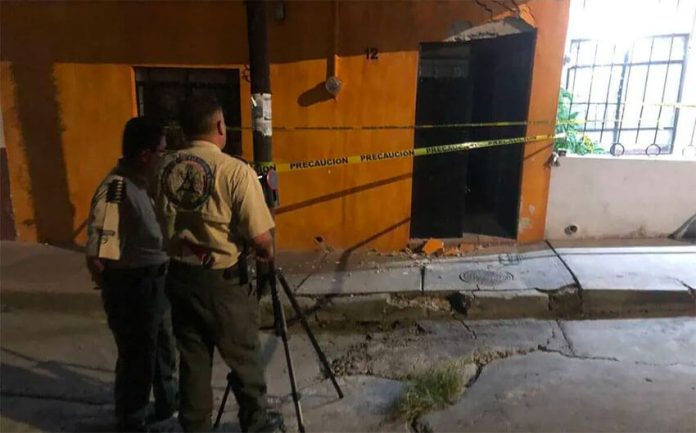
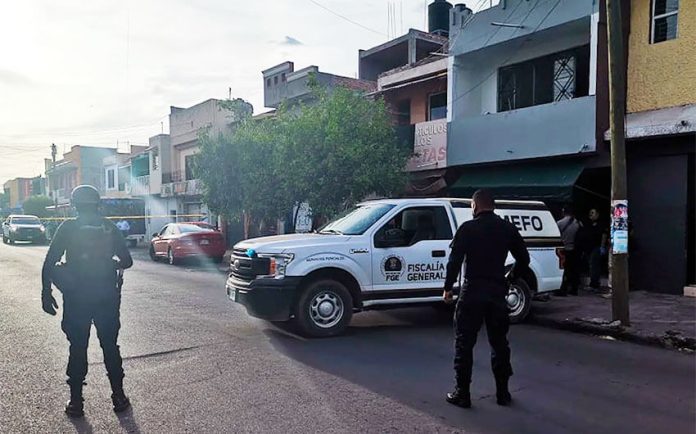
A crime scene Tuesday in Zamora, where one man killed four out of eight people in total.
Zamora, Michoacán – where a lone gunman killed four people on Tuesday – was the most violent city in the world last year, according to a study by a Mexican non-governmental organization.
The next seven most violent cities in 2021 are also in Mexico, the Citizens Council for Public Security and Criminal Justice (CCSPJP) said in a report published earlier this year. A total of 18 Mexican cities were ranked in the top 50.
The CCSPJP, which only analyzes homicide data for cities with populations of 300,000 or more, said it was the fifth consecutive year that a Mexican city was the most violent in the world.
The metropolitan area of Zamora, a city in northwestern Michoacán, recorded 610 murders last year for a per capita murder rate of 196.6 per 100,000 people. The CCSPJP said the 2021 murder rate in Zamora was the second highest it had observed since first compiling its rankings in 2008. Ciudad Juárez, Chihuahua, had a higher rate in 2010 when the northern border city recorded 229 homicides per 100,000 people.
The violence continued in Zamora early this year when seven people were killed in an armed attack on a clandestine cantina on January 27. On Tuesday, a gunman went on a shooting spree in Zamora and the neighboring municipality of Jacona, killing a total of eight people at five different locations, according to state authorities. He was eventually killed by police.
Ciudad Obregón, Sonora, ranked as the second most violent city last year with 478 homicides for a per capita rate of 155.8. A councilor from Bácum, a municipality that neighbors Cajeme – the municipality where Ciudad Obregón is located – was shot dead in the city last week.
Ranking as the third most violent city with a total of 390 homicides for a per capita murder rate of 107.5 per 100,000 people was Zacatecas city, capital of one of Mexico’s most violent states. The United States Embassy issued a security alert for the state of Zacatecas in April due to the ongoing turf war between the Jalisco New Generation Cartel and the Sinaloa Cartel.
The five other Mexican cities that made up the eight most violent cities last year, according to the CCSPJP, were Tijuana, Baja California, where there were 2,124 homicides for a per capita rate of 103.2 per 100,000 people; Celaya, Guanajuato, which recorded 747 homicides for a per capita rate of 100.9; Ciudad Juárez, Chihuahua, where 1,455 homicides were registered for a per capita rate of 95.8; Ensenada, Baja California, where there were 343 homicides for a per capita rate of 76.9; and Uruapan, Michoacán, which saw 263 homicides for a per capita rate of 73.4.
Celaya, where 10 people were killed in a massacre at a hotel and two adjoining bars last month, was the world’s most violent city in 2020, according to the CCSPJP. In terms of the total number of homicides, Tijuana was Mexico’s most violent city in terms of total numbers of homicides in 2021.
The only two non-Mexican cities among the 10 most violent were St. Louis, United States, and Kingston, Jamaica, which ranked ninth and 10 respectively. The other Mexican cities that ranked among the 50 most violent were Colima city (14th); Acapulco, Guerrero (16th); Cuernavaca, Morelos (18th); Irapuato, Guanajuato (21st); León, Guanajuato (22nd); Chihuahua city (30th); Morelia, Michoacán (34th); Cancún, Quintana Roo (40th); Culiacán, Sinaloa (43rd); and Guadalajara, Jalisco (47th).
No other country had more cities than Mexico on the list. Brazil ranked second with 11, the United States ranked third with seven and South Africa and Colombia both ranked fourth with four of the world’s 50 most violent cities each last year. The Mexican cities of Fresnillo, Manzanillo, Guaymas and Tecate had per capita murder rates above 100 per 100,000 people but didn’t make the list because their populations are below 300,000.
The CCSPJP said in its report that “Mexico has now been the global epicenter of homicidal urban violence for three years.”
“It’s not a coincidence but the result of the ‘hugs, not bullets’ policy implemented by the government of President Andrés Manuel López Obrador – a policy that consists of leaving criminal groups with almost complete freedom to murder, abduct people, extort and steal,” the NGO said.
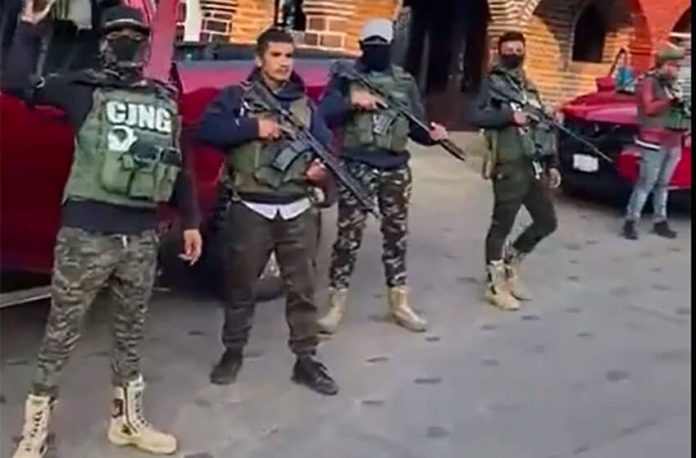
Presumed sicarios with the Jalisco New Generation Cartel brandish their weapons in El Volantín.
The Jalisco New Generation Cartel (CJNG) has announced its arrival in El Volantín, a small town in Jalisco near Lake Chapala, and it doesn’t plan on leaving any time soon.
A video showing a group of some 20 armed men in bulletproof vests, some of which were emblazoned with the CJNG initials, circulated on social media on Tuesday.
“We’ve arrived in Volantín and we’re not leaving,” some of the men shout. One declares that they are all members of the “four-letter” cartel, which is based in Jalisco but operates in most Mexican states.
The video was filmed on Juárez street one block from the main square in El Volantín, reported the newspaper El Universal, which used Google Street View to confirm the location. The town, home to approximately 500 people, is located next to the El Volantín dam in the municipality of Tizápan el Alto, which borders Michoacán.
The nearby towns of Mazamitla, Jalisco, and San José de Gracia, Michoacán, are considered strongholds of the CJNG, whose leader Nemesio “El Mencho” Oseguera Cervantes is a wanted man in Mexico and the United States.
Recent violence in the region has been attributed to a turf war between the CJNG and a crime group called Los Pájaros de la Sierra. The Tizápan el Alto police chief was ambushed and killed earlier this month while traveling on a local highway.
Authorities haven’t commented publicly on the new CJNG video, which El Universal sources say was filmed sometime during the past two weeks.
Jalisco cartel henchman have shown off the criminal organization’s immense firepower in many other videos posted to social media. One that appeared online in 2020 showed scores of heavily-armed and masked men shouting support for “El Mencho” while standing alongside a long convoy of armored vehicles.
The annual fair in Saltillo, Coahuila, begins July 14.
There are fairs, festivals and even firefly shows to keep people occupied around the country next month and even a rather late edition of one of Mexico’s most famous versions of Carnival for fans of the flamboyant celebration.
Sports fans should also look ahead to the Los Cabos Tennis Open in Baja California Sur, which is from August 1-6. There’s a range of packages available and tickets for single days start at 550 pesos ($27). The ATP event welcomes the world’s highest ranking men’s player, Russian Daniil Medvedev; U.S. serve maestro John Isner and No. 9 ranked Canadian Felix Auger-Aliassime.
• San Juan del Río Fair, San Juan del Río, Querétaro (Now-July 3)
A local festival with traditional events including cockfighting, bullfighting, equestrian shows and fairground rides, but also a modern cultural offering with documentary screenings and music of varied genres: ska, reggae, rock, rap and others, and folkloric dances.
Tickets for concerts in the palenque stadium start at 400 pesos (US $20). Artists include banda outfit Los Tucanes de Tijuana and pop singer Napoleón, who found fame in the 1970s.
Each day has a different theme, including youth, disability, environment, water, business, sport, farming, health and family, children, seniors, Women’s Day, and a day for the arts. General entrance costs 60 pesos (US $3) before 6 p.m. and 100 pesos (US $5) thereafter.
• Viewing of the Fireflies, Nanacamilpa, Tlaxcala (Now-August 14)
For those looking to connect with the natural world, the spectacle of fireflies lighting up the nighttime forest for mating season will return to the Firefly Sanctuary in the town which has become famous for its luminescent insects.
• GNP Paax Festival Classical Music Festival, near Playa del Carmen, Quintana Roo (June 29-July 3)
A new classical music festival conceived by renowned Mexican conductor Alondra de la Parra will feature over 100 international artists at the Hotel Xcaret Arte near Playa del Carmen from June 29 to July 3.
Events include two concerts every night at 7 p.m. and 10 p.m. as well as presentations of books, chamber music and talks with the creators. Tickets for a single concert start at US $50 (Coral Pass) while a package for five nights at the festival and hotel accommodation starts at US $2,240 (Manta Ray Experience), but shorter packages are also available.
De la Parra said the name “paax” comes from the word for music in Mayan and is phonetically the word for peace in Latin.
• Veracruz Carnival, Veracruz city (July 1-5)
The roots of Veracruz Carnival extend back to colonial times and it was first held in 1866. The celebration in its current form began in 1925, when the first organizing committee and the parade-style festival as it is now known were created.
Expect dance troupes, baton twirlers, drum groups, floats and squads of costumed characters. There will be parades from Saturday through Tuesday: Monday will be free, Tuesday will cost 40 pesos (US $2), while Saturday and Sunday will cost 100 pesos ($5). The festival normally takes place before Lent at the end of February, but was rescheduled to take place in July this year.
• Ultra-Marathon of the Canyons, Guachochi, Chihuahua (July 8-10)
The 25th Ultra-Marathon of the Canyons will take place at the Sinforosa Guachochi Canyon in the heartlands of the Rarámuri, an indigenous group famed for their prowess in distance running. There are distances of 10, 21, 63 and 100 kilometers, with respective participation costs of 650 ($32); 750 ($37); 1,650 ($81.50) and 1,750 pesos ($86.50). To reserve a place click on the distance you’re interested in to be directed to a checkout page.
• Flutist Elena Durán’s Concert for Paul McCartney’s 80th Birthday, Mexico City (July 14)
One of the world’s top flutists, Elena Durán, has played for esteemed guests, including Queen Elizabeth II and the British Royal Family. She also recorded a hit single with other British royalty — the Beatles’ own Paul McCartney, and is putting on a concert to coincide with McCartney’s 80th birthday, and in dedication to the Queen’s Platinum Jubilee at the Teatro de la Ciudad (City Theater) in Mexico City. Durán will be joined by the Edgar Ibarra Trio to play some of McCartney’s most famous hits. Tickets start at 300 pesos ($15).
• Marlin and Tuna Fishing Tournament, Bahía de Banderas, Nayarit (July 14-16)
Tackle and bait at the ready for the marlin and tuna fishing contest in Bahía de Banderas, Nayarit. The organizers are promising big prizes for winning boats, which can be teams of up to four people. There’s a registration fee of 20,000 pesos ($1,000) for each team to take part. There are cash prizes of up to 150,000 pesos (almost $7,500) as well as trophies and high quality tequila. The three day event, when on dry land, is based at the Paradise Village Hotel Marina on the Nayarit coast.
• Jornadas Villistas, a Celebration of Francisco “Pancho” Villa, Parral, Chihuahua (July 14-22)
There’s an element of fun to the Jornadas Villistas returning to Parral, Chihuahua, where the city’s favorite son, bandit come revolutionary general Francisco “Pancho” Villa, is celebrated. Events include a huge meetup of bikers, a horse parade, a reenactment of Villa’s assassination and a contemporary circus. There are also concerts starting from 135 pesos ($6.50) to see banda outfit Los Sebastianes, Lila Downs, who combines pop and traditional forms, rapper Santa Fe Klan and Gloria Trevi, who has been called “The supreme diva of Mexican pop,” among many others.
Saltillo’s annual festival returns. There’s a lot on offer for kids with a dinosaur exhibition, circus performances, a funfair and cowboy shows. The concert line up is banda and norteño heavy, but also includes local ska band Inspector, members of the Cuban ensemble Buena Vista Social Club and Mexican singer Flor Amargo, who crosses many genres. Entrance costs 70 pesos ($3.50) and there are 2×1 tickets on Mondays and Tuesdays. Seniors and disabled people can enter for 40 pesos ($2).
• Durango Festival, Durango city (July 15-31)
Durango’s festival, known as Fenadu, is back. Performances will come from many of the big names on the festival circuit, like Julión Álvarez, Banda MS and Bronco, as well as rock soloist Siddhartha, Colombian singer Juanes and Mexican rapper Alemán. Funfair rides, circus shows and the coronation of the beauty queen accompany the full range of traditional festival activities.
There’s free entry from 10 a.m. to 6:30 p.m. to the La Redonda vineyards for the annual grape treading, part of the process to turn the fruits into juice ready to be transformed into wine. Anyone who attends will be asked to take their shoes off and help crush the grapes. There will be entertainment too, with live music and wine tasting and plenty of opportunities to learn about how wine is made.
• Lagos de Moreno Festival, Lagos de Moreno, Jalisco (July 28-August 14)
The attractive Magical Town Lagos de Moreno in Jalisco brings back its annual festival this year. There will be performances from clowns, ranchera and pop music performances, among other genres, and a whole separate lineup of kids entertainment. It’s a local affair, but still a great opportunity to visit an often overlooked Magical Town, about midway between San Miguel de Allende and Guadalajara.
• Mexico City Half Marathon, Mexico City (July 31)
Lace up your sneakers to join 25,000 runners for the Mexico City Half Marathon. The route starts on Reforma Avenue for roughly half of the almost 22 kilometer track, before the second half takes the runners through Chapultepec Park and finishes at the Angel of Independence statue. To register for the event the price is 500 pesos ($25) for Mexican nationals and $65 for non-Mexicans, and an online sign up is required. All runners pick up an attractively designed medal for participation.
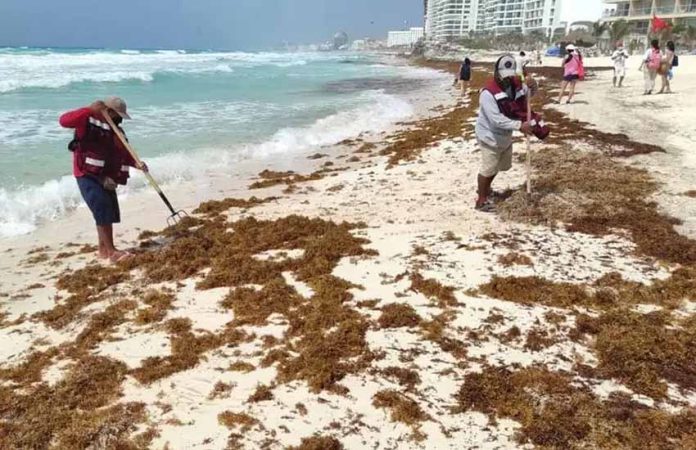
Those most at risk of health problems are people employed to remove sargassum from beaches, an UNAM scientist said. File photo
A National Autonomous University (UNAM) scientist has warned that rotting sargassum can pose a risk to human health.
Huge quantities of sargassum – a seaweed that emits a foul odor when it decomposes – have washed up on Quintana Roo beaches this year. Twenty-two beaches in the Caribbean coast state were covered with excessive quantities of the weed on Tuesday, according to the Quintana Roo Sargassum Monitoring Network, while 21 were plagued by abundant amounts.
When large quantities of sargassum decompose, gases such as hydrogen sulfide – which has a rotten egg smell – methane and ammonium are generated, said Brigitta Van Tussenbroek, a researcher at UNAM’s reef systems unit in Puerto Morelos.
“The one of greatest concern is hydrogen sulfide,” she said, explaining that chronic exposure to the gas can cause health problems, “mainly for people who have respiratory problems.”
According to the United States Agency for Toxic Substances and Disease Registry (ATSDR), “just a few breaths of air containing high levels of hydrogen sulfide can cause death.”
“… Exposure to low concentrations of hydrogen sulfide may cause irritation to the eyes, nose, or throat. It may also cause difficulty in breathing for some asthmatics,” the ATSDR said. “… Exposure to low concentrations … may cause headaches, poor memory, tiredness, and balance problems,” it added.
Those most at risk of health problems are people employed to remove sargassum from beaches. The federal Environment Ministry last year published guidelines for sargassum collectors, but they are not legally binding and consequently not adhered to all of the time, Milenio reported. Sargaceros, as such collectors are known, are supposed to wear gloves, boots and face masks when removing the seaweed from beaches, but they don’t always follow that advice, the newspaper said.
Enforceable regulations are needed, said Van Tussenbroek, adding that sensors that measure hydrogen sulfide levels could also help protect sargassum shovelers.